Overview
Experimental controls represent one of the most fundamental concepts tested in the ACT Science section, appearing in approximately 15-20% of all science reasoning questions. Understanding experimental controls is essential for analyzing research design, interpreting data accurately, and identifying flaws in scientific methodology. On the ACT, questions about experimental controls assess whether students can distinguish between controlled and manipulated variables, recognize the purpose of control groups, and evaluate whether an experiment is properly designed to test its hypothesis.
The concept of experimental controls sits at the heart of the scientific method itself. When scientists design experiments, they must isolate the effect of one variable while keeping all other factors constant. This isolation allows researchers to establish cause-and-effect relationships with confidence. Without proper controls, any observed changes could result from dozens of different factors, making conclusions unreliable. The ACT frequently presents passages describing experiments where students must identify which variables are controlled, which are manipulated, and whether the experimental design adequately tests the stated hypothesis.
Mastery of experimental controls connects directly to broader scientific reasoning skills tested throughout the ACT Science section. This topic integrates with understanding independent and dependent variables, recognizing patterns in data, evaluating experimental design, and drawing valid conclusions from evidence. Students who thoroughly understand experimental controls gain a significant advantage not only on direct questions about controls but also on questions requiring analysis of data validity, comparison of experimental conditions, and evaluation of scientific claims.
Learning Objectives
- [ ] Identify when Experimental controls is being tested in ACT Science passages
- [ ] Explain the core rule or strategy behind Experimental controls and their purpose in scientific research
- [ ] Apply Experimental controls concepts to ACT-style questions accurately
- [ ] Distinguish between control groups, controlled variables, and experimental groups in passage descriptions
- [ ] Evaluate whether an experimental design includes adequate controls to test its hypothesis
- [ ] Recognize common control-related flaws in experimental methodology
- [ ] Predict how the absence of proper controls would affect experimental conclusions
Prerequisites
- Basic understanding of variables: Students must distinguish between independent variables (what experimenters change) and dependent variables (what experimenters measure), as controls relate directly to managing these variables
- Scientific method fundamentals: Knowledge of hypothesis formation, experimentation, and conclusion-drawing provides the framework within which controls operate
- Data interpretation skills: The ability to read tables, graphs, and experimental descriptions enables students to identify which factors are held constant versus manipulated
- Cause-and-effect reasoning: Understanding that scientists seek to establish causal relationships helps explain why controls are necessary to isolate specific effects
Why This Topic Matters
In real-world scientific research, experimental controls determine whether findings are valid and reproducible. Medical researchers use control groups receiving placebos to determine if new drugs actually work. Environmental scientists control for weather conditions when testing pollution effects. Agricultural scientists maintain identical soil conditions except for the one fertilizer variable being tested. Without proper controls, billions of dollars in research funding would produce unreliable results, potentially leading to ineffective treatments, faulty technologies, and misguided policies.
On the ACT Science section, experimental controls appear in multiple question formats across different passage types. Research Summaries passages (which describe experiments) most frequently test this concept, but Data Representation and Conflicting Viewpoints passages also include control-related questions. Approximately 3-5 questions per ACT Science test directly assess understanding of controls, while many additional questions indirectly require this knowledge to interpret results correctly. Questions may ask students to identify the purpose of a control group, determine which variable should be controlled in a modified experiment, or explain why certain experimental conditions were kept constant.
Common ACT question stems involving experimental controls include: "Which variable was held constant across all trials?", "What was the purpose of Group 1 in this experiment?", "To test the hypothesis, the scientists should have controlled for...", "The results would be more valid if the researchers had...", and "Which factor, if not controlled, could affect the results?" These questions appear throughout the 40-minute Science section, making experimental controls knowledge essential for achieving competitive scores.
Core Concepts
Definition and Purpose of Experimental Controls
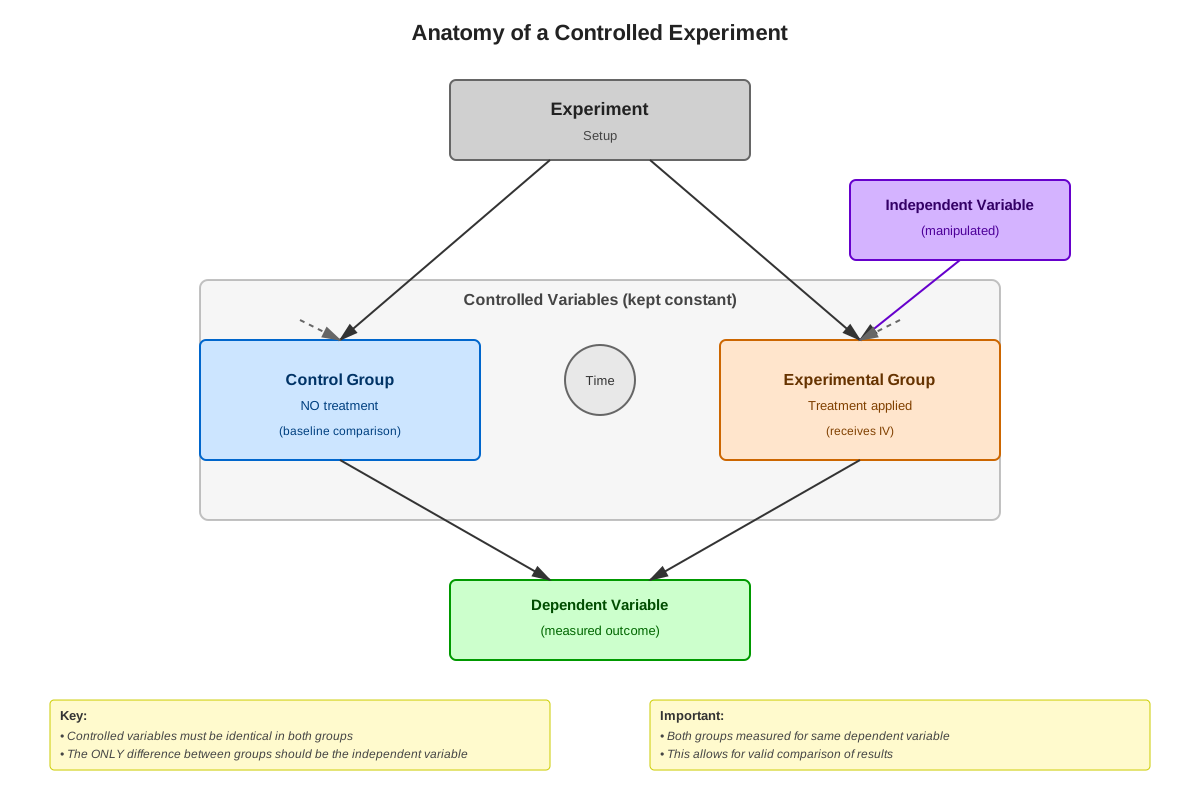
Experimental controls are the components of an experiment that remain constant or serve as a baseline for comparison, allowing researchers to isolate the effect of the variable being tested. The fundamental purpose of controls is to ensure that any observed changes in the dependent variable result from manipulation of the independent variable rather than from other factors. Without controls, experiments cannot establish valid cause-and-effect relationships because multiple variables might be changing simultaneously.
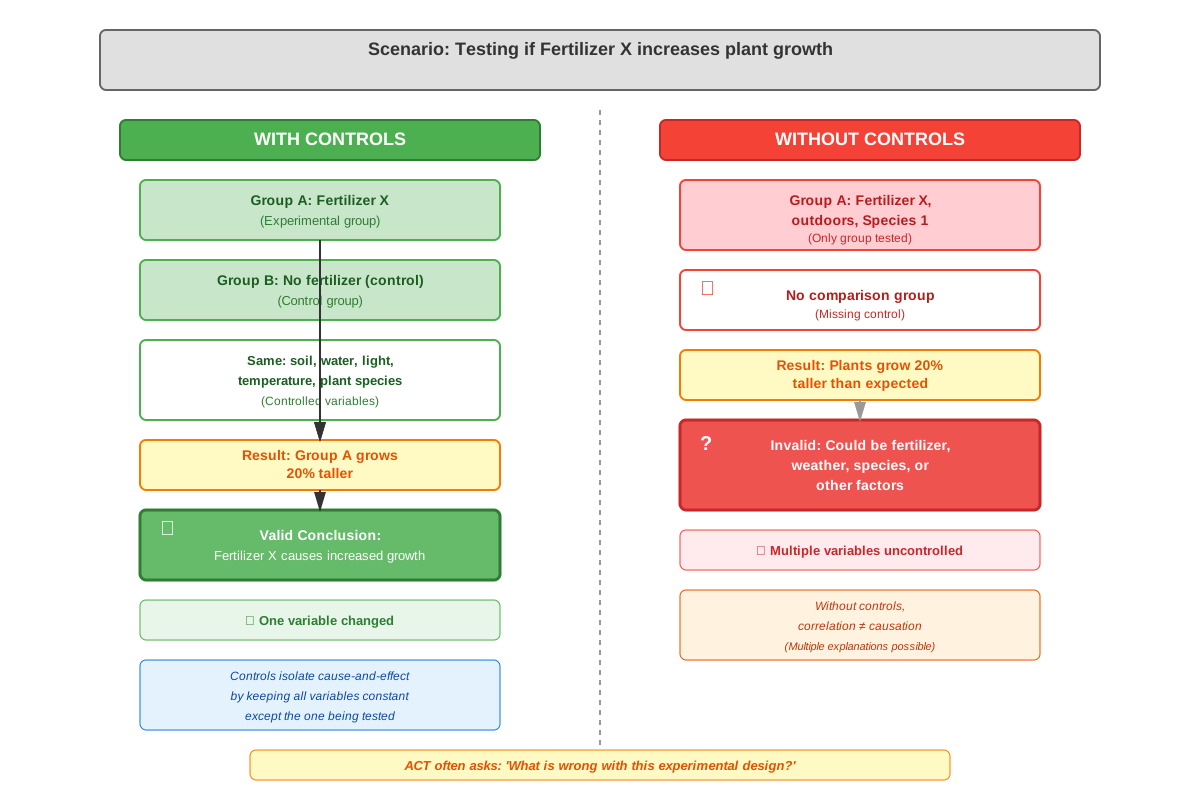
The concept operates on a simple principle: change only one thing at a time. If a researcher wants to test whether a new fertilizer increases plant growth, every other factor—water amount, sunlight exposure, temperature, soil type, plant species—must remain identical across all experimental groups. Only the fertilizer type should differ. This isolation allows the researcher to confidently attribute any growth differences to the fertilizer rather than to other variables.
Types of Controls in Experiments
Control groups represent experimental subjects that do not receive the treatment being tested but are otherwise treated identically to experimental groups. In a drug trial, the control group receives a placebo while the experimental group receives the actual medication. Both groups experience the same testing procedures, time schedules, and environmental conditions. Comparing outcomes between these groups reveals the drug's true effect.
Controlled variables (also called constant variables) are factors that experimenters deliberately keep the same across all experimental conditions. In a photosynthesis experiment testing light intensity effects, controlled variables might include plant species, water amount, temperature, carbon dioxide concentration, and observation duration. These remain constant while light intensity (the independent variable) changes and oxygen production (the dependent variable) is measured.
Positive controls are experimental conditions expected to produce a known result, confirming that the experimental system works properly. If testing a new antibiotic, a positive control might use an established antibiotic known to kill the bacteria. If this control fails, something is wrong with the experimental setup itself.
Negative controls are conditions expected to produce no effect, establishing a baseline and confirming that observed effects result from the treatment rather than from the experimental procedure itself. In an enzyme activity experiment, a negative control might include all reaction components except the enzyme, demonstrating that any observed reaction requires the enzyme's presence.
Identifying Controls in ACT Passages
ACT Science passages describe experiments using various formats, and students must extract control information from text, tables, and diagrams. Control groups are often labeled as "Group 1," "Control," or described as receiving "no treatment" or "standard conditions." Controlled variables appear in methods descriptions, often introduced with phrases like "all groups received," "temperature was maintained at," or "identical conditions except for."
| Control Type | Common ACT Descriptors | Purpose |
|---|---|---|
| Control Group | "Group 1 received no treatment," "baseline condition," "standard procedure" | Provides comparison baseline |
| Controlled Variables | "held constant," "maintained at," "identical across all trials" | Eliminates confounding factors |
| Positive Control | "known to produce," "established method," "standard treatment" | Validates experimental system |
| Negative Control | "no treatment," "absence of," "blank sample" | Establishes baseline, rules out procedural effects |
The Relationship Between Controls and Valid Conclusions
Proper experimental controls directly determine conclusion validity. When all variables except one are controlled, researchers can make strong causal claims: "X causes Y." Without adequate controls, only correlational statements are justified: "X and Y occurred together." The ACT frequently tests whether students recognize this distinction.
Consider an experiment testing whether a new teaching method improves test scores. If the experimental group uses the new method with experienced teachers in well-equipped classrooms while the control group uses the old method with inexperienced teachers in poor facilities, multiple uncontrolled variables (teacher experience, classroom quality) prevent valid conclusions about the teaching method itself. The ACT presents scenarios like this, asking students to identify confounding variables or suggest improvements to experimental design.
Common Control-Related Experimental Flaws
Several control-related flaws appear repeatedly in ACT passages. Confounding variables are factors that vary along with the independent variable, making it impossible to determine which factor caused observed effects. Lack of control groups prevents comparison and baseline establishment. Insufficient sample size in control or experimental groups reduces statistical reliability. Uncontrolled environmental conditions introduce variability that obscures treatment effects. Recognizing these flaws enables students to answer questions about experimental limitations and improvements.
Concept Relationships
The concept of experimental controls connects hierarchically to the broader scientific method framework. The scientific method begins with observations leading to questions, which generate testable hypotheses. Experimental design—including control implementation—tests these hypotheses. Data collection follows, then analysis and conclusion formation. Controls operate specifically within the experimental design phase but affect all subsequent steps.
Relationship map: Hypothesis formation → Experimental design (including control selection) → Variable identification (independent, dependent, controlled) → Data collection → Data analysis → Valid conclusions. Without proper controls in experimental design, the entire chain breaks down at the conclusion stage, as results cannot be confidently attributed to the hypothesized cause.
Experimental controls relate directly to variable types. The independent variable is what experimenters manipulate, the dependent variable is what they measure, and controlled variables are what they keep constant. Control groups experience baseline conditions for the independent variable (often "zero" or "standard" levels), allowing comparison with experimental groups experiencing different independent variable levels.
This topic also connects to data interpretation skills. When analyzing graphs or tables, students must recognize which data points represent control conditions versus experimental conditions. Comparing these reveals treatment effects. Additionally, understanding controls enhances evaluation of conflicting scientific viewpoints, as students can assess whether each scientist's supporting evidence comes from properly controlled experiments.
High-Yield Facts
⭐ Experimental controls are factors kept constant or groups receiving no treatment, enabling isolation of the independent variable's effect on the dependent variable.
⭐ A control group receives no treatment or standard treatment and provides a baseline for comparing experimental group results.
⭐ Controlled variables must remain identical across all experimental groups except for the independent variable being tested.
⭐ Without proper controls, experiments cannot establish cause-and-effect relationships, only correlations.
⭐ The ACT frequently asks students to identify which variables were controlled or should have been controlled in an experiment.
- Positive controls confirm the experimental system functions correctly by producing expected results.
- Negative controls establish baselines and demonstrate that observed effects require the treatment being tested.
- Confounding variables are uncontrolled factors that vary with the independent variable, preventing valid conclusions.
- Multiple control groups may be necessary when testing several factors or when baseline conditions vary.
- Sample size in control groups should match experimental groups to ensure statistical validity.
- Environmental controls (temperature, humidity, light) are among the most commonly tested controlled variables on the ACT.
- Time controls ensure all groups are observed for identical durations under identical schedules.
- Randomization of subjects into control and experimental groups reduces bias and strengthens conclusions.
Quick check — test yourself on Experimental controls so far.
Try Flashcards →Common Misconceptions
Misconception: The control group is less important than the experimental group and can be smaller or less carefully monitored.
Correction: Control groups are equally important because they provide the baseline for comparison. Without a properly maintained control group of adequate size, experimental results cannot be interpreted. Any differences in treatment between control and experimental groups (except the independent variable) invalidate the experiment.
Misconception: Controlling variables means eliminating them from the experiment entirely.
Correction: Controlling variables means keeping them constant at a specific value across all experimental conditions, not removing them. For example, controlling temperature means maintaining all groups at the same temperature (like 25°C), not conducting the experiment without temperature.
Misconception: If an experiment has a control group, all variables are automatically controlled.
Correction: Having a control group addresses only one aspect of experimental controls. Researchers must also identify and control all relevant variables that could affect results. An experiment can have a control group but still fail to control important variables like environmental conditions, time, or sample characteristics.
Misconception: The independent variable should be controlled.
Correction: The independent variable is what experimenters deliberately manipulate—it should NOT be controlled. Only variables other than the independent variable should be controlled. Controlling the independent variable would prevent testing its effect on the dependent variable.
Misconception: Any group labeled "Group 1" or described first in a passage is automatically the control group.
Correction: Control groups are defined by their function (receiving no treatment or baseline treatment), not by their position in a description. Students must read carefully to identify which group serves as the control based on what treatment it receives, not based on numbering or order of presentation.
Misconception: Experiments testing multiple independent variables cannot have proper controls.
Correction: Multi-factor experiments can maintain proper controls through careful design. Each factor can be tested while controlling others, or factorial designs can test multiple factors simultaneously with appropriate control conditions for each factor combination.
Worked Examples
Example 1: Identifying Controls in a Plant Growth Experiment
Passage Summary: Scientists investigated whether a new fertilizer (Formula X) increases tomato plant growth compared to a standard fertilizer. They divided 60 genetically identical tomato seedlings into three groups of 20 plants each. Group 1 received no fertilizer. Group 2 received standard fertilizer. Group 3 received Formula X. All plants were grown in identical pots with the same soil type, watered with 100 mL daily, exposed to 12 hours of light daily at 25°C, and measured after 30 days.
Question: Which group serves as the control group, and what variables were controlled in this experiment?
Solution:
Step 1: Identify the control group by determining which group provides the baseline for comparison. Group 1 received no fertilizer, representing the natural growth condition without treatment. This is the negative control group. Group 2 could be considered a positive control since it uses the established standard fertilizer, but Group 1 is the primary control for determining whether any fertilizer improves growth.
Step 2: Identify controlled variables by finding factors kept constant across all groups:
- Plant genetics (genetically identical seedlings)
- Sample size (20 plants per group)
- Pot type (identical pots)
- Soil type (same soil)
- Water amount (100 mL daily)
- Light exposure (12 hours daily)
- Temperature (25°C)
- Observation period (30 days)
Step 3: Identify the independent variable (what was manipulated): fertilizer type (none, standard, or Formula X)
Step 4: Identify the dependent variable (what was measured): plant growth (likely height, mass, or both, though not specified in this summary)
Answer: Group 1 serves as the control group. Controlled variables include plant genetics, sample size, pot type, soil type, water amount, light exposure, temperature, and observation duration. This experimental design properly isolates the effect of fertilizer type on plant growth.
Connection to Learning Objectives: This example demonstrates how to identify control groups and controlled variables in ACT passages, applying experimental controls concepts to analyze research design.
Example 2: Evaluating Experimental Design Flaws
Passage Summary: A student hypothesized that classical music improves concentration during studying. She recruited 30 volunteers and assigned 15 to study in a quiet library while listening to classical music through headphones (experimental group) and 15 to study in their dorm rooms without music (control group). After one hour, she tested all participants on the material studied. The experimental group scored an average of 85% while the control group scored 78%.
Question: Identify at least two problems with the experimental controls in this study that prevent valid conclusions about whether classical music improves concentration.
Solution:
Step 1: Identify the hypothesis being tested: Classical music improves concentration during studying.
Step 2: Identify what should be controlled: To test only music's effect, all other factors affecting concentration should be identical between groups.
Step 3: Analyze the experimental design for uncontrolled variables:
Problem 1 - Location confounding: The experimental group studied in a library while the control group studied in dorm rooms. Libraries typically provide quieter, more focused environments with fewer distractions than dorm rooms. The observed difference could result from location rather than music. The student cannot determine whether music, location, or both factors caused the improved scores.
Problem 2 - Lack of proper control for auditory stimulation: The experimental group wore headphones and heard music while the control group had no headphones and heard ambient noise. A proper control would have the control group wear headphones with no music (or white noise) to control for the physical presence of headphones and the isolation from ambient sound they provide.
Step 4: Suggest improvements: Both groups should study in identical locations (both in libraries or both in dorm rooms). The control group should wear headphones with no music playing, controlling for the headphone effect while isolating music as the only variable difference.
Answer: Two major control problems exist: (1) Location was not controlled—experimental and control groups studied in different environments that could independently affect concentration; (2) The presence of headphones was not controlled—the experimental group's headphones may have improved concentration by blocking distracting ambient noise regardless of music. These uncontrolled variables prevent valid conclusions about classical music's effect on concentration.
Connection to Learning Objectives: This example demonstrates how to evaluate experimental design, identify control-related flaws, and explain how inadequate controls prevent valid conclusions—key skills for ACT experimental controls questions.
Exam Strategy
When approaching ACT experimental controls questions, follow this systematic process:
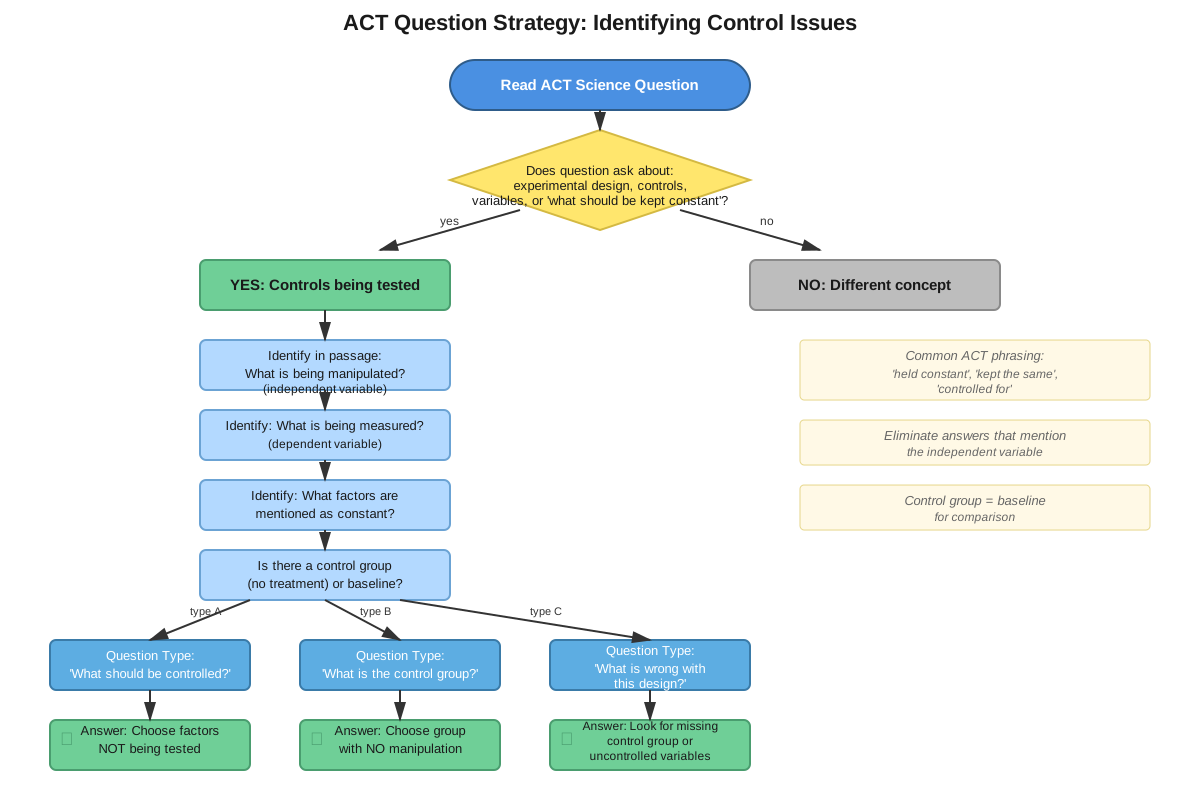
Step 1 - Identify the question type: Recognize control-related questions through trigger phrases like "control group," "held constant," "controlled variable," "to improve the experiment," "limitation of the study," or "confounding factor." These signals indicate the question tests experimental controls knowledge.
Step 2 - Locate the methods description: ACT passages typically describe experimental procedures in the introduction or in a "Methods" section. Read this carefully, noting which factors are mentioned as "identical," "constant," or "maintained" across groups.
Step 3 - Create a mental or written table: Organize information about each experimental group:
Group 1: [treatment] | Group 2: [treatment] | Group 3: [treatment]
What's the same: [controlled variables]
What's different: [independent variable]
What's measured: [dependent variable]
Step 4 - Apply the "change one thing" rule: Valid experiments change only the independent variable while controlling everything else. If a question asks what should be controlled or what's wrong with an experiment, look for factors that differ between groups besides the intended independent variable.
Exam Tip: When questions ask "What was the purpose of Group 1?" and Group 1 received no treatment or standard treatment, the answer typically involves "providing a baseline for comparison" or "determining the effect without treatment."
Process of elimination strategies:
- Eliminate answer choices that describe the independent variable when asked about controlled variables (the independent variable should NOT be controlled)
- Eliminate choices suggesting the dependent variable was controlled (it's measured, not controlled)
- For "what should be controlled" questions, eliminate factors that are already stated as identical across groups
- For "control group purpose" questions, eliminate answers suggesting the control group tests the treatment effect (it provides comparison, not treatment testing)
Time allocation: Most experimental controls questions require 30-45 seconds. Spend 20 seconds locating relevant passage information and 10-25 seconds evaluating answer choices. If a question requires comparing multiple groups across several variables, allow up to 60 seconds.
Common wrong answer traps:
- Confusing controlled variables with independent variables
- Selecting the experimental group as the control group
- Choosing answers that describe what was measured rather than what was controlled
- Falling for answers that sound scientific but don't address the specific control issue asked
Memory Techniques
Mnemonic for Control Types - "Can People Never Predict":
- Control group (baseline comparison)
- Positive control (confirms system works)
- Negative control (establishes baseline, no treatment)
- Parameters controlled (controlled variables)
Visualization Strategy: Picture an experiment as a race where all runners (experimental subjects) must start from the same line (controlled variables), run on the same track (controlled environment), but wear different shoes (independent variable). Only the shoes differ, so any performance difference must result from the shoes. The runner with standard shoes is the control.
Acronym for Identifying Controlled Variables - "SWEPT":
- Sample characteristics (size, age, genetics)
- Water/nutrients (amounts, types)
- Environment (temperature, light, humidity)
- Procedures (methods, timing, duration)
- Tools/equipment (same instruments, same measurements)
The "Twin Test" Concept: Think of experimental groups as identical twins. Everything about them should be the same (controlled) except for one thing (independent variable). If the twins differ in multiple ways, you can't tell which difference caused any observed outcome.
Phrase to Remember: "Control Everything Except the Tested variable" (CEET). This reminds students that all variables except the independent variable being tested should be controlled.
Summary
Experimental controls form the foundation of valid scientific research and represent a high-yield topic on the ACT Science section. The core principle is straightforward: to establish cause-and-effect relationships, experiments must change only one variable (the independent variable) while keeping all other factors constant (controlled variables). Control groups provide baselines for comparison by receiving no treatment or standard treatment, enabling researchers to determine whether experimental treatments produce effects beyond natural variation. Without proper controls, observed changes could result from numerous uncontrolled factors, preventing valid conclusions. ACT questions test whether students can identify control groups, recognize controlled variables, evaluate experimental design quality, and understand how inadequate controls limit conclusion validity. Success requires careful reading of experimental methods, systematic organization of information about different experimental groups, and application of the fundamental rule that valid experiments isolate single variables while controlling all others.
Key Takeaways
- Experimental controls include control groups (receiving no/standard treatment) and controlled variables (factors kept constant across all groups)
- The fundamental purpose of controls is isolating the independent variable's effect by eliminating alternative explanations for observed results
- Valid experiments change only the independent variable while controlling all other factors that could affect the dependent variable
- ACT questions frequently ask students to identify controlled variables, explain control group purposes, or recognize experimental design flaws
- Without adequate controls, experiments can only demonstrate correlation, not causation
- Common control-related flaws include confounding variables, inadequate control groups, and uncontrolled environmental conditions
- Systematic analysis of experimental methods—identifying what's the same versus what's different across groups—enables accurate answering of control-related questions
Related Topics
Independent and Dependent Variables: Understanding the distinction between variables that experimenters manipulate (independent) versus measure (dependent) provides the foundation for recognizing which variables should be controlled. Mastering experimental controls naturally leads to deeper analysis of variable relationships.
Experimental Design and Scientific Method: Experimental controls represent one component of broader experimental design principles. Students who master controls can progress to evaluating overall experimental validity, including sample size adequacy, randomization, and replication.
Data Analysis and Interpretation: Proper controls enable valid data interpretation. Understanding controls helps students recognize which data comparisons are meaningful and which conclusions are justified by experimental evidence.
Confounding Variables and Bias: Identifying uncontrolled factors that could affect results (confounding variables) extends control concepts. This leads to understanding various bias types and how experimental design minimizes them.
Statistical Significance and Variability: Controls relate to determining whether observed differences between groups exceed natural variation. This connects to understanding statistical concepts tested in advanced ACT Science questions.
Practice CTA
Now that you understand experimental controls thoroughly, test your mastery with practice questions and flashcards! These resources will reinforce your ability to quickly identify control groups, recognize controlled variables, and evaluate experimental designs under timed conditions. Remember, experimental controls appear in 15-20% of ACT Science questions—mastering this topic significantly boosts your score. Approach each practice question systematically: identify the experimental groups, list what's controlled versus what's manipulated, and apply the "change one thing" rule. With focused practice, recognizing and analyzing experimental controls becomes automatic, giving you confidence and speed on test day. You've built a strong foundation—now solidify it through application!
Sign up free to keep reading
Create a free AnvayaPrep account to finish this ACT guide on Experimental controls — plus flashcards and practice questions.