Overview
The ACT Science section is uniquely challenging not because of the complexity of scientific content, but because of the intense time pressure it imposes on test-takers. With 40 questions to answer in just 35 minutes, students have an average of only 52.5 seconds per question. ACT science pacing refers to the strategic time management approach that allows students to maximize their score by efficiently navigating through passages and questions without sacrificing accuracy. Unlike content mastery alone, which might suffice for other standardized tests, the ACT Science section demands that students develop a systematic approach to reading, analyzing, and answering questions within severe time constraints.
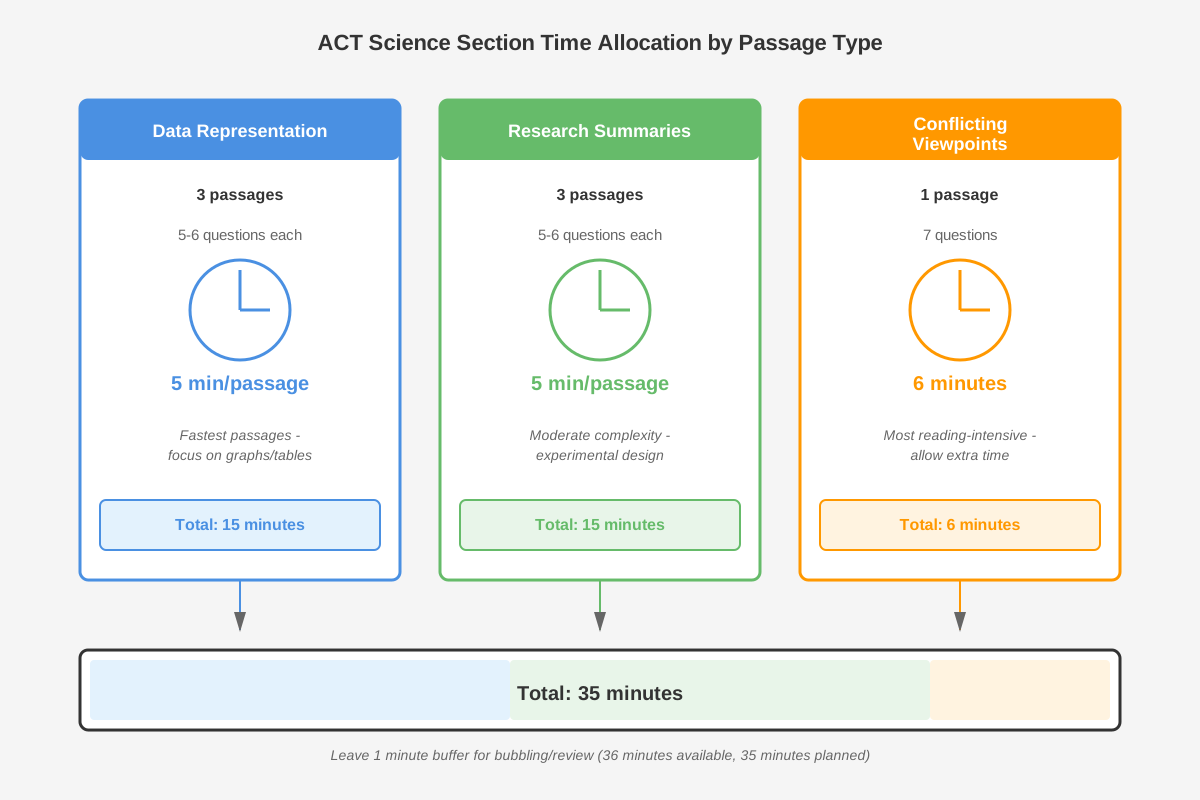
Understanding act science pacing is essential because even students with strong scientific knowledge frequently underperform on this section due to poor time management. The section contains seven passages of three types: Data Representation (3 passages), Research Summaries (3 passages), and Conflicting Viewpoints (1 passage), each with varying numbers of questions. Without a deliberate pacing strategy, students often spend too much time on early passages, leaving insufficient time for later questions, or they rush through everything and make careless errors. The difference between a score of 25 and 30+ often comes down to pacing efficiency rather than scientific knowledge.
This topic sits at the intersection of test-taking strategy and scientific reasoning skills. While other aspects of ACT Science focus on interpreting graphs, understanding experimental design, or evaluating hypotheses, pacing strategy provides the framework that makes applying those skills possible under exam conditions. Mastering act act science pacing enables students to allocate their cognitive resources effectively, ensuring they attempt every question while maintaining the accuracy needed for a competitive score.
Learning Objectives
- [ ] Identify when ACT science pacing is being tested
- [ ] Explain the core rule or strategy behind ACT science pacing
- [ ] Apply ACT science pacing to ACT-style questions accurately
- [ ] Calculate optimal time allocation for each passage type on the ACT Science section
- [ ] Recognize warning signs of falling behind pace during the exam
- [ ] Implement triage strategies to maximize points when time becomes limited
- [ ] Develop a personalized pacing plan based on individual strengths and weaknesses
Prerequisites
- Basic familiarity with ACT Science section structure: Understanding that there are 40 questions across 7 passages helps contextualize why pacing matters and how to divide time appropriately.
- Ability to read scientific graphs and tables: Pacing strategies assume students can quickly extract information from visual data representations without getting stuck on interpretation.
- Understanding of the three ACT Science passage types: Knowing the differences between Data Representation, Research Summaries, and Conflicting Viewpoints passages allows for differentiated pacing approaches.
- Experience with at least one full-length ACT Science section: Having attempted the section under timed conditions provides the baseline awareness needed to implement pacing improvements.
Why This Topic Matters
In real-world scientific work, professionals must balance thoroughness with efficiency, making strategic decisions about where to invest time and resources. Similarly, ACT science pacing teaches students to make rapid assessments about question difficulty, passage complexity, and optimal resource allocation—skills that transfer to academic and professional settings where time management determines success.
From an exam perspective, pacing is one of the highest-yield topics for score improvement. According to ACT data, approximately 40% of students fail to complete all questions in the Science section, and incomplete sections correlate strongly with lower scores. Even students who finish often report feeling rushed on the final passages, leading to increased error rates. Questions testing pacing awareness appear indirectly throughout the section: complex passages with dense information test whether students can quickly identify what to skip and what to read carefully, while straightforward questions reward those who don't waste time overthinking.
The ACT Science section commonly presents pacing challenges through several mechanisms. Dense introductory paragraphs filled with technical terminology tempt students to read slowly and carefully, consuming precious minutes before reaching any questions. Complex multi-part graphs with numerous variables can trap students in extended analysis when questions might only reference specific data points. The Conflicting Viewpoints passage, typically appearing as Passage 7, requires a different reading approach than data-heavy passages, and students who don't adjust their strategy often run out of time. Additionally, the test deliberately includes some questions that require synthesis across multiple figures or paragraphs, testing whether students can recognize when to invest extra time versus when to make an educated guess and move forward.
Core Concepts
The 5-Minute Rule
The fundamental principle of ACT science pacing is the 5-minute rule: students should aim to complete each passage and its associated questions in approximately 5 minutes. With 35 minutes for 7 passages, this creates a sustainable pace that allows for slight variations in passage difficulty while ensuring completion of all questions. However, this rule requires nuance in application. Not all passages are created equal—Data Representation passages with 5 questions and straightforward graphs might take only 4 minutes, while the Conflicting Viewpoints passage with 7 questions and dense argumentative text might require 6-7 minutes.
The 5-minute rule breaks down into two components: passage preview (30-60 seconds) and question answering (4-4.5 minutes). During the preview phase, students should scan the passage structure, note the number and types of figures, and identify the general topic without deep reading. This investment pays dividends by creating a mental map that accelerates question answering. The remaining time focuses on questions, with students referring back to specific parts of the passage only as needed rather than attempting to master all content upfront.
Strategic Passage Selection
Unlike the ACT Reading section where passages must be completed in order, the Science section allows students to choose their sequence strategically. Strategic passage selection involves quickly assessing all seven passages at the start of the section and tackling them in an order that maximizes efficiency and confidence. Most high-scoring students begin with Data Representation passages because they typically contain the most straightforward questions and build momentum. They save the Conflicting Viewpoints passage for last, as it requires a different skill set and benefits from having established a time buffer.
The assessment process for passage selection takes only 30-60 seconds at the section's start. Students flip through, noting which passages have simple graphs versus complex tables, which have minimal text versus dense paragraphs, and which topics feel familiar versus intimidating. A typical optimal order might be: easiest Data Representation passage first, remaining Data Representation passages, Research Summaries passages in order of perceived difficulty, and finally the Conflicting Viewpoints passage. This approach ensures students bank points early and face the most challenging material when they've built confidence and can accurately assess remaining time.
The Question-First Approach
The question-first approach revolutionizes how students interact with ACT Science passages. Rather than reading the entire passage introduction and studying all figures before attempting questions, students should read the first question immediately after a brief 10-second scan of the passage. This strategy works because approximately 70% of ACT Science questions are "lookup questions" that require finding specific information in a single graph or table rather than synthesizing across the entire passage.
When implementing this approach, students read each question stem, identify what information it requests, locate that specific data in the relevant figure, and answer immediately. Only when encountering questions that require understanding experimental design or comparing multiple data sources should students invest time in reading passage text. This method typically saves 1-2 minutes per passage, which accumulates to 7-14 minutes across the entire section—enough time to attempt every question twice if needed.
Time Checkpoints and Adjustment
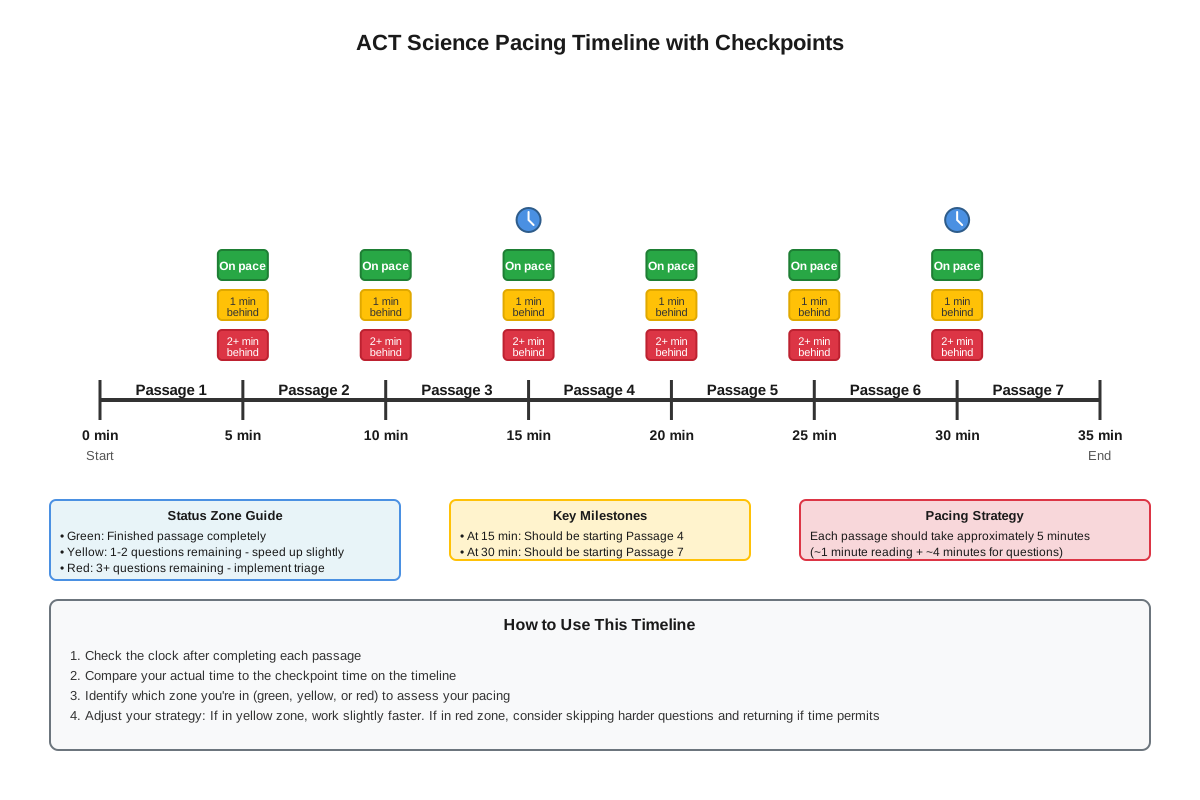
Effective pacing requires monitoring progress at specific time checkpoints throughout the section. Students should note the time remaining after completing passages 2, 4, and 6, comparing actual progress to target benchmarks. After passage 2 (approximately 10 minutes elapsed), students should have 25 minutes remaining. After passage 4 (approximately 20 minutes elapsed), 15 minutes should remain. After passage 6 (approximately 30 minutes elapsed), 5 minutes should remain for the final passage.
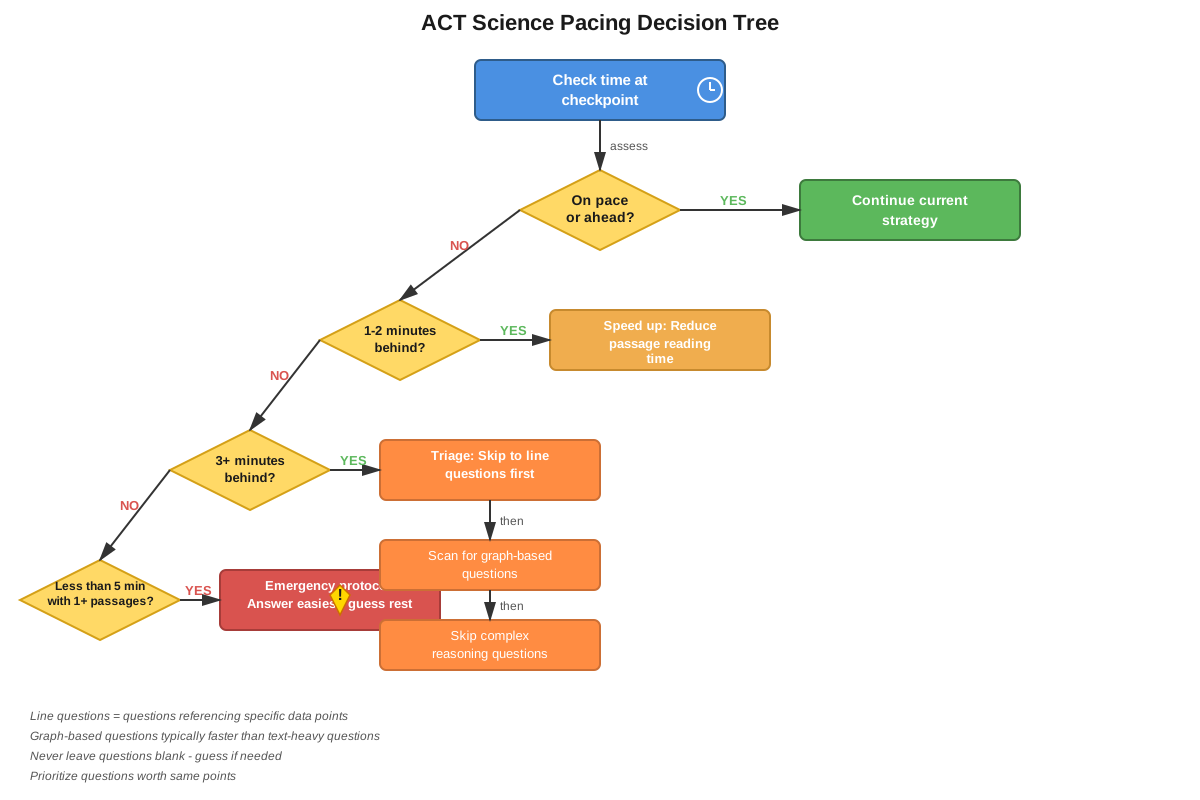
When students find themselves behind pace at a checkpoint, they must implement adjustment strategies immediately rather than hoping to "catch up later." Falling 2 minutes behind after passage 2 requires either skipping the most time-consuming question on each remaining passage or reducing passage preview time to 15 seconds. Falling 3+ minutes behind necessitates more aggressive triage: identifying the most difficult passage among those remaining and planning to guess on its 2-3 hardest questions without attempting them.
Triage and Strategic Guessing
Triage is the systematic process of identifying which questions to attempt fully, which to attempt quickly, and which to guess on immediately when time pressure increases. ACT Science questions vary dramatically in difficulty and time requirement, and recognizing this variation enables strategic point maximization. Questions asking students to read a single value from a clearly labeled graph take 15-20 seconds, while questions requiring synthesis of information across three figures and understanding of experimental methodology might take 2+ minutes.
The triage system categorizes questions into three tiers. Tier 1 questions (approximately 60% of the section) are straightforward lookups that should be answered quickly and accurately. Tier 2 questions (approximately 30%) require moderate reasoning or synthesis but remain accessible within 45-60 seconds. Tier 3 questions (approximately 10%) are complex, time-consuming, or confusing and should be marked for return only if time permits. When facing time pressure, students should ensure they've attempted all Tier 1 and Tier 2 questions before investing time in Tier 3, and they should guess immediately on Tier 3 questions if fewer than 3 minutes remain.
Passage-Specific Pacing Strategies
Each passage type demands a tailored pacing approach. Data Representation passages typically contain 5 questions focused on interpreting graphs, tables, and charts. These passages require minimal reading of introductory text—usually just identifying variables and units—and students should aim to complete them in 4 minutes. The key is recognizing that questions almost always follow the order of figures presented, allowing for efficient sequential processing.
Research Summaries passages present experimental designs with multiple studies or experiments, typically accompanied by 6 questions. These require slightly more reading to understand what each experiment tested and how procedures differed, but students should still prioritize questions over comprehensive reading. Target time is 5 minutes, with 60 seconds allocated to understanding the experimental structure and 4 minutes for questions. Students should note that questions often ask about differences between experiments, so marking key procedural variations during the initial scan pays dividends.
Conflicting Viewpoints passages present the greatest pacing challenge, with 7 questions about competing scientific hypotheses or interpretations. Unlike data-heavy passages, these require reading the introduction and each scientist's/student's perspective, but students should read strategically: understanding the main claim of each viewpoint without getting lost in supporting details. Allocate 6-7 minutes total, with 2 minutes for reading and 4-5 minutes for questions. Questions typically follow a pattern: several ask about specific viewpoints, some ask about agreements/disagreements, and one or two require synthesis or evaluation.
Concept Relationships
The core concepts of ACT science pacing form an interconnected system where each element supports and enhances the others. The 5-minute rule serves as the foundation, establishing the baseline time budget that all other strategies work within. This rule directly enables strategic passage selection because knowing the time constraint per passage allows students to assess which passages they can complete most efficiently within that window.
Strategic passage selection → leads to → question-first approach: Once students have chosen an optimal passage order, the question-first approach maximizes efficiency within each selected passage. By immediately engaging with questions rather than reading comprehensively, students extract only the information needed, respecting the 5-minute constraint.
Question-first approach → requires → triage and strategic guessing: As students work through questions, they naturally encounter varying difficulty levels. The question-first approach reveals which questions are straightforward lookups versus complex synthesis tasks, enabling real-time triage decisions about where to invest time.
Time checkpoints → inform → triage decisions: Regular monitoring of pace against benchmarks provides the data needed to implement triage effectively. Without checkpoints, students might not realize they're behind pace until too late; with them, they can adjust strategy proactively.
Passage-specific strategies → integrate with → all other concepts: Understanding how each passage type differs allows students to adjust their application of the 5-minute rule, question-first approach, and triage system. A Data Representation passage might require minimal reading and aggressive question-first implementation, while a Conflicting Viewpoints passage demands more upfront reading investment.
All these concepts connect back to the prerequisite knowledge of ACT Science section structure. Understanding that there are exactly 7 passages and 40 questions makes the 5-minute rule mathematically logical. Knowing the three passage types enables passage-specific strategies. Experience with timed sections provides the baseline awareness that makes checkpoint monitoring meaningful.
High-Yield Facts
⭐ The average time per question on ACT Science is 52.5 seconds, but optimal pacing varies dramatically by question type, from 15 seconds for simple lookups to 90+ seconds for synthesis questions.
⭐ Students should aim to complete each passage in approximately 5 minutes, but Data Representation passages often take 4 minutes while Conflicting Viewpoints passages may require 6-7 minutes.
⭐ Approximately 70% of ACT Science questions can be answered by locating specific information in a single figure without reading the passage introduction.
⭐ Reading passage introductions completely before attempting questions typically wastes 1-2 minutes per passage, totaling 7-14 minutes across the section—enough time to double-check every answer.
⭐ The Conflicting Viewpoints passage (typically Passage 7) requires a fundamentally different approach than data-heavy passages and should usually be saved for last.
- Time checkpoints should occur after passages 2, 4, and 6, with target times remaining of 25, 15, and 5 minutes respectively.
- Falling more than 2 minutes behind pace at any checkpoint requires immediate strategy adjustment, not hoping to "catch up later."
- Questions asking students to identify trends, compare values, or read single data points are Tier 1 (quick) questions that should never be skipped.
- Questions requiring synthesis across multiple experiments, evaluation of experimental design, or prediction beyond given data are typically Tier 3 (time-intensive) questions suitable for strategic guessing under time pressure.
- The first 30-60 seconds of each passage should involve scanning the structure (number of figures, amount of text, question count) rather than detailed reading.
- Approximately 40% of students fail to complete all ACT Science questions, and incomplete sections correlate with scores below 25.
- Students who implement systematic pacing strategies typically improve their Science scores by 3-5 points even without improving content knowledge.
Quick check — test yourself on ACT science pacing so far.
Try Flashcards →Common Misconceptions
Misconception: Students must read and understand the entire passage introduction before attempting any questions. → Correction: The question-first approach is more efficient for ACT Science. Most questions can be answered by referring to specific figures, and passage introductions should only be consulted when questions explicitly require understanding of experimental design or context. Reading everything first wastes 1-2 minutes per passage.
Misconception: All passages should take the same amount of time since the 5-minute rule applies to each. → Correction: The 5-minute rule is an average target, not a rigid requirement for each passage. Data Representation passages with 5 straightforward questions might take only 4 minutes, while Conflicting Viewpoints passages with 7 questions and dense text might require 6-7 minutes. Flexibility within the overall 35-minute constraint is essential.
Misconception: Passages must be completed in the order they appear in the test booklet. → Correction: Unlike ACT Reading, the Science section allows and benefits from strategic passage selection. Students should quickly assess all passages at the start and complete them in order of perceived difficulty, typically starting with the easiest Data Representation passage and saving Conflicting Viewpoints for last.
Misconception: Spending extra time on difficult questions will improve accuracy enough to justify the time investment. → Correction: ACT Science rewards completion more than perfection. A student who spends 3 minutes on a difficult question and runs out of time for 3 easier questions at the end has made a poor strategic choice. Triage and strategic guessing on the hardest 10% of questions allows time to attempt all questions, maximizing total points.
Misconception: Time checkpoints are unnecessary because students can "feel" when they're behind pace. → Correction: Subjective time perception is notoriously unreliable under test pressure. Students often believe they're on pace when they're actually 3-5 minutes behind, or they panic unnecessarily when they're actually ahead. Objective checkpoints after passages 2, 4, and 6 provide accurate data for strategy adjustments.
Misconception: Guessing should only happen if time completely runs out. → Correction: Strategic guessing is a proactive tool, not a last resort. When students identify Tier 3 questions (complex, time-consuming, or confusing), they should make an educated guess and move on rather than investing 2+ minutes for a 50% chance of correctness. This approach frees time for multiple Tier 1 and Tier 2 questions where accuracy rates are much higher.
Worked Examples
Example 1: Implementing the 5-Minute Rule with Time Checkpoints
Scenario: A student begins the ACT Science section and wants to implement systematic pacing. After completing the first two passages (both Data Representation), the student checks the time and sees that 12 minutes have elapsed, leaving 23 minutes for the remaining 5 passages.
Analysis:
The student should first calculate whether they're on pace. Target time after 2 passages is 10 minutes elapsed (2 passages × 5 minutes each), leaving 25 minutes remaining. The student has used 12 minutes, meaning they're 2 minutes behind pace.
Strategy Adjustment:
With 23 minutes for 5 passages, the student needs to average 4.6 minutes per passage for the remainder of the section. This is achievable but requires discipline. The student should implement these adjustments:
- Reduce passage preview time from 30 seconds to 15 seconds for remaining passages
- Identify one Tier 3 question per passage (the most time-consuming or confusing) and plan to guess strategically if it would take more than 60 seconds
- Ensure the question-first approach is being applied aggressively—no reading of passage text unless a question explicitly requires it
Outcome: By recognizing the deficit early (after passage 2 rather than passage 6), the student can make minor adjustments that accumulate to recover the lost time. Saving 15 seconds per passage on preview (5 passages × 15 seconds = 75 seconds) and strategically guessing on one difficult question per passage (saving approximately 60 seconds per passage, 5 passages × 60 seconds = 300 seconds) recovers 375 seconds (6.25 minutes), putting the student ahead of pace for the final passages.
Connection to Learning Objectives: This example demonstrates applying ACT science pacing to a realistic scenario, calculating optimal time allocation, and recognizing warning signs of falling behind pace.
Example 2: Strategic Passage Selection and Triage
Scenario: A student begins the ACT Science section and takes 45 seconds to flip through all 7 passages, making these observations:
- Passage 1: Data Representation, 5 questions, simple line graphs about temperature and pressure
- Passage 2: Research Summaries, 6 questions, three experiments about plant growth with detailed tables
- Passage 3: Data Representation, 5 questions, complex scatter plots with multiple variables
- Passage 4: Research Summaries, 6 questions, two experiments about chemical reactions with molecular diagrams
- Passage 5: Data Representation, 5 questions, bar graphs about population data
- Passage 6: Research Summaries, 6 questions, four experiments about soil composition with dense text
- Passage 7: Conflicting Viewpoints, 7 questions, two scientists debating climate change mechanisms
Analysis:
The student should create an optimal order based on perceived difficulty and passage type. Data Representation passages are typically fastest, so they should come first. Among these, Passage 1 (simple line graphs) and Passage 5 (bar graphs) appear more straightforward than Passage 3 (complex scatter plots). Research Summaries passages vary in complexity; Passage 2 and 4 appear more manageable than Passage 6 (four experiments with dense text). Passage 7 (Conflicting Viewpoints) should be saved for last.
Optimal Order:
- Passage 1 (easiest Data Rep) - Target: 4 minutes
- Passage 5 (straightforward Data Rep) - Target: 4 minutes
- Passage 3 (complex Data Rep) - Target: 5 minutes
- Passage 2 (manageable Research Summary) - Target: 5 minutes
- Passage 4 (manageable Research Summary) - Target: 5 minutes
- Passage 6 (complex Research Summary) - Target: 5 minutes
- Passage 7 (Conflicting Viewpoints) - Target: 7 minutes
Triage Plan:
For Passages 1, 2, 4, and 5, attempt all questions fully. For Passage 3, if any question requires comparing more than 3 data points across multiple variables, mark it for return. For Passage 6, given its complexity (four experiments), identify the 1-2 questions that require synthesis across all experiments and plan to guess strategically if time is limited. For Passage 7, ensure the main claim of each viewpoint is understood, but don't get lost in supporting details.
Connection to Learning Objectives: This example demonstrates identifying when pacing strategy is needed (at the section's start), explaining the core strategy (passage selection and triage), and applying it to create a personalized plan based on passage characteristics.
Exam Strategy
When approaching ACT Science questions with pacing in mind, students should develop automatic recognition of trigger words that indicate question difficulty and time requirements. Questions containing "according to Figure 1" or "based on Table 2" are typically Tier 1 questions requiring simple data lookup—these should be answered in 15-30 seconds. Questions using "compare," "trend," or "relationship" often require slightly more analysis but remain Tier 2 questions manageable in 45-60 seconds. Questions containing "predict," "hypothesize," "if...then," "synthesis," or "all experiments" are frequently Tier 3 questions that may require 90+ seconds and should be candidates for strategic guessing under time pressure.
Exam Tip: When you encounter a question that makes you think "I have no idea where to start," that's a Tier 3 question. Make your best educated guess immediately, mark it for return if time permits, and move on. Never spend more than 90 seconds on a single question unless you've completed all other questions in the passage.
Process-of-elimination strategies specific to pacing include recognizing when to abandon a question. If you've spent 60 seconds on a question and eliminated only one answer choice, you're facing diminishing returns. Make an educated guess from the remaining three choices and move on—your odds are 33%, and the time saved can be invested in 2-3 questions where your odds are 80%+. Additionally, when time pressure increases, prioritize eliminating extreme answer choices (those with "always," "never," "only," or "must") as ACT Science typically rewards nuanced understanding over absolute statements.
Time allocation advice should be personalized based on individual strengths. Students strong in graph interpretation but weak in experimental design should complete all Data Representation passages first, banking points and building confidence before tackling Research Summaries. Students who read quickly and understand arguments well might tackle the Conflicting Viewpoints passage earlier (perhaps 5th or 6th) rather than last, ensuring they have adequate time for their strength area. However, all students should avoid spending more than 6 minutes on any single passage during their first pass through the section—if a passage is consuming excessive time, mark remaining questions for return and move to the next passage.
The two-pass strategy can be effective for students who consistently run out of time. On the first pass (25 minutes), complete all Tier 1 and Tier 2 questions across all passages, making educated guesses on Tier 3 questions without deep analysis. This ensures every question has an answer. On the second pass (10 minutes), return to marked Tier 3 questions and invest remaining time where it's most likely to convert guesses into correct answers. This approach prevents the catastrophic scenario of leaving questions blank because time expired.
Memory Techniques
"5-2-4-6" Checkpoint Mnemonic: Remember time checkpoints with the sequence 5-2-4-6. After passage 2, you should have 25 minutes remaining (2→25). After passage 4, you should have 15 minutes remaining (4→15). After passage 6, you should have 5 minutes remaining (6→5). The pattern: passage number × 10, then subtract 5 for the first checkpoint, 5 for the second, and 10 for the third.
"SKIM" for Passage Preview: When beginning each passage, remember to SKIM:
- Structure: How many figures? How much text?
- Key variables: What's being measured?
- Identify question count: How many questions for this passage?
- Mental note: Does this look easy, medium, or hard?
"QFT" - Question First, Then Figure: Remind yourself to read the Question First, Then locate the relevant figure. This acronym prevents the time-wasting habit of studying all figures before reading questions.
Visualization Strategy: Picture the ACT Science section as a buffet where you have limited time. You wouldn't spend 10 minutes deciding on the first item while the buffet closes in 35 minutes. Instead, you'd quickly scan all options, grab what looks best first, and ensure you get something from every station. Apply this same mentality: scan all passages, tackle the easiest first, and ensure you attempt questions from every passage.
"3-2-1 Triage" System: Categorize questions using fingers:
- 3 fingers = Tier 3 (complex, time-consuming) - guess and move on under time pressure
- 2 fingers = Tier 2 (moderate difficulty) - invest up to 60 seconds
- 1 finger = Tier 1 (straightforward lookup) - answer in 15-30 seconds
This physical gesture during practice builds automatic recognition during the actual exam.
Summary
ACT science pacing is the strategic time management system that enables students to maximize their Science section score by efficiently navigating 40 questions across 7 passages in just 35 minutes. The foundation is the 5-minute rule, which establishes an average target time per passage while allowing flexibility based on passage type and difficulty. Students must implement strategic passage selection, quickly assessing all passages at the section's start and completing them in order of perceived difficulty rather than the order presented. The question-first approach revolutionizes efficiency by having students read questions before studying passages, enabling them to extract only necessary information rather than attempting comprehensive mastery. Time checkpoints after passages 2, 4, and 6 provide objective data about pacing progress, triggering strategy adjustments before time deficits become catastrophic. Triage and strategic guessing transform difficult questions from time sinks into opportunities to bank time for higher-probability questions. Passage-specific strategies recognize that Data Representation passages require minimal reading and can often be completed in 4 minutes, while Conflicting Viewpoints passages demand more upfront reading investment and typically require 6-7 minutes. Together, these interconnected strategies form a comprehensive system that addresses the ACT Science section's primary challenge: severe time pressure that prevents even knowledgeable students from demonstrating their abilities without deliberate pacing management.
Key Takeaways
- The 5-minute rule provides the foundation: aim for approximately 5 minutes per passage on average, with flexibility for passage type (Data Representation: 4 minutes, Conflicting Viewpoints: 6-7 minutes).
- Strategic passage selection is essential: spend 30-60 seconds at the section's start assessing all passages and complete them in order of perceived difficulty, not the order presented.
- The question-first approach saves 7-14 minutes: read questions before studying passages, as approximately 70% of questions can be answered by locating specific information without comprehensive reading.
- Time checkpoints enable proactive adjustment: monitor progress after passages 2, 4, and 6, with target times remaining of 25, 15, and 5 minutes respectively, and adjust strategy immediately if more than 2 minutes behind pace.
- Triage and strategic guessing maximize total points: categorize questions as Tier 1 (quick lookups), Tier 2 (moderate reasoning), or Tier 3 (complex synthesis), and guess strategically on Tier 3 questions under time pressure rather than leaving easier questions unattempted.
- Passage-specific strategies optimize efficiency: recognize that Data Representation passages require minimal reading, Research Summaries need understanding of experimental structure, and Conflicting Viewpoints demand reading each perspective's main claim.
- Completion trumps perfection: attempting all 40 questions with 85% accuracy yields a higher score than attempting 35 questions with 95% accuracy, making pacing strategy as important as content knowledge.
Related Topics
ACT Science Question Types and Classification: Understanding the specific question types (data representation, scientific investigation, evaluation of models) enables more precise triage decisions and helps students recognize which questions align with their strengths. Mastering pacing creates the time needed to apply question-type-specific strategies.
Graph and Table Interpretation Skills: While pacing determines whether students have time to attempt questions, graph interpretation skills determine whether they answer correctly. These topics work synergistically—efficient pacing provides time to apply interpretation skills to more questions.
Experimental Design and Scientific Method: Research Summaries passages test understanding of experimental design, and recognizing common experimental structures (control groups, independent/dependent variables, multiple trials) accelerates comprehension, supporting faster pacing through these passages.
Conflicting Viewpoints Analysis: The unique demands of the Conflicting Viewpoints passage (reading comprehension, argument analysis, comparison of perspectives) require specialized strategies that complement general pacing principles. Mastering this passage type ensures students can allocate the 6-7 minutes it requires without anxiety.
ACT Science Content Review: While the ACT Science section emphasizes reasoning over content knowledge, familiarity with basic concepts in biology, chemistry, physics, and earth science reduces cognitive load during passages, enabling faster processing and supporting efficient pacing.
Practice CTA
Now that you understand the comprehensive strategies behind ACT science pacing, it's time to put these concepts into action. Attempt the practice questions to apply the 5-minute rule, question-first approach, and triage strategies to realistic ACT Science scenarios. Use the flashcards to reinforce time checkpoints, passage-specific strategies, and trigger words that indicate question difficulty. Remember: pacing is a skill that improves with deliberate practice. Each timed section you complete with conscious attention to these strategies builds the automatic habits that will serve you on test day. Your goal isn't just to understand pacing intellectually—it's to internalize these approaches so they become second nature under pressure. Start practicing now, and watch your Science section scores improve as you transform time pressure from an obstacle into an advantage!
Sign up free to keep reading
Create a free AnvayaPrep account to finish this ACT guide on ACT science pacing — plus flashcards and practice questions.