Overview
Density data represents one of the most frequently tested scientific reasoning skills on the ACT Science section. This topic requires students to interpret, analyze, and draw conclusions from data presented in various formats—including tables, graphs, and experimental descriptions—where density measurements or density-related relationships are central to understanding the passage. Unlike pure calculation-based density problems found in physics or chemistry courses, ACT density data questions emphasize pattern recognition, data interpretation, and the ability to make predictions based on observed trends.
Mastering density data interpretation is essential for ACT success because it appears across multiple passage types, including Data Representation passages (which comprise approximately 30-40% of the Science section) and Research Summaries passages (another 45-50% of the section). The ACT frequently embeds density concepts within contexts ranging from material science and geology to fluid dynamics and atmospheric science. Students who can quickly identify density relationships, understand how density varies with different conditions, and apply these principles to novel scenarios gain a significant advantage in both speed and accuracy.
This topic connects fundamentally to broader scientific reasoning skills tested on the ACT, including understanding direct and inverse relationships, interpreting multi-variable data sets, and recognizing how changing one variable affects others in a system. Density data questions often integrate with concepts of mass, volume, temperature effects, and concentration gradients, making this a nexus topic that bridges multiple scientific disciplines. Strong performance on density data questions demonstrates the kind of analytical thinking and data literacy that the ACT Science section is designed to assess.
Learning Objectives
- [ ] Identify when density data is being tested in ACT Science passages
- [ ] Explain the core rule or strategy behind density data interpretation
- [ ] Apply density data concepts to ACT-style questions accurately
- [ ] Distinguish between direct and inverse relationships involving density in experimental data
- [ ] Predict how changes in temperature, pressure, or composition affect density values
- [ ] Compare density values across different materials or conditions to draw valid conclusions
- [ ] Synthesize information from multiple data representations (tables and graphs) involving density
Prerequisites
- Basic understanding of density as mass per unit volume: This foundational definition allows students to recognize when data involves density measurements or calculations
- Ability to read tables and graphs: Essential for extracting numerical values and identifying trends in ACT Science passages
- Understanding of direct and inverse relationships: Necessary for interpreting how density changes when related variables change
- Familiarity with scientific units: Helps students quickly process data presented in g/cm³, kg/m³, or other density units
- Basic algebra skills: Enables students to understand proportional relationships without necessarily performing calculations
Why This Topic Matters
Density data interpretation skills extend far beyond standardized testing into real-world applications across numerous scientific and engineering fields. Scientists use density measurements to identify unknown substances, determine purity of materials, predict whether objects will float or sink, understand atmospheric layering, analyze geological formations, and design materials with specific properties. Medical professionals rely on density measurements in bone density scans, while environmental scientists track water quality through density stratification studies.
On the ACT Science section, density data appears in approximately 15-20% of all passages, making it one of the highest-yield topics for focused study. These questions typically appear in two primary formats: Data Representation passages that present density measurements across different conditions or materials, and Research Summaries passages where density is a key dependent or independent variable in experiments. The ACT particularly favors questions that require students to identify trends (such as "as temperature increases, density decreases"), make predictions beyond the given data range, or compare density values to determine which material or condition produces specific outcomes.
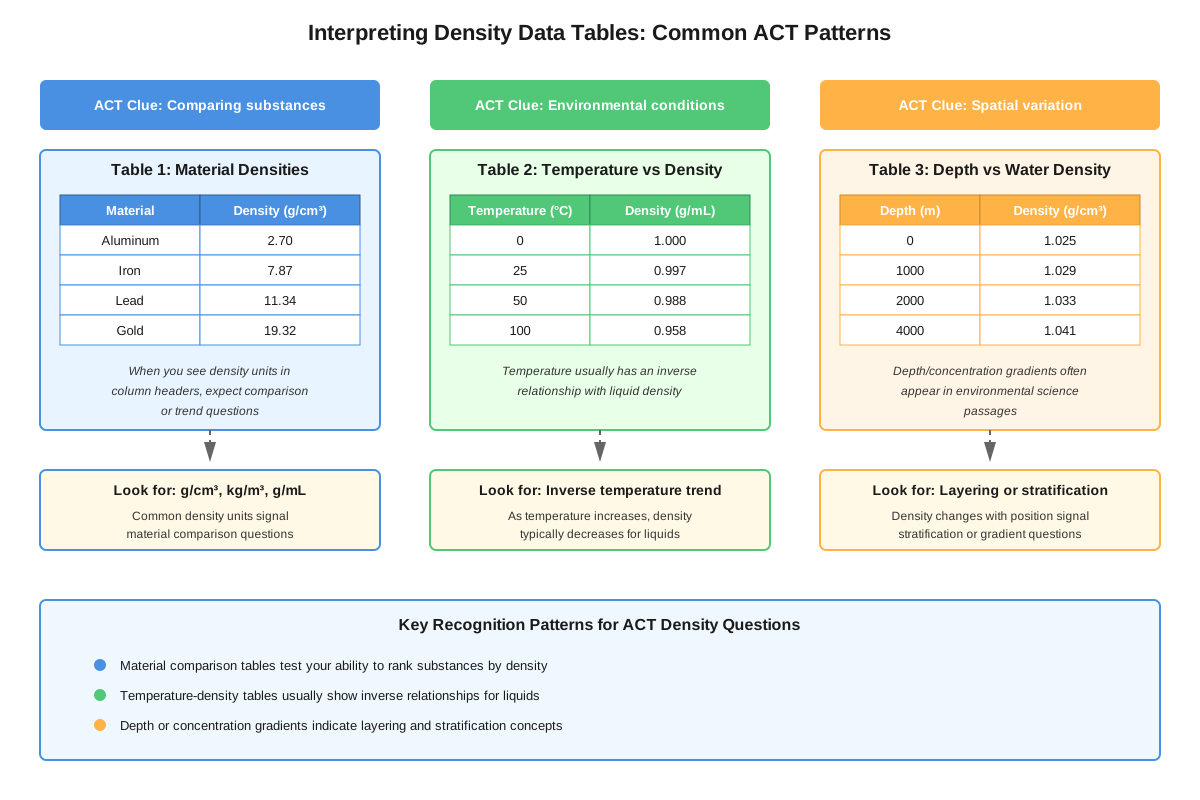
Common ACT passage contexts include: comparing densities of different liquids or solids; examining how density changes with temperature in a single substance; analyzing density variations at different depths in oceans or atmospheres; investigating how mixing substances affects overall density; and determining material composition based on density measurements. The exam rarely requires actual density calculations; instead, it tests whether students can interpret presented data, recognize patterns, and apply logical reasoning to novel scenarios.
Core Concepts
Understanding Density as a Physical Property
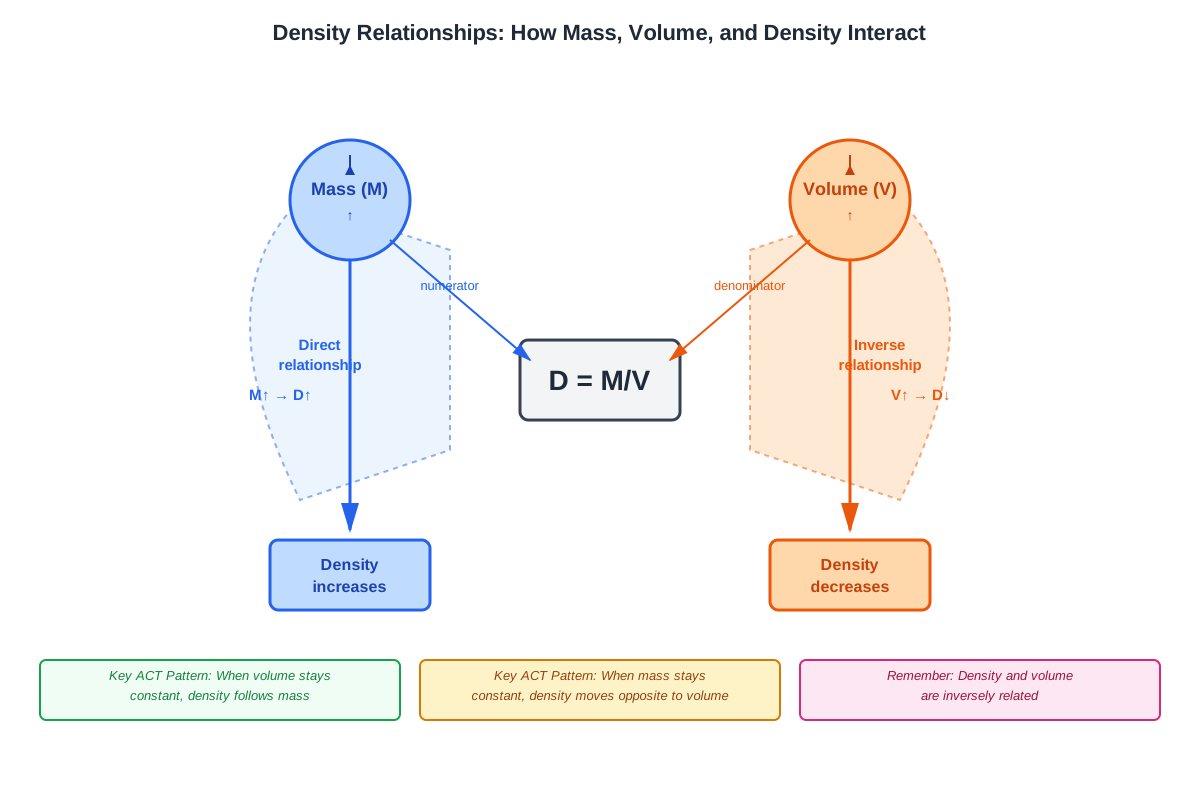
Density is defined as the mass of a substance per unit volume, typically expressed as the ratio mass/volume. On the ACT, density serves as an intensive property—meaning it remains constant for a pure substance regardless of sample size. This characteristic makes density particularly useful for identification purposes in experimental passages. When the ACT presents density data, students must recognize that higher density values indicate more mass packed into the same volume, while lower density values indicate less mass in the same space.
The ACT never requires students to memorize specific density values for substances. Instead, passages provide all necessary data in tables or graphs. However, understanding the relative density scale helps: gases typically have densities around 0.001-0.01 g/cm³, liquids range from approximately 0.7-1.5 g/cm³ (with water at 1.0 g/cm³ as a reference point), and solids generally exceed 1.0 g/cm³, with metals often ranging from 2-20 g/cm³.
Density Relationships with Temperature
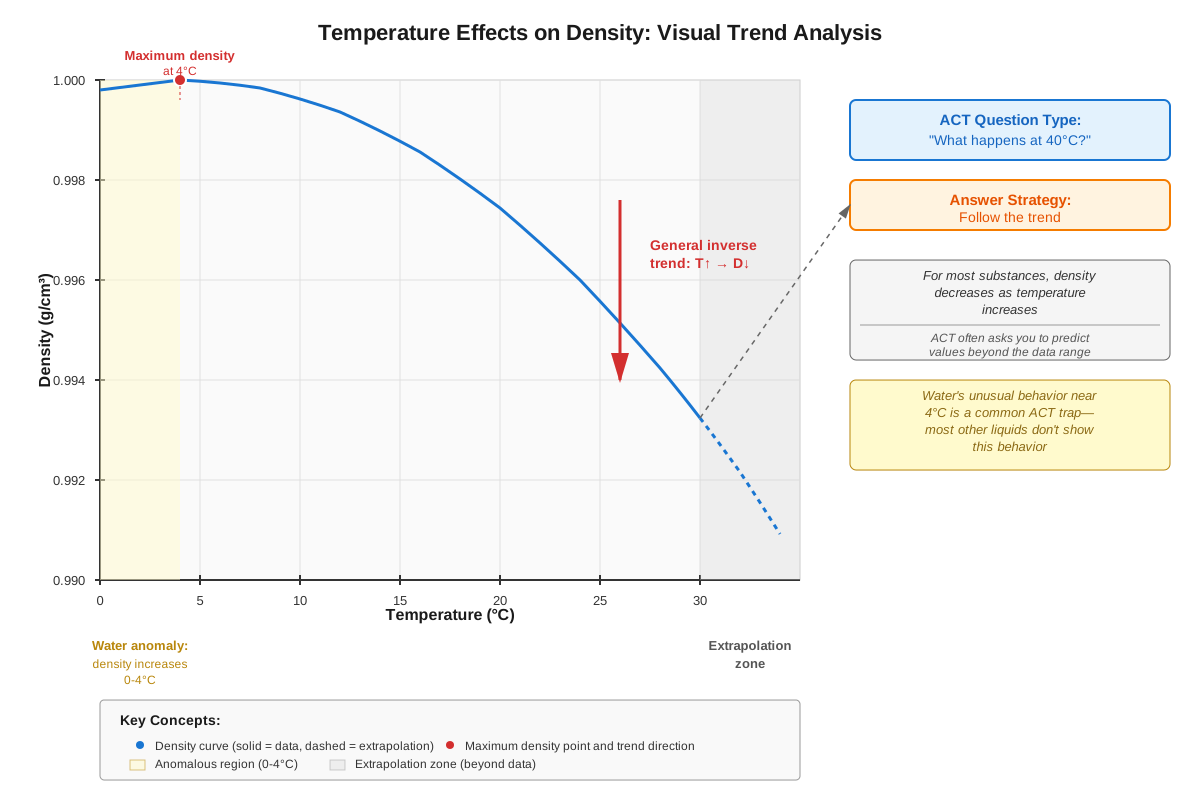
One of the most frequently tested concepts involves how temperature affects density. For most substances, density and temperature exhibit an inverse relationship: as temperature increases, density decreases. This occurs because heating typically causes substances to expand (increase volume) while mass remains constant, resulting in lower density. The ACT commonly presents this relationship through tables showing density measurements at various temperatures or graphs with temperature on the x-axis and density on the y-axis (displaying a negative slope).
Water presents a notable exception that occasionally appears on the ACT: water reaches maximum density at 4°C, with density decreasing both above and below this temperature. This anomalous behavior explains why ice floats and why lakes freeze from the top down—concepts that may appear in passage context but rarely as the primary question focus.
Density in Layering and Stratification
The ACT frequently tests understanding of how density differences cause layering in fluids. When substances with different densities are combined without mixing, they arrange themselves with the densest material at the bottom and the least dense at the top. This principle appears in passages about:
- Ocean water layers at different depths (where colder, saltier water is denser and sinks)
- Atmospheric layers (where cooler, denser air remains near Earth's surface)
- Oil and water separation (where less dense oil floats on denser water)
- Geological stratification (where denser rock layers settle below less dense layers)
Questions typically ask students to predict which layer will be at a specific position, determine relative densities based on observed layering, or explain why a particular arrangement occurs.
Density Data in Tables and Graphs
The ACT presents density information in multiple formats, and recognizing the format quickly is crucial for efficient problem-solving:
| Data Format | Common Features | What to Look For |
|---|---|---|
| Tables | Rows/columns showing density values for different materials or conditions | Compare values vertically or horizontally; identify highest/lowest values; note units |
| Line Graphs | Density plotted against another variable (temperature, depth, pressure) | Identify slope direction (positive/negative); note where lines intersect; recognize trends |
| Bar Graphs | Density comparisons across categories | Compare bar heights; identify patterns across groups |
| Scatter Plots | Individual density measurements showing relationships | Recognize clustering; identify outliers; determine correlation direction |
When interpreting ACT density data in any format, students should immediately identify: (1) what variables are being compared, (2) the units of measurement, (3) the range of values presented, and (4) any obvious trends or patterns.
Density and Composition
Many ACT passages explore how mixing substances or changing composition affects overall density. When two substances mix completely, the resulting density falls between the densities of the individual components. The ACT tests this through passages about:
- Alloys (metal mixtures with densities between constituent metals)
- Solutions (where dissolved substances change solution density)
- Composite materials (where combined materials produce intermediate densities)
The key principle: adding a denser substance to a mixture increases overall density, while adding a less dense substance decreases overall density. Questions often ask students to predict how density changes when composition changes or to determine which component was added based on observed density changes.
Buoyancy and Density Comparisons
While the ACT doesn't typically ask about buoyancy calculations, passages may present experimental scenarios where objects float or sink based on density relationships. The fundamental rule: an object floats in a fluid if the object's density is less than the fluid's density; it sinks if its density is greater. This principle appears in passages about:
- Marine biology (organisms at different ocean depths)
- Material testing (determining which materials float in various liquids)
- Geological processes (magma rising through denser rock)
Questions require students to compare density values and predict outcomes rather than perform calculations.
Concept Relationships
The concepts within density data interpretation form an interconnected web of relationships. The fundamental definition of density as mass per unit volume serves as the foundation → this leads to understanding density as an intensive property that characterizes materials → which enables using density for identification and comparison purposes.
Temperature effects on density connect directly to layering phenomena: temperature changes cause density changes → density differences drive stratification → stratification patterns can be predicted from density data. This chain of reasoning appears repeatedly in ACT passages.
The relationship between composition and density links to both identification and prediction tasks: pure substances have characteristic densities → mixtures have intermediate densities → composition changes produce predictable density changes → density measurements can reveal composition information.
Data interpretation skills form the overarching framework connecting all density concepts: recognizing data formats → extracting relevant values → identifying trends and patterns → applying patterns to make predictions → answering questions accurately. This progression applies regardless of the specific density context in a passage.
Connections to prerequisite knowledge include: basic density definition builds on understanding of mass and volume → graph reading skills enable density trend identification → understanding of direct/inverse relationships allows prediction of how variables affect density → unit awareness prevents misinterpretation of magnitude.
High-Yield Facts
⭐ Density is defined as mass per unit volume and serves as an intensive property that doesn't change with sample size for pure substances
⭐ For most substances, density and temperature have an inverse relationship: as temperature increases, density decreases
⭐ When immiscible substances layer, the densest material settles at the bottom and the least dense rises to the top
⭐ The ACT provides all necessary density values in passages; no memorization of specific densities is required
⭐ Comparing density values allows prediction of floating/sinking behavior: objects with lower density than the surrounding fluid will float
- Density data appears most commonly in Data Representation and Research Summaries passages on the ACT Science section
- Graphs showing density versus temperature typically display negative slopes for most substances
- When substances mix completely, the resulting density falls between the individual component densities
- Increasing pressure generally increases density by compressing matter into smaller volumes
- The ACT rarely requires density calculations; instead, it tests data interpretation and pattern recognition
- Density units commonly appear as g/cm³, kg/m³, or g/mL, with 1 g/cm³ = 1 g/mL = 1000 kg/m³
- Questions often ask students to extrapolate beyond given data ranges based on identified trends
- Atmospheric and oceanic passages frequently use density gradients to explain layering phenomena
- Material science passages may present density as a criterion for material selection or identification
- Density anomalies (like water's maximum density at 4°C) appear occasionally but are always explained in passage context
Quick check — test yourself on Density data so far.
Try Flashcards →Common Misconceptions
Misconception: Density changes when you have more or less of a substance → Correction: Density is an intensive property that remains constant for a pure substance regardless of sample size. Having twice as much water doesn't change water's density; both the mass and volume double, keeping the ratio constant.
Misconception: All substances become denser when cooled → Correction: While most substances follow this pattern, water is a notable exception that becomes less dense when it freezes (which is why ice floats). The ACT always provides context when exceptions apply, so students should rely on passage data rather than assumptions.
Misconception: Density data questions require mathematical calculations → Correction: The ACT Science section tests data interpretation, not calculation skills. Density questions require reading values from tables or graphs, identifying trends, and making logical predictions—not computing density from mass and volume.
Misconception: Higher density always means heavier → Correction: Density compares mass to volume, not absolute mass. A small piece of lead (high density) has less mass than a large piece of wood (low density), but lead is denser because it has more mass per unit volume.
Misconception: When two substances mix, the resulting density is always the average of the two original densities → Correction: The resulting density depends on the proportions mixed. If you mix 90% of substance A with 10% of substance B, the mixture density will be much closer to A's density than to B's density, not halfway between them.
Misconception: Density data passages always explicitly state "density" in the passage title or introduction → Correction: The ACT often presents density data without using the word "density," instead showing mass and volume data, discussing layering phenomena, or presenting data in g/cm³ units. Students must recognize density concepts even when not explicitly labeled.
Misconception: Graphs with positive slopes always indicate direct relationships → Correction: The interpretation depends on which variable is on which axis. A graph showing depth (increasing downward) versus density might show a positive slope even though deeper (colder) water is denser—the relationship between temperature and density is still inverse.
Worked Examples
Example 1: Temperature and Density Relationship
Passage Context: A student measures the density of olive oil at different temperatures and records the following data:
| Temperature (°C) | Density (g/mL) |
|---|---|
| 10 | 0.920 |
| 20 | 0.915 |
| 30 | 0.910 |
| 40 | 0.905 |
| 50 | 0.900 |
Question: Based on the data, what would be the most likely density of olive oil at 60°C?
Solution Process:
Step 1: Identify the relationship between variables. Looking at the table, as temperature increases from 10°C to 50°C, density decreases from 0.920 to 0.900 g/mL. This confirms the typical inverse relationship between temperature and density.
Step 2: Determine the pattern quantitatively. The density decreases by 0.005 g/mL for every 10°C increase in temperature. This represents a consistent linear trend.
Step 3: Extrapolate beyond the given data. At 50°C, density is 0.900 g/mL. Increasing temperature by another 10°C to 60°C should decrease density by another 0.005 g/mL.
Step 4: Calculate the prediction. 0.900 - 0.005 = 0.895 g/mL
Answer: The most likely density at 60°C would be approximately 0.895 g/mL.
Connection to Learning Objectives: This example demonstrates identifying when density data is being tested (recognizing the table format and units), explaining the core strategy (identifying the inverse temperature-density relationship and consistent trend), and applying the concept to make accurate predictions beyond the given data range.
Example 2: Layering Based on Density
Passage Context: A researcher adds four different liquids to a graduated cylinder. The liquids do not mix and form distinct layers. The densities of the liquids are:
- Liquid A: 1.26 g/cm³
- Liquid B: 0.79 g/cm³
- Liquid C: 1.00 g/cm³
- Liquid D: 0.92 g/cm³
Question 1: Which liquid will form the bottom layer?
Solution Process:
Step 1: Recall the principle that denser materials sink below less dense materials when substances don't mix.
Step 2: Identify the liquid with the highest density. Comparing all values: 1.26 > 1.00 > 0.92 > 0.79
Step 3: Determine that Liquid A, with the highest density (1.26 g/cm³), will settle at the bottom.
Answer: Liquid A will form the bottom layer.
Question 2: If a solid object with a density of 0.95 g/cm³ is placed in the cylinder, between which two liquid layers will it settle?
Solution Process:
Step 1: Understand that the object will sink through liquids less dense than itself and float on liquids denser than itself.
Step 2: Arrange liquids by density: B (0.79) < D (0.92) < C (1.00) < A (1.26)
Step 3: Locate where 0.95 g/cm³ fits in this sequence: B (0.79) < D (0.92) < object (0.95) < C (1.00) < A (1.26)
Step 4: Conclude that the object will sink through Liquids B and D (both less dense) but float on Liquid C (more dense).
Answer: The object will settle between Liquid D and Liquid C.
Connection to Learning Objectives: This example shows how to identify density data testing (recognizing the layering scenario), apply the core strategy (using density comparisons to predict positions), and accurately solve ACT-style questions requiring synthesis of multiple density values.
Exam Strategy
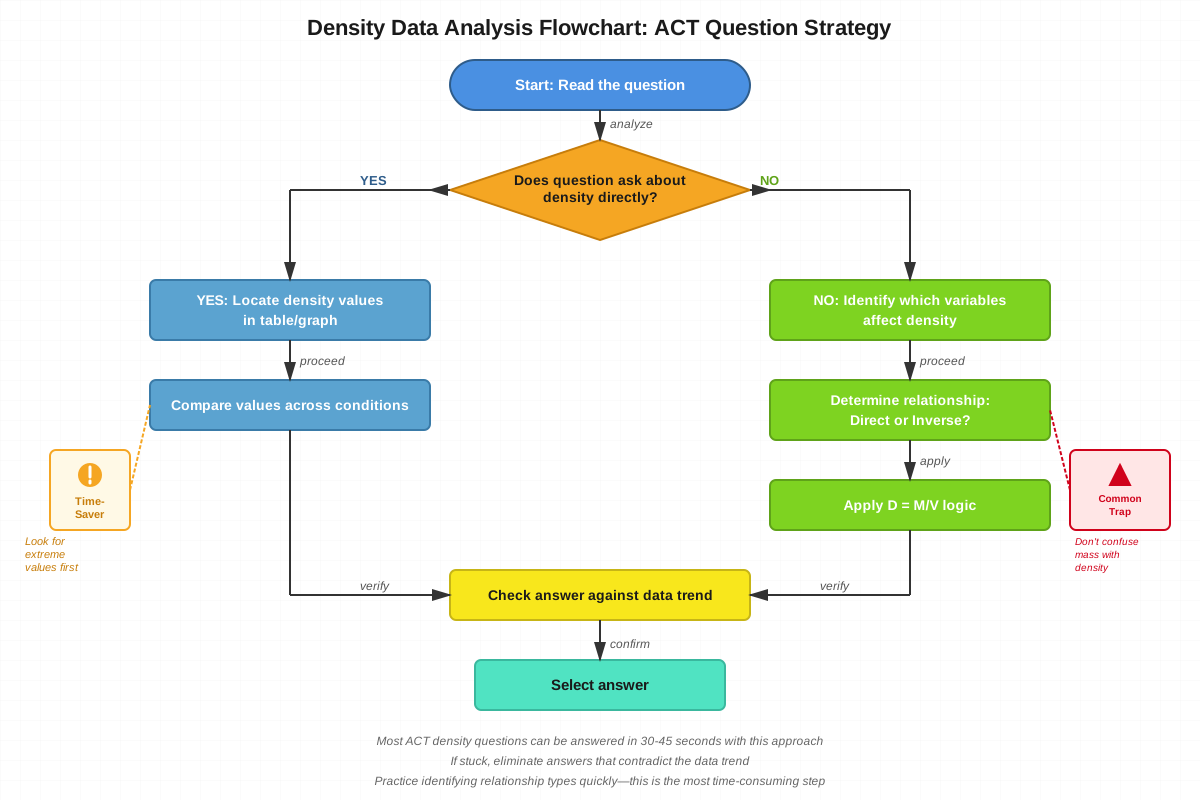
When approaching ACT Science questions involving density data, implement this systematic strategy:
Step 1: Rapid Passage Scan (15-20 seconds)
Quickly identify whether the passage involves density by looking for trigger words and phrases: "density," "g/cm³," "kg/m³," "g/mL," "mass per volume," "layering," "stratification," "floating," "sinking," or "buoyancy." Check table headers and graph axis labels for these indicators.
Step 2: Identify the Data Format
Determine whether density information appears in tables, line graphs, bar graphs, or scatter plots. Each format requires slightly different reading strategies, so recognizing the format immediately saves time.
Step 3: Note the Variables and Relationships
Identify what variables are being compared (density vs. temperature, density vs. depth, density across different materials, etc.). Quickly determine whether relationships are direct (both increase together) or inverse (one increases while the other decreases).
Step 4: Question-Specific Approach
For comparison questions ("Which substance has the highest density?"): Scan the relevant table or graph for maximum/minimum values without reading unnecessary data.
For trend questions ("How does density change as temperature increases?"): Look at the overall pattern rather than individual data points. Identify whether the trend is increasing, decreasing, or constant.
For prediction questions ("What would the density be at 70°C?"): Identify the established pattern, determine if it's linear or non-linear, and extrapolate logically.
For explanation questions ("Why does Liquid A float on Liquid B?"): Compare the relevant density values and apply the principle that less dense materials float on denser materials.
Process of Elimination Tips Specific to Density Data:
- Eliminate answer choices that contradict the basic principle that denser materials sink below less dense materials
- Rule out options that reverse the established trend (if density decreases with temperature in the data, eliminate answers suggesting it increases)
- Discard answers that place predicted values far outside the reasonable range established by the data
- Eliminate choices that confuse intensive properties (density) with extensive properties (total mass or volume)
Time Allocation Advice:
Density data questions typically require 30-45 seconds each when approached systematically. Spend no more than 10 seconds locating the relevant data, 15-20 seconds analyzing the relationship or making the comparison, and 10-15 seconds selecting and confirming the answer. If a question requires more than one minute, mark it and return after completing easier questions.
Trigger Words to Watch For:
- "Based on the data" or "According to the table/figure" → signals that the answer comes directly from presented information
- "Most likely" or "best supported by" → indicates extrapolation or prediction based on established trends
- "Compared to" or "relative to" → requires direct comparison of density values
- "If the trend continues" → explicitly asks for extrapolation beyond given data
Memory Techniques
DENSE Mnemonic for Density Data Approach:
- Determine the data format (table, graph, etc.)
- Examine the variables being compared
- Note the relationship (direct or inverse)
- Scan for the specific values needed
- Extrapolate or compare as required
Temperature-Density Relationship Visualization:
Picture a balloon being heated: as temperature goes UP, the balloon expands (volume increases), making the gas inside less dense—density goes DOWN. This mental image reinforces the inverse relationship for most substances.
Layering Memory Aid - "Heavy to the Bottom":
Remember that in any stratified system, the "heaviest" (densest) material sinks to the bottom, like rocks sinking in water. Visualize a salad dressing bottle where oil (less dense) floats on vinegar (more dense).
FLOAT Acronym for Buoyancy Predictions:
- Find the object's density
- Locate the fluid's density
- Object density less than fluid? → floats
- Above the fluid density? → sinks
- Test by comparing the numbers
Unit Conversion Quick Reference:
Remember "1-1-1000": 1 g/cm³ = 1 g/mL = 1000 kg/m³. This helps when passages use different units for different substances.
Summary
Density data interpretation represents a critical skill for ACT Science success, appearing in approximately 15-20% of passages across Data Representation and Research Summaries formats. The core concept—density as mass per unit volume—serves as an intensive property that characterizes materials and enables predictions about behavior. Students must master recognizing when density data is being tested through trigger words, units, and passage contexts involving layering, temperature effects, or material comparisons. The fundamental strategies involve identifying relationships between density and other variables (particularly the inverse temperature-density relationship), comparing density values to predict layering or floating/sinking behavior, and extrapolating trends to make predictions beyond given data ranges. Success requires rapid data format recognition, efficient value extraction from tables and graphs, and logical application of density principles without performing calculations. The ACT tests interpretation and reasoning rather than computational skills, so students should focus on pattern recognition, trend identification, and systematic comparison strategies to maximize both speed and accuracy on these high-yield questions.
Key Takeaways
- Density data questions test interpretation and pattern recognition, not calculation skills—all necessary values are provided in passages
- The inverse relationship between temperature and density (as temperature increases, density typically decreases) is the most frequently tested concept
- Layering and stratification always follow the rule: densest materials settle at the bottom, least dense rise to the top
- Rapid identification of data format (table vs. graph) and variables being compared enables efficient question-solving
- Comparison questions require only identifying maximum/minimum values, while prediction questions demand recognizing and extrapolating established trends
- Trigger words like "g/cm³," "layering," "stratification," and "floating/sinking" immediately signal density data testing
- Systematic approaches (DENSE mnemonic) prevent common errors and improve time management on density-related passages
Related Topics
Mass and Volume Relationships: Understanding how mass and volume independently affect density deepens comprehension of why density changes under different conditions. This topic builds directly on density data interpretation skills.
Phase Changes and States of Matter: Exploring how substances transition between solid, liquid, and gas phases connects to density changes, as phase transitions typically involve significant density alterations. Mastering density data provides the foundation for understanding these transitions.
Pressure Effects on Gases: Gas density responds dramatically to pressure changes, following predictable patterns. Students who master density data interpretation can more easily understand gas behavior under varying pressure conditions.
Solution Concentration: Concentration measurements relate closely to density, as dissolved substances affect solution density predictably. The data interpretation skills developed through density studies transfer directly to concentration analysis.
Experimental Design and Variables: Many density passages embed density as a dependent or independent variable within larger experimental contexts. Strong density data skills enhance overall experimental analysis capabilities across all ACT Science passage types.
Practice CTA
Now that you've mastered the core concepts, strategies, and common patterns in density data interpretation, it's time to solidify your understanding through active practice. Challenge yourself with the practice questions designed specifically to mirror ACT-style density data scenarios. Work through each question systematically, applying the DENSE approach and the strategies outlined in this guide. Use the flashcards to reinforce high-yield facts and relationships until you can instantly recognize density data testing and confidently predict outcomes. Remember: the ACT rewards pattern recognition and efficient data interpretation—skills that improve dramatically with focused practice. Every question you work through builds the automaticity that translates to faster, more accurate performance on test day. You've got this!
Sign up free to keep reading
Create a free AnvayaPrep account to finish this ACT guide on Density data — plus flashcards and practice questions.