Overview
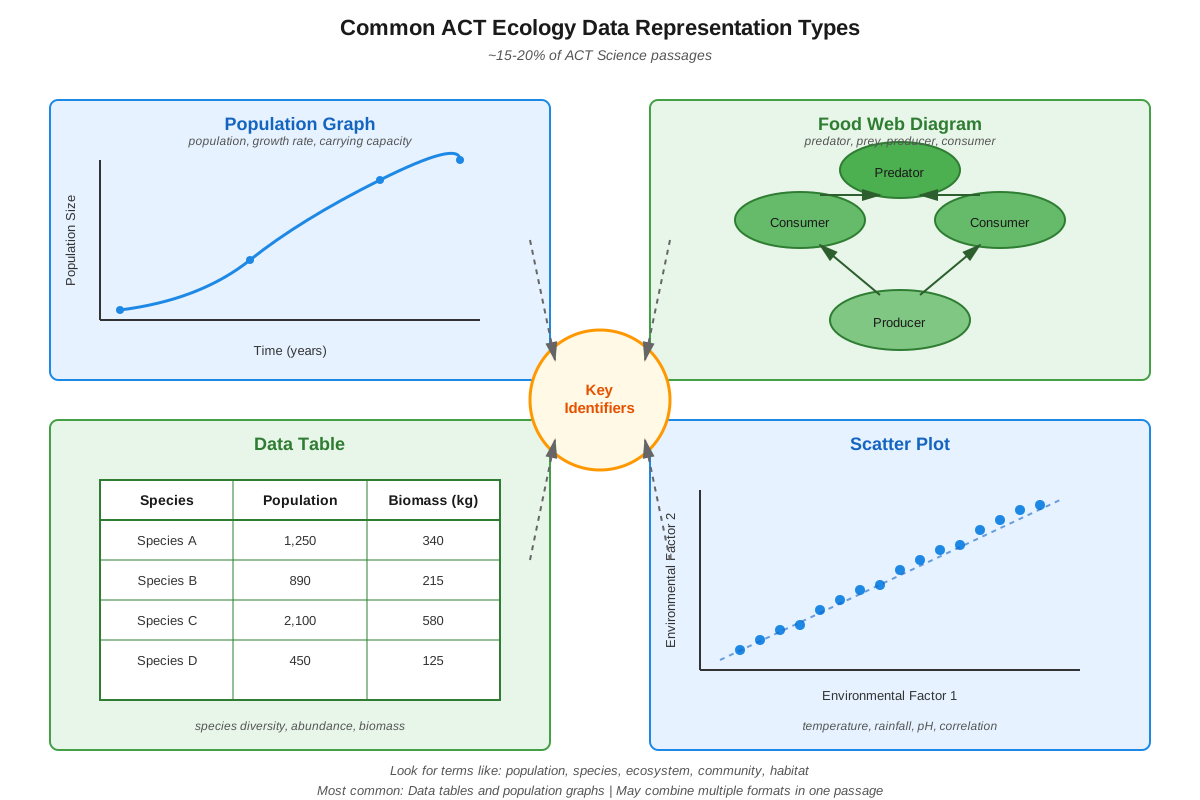
Ecology data represents one of the most frequently tested content areas within the ACT Science section, appearing in approximately 15-20% of all science passages. Unlike traditional biology content knowledge tests, the ACT Science exam emphasizes data interpretation skills, and ecology passages provide rich opportunities to assess students' abilities to analyze graphs, tables, and experimental designs related to populations, communities, ecosystems, and environmental interactions.
The ACT ecology data questions require students to interpret complex relationships between organisms and their environments through various data representations. These passages typically present information about population dynamics, food webs, energy flow, nutrient cycling, species interactions, or environmental factors affecting ecosystems. Students must quickly identify variables, recognize patterns in data, understand experimental controls, and draw valid conclusions from presented information—all within the time constraints of the ACT Science section.
Mastering ecology data interpretation connects directly to broader scientific reasoning skills tested throughout the ACT Science exam. The analytical approaches used for ecology passages—identifying independent and dependent variables, recognizing trends, comparing experimental groups, and evaluating hypotheses—transfer seamlessly to passages in chemistry, physics, and other biological topics. Strong performance on ecology data questions demonstrates proficiency in the data representation and research summaries formats that comprise the majority of ACT Science questions.
Learning Objectives
- [ ] Identify when Ecology data is being tested in ACT Science passages
- [ ] Explain the core rule or strategy behind Ecology data interpretation
- [ ] Apply Ecology data analysis skills to ACT-style questions accurately
- [ ] Distinguish between different types of ecological relationships presented in data tables and graphs
- [ ] Evaluate the validity of conclusions drawn from ecological experiments and observational studies
- [ ] Synthesize information from multiple data representations within a single ecology passage
Prerequisites
- Basic graph reading skills: Understanding x-axis, y-axis, scales, and data point interpretation is essential for analyzing the visual representations common in ecology passages
- Scientific method fundamentals: Recognizing independent variables, dependent variables, controls, and experimental design helps students evaluate the quality of ecological studies
- Basic mathematical operations: Calculating percentages, ratios, and understanding proportional relationships enables students to work with population data and ecosystem measurements
- Reading comprehension: Extracting relevant information from passage text and figure captions is necessary to contextualize data presentations
Why This Topic Matters
Ecology data interpretation skills extend far beyond standardized testing into real-world applications. Environmental scientists, conservation biologists, public health officials, and policy makers regularly analyze ecological data to make critical decisions about resource management, species protection, pollution control, and climate change mitigation. The ability to read and interpret ecological studies appears in news media, scientific journals, and policy documents that affect communities worldwide.
On the ACT Science exam, ecology passages appear with remarkable consistency. Statistical analysis of recent ACT exams reveals that ecology-related passages constitute 1-2 passages per test, translating to 5-10 questions. These passages most commonly appear in the Data Representation format (presenting 2-3 graphs or tables with 5 questions) or Research Summaries format (describing 2-3 experiments with 6 questions). The Conflicting Viewpoints format occasionally features ecological debates about conservation strategies, climate impacts, or species management.
Common manifestations of ecology data on the ACT include: population growth curves showing exponential or logistic patterns; food web diagrams with energy transfer data; tables comparing species diversity across different habitats; graphs showing the relationship between environmental factors (temperature, precipitation, pH) and organism abundance; experimental results testing the effects of competition, predation, or symbiosis; and data about biogeochemical cycles like carbon, nitrogen, or water movement through ecosystems.
Core Concepts
Understanding Ecological Data Representations
Ecology data on the ACT appears in multiple formats, each requiring specific interpretation skills. Tables typically present numerical data about populations, species counts, or environmental measurements across different conditions or time periods. Students must identify which variables are being compared and recognize patterns such as increases, decreases, or optimal ranges. Graphs—including line graphs, bar graphs, and scatter plots—visualize relationships between ecological variables. The most critical skill involves identifying the independent variable (typically on the x-axis, representing what researchers manipulated or observed) and the dependent variable (typically on the y-axis, representing what was measured as a result).
Food webs and energy pyramids represent specialized ecological diagrams that appear regularly on the ACT. Food webs show feeding relationships with arrows pointing from prey to predator (or from energy source to consumer). Energy pyramids display the amount of energy or biomass at each trophic level, with producers at the base and top predators at the apex. Understanding that energy decreases at each level (typically by about 90%) helps students answer questions about ecosystem efficiency and population sizes.
Population Dynamics and Growth Patterns
Population data forms the foundation of many ACT ecology passages. Population size refers to the number of individuals of a species in a defined area, while population density measures individuals per unit area or volume. ACT passages frequently present data showing how populations change over time under different conditions.
Two fundamental growth patterns appear repeatedly: exponential growth (J-shaped curve) occurs when populations increase rapidly without constraints, showing accelerating growth rates. This pattern appears in ideal conditions with unlimited resources. Logistic growth (S-shaped curve) reflects more realistic scenarios where population growth slows as it approaches the carrying capacity—the maximum population size that an environment can sustain given available resources.
| Growth Pattern | Shape | Characteristics | ACT Question Focus |
|---|---|---|---|
| Exponential | J-curve | Unlimited resources, constant growth rate | Identifying early growth phases |
| Logistic | S-curve | Limited resources, levels off at carrying capacity | Recognizing carrying capacity, comparing growth rates |
Species Interactions and Community Ecology
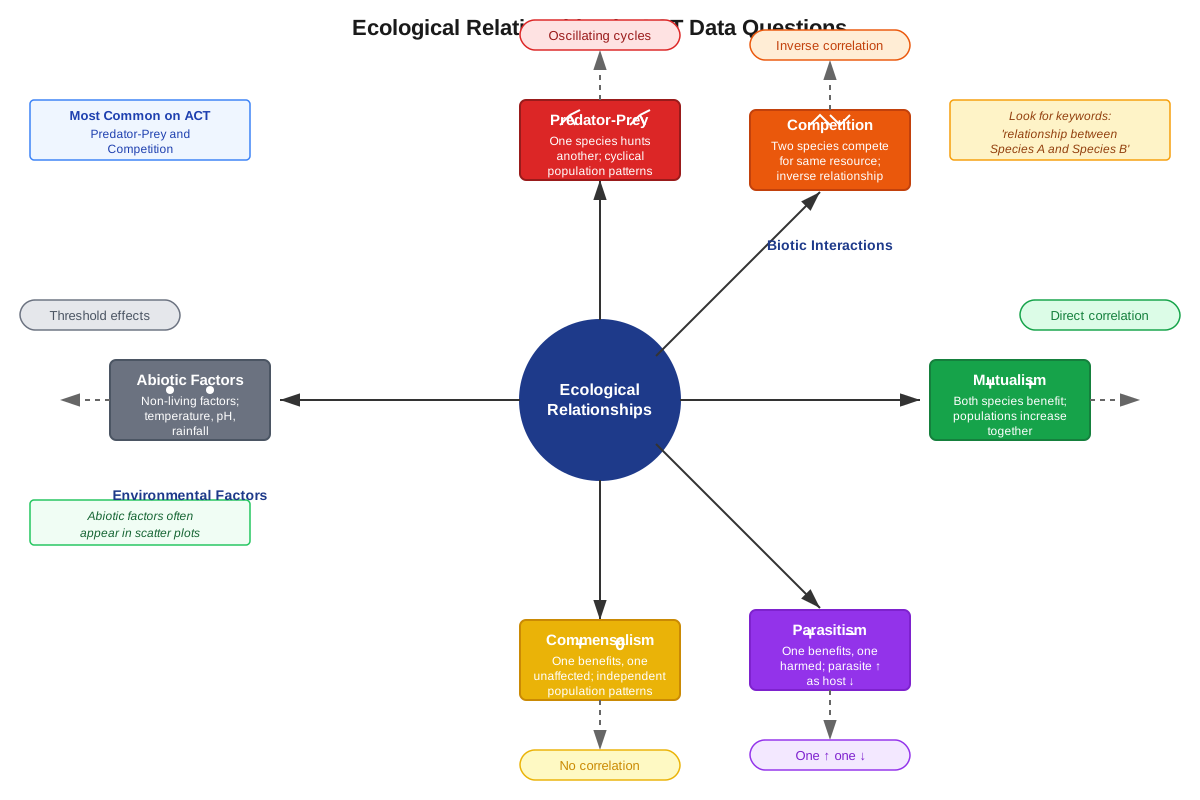
ACT ecology passages often present data about how different species affect each other. Competition occurs when species require the same limited resources, typically shown through data indicating that the presence of one species reduces the population or growth of another. Predation involves one organism consuming another, with data showing inverse relationships between predator and prey populations—as prey increases, predators increase with a time lag, then prey decreases, followed by predator decrease.
Symbiotic relationships include mutualism (both species benefit), commensalism (one benefits, the other unaffected), and parasitism (one benefits, the other harmed). ACT questions may present experimental data showing growth rates or survival of species when alone versus together, requiring students to classify the relationship type based on whether each species shows positive, negative, or neutral effects.
Environmental Factors and Ecosystem Responses
Abiotic (non-living) factors profoundly influence ecological systems, and ACT passages frequently explore these relationships. Temperature, precipitation, light availability, pH, and nutrient concentrations commonly appear as independent variables in ecology experiments. Students must interpret how changes in these factors affect dependent variables like species abundance, distribution, growth rate, or survival.
Tolerance ranges represent a critical concept: each species has optimal conditions where it thrives, with performance declining at values above or below this optimum. Graphs showing bell-shaped curves indicate optimal ranges, while graphs showing thresholds indicate minimum or maximum tolerance limits. Understanding whether organisms show narrow tolerance (specialists) or broad tolerance (generalists) helps students predict responses to environmental change.
Experimental Design in Ecological Studies
Recognizing proper experimental design distinguishes strong ACT Science students. Control groups in ecology experiments represent baseline conditions without the treatment being tested. For example, an experiment testing fertilizer effects on plant growth must include plants grown without fertilizer for comparison. Replication involves testing multiple individuals or plots under each condition to ensure results aren't due to chance variation.
Observational studies differ from controlled experiments—researchers collect data about natural systems without manipulating variables. ACT passages may present correlational data from observations, and students must recognize that correlation doesn't prove causation. Questions often ask what additional experiments would be needed to establish cause-and-effect relationships.
Concept Relationships
The concepts within ecology data interpretation form an interconnected framework. Population dynamics (growth patterns, carrying capacity) → influences → species interactions (competition, predation) → which determine → community structure (species diversity, food webs) → all of which respond to → environmental factors (temperature, nutrients, disturbances) → creating feedback loops that affect → population dynamics.
Experimental design principles connect to all ecological concepts as the methodology through which data is collected. Proper identification of independent and dependent variables enables accurate interpretation of population studies, species interaction experiments, and environmental factor investigations. The data representation skills (graph reading, table interpretation) serve as the tools for accessing information about all other ecological concepts.
These ecology-specific concepts build upon prerequisite knowledge: basic graph reading skills → enable → interpretation of population growth curves and species interaction data; scientific method understanding → supports → evaluation of ecological experimental designs; mathematical operations → facilitate → calculation of population changes and energy transfer efficiency.
High-Yield Facts
- ⭐ In ecology data passages, the independent variable is what researchers change or observe across different conditions, while the dependent variable is what they measure as a result
- ⭐ Carrying capacity represents the maximum population size an environment can sustain; populations typically stabilize near this value in logistic growth
- ⭐ Energy decreases by approximately 90% at each trophic level in food chains, explaining why top predators are less abundant than prey
- ⭐ When two species compete for the same resources, data typically shows that both species perform better when alone than when together
- ⭐ Predator-prey population cycles show time-lagged oscillations: prey increases → predator increases → prey decreases → predator decreases
- Exponential growth produces J-shaped curves and occurs when resources are unlimited; logistic growth produces S-shaped curves and reflects resource limitations
- Optimal ranges for environmental factors produce bell-shaped curves on graphs, with organism performance declining at values too high or too low
- Control groups in ecological experiments provide baseline data for comparison and must differ from experimental groups in only one variable
- Species diversity typically increases with habitat complexity, resource availability, and moderate disturbance levels
- Correlation between two variables in observational data does not prove that one causes the other; controlled experiments are needed to establish causation
Quick check — test yourself on Ecology data so far.
Try Flashcards →Common Misconceptions
Misconception: Arrows in food webs point from predator to prey, showing what eats what.
Correction: Arrows point from prey to predator (or from energy source to consumer), representing the direction of energy flow through the ecosystem. The arrow points toward the organism receiving energy.
Misconception: All population growth follows exponential patterns indefinitely.
Correction: Exponential growth only occurs temporarily when resources are unlimited. Real populations experience logistic growth, with rates slowing as they approach carrying capacity due to resource limitations, competition, and other density-dependent factors.
Misconception: If two variables change together in a graph, one must cause the other.
Correction: Correlation does not equal causation. Two variables may both respond to a third factor, or their relationship may be coincidental. Controlled experiments with proper controls are necessary to establish cause-and-effect relationships.
Misconception: Carrying capacity is a fixed number that never changes for a given environment.
Correction: Carrying capacity fluctuates based on resource availability, which varies with seasons, weather patterns, and environmental changes. A habitat's carrying capacity for a species can increase or decrease over time.
Misconception: In competition experiments, the species with the larger population always wins.
Correction: Competitive outcomes depend on resource use efficiency, tolerance ranges, and specific environmental conditions, not just initial population size. A smaller population of a better-adapted species may outcompete a larger population of a less-suited species.
Misconception: All ecological data on the ACT requires extensive biology content knowledge.
Correction: ACT ecology passages test data interpretation skills more than content memorization. The passage provides necessary background information, and questions focus on reading graphs, identifying trends, and applying logic rather than recalling specific biological facts.
Worked Examples
Example 1: Population Growth Analysis
Passage Setup: Scientists studied bacterial population growth in two culture dishes. Dish A contained unlimited nutrients, while Dish B contained limited nutrients. They counted bacteria every 2 hours for 24 hours and graphed the results.
Question: Based on the data, which dish showed logistic growth, and at approximately what time did the population reach carrying capacity?
Solution Process:
Step 1: Identify the growth patterns. Logistic growth shows an S-shaped curve that levels off, while exponential growth shows a J-shaped curve that continues accelerating.
Step 2: Examine the graph descriptions. Dish A (unlimited nutrients) would support exponential growth—bacteria can reproduce without resource constraints. Dish B (limited nutrients) would show logistic growth—bacteria initially grow rapidly but slow as they deplete nutrients.
Step 3: Locate carrying capacity. This occurs where the population curve flattens, indicating growth rate has dropped to near zero. On a typical logistic curve, this appears where the S-curve transitions from steep to horizontal.
Step 4: Read the time value. If the graph shows Dish B's population leveling off at hour 16, this represents when carrying capacity was reached.
Answer: Dish B showed logistic growth, reaching carrying capacity at approximately 16 hours.
Connection to Learning Objectives: This example demonstrates identifying ecology data (population growth patterns), explaining core strategies (distinguishing exponential from logistic growth by curve shape), and applying these concepts to ACT-style questions (interpreting graphs to determine carrying capacity).
Example 2: Species Interaction Experiment
Passage Setup: Researchers grew two plant species (Species X and Species Y) in separate pots and in mixed pots. They measured average plant height after 8 weeks:
| Condition | Species X Height (cm) | Species Y Height (cm) |
|---|---|---|
| X alone | 45 | — |
| Y alone | — | 38 |
| X and Y together | 32 | 35 |
Question: What type of interaction exists between Species X and Species Y, and which species is more affected by the interaction?
Solution Process:
Step 1: Compare each species' performance alone versus together. Species X: 45 cm alone, 32 cm together (decrease of 13 cm). Species Y: 38 cm alone, 35 cm together (decrease of 3 cm).
Step 2: Determine interaction type. Both species perform worse when together than alone, indicating competition—they're negatively affecting each other, likely competing for the same resources (light, water, nutrients, or space).
Step 3: Identify which species is more affected. Calculate percent decrease: Species X: (13/45) × 100 = 29% decrease. Species Y: (3/38) × 100 = 8% decrease. Species X shows a much larger proportional decrease.
Step 4: Interpret the biological meaning. Species X is more negatively affected by the interaction, suggesting Species Y is the superior competitor under these conditions. Species Y maintains most of its growth even with competition, while Species X's growth is substantially reduced.
Answer: The interaction is competition. Species X is more affected, showing a 29% decrease in height compared to Species Y's 8% decrease, indicating Species Y is the stronger competitor.
Connection to Learning Objectives: This example shows identifying ecology data (species interaction experiments), explaining strategies (comparing performance alone versus together to classify interactions), and applying concepts accurately (calculating and interpreting percent changes to determine competitive outcomes).
Exam Strategy
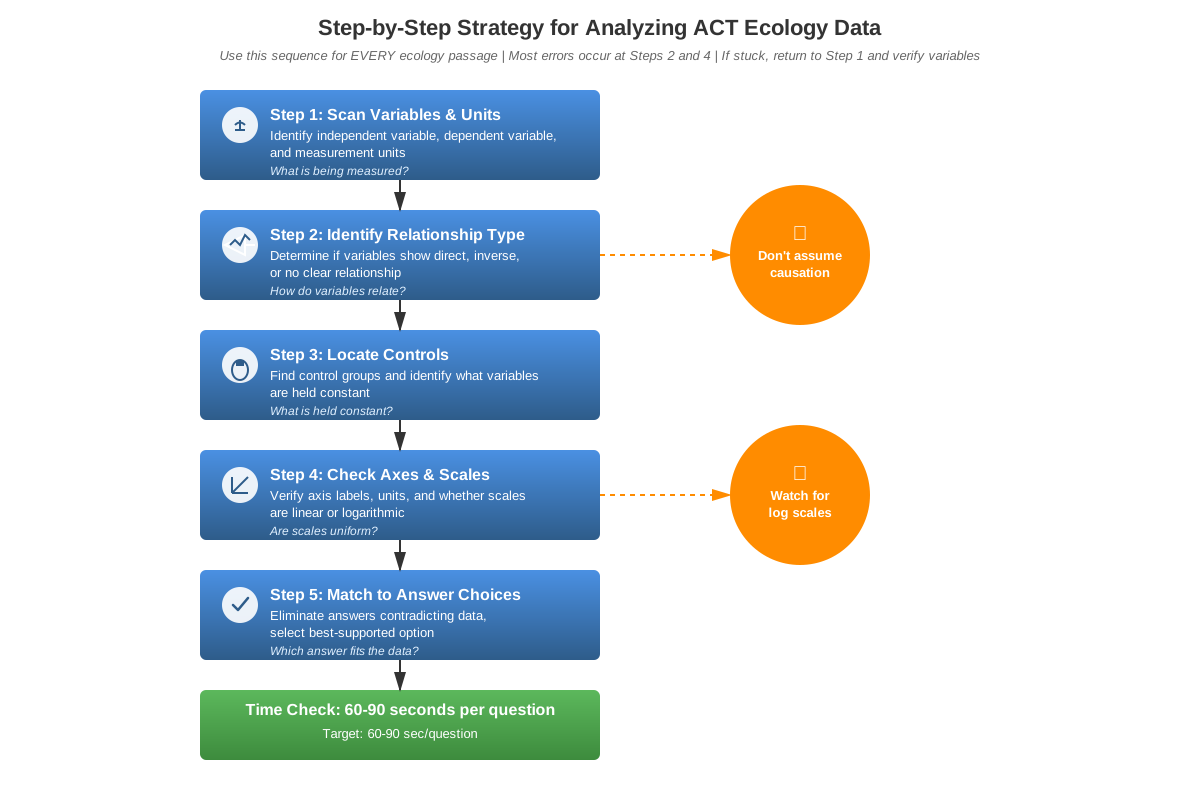
When approaching ACT ecology data passages, begin by quickly scanning the figures and tables before reading the passage text. This preview reveals what types of data are presented (population graphs, species comparisons, environmental factors) and helps focus attention while reading. Identify the independent and dependent variables in each figure immediately—this fundamental step prevents confusion when answering questions.
Trigger words that signal ecology data questions include: "population," "species," "community," "ecosystem," "predator," "prey," "competition," "growth rate," "carrying capacity," "abundance," "diversity," "habitat," "environmental factors," "trophic level," and "food web." When these terms appear in questions, immediately reference the relevant data representation rather than relying on outside knowledge.
For process-of-elimination, first eliminate answer choices that contradict the data directly. If a graph shows population increasing, eliminate any answer stating it decreased. Next, eliminate choices requiring information not provided in the passage—the ACT tests data interpretation, not content recall. Finally, eliminate choices that make logical errors, such as confusing correlation with causation or misidentifying which variable is independent versus dependent.
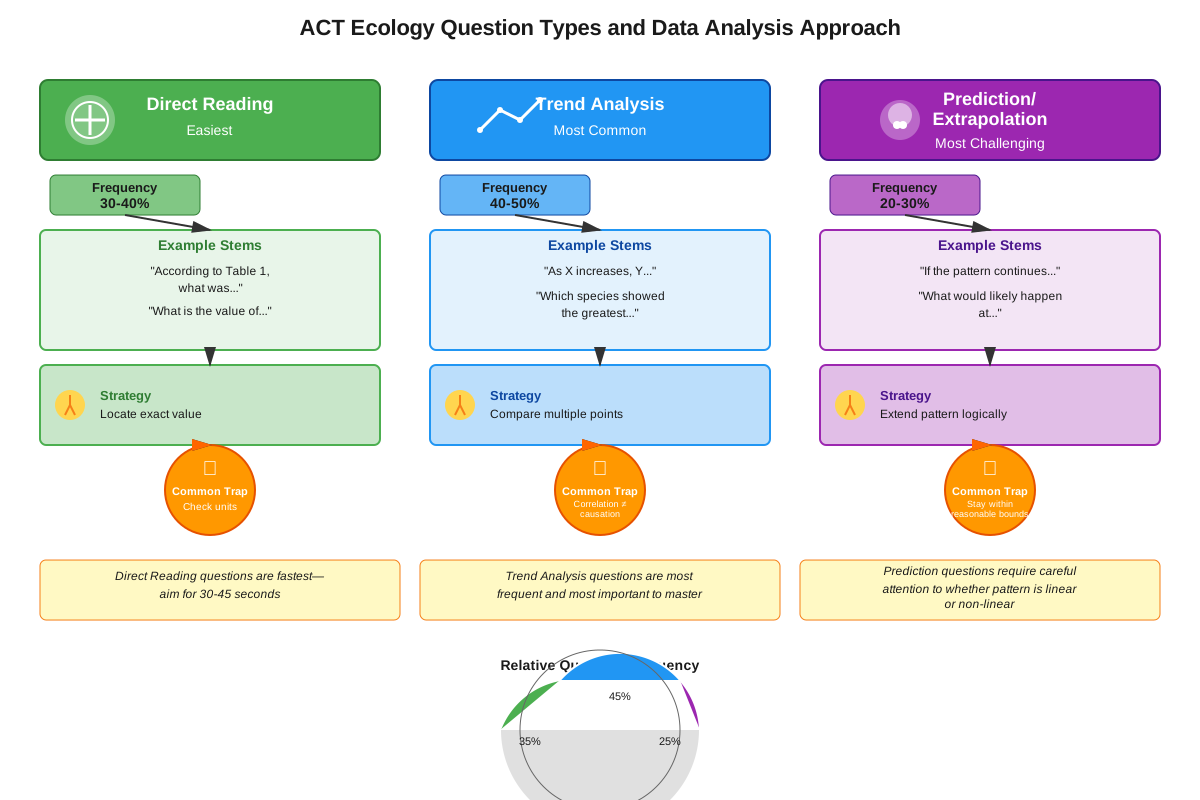
Time Management Tip: Allocate approximately 5 minutes per ecology passage (including all questions). Spend 60-90 seconds initially reviewing figures and reading the passage, then 30-45 seconds per question. If a question requires complex calculations or comparing multiple data points, mark it and return after completing quicker questions.
Watch for questions asking about experimental design improvements or additional studies needed. These often test understanding of controls, replication, and the difference between correlation and causation. The correct answer typically involves adding a control group, increasing sample size, or conducting a controlled experiment to test an observed correlation.
Memory Techniques
TIDE helps remember the four main categories of ecology data on the ACT:
- Trophic levels and food webs
- Interactions between species (competition, predation, symbiosis)
- Dynamics of populations (growth patterns, carrying capacity)
- Environmental factors (abiotic influences on organisms)
"Every Good Boy Does Fine" adapted for energy flow: "Energy Goes By Decreasing Fast" reminds students that energy decreases (by ~90%) at each trophic level as it flows through food chains.
For distinguishing growth curves, visualize: "J for Jump" (exponential growth jumps upward continuously) and "S for Stop" (logistic growth stops at carrying capacity).
"PIPER" for analyzing species interaction data:
- Performance alone (measure baseline)
- Identify performance together
- Positive, negative, or neutral effect on each species
- Evaluate the interaction type
- Recognize which species benefits or suffers more
To remember that arrows in food webs point toward energy receivers: "Energy Enters"—the arrow enters the organism that receives the energy.
Summary
Ecology data interpretation represents a high-yield, frequently tested component of ACT Science that emphasizes analytical skills over content memorization. Success requires quickly identifying independent and dependent variables, recognizing common patterns like exponential versus logistic growth, understanding species interactions through comparative data, and evaluating experimental designs for proper controls and replication. The ACT presents ecological information through graphs, tables, food webs, and experimental descriptions, testing students' abilities to extract relevant information, identify trends, and draw valid conclusions within time constraints. Mastering ecology data passages involves systematic approaches: previewing figures before reading, identifying variable relationships immediately, eliminating answer choices that contradict data or require outside knowledge, and recognizing that correlation doesn't prove causation without controlled experiments. The core strategy centers on letting the data guide interpretations rather than relying on prior biology knowledge, as passages provide necessary context and questions focus on reasoning from presented information.
Key Takeaways
- Ecology data passages test data interpretation skills, not biology content memorization—all necessary information appears in the passage
- Always identify independent variables (what changes) and dependent variables (what's measured) first when analyzing graphs and tables
- Exponential growth (J-curve) occurs with unlimited resources; logistic growth (S-curve) reflects realistic resource limitations and carrying capacity
- Species interaction types are determined by comparing each species' performance alone versus together: both worse = competition, inverse relationship = predation
- Energy decreases approximately 90% at each trophic level, explaining population size differences between producers, consumers, and top predators
- Correlation between variables in observational data doesn't prove causation; controlled experiments with proper controls are needed
- Process-of-elimination strategy: remove answers contradicting data, requiring outside knowledge, or making logical errors about causation or variable relationships
Related Topics
Population Genetics and Evolution: Building on population dynamics, this topic explores how allele frequencies change over time within populations, connecting ecological factors (selection pressures, carrying capacity) to evolutionary outcomes. Mastering ecology data interpretation provides the foundation for understanding how environmental factors drive evolutionary change.
Biogeochemical Cycles: This advanced ecology topic examines how matter (carbon, nitrogen, phosphorus, water) cycles through ecosystems. The data interpretation skills developed with ecology passages directly transfer to analyzing cycle diagrams and graphs showing nutrient movement between biotic and abiotic components.
Experimental Design Across Science Disciplines: The experimental analysis skills practiced with ecology data—identifying controls, recognizing proper replication, distinguishing correlation from causation—apply equally to chemistry, physics, and other biology passages on the ACT Science exam.
Environmental Science and Conservation: Real-world applications of ecology data interpretation appear in environmental impact assessments, conservation planning, and climate change studies. These fields require the same skills tested on the ACT: analyzing population trends, evaluating species interactions, and interpreting environmental factor effects.
Practice CTA
Now that you've mastered the core concepts and strategies for ACT ecology data interpretation, it's time to apply these skills to authentic practice questions. The flashcards will help you memorize key terms and patterns, while practice questions will build your speed and accuracy under test-like conditions. Remember: ecology passages reward systematic analysis and careful data reading more than biology content knowledge. Each practice question you complete strengthens your pattern recognition and builds confidence for test day. Start practicing now to transform these strategies into automatic skills that will boost your ACT Science score!
Sign up free to keep reading
Create a free AnvayaPrep account to finish this ACT guide on Ecology data — plus flashcards and practice questions.