Overview
Motion data represents one of the most frequently tested concepts in the ACT Science section, appearing in approximately 15-20% of all science passages. This topic involves interpreting graphs, tables, and diagrams that display how objects move through space over time. Students encounter motion data primarily in Data Representation passages and Research Summaries, where they must extract information about position, velocity, acceleration, and time relationships from visual representations.
Understanding ACT motion data is essential because it bridges multiple scientific disciplines tested on the exam. Physics passages frequently present motion graphs showing displacement-time or velocity-time relationships. Biology passages may include data on organism movement patterns or cellular migration rates. Even chemistry passages occasionally feature motion data when describing particle behavior or reaction kinetics. The ACT tests not just the ability to read these representations, but also to identify trends, make predictions, and compare multiple data sets simultaneously.
Mastery of motion data interpretation connects directly to broader scientific reasoning skills that the ACT emphasizes. Students must synthesize information from multiple sources, recognize patterns in quantitative data, and apply mathematical reasoning without performing complex calculations. This topic serves as a gateway to understanding how scientists communicate experimental results and how graphical literacy enables rapid comprehension of complex phenomena. Success with motion data questions directly correlates with overall Science section performance, making this a high-priority area for focused study.
Learning Objectives
- [ ] Identify when Motion data is being tested in ACT Science passages
- [ ] Explain the core rule or strategy behind Motion data interpretation
- [ ] Apply Motion data analysis to ACT-style questions accurately
- [ ] Distinguish between position-time, velocity-time, and acceleration-time graphs
- [ ] Extract quantitative information from motion graphs and tables without calculation errors
- [ ] Predict future motion trends based on existing data patterns
- [ ] Compare motion characteristics across multiple experimental conditions or subjects
Prerequisites
- Basic graph reading skills: Understanding x-axis and y-axis relationships, scale interpretation, and coordinate identification is fundamental to extracting information from motion representations.
- Unit awareness: Recognizing common units for distance (meters, kilometers, feet), time (seconds, minutes, hours), and speed (m/s, km/h, mph) prevents misinterpretation of data magnitude.
- Slope concept: Understanding that the steepness of a line represents rate of change is essential for interpreting velocity from position graphs and acceleration from velocity graphs.
- Table navigation: Ability to locate specific values in rows and columns and recognize how variables relate to each other in tabular format.
Why This Topic Matters
Motion data appears in real-world applications across numerous fields. Traffic engineers analyze vehicle motion patterns to optimize signal timing and highway design. Sports scientists study athlete movement to improve performance and prevent injuries. Aerospace engineers track projectile trajectories for satellite launches and aircraft navigation. Medical researchers examine cellular migration patterns to understand wound healing and cancer metastasis. Environmental scientists monitor animal movement to study migration patterns and habitat use.
On the ACT Science section, motion data questions appear in 3-5 passages per test, representing approximately 6-10 individual questions. These questions typically fall into three categories: direct data extraction (40%), trend identification (35%), and prediction or extrapolation (25%). The ACT favors passages that present motion data in multiple formats simultaneously—combining graphs, tables, and written descriptions—to test students' ability to synthesize information across representations.
Common passage formats include: experimental studies comparing motion under different conditions (friction levels, surface types, applied forces), observational studies tracking object or organism movement over time, and theoretical models predicting motion based on initial conditions. The exam frequently presents scenarios involving falling objects, rolling spheres, moving vehicles, projectile motion, or biological movement patterns. Questions often require students to identify which graph matches a written description, determine when two objects meet, or predict motion beyond the measured time range.
Core Concepts
Understanding Motion Variables
Motion data fundamentally describes how an object's position changes over time. Three primary variables characterize motion: position (location in space, measured in distance units), velocity (rate of position change, measured in distance per time), and acceleration (rate of velocity change, measured in distance per time squared). The ACT tests understanding of how these variables relate to each other through graphical and tabular representations.
Position indicates where an object is located relative to a reference point (origin). On position-time graphs, the y-axis shows distance from the starting point, while the x-axis shows elapsed time. A horizontal line indicates the object is stationary (not moving). An upward-sloping line indicates motion away from the origin, while a downward-sloping line indicates motion toward the origin. The steepness of the line reveals how fast the object moves—steeper lines mean faster motion.
Velocity describes both speed (how fast) and direction (which way). Positive velocity indicates motion in one direction (typically forward, upward, or to the right), while negative velocity indicates motion in the opposite direction. Constant velocity appears as a straight line on a position-time graph or a horizontal line on a velocity-time graph. Changing velocity (acceleration) appears as a curved line on position-time graphs or a sloped line on velocity-time graphs.
Graph Types and Interpretation
| Graph Type | Y-Axis | Slope Represents | Area Under Curve Represents | Horizontal Line Means |
|---|---|---|---|---|
| Position-Time | Distance from origin | Velocity | Not typically used | Object is stationary |
| Velocity-Time | Speed and direction | Acceleration | Distance traveled | Constant velocity |
| Acceleration-Time | Rate of velocity change | Rate of acceleration change | Velocity change | Constant acceleration |
Position-time graphs are the most common motion representation on the ACT. Key interpretation rules include:
- The slope at any point equals the instantaneous velocity
- Steeper slopes indicate faster motion
- Curved lines indicate changing velocity (acceleration)
- The highest or lowest point on the graph shows maximum displacement
- When two lines cross, the objects are at the same position at that time
Velocity-time graphs appear less frequently but test deeper understanding:
- Positive values indicate motion in the positive direction
- Negative values indicate motion in the opposite direction
- Zero velocity means the object is momentarily stopped
- The slope indicates acceleration (positive slope = speeding up in positive direction)
- The area between the line and the x-axis represents total distance traveled
Data Table Interpretation
Motion data tables typically organize information with time in one column and position, velocity, or both in additional columns. The ACT frequently presents tables showing:
- Time-series data: Measurements taken at regular intervals (every second, every 5 seconds)
- Multi-subject comparisons: Parallel columns showing motion of different objects under identical conditions
- Multi-condition comparisons: Same object's motion under varying experimental conditions
When analyzing motion tables, students must:
- Identify which variable is independent (usually time) and which is dependent (position, velocity)
- Calculate rate of change by finding the difference between consecutive measurements
- Recognize patterns such as constant change (uniform motion) or increasing/decreasing change (acceleration)
- Compare values across rows to determine when specific conditions are met
Motion Patterns and Trends
The ACT tests recognition of common motion patterns:
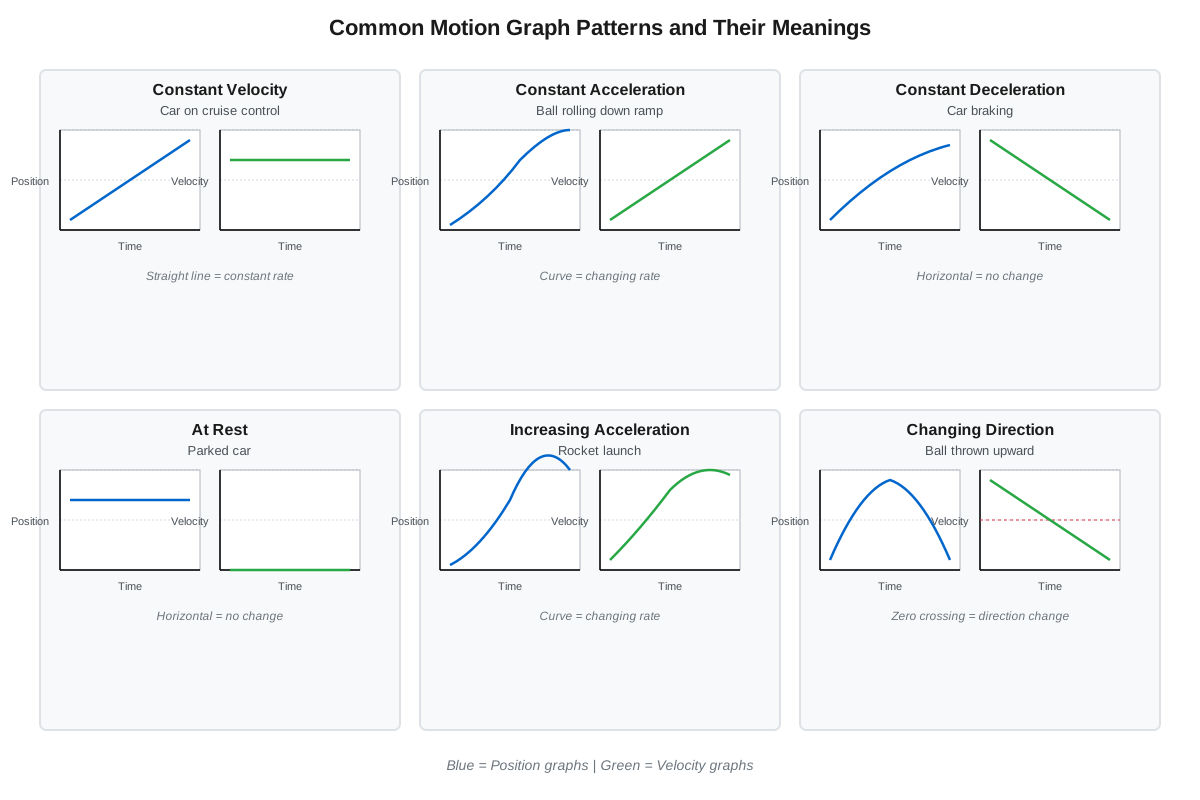
Uniform motion (constant velocity) appears as:
- Straight diagonal line on position-time graphs
- Horizontal line on velocity-time graphs
- Equal position changes in equal time intervals in tables
Uniformly accelerated motion (constant acceleration) appears as:
- Parabolic curve on position-time graphs
- Straight diagonal line on velocity-time graphs
- Position changes that increase or decrease by a constant amount each interval
Variable acceleration (changing acceleration) appears as:
- Complex curves on position-time graphs
- Curved lines on velocity-time graphs
- Irregular patterns of change in tables
Comparative Analysis
Many ACT passages present motion data for multiple objects or conditions simultaneously. Students must compare:
- Relative speeds: Which object moves faster at specific times or overall
- Meeting points: When and where two objects occupy the same position
- Direction changes: When objects reverse direction (velocity changes sign)
- Acceleration differences: Which object's velocity changes more rapidly
Comparison questions often require identifying the point where two lines intersect on a graph or finding when two table values become equal.
Concept Relationships
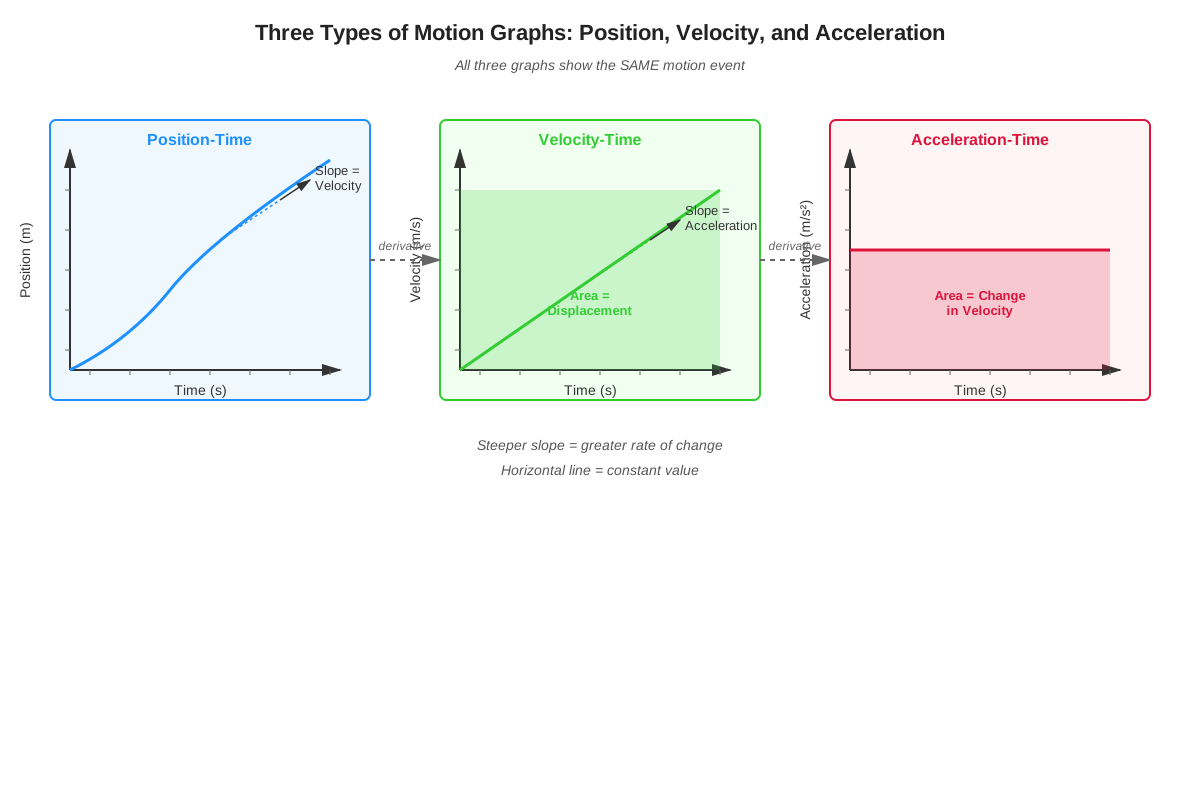
Motion data concepts form a hierarchical relationship where each level builds upon the previous. Position serves as the foundation—the most basic description of where an object is located. Velocity emerges from position by examining how position changes over time, representing the rate of that change. Acceleration builds upon velocity by describing how velocity itself changes over time.
This hierarchy creates a derivative relationship: velocity is the rate of change of position, and acceleration is the rate of change of velocity. Graphically, this means the slope of a position-time graph gives velocity, while the slope of a velocity-time graph gives acceleration. Conversely, the area under a velocity-time curve gives the change in position, while the area under an acceleration-time curve gives the change in velocity.
The connection to prerequisite knowledge is direct: graph reading skills enable extraction of position and time values; slope concept allows determination of velocity from position graphs; unit awareness prevents misinterpretation of magnitude and ensures proper comparison across different measurement systems; table navigation facilitates finding specific values and calculating rates of change.
Motion data interpretation connects to broader ACT Science skills including data representation (the primary passage type featuring motion data), trend analysis (identifying patterns in how motion changes), and prediction (extrapolating beyond measured data). These skills transfer to other science topics involving rate processes, such as chemical reaction kinetics, population growth, and energy transfer.
Relationship map: Basic graph literacy → Position identification → Velocity determination (slope of position) → Acceleration determination (slope of velocity) → Motion prediction → Comparative analysis across conditions
High-Yield Facts
⭐ The slope of a position-time graph equals velocity—steeper slopes indicate faster motion, horizontal lines indicate no motion, and downward slopes indicate motion toward the origin.
⭐ When two lines cross on a position-time graph, the objects are at the same location at that moment—this is the most common basis for ACT questions about "meeting" or "passing."
⭐ Curved lines on position-time graphs indicate acceleration—the object's velocity is changing, either speeding up or slowing down.
⭐ Constant velocity appears as a straight diagonal line on position-time graphs and a horizontal line on velocity-time graphs—this is the most frequently tested motion pattern.
⭐ Negative velocity means motion in the opposite direction from positive velocity—not slower motion, but motion in the reverse direction.
- The steepest part of a position-time graph represents the maximum velocity during that motion.
- A horizontal line on a velocity-time graph means constant velocity (zero acceleration), not zero velocity.
- The area under a velocity-time curve represents the total distance traveled during that time interval.
- In tables showing position at regular time intervals, equal position changes indicate constant velocity.
- When position values in a table increase then decrease, the object has reversed direction.
- The ACT never requires calculating actual numerical values for velocity or acceleration—only identifying trends and making comparisons.
- Graphs with multiple lines always represent either different objects under the same conditions or the same object under different conditions—the legend or caption specifies which.
Quick check — test yourself on Motion data so far.
Try Flashcards →Common Misconceptions
Misconception: A steeper line on any motion graph always means faster motion.
Correction: Steepness indicates faster motion only on position-time graphs. On velocity-time graphs, steeper lines indicate greater acceleration (faster change in velocity), not necessarily faster motion. An object can have high velocity with zero acceleration (horizontal line on velocity-time graph).
Misconception: Negative velocity means the object is slowing down.
Correction: Negative velocity indicates direction, not speed. An object with velocity of -10 m/s is moving just as fast as one with velocity of +10 m/s, but in the opposite direction. Slowing down means the magnitude of velocity is decreasing, which could occur with either positive or negative velocity values.
Misconception: A horizontal line on a position-time graph means constant velocity.
Correction: A horizontal line on a position-time graph means zero velocity—the object is not moving at all. Its position remains constant over time. Constant (non-zero) velocity appears as a straight diagonal line, not a horizontal line.
Misconception: When two objects have the same velocity, they must be at the same position.
Correction: Objects can have identical velocities (moving at the same speed in the same direction) while being at completely different positions. Velocity describes rate of motion, not location. Objects are at the same position only when their position values are equal at the same time.
Misconception: The highest point on a position-time graph represents the fastest velocity.
Correction: The highest point represents the maximum distance from the origin, not maximum velocity. Maximum velocity occurs where the graph has the steepest slope, which may occur at any point along the curve. An object can be far from the origin while moving slowly, or close to the origin while moving quickly.
Misconception: Motion data questions require mathematical calculations.
Correction: The ACT Science section tests data interpretation and trend recognition, not calculation ability. Questions ask students to identify which object moves faster, when objects meet, or what pattern exists—all answerable by examining graph features or comparing table values without performing arithmetic operations.
Worked Examples
Example 1: Position-Time Graph Analysis
Passage Context: An experiment tracked three balls rolling down ramps with different inclines. The graph below shows position (distance from starting point in meters) versus time (in seconds) for each ball.
Graph Description:
- Ball A: Straight line from origin to (10s, 20m)
- Ball B: Curved line (upward-opening parabola) from origin to (10s, 30m)
- Ball C: Straight line from origin to (10s, 15m)
Question: Which ball had the greatest velocity at t = 5 seconds?
Solution Process:
Step 1: Identify what the question asks. "Greatest velocity at t = 5 seconds" requires determining which ball was moving fastest at that specific moment.
Step 2: Recall the core principle. Velocity at any moment equals the slope of the position-time graph at that point.
Step 3: Analyze each ball at t = 5 seconds:
- Ball A: Straight line means constant velocity throughout. The slope is (20m - 0m)/(10s - 0s) = 2 m/s at all times, including t = 5s.
- Ball B: Curved line means changing velocity (acceleration). At t = 5s, the curve is steeper than Ball A's line, indicating velocity greater than 2 m/s.
- Ball C: Straight line with slope (15m - 0m)/(10s - 0s) = 1.5 m/s at all times, including t = 5s.
Step 4: Compare. Ball B has the steepest slope at t = 5 seconds, meaning greatest velocity.
Answer: Ball B
Connection to Learning Objectives: This example demonstrates identifying motion data testing (position-time graph), applying the core strategy (slope equals velocity), and accurately answering an ACT-style question requiring comparison at a specific time point.
Example 2: Motion Data Table Interpretation
Passage Context: Researchers measured the position of a remote-controlled car at 2-second intervals.
| Time (s) | Position (m) |
|---|---|
| 0 | 0 |
| 2 | 8 |
| 4 | 16 |
| 6 | 24 |
| 8 | 24 |
| 10 | 16 |
Question: During which time interval did the car reverse direction?
Solution Process:
Step 1: Understand what "reverse direction" means. The car must change from moving forward (position increasing) to moving backward (position decreasing), or vice versa.
Step 2: Examine position changes between consecutive measurements:
- 0s to 2s: Position increases from 0 to 8 (moving forward)
- 2s to 4s: Position increases from 8 to 16 (still moving forward)
- 4s to 6s: Position increases from 16 to 24 (still moving forward)
- 6s to 8s: Position stays at 24 (car stopped, zero velocity)
- 8s to 10s: Position decreases from 24 to 16 (moving backward)
Step 3: Identify the transition. The car was moving forward through t = 6s, stopped between 6s and 8s, then moved backward after 8s.
Step 4: Determine the interval. The direction change occurred between t = 6s and t = 10s. More specifically, the car stopped during 6-8s and reversed during 8-10s.
Answer: Between 6 and 10 seconds (or more specifically, between 8 and 10 seconds, depending on answer choices)
Connection to Learning Objectives: This example shows identifying motion data in table format, applying the strategy of examining position changes to determine velocity direction, and recognizing the pattern indicating direction reversal—all essential ACT skills.
Exam Strategy
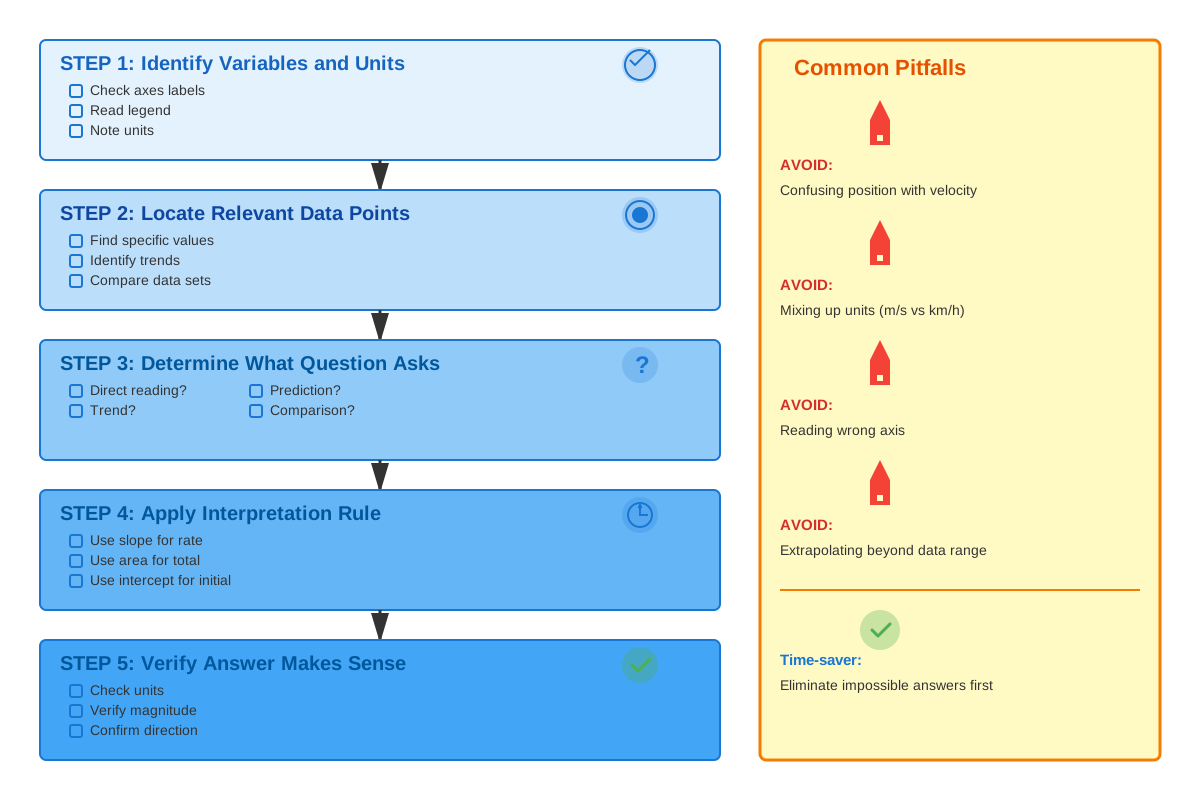
When approaching ACT motion data questions, follow this systematic process:
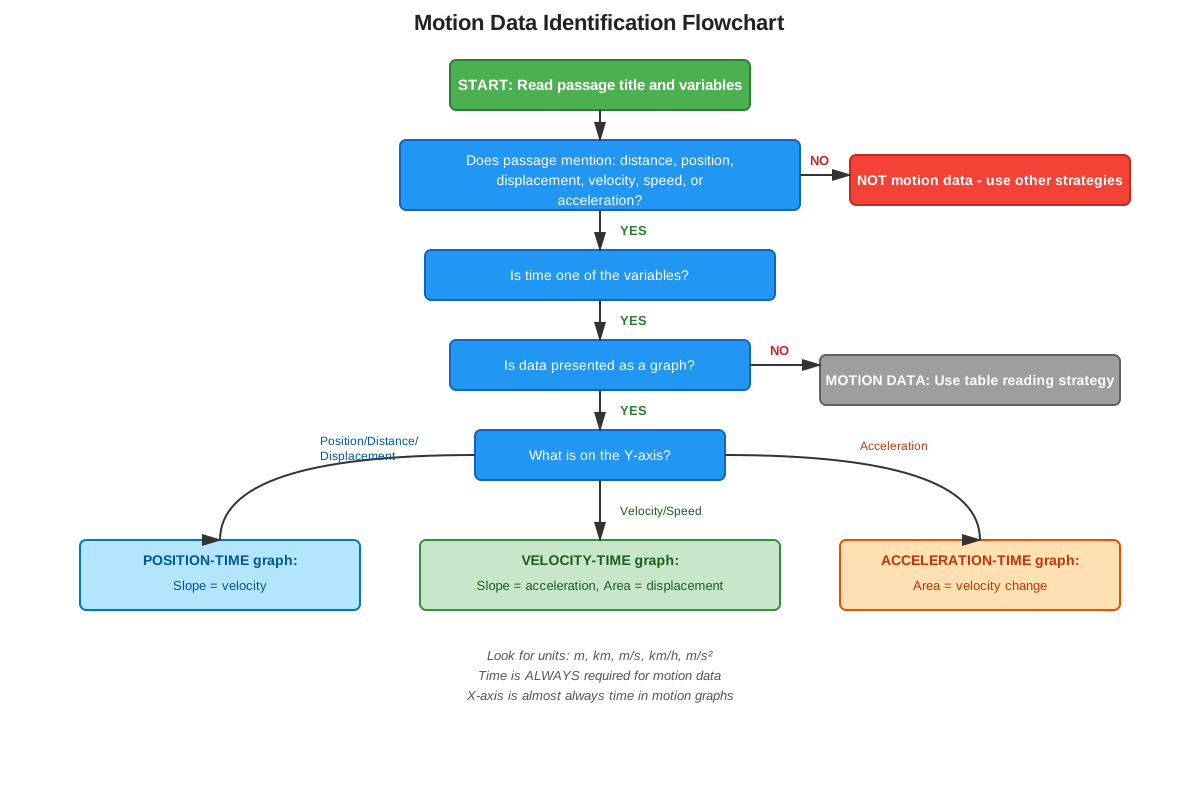
Step 1: Identify the representation type. Quickly determine whether the passage presents position-time graphs, velocity-time graphs, data tables, or combinations. This identification triggers the appropriate interpretation rules.
Step 2: Locate the legend and axes. Before reading any question, identify what each axis represents, what units are used, and what each line or data column represents. This prevents confusion when multiple objects or conditions are compared.
Step 3: Recognize trigger words:
- "Faster," "slower," "speed" → Compare slopes on position-time graphs or values on velocity-time graphs
- "Meet," "pass," "same position" → Find where lines intersect or table values equal
- "Stopped," "at rest," "stationary" → Look for horizontal lines on position-time graphs or zero values
- "Speeding up," "slowing down," "accelerating" → Examine whether slopes are increasing or decreasing
- "Direction change," "reverse" → Find where position values switch from increasing to decreasing or vice versa
Step 4: Use process of elimination effectively:
- Eliminate answers that confuse position with velocity (e.g., claiming the highest point on a position graph shows maximum velocity)
- Eliminate answers that require calculations—the correct answer is always determinable through visual inspection or simple comparison
- Eliminate answers that misinterpret negative values as "slower" rather than "opposite direction"
- Eliminate answers that claim two objects are at the same position when their lines don't intersect
Step 5: Time allocation. Motion data questions typically require 30-45 seconds each. Spend 15 seconds understanding the representation, then 15-30 seconds answering each question. If a question requires more than 45 seconds, mark it and return after completing easier questions.
Exam Tip: The ACT frequently includes one "distractor" line on motion graphs that represents a different variable or condition. Always verify which line the question asks about before selecting an answer.
Memory Techniques
SLOPE mnemonic for position-time graphs:
- Steep = Speedy (steeper slope = faster velocity)
- Level = Lazy (horizontal line = not moving)
- Opposite = Opposite direction (downward slope = moving toward origin)
- Parabola = Picking up speed (curved line = acceleration)
- Equal = Even velocity (straight line = constant velocity)
VIP acronym for remembering the motion variable hierarchy:
- Velocity is the slope of position
- Intersections show same position
- Patterns reveal acceleration
Visualization strategy: When examining a position-time graph, imagine walking along the path shown. Steep uphill sections represent fast motion away from start. Flat sections represent standing still. Downhill sections represent returning toward the starting point. This mental model makes abstract graphs concrete.
The "Meeting Point Rule": Two objects are at the same place when their lines cross on a position-time graph, NOT when their lines are parallel or when they have the same slope. Visualize two people walking—they meet when they're at the same location, regardless of whether they're walking at the same speed.
Table Pattern Recognition: When examining motion tables, use your finger to track down the position column. If your finger moves steadily in one direction, velocity is constant. If your finger accelerates (moves faster and faster), the object is accelerating. If your finger reverses direction, the object has turned around.
Summary
Motion data interpretation is a cornerstone skill for ACT Science success, appearing in multiple passages on every test. The fundamental principle is that position-time graphs encode velocity information in their slopes—steeper lines indicate faster motion, horizontal lines indicate no motion, and curved lines indicate acceleration. Students must distinguish between position (where an object is), velocity (how fast and which direction it's moving), and acceleration (how velocity changes). The ACT tests these concepts through graphs showing position versus time, tables listing measurements at intervals, and occasionally velocity-time representations. Success requires recognizing that line intersections indicate objects at the same position, that negative velocity indicates direction rather than slowness, and that the exam never requires actual calculations—only visual interpretation and comparison. Questions typically ask students to identify which object moves faster, when objects meet, whether motion is constant or accelerating, and when direction changes occur. Mastering motion data interpretation provides the foundation for understanding rate processes throughout the Science section and directly improves performance on 15-20% of all science questions.
Key Takeaways
- The slope of a position-time graph equals velocity; steeper slopes mean faster motion, and horizontal lines mean the object is stationary
- When two lines intersect on a position-time graph, the objects are at the same position at that moment—the most common basis for ACT questions
- Curved lines on position-time graphs indicate acceleration (changing velocity), while straight lines indicate constant velocity
- Negative velocity indicates motion in the opposite direction, not slower motion—direction and speed are separate concepts
- The ACT never requires calculating numerical values; all motion data questions are answerable through visual inspection and comparison
- Motion data appears in 15-20% of ACT Science passages, making it one of the highest-yield topics for focused study
- Tables showing position at regular intervals reveal velocity through the pattern of position changes—equal changes indicate constant velocity
Related Topics
Graphical Data Representation: Motion data is a specific application of the broader skill of interpreting scientific graphs. Mastering motion graphs builds confidence with all graph types, including those showing temperature changes, population growth, chemical concentrations, and energy relationships.
Experimental Design and Variables: Understanding which variable is independent (time) and which is dependent (position, velocity) in motion studies reinforces the general principle of identifying and controlling variables in all scientific experiments.
Mathematical Relationships in Science: The derivative relationship between position, velocity, and acceleration exemplifies how scientific quantities relate mathematically. This concept extends to other rate-based relationships like reaction rates in chemistry and population growth rates in biology.
Physics Concepts: While the ACT Science section doesn't require physics knowledge, students who continue to physics courses will find that motion data interpretation provides essential preparation for kinematics, dynamics, and energy concepts.
Practice CTA
Now that you've mastered the core concepts of motion data interpretation, it's time to apply these skills to authentic ACT-style questions. The practice questions and flashcards will reinforce your ability to quickly identify motion patterns, compare velocities, and predict trends—exactly as you'll need to do on test day. Remember, motion data appears on every ACT Science test, so every minute spent practicing this high-yield topic directly translates to points on your score. Approach each practice question systematically: identify the representation type, locate the relevant information, apply the core principles you've learned, and eliminate wrong answers confidently. You've built the foundation—now strengthen it through deliberate practice!
Sign up free to keep reading
Create a free AnvayaPrep account to finish this ACT guide on Motion data — plus flashcards and practice questions.