Overview
The scientific method represents the foundational framework that underlies all scientific inquiry and experimentation. On the ACT Science test, understanding this systematic approach to investigation is absolutely critical because it forms the backbone of how passages are structured, how data is collected and presented, and how conclusions are drawn. While the ACT Science section doesn't explicitly test memorization of scientific facts, it extensively evaluates a student's ability to think like a scientist—to analyze experimental designs, interpret data patterns, evaluate hypotheses, and draw logical conclusions based on evidence.
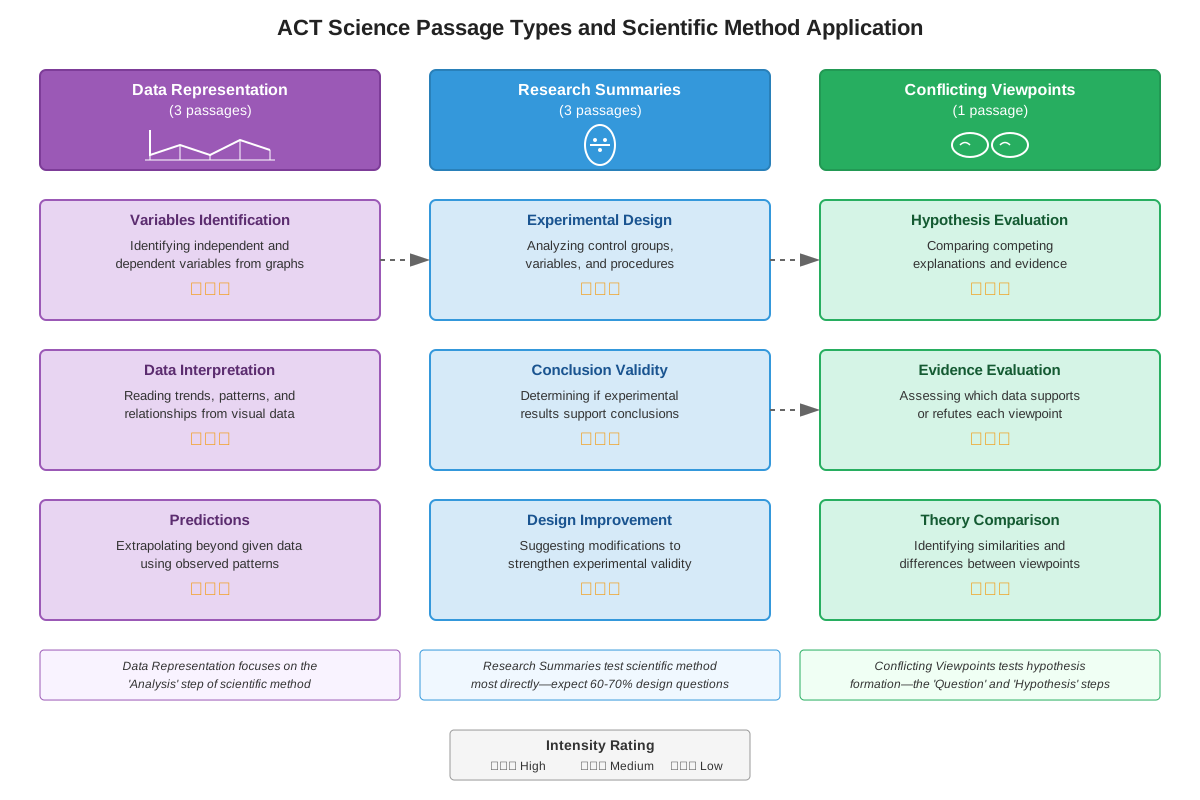
The ACT scientific method questions appear across all three passage types: Data Representation, Research Summaries, and Conflicting Viewpoints. Students who master the scientific method gain a significant advantage because they can quickly identify the purpose of experiments, recognize independent and dependent variables, understand control groups, evaluate the validity of conclusions, and spot flaws in experimental design. This topic typically accounts for 15-25% of questions on any given ACT Science test, making it one of the highest-yield areas for focused study.
Understanding the scientific method also creates a conceptual framework that connects to virtually every other topic in ACT Science. Whether analyzing graphs in Data Representation passages, comparing multiple experiments in Research Summaries, or evaluating competing theories in Conflicting Viewpoints, the principles of scientific inquiry remain constant. Students who internalize these principles can approach unfamiliar scientific content with confidence, knowing they possess the analytical tools to dissect any passage systematically.
Learning Objectives
- [ ] Identify when Scientific method is being tested in ACT passages and questions
- [ ] Explain the core rule or strategy behind Scientific method and its application to experimental design
- [ ] Apply Scientific method principles to ACT-style questions accurately and efficiently
- [ ] Distinguish between independent variables, dependent variables, and controlled variables in experimental scenarios
- [ ] Evaluate whether experimental conclusions are supported by the data presented
- [ ] Recognize the difference between correlation and causation in scientific studies
- [ ] Identify appropriate control groups and understand their purpose in experimental design
Prerequisites
- Basic reading comprehension: Essential for understanding passage content and extracting relevant information from scientific descriptions
- Graph and table interpretation: Necessary because scientific method questions often require analyzing data presented visually
- Logical reasoning skills: Required to evaluate cause-and-effect relationships and assess the validity of conclusions
- Understanding of variables: Fundamental for recognizing what changes and what stays constant in experiments
Why This Topic Matters
The scientific method represents humanity's most reliable tool for understanding the natural world. In real-world applications, this systematic approach guides everything from pharmaceutical drug development to climate change research, from engineering innovations to medical diagnostics. Scientists across all disciplines use these principles to ensure their findings are valid, reproducible, and meaningful. Understanding the scientific method empowers students to think critically about scientific claims they encounter in daily life, from news articles to product advertisements.
On the ACT Science test, scientific method questions appear with remarkable frequency—typically 6-10 questions per test out of 40 total questions. These questions span all passage types but are especially prevalent in Research Summaries passages, which describe one or more experiments. Common question formats include: identifying the purpose of an experiment, determining which variable was manipulated, recognizing appropriate control groups, evaluating whether a conclusion is supported by data, suggesting modifications to improve experimental design, and predicting outcomes if experimental conditions change.
The ACT frequently embeds scientific method concepts within passages about unfamiliar topics—from soil chemistry to astrophysics—specifically because the test aims to assess scientific reasoning rather than content knowledge. Students who understand experimental design can successfully answer questions even when the subject matter is completely new to them. This makes scientific method mastery one of the most efficient study investments for ACT preparation.
Core Concepts
The Scientific Method Framework
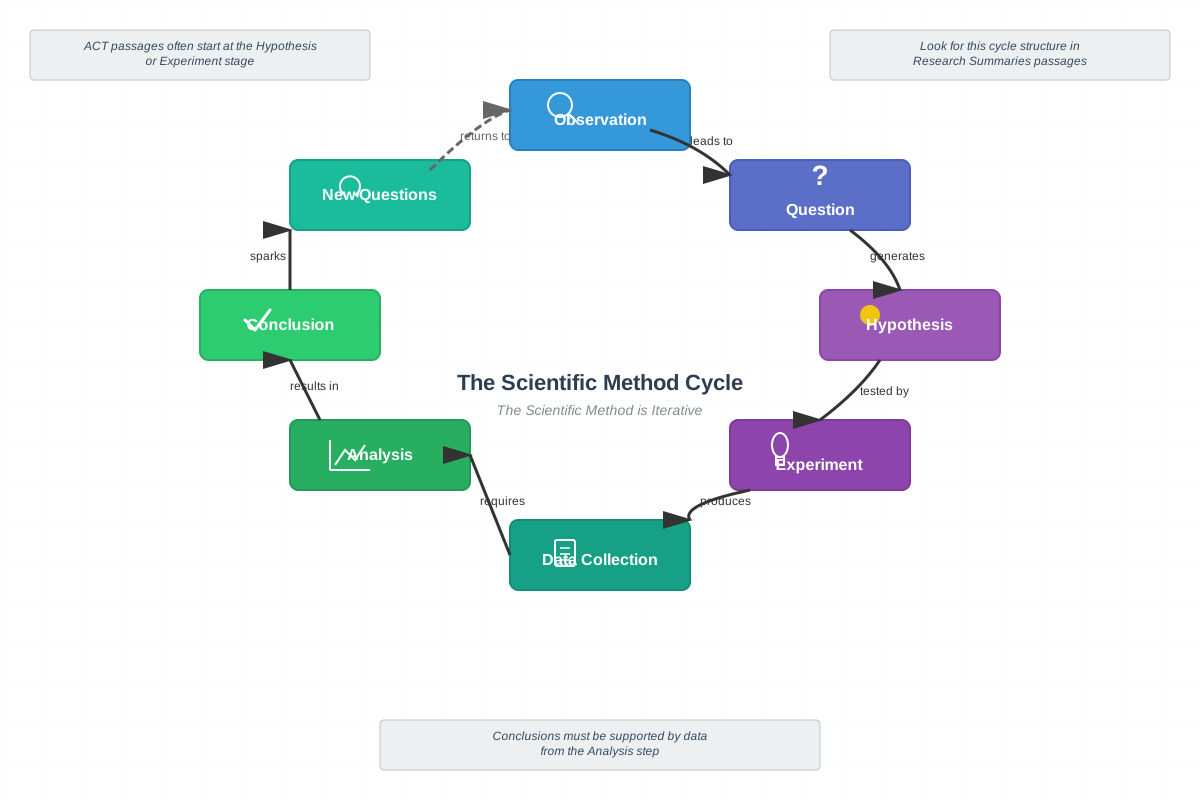
The scientific method is a systematic, iterative process for investigating phenomena, acquiring new knowledge, and correcting previous understanding. While often presented as a linear sequence, real scientific inquiry involves cycling through these steps multiple times. The core components include:
- Observation: Noticing a phenomenon or pattern in nature
- Question: Formulating a specific, testable question about the observation
- Hypothesis: Proposing a tentative explanation that can be tested
- Prediction: Stating what should happen if the hypothesis is correct
- Experimentation: Designing and conducting tests to evaluate the prediction
- Analysis: Examining data to determine patterns and relationships
- Conclusion: Determining whether results support or refute the hypothesis
- Communication: Sharing findings with the scientific community
On the ACT, questions rarely ask students to recite these steps. Instead, passages present experiments at various stages, and questions assess whether students can identify what stage is being described, what comes next logically, or whether proper scientific procedures were followed.
Variables in Experimental Design
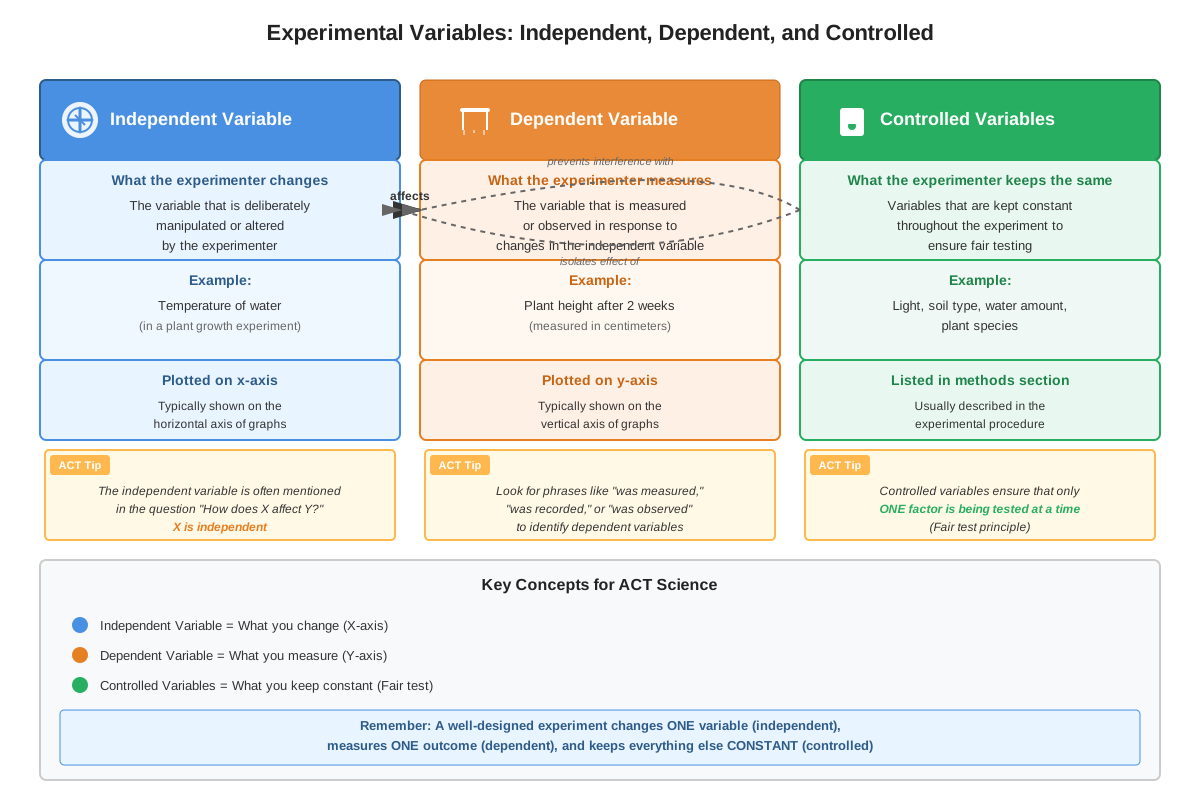
Understanding variables is absolutely essential for ACT Science success. Every well-designed experiment involves three types of variables:
Independent Variable (IV): The factor that the experimenter deliberately changes or manipulates. This is the "cause" in a cause-and-effect relationship. On the ACT, questions might ask "Which factor was varied?" or "What did the scientists change between trials?" For example, in an experiment testing how temperature affects plant growth, temperature is the independent variable.
Dependent Variable (DV): The factor that is measured or observed in response to changes in the independent variable. This is the "effect" being studied. ACT questions might ask "What was measured?" or "Which factor responded to changes in [the IV]?" In the plant growth example, the height of plants or their growth rate would be the dependent variable.
Controlled Variables (Constants): All other factors that are kept the same across all experimental groups to ensure that only the independent variable affects the dependent variable. These prevent confounding results. In the plant experiment, controlled variables would include soil type, water amount, light exposure, and plant species. ACT questions frequently test whether students recognize that proper experiments control all variables except the one being tested.
| Variable Type | Role | Example Question Phrasing |
|---|---|---|
| Independent | What is changed | "Which factor was varied between experiments?" |
| Dependent | What is measured | "What did the researchers measure?" |
| Controlled | What stays the same | "Which factors were held constant?" |
Hypotheses and Predictions
A hypothesis is a testable statement that proposes a relationship between variables. It must be falsifiable—meaning it's possible to design an experiment that could prove it wrong. On the ACT, students must distinguish between vague statements and proper hypotheses. For example, "Plants are interesting" is not a hypothesis, but "Increasing temperature will increase plant growth rate" is testable and falsifiable.
Predictions are specific statements about what experimental results should occur if the hypothesis is correct. The ACT often presents scenarios where students must predict outcomes based on established patterns. For instance, if data shows that enzyme activity increases with temperature from 20°C to 40°C, a prediction question might ask what would happen at 50°C.
Control Groups and Experimental Groups
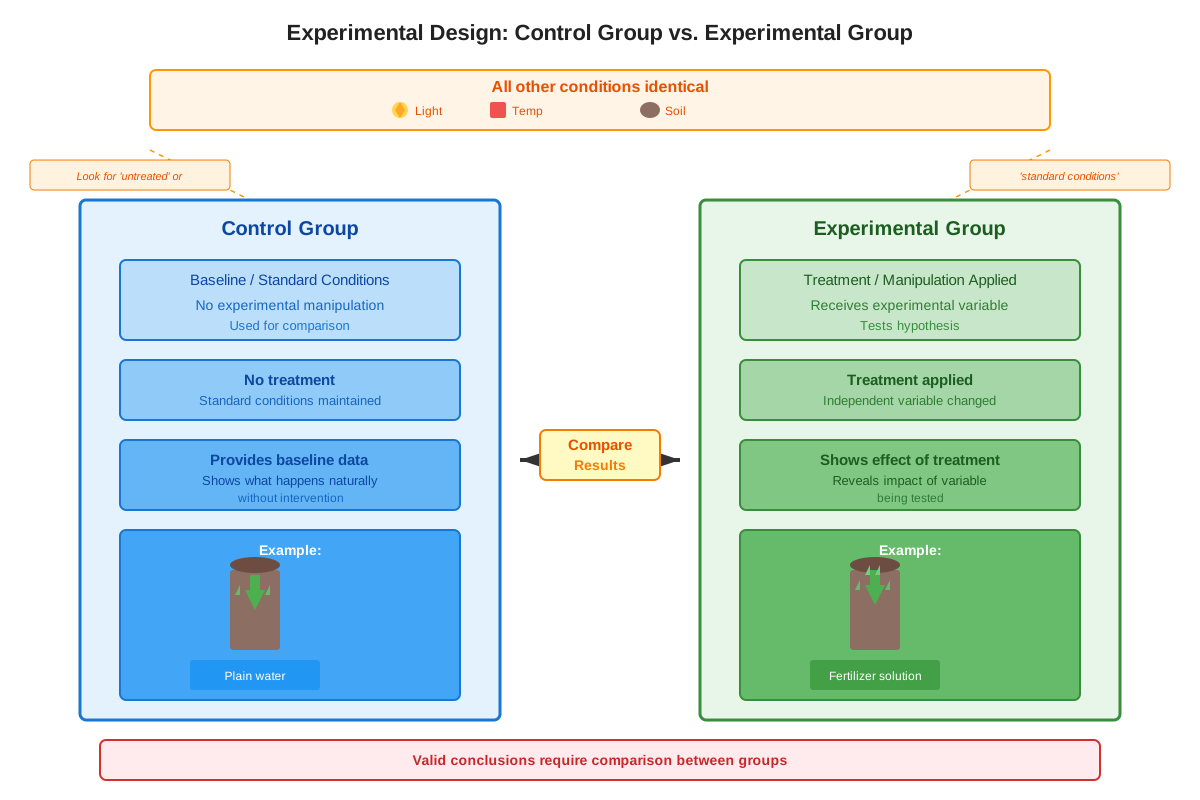
A control group serves as a baseline for comparison, receiving no treatment or a standard treatment. The experimental group receives the treatment being tested. This comparison allows scientists to determine whether the treatment actually causes an effect. On the ACT, questions might present an experimental design and ask students to identify which group is the control, or they might ask what control group should be added to improve an experiment.
For example, in a drug trial, the control group might receive a placebo while the experimental group receives the actual medication. Without this comparison, researchers couldn't determine whether improvements resulted from the drug or from other factors like the placebo effect or natural recovery.
Data Analysis and Interpretation
After conducting experiments, scientists analyze data to identify patterns, trends, and relationships. The ACT extensively tests this skill through questions about graphs, tables, and written descriptions of results. Key concepts include:
Trends: Consistent patterns in data, such as "as X increases, Y increases" (positive correlation) or "as X increases, Y decreases" (negative correlation). Students must recognize these patterns even when data points show some variation.
Outliers: Data points that don't fit the overall pattern. The ACT may ask students to identify outliers or consider how they affect conclusions.
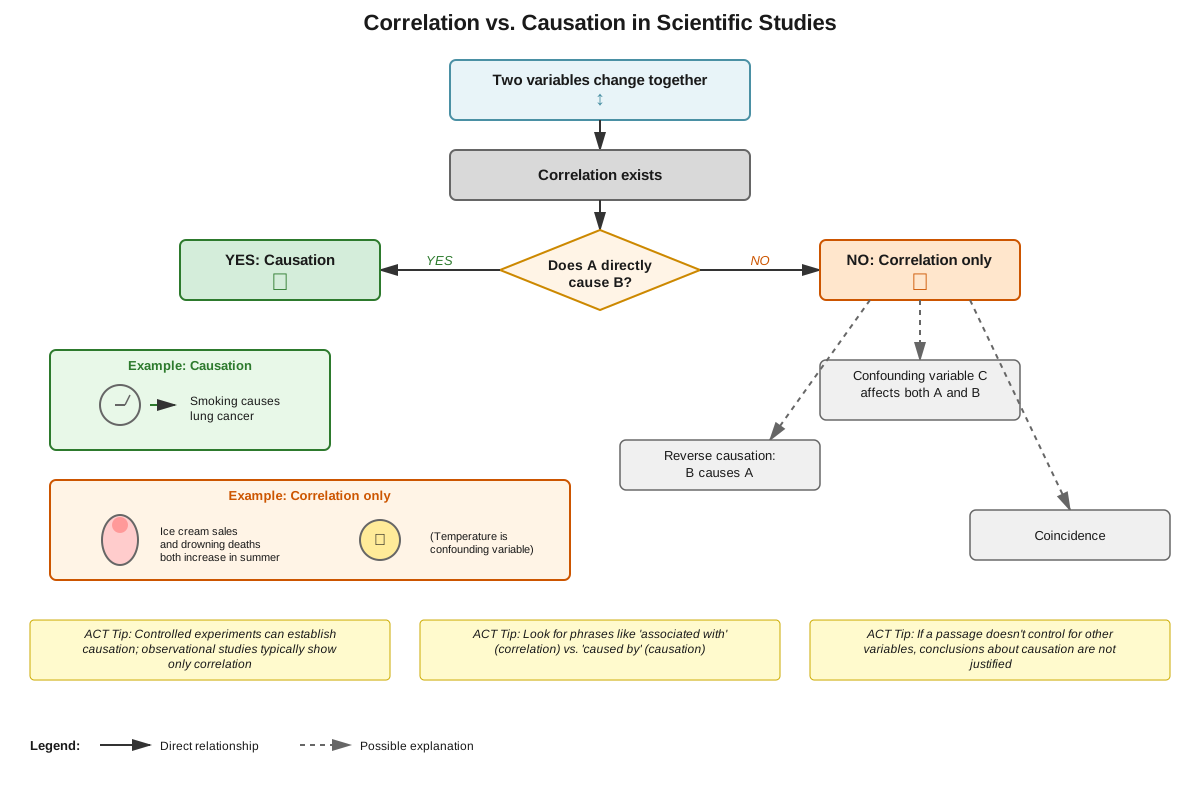
Correlation vs. Causation: Perhaps the most important distinction in scientific reasoning. Correlation means two variables change together, but causation means one variable directly causes changes in the other. The ACT frequently includes questions where students must recognize that correlation doesn't prove causation. For example, ice cream sales and drowning deaths both increase in summer, but ice cream doesn't cause drowning—both are caused by warm weather.
Drawing Valid Conclusions
A valid scientific conclusion must be directly supported by the experimental data and should not overreach beyond what the evidence shows. The ACT tests this by presenting conclusions and asking whether they're supported, or by asking students to select which conclusion is most appropriate.
Key principles for valid conclusions:
- They must address the original hypothesis
- They should acknowledge limitations of the study
- They should not generalize beyond the tested conditions
- They must be based on sufficient evidence
- They should distinguish between correlation and causation
Concept Relationships
The scientific method components form an interconnected cycle rather than a linear sequence. Observations lead to questions, which generate hypotheses that make predictions tested through experiments. The experimental design requires careful identification of variables (independent, dependent, and controlled) and establishment of control groups for valid comparison. Data collection during experiments feeds into analysis, which reveals patterns and trends that inform conclusions. These conclusions then generate new observations and questions, continuing the cycle.
The relationship between variables forms the foundation of experimental design: manipulating the independent variable → measuring changes in the dependent variable → while controlling all other variables → to establish cause-and-effect relationships. This chain of reasoning appears in virtually every Research Summaries passage on the ACT.
Understanding hypotheses connects directly to predictions and conclusions. A hypothesis proposes a relationship → predictions specify expected results → experiments test those predictions → conclusions evaluate whether results support the hypothesis. This logical flow helps students navigate complex passages by identifying where in the scientific process each paragraph or experiment falls.
The concept of controls bridges to data interpretation because valid conclusions require proper experimental design. Without appropriate controls → confounding variables may influence results → making it impossible to determine causation → leading to invalid conclusions. ACT questions exploit this relationship by presenting flawed experimental designs and asking students to identify problems or suggest improvements.
High-Yield Facts
⭐ The independent variable is what the experimenter changes; the dependent variable is what is measured in response.
⭐ A proper control group differs from experimental groups in only one way—the variable being tested.
⭐ Correlation between two variables does not prove that one causes the other.
⭐ A valid hypothesis must be testable and falsifiable through experimentation.
⭐ Controlled variables (constants) must remain the same across all experimental groups to ensure valid results.
- The scientific method is iterative—conclusions often lead to new questions and further experiments.
- Sample size affects reliability; larger samples generally produce more reliable results.
- Replication of experiments by independent researchers strengthens confidence in findings.
- A single experiment that contradicts a hypothesis is sufficient to disprove it, but many supporting experiments are needed to establish confidence.
- Conclusions should not extend beyond the conditions actually tested in the experiment.
- Random assignment to experimental groups helps eliminate bias in studies involving subjects.
- Blind and double-blind procedures reduce experimenter and subject bias in studies.
Quick check — test yourself on Scientific method so far.
Try Flashcards →Common Misconceptions
Misconception: The scientific method is a rigid, step-by-step procedure that must be followed in exact order.
Correction: The scientific method is a flexible framework. Scientists often cycle through steps multiple times, return to earlier stages when new information emerges, and may work on multiple steps simultaneously. The ACT presents realistic scientific scenarios where this flexibility is evident.
Misconception: The control group receives nothing, while experimental groups receive treatments.
Correction: Control groups often receive standard treatments or placebos rather than "nothing." The key is that control and experimental groups differ in only one variable—the factor being tested. For example, in a fertilizer study, the control group still receives water, soil, and light; it simply doesn't receive the fertilizer being tested.
Misconception: If two variables correlate, one must cause the other.
Correction: Correlation indicates variables change together but doesn't establish causation. Both variables might be caused by a third factor, the relationship might be coincidental, or causation might run in the opposite direction from what's assumed. The ACT frequently tests this distinction.
Misconception: A hypothesis that is disproven by experimental results represents a failed experiment.
Correction: Disproving a hypothesis is a valuable scientific outcome. It eliminates incorrect explanations and guides future research. The ACT may present scenarios where results contradict predictions, and students must recognize this as valid scientific progress rather than experimental failure.
Misconception: Larger numbers in data always indicate better or more significant results.
Correction: The meaning of numerical values depends entirely on context and what's being measured. A larger number might be worse (like error rate or pollution level), and statistical significance matters more than raw magnitude. ACT questions test whether students interpret data in context rather than making assumptions based on number size.
Misconception: Scientific conclusions are absolute and permanent.
Correction: Scientific conclusions are always tentative and subject to revision based on new evidence. The ACT may present passages where new data challenges previous conclusions, testing whether students understand that science is self-correcting.
Worked Examples
Example 1: Identifying Variables and Controls
Passage Summary: Scientists investigated whether different wavelengths of light affect the rate of photosynthesis in aquatic plants. They placed identical plants in separate tanks with the same water temperature, volume, and plant species. Each tank was illuminated with a different color of light (red, blue, green, or white) at the same intensity. After two weeks, they measured the oxygen production rate in each tank as an indicator of photosynthesis rate.
Question: In this experiment, what is the independent variable?
Step 1: Recall that the independent variable is what the experimenter deliberately changes or manipulates.
Step 2: Identify what varied between experimental groups. The passage states each tank received "a different color of light."
Step 3: Confirm that other factors were controlled. The passage explicitly states that water temperature, volume, plant species, and light intensity were the same across all tanks.
Answer: The independent variable is the wavelength (color) of light.
Question: What is the dependent variable?
Step 1: Recall that the dependent variable is what is measured in response to changes in the independent variable.
Step 2: Identify what the scientists measured. The passage states they "measured the oxygen production rate."
Answer: The dependent variable is the oxygen production rate (or rate of photosynthesis).
Question: Which of the following was NOT a controlled variable?
A) Water temperature
B) Light intensity
C) Light wavelength
D) Plant species
Step 1: Controlled variables remain constant across all experimental groups.
Step 2: Eliminate factors explicitly stated as being kept the same: water temperature (A), light intensity (B), and plant species (D).
Step 3: Recognize that light wavelength (C) is the independent variable—it was deliberately varied, not controlled.
Answer: C
Connection to Learning Objectives: This example demonstrates how to identify when scientific method is being tested (variable identification questions), explains the core strategy (distinguishing between what changes, what's measured, and what stays constant), and applies these concepts to ACT-style questions.
Example 2: Evaluating Conclusions
Passage Summary: Researchers studied the relationship between coffee consumption and heart disease. They surveyed 10,000 adults about their daily coffee intake and tracked heart disease incidence over 10 years. Results showed that people who drank 4+ cups of coffee daily had a 30% higher rate of heart disease than those who drank no coffee.
Question: Based on these results, which conclusion is most valid?
A) Drinking coffee causes heart disease.
B) People who drink more coffee have higher rates of heart disease.
C) Reducing coffee consumption will prevent heart disease.
D) Coffee is the primary risk factor for heart disease.
Step 1: Recognize this is an observational study, not a controlled experiment. The researchers didn't assign coffee consumption—they only observed existing patterns.
Step 2: Apply the correlation vs. causation principle. The study shows correlation but cannot establish causation because other factors weren't controlled.
Step 3: Evaluate each option:
- Option A claims causation without experimental evidence—too strong.
- Option B simply states the observed correlation—accurate and appropriately limited.
- Option C implies causation and makes a recommendation beyond the data—too strong.
- Option D makes an extreme claim ("primary risk factor") unsupported by the data.
Step 4: Select the conclusion that accurately reflects the data without overreaching.
Answer: B
Follow-up Question: What would strengthen the evidence for a causal relationship?
Analysis: To establish causation, researchers would need a controlled experiment where participants are randomly assigned to different coffee consumption levels, with other lifestyle factors (diet, exercise, stress, smoking) controlled. This would eliminate confounding variables that might explain the correlation. The ACT often asks students to suggest experimental improvements, testing understanding of what makes evidence stronger.
Connection to Learning Objectives: This example shows how to identify when scientific method principles (specifically, experimental design and valid conclusions) are being tested, explains the core strategy of distinguishing correlation from causation, and applies this reasoning to ACT-style questions about evaluating conclusions.
Exam Strategy
When approaching ACT Science questions about the scientific method, follow this systematic process:
Step 1: Identify the Question Type
Quickly determine whether the question asks about:
- Variables (independent, dependent, or controlled)
- Experimental design (controls, sample size, procedures)
- Conclusions (validity, support from data)
- Predictions (extending patterns to new conditions)
- Hypotheses (testability, relationship to results)
Step 2: Locate Relevant Information
For variable questions, scan for phrases like "varied," "changed," "manipulated," "measured," or "recorded." For conclusion questions, focus on results sections and data tables. For design questions, examine the methods or procedures description.
Trigger Words to Watch For:
- "Which factor was varied?" → Looking for independent variable
- "What was measured?" → Looking for dependent variable
- "Which remained constant?" → Looking for controlled variables
- "Based on the results..." → Conclusion must be supported by data shown
- "Which would improve the experiment?" → Identify design flaws
- "According to the hypothesis..." → Connect predictions to proposed explanations
Step 3: Apply Process of Elimination
For variable questions:
- Eliminate any factor that was measured (it's the dependent variable, not independent)
- Eliminate any factor explicitly stated as constant (it's controlled, not independent)
- The remaining factor that changed is the independent variable
For conclusion questions:
- Eliminate options that claim causation from correlational data
- Eliminate options that extend beyond tested conditions
- Eliminate options that contradict the data shown
- Select the option most directly supported by results
For design questions:
- Eliminate options that would introduce new variables
- Eliminate options that don't address the stated hypothesis
- Select options that improve controls or reduce confounding factors
Time Allocation:
Scientific method questions typically require 30-45 seconds each. They're often faster than data interpretation questions because they don't require complex graph analysis. If a question seems to require more than one minute, you may be overthinking it—return to the basic principles.
Common Traps:
- Confusing independent and dependent variables (remember: independent is changed, dependent is measured)
- Selecting conclusions that sound scientific but aren't supported by the specific data shown
- Assuming correlation proves causation
- Overlooking the importance of control groups
- Choosing overly complex answers when simple ones are correct
Memory Techniques
DRY MIX - For remembering graph axes and variables:
- Dependent
- Responding
- Y-axis
- Manipulated
- Independent
- X-axis
CONTROL - For remembering what makes a good control group:
- Comparable to experimental group
- Only one difference (the tested variable)
- No treatment or standard treatment
- Tested under same conditions
- Random assignment when possible
- Objective measurement
- Large enough sample size
Correlation ≠ Causation Visualization: Picture ice cream sales and shark attacks both increasing in summer. Ice cream doesn't cause shark attacks—both are caused by warm weather bringing people to beaches. This memorable example helps recall that correlation requires a mechanism and controlled testing to establish causation.
The Variable Triangle:
        Independent
           (What you change)
              ↓
        Dependent
           (What you measure)

    Controlled ← → Controlled
    (Everything else stays the same)
Hypothesis Testing Acronym - HOPE:
- Hypothesize a testable relationship
- Observe through experimentation
- Process and analyze data
- Evaluate whether results support hypothesis
Summary
The scientific method provides the systematic framework underlying all ACT Science passages and questions. Mastery requires understanding that experiments manipulate independent variables while measuring dependent variables, with all other factors controlled to establish valid cause-and-effect relationships. Control groups serve as essential baselines for comparison, differing from experimental groups in only the factor being tested. Students must distinguish between correlation (variables changing together) and causation (one variable directly causing changes in another), recognizing that observational studies show correlation while controlled experiments can establish causation. Valid conclusions must be directly supported by the data presented, without extending beyond tested conditions or claiming causation without experimental evidence. The ACT tests these concepts through questions about experimental design, variable identification, conclusion evaluation, and prediction of outcomes under modified conditions. Success requires quickly identifying question types, locating relevant passage information, and applying core scientific reasoning principles rather than memorizing content knowledge. Understanding the scientific method creates a powerful framework for approaching unfamiliar scientific content with confidence, making it one of the highest-yield topics for ACT Science preparation.
Key Takeaways
- The independent variable is what experimenters change; the dependent variable is what they measure in response; controlled variables remain constant
- Proper control groups differ from experimental groups in only one factor—the variable being tested
- Correlation between variables does not establish causation; controlled experiments are required to demonstrate cause-and-effect relationships
- Valid conclusions must be directly supported by the data shown and should not extend beyond the conditions actually tested
- Hypotheses must be testable and falsifiable; experiments that disprove hypotheses are valuable scientific outcomes
- Scientific method questions appear in 15-25% of ACT Science questions, making this topic essential for score improvement
- Recognizing trigger words like "varied," "measured," "constant," and "based on results" helps quickly identify what each question is testing
Related Topics
Data Representation and Graph Analysis: Understanding the scientific method enhances interpretation of graphs and tables because students recognize what variables are being displayed and how they relate. Mastering variable identification makes graph analysis more intuitive and efficient.
Experimental Design in Research Summaries: The scientific method directly applies to Research Summaries passages, which describe one or more experiments. Students who understand experimental design can quickly identify the purpose, variables, and conclusions of complex multi-experiment passages.
Conflicting Viewpoints Analysis: The scientific method helps evaluate competing scientific theories by assessing which explanations are testable, which are supported by evidence, and how new data might distinguish between alternatives.
Statistical Reasoning: Building on scientific method concepts, statistical reasoning involves understanding sample size, variability, significance, and confidence—all of which relate to drawing valid conclusions from experimental data.
Practice CTA
Now that you've mastered the scientific method concepts, it's time to apply this knowledge to ACT-style practice questions. The principles you've learned—identifying variables, evaluating experimental designs, distinguishing correlation from causation, and assessing conclusion validity—will become automatic with practice. Work through the practice questions methodically, referring back to the strategies in this guide when needed. Remember that scientific method questions are among the most predictable on the ACT Science test; consistent practice with these question types yields reliable score improvements. Challenge yourself with the flashcards to reinforce key concepts and trigger words. Your investment in mastering this high-yield topic will pay dividends across all ACT Science passage types!
Sign up free to keep reading
Create a free AnvayaPrep account to finish this ACT guide on Scientific method — plus flashcards and practice questions.