Overview
Temperature data is a fundamental component of the ACT Science test, appearing frequently across multiple passage types including Data Representation, Research Summaries, and Conflicting Viewpoints. Understanding how to interpret, analyze, and draw conclusions from temperature measurements is essential for success on the exam. Temperature data typically appears in graphs, tables, and experimental descriptions where students must identify trends, compare values, make predictions, or understand relationships between temperature and other variables.
The ACT Science section tests scientific reasoning skills rather than memorized content knowledge, making ACT temperature data questions particularly important because they assess a student's ability to read scientific information accurately and apply logical thinking. Temperature data questions often integrate with other scientific concepts such as phase changes, reaction rates, atmospheric conditions, and biological processes. These questions require students to move beyond simple data reading to demonstrate understanding of how temperature influences various phenomena and how to extract meaningful conclusions from temperature-related information.
Mastering temperature data interpretation connects directly to broader scientific reasoning skills tested throughout the ACT Science section. Temperature serves as an independent or dependent variable in countless experiments, making it one of the most common data types students will encounter. Success with temperature data questions builds confidence and efficiency, allowing students to allocate more time to challenging passages while securing points on these high-frequency question types.
Learning Objectives
- [ ] Identify when Temperature data is being tested in ACT Science passages
- [ ] Explain the core rule or strategy behind Temperature data interpretation
- [ ] Apply Temperature data analysis to ACT-style questions accurately
- [ ] Extract specific temperature values from graphs, tables, and charts within 10 seconds
- [ ] Recognize direct and inverse relationships between temperature and other variables
- [ ] Predict temperature trends based on established patterns in data sets
- [ ] Compare temperature data across multiple experiments or conditions
Prerequisites
- Basic graph reading skills: Understanding x-axis and y-axis labels, scales, and data points is essential for extracting temperature information from visual representations
- Unit awareness: Familiarity with Celsius (°C), Fahrenheit (°F), and Kelvin (K) temperature scales helps avoid confusion when interpreting data
- Table interpretation: Ability to locate specific values in rows and columns enables quick data extraction from tabular temperature presentations
- Trend recognition: Understanding concepts like "increasing," "decreasing," "constant," and "fluctuating" allows accurate description of temperature patterns
Why This Topic Matters
Temperature data appears in approximately 15-20% of all ACT Science questions, making it one of the most frequently tested data types on the exam. Students who master temperature data interpretation gain a significant strategic advantage because these questions often serve as "quick points" that can be answered rapidly and accurately, freeing up time for more complex reasoning questions.
In real-world applications, temperature data is fundamental to virtually every scientific discipline. Meteorologists track temperature patterns to predict weather, chemists monitor reaction temperatures to control synthesis processes, biologists measure body temperatures to assess organism health, and environmental scientists analyze global temperature trends to understand climate change. The skills developed through ACT temperature data questions—extracting information, identifying patterns, and drawing evidence-based conclusions—transfer directly to college-level science courses and professional scientific work.
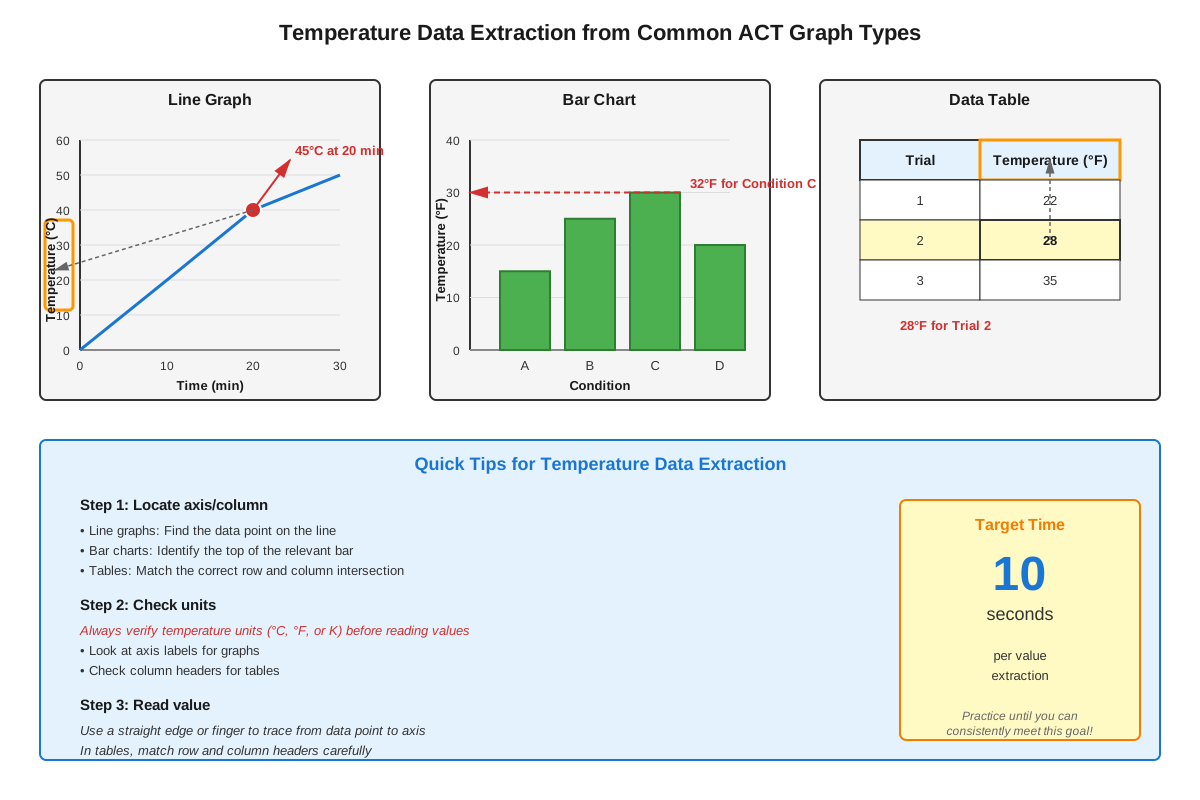
On the ACT, temperature data commonly appears in several formats: line graphs showing temperature changes over time, bar graphs comparing temperatures across different conditions, tables presenting temperature alongside other variables, and experimental descriptions where temperature serves as a controlled or manipulated variable. Questions may ask students to identify specific temperature values, describe trends, compare temperatures between groups, predict future values, or explain relationships between temperature and dependent variables. Understanding these common presentation formats and question types enables students to approach temperature data questions with confidence and efficiency.
Core Concepts
Reading Temperature from Graphs
Temperature graphs on the ACT typically display temperature on either the x-axis (independent variable) or y-axis (dependent variable). When temperature appears on the y-axis, students must locate the appropriate x-value, trace vertically to the data point or line, then trace horizontally to read the temperature value. Precision matters—students should note whether the scale uses intervals of 1, 5, 10, or other increments and estimate values between marked intervals when necessary.
Line graphs showing temperature over time are particularly common. These graphs may display single or multiple lines representing different experimental conditions, locations, or subjects. Students must distinguish between lines using legends, colors, or line styles (solid, dashed, dotted). When comparing temperatures between lines, focus on vertical distances at specific time points rather than attempting to compare entire curves simultaneously.
Extracting Temperature from Tables
Tabular temperature data requires systematic scanning to locate the correct row and column intersection. ACT tables often present multiple variables simultaneously, with temperature as one column among several. Students should first identify the temperature column by reading headers carefully, noting units (°C, °F, K). Then locate the appropriate row based on the question's specified condition, time point, or trial number.
Tables may present temperature data in ascending or descending order, or in no particular order. When questions ask about temperature ranges, maximum values, or minimum values, scanning the entire temperature column systematically prevents errors. Some tables include calculated values or averages—students must distinguish between raw temperature measurements and derived statistics.
Temperature Trends and Patterns
Identifying temperature trends involves recognizing whether temperature increases, decreases, remains constant, or fluctuates across the range of data presented. The ACT frequently tests whether students can accurately describe these patterns using appropriate scientific language. An increasing trend shows temperature rising as the independent variable increases; a decreasing trend shows temperature falling; a constant trend shows no change; and a fluctuating pattern shows irregular ups and downs.
Rate of change in temperature is another critical concept. Some temperature increases occur rapidly (steep slopes on graphs), while others occur gradually (gentle slopes). Questions may ask students to identify where temperature changes most rapidly or most slowly, requiring comparison of slopes across different regions of a graph or different time periods in a table.
Temperature Relationships
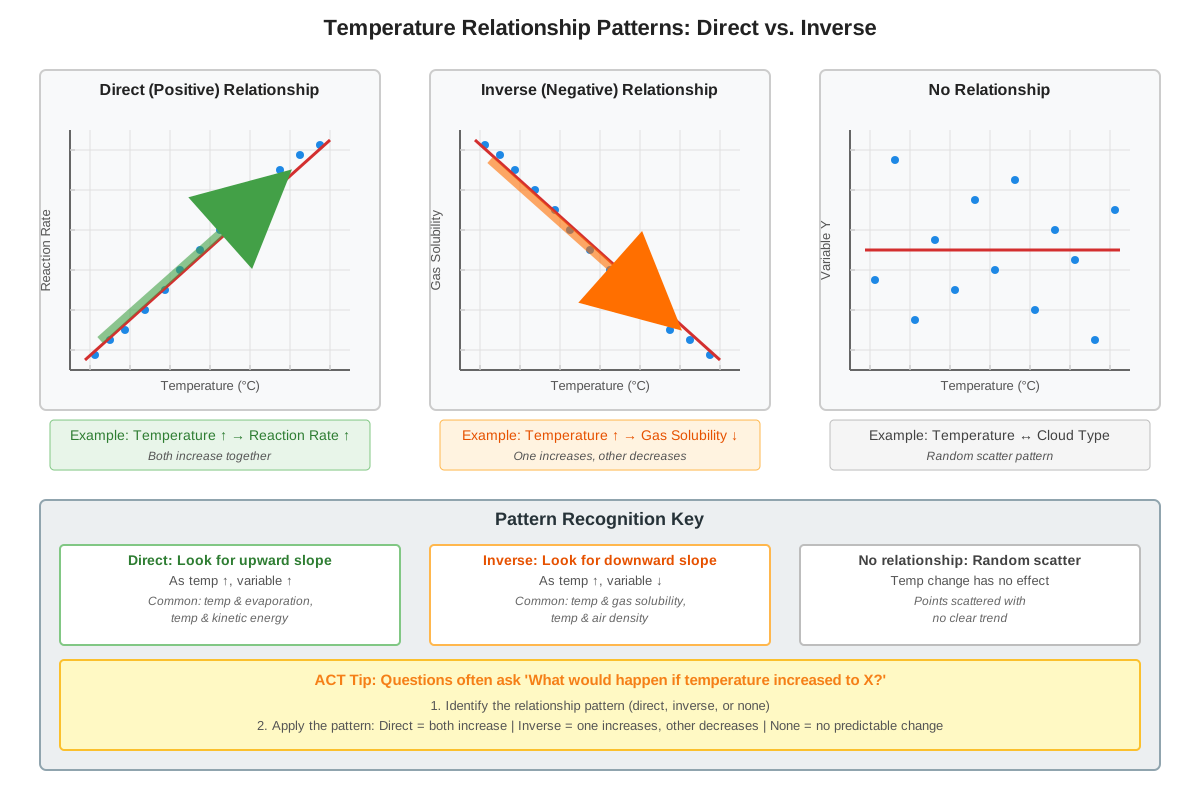
Temperature often exhibits direct relationships (positive correlations) or inverse relationships (negative correlations) with other variables. In a direct relationship, as temperature increases, the other variable also increases—for example, reaction rate typically increases with temperature. In an inverse relationship, as temperature increases, the other variable decreases—for example, gas solubility in water typically decreases as temperature rises.
Understanding these relationships enables prediction. If a graph shows that enzyme activity increases from 20°C to 40°C, students should be able to predict that activity at 30°C will fall between the values at 20°C and 40°C, assuming a consistent trend. The ACT frequently tests this extrapolation and interpolation skill with temperature data.
Temperature Comparisons
Comparative temperature analysis requires students to determine which condition, trial, or time point has the highest, lowest, or intermediate temperature. These questions may involve comparing temperatures across different experiments, between control and experimental groups, or among multiple locations or subjects. Students must carefully track which data series corresponds to which condition to avoid mixing up comparisons.
Some questions require calculating temperature differences or ranges. While the ACT Science section doesn't emphasize complex calculations, students should be comfortable with simple subtraction to find temperature changes (final temperature minus initial temperature) or temperature ranges (maximum minus minimum).
Temperature Units and Conversions
While the ACT rarely requires temperature unit conversions, students must recognize the three common temperature scales: Celsius (°C), Fahrenheit (°F), and Kelvin (K). Most scientific data uses Celsius or Kelvin. Students should know that 0°C equals 273 K (approximately) and that Kelvin cannot have negative values. Recognizing unrealistic temperature values (like -300°C or 500 K for room temperature) helps identify errors in data reading.
Concept Relationships
Temperature data interpretation skills build upon fundamental graph and table reading abilities, which serve as the foundation for all data analysis on the ACT Science section. The ability to extract specific temperature values → enables identification of temperature trends → which allows recognition of relationships between temperature and other variables → ultimately supporting prediction and hypothesis evaluation.
Temperature data connects to virtually every other scientific concept tested on the ACT. In chemistry passages, temperature affects reaction rates, equilibrium positions, and phase changes. In biology passages, temperature influences enzyme activity, metabolic rates, and organism behavior. In Earth science passages, temperature relates to atmospheric pressure, weather patterns, and climate zones. In physics passages, temperature connects to thermal energy, gas laws, and material properties.
The relationship map for temperature data mastery follows this progression: Basic data extraction skills → Pattern recognition → Relationship identification → Prediction and application → Integration with domain-specific knowledge. Students who master the first three steps can answer most temperature data questions correctly, even without extensive content knowledge in the specific scientific domain.
High-Yield Facts
- ⭐ Temperature data appears in approximately 15-20% of ACT Science questions, making it one of the most frequently tested data types
- ⭐ When temperature appears on the y-axis, always trace from the x-value vertically to the line, then horizontally to read the temperature
- ⭐ Tables require systematic row-column intersection identification—locate the temperature column first, then find the appropriate row
- ⭐ Increasing temperature trends show upward slopes on graphs and ascending values in tables as you move through the data
- ⭐ Direct relationships mean both variables increase together; inverse relationships mean one increases while the other decreases
- Temperature questions often ask for specific values, trends, comparisons, or predictions based on established patterns
- Most scientific temperature data uses Celsius (°C) or Kelvin (K) rather than Fahrenheit (°F)
- Temperature ranges are calculated by subtracting the minimum temperature from the maximum temperature
- When comparing multiple temperature lines on a graph, use the legend to identify which line represents which condition
- Interpolation (estimating values between data points) is more reliable than extrapolation (estimating beyond the data range)
- Temperature changes over time typically appear as line graphs with time on the x-axis
- Bar graphs comparing temperatures across conditions allow quick visual identification of highest and lowest values
- Questions asking "at what temperature" require finding where a specific condition or value occurs
- Steep slopes indicate rapid temperature changes; gentle slopes indicate gradual temperature changes
- Temperature data questions are typically answerable within 20-30 seconds when approached systematically
Quick check — test yourself on Temperature data so far.
Try Flashcards →Common Misconceptions
Misconception: Temperature always appears on the y-axis of graphs → Correction: Temperature can appear on either axis depending on whether it's the independent variable (x-axis) or dependent variable (y-axis). Always check axis labels carefully before attempting to extract values.
Misconception: All temperature scales are interchangeable and can be compared directly → Correction: Celsius, Fahrenheit, and Kelvin use different scales and zero points. A temperature of 30°C is not the same as 30°F or 30 K. Always note the units and ensure you're comparing temperatures in the same scale.
Misconception: If temperature increases in one part of a graph, it must continue increasing throughout → Correction: Temperature trends can change direction. Many biological and chemical processes show optimal temperatures where values increase to a peak then decrease, creating an inverted U-shape rather than a continuous increase.
Misconception: The steepest line on a temperature graph always represents the highest temperature → Correction: Slope (steepness) indicates rate of change, not absolute value. A steep line starting at a low temperature may never reach the values of a gentle line starting at a high temperature. Always compare actual temperature values, not just slopes.
Misconception: Temperature data questions require extensive scientific knowledge about heat, thermodynamics, or specific processes → Correction: Most ACT temperature data questions test data interpretation skills, not content knowledge. Students can answer correctly by carefully reading graphs and tables without knowing the underlying scientific principles, though some context helps with prediction questions.
Worked Examples
Example 1: Temperature Trend Identification
Question: A scientist measured the temperature of a chemical reaction every 5 minutes for 30 minutes. The data is shown in the table below:
| Time (min) | Temperature (°C) |
|---|---|
| 0 | 22 |
| 5 | 28 |
| 10 | 35 |
| 15 | 43 |
| 20 | 45 |
| 25 | 46 |
| 30 | 46 |
Based on the data, which statement best describes the temperature trend?
A) Temperature increases at a constant rate throughout the experiment
B) Temperature increases rapidly at first, then levels off
C) Temperature decreases throughout the experiment
D) Temperature remains constant throughout the experiment
Solution Process:
Step 1: Calculate temperature changes between consecutive measurements
- 0 to 5 min: 28 - 22 = 6°C increase
- 5 to 10 min: 35 - 28 = 7°C increase
- 10 to 15 min: 43 - 35 = 8°C increase
- 15 to 20 min: 45 - 43 = 2°C increase
- 20 to 25 min: 46 - 45 = 1°C increase
- 25 to 30 min: 46 - 46 = 0°C change
Step 2: Analyze the pattern
Early in the experiment (0-15 min), temperature increases by 6-8°C every 5 minutes—this is rapid change. Later in the experiment (15-30 min), temperature increases by only 0-2°C every 5 minutes—this is leveling off.
Step 3: Eliminate incorrect answers
- A is incorrect because the rate is not constant (changes from 6-8°C per interval to 0-2°C per interval)
- C is incorrect because temperature increases, not decreases
- D is incorrect because temperature changes from 22°C to 46°C
Answer: B - Temperature increases rapidly at first, then levels off
This example demonstrates the learning objective of identifying temperature trends and applying systematic analysis to ACT-style questions.
Example 2: Temperature Comparison Across Conditions
Question: Three identical plants were grown under different temperature conditions for 4 weeks. The graph below shows the height of each plant measured weekly:
[Description: Line graph with "Time (weeks)" on x-axis (0-4) and "Plant Height (cm)" on y-axis (0-30). Three lines are shown:
- Solid line (20°C): starts at 5 cm, reaches 25 cm by week 4
- Dashed line (25°C): starts at 5 cm, reaches 28 cm by week 4
- Dotted line (30°C): starts at 5 cm, reaches 18 cm by week 4]
At which temperature did the plant grow tallest by the end of the experiment?
Solution Process:
Step 1: Identify what the question asks
We need to find which temperature condition resulted in the tallest plant at week 4 (the end of the experiment).
Step 2: Locate week 4 on the x-axis and read the y-values for each line
- Solid line (20°C): approximately 25 cm
- Dashed line (25°C): approximately 28 cm
- Dotted line (30°C): approximately 18 cm
Step 3: Compare the values
28 cm > 25 cm > 18 cm
Step 4: Match the highest value to its temperature
The dashed line represents 25°C and shows the highest final height.
Answer: 25°C
Key Strategy Applied: When comparing temperatures across conditions, always identify which line or data series corresponds to which temperature by checking the legend, then compare the relevant values at the specified point (in this case, week 4). Don't be distracted by intermediate values—focus on what the question specifically asks.
Exam Strategy
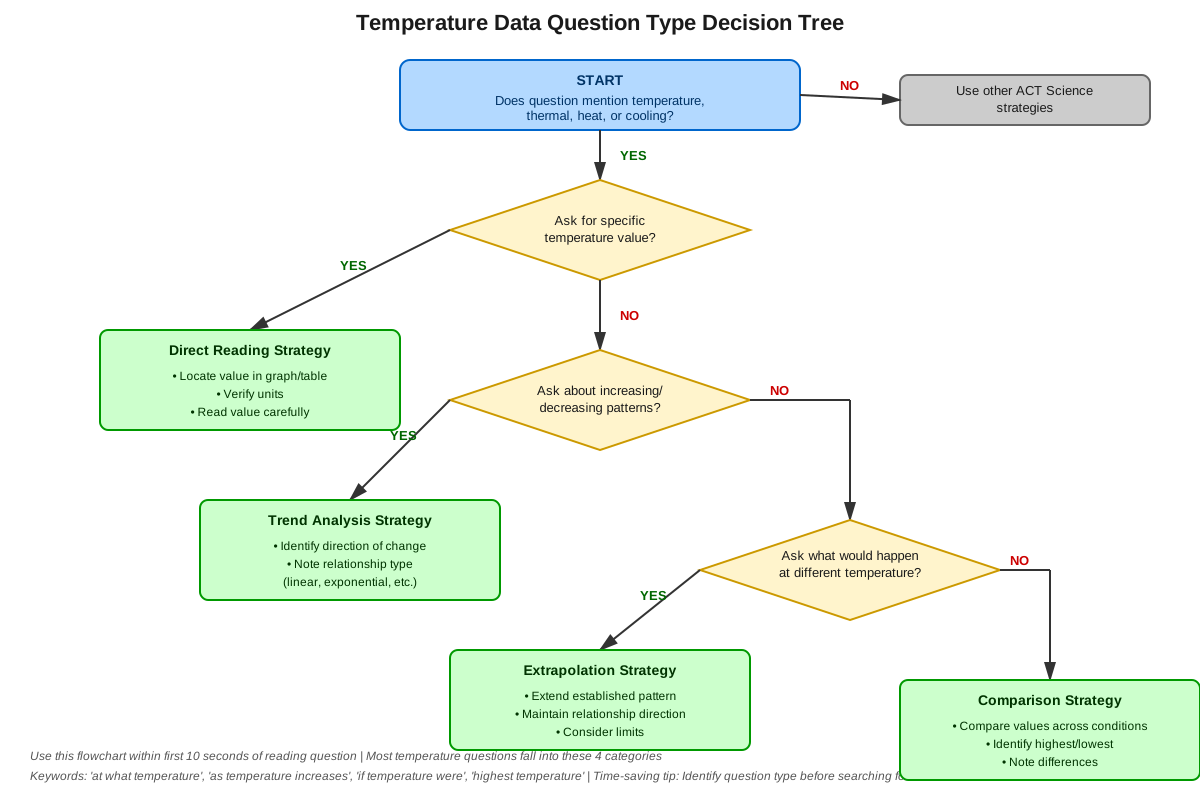
When approaching ACT temperature data questions, follow this systematic process: First, identify where temperature information appears (graph axis, table column, or text description). Second, determine what the question asks—specific value, trend, comparison, or prediction. Third, locate the relevant data point(s) or region. Fourth, extract or calculate the answer. Fifth, verify your answer makes logical sense given the context.
Trigger words that signal temperature data questions include: "at what temperature," "how does temperature change," "which temperature is highest/lowest," "as temperature increases," "temperature trend," "temperature range," and "compare temperatures." When you see these phrases, immediately locate the temperature data source and prepare to extract specific information.
Process of elimination works particularly well for temperature data questions. If a question asks about a temperature trend and one answer choice says "decreases" while the data clearly shows increasing values, eliminate that choice immediately. For comparison questions, eliminate any answer that contradicts the visual or numerical data. For prediction questions, eliminate answers that violate established trends (e.g., if temperature consistently increases with time, eliminate answers suggesting it will suddenly decrease).
Time allocation for temperature data questions should be approximately 20-30 seconds per question. These questions typically require straightforward data extraction rather than complex reasoning, making them ideal "quick points." If you find yourself spending more than 45 seconds on a temperature data question, mark it and return later—you may be overcomplicating the analysis.
Exam Tip: Always check units before answering. A question asking for temperature in Celsius when the graph shows Kelvin requires awareness of the difference, even if conversion isn't necessary.
Memory Techniques
TRACE for reading temperature from graphs:
- Time or independent variable on x-axis
- Read the axis labels and units
- Align vertically from x-value to line
- Cross horizontally to y-axis
- Estimate between marked intervals if needed
DIRECT vs. INVERSE relationships:
- DIRECT = Dual Increase (both go up together) or dual decrease
- INVERSE = Increase/Decrease (one up, one down)
TABLE for extracting temperature from tables:
- Title tells you what data represents
- Axis labels (column headers) identify variables
- Both row and column must match your target
- Locate the intersection carefully
- Ensure units match what the question asks
Visualize temperature data as a story: The beginning (initial temperature), the journey (how it changes), and the ending (final temperature). This narrative approach helps remember trends and makes predictions more intuitive.
For remembering common temperature relationships, use real-world connections: Ice cream melts faster at higher temperatures (direct relationship between temperature and melting rate), but soda goes flat faster when warm (direct relationship between temperature and gas escape rate, inverse relationship between temperature and dissolved gas).
Summary
Temperature data interpretation is a high-yield, frequently tested skill on the ACT Science section that requires systematic data extraction from graphs and tables rather than extensive content knowledge. Success depends on accurately locating temperature information, identifying trends (increasing, decreasing, constant, or fluctuating), recognizing relationships between temperature and other variables (direct or inverse), and making evidence-based comparisons and predictions. Students must distinguish between temperature as an independent variable (x-axis, manipulated by researchers) and dependent variable (y-axis, measured as an outcome), read values precisely by tracing from one axis to the data point to the other axis, and systematically scan tables by identifying the temperature column then locating the appropriate row. Most temperature data questions can be answered within 20-30 seconds using straightforward data reading skills, making them strategic "quick points" that build confidence and free up time for more complex reasoning questions. Mastery requires practice with multiple data presentation formats and question types, attention to units and scales, and systematic application of the TRACE method for graphs and TABLE method for tabular data.
Key Takeaways
- Temperature data appears in 15-20% of ACT Science questions, making it one of the most frequently tested and high-yield topics
- Systematic data extraction using TRACE (graphs) and TABLE (tables) methods ensures accuracy and speed
- Temperature trends (increasing, decreasing, constant, fluctuating) and relationships (direct, inverse) are more commonly tested than specific values
- Always verify axis labels, units, and legends before extracting temperature data to avoid misreading
- Temperature data questions are typically "quick points" answerable in 20-30 seconds with proper technique
- Comparison questions require careful tracking of which data series corresponds to which condition or temperature
- Prediction questions rely on extending established trends rather than introducing new patterns
Related Topics
Data Representation Passages: Temperature data frequently appears in Data Representation passages where students must interpret graphs and tables without experimental context. Mastering temperature data builds skills for handling all types of quantitative data in these passages.
Research Summary Passages: Understanding temperature as a controlled or manipulated variable in experiments helps students analyze Research Summary passages where temperature affects outcomes. This connects temperature data interpretation to experimental design principles.
Graphical Analysis: Temperature graphs exemplify broader graphing skills including axis interpretation, trend identification, and relationship recognition. These skills transfer to analyzing graphs of pressure, concentration, population, and other variables.
Scientific Variables: Temperature serves as an excellent example of both independent and dependent variables depending on experimental design. Understanding temperature data deepens comprehension of variable relationships tested throughout the ACT Science section.
Practice CTA
Now that you've mastered the core concepts of temperature data interpretation, it's time to apply these skills to ACT-style practice questions. Work through the practice problems systematically, using the TRACE and TABLE methods you've learned. Review the flashcards to reinforce high-yield facts and common question patterns. Remember, temperature data questions are strategic opportunities to build confidence and score quick points—with focused practice, you'll approach these questions with speed and accuracy on test day. Your investment in mastering this high-frequency topic will pay dividends across multiple passages on the ACT Science section!
Sign up free to keep reading
Create a free AnvayaPrep account to finish this ACT guide on Temperature data — plus flashcards and practice questions.