Overview
Understanding variables is fundamental to success on the ACT Science test, particularly within the Research Summaries passage type. Variables form the backbone of experimental design and data interpretation, appearing in approximately 40% of all ACT Science questions. When scientists conduct experiments, they manipulate certain factors while measuring others, and the ACT expects students to identify, distinguish, and analyze these relationships quickly and accurately. Mastery of ACT variables enables students to decode complex experimental setups, interpret graphs and tables correctly, and predict outcomes based on changing conditions.
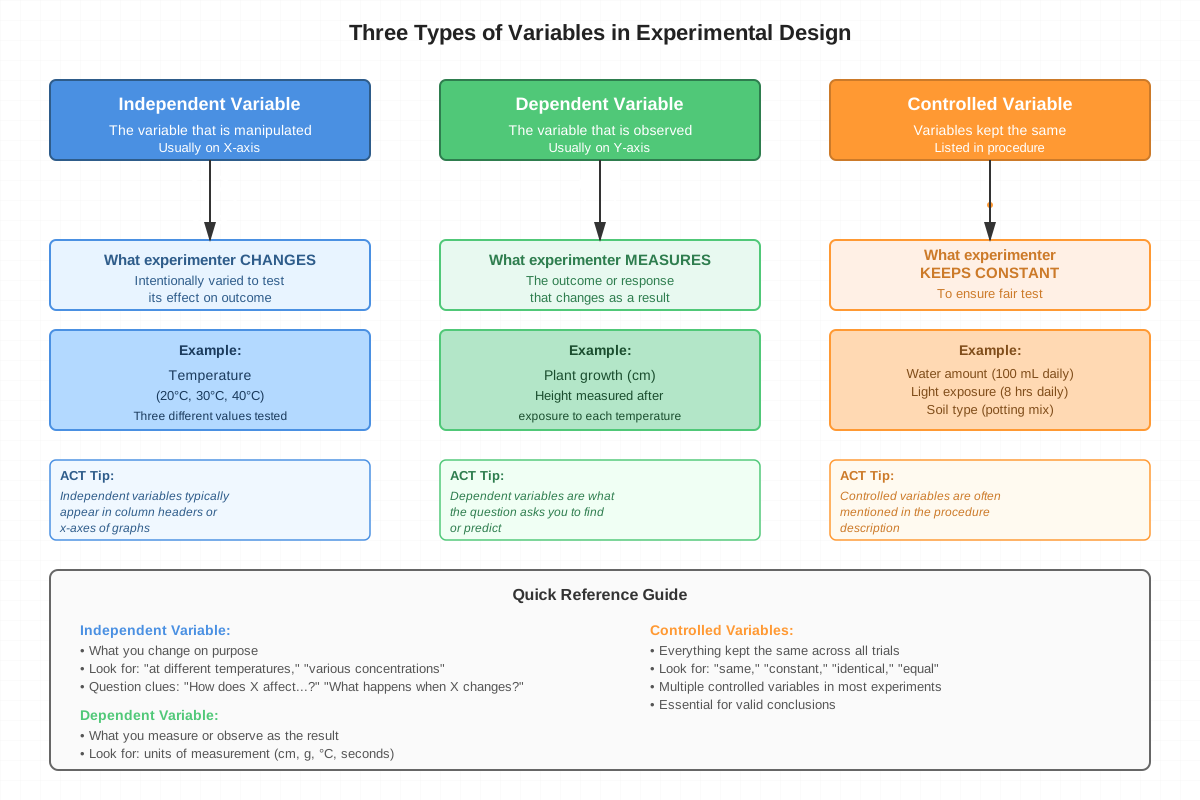
The concept of variables extends beyond simple identification—it requires understanding how different types of variables interact within experimental contexts. Students must recognize independent variables (what experimenters change), dependent variables (what experimenters measure), and controlled variables (what experimenters keep constant). This knowledge directly impacts performance on Research Summaries passages, which typically present 2-3 experiments with multiple variables at play. The ability to track these variables through tables, graphs, and written descriptions separates high-scoring students from those who struggle with the Science section.
Variables connect to virtually every other concept in ACT Science, from experimental design and data analysis to hypothesis formation and conclusion drawing. Understanding variables provides the framework for interpreting scientific method questions, comparing experimental trials, and evaluating the validity of conclusions. This topic serves as a gateway skill—once mastered, students can approach even the most complex multi-experiment passages with confidence and systematic analysis.
Learning Objectives
- [ ] Identify when Variables is being tested in ACT Science passages
- [ ] Explain the core rule or strategy behind Variables in experimental contexts
- [ ] Apply Variables concepts to ACT-style questions accurately
- [ ] Distinguish between independent, dependent, and controlled variables in complex experimental designs
- [ ] Predict how changes in independent variables affect dependent variables based on experimental data
- [ ] Evaluate whether an experiment properly controls variables to test a specific hypothesis
- [ ] Analyze multi-variable experiments to determine which factors influence observed outcomes
Prerequisites
- Basic scientific method understanding: Recognizing the structure of experiments (hypothesis, procedure, results, conclusion) helps contextualize where variables fit within research design
- Graph and table interpretation: Variables are typically presented visually, so reading axes labels, data points, and column headers is essential for variable identification
- Cause-and-effect reasoning: Understanding that changing one factor can produce changes in another underlies the entire concept of variable relationships
- Unit awareness: Recognizing measurement units (meters, seconds, grams, degrees) helps identify what is being measured and manipulated
Why This Topic Matters
Variables represent the language of scientific experimentation, and the ACT Science test is fundamentally about reading and interpreting scientific experiments. In real-world applications, scientists use variables to isolate cause-and-effect relationships, test hypotheses, and build reliable knowledge about natural phenomena. Medical researchers manipulate drug dosages (independent variable) to measure patient outcomes (dependent variable), while controlling for age, weight, and other factors. Environmental scientists track how temperature changes affect ecosystem health, carefully distinguishing between factors they control and those they observe.
On the ACT Science test, variables appear in approximately 15-18 questions per exam, making this one of the highest-yield topics for score improvement. Research Summaries passages—which constitute 3 of the 6 passages on each test—are specifically designed to assess variable comprehension. Questions typically ask students to identify which variable was manipulated, determine what was measured, recognize what was held constant, or predict outcomes if a variable changed. The test also includes "experimental design" questions that require students to propose modifications to experiments by changing specific variables.
Common question formats include: "According to the results of Experiment 2, as [Variable X] increased, [Variable Y]..."; "Which of the following variables was directly controlled by the researchers?"; "If the scientists wanted to test the effect of temperature, they should change..."; and "Based on the data, which factor most likely caused the change in...?" Understanding variables transforms these questions from confusing puzzles into straightforward reading comprehension tasks.
Core Concepts
Types of Variables
Variables are any factors in an experiment that can change or be changed. The ACT Science test focuses on three primary categories that students must distinguish rapidly and accurately.
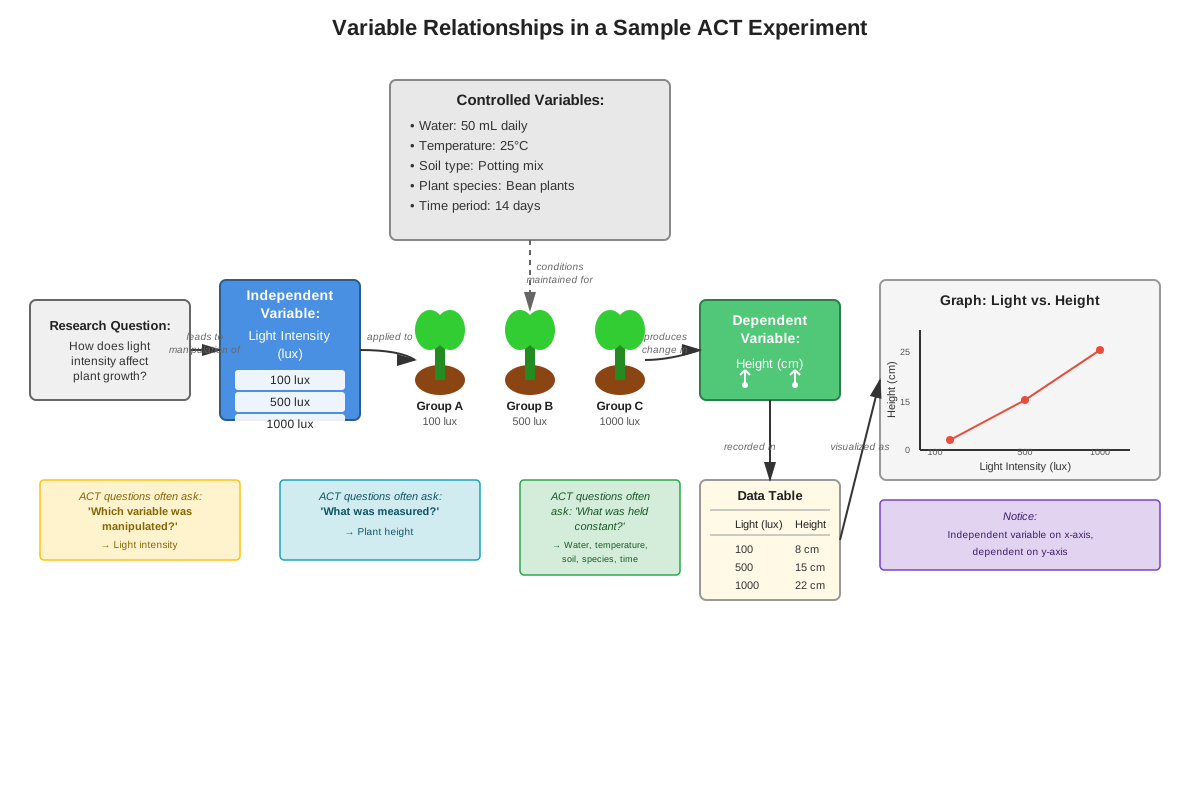
Independent variables (also called manipulated variables) are factors that experimenters deliberately change or control. These represent the "cause" in a cause-and-effect relationship. In a typical ACT passage, researchers might vary temperature, concentration, time, distance, or any measurable factor to observe its effects. The independent variable appears on the x-axis of graphs and typically in the leftmost column of data tables. For example, if scientists test how fertilizer amount affects plant growth, the fertilizer amount is the independent variable because researchers choose and control these values.
Dependent variables (also called responding variables) are factors that experimenters measure or observe. These represent the "effect" in cause-and-effect relationships. The dependent variable changes in response to manipulations of the independent variable. On graphs, dependent variables appear on the y-axis; in tables, they occupy columns to the right of the independent variable. Using the fertilizer example, plant height would be the dependent variable because it responds to different fertilizer amounts and is what researchers measure.
Controlled variables (also called constants) are factors that experimenters intentionally keep the same across all trials or experimental groups. These are crucial for experimental validity—if multiple factors change simultaneously, researchers cannot determine which factor caused observed effects. In the fertilizer experiment, controlled variables might include plant species, pot size, water amount, sunlight exposure, and soil type. The ACT frequently tests whether students recognize that proper experiments require controlling all variables except the one being tested.
Variable Relationships and Patterns
Understanding how variables relate to each other is essential for interpreting ACT Science data. Variables can show several relationship patterns:
Direct relationships occur when both variables increase together or decrease together. As the independent variable increases, the dependent variable also increases. For example, as exercise duration increases, calories burned increase. On graphs, direct relationships appear as upward-sloping lines or curves.
Inverse relationships occur when variables move in opposite directions. As the independent variable increases, the dependent variable decreases, or vice versa. For example, as altitude increases, air pressure decreases. These appear as downward-sloping lines on graphs.
No relationship exists when changes in the independent variable produce no consistent pattern in the dependent variable. Data points appear scattered with no clear trend, indicating the independent variable does not affect the dependent variable.
Complex relationships involve non-linear patterns where the relationship changes at different ranges. A variable might increase rapidly at first, then level off, or show cyclical patterns. The ACT includes these to test deeper analytical skills.
Identifying Variables in ACT Passages
The ACT presents variables through multiple formats, and students must extract variable information from text descriptions, data tables, and graphs.
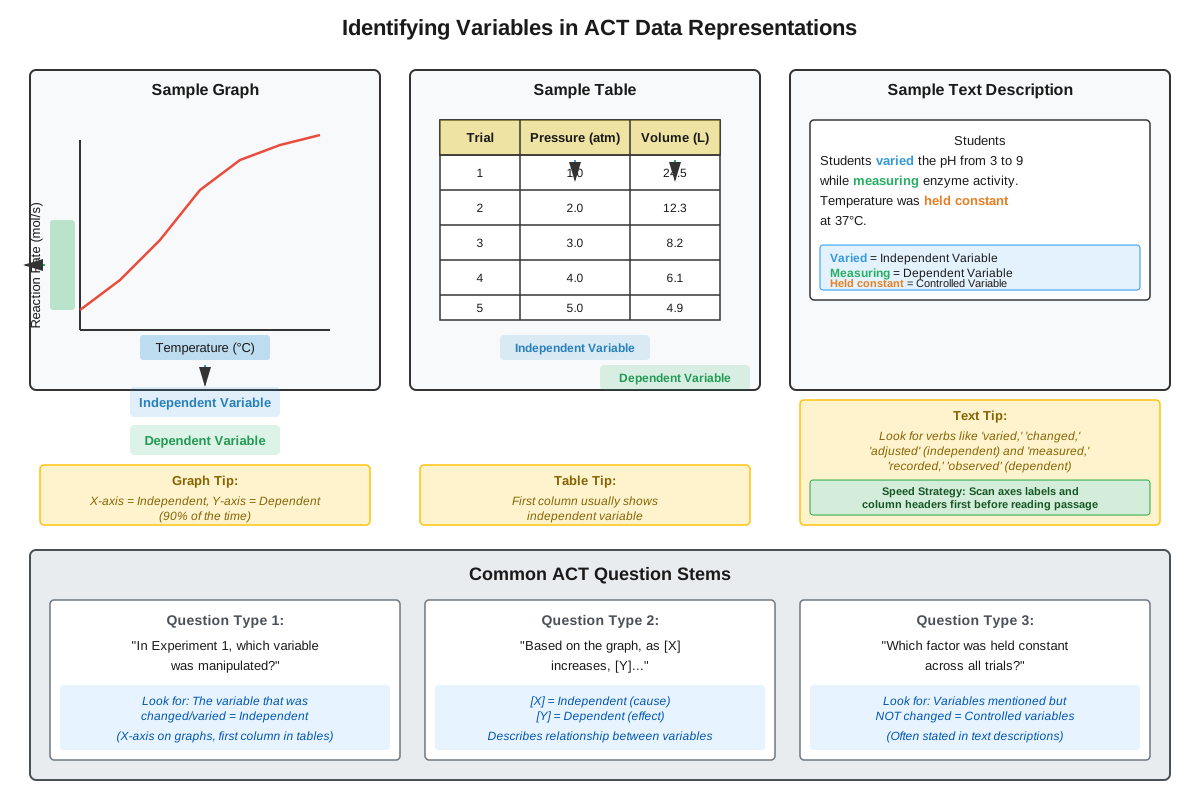
In text descriptions, look for action verbs indicating manipulation ("varied," "changed," "adjusted," "set to") to identify independent variables. Look for measurement verbs ("measured," "recorded," "observed," "determined") to identify dependent variables. Phrases like "while keeping constant" or "held at" signal controlled variables.
In data tables, the independent variable typically appears in the leftmost column with values that change systematically (increasing or decreasing). Dependent variables occupy subsequent columns showing measured results. Column headers provide variable names and units.
In graphs, the x-axis (horizontal) almost always represents the independent variable, while the y-axis (vertical) represents the dependent variable. Axis labels are critical—they name the variable and specify units. Multiple lines or data series on one graph might represent different controlled variable conditions.
Multiple Variables in Complex Experiments
ACT Research Summaries passages often present experiments with multiple independent variables or multiple dependent variables, testing students' ability to track several factors simultaneously.
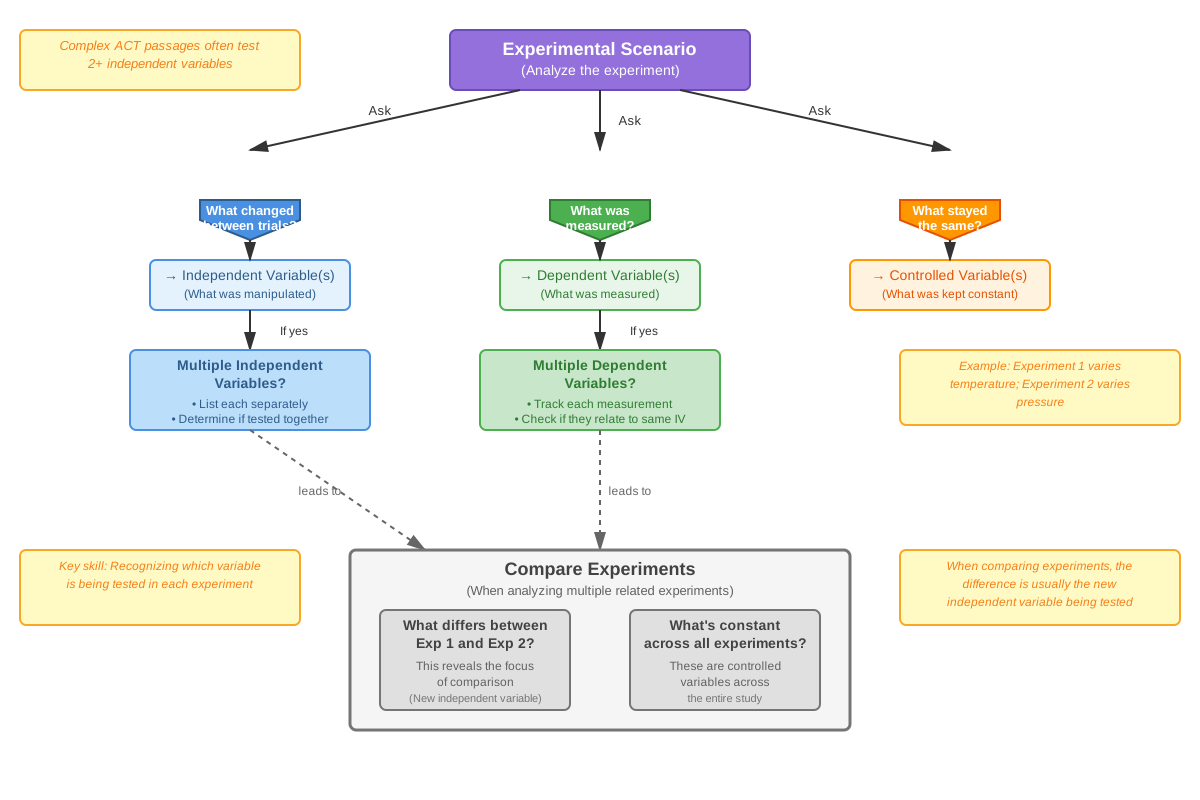
When multiple independent variables exist, experimenters typically vary one while holding others constant, then repeat with different variables. For example, Experiment 1 might vary temperature while keeping pressure constant, then Experiment 2 varies pressure while keeping temperature constant. Students must track which variable changes in each experiment.
When multiple dependent variables are measured, researchers observe several outcomes from the same manipulation. For example, changing exercise intensity might affect both heart rate and oxygen consumption—two dependent variables responding to one independent variable. Tables might show multiple columns of dependent variable data.
Confounding variables are uncontrolled factors that might affect results, compromising experimental validity. The ACT occasionally asks students to identify potential confounding variables or explain why an experiment's design prevents confounding. For example, if testing fertilizer effects but different plants receive different amounts of sunlight, sunlight becomes a confounding variable.
Concept Relationships
The three types of variables form an interconnected system within experimental design. Independent variables → directly influence → dependent variables, while controlled variables → ensure validity of → the relationship between independent and dependent variables. Without proper control of variables, the causal relationship between independent and dependent variables cannot be established with confidence.
Variables connect to prerequisite knowledge of the scientific method: hypotheses predict relationships between variables, procedures describe how variables are manipulated and measured, and conclusions interpret the observed variable relationships. Graph interpretation skills enable variable identification, as axes and data series represent different variables visually.
Within the Research Summaries unit, variables link to experimental design (choosing which variables to manipulate), data analysis (interpreting how variables relate), and hypothesis testing (determining if variable relationships support or refute predictions). Understanding variables also supports comparison between experiments—recognizing that Experiment 2 differs from Experiment 1 by changing one specific variable while keeping others constant.
The concept flows logically: identify variable types → understand their relationships → predict outcomes from changes → evaluate experimental validity → apply to new scenarios. Each step builds on the previous, creating a comprehensive framework for analyzing any ACT Science experiment.
Quick check — test yourself on Variables so far.
Try Flashcards →High-Yield Facts
⭐ The independent variable is what the experimenter changes; it appears on the x-axis of graphs and in the leftmost column of tables
⭐ The dependent variable is what the experimenter measures; it appears on the y-axis of graphs and in subsequent table columns
⭐ Controlled variables must remain constant across all trials for an experiment to be valid
⭐ Direct relationships show both variables moving in the same direction (both increase or both decrease)
⭐ Inverse relationships show variables moving in opposite directions (one increases while the other decreases)
- Multiple experiments in one passage typically vary different independent variables while keeping others constant
- Confounding variables are uncontrolled factors that can invalidate experimental conclusions
- The ACT frequently asks "as X increased, Y..." questions that test understanding of variable relationships
- Proper experimental design requires changing only one independent variable at a time
- Units in axis labels and table headers help identify what variables represent and how they're measured
- When comparing experiments, identify which variable changed between them to understand the experimental design
- "Control groups" maintain all variables at baseline levels for comparison with experimental groups
- The phrase "directly controlled" in questions refers to independent variables that experimenters manipulate
- Variables can be quantitative (numerical measurements) or qualitative (categorical descriptions)
- Reading the methods section carefully reveals which variables are independent, dependent, and controlled
Common Misconceptions
Misconception: The dependent variable is called "dependent" because it depends on the experimenter's choice.
Correction: The dependent variable depends on (responds to) changes in the independent variable, not the experimenter's arbitrary choice. It's what naturally changes as a result of manipulating the independent variable.
Misconception: All variables that don't change are dependent variables.
Correction: Variables held constant are controlled variables, not dependent variables. Dependent variables do change—they change in response to the independent variable. Controlled variables are intentionally kept the same.
Misconception: If a graph shows time on the x-axis, time is always the independent variable.
Correction: While time is frequently an independent variable, what matters is whether experimenters manipulated it or simply recorded measurements over time. However, for ACT purposes, time on the x-axis is typically treated as the independent variable.
Misconception: An experiment can have only one independent variable and one dependent variable.
Correction: Experiments can have multiple independent variables (tested separately or in combination) and multiple dependent variables (measuring different outcomes simultaneously). Complex ACT passages often include multiple variables of each type.
Misconception: The independent variable always increases in experiments.
Correction: Independent variables can increase, decrease, or vary in any pattern the experimenter chooses. What makes it independent is that the experimenter controls these changes, not the direction of change.
Misconception: Variables with larger numbers are always independent variables.
Correction: The magnitude of values doesn't determine variable type. A dependent variable might have larger numerical values than an independent variable. Variable type depends on the experimental role (manipulated vs. measured), not the size of numbers.
Misconception: Controlled variables are unimportant to experimental design.
Correction: Controlled variables are crucial for experimental validity. Without proper controls, researchers cannot determine whether the independent variable actually caused changes in the dependent variable, or whether some other factor was responsible.
Worked Examples
Example 1: Identifying Variables in a Plant Growth Experiment
Passage Summary: Scientists conducted an experiment to test how light intensity affects plant growth. They placed 20 identical seedlings in growth chambers. Five seedlings received 100 watts of light, five received 200 watts, five received 300 watts, and five received 400 watts. All plants received the same amount of water (50 mL daily), were kept at 25°C, and were grown in identical soil. After 30 days, researchers measured the height of each plant.
Question: What is the independent variable in this experiment?
Solution Process:
- Identify what the experimenters deliberately changed: light intensity (100, 200, 300, 400 watts)
- Identify what the experimenters measured: plant height after 30 days
- Identify what was kept constant: water amount, temperature, soil type, plant species, growth duration
- The independent variable is what was manipulated: light intensity
Answer: Light intensity (measured in watts) is the independent variable.
Additional Analysis: The dependent variable is plant height. Controlled variables include water amount (50 mL daily), temperature (25°C), soil type, plant species (identical seedlings), and time period (30 days). This experiment properly controls multiple variables while testing one specific factor. If the question asked about the dependent variable, the answer would be plant height. If asked about controlled variables, any of the factors kept constant would be correct.
Example 2: Analyzing Variable Relationships from Data
Data Table:
| Temperature (°C) | Reaction Rate (mL/min) |
|---|---|
| 10 | 2.1 |
| 20 | 4.3 |
| 30 | 8.7 |
| 40 | 17.2 |
Question: Based on the data, what is the relationship between temperature and reaction rate?
Solution Process:
- Identify the independent variable: Temperature (°C) appears in the left column and represents what was changed
- Identify the dependent variable: Reaction rate (mL/min) appears in the right column and represents what was measured
- Analyze the pattern: As temperature increases from 10°C to 40°C, reaction rate increases from 2.1 to 17.2 mL/min
- Determine relationship type: Both variables increase together, indicating a direct relationship
- Note the pattern: The rate approximately doubles with each 10°C increase, suggesting an exponential direct relationship
Answer: Temperature and reaction rate show a direct relationship—as temperature increases, reaction rate increases. Specifically, the relationship appears exponential, with reaction rate roughly doubling for each 10°C temperature increase.
Application to ACT Questions: This type of analysis prepares students for questions like "According to the data, as temperature increased, reaction rate..." or "Which of the following best describes the relationship between temperature and reaction rate?" Students should practice identifying whether relationships are direct, inverse, or show no pattern, and whether they're linear or non-linear.
Exam Strategy
When approaching ACT Science questions about variables, follow this systematic process:
Step 1: Quickly scan for variable indicators. Look for axis labels on graphs, column headers in tables, and key phrases in text like "varied," "measured," "held constant," or "controlled for." These immediately reveal variable types and roles.
Step 2: Create a mental or written variable map. For complex passages, briefly note: IV = [independent variable], DV = [dependent variable], CV = [controlled variables]. This prevents confusion when questions reference multiple experiments.
Step 3: Watch for trigger words in questions. "As X increased" signals a question about variable relationships. "Directly controlled" or "manipulated" refers to independent variables. "Measured" or "observed" refers to dependent variables. "Held constant" or "kept the same" refers to controlled variables.
Step 4: Use process of elimination strategically. If a question asks which variable was controlled, eliminate any variable that changed between trials. If asked about the dependent variable, eliminate anything the experimenters set or chose rather than measured.
Step 5: Check units and scales. Variables with different units cannot be the same variable. If a question asks about temperature effects but an answer choice mentions pressure, eliminate it unless the passage explicitly links these variables.
Time-Saving Tip: Don't read Research Summaries passages completely before looking at questions. Instead, skim to identify the general topic and variables, then let questions guide you to specific details. Most variable questions can be answered by examining graphs and tables without reading full paragraphs.
For comparison questions ("How did Experiment 2 differ from Experiment 1?"), identify which single variable changed while others remained constant. The ACT designs experiments to test one variable at a time, so look for the one factor that differs.
For prediction questions ("If temperature were increased to 50°C, the reaction rate would most likely..."), identify the established relationship pattern and extrapolate logically. If the relationship is direct and linear, continue the trend. If it's inverse, predict the opposite direction.
Memory Techniques
DIM acronym for variable types:
- Dependent = what you Determine by measuring
- Independent = what you Intentionally change
- Maintained = what you Maintain constant (controlled variables)
"Cause and Effect" visualization: Picture the independent variable as a hand pushing dominoes (the cause), and the dependent variable as the dominoes falling (the effect). Controlled variables are the table surface—it must stay level (constant) for the dominoes to fall predictably.
Graph axis memory aid: "DRY MIX"
- Dependent variable
- Responding variable
- Y-axis
- Manipulated variable
- Independent variable
- X-axis
The "Recipe" analogy: Think of experiments like baking. The independent variable is the ingredient you change (like sugar amount). The dependent variable is the outcome you taste or measure (like cookie sweetness). Controlled variables are everything you keep the same (oven temperature, baking time, flour amount). If you change multiple ingredients, you won't know which one affected the taste.
Relationship direction memory: "Direct = Ditto" (both variables do the same thing—both increase or both decrease). "Inverse = In opposition" (variables move in opposite directions).
Summary
Variables form the foundation of experimental analysis on the ACT Science test, appearing in the majority of Research Summaries questions. The three essential variable types—independent (what experimenters manipulate), dependent (what experimenters measure), and controlled (what experimenters keep constant)—must be identified quickly and accurately from graphs, tables, and text descriptions. Independent variables typically appear on x-axes and in leftmost table columns, while dependent variables appear on y-axes and subsequent columns. Understanding variable relationships (direct, inverse, or no relationship) enables students to interpret data patterns and predict outcomes. Successful ACT test-takers recognize that proper experimental design requires changing only one independent variable at a time while controlling all other factors, and they can identify which variables changed between different experiments in multi-experiment passages. Mastering variables transforms complex scientific passages into straightforward analysis tasks, directly improving scores on 15-18 questions per test.
Key Takeaways
- Independent variables are manipulated by experimenters and appear on x-axes; dependent variables are measured outcomes appearing on y-axes; controlled variables are held constant for validity
- Direct relationships show variables moving together (both increase or both decrease); inverse relationships show variables moving in opposite directions
- Proper experiments change only one independent variable at a time while controlling all other factors
- Variable identification requires examining axis labels, table headers, and text descriptions for manipulation and measurement language
- Multi-experiment passages typically vary different independent variables across experiments while maintaining other controls
- Questions using "as X increased, Y..." test understanding of variable relationships and require identifying patterns in data
- Controlled variables are as important as independent and dependent variables—without controls, causal relationships cannot be established
Related Topics
Experimental Design: Understanding variables enables deeper analysis of how experiments are structured, why certain procedures are chosen, and how to evaluate experimental validity. This topic builds directly on variable knowledge by examining how scientists plan studies to test specific hypotheses.
Data Interpretation and Graphs: Variables are the content of graphs and tables. Mastering variable concepts allows more sophisticated interpretation of trends, patterns, and relationships in visual data representations.
Hypothesis Testing: Scientific hypotheses predict relationships between variables. Understanding variables enables evaluation of whether experimental results support or refute hypotheses based on observed variable relationships.
Scientific Method: Variables fit within the broader framework of scientific inquiry. The scientific method uses variables as the mechanism for testing ideas and building reliable knowledge about natural phenomena.
Practice CTA
Now that you understand the fundamentals of variables in ACT Science, it's time to apply this knowledge! Work through the practice questions to test your ability to identify variable types, analyze relationships, and interpret experimental designs. The flashcards will help reinforce key concepts and ensure rapid recognition of variable indicators during the actual test. Remember: variables appear in approximately 40% of ACT Science questions, making this one of the highest-yield topics for score improvement. Every practice question you complete builds the pattern recognition and analytical speed you need for test day success. You've got this!
Sign up free to keep reading
Create a free AnvayaPrep account to finish this ACT guide on Variables — plus flashcards and practice questions.