Overview
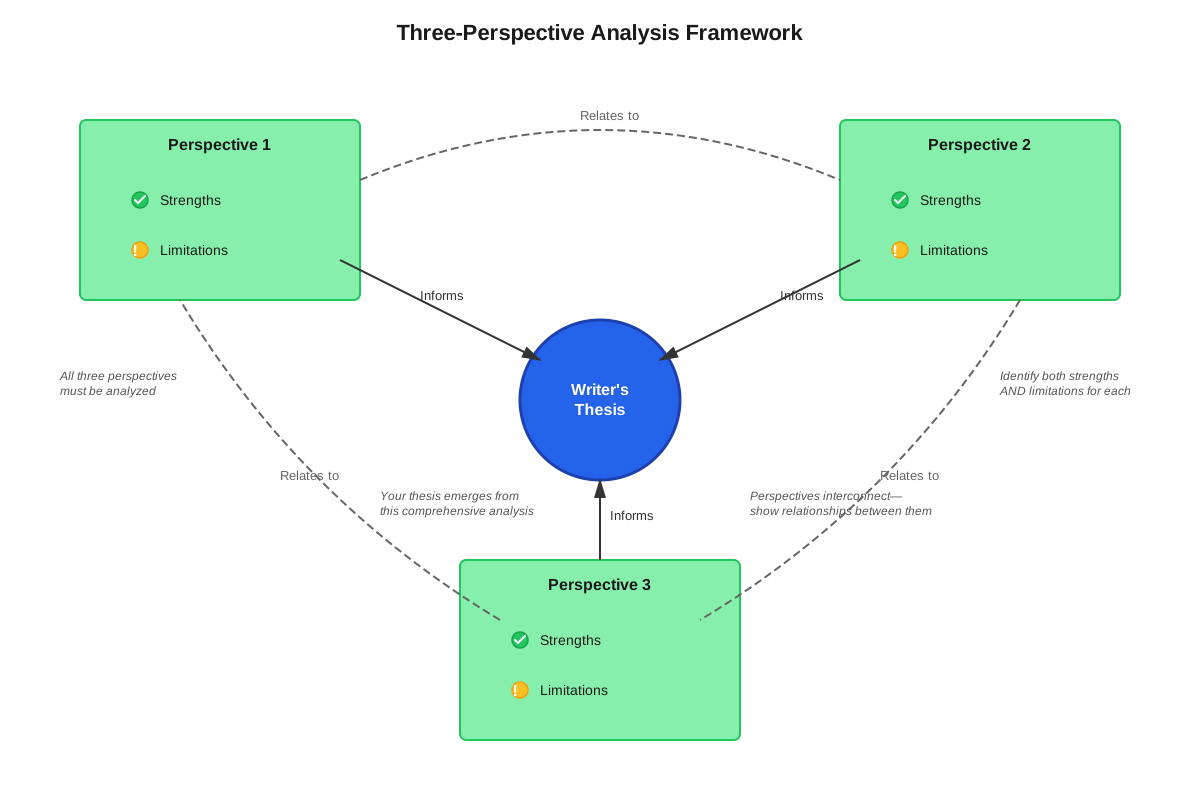
Addressing multiple perspectives is a cornerstone skill for the ACT Writing test, representing one of the most critical competencies that separates high-scoring essays from mediocre ones. On the ACT Writing section, students receive a prompt that presents a complex issue along with three distinct perspectives on that issue. The task requires not merely stating a personal opinion, but engaging thoughtfully with all provided viewpoints, analyzing their strengths and limitations, and developing a nuanced argument that demonstrates intellectual maturity and critical thinking.
This skill extends far beyond test-taking strategy—it reflects the kind of sophisticated reasoning expected in college-level writing and real-world discourse. The ability to acknowledge, analyze, and respond to opposing viewpoints demonstrates intellectual honesty and strengthens argumentative writing by showing that the writer has considered multiple angles before reaching a conclusion. On the ACT specifically, essays that fail to address all three perspectives or that dismiss alternative viewpoints without genuine engagement consistently receive lower scores across all four scoring domains: Ideas and Analysis, Development and Support, Organization, and Language Use.
Within the broader context of argument development, ACT addressing multiple perspectives serves as the framework upon which all other writing skills build. While thesis development establishes your position and evidence provides support, perspective analysis demonstrates the depth of your thinking and your ability to engage in academic discourse. This skill connects directly to counterargument strategies, comparative analysis, and synthesis—all essential components of college-ready writing that ACT graders specifically evaluate.
Learning Objectives
- [ ] Identify when addressing multiple perspectives is being tested in ACT Writing prompts
- [ ] Explain the core rule or strategy behind addressing multiple perspectives effectively
- [ ] Apply addressing multiple perspectives to ACT-style questions accurately
- [ ] Analyze the strengths and weaknesses of each provided perspective systematically
- [ ] Integrate perspective analysis seamlessly into a cohesive argumentative essay
- [ ] Distinguish between superficial acknowledgment and substantive engagement with perspectives
- [ ] Evaluate how different perspectives relate to one another and to your own thesis
Prerequisites
- Basic essay structure: Understanding introduction, body paragraphs, and conclusion organization is essential because perspective analysis must be integrated throughout the essay, not isolated in a single section
- Thesis statement construction: The ability to craft a clear, arguable position provides the foundation against which all perspectives are evaluated and compared
- Evidence and reasoning: Familiarity with supporting claims through examples and logical reasoning enables meaningful analysis of why perspectives have merit or limitations
- Paragraph development: Competence in developing focused paragraphs allows for thorough exploration of each perspective without losing coherence
Why This Topic Matters
In real-world contexts, the ability to engage with multiple perspectives is fundamental to academic research, professional decision-making, and civic participation. College courses across disciplines require students to synthesize competing theories, evaluate conflicting evidence, and develop informed positions that acknowledge complexity. Professionals in fields from law to medicine to business must regularly consider stakeholder perspectives, anticipate objections, and build consensus—all skills rooted in perspective analysis.
On the ACT Writing test, perspective engagement appears in 100% of essay prompts and significantly impacts scoring across all four domains. According to ACT scoring rubrics, essays receiving scores of 5-6 (the highest range) consistently "generate a productive discussion by examining different perspectives" and "situate their analysis within a broader context." In contrast, essays scoring 1-2 typically "show little or no attempt to engage with the perspectives" or "simply restate them without analysis." Statistical analysis of scored essays reveals that perspective engagement is the single strongest predictor of overall essay scores, even more influential than grammatical accuracy or vocabulary sophistication.
This topic appears in ACT passages through explicit presentation of three labeled perspectives (Perspective One, Perspective Two, Perspective Three) that offer distinct viewpoints on a contemporary issue. Common issue categories include education policy, technology and society, individual versus collective responsibility, tradition versus innovation, and practical versus idealistic approaches. The test consistently requires writers to address all three perspectives, though the depth and manner of engagement can vary based on the writer's approach.
Core Concepts
Understanding the ACT Perspective Structure
The ACT Writing prompt follows a consistent format: a brief introduction to a complex issue, followed by three distinct perspectives that offer different viewpoints on that issue. These perspectives are intentionally designed to represent genuinely different approaches—not simply "pro," "con," and "neutral" positions. Each perspective typically emphasizes different values, priorities, or assumptions about the issue at hand.
Perspective diversity on the ACT reflects real-world complexity. For example, on a prompt about automation and employment, one perspective might emphasize economic efficiency, another might focus on worker dignity and livelihood, and a third might advocate for educational adaptation. None of these is inherently "correct"—each represents a legitimate lens through which to view the issue. Understanding this structure is crucial because it prevents students from falling into the trap of treating the task as a simple agree/disagree exercise.
The Four Levels of Perspective Engagement
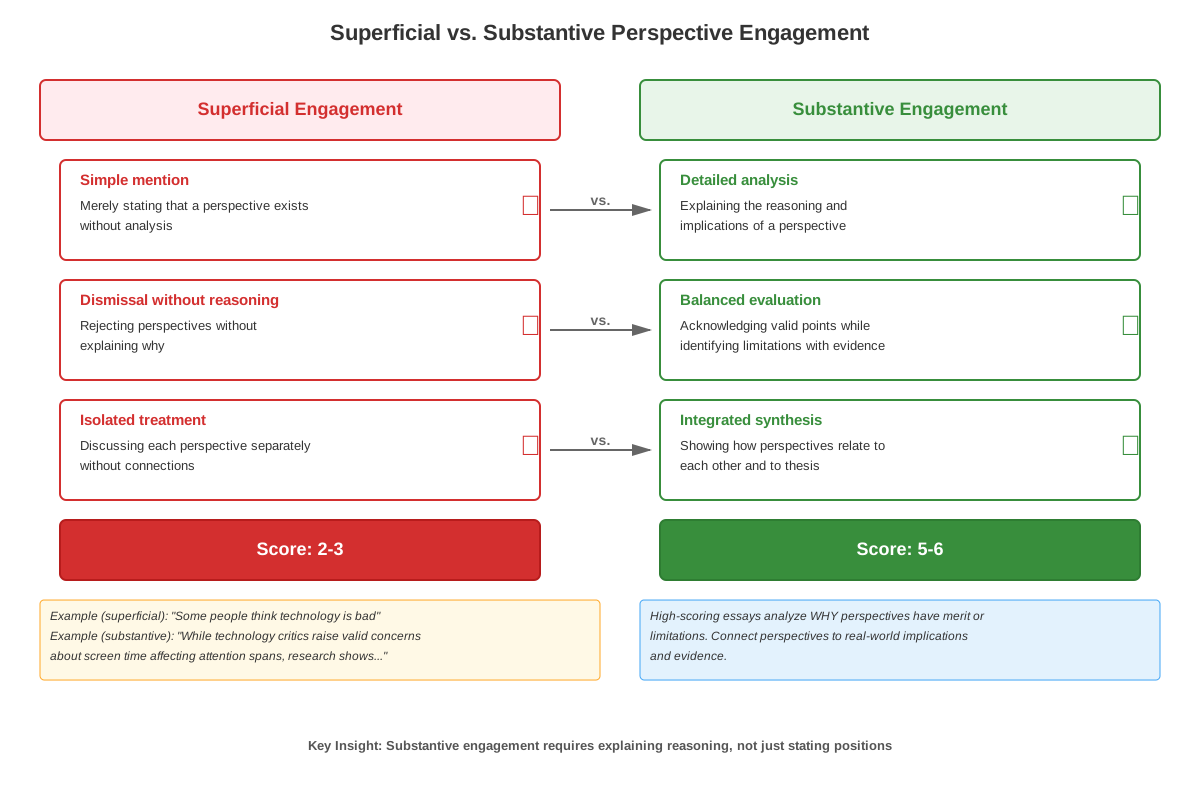
Not all perspective engagement is created equal. ACT graders distinguish between superficial acknowledgment and substantive analysis:
| Level | Description | Score Impact | Example |
|---|---|---|---|
| Dismissal | Ignoring perspectives or rejecting them without explanation | Very negative (1-2 range) | "Perspective Two is wrong." |
| Summary | Restating perspectives without analysis | Negative (2-3 range) | "Perspective Two says we should prioritize tradition." |
| Acknowledgment | Recognizing validity but minimal exploration | Neutral (3-4 range) | "Perspective Two makes a good point about tradition's value." |
| Analysis | Examining implications, limitations, and relationships | Positive (5-6 range) | "While Perspective Two correctly identifies tradition's stabilizing role, it underestimates how selective adaptation can preserve core values while embracing beneficial change." |
High-scoring essays consistently operate at the analysis level, treating perspectives as complex positions worthy of serious intellectual engagement rather than obstacles to dismiss or checkboxes to mark.
Strategies for Substantive Engagement
Comparative analysis represents one of the most effective approaches to perspective engagement. Rather than addressing each perspective in isolation, sophisticated writers examine how perspectives relate to one another—where they overlap, where they conflict, and what those relationships reveal about the underlying issue. For instance, two perspectives might share a common value (such as fairness) but disagree about how to achieve it, revealing that the real debate concerns means rather than ends.
Contextual evaluation involves examining when and under what circumstances a perspective might be most valid. A perspective emphasizing individual freedom might be particularly compelling in certain contexts (such as personal lifestyle choices) but less applicable in others (such as public health crises). This approach demonstrates nuanced thinking and avoids the oversimplification of declaring perspectives universally right or wrong.
Implication exploration requires thinking through the logical consequences of adopting each perspective. What would society, policy, or individual behavior look like if we fully embraced this viewpoint? What problems might it solve, and what new challenges might it create? This forward-thinking analysis shows intellectual depth and helps writers develop more sophisticated positions.
Integrating Perspectives into Your Argument
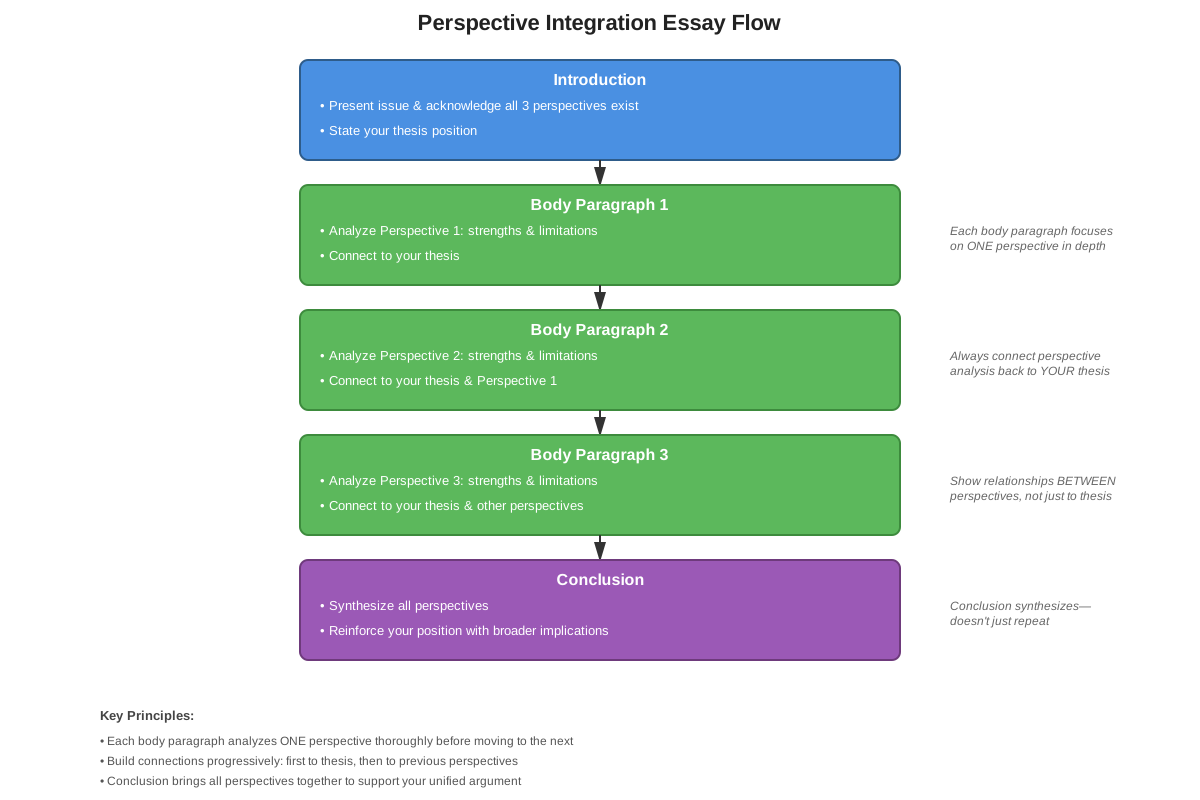
The most common structural mistake students make is treating perspective analysis as a separate task from developing their own argument. High-scoring essays integrate perspective engagement throughout the essay rather than isolating it in a single "perspectives paragraph."
Thesis integration means crafting a thesis statement that positions your argument in relation to the provided perspectives. Rather than stating your position in isolation, acknowledge where your view aligns with, diverges from, or synthesizes elements of the given perspectives. For example: "While Perspective One correctly identifies the efficiency gains of automation, a more complete approach must also address Perspective Two's concerns about displaced workers through the educational reforms suggested in Perspective Three."
Body paragraph integration involves using perspectives as analytical tools within your argument development. A body paragraph might begin with your claim, support it with evidence and reasoning, then strengthen the argument by showing how it addresses limitations in one of the provided perspectives or synthesizes insights from multiple viewpoints.
The Relationship Between Your Position and the Perspectives
Students often wonder whether they must agree with one of the provided perspectives or can develop an entirely independent position. The ACT allows both approaches, but the key requirement remains the same: substantive engagement with all three perspectives.
If your position aligns closely with one perspective, you must still meaningfully engage with the other two—explaining why they fall short, what valid concerns they raise, or how your position addresses their objections. If your position differs from all three perspectives, you must explain how it relates to each—perhaps synthesizing elements from multiple perspectives, addressing gaps that all three overlook, or reframing the issue in a way that transcends the given viewpoints.
Concept Relationships
The concepts within perspective engagement form a hierarchical relationship: Understanding the ACT structure provides the foundation → Recognizing engagement levels enables self-assessment → Applying engagement strategies produces substantive analysis → Integrating perspectives creates cohesive arguments.
This topic connects directly to prerequisite knowledge of thesis development because your thesis must position your argument relative to the perspectives. It builds upon evidence and reasoning skills because analyzing perspectives requires supporting your evaluation with logical arguments. It relates closely to counterargument strategies from broader argument development, as engaging with perspectives that differ from your position involves similar skills of acknowledging and responding to opposing views.
The relationship map flows as follows: Prompt analysis → identifies the three perspectives → Comparative evaluation → reveals relationships and implications → Thesis positioning → establishes your argument's relationship to perspectives → Integrated development → weaves perspective analysis throughout body paragraphs → Sophisticated conclusion → synthesizes insights from multiple viewpoints.
Quick check — test yourself on Addressing multiple perspectives so far.
Try Flashcards →High-Yield Facts
- ⭐ All ACT Writing prompts include exactly three distinct perspectives that must be addressed in your essay
- ⭐ Essays scoring 5-6 consistently analyze perspectives rather than merely summarizing or dismissing them
- ⭐ Perspective engagement impacts all four scoring domains, not just Ideas and Analysis
- ⭐ You can agree with, disagree with, or partially agree with any or all of the provided perspectives
- ⭐ High-scoring essays integrate perspective analysis throughout the essay rather than isolating it in one paragraph
- The three perspectives are intentionally designed to represent genuinely different approaches, not simple pro/con positions
- Comparative analysis (examining how perspectives relate to each other) demonstrates more sophisticated thinking than addressing each in isolation
- Contextual evaluation (identifying when perspectives are most/least valid) shows nuanced understanding
- Your thesis should position your argument in relation to the provided perspectives
- Dismissing perspectives without explanation consistently results in lower scores across all domains
- Exploring implications and consequences of perspectives demonstrates critical thinking valued by graders
- The strongest essays often synthesize insights from multiple perspectives rather than simply choosing one
- Perspective engagement should appear in introduction, body paragraphs, and conclusion
- Using perspectives as analytical tools to develop your argument is more effective than treating them as obstacles to overcome
- The ACT values intellectual humility—acknowledging valid points in perspectives you ultimately disagree with strengthens your argument
Common Misconceptions
Misconception: You must agree with one of the three provided perspectives and argue for it exclusively. → Correction: You can develop any position you choose—agreeing with one perspective, disagreeing with all three, or synthesizing elements from multiple perspectives—as long as you substantively engage with all three in your analysis.
Misconception: Addressing perspectives means dedicating one paragraph to summarizing all three. → Correction: High-scoring essays integrate perspective analysis throughout the entire essay, using perspectives as analytical tools within the development of your own argument rather than treating them as a separate checklist item.
Misconception: The three perspectives represent "correct," "incorrect," and "partially correct" positions. → Correction: All three perspectives represent legitimate viewpoints with both strengths and limitations; the ACT tests your ability to analyze complexity, not identify a predetermined "right answer."
Misconception: Longer discussion of perspectives automatically improves your score. → Correction: Quality of engagement matters far more than quantity; a brief but insightful analysis that explores implications and relationships scores higher than lengthy summary or superficial acknowledgment.
Misconception: You should avoid criticizing the provided perspectives because they're part of the test. → Correction: Thoughtful critique that identifies limitations or contextual boundaries of perspectives demonstrates critical thinking and strengthens your essay, as long as the critique is substantive and respectful rather than dismissive.
Misconception: Perspective engagement only matters for the Ideas and Analysis domain. → Correction: How you engage with perspectives impacts all four scoring domains—affecting organization (how you structure your analysis), development (how thoroughly you explore ideas), and even language use (the sophistication of your comparative and analytical vocabulary).
Worked Examples
Example 1: Technology in Education Prompt
Prompt Context: The issue concerns whether schools should increase technology integration in classrooms.
Perspective One: Technology enhances learning by providing personalized instruction and access to unlimited resources.
Perspective Two: Technology distracts students and reduces essential face-to-face interaction with teachers and peers.
Perspective Three: Technology should supplement but not replace traditional teaching methods.
Student's Position: Schools should strategically integrate technology in ways that enhance rather than replace human connection and critical thinking.
Worked Analysis:
Introduction Integration: "While Perspective One correctly identifies technology's potential to personalize learning, and Perspective Two raises valid concerns about distraction, the most effective approach synthesizes these insights with Perspective Three's balanced framework—using technology strategically to enhance human connection rather than replace it."
Body Paragraph Integration: "The key lies in recognizing that Perspective One's enthusiasm for personalized instruction need not conflict with Perspective Two's concern for human interaction. Adaptive learning software can handle skill practice and immediate feedback, freeing teachers to focus on the collaborative discussion and mentorship that Perspective Two values. This approach addresses Perspective Three's call for balance by using technology as a tool that amplifies rather than replaces the teacher's role."
Why This Works: The analysis moves beyond summary to examine relationships between perspectives, identifies common ground, and shows how a nuanced position can address concerns from multiple viewpoints. The writer treats perspectives as analytical tools rather than obstacles.
Example 2: Individual vs. Collective Responsibility Prompt
Prompt Context: The issue concerns whether addressing climate change should focus on individual lifestyle changes or systemic policy reforms.
Perspective One: Individual choices (recycling, reducing consumption) are the foundation of environmental progress.
Perspective Two: Only large-scale policy and corporate regulation can address climate change effectively.
Perspective Three: Both individual and collective action are necessary and reinforce each other.
Student's Position: While systemic change is essential for meaningful impact, individual action plays a crucial role in building political will for policy reforms.
Worked Analysis:
Comparative Evaluation: "Perspective Two correctly identifies that individual actions alone cannot match the scale of climate challenges—one person's recycling cannot offset industrial emissions. However, Perspective Two's dismissal of individual action overlooks how personal engagement creates the constituency necessary for the policy changes it advocates. Perspective One, while overestimating individual impact on emissions, correctly recognizes that personal investment in environmental practices builds the political support that makes Perspective Two's systemic reforms possible."
Contextual Application: "The relationship between Perspectives One and Two is not contradictory but sequential: individual action serves as a gateway to collective action. When people make personal changes, they develop stake in environmental outcomes and become more likely to support—and demand—the policy reforms Perspective Two emphasizes. Perspective Three recognizes this relationship but doesn't fully explore the mechanism by which individual and collective action reinforce each other."
Why This Works: The analysis examines not just what each perspective claims but why those claims matter and how they relate to each other. The writer identifies limitations without dismissal, shows how apparently opposing perspectives can be complementary, and develops a position that synthesizes insights while adding original analysis.
Exam Strategy
Approaching ACT Perspective Questions
Begin by spending 2-3 minutes analyzing the prompt and perspectives before writing. Create a quick chart noting one strength and one limitation for each perspective. This investment prevents the common mistake of realizing mid-essay that you've ignored a perspective or misunderstood the relationships between them.
Trigger phrases that signal perspective engagement opportunities include: "While [Perspective X] correctly identifies...", "However, this view overlooks...", "Building on [Perspective Y]'s insight...", "The tension between [Perspective A] and [Perspective B] reveals...", "In contexts where..., [Perspective Z] proves most compelling, but..."
Process of Elimination for Self-Assessment
As you write, mentally check these criteria:
- Have I mentioned all three perspectives by name or number?
- Have I done more than summarize—have I analyzed implications or limitations?
- Have I shown how perspectives relate to each other, not just to my position?
- Have I integrated perspective discussion into my argument development, not isolated it?
- Have I acknowledged valid points even in perspectives I ultimately disagree with?
If you answer "no" to any of these during your essay, you've identified a revision priority.
Time Allocation
In the 40-minute ACT Writing test, allocate approximately:
- 5 minutes: Planning and perspective analysis
- 28 minutes: Writing (with perspective integration throughout)
- 7 minutes: Revision (checking that all perspectives are substantively addressed)
Exam Tip: If time runs short, prioritize depth over breadth. A thorough analysis of two perspectives with brief acknowledgment of the third scores better than superficial treatment of all three.
Red Flags to Avoid
Watch for these warning signs in your own writing:
- Using phrases like "Perspective Two is completely wrong" without explanation
- Dedicating a single paragraph to "Now I'll discuss the three perspectives"
- Summarizing perspectives using nearly identical language to the prompt
- Failing to connect perspective analysis back to your thesis
- Treating perspectives as obstacles to overcome rather than ideas to engage
Memory Techniques
The RACE Framework for perspective engagement:
- Relate: How does this perspective relate to the others and to your position?
- Analyze: What are the implications, assumptions, and limitations?
- Contextualize: When/where is this perspective most/least valid?
- Evaluate: What's valuable here, and what's missing?
The Three S's for avoiding superficial engagement:
- Not just Summary (restating the perspective)
- Not just Support (agreeing without analysis)
- But Synthesis (integrating insights into your argument)
Visualization Strategy: Picture the three perspectives as three people in a conversation, with you as the moderator who helps them understand each other's points while adding your own insights. This mental model prevents treating perspectives as isolated statements and encourages relational thinking.
The "Yes, And" Technique: Even when disagreeing with a perspective, begin by identifying something valid ("Yes, Perspective Two correctly notes that...") before adding your critique or qualification ("And yet, this view doesn't account for..."). This structure ensures balanced engagement.
Summary
Addressing multiple perspectives on the ACT Writing test requires moving beyond simple agreement or disagreement to engage in substantive analysis that examines implications, relationships, and contextual validity. The ACT provides three distinct perspectives on every prompt, and high-scoring essays consistently analyze rather than merely summarize these viewpoints, integrating perspective engagement throughout the essay rather than isolating it in a single section. Effective perspective analysis involves comparative evaluation (examining how perspectives relate to each other), contextual assessment (identifying when perspectives are most valid), and implication exploration (considering consequences of adopting each view). Your thesis should position your argument in relation to the provided perspectives, and body paragraphs should use perspectives as analytical tools to develop your position. The ability to acknowledge valid points even in perspectives you ultimately disagree with demonstrates intellectual maturity and strengthens your argument. Success requires treating all three perspectives as legitimate viewpoints worthy of serious engagement, avoiding both dismissive rejection and uncritical acceptance, and synthesizing insights to develop a nuanced position that demonstrates college-ready critical thinking.
Key Takeaways
- All three perspectives must be substantively addressed through analysis, not just summary or acknowledgment
- High-scoring essays integrate perspective engagement throughout the entire essay, not in a single isolated paragraph
- Comparative analysis examining relationships between perspectives demonstrates more sophisticated thinking than addressing each in isolation
- Your position can agree with, disagree with, or synthesize elements from the provided perspectives—flexibility is allowed, but engagement is required
- Acknowledging valid points in perspectives you ultimately disagree with strengthens rather than weakens your argument
- Perspective engagement impacts all four scoring domains and is the strongest predictor of overall essay scores
- Effective analysis explores implications, examines contextual validity, and identifies both strengths and limitations of each perspective
Related Topics
Thesis Development and Positioning: Building on perspective engagement skills, this topic explores how to craft thesis statements that clearly articulate your position while acknowledging the complexity of the issue—essential for creating the framework within which perspective analysis operates.
Counterargument and Rebuttal Strategies: Closely related to perspective engagement, this topic focuses specifically on addressing opposing viewpoints in argumentative writing, providing techniques that deepen your ability to respond to perspectives that differ from your position.
Synthesis Writing: This advanced skill involves combining insights from multiple sources or perspectives to create a new, more comprehensive understanding—the natural progression from analyzing individual perspectives to creating integrated arguments.
Evidence Selection and Analysis: Mastering how to choose and analyze evidence strengthens your ability to evaluate the support underlying each perspective and to develop your own well-supported position in relation to them.
Practice CTA
Now that you understand the principles and strategies for addressing multiple perspectives, it's time to apply these skills to actual ACT-style prompts. The practice questions and flashcards will help you internalize the RACE framework, distinguish between superficial and substantive engagement, and develop the integrated approach that characterizes high-scoring essays. Remember: perspective engagement is a skill that improves dramatically with deliberate practice. Each prompt you analyze strengthens your ability to think comparatively, evaluate contextually, and synthesize insights—skills that will serve you not just on test day, but throughout your academic career. Approach the practice materials with the goal of moving beyond your comfort zone, experimenting with different integration strategies, and developing your unique voice as a writer who engages thoughtfully with complexity.
Sign up free to keep reading
Create a free AnvayaPrep account to finish this ACT guide on Addressing multiple perspectives — plus flashcards and practice questions.