Overview
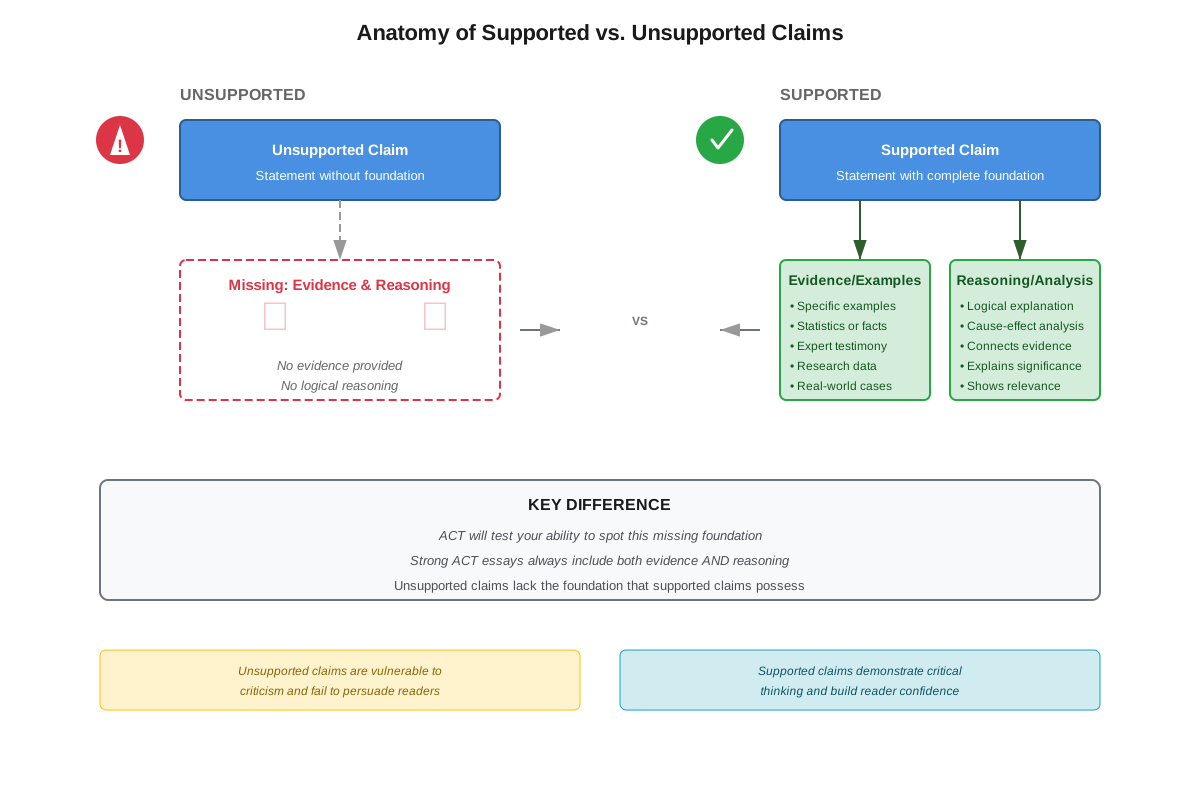
Avoiding unsupported claims is a fundamental skill tested extensively throughout the ACT Writing section, particularly in the essay portion and in English section questions that assess rhetorical skills. An unsupported claim is a statement presented as fact or a strong assertion that lacks sufficient evidence, reasoning, or logical backing to justify its validity. On the ACT, students must demonstrate the ability to recognize when arguments lack proper support and, more importantly, construct their own arguments with adequate evidence and logical reasoning.
This topic is essential for the ACT because the exam evaluates not just writing mechanics but also the quality of reasoning and argumentation. The ACT Writing test specifically assesses how well students can develop ideas with relevant support, analyze multiple perspectives, and construct coherent arguments. Questions in the English section frequently test whether added sentences provide relevant support or whether existing claims are adequately justified. Students who master this skill can identify weak arguments, strengthen their own writing, and score significantly higher on both the English and Writing sections.
Understanding how to avoid unsupported claims connects directly to broader concepts in argument development, including evidence selection, logical reasoning, and rhetorical effectiveness. This skill builds upon basic paragraph structure and transitions while serving as a foundation for more advanced concepts like counterargument analysis and perspective integration. Mastery of this topic enables students to construct persuasive, credible arguments that meet the ACT's highest scoring criteria.
Learning Objectives
- [ ] Identify when avoiding unsupported claims is being tested in ACT questions
- [ ] Explain the core rule or strategy behind avoiding unsupported claims
- [ ] Apply avoiding unsupported claims to ACT-style questions accurately
- [ ] Distinguish between adequately supported and unsupported claims in sample passages
- [ ] Evaluate the strength and relevance of evidence used to support claims
- [ ] Construct original arguments with appropriate supporting evidence
- [ ] Recognize common patterns of insufficient support in ACT passages
Prerequisites
- Basic paragraph structure: Understanding topic sentences, supporting details, and concluding sentences is essential because claims typically appear as topic sentences that require development through supporting details
- Evidence types: Familiarity with examples, statistics, expert testimony, and logical reasoning helps students recognize what constitutes adequate support
- Logical reasoning fundamentals: Basic understanding of cause-and-effect relationships and logical connections enables students to evaluate whether evidence actually supports a claim
- Thesis statement construction: Knowledge of how to formulate clear, specific thesis statements provides the foundation for understanding what makes a claim supportable or unsupportable
Why This Topic Matters
In real-world contexts, the ability to avoid unsupported claims is crucial for academic writing, professional communication, and critical thinking. College professors expect students to substantiate their arguments with credible evidence, and employers value employees who can make well-reasoned recommendations backed by data. This skill protects against spreading misinformation and helps individuals evaluate the credibility of arguments they encounter in media, advertising, and public discourse.
On the ACT, avoiding unsupported claims appears with high frequency across multiple question types. In the English section, approximately 15-20% of Rhetorical Skills questions assess whether sentences provide relevant support or whether proposed additions would strengthen an argument. The Writing section dedicates an entire scoring dimension (Ideas and Analysis) to evaluating how well students support their perspectives with reasoning and examples. Questions may ask students to identify the most relevant supporting detail, determine whether a sentence should be added for support, or evaluate whether a passage accomplishes its stated purpose.
Common manifestations in ACT passages include: sentences that make broad generalizations without examples, arguments that jump to conclusions without intermediate reasoning steps, claims that rely on personal opinion presented as fact, and paragraphs where the supporting details don't actually relate to the main claim. The exam frequently presents revision questions where students must choose between options that provide varying levels of support, making this a high-yield area for score improvement.
Core Concepts
What Constitutes an Unsupported Claim
An unsupported claim is any assertion that requires evidence or reasoning but is presented without adequate justification. These claims typically fall into several categories: factual statements without verification, causal relationships without explanation, value judgments without criteria, and generalizations without specific examples. The key distinction is between claims that are self-evident or definitional (which don't require support) and claims that make substantive arguments about the world (which do require support).
For example, "The sky appears blue during the day" is a commonly observed fact that doesn't require extensive support in most contexts, while "Blue is the best color" is a value judgment requiring explanation of criteria and reasoning. Similarly, "Many students struggle with standardized tests" is a broad claim requiring statistical evidence or specific examples, whereas "The ACT includes English, Math, Reading, and Science sections" is a verifiable fact about the test structure.
Types of Adequate Support
Effective support for claims comes in multiple forms, and the ACT expects students to recognize and utilize various evidence types:
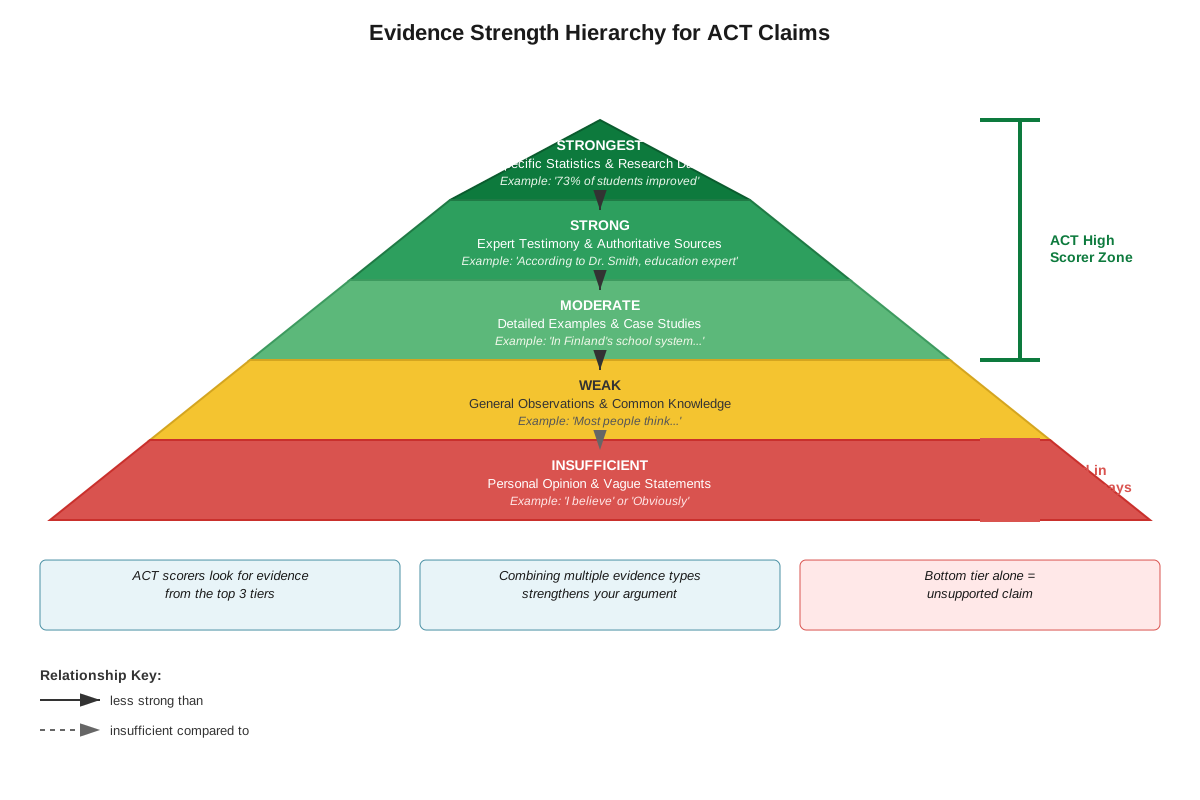
Specific Examples: Concrete instances that illustrate a general claim. Rather than stating "Technology has changed education," adequate support would provide specific examples like "Interactive whiteboards allow teachers to display multimedia content, while learning management systems enable students to submit assignments digitally and receive immediate feedback."
Statistical Evidence: Numerical data that demonstrates patterns or trends. Claims about prevalence, frequency, or magnitude require quantitative support. For instance, "Most teenagers use social media" becomes stronger with support like "According to a 2023 Pew Research study, 87% of teenagers report using at least one social media platform daily."
Expert Testimony: Citations of authorities or credible sources that lend weight to claims. This includes research findings, professional opinions, and authoritative publications. The ACT values evidence from credible sources over personal anecdotes.
Logical Reasoning: Step-by-step explanation of how premises lead to conclusions. This includes cause-and-effect relationships, analogies, and deductive reasoning. For example, explaining the mechanism by which a policy would produce specific outcomes.
Relevant Details: Descriptive information that clarifies and substantiates claims. These details must directly relate to the point being made rather than providing tangential information.
The Relationship Between Claims and Evidence
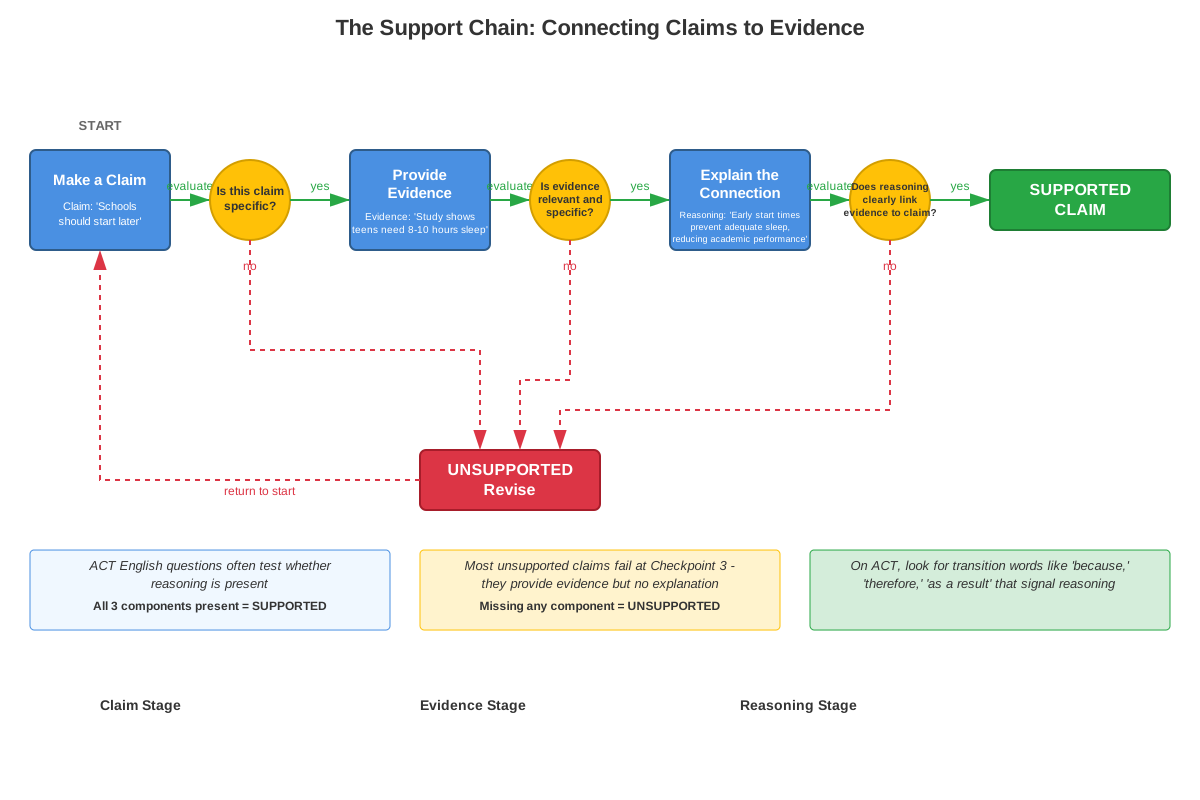
The connection between a claim and its supporting evidence must be explicit and logical. Three critical elements determine whether support is adequate:
- Relevance: The evidence must directly relate to the specific claim being made. Irrelevant details, no matter how interesting, don't constitute support.
- Sufficiency: The amount and quality of evidence must be proportional to the scope of the claim. Broader claims require more extensive support.
- Clarity of Connection: The relationship between evidence and claim must be explained, not assumed. Writers must show how the evidence supports the conclusion.
| Claim Strength | Required Support Level | Example |
|---|---|---|
| Absolute ("all," "never," "always") | Extensive, comprehensive evidence | "All students benefit from music education" requires multiple studies across diverse populations |
| Strong ("most," "generally," "typically") | Substantial evidence from representative samples | "Most high school students experience stress during finals" needs survey data or research findings |
| Moderate ("many," "some," "often") | Multiple specific examples or limited data | "Many students find group study helpful" can be supported with several concrete examples |
| Qualified ("may," "can," "might") | Logical reasoning or limited examples | "Meditation may reduce test anxiety" requires explanation of mechanism and at least one example |
Recognizing Insufficient Support Patterns
The ACT frequently tests recognition of common patterns where claims lack adequate support:
Circular Reasoning: When the evidence merely restates the claim in different words. Example: "This policy is beneficial because it provides advantages" offers no real support.
Vague Generalities: Using imprecise language that doesn't provide concrete information. Phrases like "studies show," "experts say," or "it is well known" without specifics constitute weak support.
Logical Leaps: Jumping from evidence to conclusion without explaining the connection. Example: "Student test scores increased after the new curriculum was implemented" doesn't automatically support "The new curriculum caused improved learning" without ruling out other factors.
Anecdotal Evidence for Broad Claims: Using a single personal experience or isolated example to support sweeping generalizations. One person's experience doesn't establish a universal pattern.
Irrelevant Information: Including details that don't actually support the claim, even if they're related to the general topic. This often appears in ACT questions asking whether a sentence should be added.
Strengthening Claims Through Support
The ACT rewards students who can transform weak, unsupported claims into strong, well-supported arguments. This process involves several strategies:
Specificity: Replace vague terms with precise details. Instead of "many people," use "approximately 60% of survey respondents" or "three out of five participants."
Attribution: Identify sources for factual claims. Rather than "research shows," specify "a 2022 Stanford University study found."
Explanation: Don't assume readers will make connections automatically. Explicitly state how evidence supports the claim through transitional phrases like "This demonstrates that," "As a result," or "This evidence suggests."
Multiple Forms of Support: Combine different evidence types to create comprehensive support. Use both statistical data and specific examples, or pair expert testimony with logical reasoning.
Concept Relationships
The concepts within avoiding unsupported claims form an interconnected system where each element reinforces the others. Understanding what constitutes an unsupported claim → enables recognition of insufficient support patterns → which informs the selection of adequate support types → leading to the ability to strengthen claims through proper evidence → ultimately resulting in well-developed arguments.
This topic connects directly to prerequisite knowledge of paragraph structure, as claims typically function as topic sentences that require development through supporting details. The relationship flows: thesis statement construction → claim formulation → evidence selection → logical connection → complete argument development.
ACT avoiding unsupported claims also relates to other argument development concepts. It serves as the foundation for counterargument analysis (you must support your own claims before addressing opposing views), connects to organizational strategies (evidence must be arranged logically), and integrates with perspective analysis (each perspective requires supported reasoning). The skill progression moves from avoiding unsupported claims → to developing complex arguments → to synthesizing multiple perspectives with comprehensive support.
High-Yield Facts
⭐ An unsupported claim is any assertion requiring evidence or reasoning that is presented without adequate justification
⭐ The ACT English section includes 15-20% of Rhetorical Skills questions testing whether claims are adequately supported
⭐ Adequate support requires three elements: relevance to the claim, sufficiency of evidence, and clarity of connection
⭐ Specific examples, statistics, expert testimony, logical reasoning, and relevant details all constitute valid forms of support
⭐ Broader claims require more extensive support than narrow, qualified claims
- Circular reasoning (restating the claim as evidence) is one of the most common forms of insufficient support on the ACT
- Anecdotal evidence from a single experience cannot adequately support broad generalizations
- The ACT Writing test dedicates an entire scoring dimension (Ideas and Analysis) to evaluating claim support
- Vague phrases like "studies show" or "experts say" without specifics indicate insufficient support
- Irrelevant information, even if related to the general topic, does not constitute adequate support for a specific claim
- Logical leaps that jump from evidence to conclusion without explanation represent unsupported reasoning
- The connection between evidence and claim must be explicit, not assumed by the reader
- Multiple forms of support (combining statistics with examples, for instance) create stronger arguments than single evidence types
- Questions asking "Should this sentence be added?" frequently test whether the addition provides relevant support
- Attribution of sources (identifying where information comes from) strengthens claims and demonstrates credibility
Quick check — test yourself on Avoiding unsupported claims so far.
Try Flashcards →Common Misconceptions
Misconception: Any example automatically supports a claim. → Correction: Examples must be relevant and specific to the particular claim being made. An example about one topic doesn't support a claim about a different topic, even if they're loosely related. The example must directly illustrate the point.
Misconception: Longer explanations always provide better support than shorter ones. → Correction: Quality and relevance matter more than length. Concise, specific evidence that directly addresses the claim is superior to lengthy tangential information. The ACT rewards precision over verbosity.
Misconception: Personal opinions and beliefs constitute adequate support for claims. → Correction: While personal perspectives can be starting points for arguments, they require external evidence, logical reasoning, or specific examples to become adequately supported claims. "I believe" or "In my opinion" statements need justification.
Misconception: If information is true, it automatically supports any related claim. → Correction: Truth and relevance are separate qualities. A fact can be accurate but still irrelevant to a particular claim. Support must directly connect to the specific point being argued, not just relate to the general topic area.
Misconception: Common knowledge never requires support. → Correction: What constitutes "common knowledge" varies by audience and context. On the ACT, when in doubt, providing support strengthens an argument. Additionally, claims about causes, effects, or value judgments require support even when discussing familiar topics.
Misconception: Emotional appeals and passionate language can substitute for evidence. → Correction: While rhetorical devices have their place, the ACT prioritizes logical reasoning and concrete evidence. Strong feelings about a topic don't make claims true or supported. Evidence must be substantive, not just emphatic.
Misconception: Citing "research" or "studies" without specifics provides adequate support. → Correction: Vague references to unnamed research constitute weak support. Effective support identifies specific sources, dates, or findings. The ACT rewards precision in attribution.
Worked Examples
Example 1: Identifying Unsupported Claims in a Passage
Passage Excerpt:
"Schools should eliminate homework for elementary students. Homework causes stress and takes time away from family activities. Many countries that don't assign homework have better educational outcomes. Students would be happier and more engaged in learning without the burden of homework."
Analysis Process:
Step 1: Identify the main claim: "Schools should eliminate homework for elementary students."
Step 2: Examine each supporting statement for adequate evidence:
- "Homework causes stress" - This is an unsupported claim. While it may be true, no evidence is provided. What kind of stress? How much? Based on what research or observations?
- "Takes time away from family activities" - This is somewhat self-evident (homework does take time), but the implication that this is problematic lacks support. How much time? What family activities? Why is this negative?
- "Many countries that don't assign homework have better educational outcomes" - This is a factual claim requiring specific evidence. Which countries? What outcomes? How are they measured? This correlation also doesn't establish causation.
- "Students would be happier and more engaged" - This is a prediction without support. What evidence suggests this outcome? Are there examples of schools that eliminated homework with these results?
Step 3: Determine what support would strengthen the argument:
To adequately support this claim, the passage would need:
- Specific research findings about homework's effects on elementary students (e.g., "A 2021 study published in the Journal of Educational Psychology found that elementary students who spent more than 30 minutes on homework reported significantly higher stress levels")
- Concrete examples of countries and their specific outcomes (e.g., "Finland, which assigns minimal homework in elementary grades, consistently ranks in the top five countries for reading and mathematics achievement on international assessments")
- Evidence about student engagement from schools that reduced homework
- Explanation of the causal mechanism connecting homework elimination to improved outcomes
Connection to Learning Objectives: This example demonstrates how to identify when avoiding unsupported claims is being tested by systematically examining each assertion for adequate evidence and recognizing patterns of insufficient support.
Example 2: Choosing the Best Supporting Detail
Question Stem:
The writer wants to add a sentence to support the claim that "Urban gardens provide significant environmental benefits." Which choice best accomplishes this goal?
Claim Context: The paragraph argues that cities should invest in community garden programs.
Options:
A) Many people enjoy gardening as a relaxing hobby that relieves stress.
B) Urban gardens can include vegetables, flowers, and herbs depending on community preferences.
C) According to the EPA, urban gardens reduce stormwater runoff by up to 40% and lower ambient temperatures by 2-5 degrees Fahrenheit in surrounding areas.
D) Community gardens bring neighbors together and create opportunities for social interaction.
Analysis Process:
Step 1: Identify what the claim specifically asserts - "environmental benefits" is the key phrase requiring support.
Step 2: Evaluate each option's relevance:
Option A: Discusses psychological benefits (stress relief), not environmental benefits. This is irrelevant to the specific claim, even though it's a valid point about gardens generally. Insufficient support.
Option B: Provides descriptive information about garden contents but doesn't address environmental impact. This is tangential information. Insufficient support.
Option C: Provides specific, quantified environmental benefits (stormwater reduction, temperature lowering) with attribution to a credible source (EPA). This directly supports the claim about environmental benefits with concrete data. Adequate support.
Option D: Discusses social benefits, not environmental benefits. Like Option A, this is relevant to gardens but not to the specific claim being made. Insufficient support.
Step 3: Select the option that provides relevant, specific, and credible support.
Answer: C
Reasoning: Option C is correct because it provides specific, measurable environmental benefits (40% stormwater reduction, 2-5 degree temperature decrease) from a credible source (EPA). The evidence directly addresses the claim's focus on "environmental benefits" rather than discussing other advantages of gardens. This exemplifies adequate support through statistical evidence with proper attribution.
Connection to Learning Objectives: This example demonstrates how to apply avoiding unsupported claims to ACT-style questions by evaluating relevance, specificity, and credibility of supporting evidence.
Exam Strategy
Approaching ACT Questions on This Topic
When encountering questions about avoiding unsupported claims, follow this systematic approach:
- Identify the specific claim or assertion being made or evaluated. Underline key terms that indicate what needs support.
- Determine what type of support the claim requires. Factual claims need evidence; causal claims need explanation of mechanism; value judgments need criteria and reasoning.
- Evaluate each option for the three critical elements: relevance (does it address this specific claim?), sufficiency (is it concrete enough?), and clarity of connection (is the relationship explicit?).
- Eliminate options with common insufficient support patterns: circular reasoning, vague generalities, irrelevant information, and logical leaps.
Trigger Words and Phrases
Watch for these indicators that a question tests avoiding unsupported claims:
- "Which choice provides the most specific support?"
- "Which choice most effectively supports the claim?"
- "Should the writer add this sentence? Why or why not?"
- "Which choice provides the most relevant detail?"
- "The writer wants to support the point made in the previous sentence"
- "Which choice best accomplishes the writer's goal of supporting..."
- "Which choice provides evidence that..."
In passages, watch for claims containing:
- Absolute terms (all, never, always, every)
- Causal language (causes, leads to, results in)
- Comparative statements (better, worse, more effective)
- Value judgments (should, must, best, worst)
These claims require stronger support than simple descriptive statements.
Process-of-Elimination Tips
Eliminate options that:
- Discuss a different aspect of the topic than the specific claim addresses
- Provide only vague, general statements without concrete details
- Restate the claim in different words without adding new information
- Include interesting but tangential information
- Make new unsupported claims rather than supporting the existing claim
Favor options that:
- Include specific numbers, names, dates, or concrete examples
- Attribute information to credible sources
- Directly address the key terms in the claim
- Explain mechanisms or connections explicitly
- Provide multiple forms of support (example + explanation)
Time Allocation Advice
Questions testing avoiding unsupported claims typically require 30-45 seconds each. Spend:
- 10 seconds identifying the specific claim and what it requires
- 20-30 seconds evaluating options for relevance and adequacy
- 5 seconds confirming your choice addresses the claim directly
Don't overthink these questions. The correct answer will have a clear, direct connection to the claim. If you're struggling to see how an option supports the claim, it probably doesn't.
Exam Tip: When questions ask "Should this sentence be added?" the answer is YES only if the sentence provides relevant support or necessary information. If it's interesting but tangential, the answer is NO, even if the information is accurate.
Memory Techniques
The RACE Acronym for Adequate Support
Relevant - Does the evidence directly address this specific claim?
Adequate - Is there enough evidence for the scope of the claim?
Clear - Is the connection between evidence and claim explicit?
Explicit - Are sources, examples, or reasoning stated specifically rather than vaguely?
Use RACE to quickly evaluate whether support is sufficient.
The Three S's of Strong Evidence
Specific - Concrete details, not vague generalities
Sourced - Attributed to credible authorities or research
Supporting - Directly relevant to the claim being made
Visualization Strategy
Picture claims as bridges and evidence as support pillars. An unsupported claim is a bridge floating in air with no pillars underneath. Each piece of adequate evidence is a pillar that must:
- Touch the ground (be factual/credible)
- Connect to the bridge (be relevant)
- Be strong enough (be sufficient)
Weak support is like a pillar that's too short, in the wrong location, or made of weak material.
The "So What?" Test
For any piece of evidence, ask "So what? How does this support the claim?" If you can't immediately answer, the support is probably inadequate or the connection needs to be made explicit.
Summary
Avoiding unsupported claims is a critical skill for ACT success that requires students to recognize when assertions lack adequate justification and to construct well-supported arguments in their own writing. An unsupported claim is any statement requiring evidence or reasoning that is presented without sufficient backing. Adequate support must be relevant to the specific claim, sufficient in scope and quality, and clearly connected through explicit reasoning. The ACT tests this skill extensively through English section questions about adding or revising sentences for support and through Writing section evaluation of argument development. Students must distinguish between various evidence types—specific examples, statistics, expert testimony, logical reasoning, and relevant details—and recognize common patterns of insufficient support including circular reasoning, vague generalities, logical leaps, and irrelevant information. Success requires systematic evaluation of whether evidence directly addresses claims and provides concrete, credible information rather than tangential or general statements.
Key Takeaways
- Avoiding unsupported claims requires matching evidence type and strength to the specific assertion being made, with broader claims demanding more extensive support
- Adequate support must satisfy three criteria: relevance to the claim, sufficiency of evidence, and clarity of connection between evidence and conclusion
- The ACT frequently tests this skill through questions asking whether sentences should be added for support or which option best supports a claim
- Common insufficient support patterns include circular reasoning, vague references to unnamed "studies" or "experts," irrelevant information, and logical leaps
- Specific, attributed evidence (concrete examples with numbers, dates, or sources) is superior to general statements or personal opinions
- The connection between evidence and claim must be explicit—don't assume readers will make logical leaps
- Use the RACE acronym (Relevant, Adequate, Clear, Explicit) to quickly evaluate whether support is sufficient
Related Topics
Evidence Selection and Integration: Building on avoiding unsupported claims, this topic explores advanced strategies for choosing the most effective evidence types for different argument contexts and integrating quotations and data smoothly into writing. Mastering claim support enables progression to sophisticated evidence use.
Counterargument and Rebuttal: Once students can adequately support their own claims, they can analyze opposing perspectives and construct rebuttals. This requires identifying unsupported claims in opposing arguments while ensuring counterarguments are themselves well-supported.
Logical Fallacies: This advanced topic examines specific patterns of flawed reasoning, many of which involve unsupported claims. Understanding basic claim support provides the foundation for recognizing more complex logical errors.
Rhetorical Analysis: Evaluating how authors construct arguments requires the ability to assess whether claims are adequately supported. This analytical skill builds directly on the foundational concept of avoiding unsupported claims.
Synthesis and Perspective Integration: The highest level of ACT Writing requires synthesizing multiple perspectives with comprehensive support. Students must avoid unsupported claims while developing complex, nuanced arguments that acknowledge multiple viewpoints.
Practice CTA
Now that you understand the principles of avoiding unsupported claims, it's time to apply this knowledge! Work through the practice questions to test your ability to identify unsupported claims, evaluate evidence quality, and select the best supporting details for various arguments. Use the flashcards to reinforce key concepts and patterns of insufficient support. Remember, this skill improves with practice—each question you analyze strengthens your ability to construct and evaluate well-supported arguments. Your mastery of this high-yield topic will directly impact your ACT English and Writing scores, so invest the time to practice systematically. You've got this!
Sign up free to keep reading
Create a free AnvayaPrep account to finish this ACT guide on Avoiding unsupported claims — plus flashcards and practice questions.