Overview
Logical reasoning is a cornerstone skill tested throughout the ACT Writing section, particularly within the essay component where students must construct and evaluate arguments. This cognitive skill involves the ability to analyze relationships between ideas, identify valid conclusions from given premises, recognize flawed reasoning patterns, and build coherent arguments that follow sound principles of logic. On the ACT, logical reasoning manifests not only in explicit argument analysis but also in the ability to connect evidence to claims, anticipate counterarguments, and present ideas in a sequence that builds persuasive force.
The ACT Writing test evaluates logical reasoning primarily through the essay task, where students receive a prompt presenting multiple perspectives on a complex issue. Success requires identifying the logical structure of each perspective, evaluating the strength of reasoning behind different viewpoints, and constructing an original argument that demonstrates sophisticated logical thinking. Students must recognize when perspectives contain logical fallacies, when evidence genuinely supports a claim, and when conclusions follow necessarily from their premises. This skill extends beyond mere opinion-stating into the realm of critical analysis and structured argumentation.
Understanding ACT logical reasoning connects directly to broader argument development skills, including evidence selection, thesis construction, and counterargument integration. While other Writing concepts focus on style, organization, or grammar, logical reasoning serves as the intellectual foundation that determines whether an argument is fundamentally sound. Mastering this topic enables students to not only score higher on the Writing section but also to develop critical thinking skills applicable across all ACT sections and in academic work beyond standardized testing.
Learning Objectives
- [ ] Identify when logical reasoning is being tested in ACT Writing prompts and essay tasks
- [ ] Explain the core rule or strategy behind logical reasoning in argument construction
- [ ] Apply logical reasoning to ACT-style questions accurately
- [ ] Distinguish between valid and invalid logical connections in given perspectives
- [ ] Construct original arguments that demonstrate sound logical progression from premises to conclusions
- [ ] Recognize and avoid common logical fallacies in essay writing
- [ ] Evaluate the logical strength of counterarguments and integrate them effectively
Prerequisites
- Basic argument structure: Understanding claims, evidence, and reasoning is essential because logical reasoning builds upon the fundamental components of argumentation
- Reading comprehension: The ability to extract main ideas and supporting details from complex texts enables students to analyze the logical structure of given perspectives
- Critical thinking fundamentals: Recognizing cause-and-effect relationships and distinguishing facts from opinions provides the foundation for evaluating logical validity
- Essay organization principles: Knowledge of how to structure paragraphs and transitions helps students present logical reasoning in a coherent format
Why This Topic Matters
Logical reasoning represents one of the most heavily weighted components in ACT Writing scoring rubrics. The Ideas and Analysis domain, which accounts for 25% of the Writing score, directly evaluates a student's ability to engage with multiple perspectives through logical analysis and to develop a nuanced argument with sound reasoning. Readers specifically assess whether students can generate productive context for analysis, examine implications and complexities, and situate their own argument within a broader discussion—all tasks requiring sophisticated logical reasoning.
In real-world applications, logical reasoning skills extend far beyond standardized testing. These abilities form the foundation of academic writing in college, professional communication in careers, and informed citizenship in democratic societies. The capacity to evaluate arguments, identify flawed reasoning, and construct sound conclusions enables students to navigate information-saturated environments, resist manipulation through fallacious arguments, and contribute meaningfully to complex discussions.
On the ACT, logical reasoning appears in several distinct ways. The essay prompt presents three perspectives that students must analyze for their logical coherence and implications. High-scoring essays demonstrate logical reasoning by explaining why certain perspectives are stronger or weaker, how evidence connects to claims, and what logical consequences follow from different positions. Additionally, the prompt itself often contains implicit logical relationships that students must recognize to fully engage with the issue. Questions about argument development in the multiple-choice English section also test logical reasoning by asking students to identify the most logical placement for sentences or to select transitions that accurately reflect logical relationships between ideas.
Core Concepts
Deductive vs. Inductive Reasoning
Deductive reasoning moves from general principles to specific conclusions. When an argument uses deductive logic correctly, the conclusion must be true if the premises are true. For example: "All students who study logical reasoning improve their ACT scores. Maria studied logical reasoning. Therefore, Maria improved her ACT score." The ACT values deductive reasoning when students apply general principles about society, human behavior, or ethics to specific scenarios presented in prompts.
Inductive reasoning moves from specific observations to general conclusions. This type of reasoning produces probable rather than certain conclusions. For example: "The last five ACT prompts addressed education policy. Therefore, the next prompt will likely address education policy." While less certain than deductive reasoning, inductive reasoning plays a crucial role in ACT essays when students draw broader implications from specific examples or evidence.
| Reasoning Type | Direction | Certainty | ACT Application |
|---|---|---|---|
| Deductive | General → Specific | Certain (if premises true) | Applying principles to prompt scenarios |
| Inductive | Specific → General | Probable | Drawing implications from examples |
Logical Validity and Soundness
A valid argument is one where the conclusion follows necessarily from the premises, regardless of whether the premises are actually true. An argument can be valid but unsound if it contains false premises. A sound argument is both valid and contains true premises, making the conclusion both logically necessary and factually accurate.
On the ACT, students must construct sound arguments by ensuring both that their reasoning is valid (conclusions follow from premises) and that their premises are reasonable (evidence is relevant and accurate). For instance, if a student argues "Technology improves education because it increases student engagement, and increased engagement leads to better learning," the validity depends on whether the logical connection holds, while soundness depends on whether technology actually does increase engagement.
Logical Fallacies
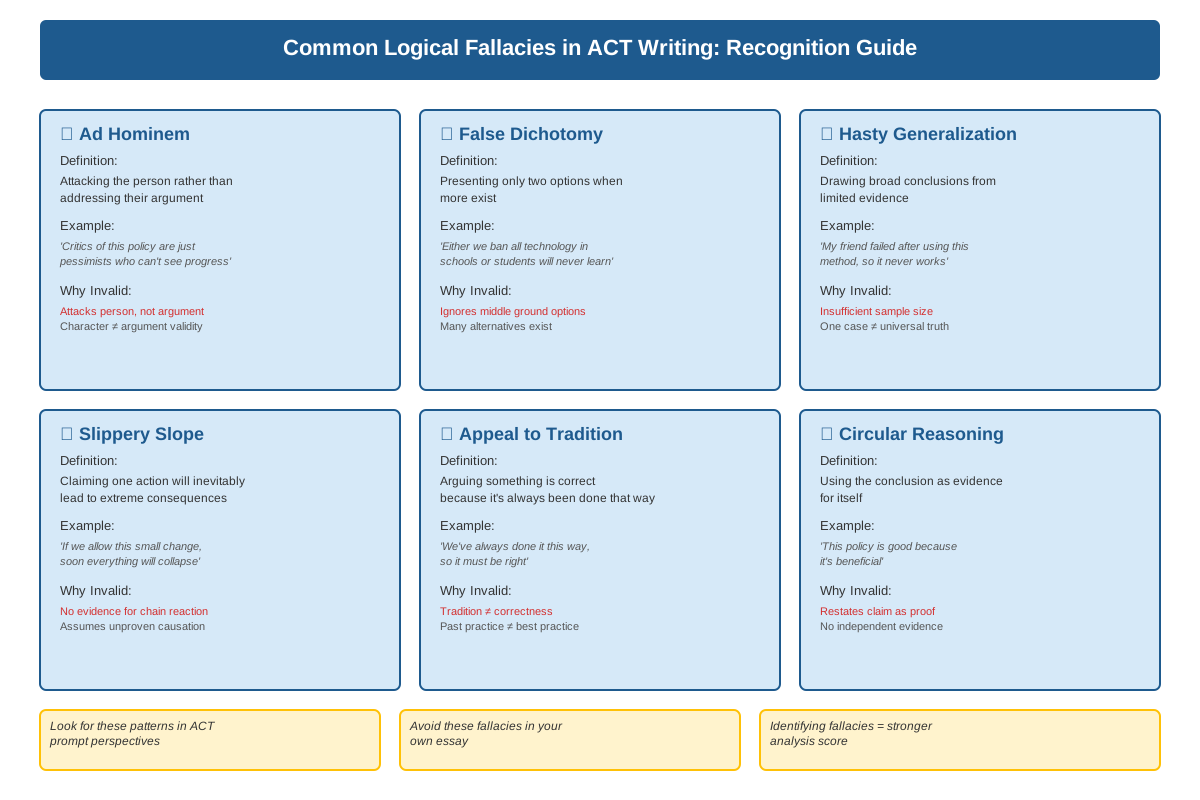
Logical fallacies are errors in reasoning that undermine an argument's validity. Recognizing these fallacies helps students avoid them in their own writing and identify weaknesses in the perspectives provided by ACT prompts.
Ad hominem: Attacking the person making an argument rather than the argument itself. Example: "We shouldn't consider this perspective on education reform because it comes from someone who never attended public school."
Straw man: Misrepresenting an opponent's argument to make it easier to attack. Example: "Those who support increased technology in classrooms want to replace all teachers with computers."
False dichotomy: Presenting only two options when more exist. Example: "Either we fully embrace artificial intelligence in education or we fall behind other nations."
Slippery slope: Arguing that one action will inevitably lead to extreme consequences without justification. Example: "If we allow students to use calculators, soon they won't be able to perform any mental math at all."
Hasty generalization: Drawing broad conclusions from insufficient evidence. Example: "My friend struggled with online learning, so online education doesn't work for anyone."
Appeal to authority: Assuming something is true because an authority figure says so, without examining the reasoning. Example: "This education policy must be good because a famous CEO supports it."
Circular reasoning: Using the conclusion as a premise. Example: "Standardized tests are necessary because we need standardized tests to measure student achievement."
Premises and Conclusions
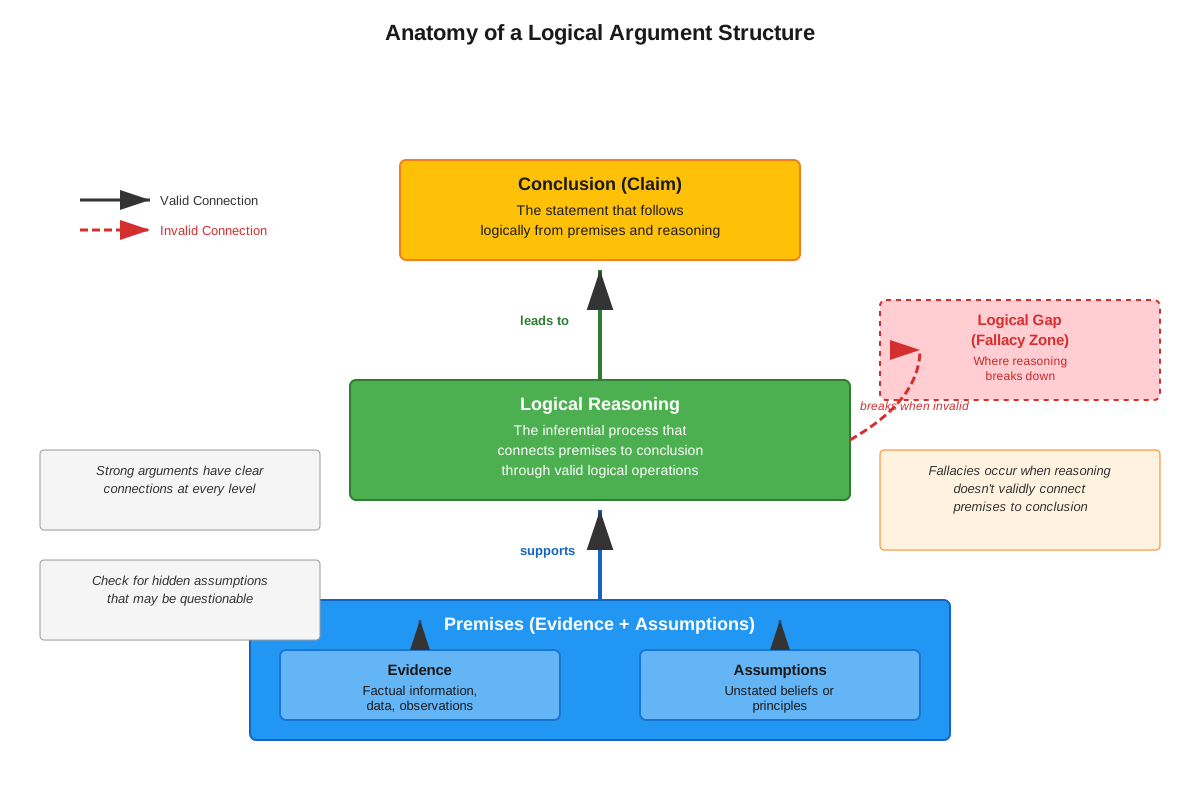
Every logical argument contains premises (statements offered as reasons) and a conclusion (the statement being supported). Identifying these components is essential for analyzing the logical structure of ACT perspectives.
Indicator words help identify premises and conclusions:
- Premise indicators: because, since, given that, for the reason that, as indicated by
- Conclusion indicators: therefore, thus, consequently, it follows that, we can conclude
In ACT essays, students must make their logical structure explicit by clearly stating premises and showing how conclusions follow. For example: "Since educational equity requires equal access to resources (premise), and technology provides access to vast information (premise), schools should prioritize technology funding (conclusion)."
Necessary and Sufficient Conditions
Understanding necessary conditions (requirements that must be met) versus sufficient conditions (requirements that guarantee an outcome) strengthens logical reasoning. A necessary condition must be present for something to occur, but its presence alone doesn't guarantee the outcome. A sufficient condition, when present, guarantees the outcome.
For example, studying is necessary for ACT success (you can't succeed without it) but not sufficient (studying alone doesn't guarantee success—you also need effective strategies). On the ACT, students often need to evaluate whether evidence provides necessary support for a claim or whether it's sufficient to prove the claim conclusively.
Logical Connectives and Relationships
Arguments rely on logical connectives that express relationships between ideas:
- Causation: One event causes another (X causes Y)
- Correlation: Two events occur together without necessarily causing each other (X correlates with Y)
- Contradiction: Two statements cannot both be true (X contradicts Y)
- Implication: One statement logically leads to another (X implies Y)
- Equivalence: Two statements mean the same thing (X is equivalent to Y)
ACT essays demonstrate strong logical reasoning when students accurately identify and articulate these relationships. A common error is confusing correlation with causation—noting that two things occur together and incorrectly concluding that one causes the other.
Concept Relationships
The concepts within logical reasoning form an interconnected system. Deductive and inductive reasoning serve as the two fundamental approaches to constructing arguments, with deductive reasoning providing certainty and inductive reasoning providing probability. Both types of reasoning must avoid logical fallacies, which represent breakdowns in the reasoning process. Understanding premises and conclusions enables students to map the structure of any argument, whether using deductive or inductive approaches. The distinction between necessary and sufficient conditions refines how students connect premises to conclusions, ensuring they don't overclaim or underclaim the strength of their reasoning. Finally, logical connectives provide the language for expressing these relationships explicitly.
These logical reasoning concepts connect to prerequisite knowledge of basic argument structure by adding analytical depth. While argument structure identifies what components exist (claim, evidence, reasoning), logical reasoning examines how these components relate and whether those relationships are valid. This topic also connects forward to counterargument integration, as evaluating opposing perspectives requires identifying their logical strengths and weaknesses.
Relationship map: Premises → (connected by logical connectives) → Conclusions (validated through deductive/inductive reasoning) → (checked against) Logical Fallacies → (evaluated for) Validity and Soundness → (expressed using) Necessary/Sufficient Conditions
High-Yield Facts
⭐ The ACT Writing rubric explicitly rewards "productive context" and "analysis of implications," both of which require logical reasoning skills
⭐ Valid arguments can contain false premises; sound arguments must have both valid structure and true premises
⭐ Correlation does not imply causation—this is the most common logical error in student essays
⭐ Every ACT Writing prompt presents exactly three perspectives that students must analyze for logical coherence
⭐ High-scoring essays demonstrate logical reasoning by explaining why and how, not just what
- Deductive reasoning provides certainty when premises are true; inductive reasoning provides probability based on evidence patterns
- Logical fallacies undermine argument credibility even when the conclusion might be correct
- Necessary conditions must be present but don't guarantee outcomes; sufficient conditions guarantee outcomes when present
- Premise indicators (because, since) and conclusion indicators (therefore, thus) help identify argument structure
- The slippery slope fallacy assumes extreme consequences without justification for the causal chain
- Ad hominem attacks target the person rather than addressing the argument's logical merit
- False dichotomies limit options artificially, ignoring middle ground or alternative solutions
- Circular reasoning uses the conclusion as evidence for itself, providing no actual support
- Hasty generalizations draw broad conclusions from insufficient or unrepresentative examples
- Strong logical reasoning anticipates objections and addresses them through sound reasoning rather than dismissal
Quick check — test yourself on Logical reasoning so far.
Try Flashcards →Common Misconceptions
Misconception: Logical reasoning only matters in formal debate or philosophy classes, not in ACT essays.
Correction: The ACT Writing rubric directly assesses logical reasoning through the Ideas and Analysis domain, which evaluates how well students analyze perspectives and develop their own arguments. Logical reasoning determines whether an essay scores in the 4-6 range (basic reasoning) or the 10-12 range (sophisticated analysis).
Misconception: If a conclusion seems obviously true, the logical reasoning doesn't need to be explained.
Correction: ACT readers specifically look for explicit reasoning that connects evidence to claims. Even when a conclusion seems self-evident, high-scoring essays demonstrate how the conclusion follows from the premises. Implicit reasoning receives lower scores than explicit logical connections.
Misconception: Using complex vocabulary and sophisticated sentence structure demonstrates logical reasoning.
Correction: Logical reasoning refers to the quality of the argument's structure and the validity of connections between ideas, not the complexity of language used. An essay can use simple language while demonstrating sophisticated logical reasoning, and conversely, can use advanced vocabulary while making logically flawed arguments.
Misconception: Providing more examples automatically strengthens logical reasoning.
Correction: The quantity of examples matters less than their relevance and how they're connected to the argument. One well-analyzed example with clear logical connections to the thesis demonstrates stronger reasoning than multiple examples listed without explanation of their logical significance.
Misconception: Acknowledging counterarguments weakens your logical position.
Correction: Addressing counterarguments actually strengthens logical reasoning by demonstrating awareness of complexity and showing that your position withstands scrutiny. The ACT rewards nuanced analysis that considers multiple perspectives rather than one-sided arguments.
Misconception: Emotional appeals are the opposite of logical reasoning and should be avoided entirely.
Correction: While logical reasoning emphasizes rational connections, effective arguments can combine logical reasoning with appropriate emotional appeals. The key is ensuring that emotional elements support rather than replace logical structure. An essay can acknowledge emotional dimensions of an issue while maintaining sound logical reasoning.
Worked Examples
Example 1: Analyzing Logical Structure in an ACT Perspective
Prompt Context: The ACT prompt discusses whether schools should require students to learn coding.
Given Perspective: "Coding should be required because it's the language of the future. Students who don't learn coding will be left behind in the job market, unable to compete with their peers who have these essential skills."
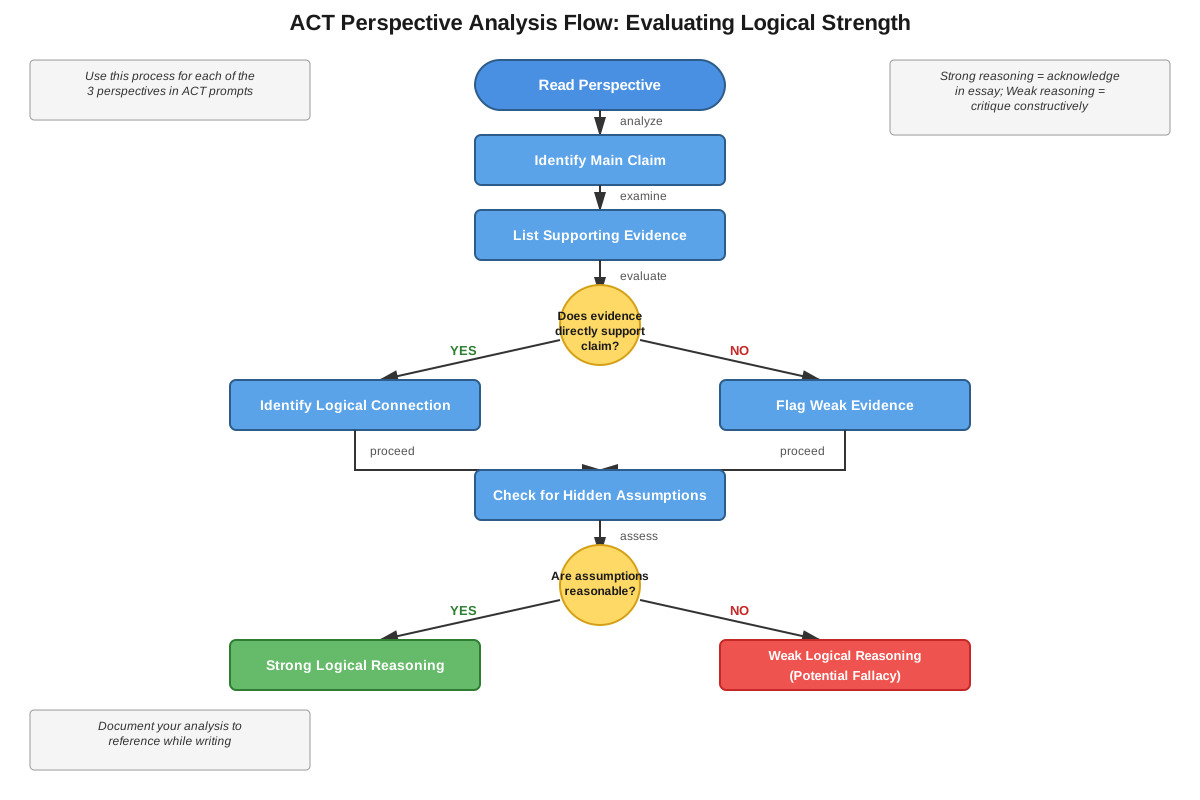
Analysis Process:
Step 1: Identify the conclusion
The conclusion is: "Coding should be required [in schools]"
Step 2: Identify the premises
- Premise 1: Coding is "the language of the future"
- Premise 2: Students without coding skills will be unable to compete in the job market
Step 3: Evaluate the logical connections
The argument uses deductive reasoning: If coding is essential for future jobs (general principle), and we want students to succeed in future jobs (implied premise), then schools should teach coding (specific conclusion).
Step 4: Identify potential logical weaknesses
- The phrase "language of the future" is vague and unsubstantiated—this premise needs support
- The argument contains a false dichotomy: it suggests students either learn coding or "will be left behind," ignoring middle ground (students might learn coding later, or succeed in non-coding careers)
- There's a hasty generalization: assuming all future jobs require coding based on current trends in some industries
Step 5: Develop a response demonstrating logical reasoning
"While this perspective correctly identifies coding as an increasingly valuable skill, its reasoning contains logical gaps. The claim that students without coding 'will be unable to compete' presents a false dichotomy, ignoring the many career paths that don't require programming skills. A more logically sound argument would acknowledge that coding provides advantages in some fields while recognizing that other skills—critical thinking, communication, creativity—remain essential across all careers. Furthermore, the premise that coding is 'the language of the future' requires support: which specific jobs require it, and what percentage of the workforce needs these skills? Without this evidence, the conclusion that coding should be required for all students doesn't necessarily follow."
Connection to Learning Objectives: This example demonstrates identifying when logical reasoning is tested (analyzing given perspectives), explaining core strategies (recognizing fallacies and evaluating premise-conclusion connections), and applying logical reasoning to ACT-style content.
Example 2: Constructing a Logically Sound Argument
Prompt Context: Should high schools allow students to design their own curricula?
Task: Develop a thesis and supporting paragraph that demonstrates strong logical reasoning.
Step 1: Establish clear premises
- Premise 1: Effective learning requires student engagement and intrinsic motivation
- Premise 2: Students are more engaged when they have agency over their learning
- Premise 3: Complete curricular freedom without guidance can lead to gaps in essential knowledge
- Premise 4: Educational systems must balance student autonomy with ensuring foundational competencies
Step 2: Construct a logically valid conclusion
"High schools should implement a hybrid model where students choose electives and project topics within a framework of required core competencies."
Step 3: Write the paragraph with explicit logical connections
"High schools should adopt a hybrid approach to curriculum design that balances student autonomy with essential learning requirements. Since research consistently demonstrates that student engagement increases when learners have agency over their education (premise), and given that engagement directly correlates with retention and deep learning (premise), schools should incorporate student choice into curricular structures (intermediate conclusion). However, complete freedom in curriculum design presents logical problems: students lack the developmental perspective to identify all skills they'll need for future success, and gaps in foundational knowledge—mathematics, literacy, scientific reasoning—would disadvantage them in higher education and careers (counterargument with logical reasoning). Therefore, the most logically sound approach provides structured choice: requiring core competencies that ensure necessary conditions for future success while allowing sufficient student agency to maintain the engagement that makes learning effective (final conclusion). This model avoids the false dichotomy of either complete teacher control or complete student freedom, recognizing that both guidance and autonomy serve necessary functions in education."
Step 4: Identify the logical reasoning demonstrated
- Uses deductive reasoning: applies general principles about engagement to specific policy recommendations
- Employs necessary and sufficient conditions: identifies core competencies as necessary but acknowledges that student agency is also needed
- Avoids false dichotomy: explicitly rejects either/or thinking
- Uses logical connectives explicitly: "since," "given that," "however," "therefore"
- Addresses counterarguments through logical analysis rather than dismissal
- Maintains validity: each conclusion follows from stated premises
- Pursues soundness: premises are reasonable and supported by evidence
Connection to Learning Objectives: This example shows how to apply logical reasoning to construct original arguments, avoid common fallacies, and integrate counterarguments through sound reasoning.
Exam Strategy
Approaching ACT Writing Questions on Logical Reasoning
Step 1: Analyze the prompt's logical structure first
Before planning your essay, spend 2-3 minutes identifying the logical relationships embedded in the prompt and perspectives. Note which perspectives use deductive vs. inductive reasoning, which contain potential fallacies, and where logical gaps exist. This analysis provides material for your essay's analytical content.
Step 2: Create a logical outline
Structure your essay so each paragraph has a clear logical purpose: establishing premises, drawing conclusions, analyzing perspective weaknesses, or addressing counterarguments. Use your outline to ensure your argument flows logically from introduction through conclusion.
Step 3: Make logical connections explicit
Use logical connectives ("because," "therefore," "however," "consequently") to show relationships between ideas. ACT readers can only credit logical reasoning they can see—implicit logic receives lower scores than explicit reasoning.
Trigger Words and Phrases
Watch for these phrases in ACT prompts that signal logical reasoning is being tested:
- "Analyze the relationship between..." (requires identifying logical connections)
- "Evaluate the implications of..." (requires deductive reasoning about consequences)
- "Consider the strengths and weaknesses..." (requires logical analysis of argument validity)
- "Develop your own perspective on the issue" (requires constructing logically sound arguments)
- "Explain the relationship between your perspective and those given" (requires comparative logical analysis)
In the perspectives themselves, notice:
- Absolute language ("always," "never," "all," "none") that may indicate overgeneralization
- Causal claims ("leads to," "causes," "results in") that require logical scrutiny
- Conditional statements ("if...then") that establish logical relationships
- Value judgments without supporting reasoning
Process-of-Elimination Tips
When evaluating which perspective to support or how to develop your argument:
- Eliminate perspectives with obvious logical fallacies as primary support for your thesis, though you can discuss them as examples of flawed reasoning
- Eliminate one-dimensional arguments that ignore complexity—ACT rewards nuanced thinking
- Eliminate responses that merely restate perspectives without analyzing their logical structure
- Prioritize arguments that acknowledge necessary vs. sufficient conditions rather than oversimplifying causal relationships
Time Allocation
- 5 minutes: Analyze prompt and perspectives for logical structure, identify fallacies, plan your logical argument
- 30 minutes: Write essay, ensuring each paragraph contains explicit logical reasoning
- 5 minutes: Review for logical coherence—do conclusions follow from premises? Are connections explicit?
Exam Tip: If you're running short on time, prioritize making your logical reasoning explicit over adding more examples. One well-reasoned paragraph outscores three paragraphs of examples without logical analysis.
Memory Techniques
Mnemonic for Common Logical Fallacies: "SHAFTS"
- Slippery slope: Assuming extreme consequences without justification
- Hasty generalization: Broad conclusions from insufficient evidence
- Ad hominem: Attacking the person, not the argument
- False dichotomy: Presenting only two options when more exist
- Transfer of authority: Assuming authority in one area means authority in all areas
- Straw man: Misrepresenting an argument to attack it more easily
Visualization Strategy for Argument Structure
Picture your argument as a bridge: premises are the support pillars, logical reasoning is the structural framework connecting them, and your conclusion is the destination. Each pillar must be solid (sound premises), and the framework must be properly engineered (valid reasoning) for the bridge to hold weight (convince readers).
Acronym for Logical Analysis: "PAVE"
When analyzing any perspective or constructing your argument:
- Premises: What are the foundational claims?
- Assumptions: What unstated beliefs does the argument rely on?
- Validity: Do conclusions follow from premises?
- Evidence: What support exists for the premises?
Memory Hook for Necessary vs. Sufficient
Necessary = Need (you need it, but it's not enough alone)
Sufficient = Sure thing (if you have it, you're sure to get the result)
Example: Oxygen is necessary for fire (you need it) but not sufficient (you also need fuel and heat). A match in a gas-filled room is sufficient for fire (it's a sure thing).
Summary
Logical reasoning forms the intellectual foundation of ACT Writing success, enabling students to analyze given perspectives critically and construct sophisticated arguments of their own. This skill encompasses understanding deductive and inductive reasoning patterns, recognizing the difference between valid and sound arguments, identifying common logical fallacies, and explicitly connecting premises to conclusions through clear logical relationships. The ACT specifically tests logical reasoning through the essay task, where students must evaluate three perspectives on a complex issue and develop their own position with nuanced analysis. High-scoring essays demonstrate logical reasoning by making connections explicit, avoiding fallacies like false dichotomies and hasty generalizations, addressing counterarguments through sound reasoning rather than dismissal, and showing awareness of necessary versus sufficient conditions. Success requires not just having good ideas but showing how those ideas follow logically from evidence and principles, using logical connectives to make reasoning visible to readers, and maintaining both validity (proper logical structure) and soundness (reasonable premises) throughout the argument.
Key Takeaways
- Logical reasoning is explicitly assessed in the ACT Writing rubric through the Ideas and Analysis domain, making it essential for high scores
- Make logical connections explicit using connectives like "because," "therefore," and "however"—implicit reasoning receives lower scores
- Avoid the seven major fallacies (ad hominem, straw man, false dichotomy, slippery slope, hasty generalization, appeal to authority, circular reasoning) in your own writing and identify them in given perspectives
- Valid arguments have proper structure; sound arguments have both proper structure and true premises—aim for soundness in your essays
- Deductive reasoning provides certainty from general to specific; inductive reasoning provides probability from specific to general—use both appropriately
- Address counterarguments through logical analysis rather than dismissal to demonstrate sophisticated reasoning
- Distinguish necessary conditions (required but not sufficient) from sufficient conditions (guarantee the outcome) to avoid overclaiming or underclaiming
Related Topics
Counterargument Integration: Building on logical reasoning skills, this topic focuses specifically on how to acknowledge, analyze, and respond to opposing viewpoints in ways that strengthen rather than weaken your argument. Mastering logical reasoning provides the analytical tools needed to evaluate counterarguments fairly and respond to them effectively.
Evidence Selection and Analysis: While logical reasoning focuses on the connections between ideas, evidence selection examines what types of support strengthen arguments. These topics work together—logical reasoning determines whether evidence actually supports a claim, while evidence selection ensures you choose the most relevant support.
Thesis Development: A strong thesis makes a claim that can be supported through logical reasoning. Understanding logical reasoning helps you craft thesis statements that are neither too broad (leading to hasty generalizations) nor too narrow (missing the prompt's complexity).
Rhetorical Analysis: This advanced skill involves identifying how writers use logical reasoning (logos), emotional appeals (pathos), and credibility (ethos) to persuade audiences. Logical reasoning provides the foundation for understanding the logos component of rhetoric.
Practice CTA
Now that you understand the principles of logical reasoning, it's time to apply these concepts to actual ACT-style prompts. The practice questions and flashcards will help you recognize logical fallacies quickly, construct sound arguments under time pressure, and develop the analytical skills that distinguish high-scoring essays from average ones. Remember: logical reasoning is a skill that improves with deliberate practice. Each practice essay you write with attention to logical structure strengthens your ability to think critically and argue persuasively—skills that will serve you not just on test day, but throughout your academic and professional career. Approach the practice materials with the same analytical mindset you've developed in this guide, and you'll see measurable improvement in your logical reasoning abilities.
Sign up free to keep reading
Create a free AnvayaPrep account to finish this ACT guide on Logical reasoning — plus flashcards and practice questions.