Overview
Specific evidence is one of the most critical components of effective argumentation on the ACT Writing test. When evaluating essays, ACT graders consistently emphasize the importance of supporting claims with concrete, detailed examples rather than vague generalizations or abstract statements. The ability to recognize, evaluate, and deploy specific evidence distinguishes high-scoring essays from mediocre ones and frequently appears in multiple-choice questions that ask students to strengthen arguments or identify weaknesses in reasoning.
On the ACT Writing test, ACT specific evidence refers to concrete details, facts, statistics, examples, or observations that directly support a claim or thesis statement. This concept extends beyond simply including "any" support—the evidence must be precise, relevant, and sufficiently detailed to convince a reader. Students who master this skill can identify when an argument lacks substantiation, recognize which types of evidence most effectively support particular claims, and understand how to integrate evidence seamlessly into their own writing. The ACT frequently tests this concept through questions asking students to select the most effective supporting detail, identify irrelevant information, or evaluate the strength of an argument based on its evidentiary foundation.
Understanding specific evidence connects directly to broader Writing concepts including thesis development, logical reasoning, and persuasive techniques. An argument's persuasiveness depends not only on its logical structure but also on the quality and specificity of evidence supporting each point. This topic serves as a bridge between understanding argument structure (knowing what claims need support) and effective implementation (providing that support convincingly). Mastery of specific evidence enables students to both analyze others' arguments critically and construct compelling arguments of their own.
Learning Objectives
- [ ] Identify when Specific evidence is being tested in ACT Writing questions
- [ ] Explain the core rule or strategy behind Specific evidence and its role in argumentation
- [ ] Apply Specific evidence principles to ACT-style questions accurately
- [ ] Distinguish between specific and vague evidence in sample passages
- [ ] Evaluate the relevance and effectiveness of evidence in supporting particular claims
- [ ] Generate appropriate specific evidence for given thesis statements
- [ ] Recognize common patterns of insufficient evidence in weak arguments
Prerequisites
- Basic argument structure: Understanding claims, reasons, and support is essential because specific evidence functions as the support layer of argumentation
- Reading comprehension skills: The ability to identify main ideas and supporting details enables recognition of how evidence relates to claims
- Understanding of relevance: Knowing what "on-topic" means helps distinguish between specific evidence that supports a claim and specific details that are irrelevant
Why This Topic Matters
In real-world contexts, the ability to support claims with specific evidence is fundamental to persuasive communication across professional, academic, and civic domains. Whether writing a business proposal, academic research paper, legal brief, or policy recommendation, the credibility of arguments depends on concrete supporting details. Employers consistently rank evidence-based reasoning among the most valuable skills for college graduates, making this competency valuable far beyond standardized testing.
On the ACT Writing test, specific evidence appears with high frequency and significant impact on scores. Approximately 30-40% of multiple-choice Writing questions directly or indirectly assess students' understanding of evidence quality and relevance. These questions appear in several formats: selecting the most effective supporting detail from multiple options, identifying sentences that should be deleted because they lack specificity, determining which addition would most strengthen a paragraph, and evaluating whether evidence adequately supports a claim. The essay portion of the ACT Writing test explicitly evaluates "Development and Support" as one of four scoring domains, with specific evidence serving as the primary criterion distinguishing scores of 4-6 from scores of 1-3.
Common manifestations in ACT passages include: arguments that begin with strong claims but provide only general statements as support; paragraphs containing a mix of specific and vague evidence where students must identify which sentences are most effective; revision questions asking students to replace vague language with concrete details; and rhetorical skills questions requiring evaluation of whether added information would strengthen or weaken an argument. Understanding specific evidence is not merely helpful—it is essential for achieving competitive Writing scores.
Core Concepts
Defining Specific Evidence
Specific evidence consists of concrete, detailed information that directly supports a claim or argument. Unlike general statements or abstract assertions, specific evidence includes particular facts, statistics, examples, observations, or scenarios that a reader can visualize or verify. The specificity lies in the precision and detail level—specific evidence answers questions like "who," "what," "when," "where," "how many," or "in what way" rather than making broad, unsubstantiated claims.
Consider the difference between these two statements:
- Vague: "Many students struggle with time management."
- Specific: "According to a 2019 survey of 1,200 high school students, 67% reported missing assignment deadlines at least once per month due to poor planning."
The second statement provides measurable details (survey year, sample size, specific percentage, frequency) that make the claim concrete and verifiable. This level of detail characterizes effective specific evidence on the ACT.
The Specificity Spectrum
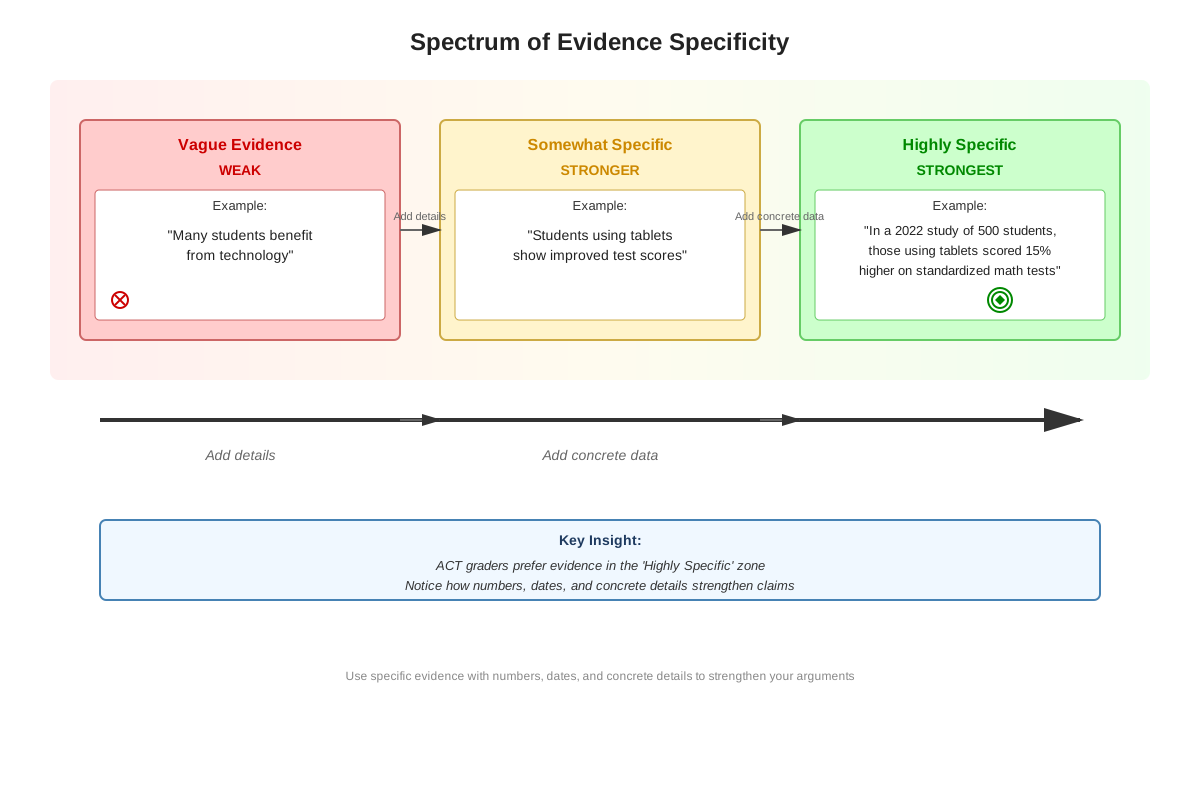
Evidence exists on a continuum from extremely vague to highly specific. Understanding this spectrum helps students evaluate evidence quality:
| Evidence Type | Characteristics | Example |
|---|---|---|
| Highly Vague | Abstract, no details, unverifiable | "Things are getting worse" |
| Moderately Vague | General category mentioned, no specifics | "Technology affects students" |
| Somewhat Specific | Category with some detail | "Smartphones distract students in class" |
| Moderately Specific | Concrete example with limited detail | "Students check social media during lectures" |
| Highly Specific | Detailed, measurable, verifiable | "A 2020 study of 500 college students found that 78% checked their phones an average of 11 times during 50-minute lectures, reducing information retention by 23%" |
On the ACT, questions typically contrast moderately vague evidence with moderately-to-highly specific evidence. Students must recognize that more specific evidence generally provides stronger support, assuming relevance remains constant.
Relevance and Specificity: The Dual Requirement
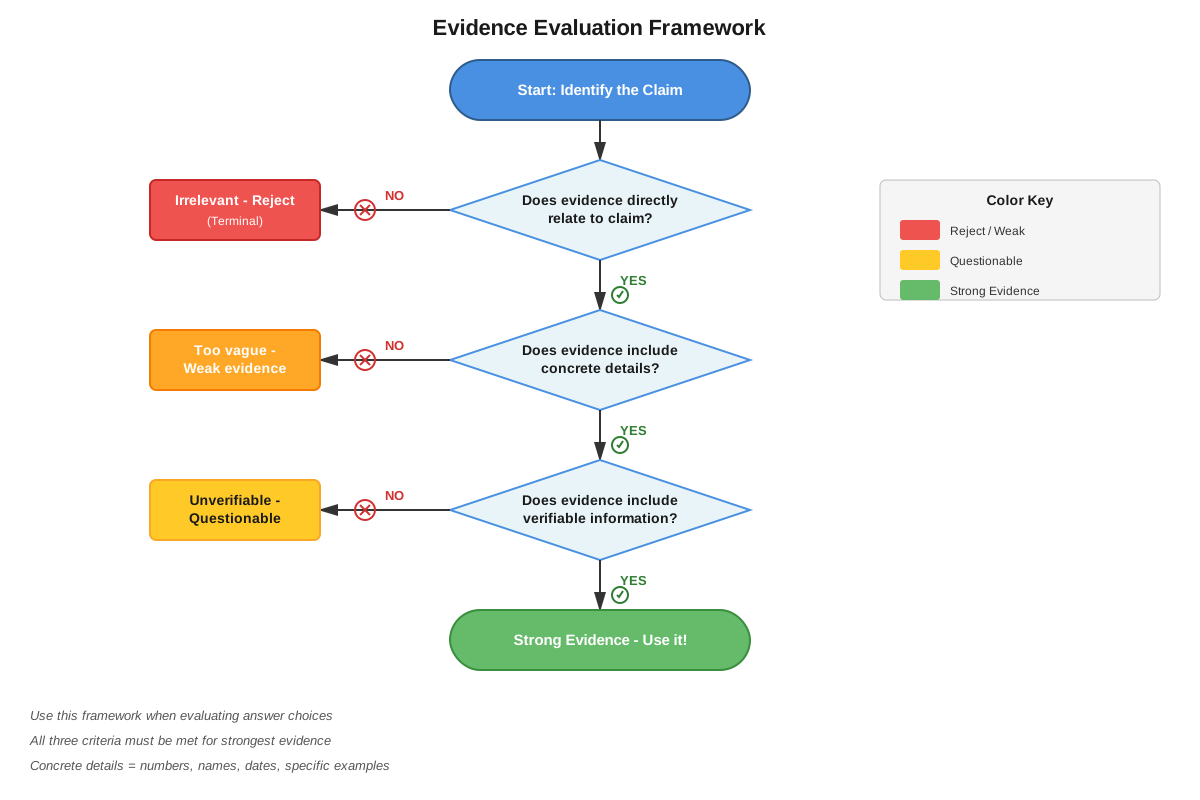
A critical concept that ACT questions frequently test is the distinction between specific evidence and relevant evidence. Evidence must satisfy both criteria to effectively support an argument. Information can be highly specific yet completely irrelevant to the claim it supposedly supports. Conversely, evidence can be relevant in topic but too vague to provide meaningful support.
Relevant but vague: "Exercise improves health" (supports a claim about fitness benefits but lacks concrete detail)
Specific but irrelevant: "The gymnasium was built in 1987 and contains 12,000 square feet of space" (provides specific details but doesn't support a claim about exercise benefits)
Both specific and relevant: "Regular aerobic exercise for 30 minutes five times weekly reduces cardiovascular disease risk by 35% according to a 10-year study of 50,000 adults" (provides concrete details directly supporting a claim about exercise benefits)
ACT questions often include answer choices that are specific but irrelevant, testing whether students understand that both criteria must be satisfied.
Types of Specific Evidence
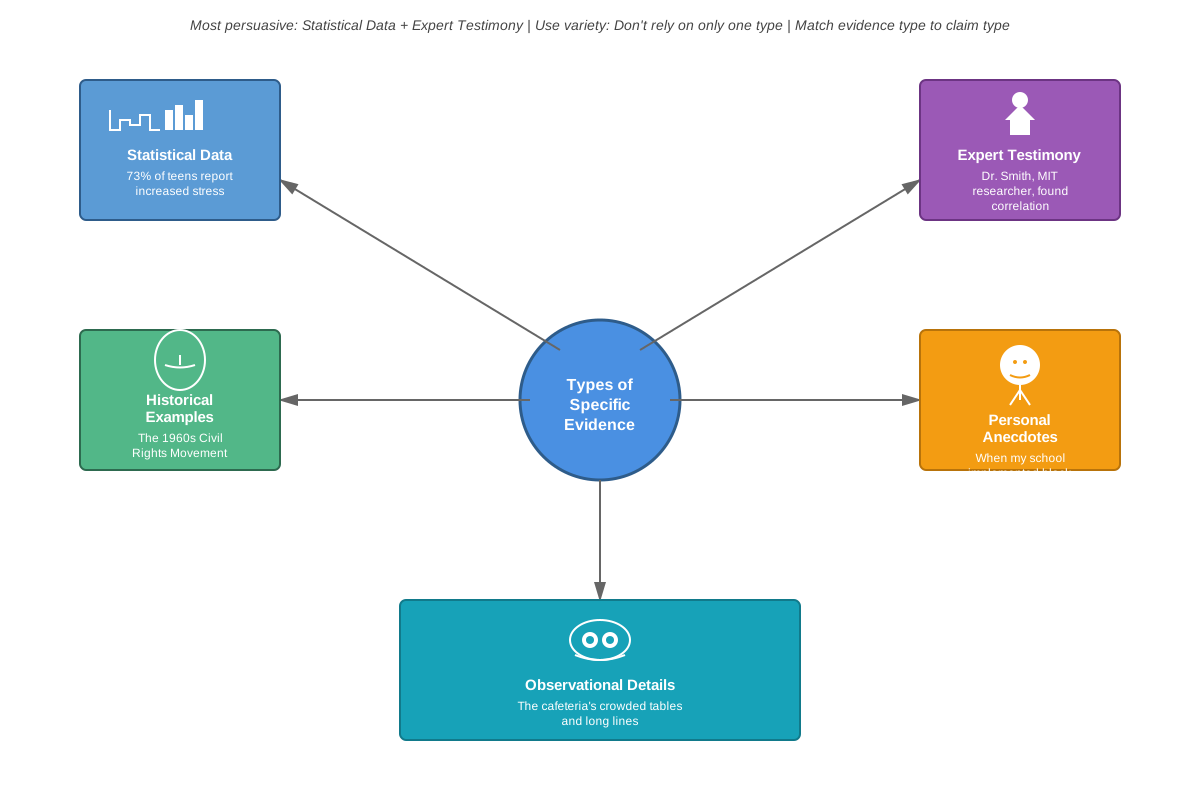
The ACT recognizes several categories of specific evidence, each with particular strengths:
- Statistical evidence: Numerical data, percentages, measurements, or quantified results that provide objective support
- Expert testimony: Specific quotations or findings from credible authorities in relevant fields
- Historical examples: Concrete instances from the past with specific dates, people, or events
- Personal anecdotes: Detailed narratives about specific individuals or experiences
- Case studies: In-depth examinations of particular situations or examples
- Comparative data: Specific before-and-after measurements or side-by-side comparisons
Understanding these categories helps students recognize what makes evidence specific and select the most appropriate type for different argumentative contexts.
Integration and Context
Specific evidence doesn't exist in isolation—it must be integrated into arguments with appropriate context and explanation. The ACT tests whether students understand that effective evidence requires:
- Introduction: Brief context explaining what the evidence is and where it comes from
- Presentation: The specific details themselves
- Explanation: Analysis connecting the evidence back to the claim it supports
Weak arguments present evidence without explanation, leaving readers to infer connections. Strong arguments explicitly articulate how evidence supports claims. ACT questions may ask students to identify which sentence best explains the significance of evidence or which transition most effectively introduces supporting details.
Concept Relationships
The concepts within specific evidence form an interconnected system. The specificity spectrum provides the framework for evaluating evidence quality, while relevance serves as the necessary filter ensuring that specific details actually support the argument. These two concepts combine to create the dual requirement that distinguishes effective from ineffective evidence. The various types of specific evidence represent different manifestations of specificity, each appropriate for different argumentative contexts. Finally, integration and context describes how specific evidence functions within the larger argument structure.
This topic connects to prerequisite knowledge of argument structure by providing the concrete support layer that validates claims and reasons. Understanding relevance from reading comprehension enables students to evaluate whether specific evidence actually connects to the claim it supposedly supports. The concept extends forward to more advanced topics including rhetorical analysis (evaluating how authors use evidence persuasively), counterargument (using specific evidence to refute opposing views), and synthesis (combining multiple pieces of specific evidence to support complex claims).
The relationship map flows as follows: Argument Structure → Requires Support → Support Must Be Specific (specificity spectrum) → Specificity Must Be Relevant (dual requirement) → Manifests as Different Types → Must Be Integrated Effectively → Creates Persuasive Arguments
High-Yield Facts
⭐ Specific evidence includes concrete details such as names, dates, statistics, or measurable observations rather than general statements
⭐ Evidence must be both specific AND relevant to effectively support a claim—specificity alone is insufficient
⭐ ACT questions frequently contrast vague evidence with specific evidence, requiring students to identify the more effective option
⭐ Numerical data and statistics typically represent highly specific evidence when they include precise measurements or percentages
⭐ The most common weakness in ACT Writing passages is providing general statements instead of concrete supporting details
- Personal anecdotes can serve as specific evidence when they include concrete details about particular people, places, or events
- Evidence specificity exists on a spectrum from highly vague to highly specific, not as a binary category
- Specific but irrelevant evidence is a common distractor in ACT answer choices
- Effective integration of specific evidence requires introduction, presentation, and explanation
- Historical examples become specific evidence when they include particular dates, people, or events rather than general historical periods
Quick check — test yourself on Specific evidence so far.
Try Flashcards →Common Misconceptions
Misconception: Any example or detail counts as specific evidence → Correction: Evidence must include concrete, precise details to qualify as specific; general examples like "many people" or "some studies" remain vague without particular details about which people or studies.
Misconception: Longer explanations automatically provide more specific evidence → Correction: Length doesn't equal specificity; a lengthy paragraph of general statements provides less effective support than a single sentence with concrete statistics or examples.
Misconception: Personal opinions become specific evidence when stated confidently → Correction: Opinions, regardless of how strongly stated, are not specific evidence; evidence requires verifiable facts, examples, or data external to the writer's beliefs.
Misconception: Specific evidence always strengthens an argument → Correction: Evidence must be both specific and relevant; highly specific details about irrelevant topics weaken rather than strengthen arguments by distracting from the main claim.
Misconception: All types of specific evidence are equally effective for all claims → Correction: Different claims require different evidence types; scientific claims benefit from statistical evidence and expert testimony, while arguments about personal experience may be better supported by detailed anecdotes.
Misconception: Adding any specific detail improves a paragraph → Correction: Specific details must directly support the paragraph's main idea; irrelevant specific details clutter arguments and reduce clarity even though they are concrete.
Worked Examples
Example 1: Identifying Specific Evidence
Question: Which of the following sentences provides the most specific evidence to support the claim that "social media use affects teenage mental health"?
A) Social media has become very popular among teenagers in recent years.
B) Many experts believe that social media can be harmful to young people.
C) A 2021 study of 3,000 teenagers found that those who spent more than 3 hours daily on social media platforms reported depression symptoms at rates 27% higher than peers who spent less than 1 hour daily.
D) Teenagers often spend too much time on their phones instead of interacting face-to-face.
Analysis:
First, identify what the claim requires: evidence demonstrating a connection between social media use and teenage mental health effects.
Option A provides specific information about social media popularity but doesn't address mental health effects—it's specific but irrelevant to the claim.
Option B mentions the topic (harm to young people) but remains vague: "many experts" (which experts? how many?), "can be harmful" (what specific harms?), "young people" (what age range?). This is relevant but not specific.
Option C includes multiple specific elements: study year (2021), sample size (3,000 teenagers), precise usage threshold (3 hours daily vs. less than 1 hour), specific outcome (depression symptoms), and quantified difference (27% higher rates). This evidence is both specific and directly relevant to the claim.
Option D makes a general statement about phone use and face-to-face interaction without providing measurable details or directly addressing mental health.
Answer: C provides the most specific evidence because it includes concrete, measurable details that directly support the claim about social media's effects on teenage mental health.
Example 2: Evaluating Evidence Relevance and Specificity
Question: A student is writing an essay arguing that "schools should start later in the morning to improve student performance." Which addition would provide the most effective specific evidence?
A) Sleep is very important for teenagers because their bodies are still developing.
B) The American Academy of Pediatrics, founded in 1930, represents over 67,000 pediatricians nationwide.
C) When Minneapolis Public Schools shifted start times from 7:15 AM to 8:40 AM in 1997, attendance rates increased by 5%, and the percentage of students earning A's and B's rose from 34% to 40%.
D) Many students feel tired during early morning classes and would prefer to sleep later.
Analysis:
The claim requires evidence connecting later school start times to improved student performance. Evaluate each option for both specificity and relevance.
Option A addresses sleep importance (relevant to the topic) but provides no specific evidence—"very important" and "still developing" are vague statements without concrete details. This lacks specificity.
Option B provides highly specific information (founding year, membership number) but this information about the organization itself doesn't connect to school start times or student performance. This is specific but irrelevant.
Option C includes multiple specific, relevant details: particular school district (Minneapolis Public Schools), specific time change (7:15 AM to 8:40 AM), exact year (1997), measurable outcomes (5% attendance increase, grade improvement from 34% to 40%). All details directly support the claim about later start times improving performance.
Option D addresses student preferences (somewhat relevant) but relies on vague language: "many students" (how many?), "feel tired" (how tired? measured how?), "would prefer" (based on what evidence?). This remains too general.
Answer: C provides the most effective specific evidence because it includes concrete, measurable details about an actual implementation of later start times and its documented effects on student performance metrics.
Exam Strategy
When approaching ACT Writing questions about specific evidence, follow this systematic process:
Step 1: Identify the claim or main idea that needs support. Before evaluating evidence, clearly understand what argument the evidence should support. Underline or mentally note the thesis statement or topic sentence.
Step 2: Apply the specificity test to each answer choice. Ask: Does this include concrete details (names, numbers, dates, specific examples) or does it use vague language (many, some, often, very)? Eliminate options that remain general or abstract.
Step 3: Apply the relevance test to remaining options. Ask: Does this specific information directly support the identified claim, or is it about a related but different topic? Eliminate specific but irrelevant options.
Step 4: Compare surviving options for degree of specificity. If multiple options are both specific and relevant, choose the one with more concrete, measurable details.
Exam Tip: Watch for trigger words that signal vague evidence: "many," "some," "often," "very," "really," "a lot," "things," "stuff," "people say," "experts believe" (without naming which experts). These words typically indicate insufficient specificity.
Exam Tip: Conversely, specific evidence often includes: proper nouns, numerical data, dates, percentages, quotations with attribution, specific place names, or detailed descriptions of particular events.
Time allocation: Spend approximately 30-45 seconds per question testing specific evidence. This allows 10 seconds to identify the claim, 15-20 seconds to evaluate options, and 10-15 seconds to verify your choice. Don't rush—these questions reward careful analysis of detail level.
Process of elimination strategy: First eliminate obviously vague options (those with multiple vague trigger words). Next eliminate specific but irrelevant options (those about related but different topics). Finally, choose the most specific among remaining relevant options. This three-stage elimination typically reduces four options to one clear answer.
Memory Techniques
SPECIFIC Acronym for evaluating evidence quality:
- Statistics or specific numbers included
- Precise language (not vague words like "many" or "some")
- Examples are concrete and detailed
- Connection to claim is clear
- Identifiable sources or attributions
- Facts that are verifiable
- Information includes who/what/when/where/how many
- Concrete rather than abstract
The "Newspaper Test": Imagine the evidence appearing in a news article. Would a journalist accept it as adequately specific, or would they ask follow-up questions like "How many?" "Which study?" "When?" If follow-up questions are needed, the evidence isn't specific enough.
Visualization Strategy: When reading evidence, try to create a mental picture. Specific evidence creates clear, detailed images (you can visualize "a 2020 study of 500 college students" or "Minneapolis schools shifting start times from 7:15 to 8:40"). Vague evidence creates fuzzy, unclear images ("many students" or "some research"). If you can't visualize concrete details, the evidence probably isn't specific enough.
The "Five W's" Check: Effective specific evidence typically answers multiple questions: Who? What? When? Where? Why? or How many? Count how many of these questions the evidence answers—more answers generally indicate greater specificity.
Summary
Specific evidence represents the concrete, detailed support that transforms weak arguments into persuasive ones. On the ACT Writing test, this concept appears frequently in questions asking students to identify effective supporting details, strengthen arguments, or evaluate evidence quality. The core principle requires understanding that evidence must satisfy two criteria: specificity (including concrete details like names, numbers, dates, or measurable observations rather than vague generalizations) and relevance (directly supporting the particular claim being made). Students must recognize that evidence exists on a spectrum from highly vague to highly specific, and ACT questions typically contrast these levels to test discrimination ability. Common question types include selecting the most effective supporting detail, identifying sentences that lack sufficient specificity, and evaluating whether proposed additions would strengthen arguments. Mastery requires both analytical skills (evaluating others' evidence) and generative skills (producing specific evidence in essay writing). The ability to distinguish specific from vague evidence and relevant from irrelevant details directly impacts both multiple-choice performance and essay scores, making this among the highest-yield topics in ACT Writing preparation.
Key Takeaways
- Specific evidence includes concrete, measurable details (names, dates, statistics, specific examples) rather than vague generalizations
- Evidence must be both specific AND relevant—specificity without relevance to the claim provides no effective support
- ACT questions frequently test the ability to distinguish between vague and specific evidence by contrasting answer choices
- Common vague trigger words include "many," "some," "often," and "very," while specific evidence includes numbers, proper nouns, and precise measurements
- The most effective specific evidence answers multiple questions: who, what, when, where, how many, or in what way
- Different types of specific evidence (statistics, expert testimony, historical examples, case studies) serve different argumentative purposes
- Integration matters—specific evidence must be introduced, presented, and explained to function effectively within arguments
Related Topics
Thesis Development: Understanding specific evidence enables stronger thesis statements because students learn to make claims they can support with concrete details rather than overly broad assertions that lack available evidence.
Counterargument and Refutation: Mastery of specific evidence allows students to both construct counterarguments using concrete opposing examples and refute them with more compelling specific evidence supporting their position.
Rhetorical Analysis: Analyzing how authors use specific evidence to persuade audiences builds on the foundational understanding of what makes evidence effective and how it functions within argumentative structures.
Source Integration and Citation: Advanced applications of specific evidence involve incorporating information from external sources, requiring understanding of how to attribute specific evidence to maintain credibility.
Practice CTA
Now that you understand the principles of specific evidence, it's time to apply this knowledge! Work through the practice questions to test your ability to identify specific versus vague evidence, evaluate relevance, and select the most effective supporting details. Use the flashcards to reinforce key concepts and trigger words that signal evidence quality. Remember: recognizing specific evidence in others' writing is the first step toward producing it in your own essays. Each practice question you complete strengthens both your analytical skills for multiple-choice questions and your writing skills for the essay portion. You've built the foundation—now practice applying it until distinguishing specific from vague evidence becomes automatic!
Sign up free to keep reading
Create a free AnvayaPrep account to finish this ACT guide on Specific evidence — plus flashcards and practice questions.