Overview
The thesis statement is the cornerstone of effective argumentative writing and represents one of the most critical elements tested on the ACT Writing exam. A thesis statement serves as the central claim or position that a writer takes on a given issue, providing both direction and purpose to the entire essay. On the ACT, the ability to craft a clear, defensible, and sophisticated thesis statement directly impacts scoring across multiple dimensions of the writing rubric, particularly in the Ideas and Analysis and Development and Support categories.
Understanding how to construct and recognize strong thesis statements is essential for ACT success because the exam evaluates not just whether students can write, but whether they can think critically and communicate complex ideas with precision. The ACT Writing test presents students with a contemporary issue and multiple perspectives, requiring them to analyze these viewpoints, develop their own position, and articulate that position through a compelling thesis. This skill extends beyond test-taking; it forms the foundation of academic writing at the college level and professional communication in virtually every career field.
The ACT thesis statement connects intimately with other Writing concepts including argument structure, evidence selection, counterargument integration, and conclusion development. A well-crafted thesis acts as the blueprint for the entire essay, determining which evidence will be relevant, how counterarguments should be addressed, and what the conclusion must accomplish. Without a strong thesis, even well-written paragraphs lack cohesion and purpose, resulting in lower scores across all rubric dimensions.
Learning Objectives
- [ ] Identify when Thesis statement is being tested
- [ ] Explain the core rule or strategy behind Thesis statement
- [ ] Apply Thesis statement to ACT-style questions accurately
- [ ] Distinguish between weak and strong thesis statements based on ACT rubric criteria
- [ ] Construct thesis statements that address multiple perspectives while establishing a clear position
- [ ] Evaluate thesis statements for specificity, defensibility, and analytical depth
- [ ] Revise vague or overly simple thesis statements to meet ACT scoring standards
Prerequisites
- Basic paragraph structure: Understanding topic sentences and supporting details provides the foundation for recognizing how a thesis governs an entire essay's organization
- Fundamental argumentation concepts: Familiarity with claims, evidence, and reasoning enables students to construct thesis statements that are actually arguable rather than statements of fact
- Reading comprehension skills: The ability to analyze the prompt and multiple perspectives is necessary before formulating a responsive thesis
- Basic grammar and sentence construction: A thesis must be grammatically correct and clearly written to effectively communicate the writer's position
Why This Topic Matters
In real-world contexts, the ability to articulate a clear position on complex issues is fundamental to academic success, professional advancement, and civic engagement. College professors expect students to develop sophisticated arguments in research papers, while employers value employees who can take positions on business challenges and defend them with reasoning. The thesis statement skill translates directly to writing proposals, policy recommendations, legal briefs, and persuasive communications across all professional fields.
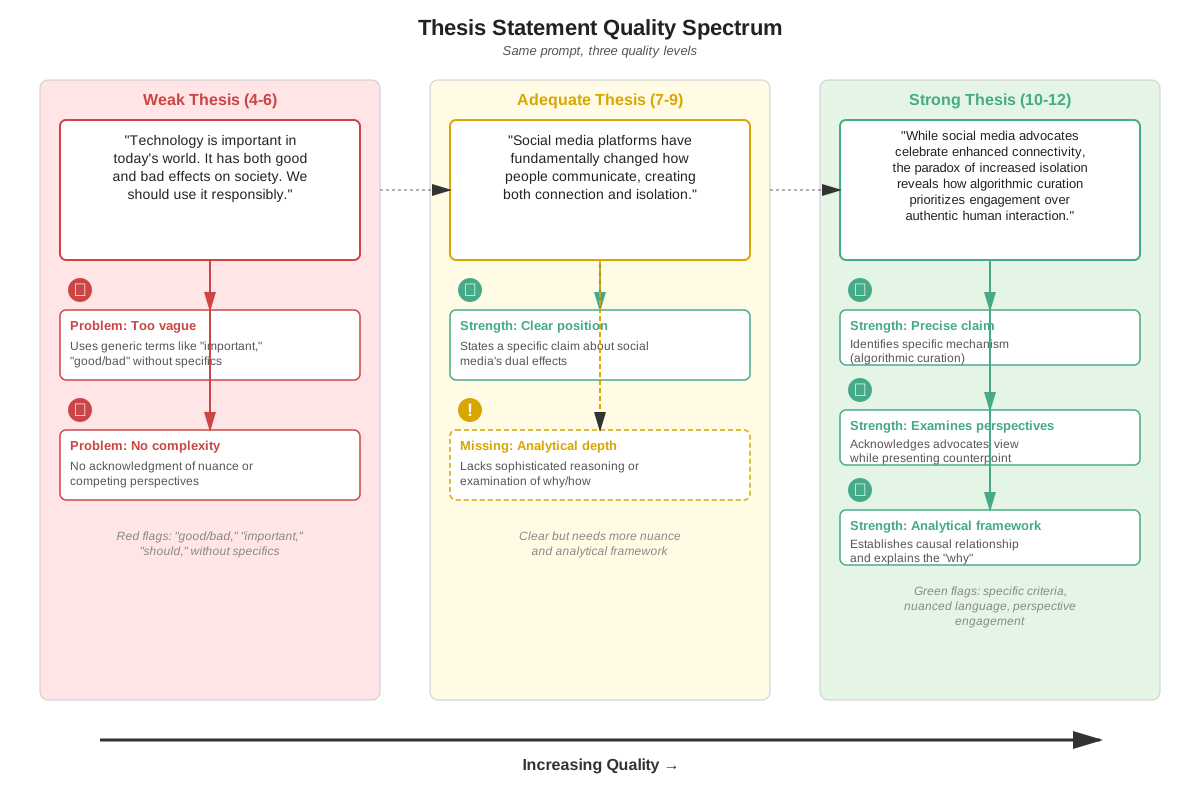
On the ACT Writing exam, the thesis statement appears in approximately 100% of high-scoring essays and is explicitly evaluated in the Ideas and Analysis domain of the rubric. According to ACT scoring guidelines, essays that score in the 10-12 range (out of 12) demonstrate "a precise central claim" that "examines multiple perspectives" and shows "a nuanced understanding of the issue." Essays scoring in the 4-6 range typically have thesis statements that are "unclear," "overly general," or fail to establish a meaningful position. The difference between these scoring tiers often hinges on thesis quality alone, making this topic one of the highest-yield areas for score improvement.
The thesis statement appears in ACT Writing in several predictable ways: as the central organizing principle of the essay (typically in the introduction), as a reference point for body paragraph development, and as a concept revisited in the conclusion. Graders specifically look for the thesis within the first two paragraphs and evaluate whether subsequent paragraphs clearly connect back to and support that central claim.
Core Concepts
Definition and Function of a Thesis Statement
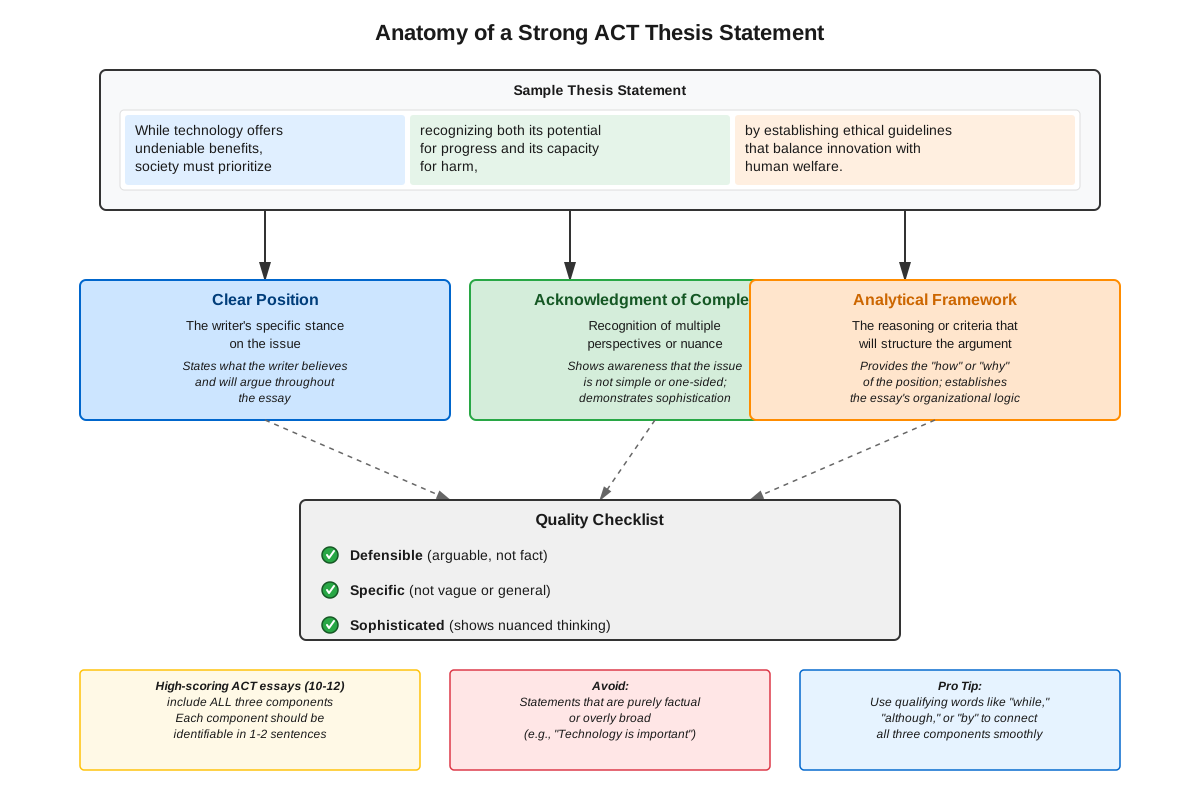
A thesis statement is a single sentence or closely related group of sentences that articulates the writer's central position on the issue presented in the prompt. Unlike a topic sentence that governs a single paragraph, the thesis governs the entire essay. It must be specific enough to be meaningful yet broad enough to require an essay-length discussion. The thesis serves three critical functions: it establishes the writer's position, it previews the reasoning that will support that position, and it provides a framework for organizing the essay's body paragraphs.
On the ACT, an effective thesis statement must respond directly to the prompt's issue while acknowledging the complexity presented by the multiple perspectives. It cannot simply restate one of the given perspectives; instead, it must demonstrate original thinking that synthesizes, extends, or complicates the perspectives provided. The strongest ACT thesis statements show analytical sophistication by recognizing nuances, qualifications, or conditions under which the position holds true.
Components of a Strong ACT Thesis Statement
A high-scoring ACT thesis contains four essential elements:
- Clear Position: The thesis must take a definitive stance on the issue, avoiding fence-sitting or excessive hedging
- Specificity: The claim must be precise enough to be meaningful, avoiding vague generalities like "there are pros and cons"
- Complexity: The thesis should acknowledge that the issue has multiple dimensions, often through qualification or conditional language
- Defensibility: The position must be supportable with reasoning and evidence within the constraints of a timed essay
Consider this comparison:
| Weak Thesis | Strong Thesis |
|---|---|
| "Technology has both positive and negative effects on education." | "While technology provides unprecedented access to information, its integration into K-12 classrooms should be carefully limited to preserve students' development of critical thinking skills that emerge from sustained, focused attention." |
| "We should think carefully about automation." | "Although automation threatens certain categories of employment, society should embrace technological advancement while simultaneously investing in robust retraining programs and strengthening social safety nets." |
| "The perspectives on this issue all have good points." | "Despite valid concerns about individual privacy, public health surveillance systems represent a necessary evolution in disease prevention, provided they include transparent oversight mechanisms and sunset provisions." |
Thesis Placement and Structure
On the ACT Writing exam, the thesis statement typically appears in one of two locations: at the end of the introductory paragraph or at the beginning of the second paragraph (after an introductory paragraph that provides context). Both placements are acceptable, but the thesis must appear early enough that graders can easily identify it and evaluate how well the essay fulfills its promise.
The structural pattern of an ACT thesis often follows this formula: [Acknowledgment of complexity] + [Clear position] + [Reasoning preview]. For example: "Although [concession to opposing view], [main claim] because [primary reason], [secondary reason], and [tertiary reason]." This structure demonstrates sophistication while maintaining clarity.
Relationship Between Thesis and Perspectives
The ACT Writing prompt always provides three perspectives on the issue. A sophisticated thesis must engage with these perspectives in some way—not necessarily agreeing or disagreeing with each one explicitly, but demonstrating awareness that multiple viewpoints exist. The strongest approaches include:
- Synthesis: Combining elements from multiple perspectives into a new position
- Qualification: Agreeing with a perspective under certain conditions or contexts
- Extension: Taking a perspective further or applying it in a new way
- Complication: Identifying limitations or unexamined assumptions in the perspectives
The thesis need not mention all three perspectives explicitly, but the essay as a whole must address them, and the thesis should set up this engagement.
Evaluating Thesis Quality
ACT graders evaluate thesis statements based on several criteria aligned with the scoring rubric:
Precision: Does the thesis make a specific, identifiable claim, or does it remain vague and general?
Arguability: Does the thesis present a position that requires defense, or does it state an obvious fact?
Analytical Depth: Does the thesis demonstrate sophisticated thinking about the issue's complexity?
Relevance: Does the thesis directly address the prompt's central question?
Students can self-evaluate their thesis statements by asking: "Could someone reasonably disagree with this claim?" If the answer is no, the statement is likely too obvious or factual to serve as an effective thesis. Similarly, asking "Does this thesis require me to provide reasoning and evidence?" helps ensure the claim is substantial enough to merit essay-length treatment.
Concept Relationships
The thesis statement functions as the central hub connecting all other elements of ACT Writing. The relationship flows as follows:
Prompt Analysis → Thesis Statement → Essay Organization → Body Paragraphs → Conclusion
Specifically, careful analysis of the prompt and its perspectives enables the writer to formulate a responsive thesis. This thesis then determines the essay's organizational structure—which points need body paragraphs, in what order they should appear, and how they relate to each other. Each body paragraph's topic sentence must clearly connect back to the thesis, advancing one aspect of the central claim. Finally, the conclusion revisits and reinforces the thesis, often by restating it in light of the evidence and reasoning presented.
The thesis also connects to counterargument strategy: a sophisticated thesis anticipates objections and may include qualifying language that acknowledges limitations. This connection means that thesis construction and counterargument planning should happen simultaneously during the planning phase.
Within the broader context of argument development, the thesis represents the "claim" element of the claim-evidence-reasoning framework. The body paragraphs provide evidence and reasoning that support the thesis, while the introduction and conclusion frame the thesis within the larger conversation about the issue.
Quick check — test yourself on Thesis statement so far.
Try Flashcards →High-Yield Facts
⭐ The thesis statement must appear within the first two paragraphs of an ACT essay to receive full credit for organization and clarity.
⭐ A strong ACT thesis takes a clear position while acknowledging the issue's complexity through qualification or conditional language.
⭐ The thesis must be arguable—someone could reasonably disagree with it—rather than a statement of fact or obvious truth.
⭐ High-scoring ACT essays demonstrate engagement with the provided perspectives, either through synthesis, qualification, extension, or complication.
⭐ Vague thesis statements using phrases like "there are many factors" or "both sides have good points" typically score in the lower ranges (4-6 out of 12).
- The thesis should be specific enough that it predicts or implies the essay's organizational structure and main supporting points.
- Effective ACT thesis statements often use subordinating conjunctions (although, while, because) to show relationships between ideas and acknowledge complexity.
- The thesis must directly address the central question or issue posed in the prompt, not a tangential or related issue.
- A thesis that simply agrees with one of the three provided perspectives without adding original analysis or insight will not score in the highest range.
- The strongest thesis statements demonstrate awareness of context, conditions, or limitations under which the claim holds true.
- Thesis statements should avoid first-person language ("I believe," "In my opinion") in favor of direct assertion of the claim.
- The thesis functions as a contract with the reader—everything in the essay should relate back to supporting or developing the thesis.
Common Misconceptions
Misconception: A thesis statement must be a single sentence. → Correction: While conciseness is valued, a thesis can span two closely related sentences if necessary to express a complex position clearly. What matters is that the central claim is identifiable and precise, not that it fits arbitrary length constraints.
Misconception: The thesis should present a balanced view by giving equal weight to opposing sides. → Correction: The ACT rewards clear positions, not fence-sitting. While acknowledging complexity is important, the thesis must ultimately take a definitive stance. Saying "there are good points on both sides" without committing to a position results in lower scores.
Misconception: The thesis must explicitly mention all three perspectives provided in the prompt. → Correction: The thesis should demonstrate awareness of multiple viewpoints, but it need not reference each perspective by number or quote them directly. The essay as a whole must engage with the perspectives, but the thesis itself should focus on articulating the writer's own position.
Misconception: A strong thesis should be controversial or extreme to stand out. → Correction: The thesis should be defensible within the constraints of a 40-minute essay. Extreme positions that require extensive evidence or specialized knowledge are difficult to support adequately. Sophistication comes from nuanced thinking, not from taking radical stances.
Misconception: The thesis can be implied rather than explicitly stated. → Correction: ACT graders spend limited time on each essay and need to quickly identify the thesis. An implied or unclear thesis will be scored as if no thesis exists. The central claim must be explicitly and clearly stated, typically in a single identifiable location.
Misconception: Once written, the thesis cannot be adjusted. → Correction: During the writing process, if the essay develops in a direction that doesn't align with the original thesis, the thesis should be revised to match the actual argument presented. Consistency between thesis and body paragraphs is more important than adhering to the initial plan.
Worked Examples
Example 1: Technology in Education Prompt
Prompt Summary: Should schools increase their reliance on educational technology?
Perspective 1: Technology provides personalized learning opportunities that traditional instruction cannot match.
Perspective 2: Excessive screen time harms students' social development and attention spans.
Perspective 3: Technology is a tool—its value depends entirely on how teachers implement it.
Weak Thesis Attempt: "Technology in schools has both advantages and disadvantages that we need to consider."
Analysis of Weakness: This thesis takes no position, offers no specificity, and demonstrates no analytical thinking. It merely restates the obvious fact that the issue is debatable.
Improved Thesis: "While educational technology offers valuable tools for differentiated instruction, schools should prioritize face-to-face teaching methods for students under age 12, as early childhood development requires the social-emotional learning that emerges primarily through direct human interaction."
Analysis of Strength: This thesis takes a clear position (prioritize traditional methods for younger students), acknowledges complexity (technology has value for differentiation), includes specificity (age 12 as a threshold), and provides reasoning (social-emotional development needs). It engages with multiple perspectives by synthesizing elements from Perspectives 2 and 3 while qualifying Perspective 1.
Example 2: Automation and Employment Prompt
Prompt Summary: How should society respond to increasing workplace automation?
Perspective 1: Automation will create new jobs to replace those it eliminates, as has happened with previous technological revolutions.
Perspective 2: Government must intervene to protect workers whose jobs are threatened by automation.
Perspective 3: Individuals must take responsibility for continuously updating their skills to remain employable.
Weak Thesis Attempt: "I believe that automation is going to change many jobs, and people need to be ready for these changes."
Analysis of Weakness: This thesis uses first-person language unnecessarily, makes an obvious observation rather than an arguable claim, and provides no specific position on how society should respond.
Improved Thesis: "Rather than resisting automation or relying solely on individual adaptation, governments should proactively invest in comprehensive retraining programs and portable benefits systems that allow workers to transition between industries while maintaining economic security."
Analysis of Strength: This thesis takes a specific position (government investment in retraining and portable benefits), implicitly engages with all three perspectives (acknowledging but moving beyond Perspective 1's optimism, supporting Perspective 2's call for intervention while specifying how, and recognizing Perspective 3's emphasis on adaptation while arguing it requires structural support), and demonstrates sophisticated thinking about the issue's complexity.
Exam Strategy
When approaching the ACT Writing exam, allocate approximately 8-10 minutes to planning, including thesis development. This investment pays dividends because a strong thesis makes the actual writing process faster and more focused.
Trigger words in prompts that signal the need for a nuanced thesis include: "should," "ought," "best approach," "most important," and "how should society respond." These words indicate that multiple reasonable positions exist and that the thesis must stake out a specific, defensible claim.
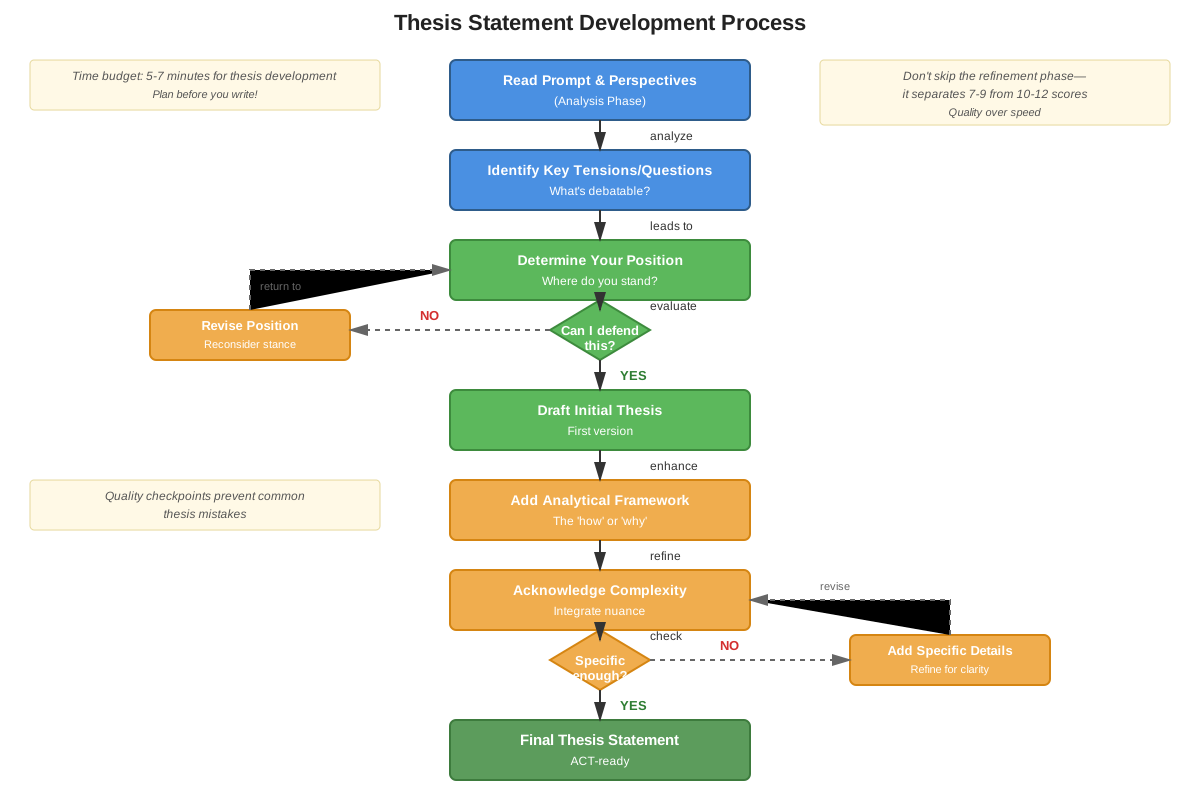
Process for developing your thesis:
- Read the prompt and all three perspectives carefully
- Identify your initial reaction or position
- Consider what qualifications, conditions, or limitations apply to your position
- Determine which perspectives you'll engage with and how (agree, disagree, qualify, synthesize)
- Draft your thesis, ensuring it includes position + complexity + reasoning
- Test your thesis: "Can I write three body paragraphs supporting this? Is it specific enough? Does it address the prompt directly?"
Process-of-elimination for evaluating thesis options (if practicing with multiple-choice questions about thesis quality):
- Eliminate any option that takes no clear position or says "both sides have merit" without committing
- Eliminate options that are too broad or vague to be meaningful
- Eliminate options that don't address the specific prompt question
- Eliminate options that would be impossible to support in a 40-minute essay
- Choose the option that is most specific, takes the clearest position, and acknowledges complexity
Time allocation: If you find yourself struggling to develop a thesis after 5 minutes of planning, choose a position and commit to it. An imperfect thesis that you can support is better than no thesis at all. You can refine the wording as you write the introduction.
Exam Tip: Write your thesis on your planning page first, then copy it into your essay. This allows you to refer back to it as you write body paragraphs, ensuring everything connects to your central claim.
Memory Techniques
PAC Acronym for Thesis Quality:
- Position: Does it take a clear stance?
- Acknowledgment: Does it recognize complexity?
- Connection: Does it connect to the prompt and perspectives?
The "Although-Because" Formula: When in doubt, structure your thesis as "Although [concession/complexity], [position] because [reasoning]." This formula automatically builds in sophistication while maintaining clarity.
Visualization Strategy: Picture your thesis as a road sign that tells readers exactly where the essay is going. If the sign is vague ("Interesting thoughts ahead") or points in multiple directions, readers get lost. A clear thesis is a specific destination marker.
The "Disagree Test" Mnemonic: Before finalizing your thesis, ask "Could someone reasonably Disagree with this?" If yes, you have an arguable claim. If no, Revise to make it more specific and debatable.
Three-Finger Check: Use three fingers to represent the three elements every ACT thesis needs:
- Thumb = Clear position (thumbs up or down, not sideways)
- Index finger = Points to specific claim (not vague direction)
- Middle finger = Stands tall with complexity (acknowledges nuance)
Summary
The thesis statement represents the single most important sentence in an ACT Writing essay, serving as the central claim that organizes and directs all other elements of the argument. A strong ACT thesis takes a clear, specific position on the prompt's issue while acknowledging complexity through qualification, condition, or nuance. It must be arguable rather than factual, defensible within the essay's scope, and responsive to the multiple perspectives provided. The thesis typically appears in the first or second paragraph and functions as a contract with the reader, promising what the essay will demonstrate. High-scoring essays feature thesis statements that show analytical sophistication by synthesizing perspectives, identifying conditions under which claims hold true, or extending ideas in original ways. Students should invest significant planning time in crafting their thesis because it determines the essay's organization, focus, and ultimate scoring across multiple rubric dimensions. The difference between a score of 6 and a score of 10 often hinges on whether the thesis is vague and general or precise and analytically sophisticated.
Key Takeaways
- The thesis statement is the central claim that governs the entire ACT essay and appears in the first two paragraphs
- Strong ACT theses take clear positions while acknowledging complexity through qualification or conditional language
- A thesis must be arguable (someone could reasonably disagree), specific (not vague generalities), and defensible (supportable in 40 minutes)
- High-scoring theses engage with the provided perspectives through synthesis, qualification, extension, or complication rather than simple agreement
- The "Although-Because" formula provides a reliable structure: acknowledge complexity, state position, provide reasoning
- Avoid fence-sitting phrases like "both sides have merit" or "there are many factors to consider" without taking a definitive stance
- Test your thesis by asking whether it predicts your essay's organization and whether someone could reasonably disagree with it
Related Topics
Body Paragraph Development: Once the thesis is established, each body paragraph must clearly connect to and support one aspect of the central claim, requiring topic sentences that explicitly link back to the thesis.
Counterargument Integration: Sophisticated thesis statements anticipate objections, and the skill of addressing counterarguments in body paragraphs directly extends from the complexity acknowledged in the thesis.
Introduction and Conclusion Strategies: The thesis anchors both the introduction (where it first appears) and conclusion (where it's reinforced), making these structural elements dependent on thesis quality.
Evidence Selection and Analysis: The thesis determines what counts as relevant evidence, as only examples and reasoning that support the central claim should be included in the essay.
Perspective Analysis: Before crafting a thesis, students must analyze the three provided perspectives, making this analytical skill a prerequisite that directly feeds into thesis development.
Practice CTA
Now that you understand the critical role of thesis statements in ACT Writing success, it's time to apply these concepts through deliberate practice. Work through the practice questions to identify strong versus weak thesis statements, then attempt to write your own thesis statements for various prompts. Use the flashcards to reinforce the key characteristics of effective ACT theses. Remember: the thesis is your essay's foundation—invest the time to master this skill, and your scores across all rubric dimensions will improve. Every high-scoring ACT essay begins with a strong thesis statement, and with focused practice, you can consistently craft thesis statements that demonstrate the analytical sophistication graders reward.
Sign up free to keep reading
Create a free AnvayaPrep account to finish this ACT guide on Thesis statement — plus flashcards and practice questions.