Overview
Body paragraphs form the argumentative core of the ACT Writing essay, serving as the primary vehicle through which students develop their thesis and demonstrate critical thinking. On the ACT Writing test, students must compose an essay that analyzes multiple perspectives on a complex issue, and the body paragraphs are where this analysis takes place. These paragraphs bridge the introduction's thesis statement and the conclusion's synthesis, providing the evidence, reasoning, and perspective analysis that evaluators use to assess a student's writing proficiency. Strong ACT body paragraphs distinguish high-scoring essays (scores of 10-12) from mediocre ones (scores of 6-8) by demonstrating depth of analysis, logical organization, and sophisticated integration of ideas.
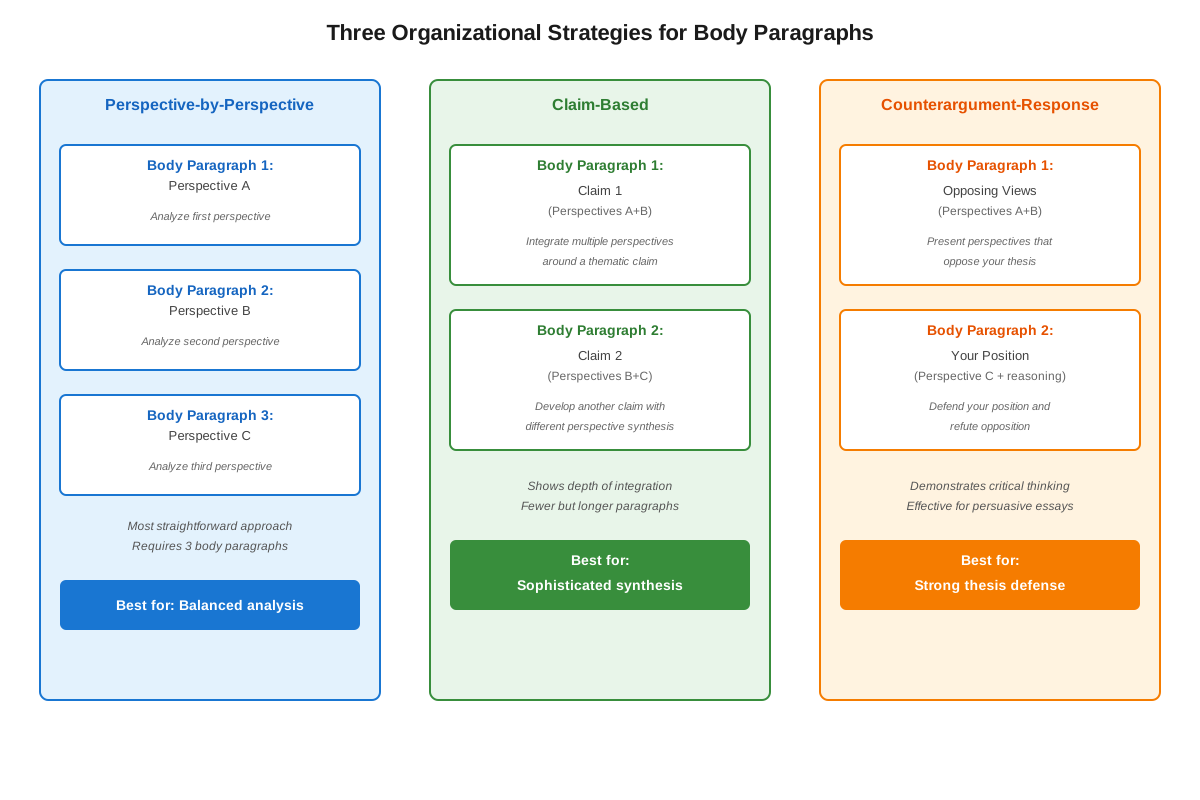
The ACT Writing rubric evaluates essays across four domains: Ideas and Analysis, Development and Support, Organization, and Language Use. Body paragraphs directly impact all four domains but are especially critical for Development and Support and Organization. Each body paragraph must advance the essay's central argument while maintaining coherence with the overall structure. Unlike five-paragraph essays taught in many high school English classes, effective ACT essays may contain two, three, or even four body paragraphs, depending on the complexity of the argument and the writer's organizational strategy.
Understanding how to construct effective body paragraphs connects directly to broader essay organization principles, including thesis development, transitions, and conclusion writing. Body paragraphs must work in concert with these elements to create a unified, persuasive essay. The skills developed through mastering body paragraph construction—logical sequencing, evidence integration, and counterargument acknowledgment—transfer to college-level academic writing and professional communication, making this topic essential beyond test preparation.
Learning Objectives
- [ ] Identify when Body paragraphs is being tested
- [ ] Explain the core rule or strategy behind Body paragraphs
- [ ] Apply Body paragraphs to ACT-style questions accurately
- [ ] Construct body paragraphs that effectively analyze at least two of the three provided perspectives
- [ ] Integrate specific examples and reasoning to support claims within body paragraphs
- [ ] Organize body paragraphs using clear topic sentences and logical transitions
- [ ] Evaluate the effectiveness of body paragraph structure in sample essays
Prerequisites
- Thesis statement construction: Body paragraphs must support and develop the central claim established in the introduction
- Paragraph structure basics: Understanding topic sentences, supporting details, and concluding sentences provides the foundation for more sophisticated body paragraph construction
- Perspective analysis: The ACT Writing prompt provides three perspectives that must be addressed, requiring students to understand how to engage with multiple viewpoints
- Evidence and reasoning: Body paragraphs require the integration of examples and logical reasoning to support claims
Why This Topic Matters
Body paragraphs represent approximately 60-70% of the ACT Writing essay's content and are the primary basis for scoring in the Development and Support domain. According to ACT scoring data, essays that score in the top range (10-12) consistently feature body paragraphs with "well-developed analysis" and "integrated discussion of ideas," while lower-scoring essays (6-8) typically contain body paragraphs with "simplistic or unclear analysis" and "limited development."
On every ACT Writing test, students encounter a prompt presenting a complex issue with three distinct perspectives. The essay task explicitly requires students to "analyze the relationship between your perspective and at least one other perspective," which occurs primarily in body paragraphs. Evaluators specifically look for how students engage with these perspectives—whether they merely summarize them or provide genuine analysis of their strengths, weaknesses, and implications.
In real-world applications, the ability to construct well-organized, evidence-supported paragraphs is fundamental to college success. Research papers, lab reports, essay exams, and professional communications all require the paragraph-level organization skills developed through ACT Writing preparation. Students who master body paragraph construction develop transferable skills in logical argumentation, evidence integration, and audience awareness that serve them throughout their academic and professional careers.
Core Concepts
Structure of Effective Body Paragraphs
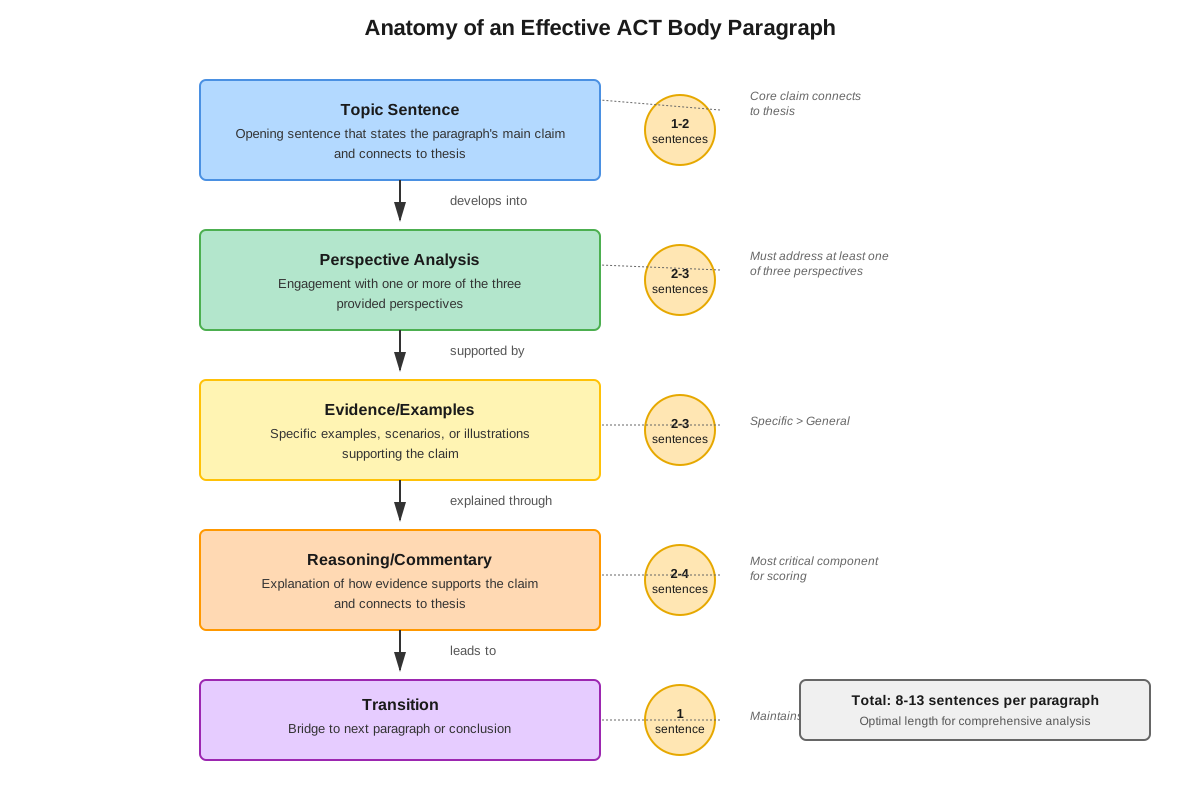
An effective body paragraph follows a clear internal structure that guides readers through the writer's reasoning. The standard structure includes:
- Topic sentence: Introduces the paragraph's main idea and connects to the thesis
- Perspective engagement: Addresses one or more of the provided perspectives
- Analysis and reasoning: Explains why the perspective is valid, limited, or flawed
- Evidence and examples: Provides specific support for claims
- Connection to thesis: Explicitly links the paragraph's content back to the central argument
- Transition: Prepares readers for the next paragraph
This structure ensures coherence and prevents the common pitfall of merely summarizing perspectives without analyzing them. High-scoring ACT essays demonstrate flexibility within this structure, sometimes combining elements or adjusting the order to serve rhetorical purposes.
Topic Sentences and Paragraph Unity
The topic sentence serves as the paragraph's thesis, establishing what the paragraph will accomplish. Strong topic sentences for ACT body paragraphs accomplish three functions simultaneously:
- State the paragraph's main claim
- Connect to the essay's overall thesis
- Signal which perspective(s) will be discussed
For example, if the thesis argues that technological innovation should be balanced with consideration for social impacts, a topic sentence might read: "While Perspective One correctly identifies innovation's economic benefits, it overlooks the displacement effects that require proactive policy responses." This sentence establishes the paragraph's evaluative stance, connects to the balanced approach advocated in the thesis, and signals which perspective will be analyzed.
Paragraph unity requires that every sentence within the body paragraph relates directly to the topic sentence. Digressions, tangential examples, or sudden shifts in focus undermine coherence and lower Organization scores.
Perspective Analysis Strategies
The ACT Writing prompt provides three perspectives that students must engage with analytically, not merely summarize. Effective perspective analysis involves:
| Analysis Type | Description | Example Language |
|---|---|---|
| Evaluation | Assessing the perspective's validity | "This perspective accurately captures... but fails to account for..." |
| Extension | Building upon the perspective's logic | "Taking this reasoning further reveals..." |
| Qualification | Identifying conditions under which the perspective holds | "While true in cases where..., this perspective breaks down when..." |
| Comparison | Contrasting perspectives to reveal insights | "Unlike Perspective Two, which emphasizes..., this view prioritizes..." |
High-scoring essays typically employ multiple analysis strategies across body paragraphs, demonstrating sophisticated engagement with the prompt's complexity.
Evidence Integration
Body paragraphs require specific examples to support analytical claims. On the ACT Writing test, students cannot research facts, so evidence comes from:
- Personal experience: Observations from school, community, or family life
- Current events knowledge: Major news stories or historical events
- Hypothetical scenarios: Plausible "what if" situations that illustrate principles
- Logical reasoning: Cause-and-effect chains or analogies
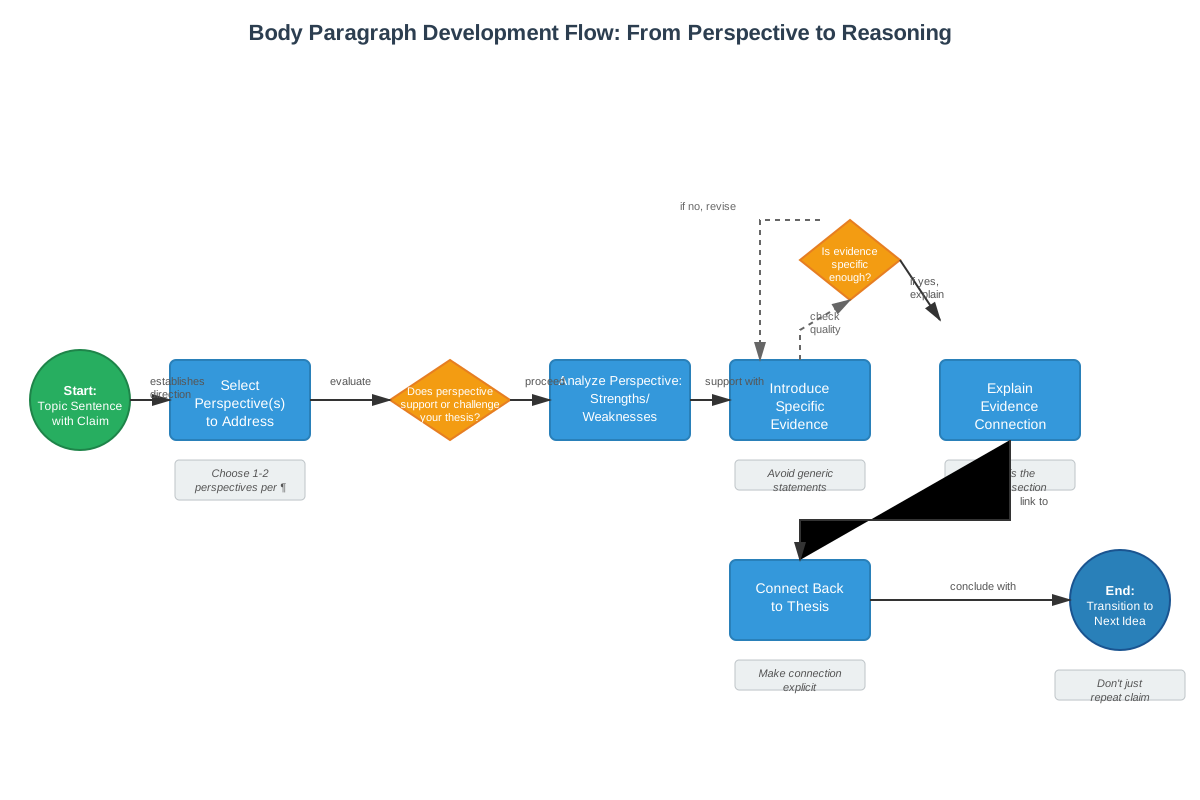
Effective evidence integration involves more than simply stating an example. Writers must explain the connection between evidence and claim through reasoning. The pattern follows: Claim → Evidence → Reasoning → Connection to thesis.
For instance: "Perspective Two's emphasis on individual responsibility ignores systemic barriers [claim]. Many students in underfunded schools lack access to advanced coursework regardless of personal motivation [evidence]. Without addressing resource inequities, appeals to individual effort merely perpetuate existing disparities [reasoning]. Therefore, a comprehensive approach must combine personal accountability with structural reform [connection to thesis]."
Paragraph Length and Development
ACT body paragraphs typically range from 6-10 sentences or 100-150 words. Shorter paragraphs (3-5 sentences) often indicate underdevelopment, while excessively long paragraphs (12+ sentences) may lack focus or contain multiple ideas that should be separated.
Development depth distinguishes score ranges:
- Scores 10-12: Paragraphs explore implications, consider counterarguments, and demonstrate nuanced thinking
- Scores 7-9: Paragraphs provide adequate support but may lack depth or sophistication
- Scores 4-6: Paragraphs offer limited development, often merely restating perspectives
- Scores 1-3: Paragraphs lack coherent development or relevant support
Transitions Between and Within Paragraphs
Transitions create coherence by showing relationships between ideas. Within body paragraphs, transitional phrases guide readers through reasoning steps:
- Adding information: furthermore, additionally, moreover
- Contrasting: however, nevertheless, conversely
- Showing causation: consequently, therefore, thus
- Providing examples: for instance, specifically, to illustrate
Between body paragraphs, transitions signal shifts in focus while maintaining connection to the thesis. Effective inter-paragraph transitions reference both the previous paragraph's content and the upcoming paragraph's focus: "While economic considerations favor innovation, social implications require equal attention."
Counterargument Acknowledgment
High-scoring body paragraphs often acknowledge potential objections or limitations to the writer's position. This demonstrates sophisticated thinking and strengthens arguments by addressing weaknesses proactively. Counterargument acknowledgment typically follows this pattern:
- State the potential objection
- Acknowledge its validity or appeal
- Explain why it doesn't undermine the main argument
- Reinforce the original claim
For example: "Some might argue that prioritizing environmental concerns stifles economic growth. While short-term costs may increase, sustainable practices ultimately create long-term economic stability and new market opportunities, making environmental consideration economically prudent rather than prohibitive."
Concept Relationships
The concepts within body paragraph construction form an interconnected system. Topic sentences establish the foundation upon which perspective analysis builds, while evidence integration provides the concrete support that makes analysis credible. Transitions connect these elements both within and between paragraphs, creating the coherence that evaluators assess in the Organization domain.
The relationship flows: Thesis statement (from introduction) → Topic sentence (establishes paragraph focus) → Perspective engagement (addresses prompt requirements) → Analysis and reasoning (demonstrates critical thinking) → Evidence (supports claims) → Connection to thesis (maintains essay unity) → Transition (prepares for next paragraph).
Body paragraphs connect to prerequisite knowledge of thesis construction because they must support the central claim established in the introduction. They also relate to conclusion writing, as effective conclusions synthesize insights developed in body paragraphs rather than merely restating them. The organizational skills developed through body paragraph construction transfer to other ACT Writing components, including introduction hooks and conclusion strategies.
Understanding body paragraph structure enables progression to more advanced writing skills like rhetorical analysis, argumentation strategies, and style refinement. Students who master body paragraph organization can focus attention on sophisticated language use and nuanced perspective integration that distinguish top-scoring essays.
Quick check — test yourself on Body paragraphs so far.
Try Flashcards →High-Yield Facts
⭐ Each body paragraph should address at least one of the three provided perspectives explicitly
⭐ Topic sentences must connect to the thesis while introducing the paragraph's specific focus
⭐ High-scoring essays (10-12) feature body paragraphs with 6-10 sentences and 100-150 words
⭐ Evidence must be explained through reasoning, not merely stated
⭐ Transitions between body paragraphs should reference both previous and upcoming content
- Body paragraphs account for approximately 60-70% of essay content and scoring weight
- Effective body paragraphs analyze perspectives rather than simply summarizing them
- Counterargument acknowledgment demonstrates sophisticated thinking and strengthens arguments
- Paragraph unity requires every sentence to relate directly to the topic sentence
- The ACT Writing rubric specifically evaluates "development and support" primarily through body paragraph quality
- Personal experience, current events, and hypothetical scenarios all serve as valid evidence
- Body paragraphs should follow a logical sequence that builds the overall argument progressively
- Evaluators look for "integrated discussion" where perspectives are compared and contrasted
- Underdeveloped body paragraphs (fewer than 5 sentences) typically result in lower Development and Support scores
- Effective body paragraphs explicitly connect back to the thesis rather than leaving connections implicit
Common Misconceptions
Misconception: Body paragraphs must follow the exact same structure in every essay → Correction: While body paragraphs share common elements (topic sentence, analysis, evidence), effective writers adapt structure to serve rhetorical purposes. Some paragraphs may emphasize comparison between perspectives, while others focus on evaluating a single perspective's implications.
Misconception: Each body paragraph must address exactly one perspective → Correction: Body paragraphs can address multiple perspectives, especially when comparing or contrasting them. High-scoring essays often feature paragraphs that analyze relationships between perspectives rather than treating each in isolation.
Misconception: Longer body paragraphs always score higher → Correction: Development quality matters more than length. A focused 8-sentence paragraph with deep analysis outscores a rambling 15-sentence paragraph that lacks coherence. Optimal length is 6-10 sentences with substantive content.
Misconception: Personal examples are less valid than historical or current events examples → Correction: The ACT Writing rubric values reasoning quality, not example prestige. A well-explained personal observation can be more effective than a poorly integrated historical reference. What matters is how evidence supports the analytical claim.
Misconception: Body paragraphs should only present ideas that support the thesis → Correction: Acknowledging counterarguments or limitations strengthens essays by demonstrating nuanced thinking. High-scoring body paragraphs often address potential objections before explaining why the thesis remains valid despite these considerations.
Misconception: Transitions are optional stylistic flourishes → Correction: Transitions are essential for coherence and directly impact Organization scores. Essays lacking clear transitions between and within body paragraphs receive lower scores even if individual paragraphs contain strong analysis.
Misconception: Summarizing perspectives demonstrates understanding → Correction: The ACT Writing task requires analysis, not summary. Simply restating what each perspective says results in low Ideas and Analysis scores. Effective body paragraphs evaluate perspectives' validity, implications, and relationships.
Worked Examples
Example 1: Technology and Education Prompt
Prompt Context: The prompt discusses whether schools should increase technology integration, with perspectives ranging from enthusiastic adoption to cautious skepticism.
Thesis: "While technology offers valuable educational tools, effective implementation requires balancing innovation with pedagogical principles and equity considerations."
Body Paragraph:
"Perspective One's advocacy for rapid technology adoption captures the genuine benefits of digital tools but overlooks critical implementation challenges. Interactive software and online resources can indeed personalize learning, allowing students to progress at individual paces and access materials beyond traditional textbooks. In my own school, students using adaptive math programs showed measurable improvement in standardized test scores. However, this perspective assumes universal access and technological literacy that don't exist in many communities. Rural schools with limited broadband and low-income families without home internet face barriers that enthusiastic adoption ignores. Furthermore, research suggests that technology's educational value depends heavily on teacher training and pedagogical integration—simply providing devices doesn't guarantee learning improvements. Therefore, while Perspective One correctly identifies technology's potential, realizing that potential requires addressing the equity and implementation gaps that pure enthusiasm overlooks. A balanced approach must combine technological innovation with infrastructure investment and professional development."
Analysis of Effectiveness:
- Topic sentence establishes evaluative stance ("captures benefits but overlooks challenges") and connects to thesis's balanced approach
- Perspective engagement directly addresses Perspective One with specific reference to its claims
- Evidence integration includes personal observation (school math programs) with reasoning about why it supports the claim
- Counterargument acknowledgment addresses potential objection about technology's proven benefits
- Connection to thesis explicitly links back to the balanced approach advocated
- Transition preparation sets up discussion of implementation considerations that might continue in the next paragraph
Example 2: Community Service Requirement Prompt
Prompt Context: The prompt debates whether high schools should require community service for graduation, with perspectives addressing civic responsibility, student autonomy, and practical concerns.
Thesis: "Mandatory community service, when thoughtfully implemented, cultivates civic engagement without undermining the authentic volunteerism that Perspective Two values."
Body Paragraph:
"While Perspective Two raises valid concerns about mandatory service contradicting volunteerism's spirit, this view presents a false dichotomy between requirement and authenticity. The perspective assumes that compulsion necessarily eliminates meaningful engagement, yet educational requirements routinely introduce students to valuable experiences they wouldn't independently choose. Few students voluntarily study calculus or read Shakespeare, yet these requirements often spark genuine interest and lasting appreciation. Similarly, required community service can serve as an introduction that develops into authentic commitment. My neighbor initially resented her school's tutoring requirement but discovered a passion for education that led to continued volunteering and ultimately influenced her college major. The key distinction lies not in whether service is required but in how programs are structured—offering choice among service options and emphasizing reflection preserves agency while ensuring exposure. Perspective Two's concern becomes valid only when programs are rigidly structured without student input, suggesting that implementation quality rather than the requirement itself determines whether service cultivates or undermines authentic civic engagement."
Analysis of Effectiveness:
- Topic sentence acknowledges perspective's validity while establishing the paragraph's qualifying argument
- Analogy (calculus and Shakespeare) provides reasoning that explains why requirements don't necessarily undermine authenticity
- Personal evidence (neighbor's experience) illustrates the claim with specific detail
- Qualification identifies conditions under which the perspective's concerns are valid
- Sophisticated analysis distinguishes between requirement itself and implementation quality
- Implicit transition sets up potential discussion of implementation strategies in subsequent paragraphs
Exam Strategy
When approaching ACT Writing body paragraphs under time pressure, employ this strategic process:
Time Allocation: Reserve 20-25 minutes of the 40-minute essay period for drafting body paragraphs. With 2-3 body paragraphs, this allows approximately 7-10 minutes per paragraph, including brief planning.
Trigger Words in Prompts: ACT Writing prompts contain specific language that signals what body paragraphs should accomplish:
- "Analyze the relationship between your perspective and at least one other" → Body paragraphs must compare/contrast perspectives, not just describe them
- "Evaluate the perspectives" → Body paragraphs should assess strengths and weaknesses
- "Consider the implications" → Body paragraphs should explore consequences and applications
Pre-Writing Strategy: Before drafting body paragraphs, spend 2-3 minutes creating a brief outline:
- Decide which perspectives to address in each paragraph
- Note one specific example for each paragraph
- Identify the analytical move each paragraph will make (evaluate, compare, qualify, extend)
Paragraph-by-Paragraph Approach:
- First body paragraph: Address the perspective most closely aligned with your thesis, establishing your position's foundation
- Second body paragraph: Engage with a contrasting perspective, demonstrating ability to consider multiple viewpoints
- Third body paragraph (if time permits): Synthesize insights or address implementation considerations
Quality Over Quantity: If time runs short, prioritize developing two strong body paragraphs over rushing through three underdeveloped ones. Evaluators value depth over breadth.
Self-Monitoring Questions: While drafting, periodically check:
- Does this sentence relate to my topic sentence?
- Have I explained why this example supports my claim?
- Have I explicitly addressed a perspective from the prompt?
- Does this paragraph connect back to my thesis?
Revision Priorities: If time remains, focus revision efforts on:
- Adding topic sentences if missing
- Inserting transitions between paragraphs
- Clarifying connections between evidence and claims
- Ensuring perspective engagement is analytical, not merely descriptive
Memory Techniques
TEACUP Mnemonic for body paragraph structure:
- Topic sentence
- Engage perspective
- Analyze (don't just summarize)
- Connect evidence to claim
- Unify with thesis
- Prepare transition
"Three A's" for Perspective Engagement:
- Acknowledge what the perspective says
- Assess its validity and limitations
- Apply it to your thesis argument
Visualization Strategy: Picture body paragraphs as bridges connecting the introduction's thesis to the conclusion's synthesis. Each paragraph is a bridge section that must be structurally sound (well-organized) and load-bearing (substantive) to support the essay's overall argument.
"TREE" for Evidence Integration:
- Topic claim
- Relevant example
- Explanation of connection
- Extension to thesis
Transition Reminder: "Look back, look forward" - effective transitions reference the previous paragraph's content while introducing the next paragraph's focus.
Summary
Body paragraphs constitute the argumentative core of ACT Writing essays, serving as the primary vehicle for perspective analysis, evidence integration, and thesis development. Effective body paragraphs follow a clear structure: topic sentences establish focus and connect to the thesis, perspective engagement addresses the prompt's requirements analytically rather than descriptively, evidence provides specific support, and reasoning explains connections between claims and support. High-scoring body paragraphs demonstrate depth through sophisticated analysis strategies including evaluation, qualification, comparison, and counterargument acknowledgment. Organization within and between paragraphs relies on clear transitions and paragraph unity, with every sentence relating directly to the topic sentence. The ACT Writing rubric evaluates body paragraphs across multiple domains, but they most directly impact Development and Support and Organization scores. Students should aim for 2-3 well-developed body paragraphs of 6-10 sentences each, prioritizing analytical depth over mere length and ensuring explicit connections to the thesis throughout.
Key Takeaways
- Body paragraphs must analyze perspectives, not merely summarize them—evaluation and reasoning distinguish high-scoring essays
- Topic sentences should simultaneously state the paragraph's claim, connect to the thesis, and signal which perspective(s) will be addressed
- Evidence requires explanation through reasoning; the pattern is Claim → Evidence → Reasoning → Connection to thesis
- Effective body paragraphs range from 6-10 sentences (100-150 words) with focused development
- Transitions between paragraphs should reference both previous content and upcoming focus to maintain coherence
- Counterargument acknowledgment demonstrates sophisticated thinking and strengthens rather than weakens arguments
- The TEACUP structure (Topic, Engage, Analyze, Connect, Unify, Prepare) provides a reliable framework for body paragraph construction
Related Topics
Introduction Strategies: Mastering body paragraphs enables more sophisticated introduction writing, as strong thesis statements anticipate the analysis that body paragraphs will develop. Understanding how to structure body paragraphs helps writers craft introductions that effectively preview the essay's argumentative arc.
Conclusion Techniques: Effective conclusions synthesize insights developed in body paragraphs rather than merely restating them. Students who master body paragraph analysis can write conclusions that demonstrate genuine intellectual progression.
Rhetorical Analysis: The analytical skills developed through body paragraph construction—evaluating claims, assessing evidence, identifying logical relationships—transfer directly to rhetorical analysis tasks in college writing courses.
Argumentation and Logic: Body paragraph construction develops formal reasoning skills including claim-evidence relationships, counterargument acknowledgment, and qualification that apply across academic disciplines.
Style and Tone Refinement: Once body paragraph structure becomes automatic, students can focus attention on sophisticated language use, varied sentence structure, and tone control that distinguish top-scoring essays.
Practice CTA
Now that you understand the principles of effective body paragraph construction, apply these concepts through targeted practice. The practice questions will challenge you to identify strong versus weak body paragraphs, construct topic sentences, integrate evidence effectively, and analyze perspective relationships. The flashcards will reinforce key concepts like the TEACUP structure, transition strategies, and common pitfalls to avoid. Consistent practice with these materials will transform body paragraph construction from a conscious process into an automatic skill, freeing mental energy for sophisticated analysis and style refinement during the actual exam. Remember: every high-scoring ACT essay features well-developed body paragraphs—mastering this skill is essential for achieving your target score.
Sign up free to keep reading
Create a free AnvayaPrep account to finish this ACT guide on Body paragraphs — plus flashcards and practice questions.