Overview
Formal tone is a critical component of effective writing on the ACT Writing test, representing one of the most frequently tested stylistic elements across both the essay and English sections. Understanding and applying formal tone means recognizing the appropriate level of language sophistication, word choice, and sentence structure that academic and professional writing demands. On the ACT, students must demonstrate the ability to identify when informal language disrupts the professional quality of a passage and select revisions that maintain consistency in formality throughout a piece of writing.
The ACT places significant emphasis on formal tone because it reflects real-world writing expectations in academic, professional, and public contexts. College-level writing, business communications, and scholarly discourse all require writers to maintain an appropriate level of formality that conveys credibility and respect for the audience. The ACT formal tone questions test whether students can distinguish between casual, conversational language and the more polished, objective language expected in formal contexts. These questions appear regularly in the English section's Rhetorical Skills subsection and form a fundamental criterion in the Writing test's scoring rubric.
Formal tone connects intimately with other essential Writing concepts including diction, audience awareness, and style consistency. While grammar and mechanics ensure technical correctness, formal tone operates at a higher level of rhetorical effectiveness, determining whether the overall voice and register of a piece match its purpose and intended readership. Mastering formal tone enables students to make sophisticated choices about word selection, sentence structure, and overall presentation that elevate their writing from merely correct to genuinely effective.
Learning Objectives
- [ ] Identify when Formal tone is being tested in ACT English passages and essay prompts
- [ ] Explain the core rule or strategy behind Formal tone and its application in academic writing
- [ ] Apply Formal tone to ACT-style questions accurately by selecting appropriate revisions
- [ ] Distinguish between varying levels of formality in word choice and phrasing
- [ ] Recognize specific markers of informal language that violate formal tone expectations
- [ ] Evaluate whether a given passage maintains consistent formal tone throughout
- [ ] Construct original sentences and paragraphs that demonstrate appropriate formal tone
Prerequisites
- Basic grammar and sentence structure: Understanding subject-verb agreement, proper punctuation, and complete sentences provides the foundation upon which formal tone is built; tone cannot be properly assessed without grammatical correctness.
- Vocabulary knowledge: Familiarity with a range of vocabulary words at different formality levels enables recognition of when word choice is too casual or inappropriately sophisticated for the context.
- Reading comprehension: The ability to understand passage context and purpose is essential for determining what level of formality is appropriate for a given piece of writing.
- Audience awareness: Recognizing who the intended reader is helps determine whether formal or informal language would be more suitable in different writing situations.
Why This Topic Matters
Formal tone represents one of the most practical writing skills tested on the ACT because it directly translates to success in college and professional environments. Every academic paper, scholarship application, professional email, and business proposal requires writers to maintain appropriate formality. Students who master formal tone demonstrate readiness for the writing demands they will face throughout their educational and professional careers.
On the ACT English section, formal tone questions appear with remarkable frequency—typically 2-4 questions per test, making them among the most reliable question types students will encounter. These questions usually present a sentence or phrase that contains informal language and ask students to select the revision that best maintains the formal tone of the passage. In the ACT Writing test, formal tone accounts for a significant portion of the Language Use and Conventions domain score, with essays that maintain consistent formal tone typically scoring in the upper ranges (4-6 on the 6-point scale).
Common manifestations of formal tone testing include: identifying and replacing slang or colloquialisms; recognizing when contractions should be avoided; selecting more precise, sophisticated vocabulary over casual alternatives; eliminating conversational phrases and clichés; and maintaining objective, third-person perspective rather than overly personal or casual first-person narration. The ACT particularly favors questions where one answer choice contains obviously informal language (like "kids" instead of "children" or "a lot" instead of "numerous"), making these questions highly predictable for prepared students.
Core Concepts
Defining Formal Tone
Formal tone refers to the level of language sophistication, objectivity, and professionalism appropriate for academic and professional writing contexts. It represents a writing voice that maintains distance from casual conversation, avoids slang and colloquialisms, uses precise vocabulary, and presents ideas with clarity and authority. Formal tone does not mean unnecessarily complex or pretentious language; rather, it means selecting words and structures that convey respect for the subject matter and audience while maintaining accessibility and clarity.
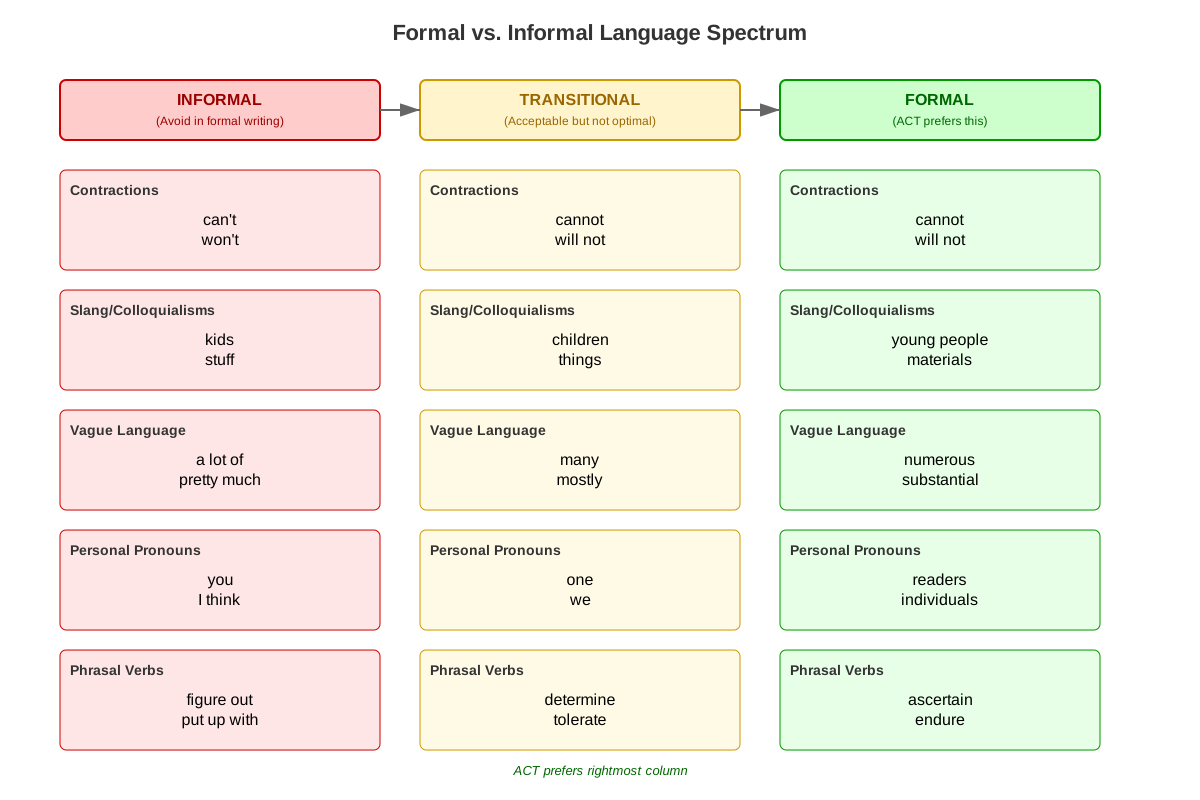
The spectrum of formality ranges from highly informal (text messages, casual conversations with friends) through semi-formal (personal emails, blog posts) to formal (academic essays, business reports, scholarly articles) and highly formal (legal documents, diplomatic communications). The ACT consistently tests the formal end of this spectrum, expecting students to recognize and produce writing appropriate for academic contexts.
Characteristics of Formal Tone
Several distinct features characterize formal writing and distinguish it from informal alternatives:
| Formal Tone Feature | Explanation | Example (Informal → Formal) |
|---|---|---|
| Precise vocabulary | Specific, sophisticated word choices | "get" → "obtain," "acquire," "receive" |
| Complete words | Avoiding contractions | "don't" → "do not," "it's" → "it is" |
| Objective language | Avoiding emotional or biased terms | "terrible" → "inadequate," "problematic" |
| Standard expressions | Avoiding slang and colloquialisms | "kids" → "children," "a lot" → "numerous" |
| Third-person perspective | Maintaining professional distance | "I think" → "Evidence suggests," "Research indicates" |
| Complete sentences | Avoiding fragments used for effect | "Really important." → "This factor is particularly significant." |
Words and Phrases to Avoid
Certain categories of language consistently violate formal tone expectations on the ACT:
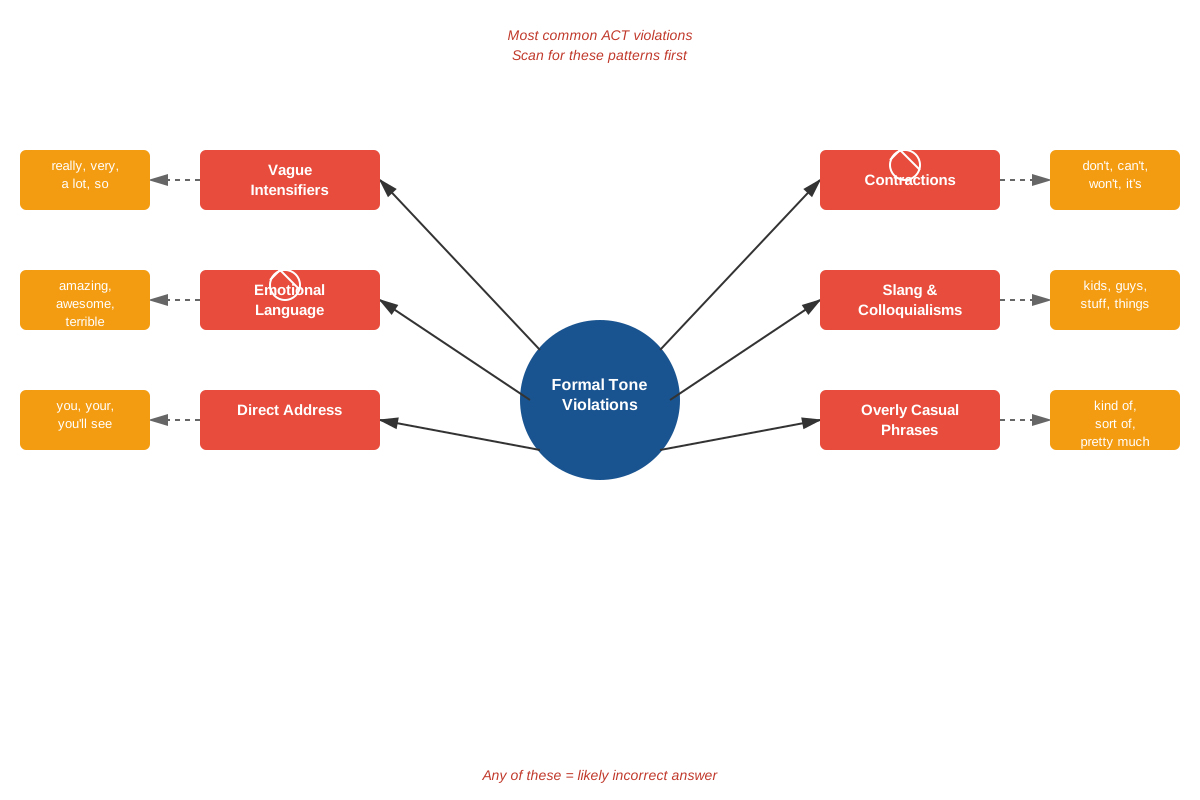
Contractions: Words like "can't," "won't," "shouldn't," "it's," and "they're" should be written out fully in formal writing. While contractions appear frequently in speech and informal writing, academic writing maintains the full forms to preserve formality.
Slang and colloquialisms: Regional expressions, trendy phrases, and casual language like "cool," "awesome," "kids," "guys," "stuff," "things," "a lot," "kind of," "sort of," and "pretty much" undermine formal tone. These words carry conversational connotations inappropriate for academic contexts.
Vague intensifiers: Words like "really," "very," "so," and "totally" add emphasis in speech but weaken formal writing by lacking precision. Formal writing prefers specific, measured language.
Conversational transitions: Phrases like "anyway," "by the way," "well," and "you know" mimic speech patterns but disrupt the professional flow of formal writing.
Overly casual verbs: Phrasal verbs and casual verb choices like "get," "got," "put up with," "figure out," and "come up with" should be replaced with more formal alternatives like "obtain," "received," "tolerate," "determine," and "develop."
Maintaining Appropriate Formality
Formal tone requires consistency throughout a piece of writing. A passage that begins with sophisticated, academic language but suddenly shifts to casual expressions creates jarring inconsistency that the ACT specifically tests. Students must recognize when a single informal word or phrase disrupts an otherwise formal passage.
However, formal tone does not require unnecessarily complex or pretentious language. The ACT values clarity and directness alongside formality. Words like "utilize" instead of "use" or "commence" instead of "begin" may sound more formal but often create unnecessary complexity. The goal is professional clarity, not obscurity.
Context and Audience Considerations
While the ACT primarily tests formal academic tone, understanding context remains important. The formality level appropriate for a scientific research paper differs slightly from that of a persuasive essay or historical analysis. However, the ACT consistently expects students to maintain formal academic tone across all contexts presented in test passages.
Audience awareness drives formality choices. Academic writing assumes an educated audience of peers, instructors, or general educated readers who expect professional presentation. This audience expects writers to demonstrate command of standard written English and respect for conventions of formal discourse.
Concept Relationships
Formal tone serves as a unifying concept that connects multiple aspects of effective writing. At its foundation, formal tone builds upon grammar and mechanics—a passage cannot achieve formal tone if it contains grammatical errors, regardless of word choice sophistication. Moving upward in complexity, formal tone directly influences diction (word choice), requiring writers to select vocabulary appropriate for academic contexts rather than casual alternatives.
Formal tone connects horizontally to style consistency, as maintaining uniform formality throughout a passage represents a specific application of broader stylistic coherence. Both concepts require writers to recognize and preserve patterns established in a passage. Additionally, formal tone relates closely to audience awareness—understanding who will read the writing determines what level of formality is appropriate.
The relationship map flows as follows: Grammar/Mechanics → provides foundation for → Formal Tone → influences → Diction → contributes to → Style Consistency → serves → Audience Awareness → determines → Overall Rhetorical Effectiveness. Each element builds upon previous concepts while contributing to the ultimate goal of effective communication.
Understanding formal tone also enables progression to more advanced concepts like voice development and rhetorical sophistication, where writers make nuanced choices about how to present ideas persuasively while maintaining appropriate formality.
High-Yield Facts
⭐ Contractions always violate formal tone on the ACT—when an answer choice contains a contraction and another provides the expanded form, choose the expanded form.
⭐ The words "kids," "guys," "a lot," and "stuff" are consistently marked as too informal on ACT questions and should be replaced with "children," "people/individuals," "numerous/many," and specific nouns.
⭐ Formal tone questions typically appear 2-4 times per ACT English section, making them among the most predictable question types.
⭐ Slang and colloquialisms always represent incorrect answers when formal tone is being tested, regardless of how common the expression may be.
⭐ Phrasal verbs (multi-word verbs like "put up with" or "figure out") are generally less formal than single-word alternatives like "tolerate" or "determine."
- Formal tone does not require the most complex vocabulary option—clarity and appropriateness matter more than showing off sophisticated words.
- First-person pronouns ("I," "me," "my") can appear in formal writing but should be used judiciously and avoided when objective alternatives exist.
- Exclamation points rarely appear in formal academic writing and typically signal informal enthusiasm inappropriate for the context.
- Questions directed at the reader ("Have you ever wondered...?") generally violate formal tone by creating conversational intimacy.
- Clichés and overused expressions ("at the end of the day," "think outside the box") undermine formal tone by lacking originality and precision.
- Formal writing prefers active voice but uses passive voice when appropriate for emphasis or when the actor is unknown or unimportant.
- Emotional language and extreme adjectives ("terrible," "amazing," "horrible") should be replaced with measured, objective descriptions in formal contexts.
Quick check — test yourself on Formal tone so far.
Try Flashcards →Common Misconceptions
Misconception: Formal tone means using the longest, most complex words available. → Correction: Formal tone prioritizes clarity and appropriateness over complexity. The word "use" is perfectly acceptable in formal writing; replacing it with "utilize" adds no value and may create unnecessary complexity. Formal tone means avoiding casual language, not embracing obscurity.
Misconception: All first-person pronouns violate formal tone. → Correction: While formal writing often uses third-person perspective, first-person pronouns can appear in formal contexts, particularly in personal essays, reflective writing, and when describing original research. The ACT Writing test essay, for instance, appropriately uses first-person perspective. The key is avoiding overly personal or casual constructions like "I think" when objective alternatives like "Evidence suggests" would be more appropriate.
Misconception: Formal tone and sophisticated ideas are the same thing. → Correction: Formal tone refers specifically to language choices—word selection, sentence structure, and overall register—while sophisticated ideas relate to content depth and analytical complexity. A passage can present simple ideas in formal language or complex ideas in informal language. The ACT tests whether language matches the formal academic context, not whether ideas are profound.
Misconception: Contractions are acceptable in formal writing if they appear in quoted speech. → Correction: This is partially true—contractions within direct quotations preserve the speaker's original words and do not violate formal tone. However, in the narrative portions of formal writing, contractions remain inappropriate. The ACT typically tests contractions in narrative or expository sections, not within quotations.
Misconception: Formal tone means avoiding all conversational elements. → Correction: While formal writing avoids casual language, it can still be engaging and accessible. Rhetorical questions, when used strategically and sparingly, can appear in formal writing. The distinction lies between calculated rhetorical devices and casual conversational habits. The ACT tests obvious violations of formality, not subtle rhetorical choices.
Misconception: If a passage begins informally, maintaining that informal tone is correct. → Correction: The ACT consistently expects formal academic tone in its passages, regardless of how a passage begins. If a passage contains informal language, the correct answer will move toward greater formality, not maintain informality. The test assumes academic writing contexts where formal tone is always appropriate.
Worked Examples
Example 1: Identifying and Correcting Informal Language
Passage excerpt: "The Industrial Revolution really changed how people lived and worked. It got started in Britain during the late 1700s and pretty much transformed society."
Question: Which of the following alternatives to the underlined portion would be LEAST acceptable?
A. fundamentally
B. significantly
C. totally
D. substantially
Solution Process:
Step 1: Identify the context and current tone. The passage discusses a historical topic (Industrial Revolution) in what should be formal academic writing.
Step 2: Analyze the underlined word "really." This is an informal intensifier that weakens formal tone through vagueness and conversational quality.
Step 3: Evaluate each answer choice for formality:
- "Fundamentally" is formal, precise, and appropriate for academic writing
- "Significantly" is formal, commonly used in academic contexts
- "Totally" is slang/colloquial, extremely informal, conversational
- "Substantially" is formal, precise, appropriate for academic writing
Step 4: The question asks for the LEAST acceptable alternative. "Totally" represents casual, conversational language completely inappropriate for formal historical analysis.
Answer: C. "Totally" is the least acceptable because it maintains or worsens the informal tone problem, while the other options improve formality.
Connection to Learning Objectives: This example demonstrates identifying when formal tone is being tested (recognizing informal intensifiers) and applying the core strategy (selecting vocabulary appropriate for academic contexts).
Example 2: Comprehensive Tone Revision
Original passage: "Scientists have been trying to figure out climate change for years now. They've found that it's a really big problem that we can't just ignore. A lot of experts think we need to do something about it soon, or things could get pretty bad for future generations."
Question: The writer wants to revise this paragraph to make it appropriate for a formal research paper. Which of the following revisions best accomplishes this goal?
A. Scientists have attempted to understand climate change for years. They have discovered that it is a significant problem that cannot be ignored. Numerous experts believe immediate action is necessary, or consequences could be severe for future generations.
B. Scientists have been working on understanding climate change for a while. They've discovered it's a major problem we can't overlook. Many experts think we should act soon, or things might get bad for our kids.
C. Scientists have tried figuring out climate change for years. They found it's a really serious issue that shouldn't be ignored. Lots of experts believe we need to take action quickly, or stuff could get terrible for future generations.
D. Scientists have been attempting to comprehend climate change for numerous years. They have ascertained that it constitutes a tremendously significant problematic situation that cannot be disregarded. A multiplicity of experts postulate that immediate action is necessitated, or ramifications could be severe for subsequent generations.
Solution Process:
Step 1: Identify all informal elements in the original:
- "trying to figure out" (phrasal verb, casual)
- "They've" (contraction)
- "it's" (contraction)
- "really big" (informal intensifier + vague adjective)
- "we can't" (contraction)
- "A lot of" (colloquial quantifier)
- "think" (less formal than alternatives)
- "do something" (vague)
- "things could get pretty bad" (vague, informal)
Step 2: Evaluate each answer choice:
Choice A: Eliminates all contractions ("have attempted," "have discovered," "is," "cannot"), replaces phrasal verb with formal alternative ("understand"), uses precise vocabulary ("significant," "numerous," "immediate action," "consequences," "severe"), maintains clarity while achieving formality.
Choice B: Retains contraction "They've," uses informal "for a while," keeps contraction "can't," includes casual "our kids" instead of "future generations."
Choice C: Keeps informal "figuring out," retains "really," uses colloquial "Lots of," includes extremely informal "stuff," maintains casual tone throughout.
Choice D: Overcorrects into unnecessarily complex, pretentious language ("ascertained," "constitutes," "tremendously significant problematic situation," "multiplicity," "postulate," "necessitated," "subsequent"). While technically formal, this creates awkward, unclear prose that prioritizes complexity over clarity.
Step 3: Select the revision that achieves appropriate formal tone without sacrificing clarity.
Answer: A. This revision successfully eliminates all informal elements while maintaining clear, accessible academic prose. It demonstrates that formal tone means professional clarity, not unnecessary complexity.
Connection to Learning Objectives: This example requires identifying multiple instances where formal tone is violated, explaining the core strategy of replacing informal elements with formal alternatives, and applying this understanding to select the most appropriate comprehensive revision.
Exam Strategy
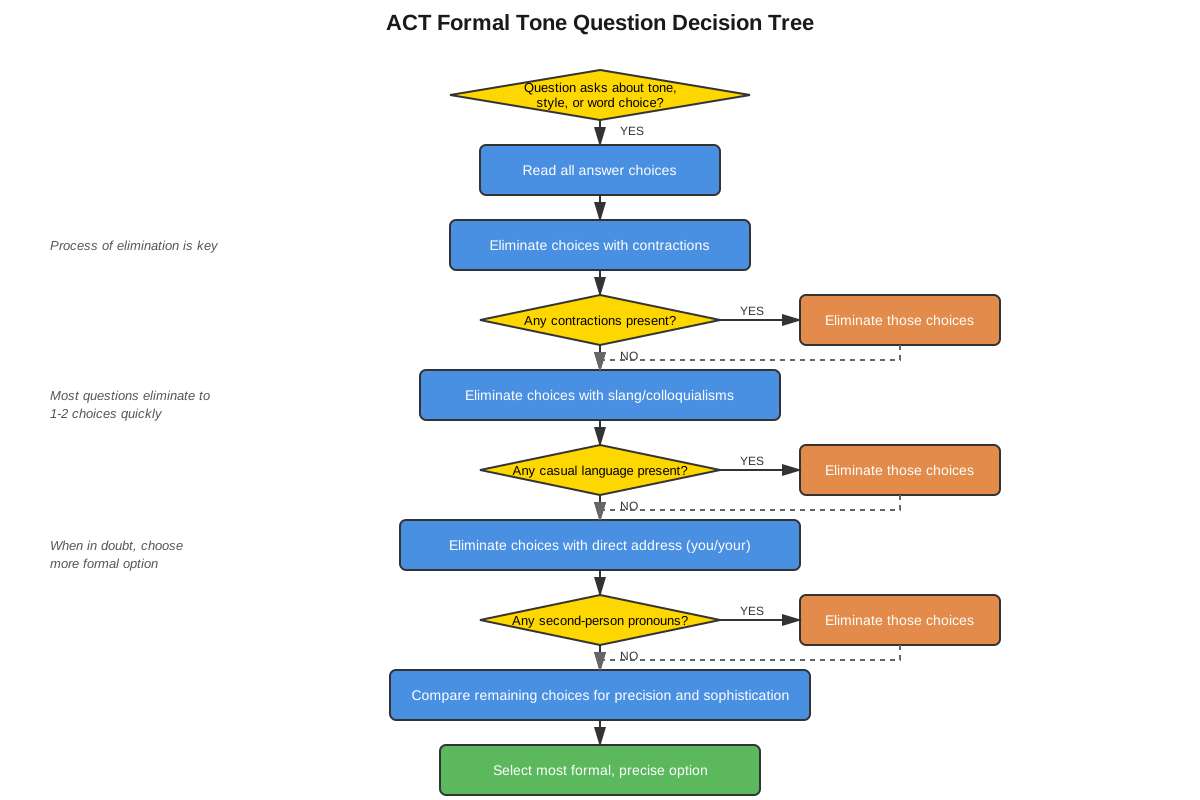
When approaching formal tone questions on the ACT, implement this systematic process:
Step 1: Identify the question type. Formal tone questions often include phrases like "maintain the formal tone," "appropriate for an academic essay," "consistent with the style of the passage," or "LEAST acceptable alternative." When you see these triggers, immediately shift to evaluating formality.
Step 2: Scan for obvious informal markers. Before reading all answer choices carefully, quickly scan for contractions, slang words ("kids," "guys," "stuff," "a lot"), and casual intensifiers ("really," "pretty," "so"). These almost always indicate incorrect answers when formal tone is being tested.
Step 3: Read the surrounding passage. Context determines whether formal tone is expected. If the passage discusses academic, scientific, historical, or professional topics in sophisticated language, formal tone is required. The ACT rarely presents genuinely informal contexts where casual language would be appropriate.
Step 4: Apply the "would this appear in a textbook?" test. If a word or phrase would seem out of place in a high school or college textbook, it likely violates formal tone. This quick mental check helps identify informal language.
Step 5: Eliminate answers systematically. Remove any choice containing contractions first, then eliminate slang and colloquialisms, then remove unnecessarily complex or pretentious options. The remaining choice typically represents appropriate formal tone.
Exam Tip: When a question asks for the "LEAST acceptable" alternative, three answers will be roughly equivalent in formality, and one will be noticeably more informal. Don't overthink these questions—the informal option is usually obvious.
Time allocation: Formal tone questions should take 20-30 seconds each. They test recognition rather than complex analysis, so if you find yourself spending more than 45 seconds, you're likely overthinking. Trust your instinct about what sounds appropriately formal.
Common trap answers: The ACT often includes one answer that is technically grammatically correct but uses informal language, testing whether students prioritize tone over mere correctness. Remember that formal tone is a rhetorical skill, not just a grammar issue.
Memory Techniques
The CAFÉ Acronym for Formal Tone:
- Contractions: Avoid them
- Audience: Write for educated readers
- Formal vocabulary: Choose precise, sophisticated words
- Eliminate slang: Remove casual expressions
The "Three Strikes" Rule: If language has three strikes against it, it's too informal:
- Strike 1: Would you say this to a friend casually?
- Strike 2: Would it appear in a text message?
- Strike 3: Would your English teacher mark it as too casual?
Visualization Strategy: Picture yourself presenting your writing to a panel of college professors. Would they find your language appropriately professional, or would they perceive it as too casual? This mental image helps calibrate formality.
The Substitution List (memorize these common informal → formal replacements):
- kids → children
- guys → people, individuals
- a lot → numerous, many, substantial
- stuff/things → specific nouns (materials, items, factors, elements)
- really/very/so → specific intensifiers (significantly, considerably, substantially)
- get/got → obtain, receive, acquire, become
- figure out → determine, calculate, discover
- put up with → tolerate, endure
The Contraction Catch: Remember "Don't contract in formal writing" (ironically using a contraction to remember not to use them). When you see a contraction on the ACT, it's almost always wrong when formal tone is being tested.
Summary
Formal tone represents one of the most testable and predictable elements of ACT Writing, requiring students to recognize and produce language appropriate for academic contexts. The core principle is straightforward: formal writing avoids contractions, slang, colloquialisms, vague intensifiers, and casual expressions while employing precise vocabulary, complete words, and objective language. Success on formal tone questions depends on recognizing obvious informal markers—particularly contractions and common casual words like "kids," "guys," "a lot," and "stuff"—and selecting revisions that maintain professional clarity without unnecessary complexity. The ACT consistently expects formal academic tone across all passages, making these questions highly predictable for prepared students. Mastering formal tone requires understanding that formality means professional appropriateness and clarity, not pretentious complexity or obscure vocabulary. Students who internalize the distinction between conversational language and academic prose, memorize common informal markers to avoid, and practice identifying tone violations will reliably answer these questions correctly, securing valuable points on both the English section and Writing test.
Key Takeaways
- Contractions always violate formal tone on the ACT—expand them to full forms in formal writing contexts
- Common informal words like "kids," "guys," "a lot," "stuff," "really," and "pretty" consistently appear in incorrect answer choices
- Formal tone questions appear 2-4 times per test, making them among the most reliable question types for prepared students
- Appropriate formal tone balances professionalism with clarity—avoid both casual language and unnecessarily complex vocabulary
- Context determines formality expectations, but the ACT consistently presents academic contexts requiring formal tone
- Phrasal verbs and slang expressions should be replaced with single-word formal alternatives and standard expressions
- Systematic elimination of obvious informal markers (contractions, slang, casual intensifiers) quickly identifies correct answers
Related Topics
Diction and Word Choice: Formal tone represents a specific application of broader diction principles. Mastering formal tone provides foundation for understanding how word choice affects meaning, connotation, and rhetorical effect across various writing contexts.
Style and Consistency: Formal tone questions often overlap with style consistency, as maintaining uniform formality throughout a passage represents a specific type of stylistic coherence. Understanding formal tone enables recognition of broader style patterns.
Audience Awareness: Formal tone directly connects to understanding audience expectations. Recognizing when formal tone is appropriate develops broader skills in adapting writing to different audiences and purposes.
Rhetorical Skills: Formal tone falls within the ACT's Rhetorical Skills category, connecting to organization, strategy, and style questions that test higher-order writing decisions beyond grammar and mechanics.
Essay Writing and Development: The ACT Writing test scoring rubric explicitly evaluates formal tone within the Language Use and Conventions domain, making formal tone mastery essential for achieving high essay scores.
Practice CTA
Now that you understand the principles of formal tone and can identify informal language that violates academic writing expectations, you're ready to apply these skills to practice questions. The concepts covered in this guide—recognizing contractions, identifying slang and colloquialisms, selecting appropriately formal vocabulary, and maintaining consistent professional tone—will appear repeatedly on your ACT. Each practice question you complete reinforces pattern recognition and builds the automatic responses that lead to quick, confident answers on test day. Approach the practice questions strategically, using the elimination techniques and trigger word recognition you've learned. Remember: formal tone questions reward preparation and pattern recognition, making them some of the most reliable points you can earn on the ACT. Your investment in mastering this topic will pay dividends across multiple questions on every test you take.
Sign up free to keep reading
Create a free AnvayaPrep account to finish this ACT guide on Formal tone — plus flashcards and practice questions.