Overview
Audience awareness is a critical rhetorical skill tested extensively on the ACT English section. This concept requires students to evaluate whether a piece of writing appropriately addresses its intended readers, considering factors such as tone, vocabulary level, formality, and the amount of background information provided. Questions testing ACT audience awareness typically ask students to determine whether a passage or sentence is suitable for a specific readership, whether additional context is needed, or whether certain information would be appropriate given the audience's presumed knowledge level.
Understanding audience awareness is essential for the ACT because approximately 15-20% of the Rhetorical Skills questions directly assess this competency. These questions move beyond simple grammar and mechanics to evaluate a student's ability to think critically about communication effectiveness. The ACT presents passages written for various audiences—from academic journals to general interest magazines, from technical manuals to personal narratives—and expects students to recognize when the writing successfully matches its intended readership.
Audience awareness connects intimately with other rhetorical skills tested on the ACT, including purpose, tone, and style. While purpose addresses why something is written and tone reflects how the author feels about the subject, audience awareness focuses on for whom the writing is intended. These three elements work together to create effective communication. Additionally, audience awareness relates to organization and transitions, as the logical flow and explanatory depth of a passage should align with what the target audience needs to understand the content. Mastering audience awareness enables students to evaluate writing holistically, considering not just correctness but appropriateness and effectiveness.
Learning Objectives
- [ ] Identify when Audience awareness is being tested in ACT English questions
- [ ] Explain the core rule or strategy behind Audience awareness
- [ ] Apply Audience awareness to ACT-style questions accurately
- [ ] Distinguish between appropriate and inappropriate vocabulary levels for different audiences
- [ ] Evaluate whether a passage provides sufficient background information for its intended readership
- [ ] Recognize tone mismatches between content and target audience
- [ ] Determine when technical terminology requires definition or simplification
Prerequisites
- Basic understanding of tone: Recognizing formal vs. informal language is essential because audience awareness often hinges on matching tone to readership expectations.
- Familiarity with passage types: Knowing the difference between narrative, expository, and persuasive writing helps predict appropriate audience considerations for each genre.
- Reading comprehension skills: Students must understand the passage content and context to evaluate whether it suits its intended audience.
- Vocabulary knowledge: Recognizing when words are too technical, too simple, or appropriately matched to context requires a solid vocabulary foundation.
Why This Topic Matters
In real-world communication, audience awareness determines whether writing achieves its purpose. Professional emails, academic papers, technical documentation, marketing materials, and journalistic articles all require careful calibration to their intended readers. A research paper written for specialists would confuse general readers, while an oversimplified explanation would insult experts. Effective communicators constantly adjust their language, detail level, and assumptions based on who will read their work.
On the ACT English section, audience awareness questions appear in approximately 4-6 questions per test, making them a significant component of the Rhetorical Skills subscore. These questions typically account for 15-20% of all rhetorical skills questions. The ACT frequently presents these questions in two formats: (1) questions asking whether a sentence or passage accomplishes a specific goal for a particular audience, and (2) questions asking students to evaluate whether additional information or clarification is needed given the audience's presumed knowledge.
Common manifestations in ACT passages include: evaluating whether scientific terminology needs definition in a general-interest article; determining if historical context should be added for readers unfamiliar with a time period; assessing whether a personal anecdote is appropriate for an academic audience; judging if the vocabulary level matches the publication venue (scholarly journal vs. popular magazine); and deciding whether cultural references require explanation for a broad readership. The ACT often provides explicit information about the intended audience in the question stem, such as "assuming the writer is addressing an audience of marine biology experts" or "for readers unfamiliar with 19th-century American history."
Core Concepts
Defining Audience Awareness
Audience awareness refers to a writer's consciousness of who will read their work and the deliberate choices made to ensure the writing meets that audience's needs, expectations, and knowledge level. This rhetorical skill encompasses multiple dimensions: the reader's background knowledge, their familiarity with specialized terminology, their interest level in the topic, their reading purpose, and their expectations for formality and tone.
On the ACT, audience awareness questions test whether students can recognize when writing successfully addresses its intended readership. The exam assumes that effective writing adjusts based on audience characteristics. A passage written for elementary school students should use simpler vocabulary and provide more explanatory context than one written for graduate students. Similarly, an article in a popular science magazine should define technical terms that could remain undefined in a peer-reviewed journal.
The Three Pillars of Audience Awareness
Successful audience-appropriate writing rests on three foundational elements:
1. Knowledge Level Calibration: Writers must assess what their audience already knows and what requires explanation. For expert audiences, basic concepts can be assumed as background knowledge. For general audiences, even fundamental terms may need definition. The ACT tests this by asking whether additional context or explanation is necessary given the specified audience.
2. Vocabulary and Terminology Matching: Word choice must align with audience sophistication. Technical jargon is appropriate for specialist readers but alienates general audiences unless defined. Conversely, oversimplifying for knowledgeable readers can seem condescending. The ACT frequently presents sentences with vocabulary that is either too advanced or too simplistic for the stated audience.
3. Tone and Formality Alignment: Different audiences expect different levels of formality. Academic audiences expect scholarly tone, while popular audiences prefer conversational approaches. Personal anecdotes work well for general readers but may seem inappropriate in technical writing. The ACT tests whether students recognize tone mismatches.
Audience Types on the ACT
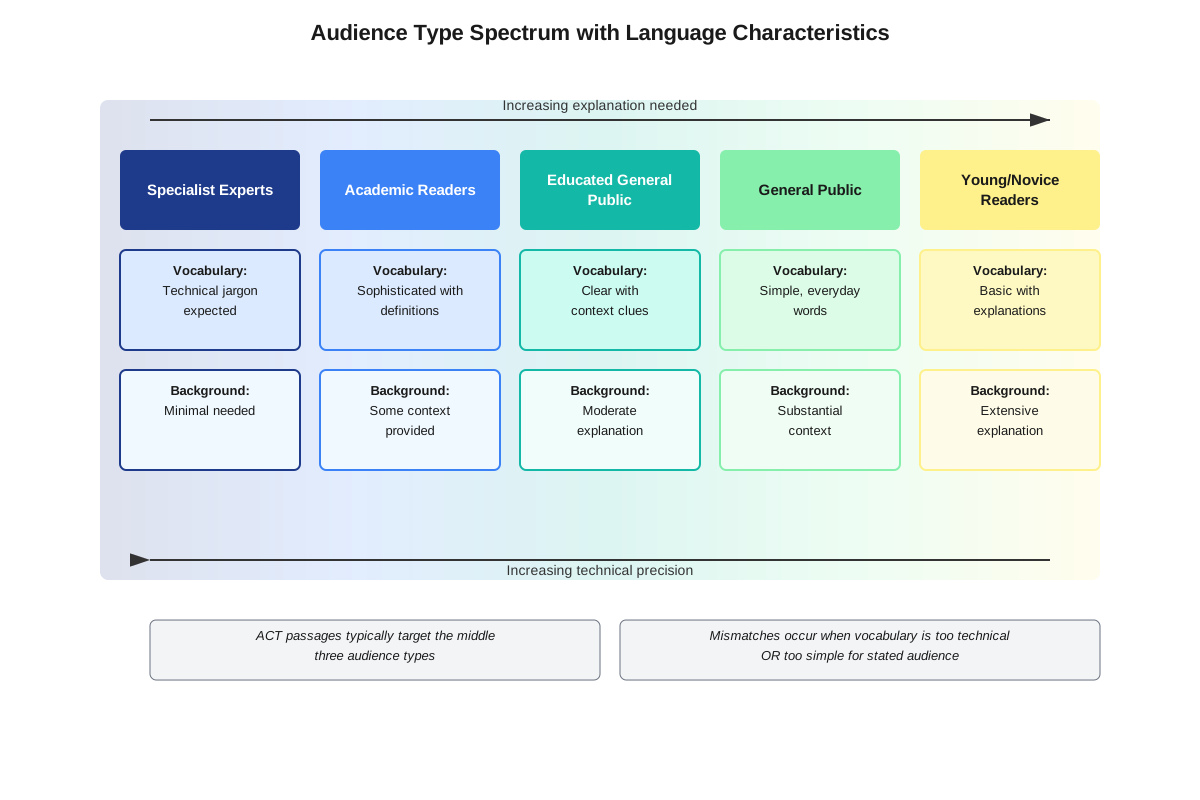
The ACT typically presents four main audience categories:
| Audience Type | Characteristics | Appropriate Features | Inappropriate Features |
|---|---|---|---|
| General/Popular | Broad readership, varied backgrounds | Defined terms, accessible vocabulary, engaging examples | Unexplained jargon, assumed specialized knowledge |
| Academic/Scholarly | Educated specialists, field experts | Technical terminology, formal tone, detailed analysis | Oversimplification, casual language, basic explanations |
| Young/Student | Limited background knowledge | Simple vocabulary, extensive context, clear explanations | Complex syntax, undefined terms, assumed cultural knowledge |
| Professional/Technical | Industry practitioners | Field-specific language, practical applications | Overly basic explanations, irrelevant tangents |
Recognizing Audience Awareness Questions
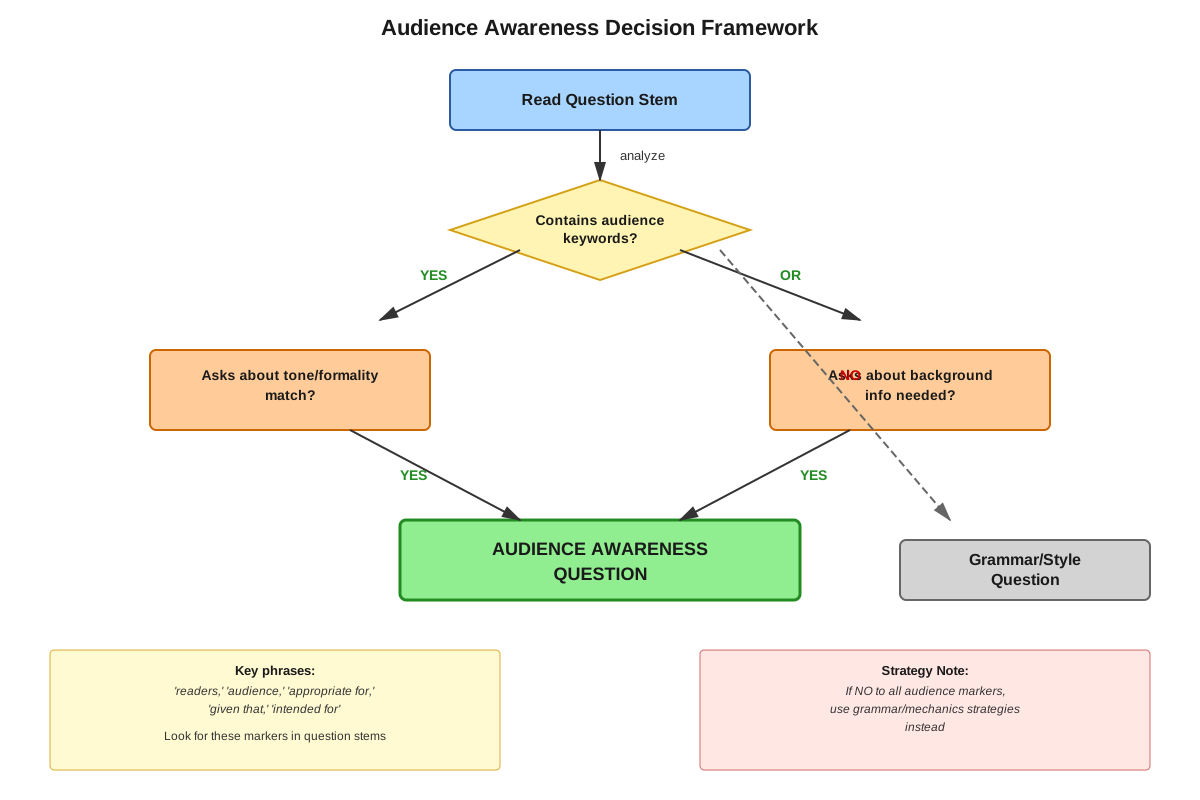
ACT audience awareness questions typically include specific signals in the question stem:
- Explicit audience identification: "Given that this essay is written for an audience of high school students..."
- Purpose statements tied to audience: "If the writer's goal is to inform readers unfamiliar with quantum physics..."
- Publication venue mentions: "Assuming this article will appear in a general-interest magazine..."
- Effectiveness queries: "Does this sentence accomplish the writer's goal of explaining the concept to non-specialists?"
These questions often follow a YES/YES/NO/NO format, where two answer choices say "Yes" (with different reasons) and two say "No" (with different reasons). Students must determine both whether the writing succeeds AND why or why not.
The Background Knowledge Principle
A crucial concept in audience awareness is the background knowledge principle: writers should provide exactly the amount of context their audience needs—neither too much nor too little. Overexplaining to knowledgeable readers wastes space and insults intelligence. Underexplaining to novice readers creates confusion and disengagement.
The ACT tests this principle by presenting passages where:
- Technical terms appear without definition for general audiences (needs correction)
- Basic concepts are over-explained to expert audiences (unnecessarily verbose)
- Historical or cultural references lack context for unfamiliar readers (needs addition)
- Common knowledge is unnecessarily explained to appropriate audiences (should be removed)
Evaluating Appropriateness
When evaluating whether writing suits its audience, consider these questions:
- Would this audience understand all terms used? If not, definitions or simpler alternatives are needed.
- Does this audience have the background knowledge assumed? If not, additional context is required.
- Is the tone appropriate for this audience's expectations? Formal for academic, conversational for popular.
- Is the detail level right? Experts want depth; general readers want clarity.
- Are examples and analogies suitable? They should connect to the audience's likely experiences.
Concept Relationships
Audience awareness functions as the central hub connecting multiple rhetorical skills. The relationship flows as follows:
Purpose → Audience Awareness → Tone/Style: The writer's purpose (to inform, persuade, entertain) determines the target audience, which in turn dictates appropriate tone and stylistic choices. For example, a purpose to inform general readers about climate change requires accessible language and defined scientific terms, creating an informative yet conversational tone.
Audience Awareness → Word Choice: Once the audience is identified, vocabulary selection follows naturally. This connection is bidirectional—word choice both reflects and reinforces audience appropriateness.
Audience Awareness → Organization: How information is structured depends on audience needs. Expert audiences can handle complex organizational schemes, while general audiences benefit from clearer, more linear structures with explicit transitions.
Audience Awareness ↔ Context/Background Information: This relationship is particularly strong on the ACT. Audience awareness determines how much background information is necessary, while the presence or absence of context signals the intended audience.
Within audience awareness itself, the three pillars (knowledge level, vocabulary, tone) interconnect: appropriate vocabulary depends on knowledge level, while tone reflects both vocabulary choices and knowledge assumptions. These elements must align consistently throughout a passage for effective communication.
High-Yield Facts
⭐ Audience awareness questions typically provide explicit information about the intended readership in the question stem itself.
⭐ When writing for general audiences, technical terms should be defined or replaced with accessible alternatives.
⭐ Academic or expert audiences expect formal tone and can handle specialized terminology without definition.
⭐ The ACT often asks whether a sentence "accomplishes the writer's goal" for a specific audience—both the yes/no answer AND the reasoning matter.
⭐ Overexplaining basic concepts to expert audiences is as problematic as underexplaining complex concepts to general audiences.
- Historical or cultural references should be explained when writing for audiences who may lack that background knowledge.
- Personal anecdotes and informal language are generally appropriate for popular/general audiences but not for academic writing.
- The publication venue (scholarly journal vs. popular magazine) provides crucial context for determining appropriate audience level.
- Audience awareness questions appear approximately 4-6 times per ACT English test.
- Vocabulary that is too simple for the stated audience can be as incorrect as vocabulary that is too complex.
- The amount of background information provided should match the audience's presumed prior knowledge.
- Tone consistency throughout a passage is essential for maintaining appropriate audience address.
Quick check — test yourself on Audience awareness so far.
Try Flashcards →Common Misconceptions
Misconception: All writing should be as simple and accessible as possible to reach the widest audience.
Correction: Writing should match its intended audience. Academic writing for specialists should use appropriate technical language, while oversimplifying for expert readers is ineffective and inappropriate.
Misconception: If a term is defined once in a passage, it's appropriate for any audience.
Correction: For general audiences, even with definitions, excessive technical terminology can be overwhelming. The overall vocabulary level and density of specialized terms must match audience sophistication.
Misconception: Formal tone is always better than informal tone.
Correction: Tone should match audience expectations. Popular magazines and personal essays appropriately use conversational tone, while overly formal language in these contexts creates distance and reduces engagement.
Misconception: Audience awareness questions only test vocabulary difficulty.
Correction: These questions assess multiple dimensions including background knowledge assumptions, tone appropriateness, level of detail, and whether examples/analogies suit the audience's experiences.
Misconception: If the question says "Yes" accomplishes the goal, that's automatically the right answer.
Correction: Both "Yes" answers and both "No" answers provide different reasoning. Students must evaluate not just whether the goal is accomplished but also whether the reasoning provided accurately explains why or why not.
Misconception: More information is always better for clarity.
Correction: Providing unnecessary background information to knowledgeable audiences wastes space and can seem condescending. The right amount of information depends on audience needs.
Misconception: Cultural or historical references should always be explained in detail.
Correction: The need for explanation depends on the audience. References to major historical events (World War II) may not need explanation for adult general audiences, while obscure references or those unfamiliar to the specific audience should be clarified.
Worked Examples
Example 1: Evaluating Technical Terminology
Passage Context: An article about photosynthesis appearing in a general-interest science magazine includes this sentence:
"The light-dependent reactions occur in the thylakoid membranes, where photosystems I and II facilitate the photolysis of water molecules, generating ATP through chemiosmosis."
Question: Given that this article is intended for readers without specialized biology knowledge, does this sentence effectively explain the process?
A) Yes, because it accurately describes the scientific process.
B) Yes, because it uses proper scientific terminology.
C) No, because it uses technical terms that would be unfamiliar to general readers without definition.
D) No, because it provides too much detail about the process.
Analysis:
First, identify the audience: "readers without specialized biology knowledge" = general audience.
Next, evaluate the vocabulary: "thylakoid membranes," "photosystems I and II," "photolysis," "chemiosmosis" are all technical terms that general readers would not understand.
Then, assess whether the sentence accomplishes effective communication for this audience: While scientifically accurate, the sentence would confuse general readers because it assumes specialized knowledge they don't have.
Consider each answer:
- A is incorrect because accuracy alone doesn't ensure audience appropriateness
- B is incorrect because proper scientific terminology is actually the problem for general audiences
- C correctly identifies the issue: technical terms without definition alienate the target audience
- D is incorrect because the problem isn't too much detail but rather inaccessible language
Answer: C
Connection to Learning Objectives: This example demonstrates identifying when audience awareness is tested (explicit audience statement), explaining the core strategy (match vocabulary to audience knowledge level), and applying the concept to select the correct answer.
Example 2: Assessing Background Information Needs
Passage Context: An essay about the Harlem Renaissance includes this sentence:
"The movement flourished during the 1920s and 1930s, producing influential works that shaped American culture."
Question: The writer is considering adding the following sentence after the sentence above: "The Harlem Renaissance was a cultural, social, and artistic explosion centered in Harlem, New York." Assuming the essay is written for high school students who may be unfamiliar with this historical period, should the writer make this addition?
A) Yes, because it provides necessary context about what the Harlem Renaissance was.
B) Yes, because it mentions the specific location of Harlem, New York.
C) No, because the information is already implied in the original sentence.
D) No, because high school students should already know about the Harlem Renaissance.
Analysis:
Identify the audience: high school students who "may be unfamiliar with this historical period" = needs background information.
Evaluate what the original sentence assumes: It uses the term "the movement" assuming readers know what movement is being discussed, but never defines the Harlem Renaissance.
Assess the proposed addition: It provides a clear, concise definition of what the Harlem Renaissance was—exactly what unfamiliar readers need.
Consider each answer:
- A correctly identifies that the addition provides necessary context for the stated audience
- B is true but doesn't capture the main reason for adding the sentence (definition, not just location)
- C is incorrect because the original sentence doesn't define what the Harlem Renaissance was
- D is incorrect because the question explicitly states the audience "may be unfamiliar" with this period
Answer: A
Connection to Learning Objectives: This example shows how to identify audience awareness testing (explicit audience description with knowledge level), apply the background knowledge principle (unfamiliar audiences need definitions), and select the answer that correctly evaluates appropriateness for the specified readership.
Exam Strategy
Approaching Audience Awareness Questions
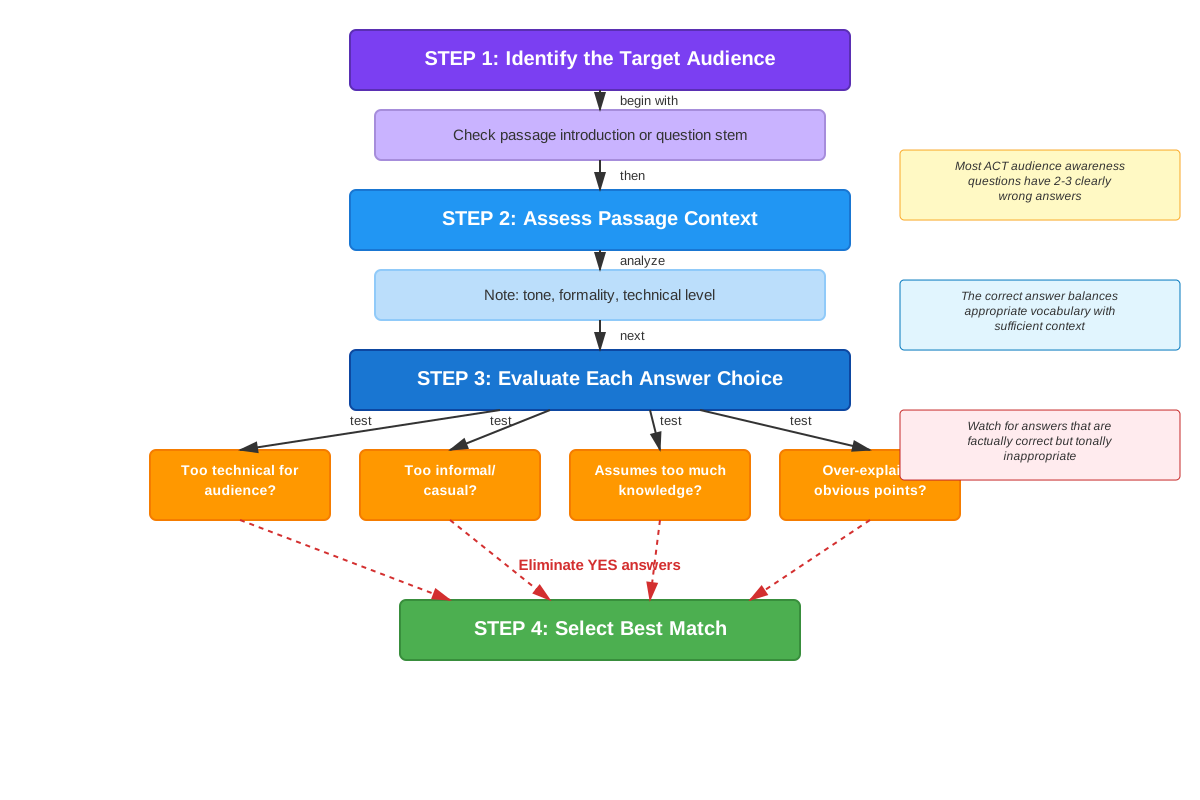
Step 1: Identify the Audience
Read the question stem carefully to determine who the intended readers are. Look for phrases like:
- "for an audience of..."
- "readers unfamiliar with..."
- "assuming this appears in..."
- "for specialists in..."
Step 2: Assess Audience Characteristics
Quickly categorize the audience:
- General/Popular: needs accessible language, defined terms, background context
- Academic/Expert: expects technical language, formal tone, minimal basic explanation
- Young/Student: requires simple vocabulary, extensive context, clear explanations
- Professional: understands field-specific terminology, values practical relevance
Step 3: Evaluate the Writing Against Audience Needs
Ask yourself:
- Would this audience understand all the words used?
- Does this audience have the assumed background knowledge?
- Is the tone appropriate for this audience?
- Is the level of detail right for this readership?
Step 4: Eliminate Based on Reasoning
For YES/YES/NO/NO questions, first decide whether the writing succeeds (Yes or No), then evaluate which reasoning is accurate. Often, one "Yes" and one "No" can be eliminated because their reasoning is flawed, even if the Yes/No determination is correct.
Trigger Words and Phrases
Watch for these signals that audience awareness is being tested:
- "Given that this essay is written for..."
- "Assuming the audience consists of..."
- "For readers unfamiliar with..."
- "Does this accomplish the writer's goal of..."
- "Should the writer add/delete this information for..."
- "Is this sentence appropriate for..."
Process of Elimination Tips
Eliminate answers that:
- Ignore the specified audience (treating all audiences the same)
- Confuse accuracy with appropriateness (something can be factually correct but still wrong for the audience)
- Assume all readers have expert knowledge or all readers are novices (when the question specifies otherwise)
- Focus on minor details while missing the main audience mismatch
- Claim something is "too simple" for general audiences or "too complex" for experts without justification
Favor answers that:
- Directly address the specified audience's needs
- Recognize when technical terms need definition for general readers
- Acknowledge when expert audiences don't need basic explanations
- Identify tone mismatches between content and readership
- Correctly assess whether background information is necessary
Time Allocation
Audience awareness questions typically require 30-45 seconds each. They demand more reading and analysis than pure grammar questions but less than complex organization questions. Budget your time accordingly:
- 10 seconds: Read and understand the question stem, identify the audience
- 15-20 seconds: Evaluate the passage content against audience needs
- 10-15 seconds: Eliminate wrong answers and select the best choice
Don't rush these questions—they reward careful analysis of the audience-writing match.
Memory Techniques
The MATCH Acronym
Use MATCH to remember the key elements of audience awareness:
- Match vocabulary to knowledge level
- Assess background information needs
- Tone should fit audience expectations
- Consider the publication context
- Help readers understand—don't confuse or condescend
The Audience Spectrum Visualization
Visualize a spectrum from "General Reader" to "Expert Specialist":
General → Educated Non-Specialist → Professional → Academic Expert
[Define all terms] → [Define technical terms] → [Minimal definition] → [No basic definitions]
[Conversational tone] → [Semi-formal] → [Formal] → [Highly formal]
[Extensive context] → [Moderate context] → [Limited context] → [Minimal context]
When you see an audience awareness question, mentally place the specified audience on this spectrum, then evaluate whether the writing matches that position.
The "Would Grandma Understand?" Test
For general audience questions, ask: "Would my grandmother (or someone with no specialized knowledge) understand this?" If the answer is no, the writing likely needs simplification or definition for a general audience.
For expert audience questions, flip it: "Would a professor in this field find this too basic?" If yes, the writing may be oversimplified for specialists.
The Three-Question Quick Check
Before answering any audience awareness question, quickly ask:
- Who is the audience? (Identify from question stem)
- What do they know? (Assess presumed background)
- Does this fit? (Match writing to audience needs)
Summary
Audience awareness is a fundamental rhetorical skill that requires writers to calibrate their language, tone, and content to their intended readers' needs and knowledge levels. On the ACT English section, these questions test whether students can recognize when writing successfully addresses its specified audience by evaluating vocabulary appropriateness, background information sufficiency, and tone alignment. The key principle is matching: technical terminology suits expert audiences but requires definition for general readers; formal tone fits academic contexts while conversational tone works for popular publications; extensive background information helps unfamiliar readers while unnecessary explanation wastes space for knowledgeable audiences. Success on these questions depends on carefully reading the question stem to identify the target audience, assessing that audience's characteristics and needs, and evaluating whether the passage content appropriately serves those readers. Students must recognize that effective writing isn't universally "simple" or "complex" but rather appropriately calibrated to its specific readership.
Key Takeaways
- Audience awareness questions explicitly identify the target readership in the question stem—always read this carefully to understand who the intended readers are.
- The three pillars of audience-appropriate writing are knowledge level calibration, vocabulary matching, and tone alignment—all three must suit the specified audience.
- General audiences need technical terms defined and background context provided, while expert audiences expect specialized terminology and minimal basic explanation.
- Appropriateness matters more than accuracy—writing can be factually correct but still wrong for the audience if it's too technical or too simplistic.
- YES/YES/NO/NO questions require evaluating both whether the goal is accomplished AND whether the reasoning is correct—both parts must be right.
- The amount of background information should match audience needs: neither overexplaining to experts nor underexplaining to novices.
- Publication venue (scholarly journal vs. popular magazine) provides crucial context for determining appropriate audience level and tone.
Related Topics
Purpose and Main Idea: Understanding a passage's purpose helps determine its appropriate audience, as different purposes (inform, persuade, entertain) target different readerships. Mastering audience awareness enables better evaluation of whether a passage achieves its stated purpose.
Tone and Style: These elements work hand-in-hand with audience awareness. Once you've mastered identifying appropriate audiences, you'll more easily recognize when tone and style choices match or mismatch the intended readership.
Word Choice and Precision: Audience awareness directly informs vocabulary selection. Advanced study of word choice builds on audience awareness principles to evaluate whether specific words suit their context and readership.
Adding and Deleting Information: Many addition/deletion questions involve audience awareness considerations—whether information is necessary depends partly on what the audience needs to know. Mastering audience awareness strengthens your ability to evaluate these questions.
Transitions and Organization: How information is structured and connected should reflect audience needs. Expert audiences can follow complex organizational schemes, while general audiences benefit from clearer signposting—a connection you'll explore in advanced rhetorical skills study.
Practice CTA
Now that you've mastered the core concepts of audience awareness, it's time to put your knowledge into action! Attempt the practice questions to reinforce your understanding and build the pattern recognition skills essential for ACT success. The flashcards will help you internalize the key principles and trigger words that signal audience awareness questions. Remember: these questions reward careful analysis of the audience-writing match, so take your time to identify the specified readership and evaluate whether the content truly serves those readers. With focused practice, you'll develop the instinct to quickly spot audience mismatches and select the correct answer with confidence. You've got this!
Sign up free to keep reading
Create a free AnvayaPrep account to finish this ACT guide on Audience awareness — plus flashcards and practice questions.