Overview
Topic sentences are the foundation of effective paragraph construction and serve as critical organizational tools in ACT Writing. A topic sentence is the opening statement of a paragraph that introduces the main idea and sets the direction for all supporting sentences that follow. On the ACT, understanding and crafting strong topic sentences is essential not only for the essay portion but also for analyzing passage organization in the English section.
The ACT frequently tests students' ability to recognize effective topic sentences, identify where they should be placed, and determine whether a given sentence adequately introduces a paragraph's content. Questions may ask students to choose the best opening sentence for a paragraph, evaluate whether a topic sentence effectively transitions from previous content, or assess whether the existing topic sentence aligns with the paragraph's supporting details. Mastery of ACT topic sentences directly impacts scores because these questions appear consistently across multiple test administrations and require students to demonstrate both reading comprehension and writing skills simultaneously.
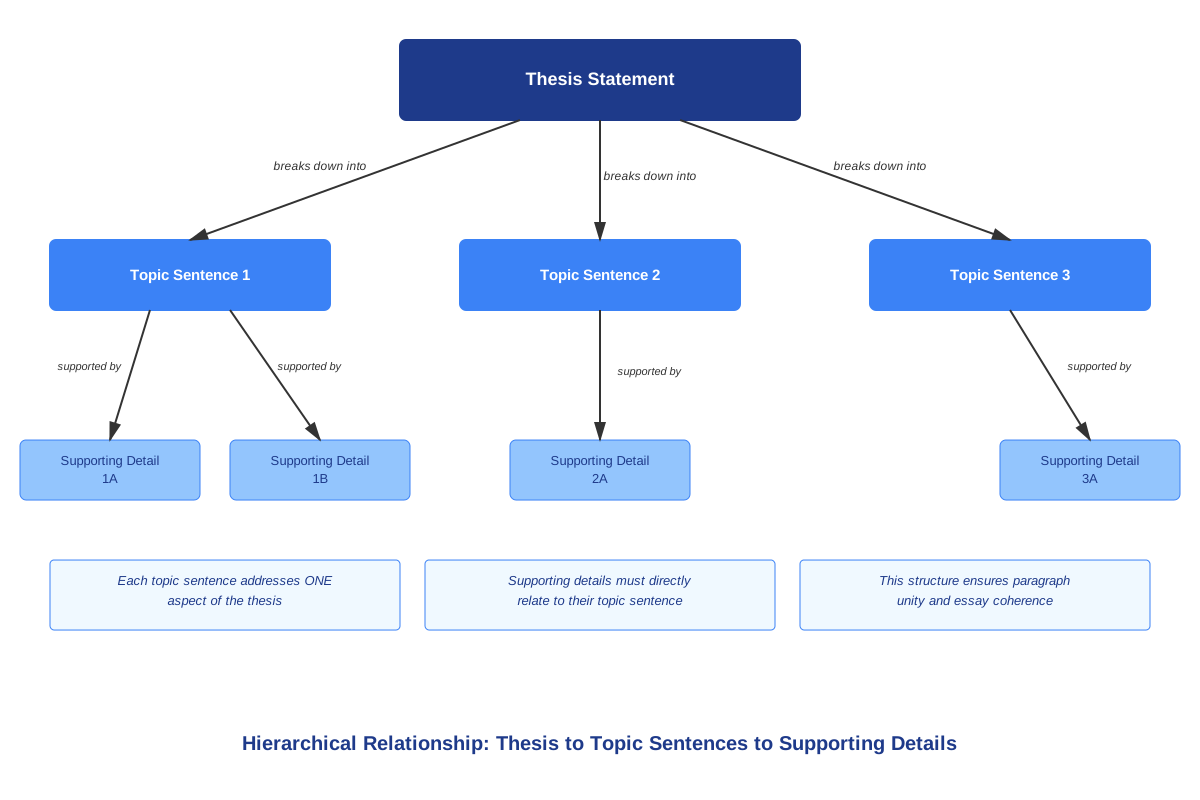
Topic sentences connect intimately with broader essay organization principles, including thesis statements, paragraph unity, and logical flow. While a thesis statement presents the overarching argument of an entire essay, topic sentences break down that argument into manageable, paragraph-sized chunks. Each topic sentence should relate back to the thesis while introducing a distinct supporting point. Understanding this hierarchical relationship—thesis governing topic sentences, topic sentences governing supporting details—is fundamental to achieving high scores on ACT Writing tasks.
Learning Objectives
- [ ] Identify when Topic sentences is being tested
- [ ] Explain the core rule or strategy behind Topic sentences
- [ ] Apply Topic sentences to ACT-style questions accurately
- [ ] Evaluate whether a given topic sentence effectively introduces paragraph content
- [ ] Construct original topic sentences that establish clear focus and direction
- [ ] Recognize the relationship between topic sentences and thesis statements
- [ ] Distinguish between effective and ineffective topic sentence placement
Prerequisites
- Basic paragraph structure: Understanding that paragraphs contain a main idea supported by details is essential for recognizing how topic sentences function as organizational anchors
- Thesis statement construction: Knowing how to identify and create thesis statements helps students understand the hierarchical relationship between essay-level and paragraph-level main ideas
- Reading comprehension fundamentals: The ability to identify main ideas in passages enables students to evaluate whether topic sentences accurately reflect paragraph content
Why This Topic Matters
Topic sentences represent one of the most practical writing skills students will use throughout their academic and professional careers. Every research paper, business report, email, and analytical essay relies on clear topic sentences to guide readers through complex information. In college writing, professors expect students to begin each body paragraph with a focused topic sentence that signals the paragraph's purpose and connects to the broader argument.
On the ACT, topic sentence questions appear with high frequency, typically comprising 3-5 questions per English section and serving as a fundamental evaluation criterion in the Writing essay. These questions often appear as "Which choice provides the most effective introduction to this paragraph?" or "The writer wants to add a sentence that introduces the main idea of the paragraph. Which choice best accomplishes this goal?" The ACT also tests topic sentences indirectly through organization questions that ask about sentence placement and paragraph unity.
Common manifestations in ACT passages include: paragraphs with missing opening sentences where students must select the best option; paragraphs with weak or off-topic opening sentences that need revision; transition questions where the topic sentence must connect previous content to new ideas; and organization questions where students must determine if a sentence functions effectively as a topic sentence or belongs elsewhere in the paragraph. Understanding topic sentences is classified as "High" importance because these questions are both frequent and foundational—students who master this concept gain advantages across multiple question types.
Core Concepts
Definition and Function of Topic Sentences
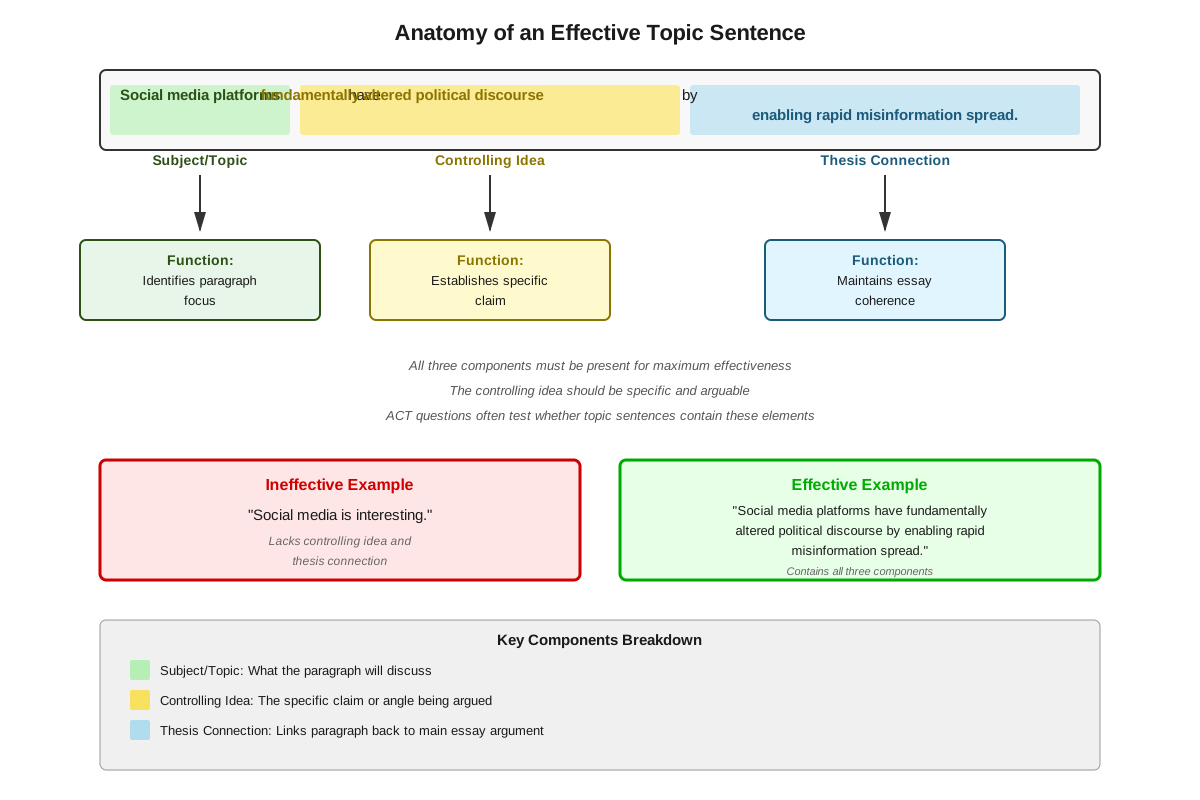
A topic sentence is a declarative statement, typically positioned at the beginning of a paragraph, that explicitly states the paragraph's main idea and establishes the scope of discussion for all subsequent sentences. The primary function is to provide a roadmap for readers, signaling what information to expect and how it relates to the broader argument. Effective topic sentences accomplish three simultaneous goals: they introduce a specific, focused idea; they connect to the essay's thesis or previous paragraphs; and they establish a clear direction that supporting sentences can follow.
The anatomy of a strong topic sentence includes a subject (what the paragraph discusses) and a controlling idea (the specific aspect or claim about that subject). For example, "Social media platforms have revolutionized political campaigning" contains the subject (social media platforms) and controlling idea (revolutionized political campaigning). Every sentence following this topic sentence should provide evidence, examples, or analysis related to how social media changed political campaigns.
Characteristics of Effective Topic Sentences
Effective topic sentences share several distinguishing characteristics that ACT questions frequently test:
Specificity: Strong topic sentences make precise claims rather than vague generalizations. "Technology affects society" is too broad, while "Smartphone addiction has decreased face-to-face social interactions among teenagers" provides specific, discussable content.
Focus: Each topic sentence should introduce one main idea, not multiple competing concepts. "Electric vehicles reduce emissions and solar panels generate clean energy" attempts to cover two distinct topics and would require splitting into separate paragraphs.
Assertiveness: Topic sentences make clear claims or statements rather than posing questions or using tentative language. "Does exercise improve mental health?" is a question, not a topic sentence, while "Regular exercise significantly reduces symptoms of anxiety and depression" makes a definitive claim.
Relevance: Every topic sentence must connect logically to the essay's thesis statement and fit within the overall argument structure. A paragraph about historical voting patterns would be irrelevant in an essay arguing for renewable energy adoption.
Transitional quality: While not always required, effective topic sentences often include transitional elements that connect to previous content, creating smooth flow between paragraphs.
Topic Sentence Placement and Variations
While topic sentences typically appear as the first sentence of a paragraph, the ACT recognizes several legitimate placement variations:
| Placement | Description | When to Use | Example Context |
|---|---|---|---|
| Opening position | First sentence of paragraph | Most common; provides immediate clarity | Standard body paragraphs in analytical essays |
| After transition | Second sentence, following a transitional phrase | When connecting closely to previous paragraph | "However, not everyone agrees. The opposing viewpoint argues..." |
| Delayed position | After brief context or hook | When background information enhances understanding | "In 1969, humans first walked on the moon. This achievement represented..." |
| Implied | Main idea clear from context without explicit statement | Narrative or descriptive writing (rare on ACT) | Creative writing contexts |
The ACT overwhelmingly favors opening position topic sentences, and questions typically reward choices that place the main idea statement first. Students should default to this structure unless specific context demands otherwise.
Relationship Between Topic Sentences and Supporting Details
The connection between topic sentences and supporting details follows a hierarchical structure where every supporting sentence must directly relate to the topic sentence's claim. This relationship operates through three primary patterns:
- Illustration pattern: Topic sentence makes a claim; supporting sentences provide examples
- Explanation pattern: Topic sentence introduces a concept; supporting sentences define, describe, or analyze
- Argumentation pattern: Topic sentence presents a position; supporting sentences offer evidence and reasoning
When evaluating topic sentences on the ACT, students must read the entire paragraph to verify alignment. A sentence might sound impressive in isolation but fail as a topic sentence if the paragraph's content doesn't support it. For instance, if a paragraph discusses specific renewable energy technologies (solar, wind, hydroelectric), the topic sentence must address renewable energy technologies generally, not climate change broadly or one specific technology exclusively.
Common Topic Sentence Errors
The ACT frequently tests recognition of flawed topic sentences. Understanding these common errors helps students eliminate incorrect answer choices:
Overgeneralization: Topic sentences that make claims too broad for the paragraph to support adequately. "Climate change affects everything" cannot be sufficiently addressed in one paragraph.
Undergeneralization: Topic sentences too narrow or specific, essentially functioning as supporting details themselves. "The Tesla Model 3 costs $40,000" is a fact, not a discussable main idea.
Irrelevance: Topic sentences that introduce ideas unrelated to the paragraph's actual content or the essay's thesis.
Lack of assertion: Sentences that merely announce the topic without making a claim. "This paragraph will discuss renewable energy" tells what the paragraph covers but makes no meaningful statement about it.
Multiple ideas: Topic sentences attempting to introduce several distinct concepts that should be separated into different paragraphs.
Concept Relationships
Topic sentences function as the critical link in a hierarchical chain of ideas within essay organization. At the highest level, the thesis statement presents the essay's central argument or main idea. Each topic sentence then introduces one supporting point that develops or proves the thesis. Finally, supporting details (evidence, examples, analysis) within each paragraph develop and prove the topic sentence's claim.
This relationship flows in both directions: topic sentences must connect upward to the thesis (ensuring relevance to the overall argument) and downward to supporting details (ensuring the paragraph content actually supports the claim made). When ACT questions ask about paragraph unity or organization, they're testing whether students recognize these vertical relationships.
Topic sentences also create horizontal relationships between paragraphs through transitional elements. Each topic sentence should acknowledge what came before while introducing new content, creating a logical progression of ideas. The sequence might follow patterns like chronological order (first, then, finally), order of importance (most significantly, additionally, furthermore), or logical argumentation (one reason, another factor, however).
The concept connects to prerequisite knowledge of thesis statements by operating as the thesis's supporting structure—if the thesis is the roof of a house, topic sentences are the supporting beams. Understanding basic paragraph structure is prerequisite because students must recognize that topic sentences govern all other sentences in their paragraph, just as the main idea governs supporting details in any text.
High-Yield Facts
⭐ Topic sentences typically appear as the first sentence of a body paragraph and introduce the paragraph's main idea
⭐ Every topic sentence must connect logically to the essay's thesis statement
⭐ Effective topic sentences contain both a subject and a controlling idea that limits the scope of discussion
⭐ All supporting sentences in a paragraph must directly relate to and develop the topic sentence's claim
⭐ The ACT frequently asks students to choose the most effective introduction to a paragraph, testing topic sentence recognition
- Topic sentences should make assertions or claims rather than pose questions or merely announce topics
- Overly broad topic sentences cannot be adequately supported within a single paragraph
- Overly narrow topic sentences function as supporting details rather than main ideas
- Transitional topic sentences connect to previous content while introducing new ideas
- Topic sentences that introduce multiple distinct ideas should be split into separate paragraphs
- The controlling idea in a topic sentence determines what supporting evidence is relevant
- Effective topic sentences are specific enough to provide clear direction but broad enough to require development
- Questions about paragraph unity often test whether the topic sentence aligns with supporting content
- Implied topic sentences (where the main idea isn't explicitly stated) are rare and generally not rewarded on the ACT
- Topic sentence placement questions typically favor opening position over delayed or embedded positions
Quick check — test yourself on Topic sentences so far.
Try Flashcards →Common Misconceptions
Misconception: Topic sentences must always be the absolute first sentence of every paragraph without exception.
Correction: While opening position is standard and preferred on the ACT, topic sentences can occasionally appear after a brief transitional phrase or contextual sentence. However, students should default to first-position topic sentences unless specific context clearly demands otherwise.
Misconception: A topic sentence just needs to relate to the general essay topic, not necessarily to the specific thesis statement.
Correction: Every topic sentence must connect directly to the thesis statement, serving as one supporting point in the overall argument. A topic sentence might relate to the general subject area but still be irrelevant if it doesn't advance the specific thesis claim.
Misconception: Longer, more complex topic sentences are more sophisticated and will score higher.
Correction: Effective topic sentences prioritize clarity and focus over length or complexity. A concise, clear topic sentence that precisely introduces the paragraph's content is superior to a lengthy, convoluted sentence that obscures the main idea.
Misconception: Topic sentences should introduce new vocabulary or concepts that will be defined later in the paragraph.
Correction: Topic sentences should use clear, accessible language to state the main idea. While supporting sentences can define terms or explain concepts, the topic sentence itself should be immediately comprehensible to readers.
Misconception: If a paragraph contains good supporting details and evidence, the topic sentence doesn't matter much.
Correction: Without an effective topic sentence, even excellent supporting details lack context and direction. The topic sentence is essential for paragraph unity and helps readers understand how to interpret the evidence presented. ACT questions specifically test whether topic sentences align with paragraph content.
Misconception: Topic sentences and thesis statements are essentially the same thing at different scales.
Correction: While both introduce main ideas, they function differently. A thesis statement presents the essay's overall argument and typically appears in the introduction, while topic sentences introduce paragraph-specific supporting points and appear at the start of body paragraphs. The thesis governs the entire essay; topic sentences govern individual paragraphs.
Worked Examples
Example 1: Identifying an Effective Topic Sentence
Question: The writer wants to add a sentence that introduces the main idea of the following paragraph. Which choice best accomplishes this goal?
[Paragraph content]: Studies from Stanford University show that students who take handwritten notes retain information 34% better than those who type. The physical act of writing engages different neural pathways associated with memory formation. Additionally, handwriting forces students to summarize and paraphrase rather than transcribe verbatim, promoting deeper processing of information. Research participants who wrote notes by hand scored significantly higher on conceptual questions one week after lectures.
Answer Choices:
A) Technology has changed how students learn in many ways.
B) Handwriting notes offers significant cognitive advantages over typing.
C) Many students prefer typing notes because it's faster.
D) Note-taking strategies vary widely among college students.
Analysis:
First, identify what the paragraph actually discusses by reading all supporting sentences. The paragraph presents research evidence about handwriting's benefits for memory retention and learning, comparing handwriting favorably to typing.
Choice A is too broad and vague. While technology is mentioned (typing), the paragraph's focus is specifically on handwriting's advantages, not technology's general impact on learning. This represents the overgeneralization error.
Choice B directly states the paragraph's main idea: handwriting provides cognitive benefits compared to typing. The controlling idea ("cognitive advantages") aligns perfectly with the supporting content about memory retention, neural pathways, and deeper processing. This is the correct answer.
Choice C introduces a claim about student preferences that the paragraph never addresses. The paragraph discusses effectiveness, not preferences. This represents the irrelevance error—the sentence might relate to note-taking generally but doesn't match the paragraph's actual content.
Choice D is too broad and doesn't make a specific claim. It merely announces that strategies vary without stating anything meaningful about handwriting specifically. This represents the "lack of assertion" error.
Connection to Learning Objectives: This example demonstrates how to identify when topic sentences are being tested (recognizing the question format) and apply the core strategy (matching the topic sentence to paragraph content by reading all supporting details first).
Example 2: Evaluating Topic Sentence Placement and Effectiveness
Question: The writer is considering adding the following sentence to the paragraph. Should the sentence be added, and if so, where?
Proposed sentence: "However, critics argue that standardized testing narrows curriculum and encourages teaching to the test."
[Existing paragraph]: Standardized tests provide objective measures of student achievement across different schools and districts. These assessments allow policymakers to identify underperforming schools and allocate resources accordingly. Furthermore, standardized metrics enable colleges to compare applicants from diverse educational backgrounds fairly. Without common benchmarks, evaluating student performance would rely entirely on subjective measures like teacher grades, which vary significantly in rigor.
Answer Choices:
A) Yes, at the beginning of the paragraph, because it introduces the main idea.
B) Yes, at the end of the paragraph, because it provides a conclusion.
C) No, because it contradicts the paragraph's main idea and would disrupt unity.
D) No, because the information is not relevant to the essay's topic.
Analysis:
First, identify the existing paragraph's topic sentence and main idea. The opening sentence, "Standardized tests provide objective measures of student achievement across different schools and districts," introduces the main idea: standardized tests offer objective measurement benefits. All supporting sentences develop this idea by explaining specific advantages (resource allocation, college admissions, comparison to subjective alternatives).
Now evaluate the proposed sentence. It introduces criticism of standardized testing, arguing they narrow curriculum and encourage teaching to the test. This presents an opposing viewpoint that contradicts the paragraph's pro-standardized-testing argument.
Choice A is incorrect because placing this sentence at the beginning would make it the topic sentence, but the rest of the paragraph supports standardized testing's benefits, not criticisms. This would create immediate disunity.
Choice B is incorrect because ending with this contradictory claim would undermine the entire paragraph's argument without resolution or rebuttal. Conclusions should reinforce the topic sentence, not contradict it.
Choice C is correct. The proposed sentence introduces an opposing viewpoint that contradicts the paragraph's main idea. Including it would disrupt paragraph unity because all other sentences support standardized testing while this one criticizes it. This sentence might belong in a different paragraph that addresses counterarguments, but not in this paragraph focused on benefits.
Choice D is incorrect because the information is relevant to the essay's topic (standardized testing). The issue isn't relevance to the topic but rather contradiction of the specific paragraph's main idea.
Connection to Learning Objectives: This example demonstrates applying topic sentence principles to evaluate paragraph unity and organization, showing how topic sentences govern all content within their paragraphs and how contradictory information disrupts that unity.
Exam Strategy
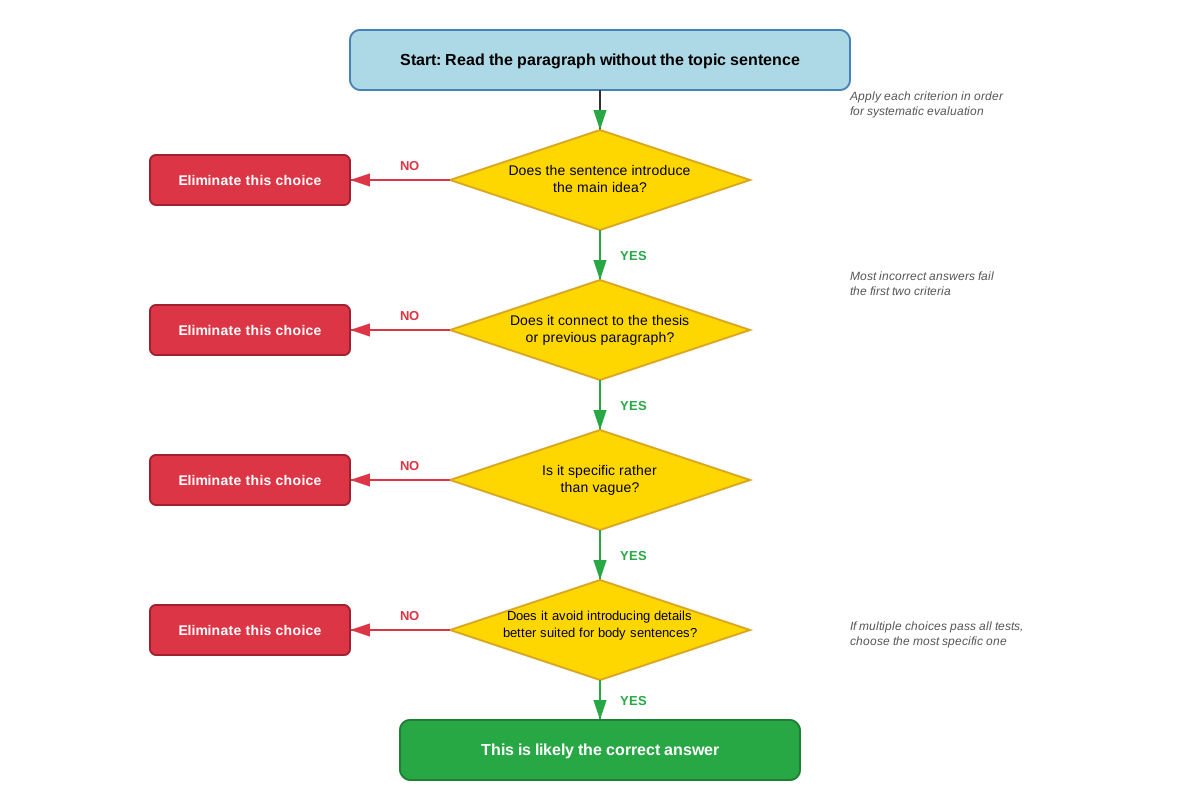
When approaching ACT questions about topic sentences, follow this systematic process:
Step 1: Identify the question type. Watch for trigger phrases like "most effective introduction to the paragraph," "best introduces the main idea," "which choice provides the most logical beginning," or "should the writer add this sentence at the beginning of the paragraph." These signal topic sentence questions.
Step 2: Read the entire paragraph carefully. Never evaluate a potential topic sentence without reading all supporting content. The correct topic sentence must align with what the paragraph actually discusses, not what sounds good in isolation.
Step 3: Identify the paragraph's actual content. Summarize in your own words what the paragraph discusses. What is the one main idea? What specific aspects or examples are provided?
Step 4: Evaluate each answer choice against the paragraph content. Ask three questions for each option:
- Does this introduce the main idea the paragraph actually develops?
- Is this specific enough to provide direction but broad enough to cover all supporting content?
- Does this connect logically to the thesis or previous content?
Step 5: Eliminate common wrong answer types:
- Too broad: Choices that make claims too large for the paragraph to support
- Too narrow: Choices that function as supporting details rather than main ideas
- Irrelevant: Choices that sound good but don't match the paragraph's actual content
- Multiple ideas: Choices that try to introduce several distinct concepts
- Question format: Choices phrased as questions rather than assertions
Exam Tip: If two answer choices seem similar, the more specific one that includes a controlling idea is usually correct. "Social media affects communication" is weaker than "Social media has reduced face-to-face interactions among teenagers" because the second includes a specific controlling idea.
Time allocation: Topic sentence questions should take 30-45 seconds each. If you're spending more than one minute, you're likely overthinking. Trust the process: read the paragraph, identify its content, match the topic sentence to that content.
Process of elimination: Start by eliminating obviously wrong answers (questions, irrelevant content, extreme overgeneralizations), then carefully compare remaining choices against the paragraph's specific content. The correct answer will feel like a natural introduction to what follows.
Memory Techniques
STAR Method for Evaluating Topic Sentences:
- Specific: Does it make a precise, focused claim?
- Transitional: Does it connect to previous content or the thesis?
- Assertive: Does it make a clear statement rather than pose a question?
- Relevant: Does it match the paragraph's actual supporting content?
The "Umbrella Visualization": Picture the topic sentence as an umbrella that must cover all the supporting details beneath it. If any supporting sentence sticks out beyond the umbrella (doesn't relate to the topic sentence), either the topic sentence is too narrow or that supporting sentence doesn't belong in the paragraph.
First-Sentence Default Rule: When in doubt, assume the topic sentence should be the first sentence of the paragraph. The ACT rewards this placement in the vast majority of cases.
The "Thesis Baby" Concept: Think of topic sentences as "babies" of the thesis statement—each one is a smaller version that inherits characteristics from the parent (connects to the main argument) but has its own distinct identity (introduces one specific supporting point).
MATCH Acronym for Topic Sentence Content:
- Main idea stated clearly
- Aligns with paragraph content
- Ties to thesis statement
- Controlling idea included
- Helps reader predict what follows
Summary
Topic sentences serve as the organizational foundation of effective paragraph construction, introducing the main idea that all supporting sentences develop. On the ACT, mastery of topic sentences is essential because these questions appear frequently in the English section and represent a fundamental evaluation criterion in the Writing essay. Effective topic sentences share key characteristics: they make specific, focused claims; they contain both a subject and controlling idea; they connect logically to the essay's thesis; and they align with the paragraph's supporting content. The ACT typically tests topic sentences through questions asking students to select the most effective introduction to a paragraph or evaluate whether a proposed sentence should be added at the beginning. Success requires reading the entire paragraph to understand its actual content, then selecting the topic sentence that best introduces that specific content while connecting to the broader argument. Common errors include overgeneralization, irrelevance, lack of assertion, and attempting to introduce multiple ideas in one sentence. Students should default to placing topic sentences in opening position and use the STAR method (Specific, Transitional, Assertive, Relevant) to evaluate effectiveness.
Key Takeaways
- Topic sentences introduce the main idea of a paragraph and must align with all supporting content that follows
- Effective topic sentences contain both a subject and a controlling idea that limits the scope of discussion
- Every topic sentence must connect logically to the essay's thesis statement, serving as one supporting point in the overall argument
- The ACT frequently tests topic sentences through questions asking for the "most effective introduction" to a paragraph
- Read the entire paragraph before selecting a topic sentence—the correct answer must match the paragraph's actual content, not just sound good in isolation
- Default to placing topic sentences in opening position (first sentence) unless specific context clearly demands otherwise
- Use process of elimination to remove overly broad, overly narrow, irrelevant, or question-formatted answer choices
Related Topics
Thesis Statements: Understanding how to construct and identify thesis statements is essential because topic sentences must connect to and support the thesis. Mastering topic sentences enables students to see how individual paragraphs build toward proving an overall argument.
Paragraph Unity and Coherence: Topic sentences are the foundation of paragraph unity—every sentence must relate to the topic sentence. Students who master topic sentences are prepared to tackle questions about whether sentences belong in a paragraph or should be moved.
Transitions and Flow: Topic sentences often include transitional elements that connect to previous content. Understanding topic sentences prepares students for more advanced work on creating smooth transitions between paragraphs and ideas.
Supporting Evidence and Examples: Once students master topic sentences, they can focus on selecting and organizing supporting details that effectively develop the main idea introduced in the topic sentence.
Essay Organization and Structure: Topic sentences are building blocks of overall essay organization. Mastering them enables students to construct well-organized essays with clear progression of ideas from introduction through body paragraphs to conclusion.
Practice CTA
Now that you understand the principles and strategies behind effective topic sentences, it's time to apply this knowledge! Work through the practice questions to test your ability to identify, evaluate, and construct strong topic sentences in ACT-style contexts. Use the flashcards to reinforce key concepts and characteristics of effective topic sentences. Remember, topic sentence questions are high-frequency on the ACT, so mastering this skill will directly impact your score. Each practice question you complete builds the pattern recognition and analytical skills needed to answer these questions quickly and accurately on test day. You've got this!
Sign up free to keep reading
Create a free AnvayaPrep account to finish this ACT guide on Topic sentences — plus flashcards and practice questions.