Overview
Paragraph unity is a fundamental principle of effective writing that the ACT English Test assesses extensively throughout its passages. This concept refers to the requirement that every sentence within a paragraph must relate directly to a single main idea or topic. When a paragraph maintains unity, all sentences work together cohesively to develop one central point, creating clear and logical communication. The ACT frequently tests whether students can identify sentences that disrupt this unity and determine the most appropriate placement for new information within or between paragraphs.
Understanding ACT paragraph unity is critical because approximately 15-20% of ACT English questions involve organization and structure, with paragraph unity questions appearing in nearly every test administration. These questions require students to evaluate whether sentences belong in their current location, should be moved elsewhere, or should be deleted entirely. Mastery of this topic directly impacts a student's ability to score in the upper ranges of the English section, as these questions often separate high-scoring students from those in the mid-range.
Paragraph unity connects intimately with broader essay organization principles, including topic sentences, transitions, and logical flow. While topic sentences establish the main idea, paragraph unity ensures that every supporting sentence reinforces that idea without introducing tangential information. This concept also relates closely to relevance, coherence, and the elimination of redundancy—all essential skills for both the ACT English Test and the optional ACT Writing Test. Students who master paragraph unity develop a critical eye for identifying when information strays from the central purpose, a skill that enhances both reading comprehension and writing quality.
Learning Objectives
- [ ] Identify when paragraph unity is being tested in ACT English questions
- [ ] Explain the core rule or strategy behind paragraph unity
- [ ] Apply paragraph unity principles to ACT-style questions accurately
- [ ] Distinguish between relevant and irrelevant sentences within a given paragraph
- [ ] Determine the appropriate placement for sentences that disrupt paragraph unity
- [ ] Evaluate whether a sentence should be deleted, moved, or retained based on unity principles
- [ ] Recognize common question stems that signal paragraph unity assessment
Prerequisites
- Basic paragraph structure: Understanding that paragraphs contain a main idea supported by details is essential for recognizing when sentences deviate from the central topic
- Topic sentence identification: Recognizing the sentence that introduces the paragraph's main idea helps determine whether supporting sentences maintain unity
- Reading comprehension skills: The ability to identify main ideas and supporting details enables students to evaluate whether all sentences contribute to the paragraph's purpose
- Logical reasoning: Understanding cause-effect relationships and logical connections helps assess whether sentences belong together in a unified paragraph
Why This Topic Matters
Paragraph unity represents a cornerstone of effective communication in academic, professional, and personal contexts. In college writing, professors expect students to construct paragraphs where every sentence advances a single argument or explores one facet of a topic. Professional communications—from business reports to technical documentation—rely on unified paragraphs to convey information efficiently without confusing readers. Even in everyday contexts like emails and social media posts, maintaining focus within each paragraph ensures that messages are understood as intended.
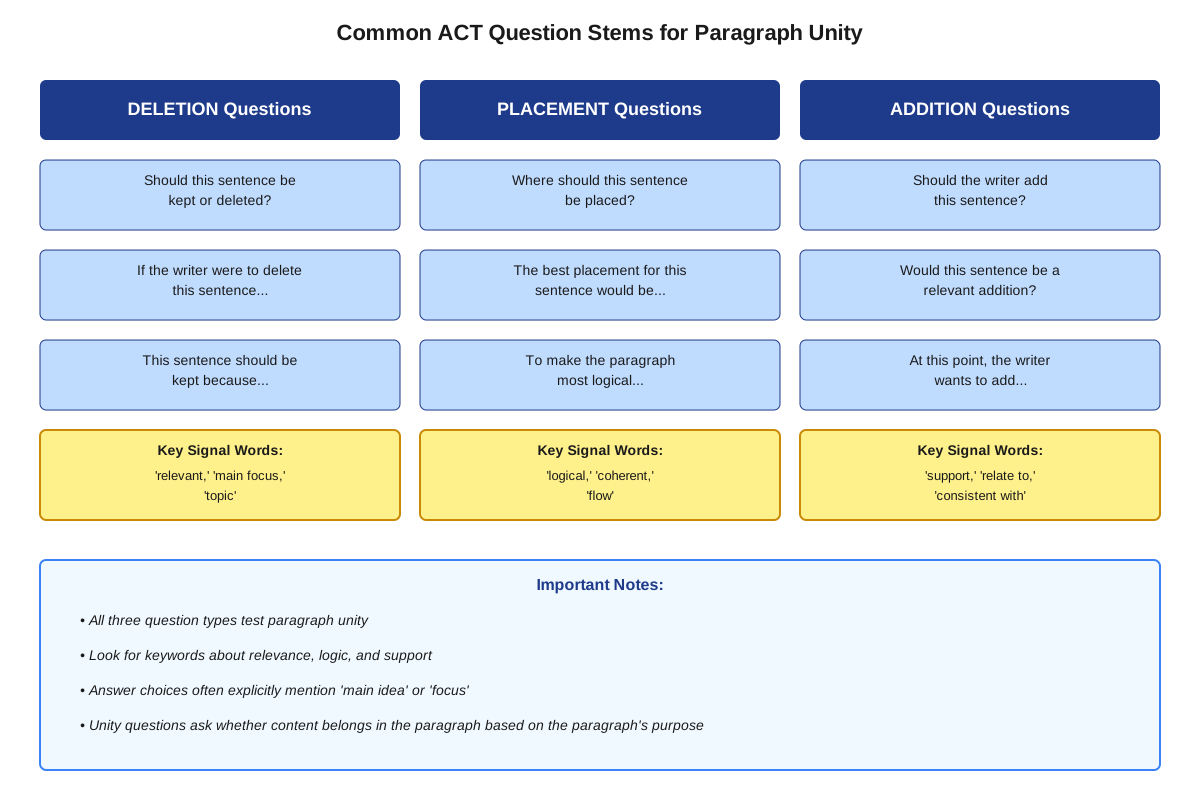
On the ACT English Test, paragraph unity questions appear with remarkable consistency. Students can expect to encounter 3-5 questions per test that directly assess this concept, typically appearing as "sentence placement" questions, "deletion" questions, or "relevance" questions. These questions often carry the format: "The writer is considering deleting the preceding sentence. Should the sentence be kept or deleted?" or "At this point, the writer is considering adding the following sentence... Should the writer make this addition?" Additionally, questions may ask where a sentence should be placed within a paragraph or whether it belongs in the current paragraph at all.
The ACT presents paragraph unity questions within the context of complete passages, requiring students to read surrounding sentences carefully to understand the paragraph's main focus. These questions frequently appear in passages about science, history, personal narratives, and cultural topics. The test-makers deliberately include sentences that may be factually accurate and well-written but nonetheless disrupt the paragraph's unity by introducing tangential information. This design tests whether students can distinguish between "good writing" and "appropriate placement"—a nuanced skill that reflects genuine writing competence.
Core Concepts
Definition of Paragraph Unity
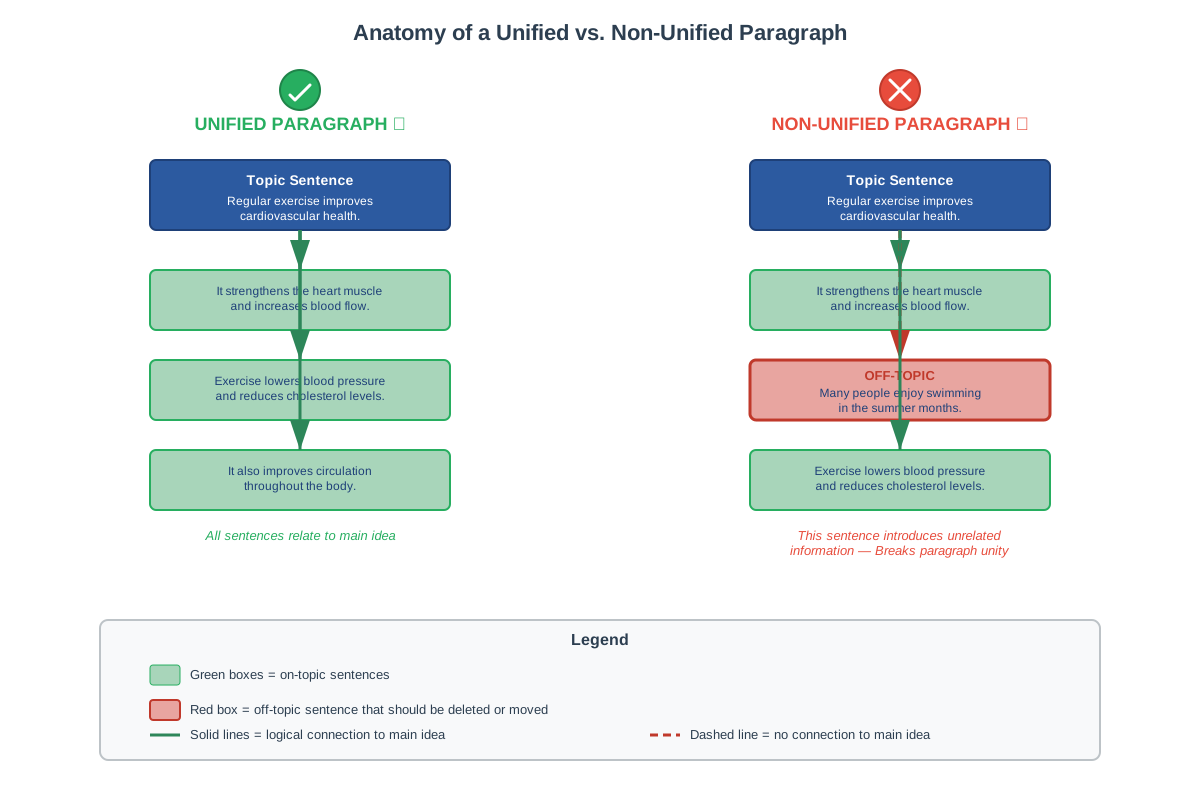
Paragraph unity exists when every sentence in a paragraph directly supports, explains, or develops a single main idea. A unified paragraph maintains a clear focus from beginning to end, with no sentences that introduce unrelated topics, digress into tangential information, or shift the discussion in a new direction. The principle operates on the understanding that readers process information most effectively when related ideas are grouped together and unrelated ideas are separated into distinct paragraphs.
The main idea of a paragraph typically appears in the topic sentence, though it may occasionally be implied rather than explicitly stated. Once established, this main idea serves as the criterion for evaluating every subsequent sentence: Does this sentence help develop, support, illustrate, or explain the main idea? If the answer is no, the sentence disrupts unity and should be relocated or removed.
Components of a Unified Paragraph
A unified paragraph contains several key components working in harmony:
| Component | Function | Unity Requirement |
|---|---|---|
| Topic Sentence | Introduces the main idea | Must establish the focus that all other sentences support |
| Supporting Sentences | Provide evidence, examples, or explanation | Must directly relate to the topic sentence |
| Detail Sentences | Elaborate on supporting sentences | Must connect to both supporting sentences and main idea |
| Concluding Sentence | Reinforces or summarizes the main idea | Must tie back to the paragraph's central focus |
Each component must maintain a clear connection to the paragraph's central purpose. Supporting sentences might provide factual evidence, personal anecdotes, expert quotations, statistical data, or logical reasoning—but regardless of the type of support, the content must remain focused on the main idea.
Types of Unity Violations
Understanding how unity breaks down helps students identify problems quickly on the ACT:
Off-topic sentences introduce information that, while potentially interesting or accurate, does not relate to the paragraph's main idea. For example, in a paragraph about the architectural features of Gothic cathedrals, a sentence about the religious practices of medieval worshippers would disrupt unity unless the paragraph specifically discusses how architecture influenced worship.
Premature transitions occur when a sentence begins discussing the next paragraph's topic before the current paragraph has fully developed its own idea. These sentences often contain transitional phrases like "Another important factor" or "In addition to this" but shift focus to a new main idea rather than continuing to develop the current one.
Overly broad generalizations that extend beyond the paragraph's specific focus can disrupt unity. If a paragraph discusses the specific benefits of solar panels for residential homes, a sentence about global renewable energy policy would be too broad unless the paragraph's scope explicitly includes policy considerations.
Redundant information that repeats points already made without adding new insight can weaken unity by diluting the paragraph's focus. While repetition for emphasis can be effective, unnecessary restatement suggests the paragraph lacks sufficient development of its main idea.
Identifying the Main Idea
To evaluate paragraph unity, students must first accurately identify the main idea. The ACT tests this skill indirectly through unity questions. Effective strategies include:
- Read the topic sentence carefully: Most paragraphs begin with a sentence that establishes the focus
- Identify repeated keywords or concepts: Words and ideas that appear multiple times often signal the main focus
- Look for the common thread: Ask what connects most sentences in the paragraph
- Consider the paragraph's purpose: Is it describing, explaining, arguing, narrating, or comparing?
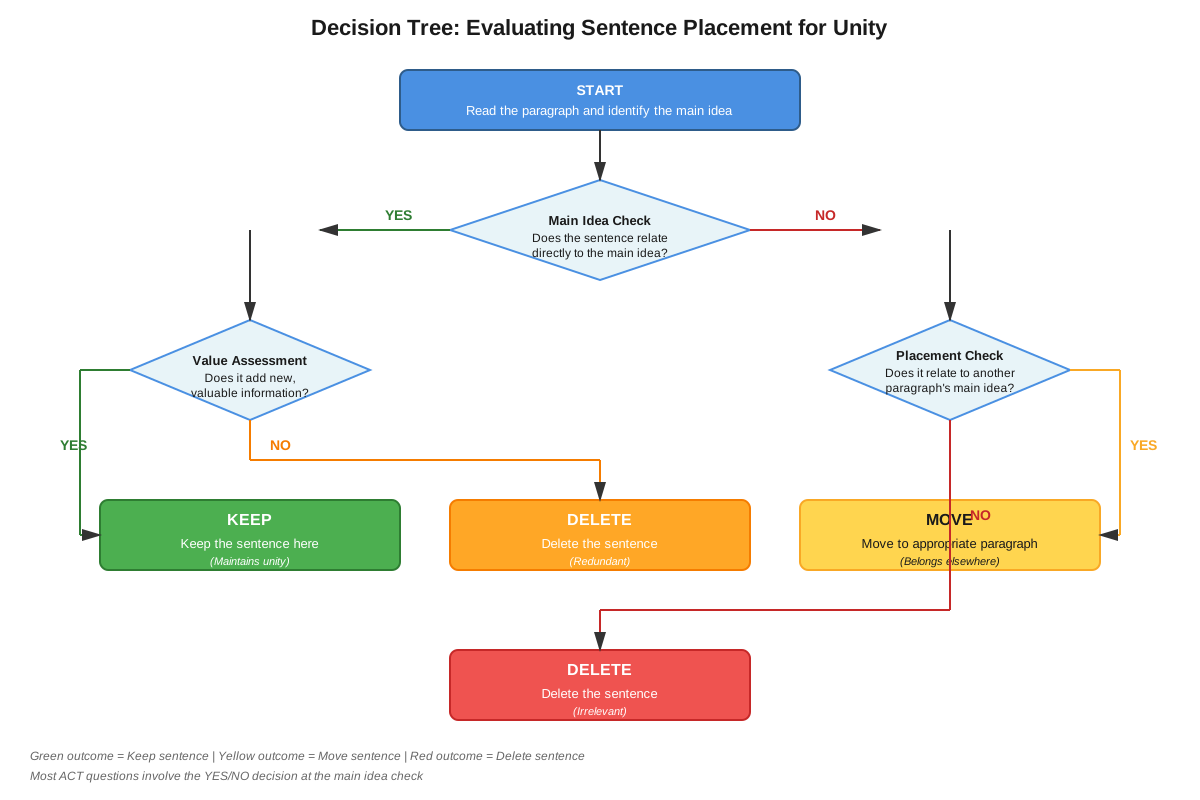
Once the main idea is clear, evaluating each sentence becomes more straightforward. Students should ask of each sentence: "Does this sentence help me better understand the main idea?" If the answer is yes, the sentence contributes to unity. If no, it disrupts unity.
The Unity Test: Three Critical Questions
When evaluating whether a sentence maintains paragraph unity, apply these three questions:
- Relevance: Does this sentence relate directly to the paragraph's main idea?
- Specificity: Does this sentence match the level of specificity established by the paragraph (not too broad, not too narrow)?
- Progression: Does this sentence move the discussion forward, or does it repeat, digress, or jump ahead?
All three questions must be answered affirmatively for a sentence to maintain unity. A sentence might be relevant but too broad (failing the specificity test), or it might be relevant and appropriately specific but redundant (failing the progression test).
Unity Across Paragraph Boundaries
Paragraph unity also involves understanding when information belongs in a different paragraph entirely. The ACT frequently tests whether students recognize that a sentence, while related to the passage's overall topic, belongs in a different paragraph because it supports a different main idea. For example, a passage about the history of jazz might contain one paragraph focused on early New Orleans jazz and another on the Chicago jazz scene. A sentence about Louis Armstrong's time in Chicago would disrupt unity if placed in the New Orleans paragraph, even though Armstrong is relevant to both topics.
Concept Relationships
Paragraph unity serves as the foundation for larger organizational structures in writing. The relationship flows hierarchically: individual sentences → unified paragraphs → coherent essay sections → well-organized complete essays. Each level depends on the level below it maintaining its integrity.
Within the topic of paragraph unity itself, several concepts interconnect. Main idea identification must precede relevance evaluation, which in turn enables sentence placement decisions. The process follows this sequence: First, determine the paragraph's main idea by analyzing the topic sentence and recurring themes. Second, evaluate each sentence's relevance to that main idea using the three critical questions. Third, make decisions about whether sentences should be kept, deleted, or moved based on that evaluation.
Paragraph unity connects directly to prerequisite knowledge of topic sentences because the topic sentence establishes the standard against which all other sentences are measured. It also relates to transitions (a related topic) because effective transitions help maintain unity by explicitly showing how sentences connect to the main idea. Additionally, paragraph unity links to essay organization more broadly, as unified paragraphs are the building blocks of well-organized essays.
The relationship between paragraph unity and coherence is particularly important: unity ensures all sentences relate to the same topic, while coherence ensures those sentences flow logically from one to another. A paragraph can be unified but lack coherence if sentences jump around without clear connections, or it can be coherent but lack unity if sentences flow smoothly while discussing multiple unrelated topics.
Understanding paragraph unity also enables progression to more advanced concepts like paragraph development, emphasis, and rhetorical effectiveness. Once students master keeping paragraphs unified, they can focus on developing ideas more fully, emphasizing key points strategically, and crafting paragraphs that achieve specific rhetorical purposes.
Quick check — test yourself on Paragraph unity so far.
Try Flashcards →High-Yield Facts
- ⭐ Every sentence in a unified paragraph must directly support, explain, or develop the paragraph's single main idea
- ⭐ The ACT frequently asks whether a sentence should be deleted because it disrupts paragraph unity
- ⭐ A sentence can be factually accurate and well-written but still disrupt unity if it introduces a different topic
- ⭐ Topic sentences establish the main idea that determines whether subsequent sentences maintain unity
- ⭐ Sentences that belong in a different paragraph of the same passage still disrupt unity in their current location
- Paragraph unity questions often include the phrase "at this point" or "the preceding sentence," signaling placement or deletion issues
- Off-topic sentences typically introduce information that is related to the passage's general subject but not to the specific paragraph's focus
- Unity violations often occur at paragraph boundaries, where writers prematurely transition to the next topic
- The ACT tests unity through deletion questions, addition questions, and sentence placement questions
- Reading 2-3 sentences before and after a questioned sentence helps determine whether it maintains unity
- Sentences that provide background information may disrupt unity if the paragraph focuses on a specific aspect rather than general context
- Unity questions require understanding the paragraph's scope—whether it addresses a broad topic or a narrow subtopic
Common Misconceptions
Misconception: A sentence maintains unity as long as it relates to the passage's overall topic.
Correction: Sentences must relate specifically to the individual paragraph's main idea, not just the general passage topic. A passage about climate change might contain one paragraph about rising temperatures and another about policy solutions. A sentence about policy would disrupt unity in the temperature paragraph even though it relates to the passage's overall subject.
Misconception: Interesting or well-written sentences should always be kept in a paragraph.
Correction: The quality of writing does not determine whether a sentence maintains unity. A beautifully crafted sentence that introduces tangential information still disrupts unity and should be deleted or moved. The ACT deliberately includes well-written sentences that nonetheless fail to maintain paragraph focus.
Misconception: Transitional phrases like "furthermore" or "additionally" automatically mean a sentence maintains unity.
Correction: Transitions indicate relationships between ideas but do not guarantee unity. A sentence beginning with "Furthermore" might introduce a new topic rather than continuing to develop the current one. Evaluate the content, not just the transitional language.
Misconception: The first sentence of a paragraph always states the main idea explicitly.
Correction: While topic sentences often appear first, they may occasionally appear elsewhere in the paragraph, or the main idea may be implied rather than directly stated. Students must identify the main idea by analyzing the paragraph's overall focus, not by assuming the first sentence always provides it.
Misconception: Deleting sentences always improves paragraph unity.
Correction: Only sentences that disrupt unity should be deleted. Many deletion questions on the ACT have "No, because..." as the correct answer, indicating the sentence should be kept because it maintains unity and contributes essential information.
Misconception: Sentences that provide examples always maintain unity.
Correction: Examples maintain unity only if they illustrate the paragraph's specific main idea. An example that illustrates a related but different concept disrupts unity. For instance, in a paragraph about the benefits of exercise for mental health, an example about exercise improving physical stamina would disrupt unity despite being a valid example of exercise benefits.
Worked Examples
Example 1: Deletion Question
Passage Context: The paragraph discusses how Marie Curie's research on radioactivity led to important medical applications.
[1] Marie Curie's groundbreaking research on radioactivity revolutionized medical treatment in the early twentieth century. [2] Her discovery of radium enabled doctors to develop radiation therapy for cancer patients. [3] Curie was born in Warsaw, Poland, in 1867 and faced significant obstacles as a woman pursuing scientific education. [4] The medical applications of her work saved countless lives and established radiation as a crucial tool in oncology.
Question: The writer is considering deleting sentence 3. Should the sentence be kept or deleted?
Analysis:
First, identify the paragraph's main idea by examining the topic sentence (sentence 1) and the overall focus. The paragraph discusses how Curie's research led to medical applications—specifically, the development of radiation therapy.
Next, evaluate sentence 3 against the unity criteria:
- Relevance: Does this sentence relate to medical applications of Curie's research? No—it provides biographical information about her birthplace and educational challenges.
- Specificity: The paragraph focuses specifically on medical applications, not Curie's biography.
- Progression: This sentence interrupts the logical flow from discovery (sentence 2) to impact (sentence 4).
Sentence 3 disrupts unity because it shifts focus from medical applications to biographical details. While this information might be appropriate in a different paragraph about Curie's background, it does not support the current paragraph's main idea.
Answer: The sentence should be deleted because it introduces biographical information that does not relate to the paragraph's focus on medical applications of Curie's research.
Example 2: Addition Question
Passage Context: The paragraph explains how urban gardens provide fresh produce to city residents.
[1] Urban gardens have emerged as an effective solution to food accessibility challenges in cities. [2] These gardens transform vacant lots and rooftops into productive growing spaces. [3] Residents can harvest fresh vegetables and herbs within walking distance of their homes. [4] _____ [5] The proximity of these gardens reduces transportation costs and ensures produce reaches consumers at peak freshness.
Question: At this point, the writer is considering adding the following sentence:
"Community gardens also provide social gathering spaces where neighbors can meet and build relationships."
Should the writer make this addition?
Analysis:
First, identify the paragraph's main idea. The topic sentence (sentence 1) establishes that urban gardens address food accessibility. Sentences 2, 3, and 5 all discuss how gardens provide fresh produce to city residents—the focus is on food access, not social benefits.
Next, evaluate the proposed addition:
- Relevance: Does this sentence relate to food accessibility? No—it discusses social benefits, which is a different topic.
- Specificity: The paragraph maintains a narrow focus on food access; social benefits would broaden the scope inappropriately.
- Progression: This sentence would interrupt the logical flow from harvest (sentence 3) to freshness benefits (sentence 5).
The proposed sentence discusses a valid benefit of community gardens, but it introduces a new main idea (social gathering) rather than developing the current main idea (food accessibility). This information might belong in a different paragraph about additional benefits of urban gardens.
Answer: No, because the sentence introduces social benefits that do not relate to the paragraph's focus on food accessibility and fresh produce availability.
Exam Strategy
When approaching paragraph unity questions on the ACT, follow this systematic process:
Step 1: Identify the question type. Look for trigger phrases that signal unity questions:
- "Should the writer delete the preceding sentence?"
- "At this point, the writer is considering adding..."
- "The best placement for this sentence would be..."
- "Should the writer make this addition?"
Step 2: Read strategically. Before evaluating the questioned sentence, read:
- The paragraph's first sentence (likely topic sentence)
- 2-3 sentences before the questioned sentence
- 2-3 sentences after the questioned sentence
- The paragraph's last sentence (often reinforces main idea)
This context reveals the paragraph's main idea and flow.
Step 3: Articulate the main idea. In your mind or in the margin, state the paragraph's main idea in 5-7 words. For example: "benefits of solar energy for homeowners" or "causes of the 1929 stock market crash." This statement becomes your evaluation criterion.
Step 4: Apply the three critical questions:
- Does the sentence relate directly to the main idea?
- Does it match the paragraph's level of specificity?
- Does it move the discussion forward without repeating or digressing?
Step 5: Eliminate answer choices systematically. For deletion questions:
- If the sentence disrupts unity, eliminate "No" answers
- If the sentence maintains unity, eliminate "Yes" answers
- Then evaluate the reasoning in remaining choices
For addition questions:
- If the addition disrupts unity, eliminate "Yes" answers
- If the addition maintains unity, eliminate "No" answers
- Verify that the reasoning in your chosen answer accurately explains why
Time management: Allocate 30-45 seconds per paragraph unity question. These questions require careful reading but should not consume excessive time. If uncertain, mark the question and return after completing easier questions.
Common trap answers: The ACT includes answer choices with reasoning that sounds plausible but misidentifies the issue. For example, an answer might say "Yes, because it provides interesting information" when the real issue is that the information disrupts unity. Always verify that the reasoning addresses unity specifically.
Exam Tip: When a sentence contains accurate, interesting information but seems out of place, it likely disrupts unity. The ACT deliberately includes well-written sentences that belong elsewhere to test whether students can distinguish between good writing and appropriate placement.
Memory Techniques
The MAIN Acronym for evaluating paragraph unity:
- Main idea: Identify the paragraph's central focus
- Alignment: Check if the sentence aligns with that focus
- Interruption: Determine if the sentence interrupts logical flow
- Necessity: Assess whether the sentence is necessary for developing the main idea
The Unity Rule of One: Every paragraph = ONE main idea. If a sentence introduces a second main idea, it disrupts unity. Visualize each paragraph as a container that can hold only one topic; any sentence that doesn't fit in that container must go elsewhere.
The "So What?" Test: After reading a questioned sentence, ask "So what does this tell me about [the main idea]?" If you cannot answer this question, the sentence likely disrupts unity.
The Highlighter Visualization: Imagine highlighting all sentences that relate to the main idea in yellow. Any sentence you cannot highlight in yellow disrupts unity and should be deleted or moved.
The Conversation Analogy: Think of a unified paragraph as a focused conversation. If you were discussing the benefits of exercise for heart health, a comment about exercise equipment costs would derail the conversation. Similarly, sentences that "change the subject" disrupt paragraph unity.
Summary
Paragraph unity requires that every sentence within a paragraph directly supports, explains, or develops a single main idea. This fundamental principle of effective writing appears frequently on the ACT English Test through deletion questions, addition questions, and sentence placement questions. To evaluate unity, students must first identify the paragraph's main idea—typically established in the topic sentence—and then assess whether each sentence relates specifically to that idea. Sentences can disrupt unity by introducing off-topic information, prematurely transitioning to new topics, providing overly broad generalizations, or presenting redundant content. The ACT deliberately includes well-written, factually accurate sentences that nonetheless disrupt unity by failing to maintain the paragraph's specific focus. Success on unity questions requires applying three critical questions: Does the sentence relate directly to the main idea? Does it match the paragraph's level of specificity? Does it move the discussion forward? Mastering paragraph unity enables students to recognize when information belongs in a different paragraph or should be deleted entirely, a skill essential for achieving high scores on the ACT English Test.
Key Takeaways
- Paragraph unity means every sentence must directly support one main idea—no exceptions
- Identify the main idea first by analyzing the topic sentence and recurring themes throughout the paragraph
- Well-written sentences can still disrupt unity if they introduce different topics or shift focus prematurely
- Apply the three critical questions: relevance, specificity, and progression
- Information related to the passage's general topic may still disrupt unity if it doesn't match the specific paragraph's focus
- Unity questions appear as deletion, addition, and placement questions—learn to recognize trigger phrases
- Read surrounding context (2-3 sentences before and after) to understand the paragraph's flow and main idea
Related Topics
Transitions and Coherence: While paragraph unity ensures all sentences relate to the same topic, transitions create smooth connections between those sentences. Mastering unity provides the foundation for understanding how transitional words and phrases guide readers through unified content.
Topic Sentences and Thesis Statements: Topic sentences establish the main idea that determines paragraph unity. Understanding how to craft and identify effective topic sentences strengthens the ability to evaluate unity.
Essay Organization and Structure: Unified paragraphs serve as building blocks for well-organized essays. After mastering paragraph unity, students can focus on organizing multiple unified paragraphs into coherent essay sections.
Relevance and Conciseness: Paragraph unity relates closely to eliminating irrelevant information and maintaining concise writing. These skills work together to create focused, effective communication.
Rhetorical Strategy: Understanding paragraph unity enables analysis of how writers use paragraph structure to achieve rhetorical purposes, a skill tested in both ACT English and Reading sections.
Practice CTA
Now that you understand the principles of paragraph unity, apply this knowledge to practice questions and flashcards. Working through ACT-style questions will reinforce your ability to identify unity violations quickly and accurately. Each practice question you complete strengthens your pattern recognition skills, making unity questions easier to spot and answer correctly on test day. Remember: paragraph unity questions are highly predictable once you master the core principles—this is an area where focused practice translates directly into score improvement. Challenge yourself to articulate the main idea of each paragraph before evaluating individual sentences, and you'll develop the systematic approach that leads to consistent success on these high-yield questions.
Sign up free to keep reading
Create a free AnvayaPrep account to finish this ACT guide on Paragraph unity — plus flashcards and practice questions.