Overview
Choosing a thesis is the foundational skill for success on the ACT Writing test. The thesis statement serves as the backbone of the entire essay, establishing the writer's position on the issue presented in the prompt and providing the roadmap for all subsequent arguments. On the ACT, students receive a prompt that presents a contemporary issue along with three distinct perspectives, and they must develop their own perspective while analyzing the relationship between their viewpoint and at least one of the given perspectives. The quality of the thesis directly impacts scores across multiple domains of the ACT Writing rubric, including Ideas and Analysis, Development and Support, and Organization.
The ACT Writing test evaluates a student's ability to construct a coherent argument under time pressure—specifically, 40 minutes to plan, write, and revise a complete essay. Within this constraint, act choosing a thesis becomes a critical time-management decision that sets the trajectory for the entire writing process. A well-crafted thesis enables efficient paragraph development, clear transitions, and focused supporting evidence. Conversely, a weak, vague, or contradictory thesis creates organizational problems that cascade throughout the essay, making it nearly impossible to achieve scores in the upper ranges (10-12) even if individual paragraphs contain strong writing.
This topic connects intimately with other essential Writing concepts including prompt analysis, perspective evaluation, argument structure, and evidence selection. The thesis acts as the bridge between understanding what the prompt asks and executing a response that demonstrates sophisticated thinking. Students who master thesis selection can approach any ACT Writing prompt with confidence, knowing they have a systematic method for establishing a defensible, nuanced position that will support high-level analysis throughout their essay.
Learning Objectives
- [ ] Identify when Choosing a thesis is being tested
- [ ] Explain the core rule or strategy behind Choosing a thesis
- [ ] Apply Choosing a thesis to ACT-style questions accurately
- [ ] Distinguish between effective and ineffective thesis statements for ACT prompts
- [ ] Generate multiple thesis options and select the most strategically advantageous one
- [ ] Craft thesis statements that incorporate nuance and acknowledge complexity
- [ ] Align thesis statements with the ACT Writing scoring rubric requirements
Prerequisites
- Understanding of argumentative essay structure: The thesis functions as the central claim that body paragraphs must support, requiring knowledge of how arguments are organized.
- Ability to identify main ideas and perspectives: Students must comprehend the issue presented in the prompt and distinguish between the three provided perspectives before formulating their own position.
- Basic knowledge of claim and evidence relationships: Recognizing how supporting details connect to broader arguments helps in crafting a thesis that can be adequately defended within the essay's scope.
Why This Topic Matters
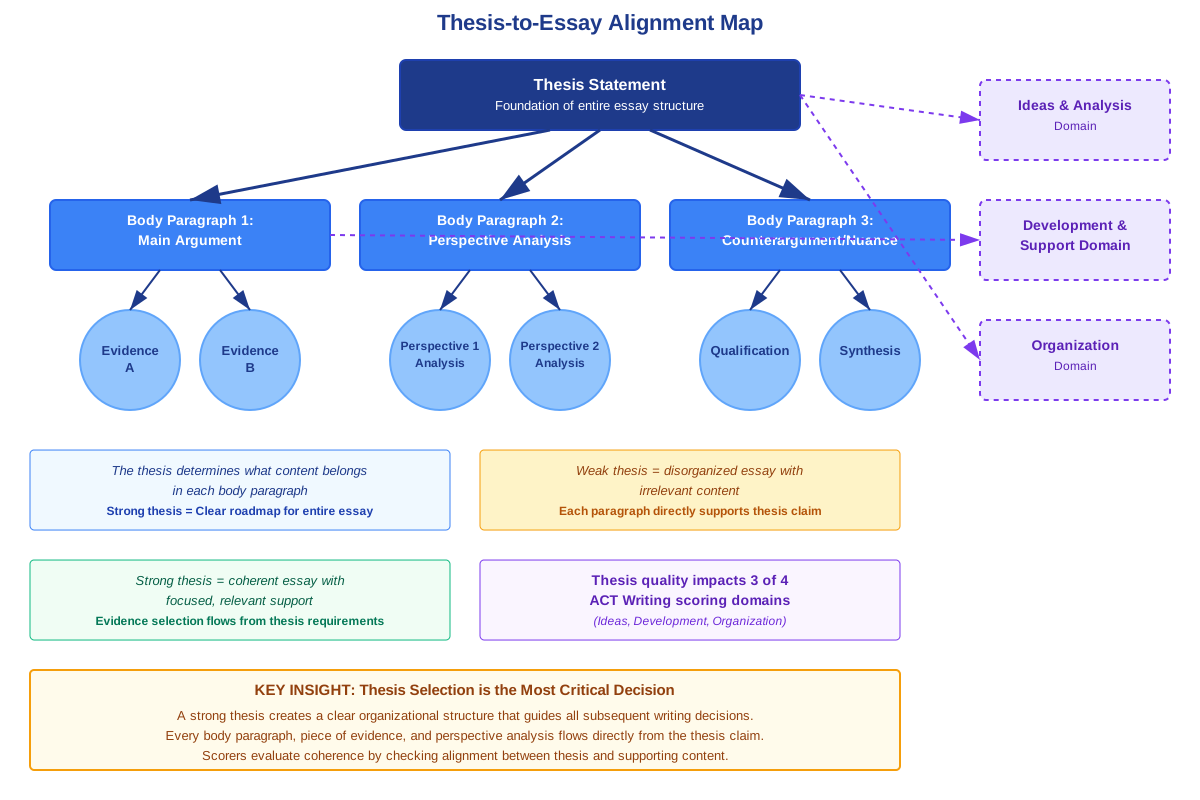
The thesis statement directly influences scoring in three of the four ACT Writing domains. In Ideas and Analysis, scorers evaluate whether the essay generates a productive argument and demonstrates understanding of multiple perspectives—both qualities that originate in thesis selection. In Development and Support, the thesis determines what evidence is relevant and how examples should be deployed. In Organization, the thesis provides the structural framework that guides paragraph sequencing and transitions.
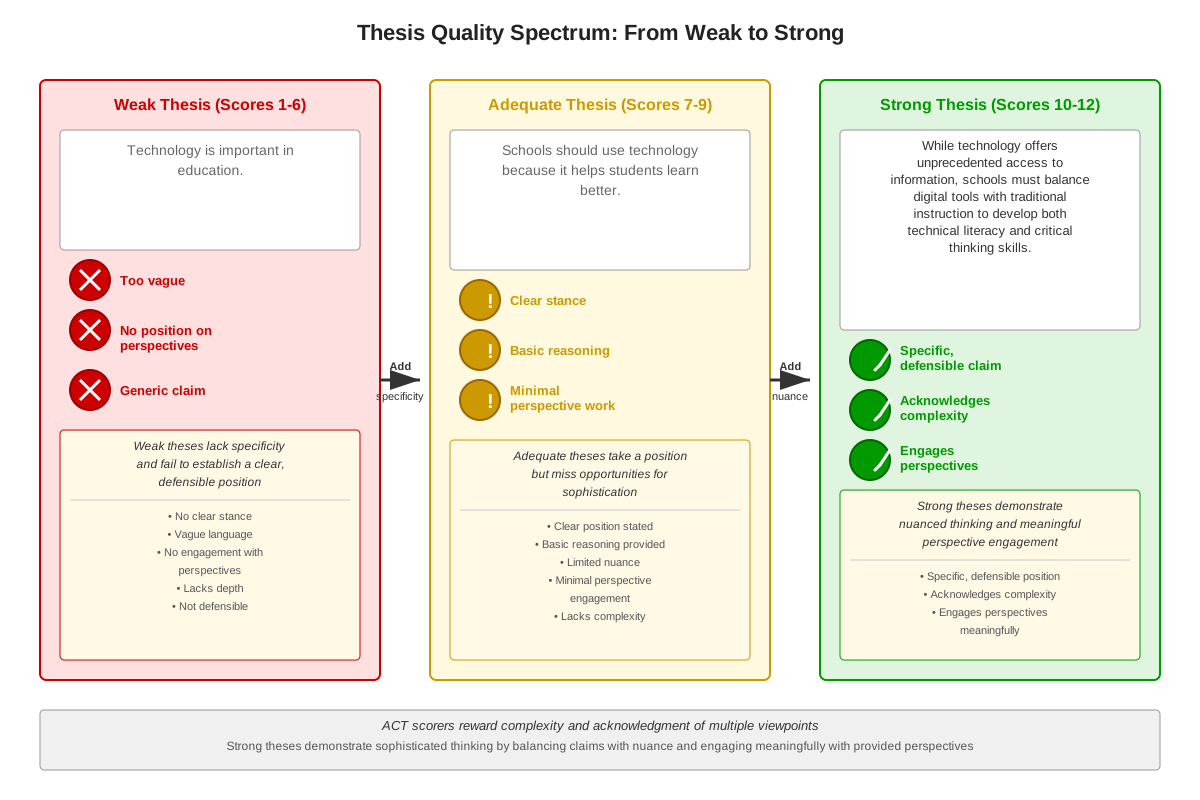
Statistical analysis of ACT Writing scores reveals that essays scoring 10-12 (the highest range) consistently feature thesis statements that take a clear position while acknowledging complexity or nuance. Essays scoring 7-9 typically have identifiable theses but may lack sophistication or fail to establish a meaningful relationship with the provided perspectives. Essays scoring below 7 often suffer from absent, unclear, or contradictory thesis statements that undermine the entire response.
On the ACT, thesis selection appears in every single Writing test administration—it is not an optional skill but an absolute requirement. The prompt structure remains consistent: students encounter an issue relevant to their lives, three distinct perspectives on that issue, and instructions to develop their own perspective while engaging with at least one of the given viewpoints. This format means that choosing a thesis involves both original position-taking and strategic perspective analysis, making it a multifaceted skill that separates high-scoring essays from mediocre ones.
Core Concepts
Understanding the ACT Thesis Requirements
The ACT Writing thesis differs significantly from thesis statements in other contexts. Rather than simply stating an opinion on a topic, an effective ACT thesis must accomplish three specific goals: establish a clear position on the issue, indicate awareness of complexity or multiple viewpoints, and set up a framework for engaging with the provided perspectives. The thesis should appear in the introductory paragraph, typically as the final sentence, though sophisticated writers may build toward it across multiple sentences.
The ACT scoring rubric explicitly rewards essays that "generate a productive discussion by establishing a thoughtful and insightful context for analysis." This language signals that the thesis should do more than pick a side—it should demonstrate intellectual engagement with the issue's nuances. For example, on a prompt about whether schools should require community service, a basic thesis might state: "Schools should require community service because it benefits students." A more sophisticated thesis would acknowledge complexity: "While mandatory community service risks diminishing intrinsic motivation, schools should implement structured service requirements that emphasize reflection and student choice, thereby cultivating civic engagement without undermining authentic altruism."
The Spectrum of Thesis Positions
Students often mistakenly believe they must fully agree or disagree with one of the three provided perspectives. In reality, the ACT rewards thesis positions that fall anywhere along a spectrum of agreement and disagreement. The most strategic approaches include:
| Thesis Strategy | Description | Example Application |
|---|---|---|
| Full Agreement | Adopt one perspective entirely | "Perspective One correctly identifies that..." |
| Qualified Agreement | Agree with one perspective but add conditions | "Perspective Two is valid when..., but fails to account for..." |
| Synthesis | Combine elements from multiple perspectives | "Both Perspective One and Three offer valuable insights that together suggest..." |
| Modification | Accept the core of one perspective but refine it | "Perspective Two's emphasis on X is crucial, though it should be understood as..." |
| Alternative Position | Propose a viewpoint distinct from all three | "While the three perspectives focus on X, the real issue concerns Y..." |
The key principle is that the thesis must be defensible within 40 minutes. Students should select positions they can support with specific examples, logical reasoning, and clear connections to the provided perspectives. A brilliant but highly complex thesis that requires extensive explanation may be less strategic than a moderately sophisticated thesis that allows for efficient, focused development.
Incorporating Nuance and Complexity
High-scoring ACT essays demonstrate "critical thinking" and "analysis of multiple perspectives." These qualities begin with the thesis statement. Nuance in a thesis appears through several techniques:
- Acknowledging limitations: "Although X is generally true, it does not apply when..."
- Recognizing trade-offs: "While Y offers benefits, it also creates challenges that must be addressed through..."
- Identifying context-dependency: "The validity of Z depends on factors such as..."
- Distinguishing between different scenarios: "In cases where A occurs, the appropriate response is B, but when C is present, D becomes necessary..."
Consider a prompt about technology's impact on human relationships. A thesis lacking nuance might state: "Technology damages relationships and should be limited." A nuanced thesis would read: "While technology can create superficial connections that substitute for meaningful interaction, it also enables relationship maintenance across distances and provides communication tools for those who struggle with face-to-face interaction, suggesting that the quality of technological impact depends on intentionality of use rather than quantity of use."
Strategic Perspective Engagement
The ACT prompt provides three perspectives specifically to test students' ability to engage with viewpoints beyond their own. The thesis should preview how the essay will interact with these perspectives. This can be accomplished through:
- Direct naming: "This essay will examine why Perspective One's emphasis on individual freedom, while appealing, ultimately proves less practical than Perspective Three's focus on collective responsibility."
- Implicit setup: A thesis that takes a position naturally opposed to one perspective and aligned with another creates an obvious framework for later analysis.
- Comparative framing: "The debate between Perspectives Two and Three reveals a fundamental tension between efficiency and equity that can be resolved through..."
The thesis need not mention all three perspectives—ACT requirements specify engaging with "at least one"—but it should make clear that the essay will do more than simply assert an opinion. The thesis signals that analysis and evaluation will follow.
Thesis Placement and Presentation
While content matters most, the presentation of the thesis affects clarity and organization scores. Best practices include:
- Positioning: Place the thesis at the end of the introductory paragraph after providing context about the issue
- Clarity: Use direct, declarative language rather than hedging phrases like "I think" or "In my opinion"
- Specificity: Include concrete terms related to the prompt rather than vague generalities
- Appropriate length: A thesis can be a single sentence or 2-3 sentences if complexity requires it, but should not dominate the introduction
The thesis should be immediately identifiable to a scorer reading quickly. Embedding it within a long, complex paragraph or using ambiguous language creates unnecessary risk that the scorer will miss or misunderstand the central argument.
Concept Relationships
The process of choosing a thesis begins with prompt analysis—students must first understand the issue and the three perspectives before they can formulate their own position. This understanding flows into thesis selection, which then determines the essay's organizational structure. The thesis dictates which perspectives require detailed analysis, what types of evidence will be relevant, and how body paragraphs should be sequenced.
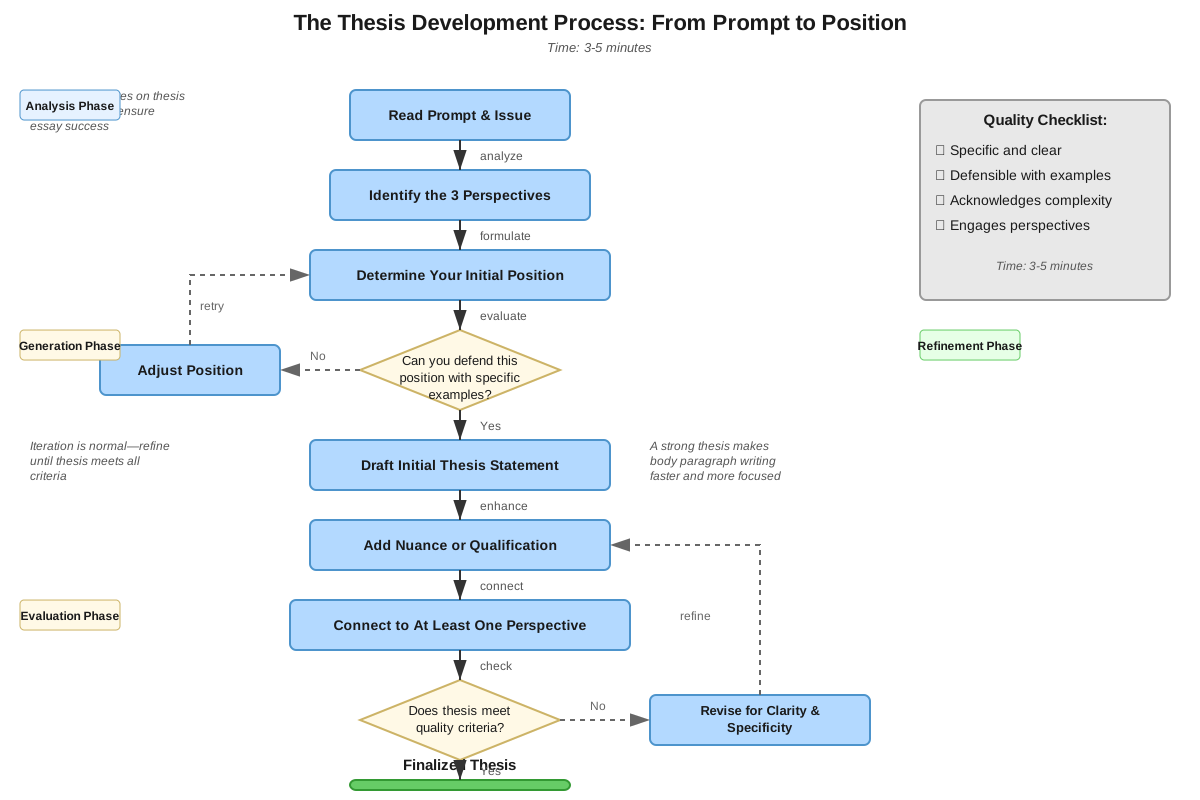
The relationship can be mapped as: Prompt Analysis → Perspective Evaluation → Thesis Selection → Organizational Planning → Evidence Selection → Paragraph Development. Each stage depends on the previous one, with the thesis serving as the pivotal decision point that transforms comprehension into argumentation.
Within the thesis itself, multiple elements must work together: the position (what the writer believes), the rationale (why this position is valid), and the framework (how the essay will prove it). These three components are interdependent—a position without a rationale lacks persuasiveness, while a framework that doesn't align with the position creates organizational confusion.
The thesis also connects forward to conclusion writing. An effective conclusion should return to the thesis, demonstrating how the essay's analysis has validated or refined the initial position. This circular structure—thesis in introduction, development in body, return to thesis in conclusion—creates the coherence that ACT scorers reward.
Quick check — test yourself on Choosing a thesis so far.
Try Flashcards →High-Yield Facts
⭐ The ACT Writing thesis must establish a clear position on the issue while demonstrating awareness of complexity or multiple perspectives.
⭐ Students are not required to fully agree with one of the three provided perspectives; they can modify, combine, or propose alternative positions.
⭐ The thesis should appear in the introductory paragraph, typically as the final sentence or sentences.
⭐ High-scoring theses (10-12 range) incorporate nuance through acknowledging limitations, recognizing trade-offs, or identifying context-dependency.
⭐ The thesis must be defensible within 40 minutes using specific examples and logical reasoning.
- A thesis that mentions or implies engagement with the provided perspectives scores higher than one that ignores them entirely.
- Vague thesis statements using terms like "good," "bad," "important," or "interesting" without specificity typically result in lower scores.
- The thesis determines what evidence is relevant throughout the essay, making it a strategic planning tool as well as an argumentative statement.
- Scorers can identify an essay's thesis within 30-60 seconds of reading; clarity and directness are essential.
- A thesis can be refined or qualified in the conclusion, but the core position should remain consistent throughout the essay.
- Essays that change positions mid-argument or present contradictory theses score poorly in the Organization domain.
- The most common thesis weakness is being too broad or general rather than specifically addressing the prompt's particular issue.
Common Misconceptions
Misconception: The thesis must be stated in a single sentence. → Correction: While conciseness is valuable, a complex thesis can span 2-3 sentences if needed to adequately capture nuance and establish the argumentative framework. Clarity matters more than brevity.
Misconception: Students must choose one of the three provided perspectives as their thesis. → Correction: The three perspectives are provided for analysis, not as mandatory positions. Students can agree, disagree, modify, combine, or propose entirely different viewpoints as long as they engage with at least one provided perspective somewhere in the essay.
Misconception: A strong thesis takes an extreme or controversial position. → Correction: The ACT rewards thoughtful analysis and defensible positions, not extremism. A moderate, nuanced thesis that acknowledges complexity typically scores higher than an extreme position that ignores counterarguments or alternative viewpoints.
Misconception: The thesis should include personal pronouns like "I believe" or "In my opinion." → Correction: While not explicitly penalized, these phrases waste words and weaken the assertiveness of the claim. Direct, declarative statements demonstrate more confidence and clarity: "Schools should implement..." rather than "I believe schools should implement..."
Misconception: Once stated, the thesis cannot be refined or developed further in the essay. → Correction: Sophisticated essays often return to the thesis in the conclusion with added depth or qualification based on the analysis conducted in body paragraphs. This demonstrates intellectual growth and complex thinking, both valued by ACT scorers.
Misconception: The thesis must address all three perspectives explicitly. → Correction: The ACT requires engagement with "at least one" perspective. While discussing multiple perspectives can demonstrate analytical breadth, attempting to address all three in the thesis often creates unwieldy, unfocused statements. Strategic selection of which perspectives to engage is part of effective thesis planning.
Worked Examples
Example 1: Technology and Education Prompt
Prompt Summary: Should schools increase their use of educational technology? Perspective One argues technology enhances learning through personalization. Perspective Two warns that technology distracts from deep thinking. Perspective Three emphasizes that technology access creates equity issues.
Student's Thinking Process:
- Initial reaction: I've seen both benefits and problems with technology in my classes
- Perspective evaluation: Perspective One seems too optimistic; Perspective Two has valid concerns; Perspective Three raises an issue the others ignore
- Position consideration: I don't want to fully agree with any single perspective—they each capture part of the truth
- Thesis strategy: I'll use a synthesis approach that acknowledges Perspective Three's equity concern while qualifying Perspective One's optimism
Resulting Thesis: "While educational technology offers genuine opportunities for personalized learning, as Perspective One suggests, schools should prioritize equitable access and teacher training over rapid technology adoption, ensuring that digital tools enhance rather than replace critical thinking skills and that all students benefit regardless of socioeconomic background."
Analysis: This thesis accomplishes multiple goals. It establishes a clear position (prioritize equity and training over rapid adoption), engages with two perspectives explicitly (One and implicitly Three), acknowledges complexity (technology has benefits but requires careful implementation), and provides a framework for body paragraphs (one could discuss equity issues, another could address the critical thinking concern from Perspective Two, and a third could explore effective implementation strategies).
Example 2: Community Service Requirement Prompt
Prompt Summary: Should high schools require community service for graduation? Perspective One argues requirements teach civic responsibility. Perspective Two contends that forced service contradicts the spirit of volunteerism. Perspective Three suggests that service requirements burden students already facing academic pressure.
Student's Thinking Process:
- Initial reaction: I had to do community service and found it valuable, but I know some students resented it
- Perspective evaluation: Perspective Two raises a philosophical point about authenticity; Perspective One focuses on outcomes; Perspective Three considers student welfare
- Position consideration: Maybe the issue isn't whether to require service but how to structure requirements
- Thesis strategy: I'll modify Perspective One by addressing Perspective Two's concern about authenticity
Resulting Thesis: "High schools should implement community service requirements that emphasize student choice and reflective practice rather than mere hour completion, thereby cultivating genuine civic engagement while respecting the concern that mandatory service can undermine intrinsic motivation."
Analysis: This thesis takes a qualified agreement position—supporting requirements (aligning with Perspective One) but with specific conditions that address Perspective Two's authenticity concern. The thesis is defensible because the student can provide concrete examples of how choice and reflection make service meaningful. It also implicitly acknowledges Perspective Three by suggesting that thoughtful implementation (rather than burdensome hour requirements) matters. The framework is clear: body paragraphs can discuss why civic education matters, how choice preserves authenticity, and what reflective practices look like in successful programs.
Exam Strategy
When approaching the ACT Writing test, allocate approximately 8-10 minutes to reading the prompt, analyzing perspectives, and formulating your thesis. This planning time is not wasted—it prevents the costly mistake of starting an essay without clear direction and having to restart or significantly revise mid-writing.
Trigger words in ACT Writing prompts that signal thesis opportunities include: "should," "ought," "must," "responsibility," "balance," "tension," "debate," and "controversy." These words indicate that the prompt expects you to take a position on a contested issue, which is precisely what your thesis should do.
Use this systematic approach to thesis selection:
- Read the prompt and all three perspectives carefully (2-3 minutes)
- Identify your initial reaction: Which perspective resonates? Which seems flawed? (1 minute)
- Generate 2-3 possible thesis positions using different strategies (agreement, synthesis, modification) (2-3 minutes)
- Evaluate each option: Which can I support with specific examples? Which allows for the most sophisticated analysis? (2 minutes)
- Select and refine: Choose the most strategic option and craft the precise wording (2 minutes)
Process-of-elimination thinking applies to thesis selection: eliminate positions that you cannot adequately support with examples, positions that are too extreme to defend in 40 minutes, and positions that don't clearly engage with at least one provided perspective. The remaining options are all viable—choose based on which allows you to write most efficiently and confidently.
Exam Tip: If you're torn between two thesis options, choose the one that more clearly engages with the provided perspectives. Explicit perspective engagement is easier for scorers to identify and reward than implicit engagement.
Time allocation after thesis selection should follow this pattern: Introduction with thesis (5-7 minutes), Body paragraphs developing the thesis (20-25 minutes), Conclusion returning to thesis (3-5 minutes), Revision (3-5 minutes). If you find yourself spending more than 10 minutes on the introduction, your thesis may be too complex or unclear—simplify and move forward.
Memory Techniques
THESIS Acronym for essential components:
- Take a clear position
- Honor complexity and nuance
- Engage with provided perspectives
- Specific to the prompt's issue
- Introduce your argumentative framework
- Support it with available evidence
The Three D's of thesis evaluation before you start writing:
- Defensible: Can I support this with examples?
- Direct: Is my position clear and unambiguous?
- Developed: Does this give me enough to write about for 3-4 body paragraphs?
Visualization strategy: Picture your thesis as a bridge. One side is the prompt and perspectives (where you start), the other side is your conclusion (where you're going). The thesis must be strong enough to support the weight of all your body paragraphs. If you can't visualize specific paragraphs that would support your thesis, the bridge isn't structurally sound—revise before writing.
The "So What?" Test: After drafting your thesis, ask "So what? Why does this matter?" If you can't immediately answer, your thesis may be too vague or obvious. A strong thesis implies its own significance.
Summary
Choosing a thesis for the ACT Writing test is a strategic decision that determines the success of the entire essay. An effective thesis establishes a clear, defensible position on the prompt's issue while demonstrating awareness of complexity through nuance, qualification, or acknowledgment of multiple perspectives. The thesis must engage with at least one of the three provided perspectives, either through agreement, disagreement, modification, or synthesis. High-scoring theses avoid vague generalities and extreme positions, instead offering specific, thoughtful arguments that can be supported with concrete examples within the 40-minute time limit. The thesis should appear clearly in the introductory paragraph and provide an organizational framework that guides body paragraph development. Students who master thesis selection gain a significant advantage on the ACT Writing test, as the thesis directly impacts scoring in Ideas and Analysis, Development and Support, and Organization domains. Strategic thesis planning—allocating 8-10 minutes to prompt analysis and position formulation—prevents organizational problems and enables efficient, focused writing throughout the essay.
Key Takeaways
- The ACT Writing thesis must take a clear position while acknowledging complexity or multiple perspectives, not simply restate one of the three provided viewpoints
- High-scoring theses incorporate nuance through techniques like acknowledging limitations, recognizing trade-offs, or identifying context-dependency
- Students should select thesis positions they can defend with specific examples within 40 minutes, prioritizing strategic defensibility over philosophical brilliance
- The thesis determines the essay's organizational structure and what evidence will be relevant, making it both an argumentative statement and a planning tool
- Allocating 8-10 minutes to prompt analysis and thesis formulation prevents costly mid-essay revisions and enables confident, efficient writing
- The thesis should appear clearly at the end of the introductory paragraph using direct, specific language rather than vague generalities or hedging phrases
- Engaging explicitly with at least one provided perspective in or through the thesis makes it easier for scorers to identify the sophisticated analysis that earns high scores
Related Topics
Prompt Analysis and Perspective Evaluation: Before choosing a thesis, students must thoroughly understand the issue and the three perspectives. This prerequisite skill involves identifying the core question, recognizing what each perspective emphasizes or ignores, and determining which perspectives align with or oppose each other.
Essay Organization and Structure: Once the thesis is established, students must organize body paragraphs that develop the thesis logically. This includes deciding paragraph order, creating effective transitions, and ensuring each paragraph connects back to the central argument.
Evidence Selection and Development: The thesis determines what types of evidence are relevant. Students must learn to generate specific examples, explain how evidence supports their position, and connect examples to the broader argument established in the thesis.
Counterargument and Perspective Analysis: Engaging with perspectives that challenge or differ from the thesis demonstrates critical thinking. This advanced skill involves fairly representing opposing viewpoints before explaining why the thesis position is more valid or how different perspectives can be reconciled.
Practice CTA
Now that you understand the strategies and principles behind choosing an effective thesis for the ACT Writing test, it's time to apply this knowledge. Complete the practice questions to test your ability to identify strong versus weak thesis statements, and use the flashcards to reinforce the key concepts and strategies. Remember: thesis selection is a skill that improves with deliberate practice. Each prompt you analyze strengthens your ability to quickly identify defensible positions and craft sophisticated arguments. Your investment in mastering this foundational skill will pay dividends across all aspects of your ACT Writing performance!
Sign up free to keep reading
Create a free AnvayaPrep account to finish this ACT guide on Choosing a thesis — plus flashcards and practice questions.