Overview
The ACT Writing test requires students to analyze multiple perspectives on a complex issue and develop their own informed position. Comparing perspectives is a critical skill that forms the foundation of a high-scoring essay. This task involves identifying the similarities and differences between given viewpoints, understanding the underlying assumptions and values of each perspective, and evaluating the strengths and limitations of different positions. Rather than simply summarizing each perspective in isolation, successful test-takers must demonstrate sophisticated analytical thinking by placing perspectives in dialogue with one another.
ACT comparing perspectives is essential because the essay prompt explicitly requires students to "analyze the relationship between your perspective and at least one other perspective." Essays that merely describe perspectives without meaningful comparison typically score in the lower ranges (1-3 out of 6), while those that skillfully compare and contrast perspectives, identifying nuances and connections, consistently earn higher scores (4-6). The ability to compare perspectives demonstrates critical thinking, intellectual maturity, and the kind of analytical reasoning valued in college-level writing.
This topic connects directly to other Writing concepts within the ACT framework. Effective perspective comparison requires strong thesis development (your position must be situated relative to others), evidence selection (you must support claims about what perspectives share or how they differ), and organizational skills (comparisons must be logically structured). Additionally, comparing perspectives enhances counterargument strategies, as understanding opposing viewpoints thoroughly enables more persuasive rebuttals. Mastering this skill elevates an essay from basic to sophisticated, signaling to graders that the writer can engage in complex intellectual discourse.
Learning Objectives
- [ ] Identify when Comparing perspectives is being tested
- [ ] Explain the core rule or strategy behind Comparing perspectives
- [ ] Apply Comparing perspectives to ACT-style questions accurately
- [ ] Analyze the underlying assumptions and values that distinguish different perspectives
- [ ] Synthesize multiple perspectives to develop a more nuanced position
- [ ] Evaluate the relative strengths and weaknesses of competing viewpoints
- [ ] Construct effective transition sentences that highlight relationships between perspectives
Prerequisites
- Understanding of the ACT Writing test format: Students must know that the essay presents an issue with three distinct perspectives to analyze, as this structure forms the basis for all comparison work.
- Basic argumentative writing skills: The ability to construct a thesis statement and support claims with evidence is necessary before attempting sophisticated perspective comparison.
- Reading comprehension of complex viewpoints: Students must accurately understand each perspective's position before they can meaningfully compare them.
- Familiarity with rhetorical analysis: Recognizing persuasive techniques and logical structures helps identify what makes perspectives similar or different.
Why This Topic Matters
In academic and professional contexts, the ability to compare perspectives is fundamental to critical thinking. Whether evaluating competing scientific theories, analyzing policy proposals, or making informed decisions, individuals must regularly assess multiple viewpoints to reach sound conclusions. This skill transcends test-taking and represents genuine intellectual competence that colleges seek in applicants.
On the ACT Writing test, comparing perspectives appears in every single essay prompt—making it 100% testable. The scoring rubric explicitly evaluates "Analysis of Perspectives" as one of four domains, accounting for 25% of the essay score. Graders specifically look for evidence that students can "analyze the relationship between their own perspective and at least one other perspective" and "examine different perspectives through analysis, not just summary." Essays that fail to compare perspectives adequately cannot score above a 3 in the Analysis domain, regardless of writing quality.
Common manifestations in exam passages include prompts asking students to consider whether perspectives complement each other, whether one perspective addresses concerns raised by another, or whether perspectives represent fundamentally different value systems. The three provided perspectives typically represent a spectrum of positions—often a more extreme stance on each side with a moderate or alternative approach in the middle—specifically designed to invite comparison. Test-makers deliberately craft perspectives that share some common ground while differing in crucial ways, rewarding students who can identify both similarities and distinctions.
Core Concepts
Understanding What Comparison Means
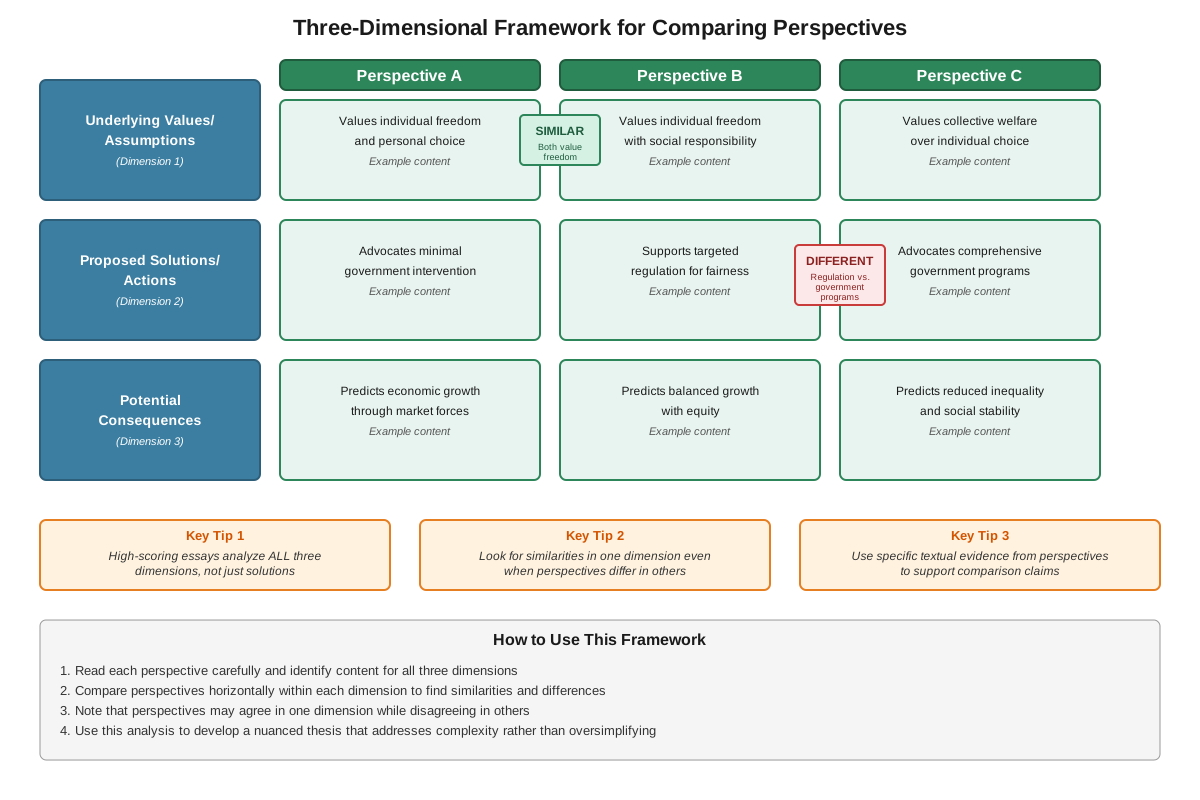
Comparing perspectives involves more than listing how viewpoints differ. True comparison requires analyzing relationships: identifying where perspectives overlap, where they diverge, what assumptions underlie each position, and how perspectives might complement or contradict one another. Effective comparison operates on multiple levels—examining not just conclusions but also reasoning, values, and implications.
When comparing perspectives, students should consider:
- Shared concerns: What problem or issue do multiple perspectives acknowledge?
- Different solutions: How do perspectives propose addressing the shared concern differently?
- Underlying values: What principles or priorities drive each perspective?
- Scope and scale: Do perspectives differ in how broadly or narrowly they frame the issue?
- Practical implications: What real-world outcomes would each perspective produce?
The Three-Perspective Structure
ACT essay prompts always provide exactly three perspectives, typically arranged to represent different positions along a spectrum. Understanding this structure helps students approach comparison systematically.
| Perspective Type | Characteristics | Comparison Strategy |
|---|---|---|
| Perspective One | Often represents a traditional, conservative, or cautious stance | Compare to Perspective Two by identifying the fundamental disagreement; compare to Perspective Three by examining whether it addresses similar concerns differently |
| Perspective Two | Frequently presents an opposing, progressive, or change-oriented view | Contrast directly with Perspective One; identify whether Perspective Three mediates between the two extremes |
| Perspective Three | Typically offers an alternative framework, middle ground, or different angle | Analyze how it relates to the binary opposition between Perspectives One and Two; determine if it transcends, synthesizes, or reframes the debate |
Levels of Comparison
Sophisticated perspective comparison operates at three distinct levels, moving from surface observations to deeper analysis:
- Surface-level comparison: Identifying obvious differences in positions
- Example: "Perspective One supports increased regulation while Perspective Two opposes it"
- This level is necessary but insufficient for high scores
- Analytical comparison: Examining the reasoning and assumptions behind positions
- Example: "Perspective One assumes that individual choice leads to harmful outcomes without guidance, while Perspective Two assumes that individuals make rational decisions when given freedom"
- This level demonstrates critical thinking
- Evaluative comparison: Assessing the relative merits and limitations of perspectives
- Example: "While Perspective One's concern about negative consequences is valid, Perspective Two correctly identifies that excessive regulation may create unintended problems; however, neither perspective adequately addresses the implementation challenges"
- This level shows intellectual maturity and earns the highest scores
Comparison Frameworks
Students can employ several frameworks to structure their perspective comparisons effectively:
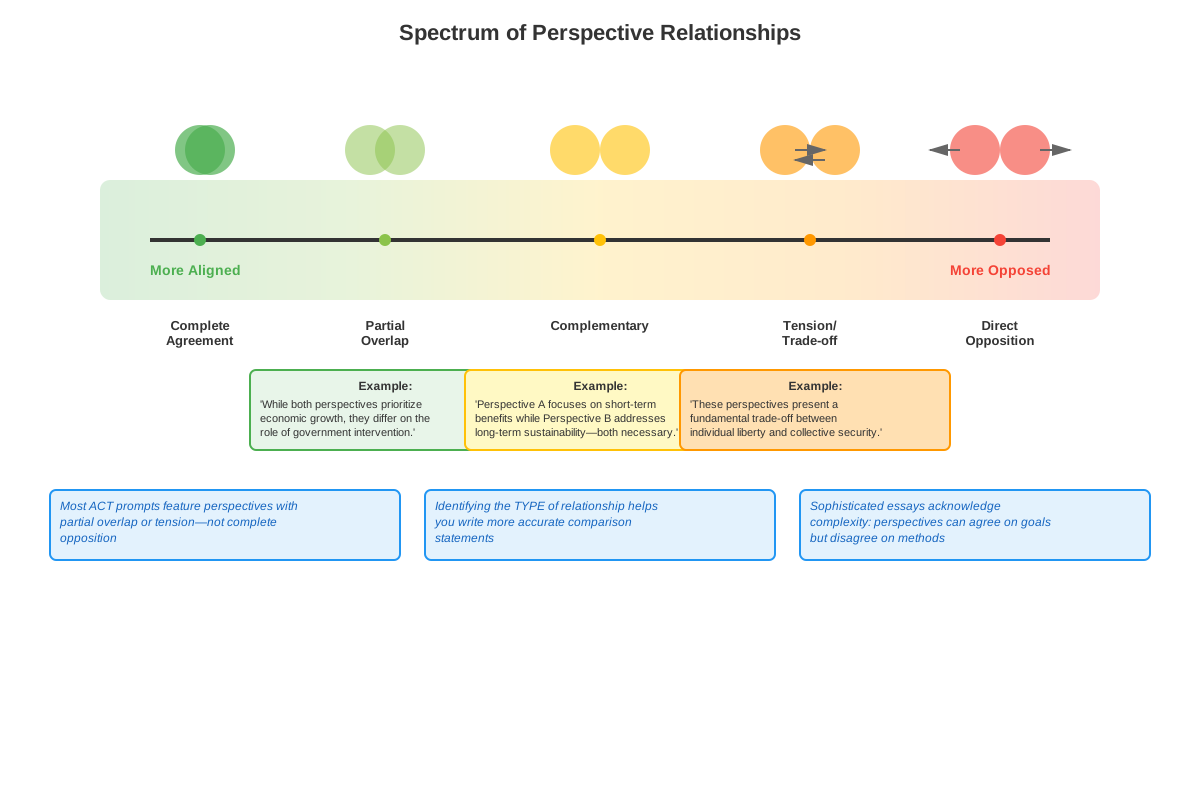
The Spectrum Framework: Position perspectives along a continuum from one extreme to another, then analyze where your position falls and why.
The Venn Diagram Framework: Identify areas of overlap (shared concerns or values) and areas of distinction (different solutions or priorities).
The Strengths-Limitations Framework: For each perspective, acknowledge what it gets right before explaining what it overlooks or oversimplifies.
The Context-Dependent Framework: Explain how different perspectives might be more or less valid depending on specific circumstances or contexts.
Transitional Language for Comparison
Effective comparison requires precise transitional language that signals relationships between perspectives:
- Similarity indicators: "Similarly," "Likewise," "Both perspectives share," "In agreement with"
- Contrast indicators: "However," "In contrast," "While Perspective One argues X, Perspective Two contends Y," "Conversely"
- Qualification indicators: "Although," "Despite," "While acknowledging," "To some extent"
- Synthesis indicators: "Building on," "Extending this logic," "Integrating these views," "A more comprehensive approach"
Common Comparison Patterns
ACT essay prompts typically present perspectives that follow predictable patterns, making comparison more systematic:
Pattern 1: Binary Opposition with Alternative
- Perspectives One and Two represent opposing positions
- Perspective Three offers a different framework or middle ground
- Comparison strategy: Analyze the debate between One and Two, then evaluate whether Three successfully transcends or merely compromises
Pattern 2: Degree of Intervention
- Perspectives differ in how much action, regulation, or change they advocate
- Comparison strategy: Examine what drives different levels of intervention (risk tolerance, trust in institutions, values regarding freedom vs. security)
Pattern 3: Individual vs. Collective Focus
- Some perspectives prioritize individual rights, choices, or responsibilities
- Others emphasize collective welfare, social obligations, or systemic solutions
- Comparison strategy: Analyze the tension between individual and collective goods, identifying when each focus is most appropriate
Concept Relationships
The skill of comparing perspectives builds directly on reading comprehension—students must first accurately understand each perspective before attempting comparison. This understanding then feeds into thesis development, as a strong thesis positions the writer's perspective relative to the provided viewpoints. The comparison work itself requires analytical reasoning, which connects to evidence selection (choosing examples that illuminate similarities or differences) and counterargument strategies (addressing opposing views requires understanding them thoroughly).
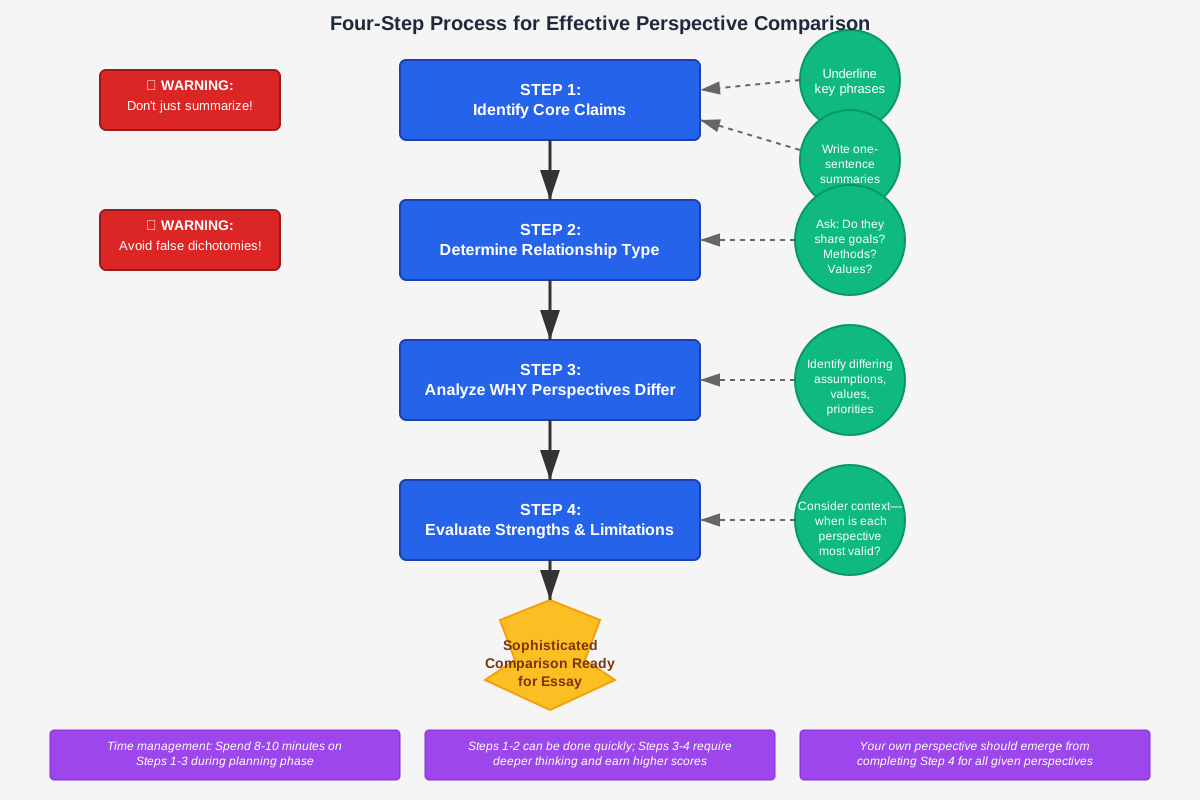
Within the comparison process itself, concepts connect sequentially: Surface-level identification → Analytical examination of assumptions → Evaluative assessment of strengths and limitations → Synthesis into a nuanced position. Each level depends on the previous one; students cannot evaluate perspectives without first analyzing their underlying logic, and they cannot analyze logic without first identifying what each perspective claims.
Comparing perspectives also relates to organizational structure. Essays typically dedicate body paragraphs to exploring relationships between viewpoints, meaning comparison directly shapes the essay's architecture. Additionally, the quality of perspective comparison influences the sophistication of the conclusion, where writers often synthesize insights from multiple viewpoints into a refined final position.
High-Yield Facts
⭐ The ACT Writing rubric explicitly requires analysis of the relationship between your perspective and at least one other perspective—essays that omit comparison cannot score above a 3 in the Analysis domain.
⭐ Effective comparison involves identifying both similarities and differences, not just contrasts—acknowledging shared concerns before explaining different solutions demonstrates sophisticated thinking.
⭐ The three provided perspectives are deliberately designed to represent different positions along a spectrum, typically including opposing views and an alternative framework.
⭐ High-scoring essays compare perspectives at the analytical level (examining assumptions and reasoning) rather than just the surface level (stating different conclusions).
⭐ Comparison should be integrated throughout the essay, not isolated in a single paragraph—each body paragraph should reference relationships between perspectives.
- Transitional language that signals comparison (however, similarly, in contrast) is essential for clarity and coherence.
- Acknowledging the strengths of perspectives you ultimately disagree with demonstrates intellectual fairness and strengthens your argument.
- The most sophisticated essays identify contexts or conditions under which different perspectives might be more or less valid.
- Comparison enables effective counterargument—understanding opposing views thoroughly allows you to address them persuasively.
- Essays that merely summarize each perspective without analyzing relationships typically score in the 1-3 range, regardless of writing quality.
Quick check — test yourself on Comparing perspectives so far.
Try Flashcards →Common Misconceptions
Misconception: Comparing perspectives means simply stating that they are different.
Correction: Effective comparison requires analyzing how and why perspectives differ, examining the underlying assumptions, values, and reasoning that lead to different conclusions. Stating "Perspective One and Perspective Two disagree" is insufficient; explaining "Perspective One prioritizes security over freedom because it assumes individuals cannot assess risks accurately, while Perspective Two reverses these priorities based on a belief in rational decision-making" demonstrates genuine comparison.
Misconception: Students must agree with one of the three provided perspectives.
Correction: The ACT Writing test encourages students to develop their own perspective, which may align with one of the provided viewpoints, synthesize elements from multiple perspectives, or present an entirely different position. The key is to compare your perspective to at least one other, regardless of whether you agree or disagree.
Misconception: Comparison should be confined to a single paragraph that discusses all three perspectives.
Correction: While some essays include a dedicated comparison paragraph, the most sophisticated essays integrate comparison throughout, referencing relationships between perspectives in multiple body paragraphs as relevant to different aspects of the argument.
Misconception: Acknowledging strengths in opposing perspectives weakens your argument.
Correction: Intellectual fairness strengthens credibility. High-scoring essays often acknowledge valid points in perspectives they ultimately reject, then explain why these points are insufficient or why competing considerations are more important. This approach demonstrates nuanced thinking rather than weakness.
Misconception: All three perspectives must be discussed equally and in detail.
Correction: The rubric requires analysis of "at least one other perspective," not necessarily all three. While discussing all three can demonstrate thoroughness, depth of analysis matters more than breadth of coverage. A detailed comparison of your perspective with one other viewpoint is superior to superficial mentions of all three.
Worked Examples
Example 1: Technology and Human Connection Prompt
Prompt Context: The issue concerns whether technology enhances or diminishes human connection. Perspective One argues that technology creates superficial relationships and reduces face-to-face interaction. Perspective Two contends that technology expands our ability to connect with diverse people across distances. Perspective Three suggests that technology is neutral—outcomes depend on how individuals choose to use it.
Student's Position: Technology offers genuine benefits for connection but requires intentional use to avoid pitfalls.
Effective Comparison Paragraph:
"While Perspective One raises valid concerns about the quality of digital interactions, its blanket dismissal of technology overlooks the meaningful connections that many people maintain through digital platforms. Perspective One assumes that physical presence is necessary for authentic relationships, but this assumption fails to account for long-distance friendships, international collaborations, and communities built around shared interests that would be impossible without technology. Perspective Two correctly identifies these benefits, yet it too oversimplifies by suggesting that expanded connection automatically translates to enhanced connection. The quantity of contacts does not guarantee quality of relationships. Perspective Three offers a more nuanced framework by recognizing that technology itself is neither inherently beneficial nor harmful. However, this perspective risks understating how platform design—algorithms that prioritize engagement over well-being, features that encourage constant availability—shapes user behavior in ways that individuals cannot entirely control through personal choice alone. My position builds on Perspective Three's recognition that outcomes vary but adds that we must consider both individual responsibility and systemic factors like platform design when evaluating technology's impact on human connection."
Analysis of What Makes This Effective:
- Identifies specific assumptions underlying each perspective (physical presence requirement, quantity equals quality, individual control)
- Acknowledges strengths before presenting limitations ("correctly identifies," "offers a more nuanced framework")
- Uses precise transitional language ("while," "however," "builds on")
- Positions the student's perspective in relation to all three provided viewpoints
- Operates at the analytical level, examining reasoning rather than just restating conclusions
Example 2: Education Specialization Prompt
Prompt Context: The issue concerns whether students should specialize early in their education or maintain broad exposure to multiple subjects. Perspective One advocates for early specialization to develop expertise. Perspective Two supports broad education to create well-rounded individuals. Perspective Three argues for a hybrid approach with foundational breadth followed by later specialization.
Student's Position: The optimal approach depends on individual student needs and career paths, but most students benefit from Perspective Three's hybrid model.
Effective Comparison Paragraph:
"Perspectives One and Two represent opposing philosophies that reflect different educational values. Perspective One prioritizes depth of knowledge and career preparation, assuming that focused study produces expertise and competitive advantage. This perspective resonates in fields like athletics or music, where early intensive training often correlates with high achievement. Perspective Two, conversely, prioritizes breadth of knowledge and intellectual flexibility, assuming that exposure to diverse subjects develops critical thinking and adaptability. This view aligns with liberal arts traditions that value educated citizens over trained specialists. Both perspectives, however, present false dichotomies by suggesting students must choose between depth and breadth. Perspective Three recognizes that these goals need not be mutually exclusive, proposing a developmental sequence that provides foundational breadth before allowing specialization. This approach acknowledges that younger students may lack the self-knowledge to choose specializations wisely (addressing a weakness in Perspective One) while also recognizing that some degree of focus becomes valuable as students mature and identify interests (addressing a limitation in Perspective Two's lifelong generalism). My position extends Perspective Three by adding that the timing and degree of specialization should vary based on individual circumstances—a student certain of pursuing medicine might reasonably specialize earlier than one exploring multiple potential careers."
Analysis of What Makes This Effective:
- Identifies the underlying values and assumptions driving each perspective (expertise vs. well-roundedness, career preparation vs. intellectual development)
- Provides concrete examples that illustrate when each perspective might be valid (athletics, liberal arts traditions)
- Explicitly addresses how Perspective Three responds to limitations in the other two
- Demonstrates evaluative comparison by assessing relative merits
- Extends the analysis by introducing a context-dependent consideration (individual circumstances)
Exam Strategy
When approaching ACT Writing prompts, follow this systematic process for effective perspective comparison:
Step 1: Annotate the Perspectives (2-3 minutes)
- Read each perspective carefully and underline the main claim
- Note in the margin what value or assumption drives each perspective
- Identify one strength and one limitation for each viewpoint
- Look for patterns: Do two perspectives oppose each other? Does one offer middle ground?
Step 2: Position Your Perspective (2-3 minutes)
- Decide where your position falls relative to the provided perspectives
- Identify which perspective is closest to yours and which is furthest
- Determine whether you'll align with one perspective, synthesize multiple views, or present an alternative
Step 3: Plan Comparison Points (3-4 minutes)
- Select at least one perspective to compare in depth (two is better, all three is ideal if time permits)
- For each comparison, plan to address: What does this perspective get right? What does it overlook? How does my perspective relate?
- Identify specific transitional phrases you'll use to signal relationships
Trigger Words and Phrases to Watch For:
In the prompt instructions, phrases like "analyze the relationship between your perspective and at least one other perspective" directly signal that comparison is required. Within the perspectives themselves, watch for:
- Absolute language ("always," "never," "all," "no") suggesting extreme positions that invite qualification
- Value-laden terms ("freedom," "security," "progress," "tradition") indicating underlying priorities
- Causal claims ("leads to," "results in," "causes") that can be questioned or supported
- Scope indicators ("some," "most," "primarily") suggesting degree of agreement or disagreement
Process-of-Elimination Tips:
While the ACT Writing test doesn't have multiple-choice questions about perspectives, students can use elimination thinking during planning:
- Eliminate perspectives that you find completely unpersuasive—these are candidates for counterargument
- Eliminate surface-level observations ("they disagree") in favor of analytical insights ("they disagree because they prioritize different values")
- Eliminate vague comparison language ("somewhat similar") in favor of precise description ("both acknowledge X concern but propose different solutions")
Time Allocation Advice:
In a 40-minute essay, dedicate:
- 8-10 minutes to planning (including perspective analysis and comparison strategy)
- 25-28 minutes to writing (with comparison integrated throughout, not isolated)
- 3-5 minutes to revision (checking that comparison is explicit and clear)
Exam Tip: If time runs short, prioritize depth over breadth. A thorough comparison of your perspective with one other viewpoint scores better than superficial mentions of all three perspectives.
Memory Techniques
COMPARE Acronym for Perspective Analysis:
- Claims: What does each perspective assert?
- Overlaps: Where do perspectives share common ground?
- Motivations: What values or assumptions drive each view?
- Problems: What limitations does each perspective have?
- Alternatives: How might perspectives be reconciled or transcended?
- Relationships: How does your perspective connect to others?
- Evidence: What examples support or challenge each view?
The "Spectrum Visualization" Technique:
When reading perspectives, visualize a horizontal line with opposing views at each end and alternative frameworks above or below the line. Mentally place each perspective on this map, then position your own view. This spatial representation helps clarify relationships and makes comparison more concrete.
The "Strength-Then-Limitation" Pattern:
Train yourself to automatically think in this sequence when encountering any perspective: "This perspective correctly recognizes [strength], but it overlooks [limitation]." This pattern ensures balanced, sophisticated analysis and prevents one-sided dismissal of opposing views.
Three-Level Depth Check:
Remember the three levels of comparison with this mnemonic: "SAE" (Surface, Analytical, Evaluative). Before finishing any comparison paragraph, check: Have I moved beyond surface-level differences (S) to analyze underlying assumptions (A) and evaluate relative merits (E)?
Summary
Comparing perspectives is the cornerstone of ACT Writing success, directly tested in every essay prompt and accounting for 25% of the overall score through the Analysis domain. Effective comparison requires more than identifying that perspectives differ—it demands analytical examination of the assumptions, values, and reasoning underlying different viewpoints. Students must operate at multiple levels, moving from surface-level identification of positions to analytical exploration of why perspectives differ to evaluative assessment of relative strengths and limitations. The ACT's three-perspective structure typically presents opposing views with an alternative framework, inviting systematic comparison that positions the writer's own perspective in relation to provided viewpoints. High-scoring essays integrate comparison throughout rather than isolating it, use precise transitional language to signal relationships, acknowledge strengths in opposing views before presenting limitations, and demonstrate intellectual sophistication by recognizing contexts where different perspectives might be more or less valid. Mastering this skill transforms an essay from basic summary to sophisticated analysis, signaling the critical thinking ability that colleges value.
Key Takeaways
- Comparing perspectives is explicitly required by the ACT Writing rubric—essays that omit meaningful comparison cannot score above a 3 in the Analysis domain, regardless of writing quality
- Effective comparison operates at three levels: surface (identifying different positions), analytical (examining underlying assumptions), and evaluative (assessing relative merits)
- The three provided perspectives typically follow predictable patterns—often opposing views with an alternative framework—making systematic comparison possible
- Integration throughout the essay is superior to isolation—reference relationships between perspectives in multiple paragraphs rather than confining comparison to a single section
- Acknowledging strengths in opposing perspectives strengthens rather than weakens arguments—intellectual fairness demonstrates sophisticated thinking
- Precise transitional language is essential—words like "however," "similarly," "while," and "building on" signal relationships clearly to graders
- Context-dependent analysis represents the highest level of sophistication—recognizing when different perspectives might be valid under different circumstances demonstrates nuanced thinking
Related Topics
Thesis Development: Mastering perspective comparison enables more sophisticated thesis statements that position your argument relative to other viewpoints rather than simply stating an opinion in isolation.
Counterargument Strategies: Thorough understanding of opposing perspectives through comparison work provides the foundation for effective counterarguments that address the strongest versions of opposing views.
Evidence Selection and Analysis: Comparing perspectives helps identify what types of evidence would support or challenge different viewpoints, improving the strategic use of examples in your essay.
Essay Organization: The relationships you identify through perspective comparison directly shape your essay's structure, determining how body paragraphs relate to one another and build toward a conclusion.
Rhetorical Analysis: The skills used to compare perspectives—identifying assumptions, evaluating reasoning, recognizing values—transfer directly to analyzing persuasive texts in other contexts.
Practice CTA
Now that you understand the principles and strategies behind comparing perspectives, it's time to apply this knowledge! Work through the practice questions to test your ability to identify relationships between viewpoints, analyze underlying assumptions, and construct sophisticated comparisons. Use the flashcards to reinforce key concepts and terminology. Remember: perspective comparison is a skill that improves with deliberate practice. Each essay you write offers an opportunity to deepen your analytical thinking and move closer to your target score. The investment you make in mastering this high-yield skill will pay dividends not only on test day but throughout your academic career. You've got this!
Sign up free to keep reading
Create a free AnvayaPrep account to finish this ACT guide on Comparing perspectives — plus flashcards and practice questions.