Overview
Evaluating perspectives is a critical skill tested in the ACT Writing section, where students must analyze, compare, and assess multiple viewpoints on a complex issue. Unlike traditional essay writing that focuses solely on presenting a single argument, the ACT Writing test requires students to engage with three distinct perspectives provided in the prompt, examining their strengths, weaknesses, and relationships to one another. This analytical process forms the foundation of a high-scoring essay, as it demonstrates sophisticated critical thinking and the ability to navigate nuanced debates.
The ACT essay prompt always presents a contemporary issue followed by three different perspectives that offer varying approaches or opinions on that issue. Students must not only develop their own perspective but also meaningfully engage with these provided viewpoints. This engagement goes beyond simple agreement or disagreement—it requires understanding the underlying assumptions, implications, and potential consequences of each perspective. The ability to evaluate perspectives effectively separates essays that score in the 7-9 range from those that receive lower scores, making this skill essential for achieving competitive writing scores.
Within the broader context of ACT Writing concepts, evaluating perspectives serves as the analytical backbone that supports both thesis development and argumentative structure. It connects directly to understanding how to construct counterarguments, synthesize multiple viewpoints, and demonstrate intellectual maturity in written discourse. Mastering this skill enables students to write essays that showcase depth of thought rather than superficial analysis, which is precisely what ACT graders seek when assessing the "Ideas and Analysis" domain of the scoring rubric.
Learning Objectives
- [ ] Identify when Evaluating perspectives is being tested in ACT Writing prompts
- [ ] Explain the core rule or strategy behind Evaluating perspectives in essay construction
- [ ] Apply Evaluating perspectives to ACT-style questions accurately and effectively
- [ ] Distinguish between superficial and sophisticated perspective analysis
- [ ] Generate meaningful connections between provided perspectives and original arguments
- [ ] Assess the relative strengths and limitations of competing viewpoints systematically
- [ ] Integrate perspective evaluation seamlessly into essay organization and development
Prerequisites
- Basic essay structure: Understanding introduction, body paragraphs, and conclusion organization is essential because perspective evaluation must be woven throughout the essay framework
- Thesis statement construction: The ability to craft a clear position statement is necessary because the student's own perspective must be articulated in relation to the provided viewpoints
- Paragraph development: Knowledge of topic sentences, evidence, and analysis is required because each perspective discussion needs coherent development
- Reading comprehension: The capacity to understand complex arguments quickly is fundamental because students must accurately interpret three perspectives under time pressure
Why This Topic Matters
In real-world contexts, evaluating perspectives is a fundamental skill for academic discourse, professional decision-making, and civic engagement. Whether analyzing policy proposals, assessing business strategies, or participating in democratic debate, the ability to fairly represent multiple viewpoints while critically examining their merits is invaluable. This skill demonstrates intellectual maturity and prepares students for college-level writing, where professors expect nuanced engagement with scholarly debates rather than one-sided arguments.
On the ACT Writing test, perspective evaluation appears in 100% of essay prompts—it is not optional. The scoring rubric explicitly evaluates how well students analyze and evaluate perspectives in the "Ideas and Analysis" domain, which accounts for one-fourth of the total essay score. Essays that score 10-12 (the highest range) consistently demonstrate "nuanced understanding of multiple perspectives" and "insightful analysis of implications, complexities, and tensions." Conversely, essays scoring 4-6 typically show "little or no analysis of perspectives" or "superficial engagement" with the provided viewpoints.
The topic appears in several specific ways on the exam. First, the prompt explicitly presents three labeled perspectives (Perspective One, Perspective Two, Perspective Three) that students must address. Second, the essay task instructions specifically direct students to "evaluate and analyze" these perspectives. Third, the highest-scoring essays integrate perspective analysis throughout multiple paragraphs rather than isolating it to a single section. Understanding these patterns helps students recognize exactly what the test demands and how to deliver it effectively.
Core Concepts
Understanding What Perspectives Are
Perspectives on the ACT Writing test are brief statements (typically 2-4 sentences) that present distinct viewpoints on the issue introduced in the prompt. Each perspective represents a coherent position with underlying assumptions and implications. These are not random opinions but carefully constructed viewpoints that often represent different philosophical approaches, value systems, or practical considerations related to the issue. For example, on a prompt about automation and employment, one perspective might prioritize economic efficiency, another might emphasize worker protection, and a third might focus on innovation and progress.
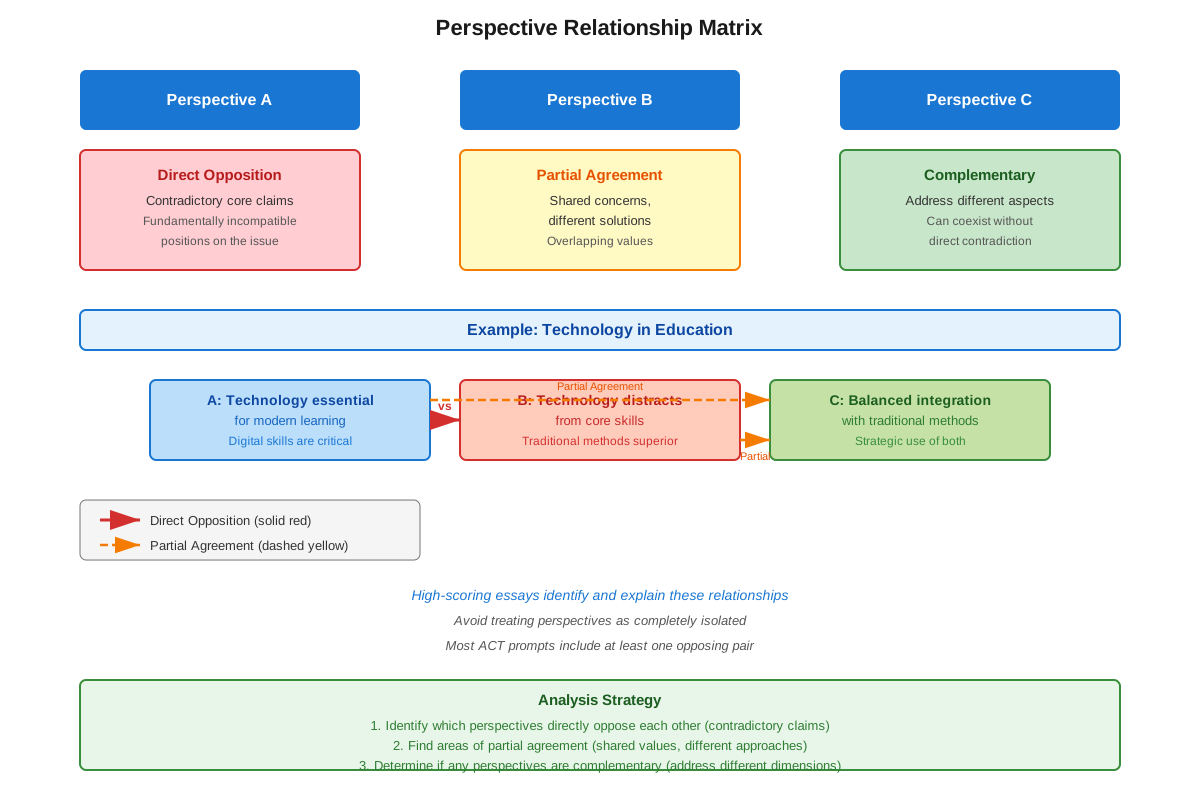
The perspectives are designed to be genuinely different from one another—not merely variations on the same theme. They may conflict directly, or they may address different aspects of the issue. Recognizing these distinctions is the first step in effective evaluation. Students must resist the temptation to oversimplify perspectives into "good" and "bad" categories; instead, each perspective typically contains both valid insights and potential limitations.
The Core Strategy: Analytical Engagement
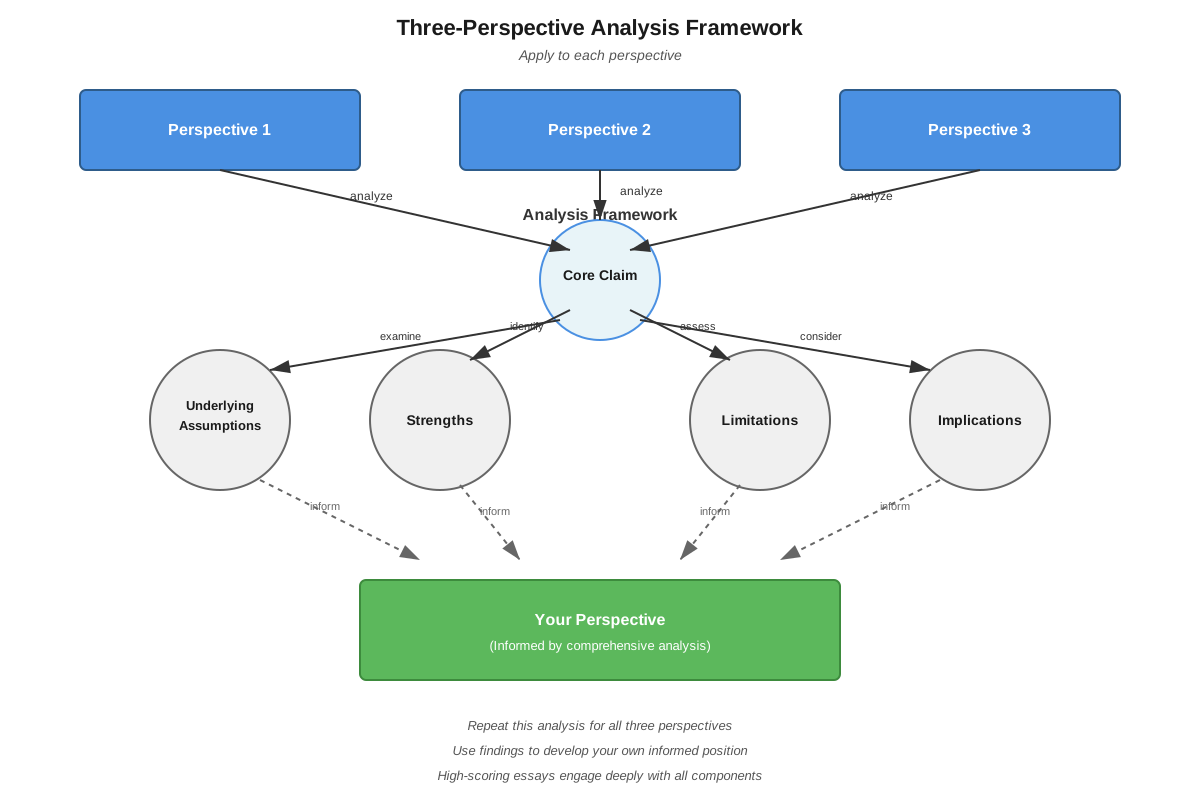
ACT evaluating perspectives requires a systematic approach that goes beyond surface-level agreement or disagreement. The core strategy involves four key components:
- Comprehension: Accurately understanding what each perspective claims and why
- Analysis: Examining the reasoning, assumptions, and implications of each perspective
- Evaluation: Assessing the strengths and weaknesses of each viewpoint
- Synthesis: Connecting the perspectives to one another and to the student's own position
This process should not be mechanical or formulaic. High-scoring essays demonstrate genuine intellectual engagement, showing that the writer has thoughtfully considered each perspective's merits and limitations. The goal is not to "defeat" perspectives that differ from the student's own position but to demonstrate sophisticated understanding of a complex issue.
Levels of Perspective Evaluation
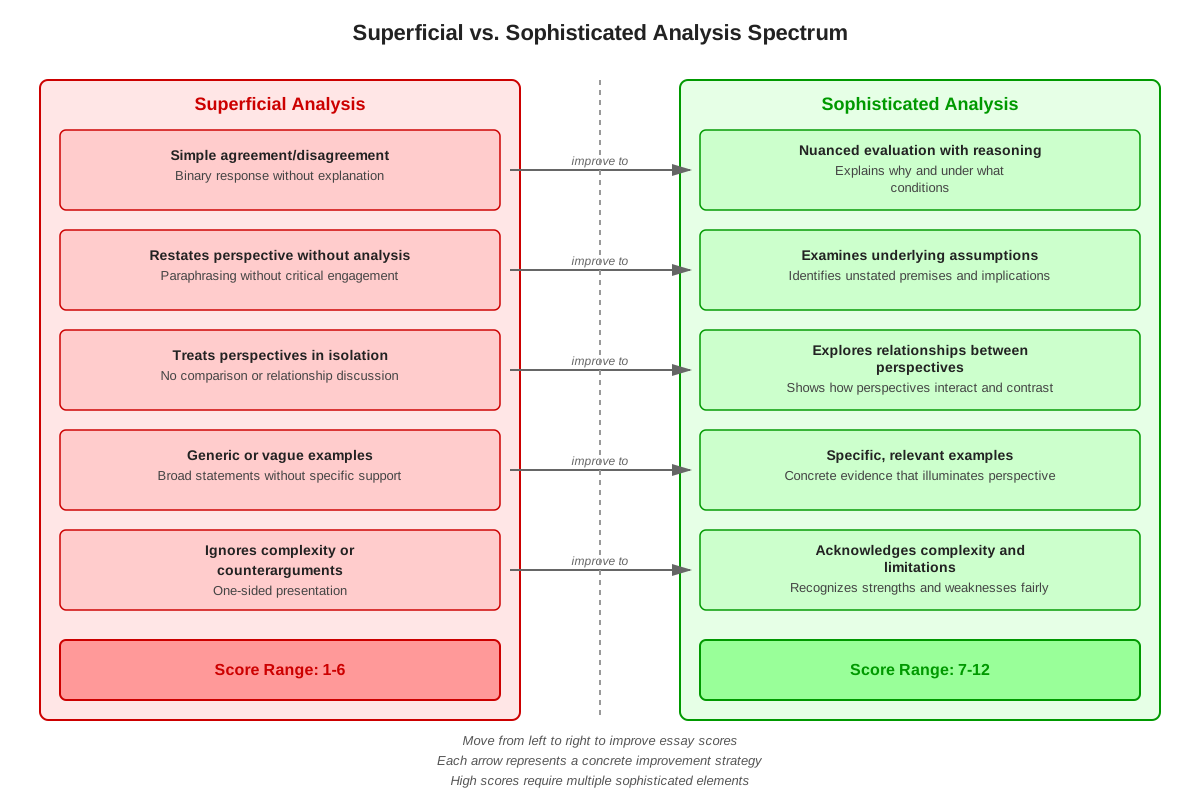
| Level | Characteristics | Score Range |
|---|---|---|
| Superficial | Simple agreement/disagreement; no analysis of reasoning; perspectives mentioned but not explored | 4-6 |
| Adequate | Basic analysis of what perspectives claim; some discussion of strengths or weaknesses; limited integration | 7-9 |
| Sophisticated | Deep analysis of assumptions and implications; nuanced evaluation of multiple dimensions; seamless integration throughout essay | 10-12 |
Understanding these levels helps students recognize what distinguishes exceptional perspective evaluation from merely adequate treatment. The difference often lies in specificity, depth of reasoning, and the ability to identify subtle complexities within each viewpoint.
Identifying Strengths and Limitations
Effective perspective evaluation requires balanced analysis. For each perspective, students should consider:
Potential Strengths:
- Valid concerns or values it addresses
- Practical benefits of adopting this viewpoint
- Evidence or reasoning that supports it
- Contexts where this perspective is particularly applicable
Potential Limitations:
- Unstated assumptions that may not hold true
- Negative consequences or trade-offs
- Situations where this perspective fails or creates problems
- Values or concerns it overlooks or minimizes
This balanced approach demonstrates intellectual fairness and analytical sophistication. Even when disagreeing with a perspective, acknowledging its valid elements shows maturity of thought.
Integration vs. Isolation
A critical distinction in perspective evaluation is between integration (weaving perspective analysis throughout the essay) and isolation (dedicating one paragraph to summarizing all three perspectives without deeper engagement). High-scoring essays typically integrate perspective evaluation in multiple ways:
- Introducing relevant perspectives when developing specific arguments
- Using perspectives as counterarguments to address and refine
- Drawing connections between perspectives to show relationships
- Returning to perspectives in the conclusion to demonstrate synthesis
Isolated treatment—such as a single paragraph that states "Perspective One says X, Perspective Two says Y, Perspective Three says Z"—rarely receives high scores because it demonstrates minimal analytical engagement.
Developing Your Own Perspective in Context
The student's own perspective should emerge from thoughtful consideration of the provided viewpoints. This does not mean the student must adopt one of the three perspectives verbatim; rather, the student's position should be informed by analyzing all three. Strong approaches include:
- Alignment with modification: Agreeing with one perspective while addressing its limitations
- Synthesis: Combining elements from multiple perspectives into a more comprehensive view
- Alternative position: Proposing a different approach while explaining why the provided perspectives are insufficient
- Conditional agreement: Supporting different perspectives under different circumstances
The key is demonstrating that the student's own perspective has been developed through careful consideration of multiple viewpoints rather than in isolation from them.
Concept Relationships
The concepts within evaluating perspectives form a hierarchical and interconnected system. Understanding what perspectives are serves as the foundation, enabling students to accurately interpret the viewpoints presented in the prompt. This comprehension then enables analytical engagement, which involves the deeper work of examining reasoning and assumptions. Analytical engagement produces identification of strengths and limitations, which provides the specific content for evaluation. These evaluations must then be integrated throughout the essay rather than isolated, and this integration process directly shapes how the student's own perspective is developed and positioned.
The relationship flows as follows: Comprehension → Analysis → Evaluation → Integration → Synthesis. Each stage depends on the previous one, and skipping stages results in superficial treatment that limits essay scores.
Evaluating perspectives connects to prerequisite topics in essential ways. Basic essay structure provides the framework within which perspective evaluation occurs—perspectives might be addressed in the introduction, developed in body paragraphs, and synthesized in the conclusion. Thesis statement construction is directly informed by perspective evaluation, as the student's thesis should reflect thoughtful consideration of the provided viewpoints. Paragraph development skills enable students to fully explore each perspective's implications rather than merely mentioning them.
Looking forward, mastering perspective evaluation enables progression to advanced writing skills such as constructing sophisticated counterarguments, developing nuanced claims that acknowledge complexity, and demonstrating the intellectual maturity that college-level writing demands.
High-Yield Facts
⭐ The ACT Writing prompt always provides exactly three perspectives that must be addressed in the essay
⭐ Essays scoring 10-12 demonstrate "nuanced understanding" and "insightful analysis" of perspectives, not just summary
⭐ Perspective evaluation contributes directly to the "Ideas and Analysis" domain score, which represents 25% of the total essay score
⭐ High-scoring essays integrate perspective analysis throughout multiple paragraphs rather than isolating it to one section
⭐ Effective evaluation requires identifying both strengths and limitations of perspectives, not just agreement or disagreement
- The student's own perspective should be developed in relation to the provided perspectives, not in isolation from them
- Perspectives are designed to represent genuinely different viewpoints, not minor variations on the same position
- Acknowledging valid elements in perspectives you disagree with demonstrates intellectual maturity and analytical sophistication
- Superficial perspective treatment (simply stating what each says) typically results in scores of 6 or below
- The essay task instructions explicitly direct students to "evaluate and analyze" the perspectives, making this a non-negotiable requirement
- Perspectives often represent different value systems, philosophical approaches, or practical considerations related to the issue
- Synthesis of multiple perspectives into a more comprehensive view is a hallmark of the highest-scoring essays
Quick check — test yourself on Evaluating perspectives so far.
Try Flashcards →Common Misconceptions
Misconception: Students must agree with one of the three provided perspectives and argue for it exclusively → Correction: Students should develop their own perspective, which may align with, synthesize, or differ from the provided viewpoints. The goal is thoughtful engagement, not forced agreement.
Misconception: Evaluating perspectives means dedicating one paragraph to summarizing all three perspectives without analysis → Correction: Effective evaluation involves deep analysis of reasoning, assumptions, and implications, integrated throughout the essay rather than isolated in a single summary paragraph.
Misconception: Perspectives that differ from the student's position should be dismissed or attacked → Correction: Even when disagreeing with a perspective, students should acknowledge its valid elements and explain its limitations fairly. This demonstrates intellectual maturity rather than one-sided thinking.
Misconception: All three perspectives must receive equal attention and development in the essay → Correction: While all three should be addressed, students may choose to develop some perspectives more fully than others based on their relevance to the student's own argument. Strategic emphasis is acceptable.
Misconception: Perspective evaluation is separate from developing the student's own argument → Correction: The two processes are interconnected. Analyzing the provided perspectives should inform and strengthen the student's own position, and the student's argument should emerge from thoughtful consideration of multiple viewpoints.
Misconception: Using sophisticated vocabulary when discussing perspectives is more important than demonstrating genuine understanding → Correction: Clarity and depth of analysis matter far more than impressive-sounding language. Graders reward genuine intellectual engagement, not verbal decoration.
Worked Examples
Example 1: Technology and Privacy Prompt
Prompt Issue: As technology advances, companies collect increasing amounts of personal data. Should individuals be concerned about privacy, or do the benefits of data collection outweigh the risks?
Perspective One: Privacy is a fundamental right that must be protected. Companies should be strictly limited in what data they can collect and how they can use it.
Perspective Two: Data collection enables valuable services and innovations. Individuals who want these benefits must accept some loss of privacy as a reasonable trade-off.
Perspective Three: The focus should be on transparency and consent. As long as individuals understand and agree to data collection, companies should be free to collect data.
Student's Approach: The student decides to develop a position that synthesizes elements of Perspectives One and Three while addressing limitations in Perspective Two.
Worked Analysis:
Introduction excerpt: "While Perspective Two correctly identifies that data collection enables innovation, it oversimplifies the trade-off by assuming individuals have genuine choice in whether to participate in the digital economy. A more nuanced approach recognizes that privacy protections (Perspective One) and meaningful consent mechanisms (Perspective Three) must work together to address power imbalances between individuals and corporations."
Body paragraph excerpt: "Perspective Three's emphasis on transparency and consent addresses a crucial element that Perspective One's regulatory approach might overlook: individual autonomy. However, Perspective Three's framework contains a significant limitation—it assumes that consent is meaningful when, in reality, most users face a 'take it or leave it' choice with essential services. This suggests that pure consent-based models must be supplemented with baseline protections that cannot be waived, combining the strengths of both perspectives."
Why this works: The student demonstrates sophisticated analysis by identifying valid elements in multiple perspectives, explaining specific limitations with reasoning, and developing a synthesis that addresses the weaknesses identified. The evaluation is integrated into the argument rather than isolated.
Example 2: Education and Standardized Testing Prompt
Prompt Issue: Standardized testing plays a major role in education. What should be the role of standardized tests in evaluating student achievement and school quality?
Perspective One: Standardized tests provide objective measures that ensure accountability and allow fair comparisons across different schools and districts.
Perspective Two: Standardized tests narrow the curriculum and encourage teaching to the test rather than fostering genuine learning and critical thinking.
Perspective Three: Tests should be one factor among many, including teacher evaluations, student portfolios, and other assessments that capture different dimensions of learning.
Student's Approach: The student develops a position that largely aligns with Perspective Three but addresses its vagueness while engaging critically with Perspectives One and Two.
Worked Analysis:
Body paragraph 1 excerpt: "Perspective One's appeal to objectivity deserves serious consideration, as subjective assessments can indeed introduce bias and inconsistency. However, this perspective assumes that what standardized tests measure—primarily recall and procedural knowledge—represents the full scope of valuable learning. By treating 'objectivity' and 'validity' as synonymous, Perspective One overlooks that tests can be objectively measuring the wrong things."
Body paragraph 2 excerpt: "Perspective Two identifies a genuine problem: the narrowing effect of high-stakes testing on curriculum. Research from districts that implemented test-based accountability confirms that instructional time for untested subjects like art and social studies declined significantly. Yet Perspective Two's implicit solution—eliminating or drastically reducing standardized testing—creates its own problems by removing a tool that, despite its limitations, can identify achievement gaps and schools needing support."
Body paragraph 3 excerpt: "Perspective Three offers a more balanced approach by advocating for multiple measures, but it lacks specificity about how to weight different assessments or prevent the same narrowing effect if any single measure becomes dominant. A refined version of this perspective would specify that standardized tests should constitute no more than 30% of accountability measures and must be complemented by assessments of critical thinking, creativity, and real-world application."
Why this works: The student engages deeply with each perspective's reasoning, identifies specific strengths and limitations with evidence and logic, and develops a refined position that addresses the weaknesses identified. The evaluation demonstrates genuine intellectual work rather than formulaic treatment.
Exam Strategy
When approaching ACT Writing prompts, students should allocate approximately 5-7 minutes of the 40-minute time limit to reading, analyzing, and planning perspective evaluation. This upfront investment pays dividends by ensuring the essay demonstrates sophisticated engagement rather than superficial treatment.
Trigger phrases in the essay task instructions that signal perspective evaluation is required include:
- "Evaluate and analyze the perspectives given"
- "Discuss the relationship between your perspective and those given"
- "Explain how your perspective relates to at least one other perspective"
- "Analyze the relationship between your perspective and at least one other perspective"
These phrases appear in every ACT Writing prompt and explicitly direct students to engage with perspectives, making this skill non-negotiable for achieving competitive scores.
Step-by-step approach:
- Read all three perspectives carefully before forming your own position (2 minutes)
- Identify the core claim and underlying assumption of each perspective (1 minute)
- Note one strength and one limitation for each perspective (2 minutes)
- Determine your own position in relation to the three perspectives (1 minute)
- Plan where in your essay you will address each perspective (1 minute)
Exam Tip: Use the planning page to create a quick chart with three columns (Perspective 1, 2, 3) and two rows (Strength, Limitation). This ensures balanced analysis and provides reference points while writing.
Process-of-elimination strategy: When deciding which perspectives to emphasize, consider:
- Which perspective is most relevant to your thesis? (Develop this one most fully)
- Which perspectives conflict with each other? (Exploring this tension demonstrates sophistication)
- Which perspective has the most obvious limitation? (This may be easiest to evaluate critically)
Time allocation within the essay:
- Introduction: Briefly introduce the issue and preview your engagement with perspectives (3-4 minutes)
- Body paragraphs: Integrate perspective analysis into 2-3 paragraphs (20-25 minutes)
- Conclusion: Synthesize perspectives and reinforce your position (3-4 minutes)
- Revision: Check that all three perspectives are addressed (2-3 minutes)
Red flags to avoid:
- Spending an entire paragraph simply restating what each perspective says without analysis
- Addressing only one or two perspectives while ignoring the third
- Treating perspectives as "right" or "wrong" rather than analyzing their reasoning
- Discussing perspectives only in the introduction and never returning to them
Memory Techniques
SEALS Mnemonic for evaluating each perspective:
- Strengths: What valid points does this perspective make?
- Evidence: What examples or reasoning support it?
- Assumptions: What unstated beliefs underlie this perspective?
- Limitations: What problems or gaps does it have?
- Synthesis: How does it relate to other perspectives and your position?
The Three-Column Visualization: Picture a table with three columns representing the three perspectives. As you read each one, mentally place it in its column and note whether it leans toward values (what should be), practicality (what works), or principles (what's right). This helps you see the relationships between perspectives and identify which dimension your own argument emphasizes.
IDEA Acronym for integration:
- Introduce perspectives when relevant to your argument
- Develop analysis of their reasoning and implications
- Explain their strengths and limitations specifically
- Articulate how they relate to your position
The Balance Scale Mental Image: Visualize each perspective on a balance scale. On one side, place its strengths and valid concerns; on the other, place its limitations and problems. This visualization reinforces that effective evaluation requires acknowledging both sides rather than one-sided judgment.
Summary
Evaluating perspectives is the analytical core of the ACT Writing test, requiring students to engage thoughtfully with three provided viewpoints on a complex issue. This skill goes far beyond simple agreement or disagreement—it demands understanding each perspective's reasoning, identifying its strengths and limitations, and integrating this analysis throughout the essay. High-scoring essays demonstrate nuanced understanding by acknowledging valid elements even in perspectives the student ultimately disagrees with, explaining specific limitations with clear reasoning, and developing the student's own position in relation to the provided viewpoints. The key to success lies in integration rather than isolation: weaving perspective analysis into multiple paragraphs rather than confining it to a single summary section. Students must allocate sufficient planning time to analyze all three perspectives systematically, using strategies like identifying underlying assumptions and noting both strengths and limitations. Mastering this skill directly impacts the "Ideas and Analysis" domain score and distinguishes essays that demonstrate intellectual maturity from those that offer only superficial treatment of complex issues.
Key Takeaways
- Evaluating perspectives appears in 100% of ACT Writing prompts and directly affects 25% of the essay score through the "Ideas and Analysis" domain
- Effective evaluation requires identifying both strengths and limitations of each perspective, not just stating agreement or disagreement
- High-scoring essays integrate perspective analysis throughout multiple paragraphs rather than isolating it to a single summary section
- The student's own perspective should emerge from thoughtful consideration of the provided viewpoints, demonstrating synthesis rather than isolation
- Acknowledging valid elements in perspectives you disagree with demonstrates intellectual maturity and analytical sophistication
- Superficial treatment (merely restating what perspectives say) typically results in scores of 6 or below, while nuanced analysis characterizes essays scoring 10-12
- Strategic planning—allocating 5-7 minutes to analyze perspectives before writing—ensures sophisticated engagement rather than rushed, formulaic treatment
Related Topics
Thesis Development in ACT Writing: Building on perspective evaluation skills, students learn to craft thesis statements that reflect sophisticated engagement with multiple viewpoints. Mastering perspective evaluation provides the analytical foundation for developing nuanced, defensible thesis statements.
Counterargument Construction: Understanding how to evaluate perspectives prepares students to anticipate and address counterarguments effectively. The skills of identifying limitations and acknowledging valid concerns transfer directly to constructing and refuting counterarguments.
Evidence Selection and Analysis: Once students can evaluate perspectives, they must support their evaluations with relevant evidence and reasoning. This progression moves from analytical thinking to persuasive writing.
Essay Organization Strategies: Integrating perspective evaluation throughout an essay requires sophisticated organizational skills. Students learn various structures for weaving perspective analysis into coherent arguments.
Scoring Rubric Mastery: Understanding how perspective evaluation affects all four domains of the ACT Writing rubric (Ideas and Analysis, Development and Support, Organization, Language Use) helps students maximize their scores across all dimensions.
Practice CTA
Now that you understand the core principles of evaluating perspectives, it's time to apply these skills to actual ACT-style prompts. The practice questions and flashcards will help you internalize the strategies covered in this guide and build the automaticity needed to perform under timed conditions. Remember: perspective evaluation is a skill that improves with deliberate practice. Each prompt you analyze strengthens your ability to identify assumptions, assess reasoning, and integrate multiple viewpoints into sophisticated arguments. Approach the practice materials with the same analytical mindset you'll bring to test day, and you'll see measurable improvement in both your confidence and your scores. You've got this!
Sign up free to keep reading
Create a free AnvayaPrep account to finish this ACT guide on Evaluating perspectives — plus flashcards and practice questions.