Overview
The ACT Writing test presents students with a single essay prompt that requires careful analysis and interpretation before any writing begins. Understanding the writing prompt is the foundational skill that determines whether a student can craft a focused, relevant, and high-scoring essay. This skill involves more than simply reading the prompt—it requires identifying the central issue, recognizing the multiple perspectives provided, understanding what the test asks the writer to do, and determining how to position one's own argument within the framework established by the prompt.
On the ACT, the essay prompt always follows a consistent structure: it presents a contemporary issue relevant to students' lives, offers three distinct perspectives on that issue, and asks students to evaluate these perspectives while developing their own position. Many students make the critical error of beginning to write immediately after a superficial reading, which leads to essays that drift off-topic, fail to address all required elements, or misinterpret the perspectives. ACT understanding the writing prompt is not merely a preliminary step—it is the strategic foundation that shapes every subsequent decision in the essay-writing process, from thesis formulation to evidence selection to organizational structure.
This topic connects directly to all other aspects of ACT essay writing. Without proper prompt analysis, students cannot effectively plan their essays, develop coherent arguments, or integrate the provided perspectives into their writing. The ability to dissect and comprehend the prompt influences essay organization, paragraph development, and even the sophistication of ideas—all components of the ACT Writing rubric. Mastering prompt analysis ensures that students write essays that directly respond to what the test asks, maximizing their potential scores across all four scoring domains: Ideas and Analysis, Development and Support, Organization, and Language Use.
Learning Objectives
- [ ] Identify when Understanding the writing prompt is being tested
- [ ] Explain the core rule or strategy behind Understanding the writing prompt
- [ ] Apply Understanding the writing prompt to ACT-style questions accurately
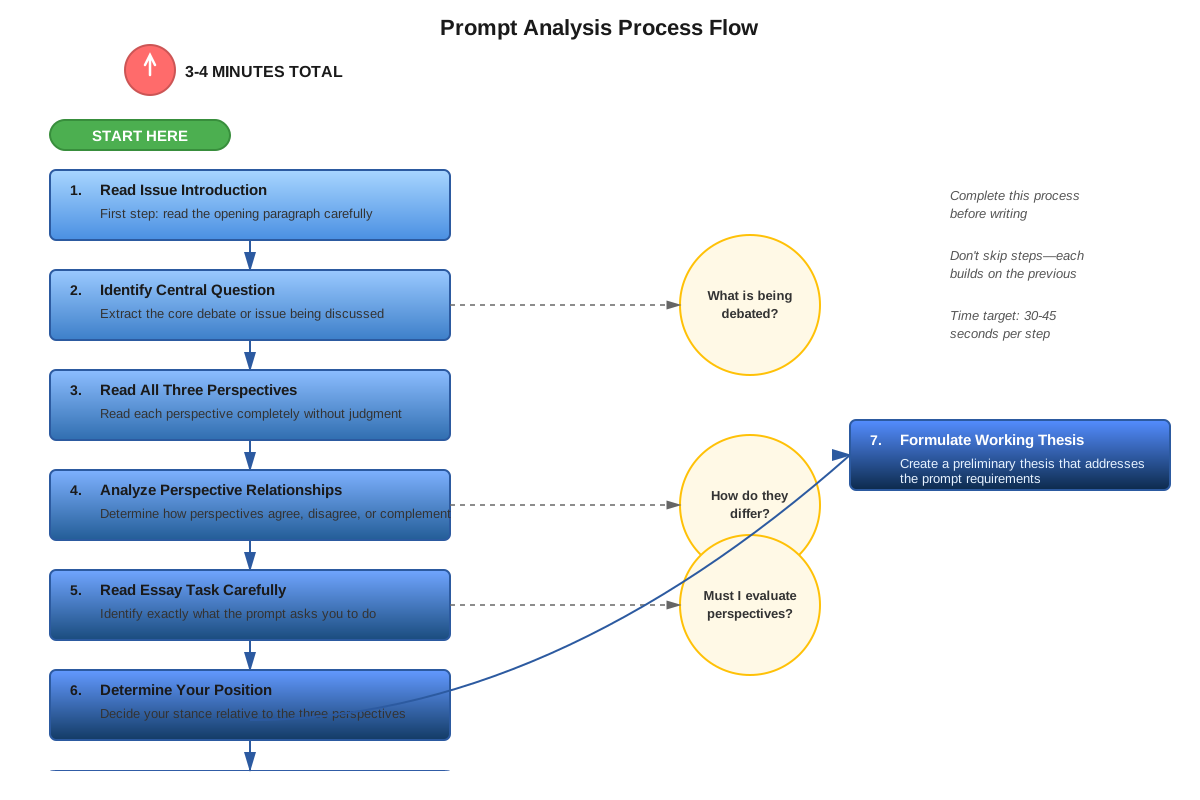
- [ ] Deconstruct an ACT essay prompt into its essential components within 3-4 minutes
- [ ] Distinguish between the issue, the perspectives, and the task requirements in any ACT prompt
- [ ] Evaluate how the three perspectives relate to each other and to the central issue
- [ ] Formulate a preliminary thesis statement that directly addresses the prompt's requirements
Prerequisites
- Basic reading comprehension skills: Students must be able to understand complex sentences and identify main ideas in multi-paragraph texts, as ACT prompts contain sophisticated vocabulary and nuanced positions.
- Familiarity with argumentative writing structure: Understanding thesis statements, supporting evidence, and counterarguments is essential because the ACT essay requires students to construct a position-based argument.
- Awareness of contemporary social issues: Students should have general knowledge of current debates in education, technology, society, and culture, as ACT prompts address topics relevant to high school students' experiences.
- Time management fundamentals: Students need basic skills in allocating time across multiple tasks, since prompt analysis must occur within the 40-minute essay time limit.
Why This Topic Matters
Understanding the writing prompt is the single most critical skill for ACT essay success because it determines whether students write on-topic, address all required elements, and demonstrate the analytical thinking that earns high scores. According to ACT scoring data, essays that fail to address the prompt appropriately rarely score above a 6 out of 12 in any domain, regardless of writing quality. The most common reason for low scores in the Ideas and Analysis domain—which accounts for 25% of the essay score—is failure to engage meaningfully with the prompt's issue and perspectives.
In real-world applications, the skill of carefully analyzing prompts and questions translates directly to college success. University assignments, essay exams, and research projects all require students to understand precisely what is being asked before they begin work. Employers similarly value the ability to comprehend complex instructions and respond appropriately to specific requests. The analytical reading skills developed through prompt analysis strengthen critical thinking across all academic disciplines.
On the ACT Writing test, prompt understanding appears in every single essay—there is no way to avoid this skill. The test consistently presents prompts that require students to analyze three perspectives, develop their own position, and explain relationships between their ideas and at least one of the given perspectives. Questions about prompt understanding don't appear as multiple-choice items; instead, the entire essay serves as evidence of whether the student understood what was asked. Scorers specifically evaluate whether the essay "engages with multiple perspectives" and whether the student's analysis "examines implications, complexities and tensions, and/or underlying values and assumptions" related to the prompt's issue.
Core Concepts
The Anatomy of an ACT Essay Prompt
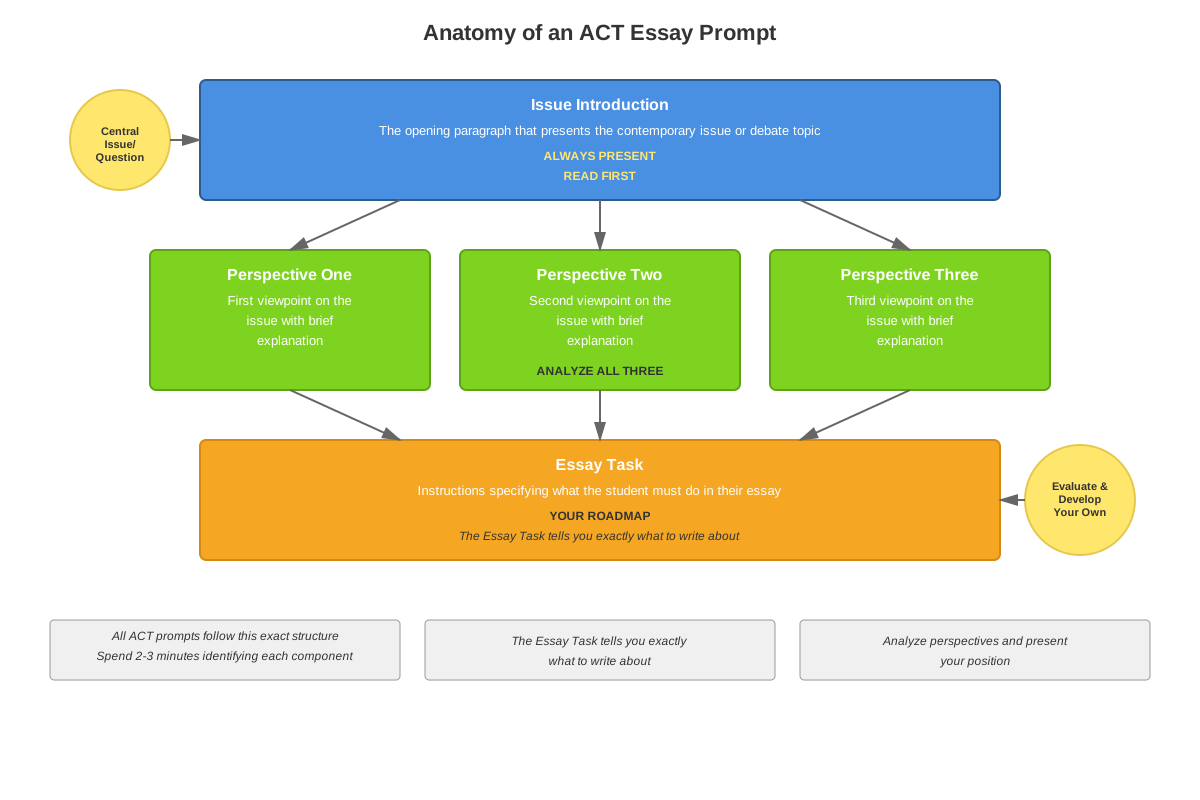
Every ACT essay prompt follows a predictable three-part structure that students must recognize and analyze systematically. The first component is the issue statement, which introduces a broad contemporary topic and provides context. This section typically consists of 2-4 sentences that frame a debate or question relevant to students' lives. For example, a prompt might introduce the issue of whether schools should prioritize STEM education over arts and humanities, or whether social media has improved or damaged interpersonal communication.
The second component presents three distinct perspectives on the issue, each labeled as Perspective One, Perspective Two, and Perspective Three. These perspectives represent different positions or approaches to the issue, and they may agree with each other, contradict each other, or address different aspects of the issue entirely. Each perspective is typically 1-2 sentences long and presents a clear stance. Understanding that these perspectives are not necessarily opposing viewpoints is crucial—sometimes two perspectives might align while differing from the third, or all three might address different dimensions of the issue rather than directly contradicting each other.
The third component is the essay task, which appears after the perspectives and explicitly tells students what they must do in their essay. This section always includes specific requirements: analyze and evaluate the perspectives, state and develop your own perspective, and explain the relationship between your perspective and at least one of the given perspectives. The task section is the most important part of the prompt because it defines the criteria by which the essay will be scored.
Identifying the Central Issue
The central issue is the overarching question or debate that the prompt addresses. Students must distinguish between the general topic and the specific issue being debated. For instance, "technology" is a topic, but "whether increased technology use in classrooms improves or hinders learning" is an issue. The issue always involves some tension, debate, or question that reasonable people might answer differently.
To identify the central issue accurately, students should ask themselves: "What question is being debated here?" or "What decision or judgment is at stake?" The issue statement typically appears in the opening paragraph of the prompt, often phrased as a question or as a statement about competing values or priorities. Underlining or circling the key question or tension in the issue statement helps students maintain focus throughout the essay-writing process.
Understanding the issue's scope is equally important. ACT prompts are deliberately broad enough to allow multiple approaches but specific enough to provide direction. Students who misidentify the issue—either making it too narrow or too broad—will struggle to write relevant essays. For example, if the issue concerns "whether high schools should require community service for graduation," an essay about the general benefits of volunteering would be too broad, while an essay about one specific community service program would be too narrow.
Analyzing the Three Perspectives
Each perspective represents a distinct position or approach to the issue, and students must understand what each perspective actually argues before they can evaluate it or relate their own ideas to it. Perspective analysis involves identifying the main claim of each perspective, recognizing the underlying assumptions or values, and understanding the implications of adopting that viewpoint.
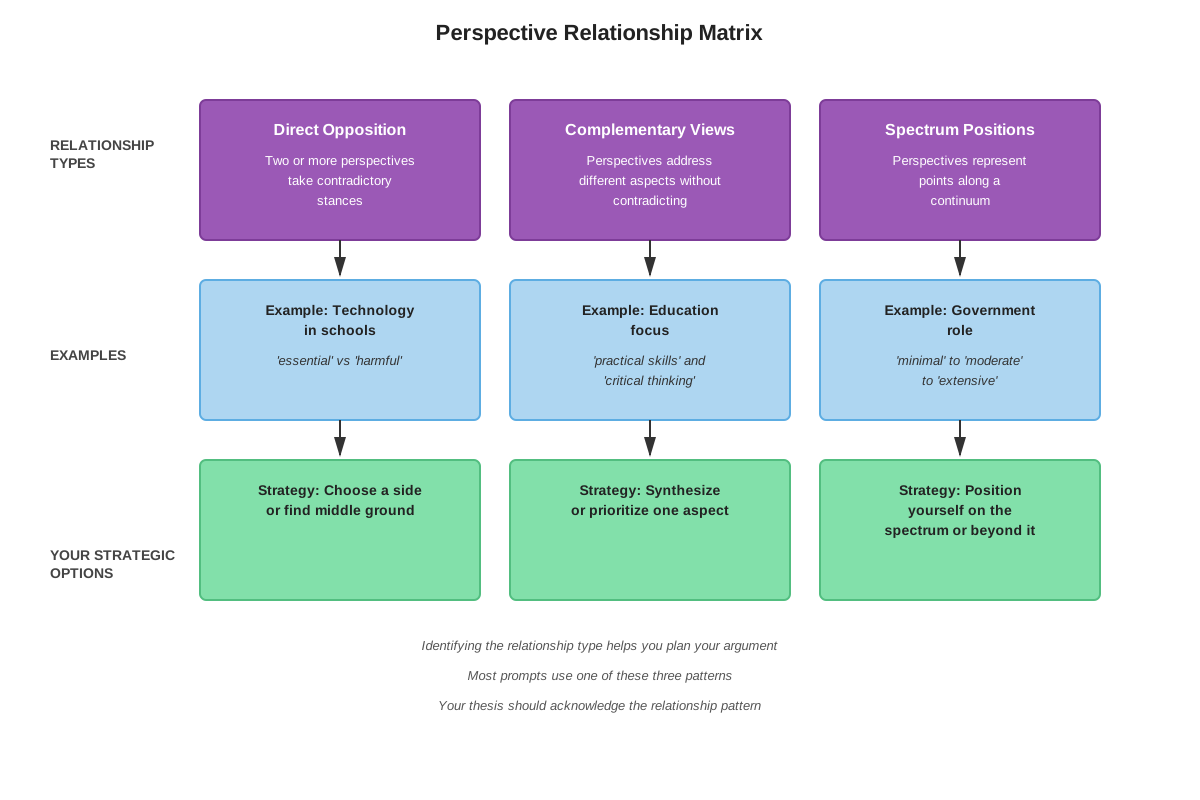
The three perspectives typically fall into several common patterns. Sometimes they represent a spectrum from one extreme position to the opposite extreme, with a moderate or compromise position in the middle. Other times, they address different aspects or dimensions of the issue rather than directly opposing each other. Occasionally, two perspectives might align against a third. Recognizing these patterns helps students understand the intellectual landscape of the issue.
Students should annotate each perspective by summarizing it in their own words, identifying its key assumption, and noting whether it takes a positive, negative, or neutral stance on the issue. For example, if Perspective One argues that "technology in classrooms distracts students from deep learning," the key assumption is that technology and deep learning are incompatible, and the stance is negative toward classroom technology. This level of analysis enables students to engage meaningfully with the perspectives in their essays rather than simply restating them.
Decoding the Essay Task Requirements
The essay task section contains specific instructions that define what a successful essay must accomplish. Students must identify and address every requirement to achieve high scores. The ACT essay task consistently includes three core requirements, though the exact wording may vary slightly from prompt to prompt.
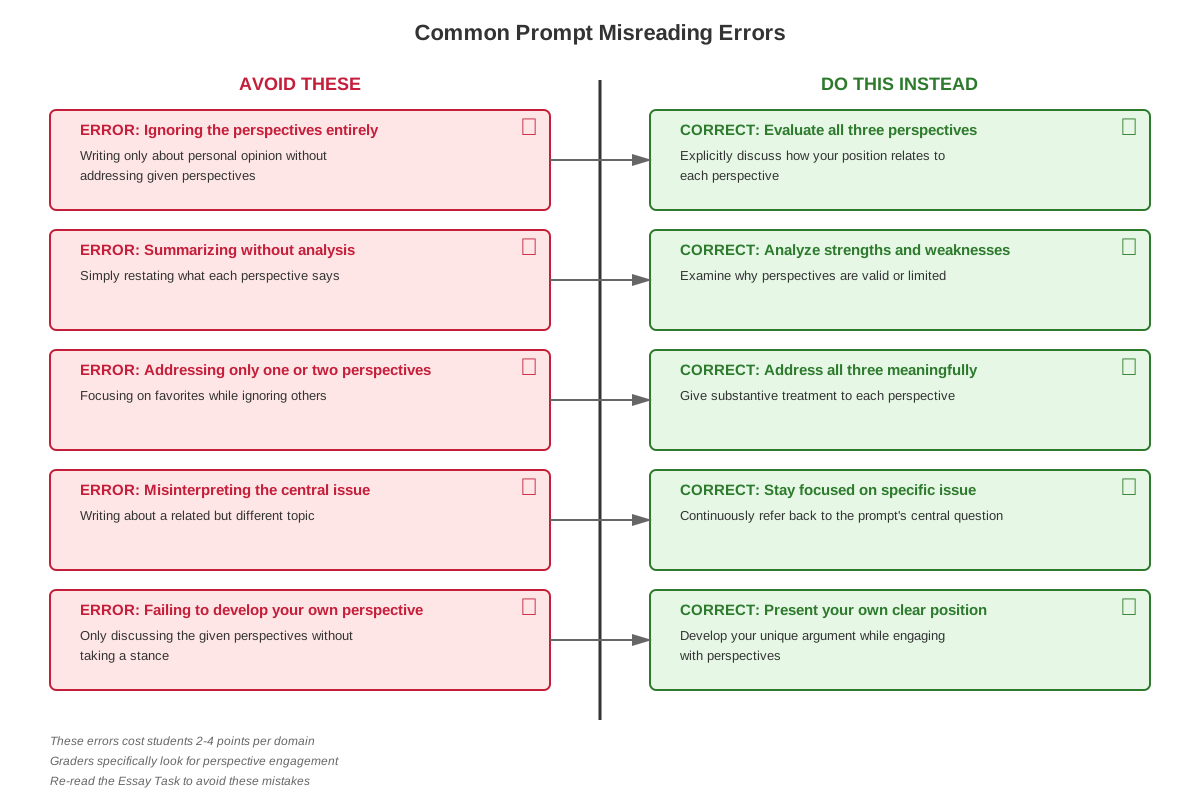
Requirement 1: Analyze and evaluate the perspectives given. This means students must demonstrate understanding of what each perspective argues and must make judgments about the strengths, weaknesses, implications, or limitations of at least some of the perspectives. Simply summarizing the perspectives without evaluation does not fulfill this requirement.
Requirement 2: State and develop your own perspective on the issue. Students must take a clear position and support it with reasoning and examples. The position can align with one of the given perspectives, synthesize elements from multiple perspectives, or present an entirely different viewpoint. The key is that students must develop their own argument, not merely choose a side without elaboration.
Requirement 3: Explain the relationship between your perspective and at least one of the given perspectives. This is the requirement students most frequently overlook. The essay must explicitly discuss how the student's position relates to, differs from, builds upon, or challenges at least one of the provided perspectives. This requirement ensures that students engage with the prompt's framework rather than writing a generic essay on the topic.
Recognizing Prompt Variations and Nuances
While ACT essay prompts follow a consistent structure, the issues they address vary widely, and students must adapt their analysis to each prompt's specific characteristics. Some prompts present issues with clear pro/con positions, while others address questions of priority, value, or approach. Understanding these variations helps students respond appropriately.
Value-based prompts ask students to consider competing priorities or principles. For example, a prompt might address whether schools should prioritize individual achievement or collaborative learning, or whether society should value innovation or tradition. These prompts require students to discuss trade-offs and to consider what principles should guide decision-making.
Policy-based prompts focus on whether a particular action or policy should be implemented. These prompts often include perspectives that address practical considerations, ethical concerns, and potential consequences. Students responding to policy prompts should consider feasibility, effectiveness, and implications.
Conceptual prompts explore ideas, definitions, or ways of thinking about an issue. For instance, a prompt might ask students to consider what constitutes success, how we should define education, or what role technology should play in human relationships. These prompts require more abstract thinking and often benefit from concrete examples to illustrate abstract ideas.
The Relationship Between Prompt Understanding and Essay Planning
Thorough prompt analysis directly enables effective essay planning. Once students understand the issue, perspectives, and task requirements, they can make strategic decisions about thesis formulation, organizational structure, and evidence selection. The prompt itself provides the framework for the essay's organization—students who understand this framework can write more coherent, focused essays.
The most effective approach is to use the prompt's structure as a guide. After analyzing the prompt, students should formulate a thesis that directly addresses the issue and indicates their position. They should then plan body paragraphs that evaluate at least some of the given perspectives, develop their own perspective with reasoning and examples, and explicitly connect their ideas to the provided perspectives. This approach ensures that the essay addresses all task requirements and maintains focus throughout.
Concept Relationships
The concepts within prompt understanding form a sequential and hierarchical relationship. Identifying the central issue is the foundation upon which all other analysis rests—students cannot effectively analyze perspectives or understand task requirements without first grasping what question or debate is at stake. This leads directly to analyzing the three perspectives, which requires understanding how each perspective addresses the central issue. The perspectives cannot be properly evaluated in isolation from the issue they address.
Decoding the essay task requirements depends on understanding both the issue and the perspectives, as the task always asks students to engage with these elements in specific ways. The task requirements then guide essay planning, which translates prompt understanding into a concrete writing strategy. Finally, recognizing prompt variations is an advanced skill that builds on all other concepts, enabling students to adapt their analytical approach to different types of issues and questions.
This topic connects to prerequisite knowledge of argumentative writing structure because understanding what the prompt asks enables students to construct an appropriate thesis and organizational framework. It leads directly to subsequent topics in ACT essay writing, including thesis development, paragraph organization, evidence selection, and perspective integration. Without mastering prompt understanding, students cannot effectively execute any of these downstream skills.
The relationship can be visualized as: Issue Identification → Perspective Analysis → Task Requirement Decoding → Essay Planning → Effective Writing. Each step depends on the previous one, and weakness at any stage compromises the entire essay.
Quick check — test yourself on Understanding the writing prompt so far.
Try Flashcards →High-Yield Facts
⭐ Every ACT essay prompt contains exactly three perspectives that students must engage with in their essay.
⭐ The essay task always requires students to explain the relationship between their perspective and at least one given perspective—this is the most commonly overlooked requirement.
⭐ The central issue is always debatable, meaning reasonable people could disagree about it; if there's no debate, you've misidentified the issue.
⭐ Students' own perspectives can agree with, partially agree with, or completely differ from the given perspectives—all approaches are acceptable if well-developed.
⭐ The three perspectives may not represent opposing viewpoints; sometimes they address different dimensions of the issue or two may align against the third.
- The issue statement appears in the opening paragraph of the prompt and provides context for the debate.
- Each perspective is typically 1-2 sentences and presents a clear position or approach to the issue.
- Analyzing perspectives means identifying their main claims, underlying assumptions, and implications—not just restating them.
- The essay task section explicitly lists what students must do; reading it carefully prevents missing required elements.
- Prompt understanding should take 3-4 minutes of the 40-minute time limit—rushing this step leads to off-topic essays.
- Annotating the prompt (underlining key phrases, circling the main issue, numbering requirements) improves comprehension and focus.
- The ACT Writing rubric specifically evaluates whether essays engage with multiple perspectives and address the prompt's complexity.
Common Misconceptions
Misconception: The three perspectives always represent opposing viewpoints (pro, con, and neutral).
Correction: The perspectives often address different aspects or dimensions of the issue rather than directly opposing each other. Sometimes two perspectives align while differing from the third, or all three might agree on some points while emphasizing different priorities or approaches. Students must analyze what each perspective actually argues rather than assuming they represent a simple spectrum.
Misconception: Students must choose one of the three given perspectives as their own position.
Correction: Students can develop their own unique perspective that differs from all three provided perspectives, or they can synthesize elements from multiple perspectives. The requirement is to state and develop your own perspective and explain how it relates to at least one given perspective—not to adopt one of the given perspectives wholesale.
Misconception: Understanding the prompt means simply reading it once before starting to write.
Correction: Effective prompt understanding requires active analysis: identifying the central issue, annotating each perspective to understand its claims and assumptions, noting all task requirements, and planning how to address each element. This process should take 3-4 minutes and involve marking up the prompt with underlining, circling, and brief notes.
Misconception: The essay can ignore one or two of the perspectives as long as it addresses at least one.
Correction: While the task requires explicitly relating your perspective to at least one given perspective, high-scoring essays typically engage with multiple perspectives to demonstrate sophisticated analysis. Essays that ignore most of the perspectives often score lower in the Ideas and Analysis domain because they fail to explore the issue's complexity.
Misconception: The prompt's issue is just the general topic mentioned (like "technology" or "education").
Correction: The issue is the specific question or debate about that topic. For example, the topic might be technology, but the issue is "whether increased reliance on technology improves or diminishes critical thinking skills." Students must identify the specific question or tension being debated, not just the general subject area.
Worked Examples
Example 1: Analyzing a Technology in Education Prompt
Prompt: As technology becomes increasingly integrated into educational settings, educators and policymakers debate its impact on learning. Some argue that technology enhances education by providing access to vast information and enabling personalized learning. Others worry that technology distracts students and reduces face-to-face interaction essential for social development. Still others suggest that the impact of technology depends entirely on how it is implemented and used.
Perspective One: Technology in classrooms provides unprecedented access to information and learning tools, democratizing education and enabling students to learn at their own pace.
Perspective Two: Increased screen time and digital distractions undermine deep learning and critical thinking, while reducing the interpersonal skills students develop through traditional classroom interaction.
Perspective Three: Technology is neither inherently beneficial nor harmful; its educational value depends on thoughtful implementation, teacher training, and balanced integration with traditional methods.
Essay Task: Write a unified, coherent essay in which you evaluate multiple perspectives on technology in education. In your essay, be sure to: analyze and evaluate the perspectives given, state and develop your own perspective on the issue, explain the relationship between your perspective and at least one of the given perspectives.
Step-by-Step Analysis:
- Identify the central issue: The issue is not simply "technology in education" but specifically "whether and how technology impacts learning quality and student development." The debate centers on technology's effects—positive, negative, or dependent on implementation.
- Analyze Perspective One: This perspective takes a positive stance, arguing that technology democratizes education and enables personalization. The underlying assumption is that access to information and self-paced learning are primary educational goods. The implication is that schools should embrace technology integration.
- Analyze Perspective Two: This perspective takes a negative stance, arguing that technology harms deep learning and social development. The underlying assumption is that traditional methods better support critical thinking and interpersonal skills. The implication is that schools should limit technology use.
- Analyze Perspective Three: This perspective takes a conditional or nuanced stance, arguing that technology's impact depends on implementation. The underlying assumption is that technology is a tool whose value depends on how it's used. The implication is that schools should focus on thoughtful integration rather than wholesale adoption or rejection.
- Identify the relationship between perspectives: Perspectives One and Two represent opposing views (positive vs. negative), while Perspective Three offers a middle ground that acknowledges both potential benefits and risks. This is a classic "spectrum" pattern.
- Note all task requirements: (1) Evaluate multiple perspectives—must discuss strengths/weaknesses of at least some perspectives; (2) State and develop own perspective—must take a clear position with reasoning; (3) Relate own perspective to at least one given perspective—must explicitly connect ideas.
- Formulate a preliminary thesis: "While technology offers valuable educational tools, its benefits depend on balanced implementation that preserves essential face-to-face learning experiences." This thesis aligns most closely with Perspective Three but can engage with all three perspectives.
Example 2: Analyzing a Community Service Requirement Prompt
Prompt: Many high schools are considering whether to require students to complete community service hours as a graduation requirement. Supporters believe mandatory service teaches civic responsibility and helps students develop empathy. Critics argue that forcing students to volunteer contradicts the spirit of voluntary service and may breed resentment. Others suggest that while service is valuable, schools should encourage rather than mandate it.
Perspective One: Requiring community service ensures all students gain valuable experience helping others and develops a sense of civic duty that voluntary programs cannot guarantee.
Perspective Two: Mandatory service is a contradiction in terms; true service must be voluntary, and forcing students to participate undermines the authentic generosity and personal growth that voluntary service fosters.
Perspective Three: Schools should strongly encourage and facilitate service opportunities without making them mandatory, allowing students to discover the value of service through positive experiences rather than obligation.
Step-by-Step Analysis:
- Identify the central issue: The issue is "whether high schools should require community service for graduation." This is a policy question that involves competing values: civic education vs. voluntary choice, guaranteed participation vs. authentic motivation.
- Analyze Perspective One: This perspective supports mandatory service, arguing that requirements ensure universal participation and civic development. The underlying assumption is that the benefits of service justify compulsion and that students won't participate without requirements. The value prioritized is civic education and guaranteed outcomes.
- Analyze Perspective Two: This perspective opposes mandatory service, arguing that compulsion contradicts the nature of service and undermines its benefits. The underlying assumption is that authentic motivation is essential for service to be meaningful and that forced participation breeds resentment rather than civic virtue. The value prioritized is voluntary choice and authentic motivation.
- Analyze Perspective Three: This perspective takes a middle position, supporting encouragement without mandates. The underlying assumption is that students will choose to serve if given positive opportunities and that encouragement can achieve the benefits of service without the drawbacks of compulsion. The value prioritized is balancing civic education with student autonomy.
- Identify the relationship between perspectives: Perspectives One and Two directly oppose each other (mandate vs. no mandate), while Perspective Three offers a compromise position (encourage but don't mandate). This is another spectrum pattern, but with the middle position representing a distinct approach rather than a simple compromise.
- Note all task requirements: Same three requirements as Example 1—evaluate perspectives, develop own perspective, relate to given perspectives.
- Formulate a preliminary thesis: "High schools should require community service because the civic and personal benefits outweigh concerns about compulsion, though schools must design programs that help students find meaningful service opportunities." This thesis aligns with Perspective One but acknowledges concerns raised by Perspective Two.
Exam Strategy
When approaching ACT essay prompts, students should follow a systematic process that ensures thorough understanding before writing begins. Immediately upon receiving the prompt, read it twice: once for general comprehension and once for detailed analysis. During the second reading, actively annotate the prompt by underlining the central issue, numbering the three perspectives, and circling key words in the task requirements.
Trigger phrases that indicate the central issue include: "debate," "question," "consider whether," "some argue," "others believe," and "disagreement about." These phrases signal that a debatable question follows. When analyzing perspectives, watch for words that indicate stance: "should," "must," "never," "always," "benefits," "harms," "depends on," and "requires." These words reveal whether a perspective takes a positive, negative, or conditional position.
For process of elimination in prompt analysis, students can verify their understanding by asking: "Can I state the issue as a question?" "Can I summarize each perspective in one sentence?" "Can I list all the task requirements?" If the answer to any question is no, the prompt requires further analysis before writing begins. Students should also check whether their preliminary thesis actually addresses the issue identified—if the thesis seems off-topic, the issue was likely misidentified.
Time allocation for prompt understanding should be approximately 3-4 minutes of the 40-minute time limit. This breaks down as: 1 minute for initial reading, 2 minutes for detailed analysis and annotation, and 1 minute for preliminary thesis formulation. Students who spend less than 3 minutes on prompt analysis often write off-topic essays, while those who spend more than 5 minutes may not leave sufficient time for writing and revision.
Exam Tip: If a perspective seems confusing or unclear, rephrase it in your own words and identify what value or principle it prioritizes. Every perspective has an underlying assumption or value—identifying it clarifies what the perspective actually argues.
The most effective strategy is to create a brief "prompt analysis checklist" on scratch paper: (1) Issue = [state as question], (2) P1 = [one-sentence summary], (3) P2 = [one-sentence summary], (4) P3 = [one-sentence summary], (5) Task requirements = [list all], (6) My thesis = [preliminary statement]. This checklist ensures all elements are understood before writing begins and serves as a reference throughout the essay-writing process.
Memory Techniques
The "I-P-T" Mnemonic: Remember that every ACT essay prompt has three components: Issue, Perspectives, and Task. Visualize these as three pillars supporting your essay—if any pillar is weak, the essay collapses.
The "3-3-3" Rule: Every prompt has 3 perspectives, requires 3 core actions (evaluate perspectives, state your perspective, relate perspectives), and should take approximately 3 minutes to analyze thoroughly. This triple-three pattern helps students remember the prompt's structure.
The "STAR" Method for Perspective Analysis: For each perspective, identify its Stance (positive, negative, or conditional), Thesis (main claim), Assumption (underlying belief), and Result (implication if adopted). This acronym ensures thorough analysis of each perspective.
Visualization Strategy: Picture the three perspectives as three people sitting at a table discussing the issue. Imagine what each person is arguing, what they value, and how they might respond to each other. This personification makes abstract perspectives more concrete and memorable.
The "Question Test": To verify you've identified the issue correctly, turn it into a question starting with "Should," "Does," or "How." If you can't form a clear question, you haven't identified the issue. For example: "Should schools require community service?" or "Does technology improve learning?"
Summary
Understanding the writing prompt is the foundational skill for ACT essay success, requiring students to systematically analyze the issue, perspectives, and task requirements before beginning to write. Every ACT essay prompt follows a consistent three-part structure: an issue statement that introduces a debatable question, three distinct perspectives that represent different positions or approaches to that issue, and an essay task that specifies what students must accomplish. Effective prompt analysis involves identifying the central issue as a specific question or debate (not just a general topic), analyzing each perspective to understand its claims, assumptions, and implications, and carefully noting all task requirements—particularly the requirement to relate one's own perspective to at least one given perspective. The three perspectives may represent opposing viewpoints, address different dimensions of the issue, or include two aligned perspectives against a third. Students must spend 3-4 minutes actively annotating and analyzing the prompt, as this investment prevents off-topic essays and enables strategic planning. Mastering prompt understanding directly enables all subsequent essay-writing skills, from thesis formulation to organizational structure to perspective integration, and is essential for achieving high scores across all four ACT Writing rubric domains.
Key Takeaways
- Every ACT essay prompt contains three components: an issue statement, three perspectives, and an essay task with specific requirements that must all be addressed.
- The central issue is always a debatable question or tension, not just a general topic—students must identify the specific question being debated.
- The three perspectives may not represent simple pro/con positions; they often address different dimensions of the issue or include aligned perspectives.
- The essay task always requires three actions: evaluate perspectives, develop your own perspective, and relate your perspective to at least one given perspective—the third requirement is most commonly overlooked.
- Effective prompt analysis takes 3-4 minutes and involves active annotation: underlining the issue, summarizing perspectives, and listing task requirements.
- Students' own perspectives can agree with, partially agree with, or differ from all given perspectives—any approach works if well-developed and clearly related to the prompt.
- Thorough prompt understanding prevents off-topic essays and enables strategic planning, directly improving scores across all ACT Writing rubric domains.
Related Topics
Thesis Development for ACT Essays: After understanding the prompt, students must formulate a clear, arguable thesis that directly addresses the issue and indicates their position. This topic builds directly on prompt understanding by translating analysis into a focused claim.
Integrating Perspectives into Body Paragraphs: Students must learn how to discuss the given perspectives within their essays, evaluating their strengths and weaknesses while relating them to their own position. This skill depends entirely on accurate perspective analysis.
Essay Organization and Structure: Understanding the prompt enables students to plan an organizational structure that addresses all task requirements systematically. This topic shows how prompt analysis translates into paragraph planning.
Evidence Selection and Development: Once students understand what the prompt asks, they must choose relevant examples and reasoning to support their position. This topic addresses how to develop ideas that directly respond to the prompt's issue.
Time Management for the ACT Essay: Mastering prompt analysis is one component of effective time management, which also includes planning, drafting, and revising within the 40-minute limit.
Practice CTA
Now that you understand how to analyze ACT essay prompts systematically, it's time to apply these skills to real practice prompts. Complete the practice questions to test your ability to identify issues, analyze perspectives, and decode task requirements. Use the flashcards to reinforce key concepts and terminology. Remember: every minute spent mastering prompt analysis saves multiple minutes during the actual essay-writing process and dramatically improves your essay's focus and relevance. The difference between a mediocre essay and a high-scoring essay often comes down to how well you understood what the prompt was actually asking—so practice this skill until it becomes automatic!
Sign up free to keep reading
Create a free AnvayaPrep account to finish this ACT guide on Understanding the writing prompt — plus flashcards and practice questions.