Overview
Data Sufficiency questions represent one of the most distinctive and challenging question types on the GMAT, and understanding combined statements is absolutely critical to success on these problems. In Data Sufficiency, test-takers are presented with a question followed by two statements, and must determine whether the information provided is sufficient to answer the question. While some questions can be answered using just Statement (1) or just Statement (2) alone, many require analyzing both statements together—this is where GMAT combined statements come into play.
The concept of combined statements refers to the strategic approach of evaluating whether Statements (1) and (2), when considered together, provide sufficient information to answer the question, even when neither statement alone is sufficient. This represents one of the five possible answer choices in Data Sufficiency questions and typically accounts for a significant portion of correct answers. Mastering this skill requires not only understanding each statement individually but also recognizing how information from both statements can complement, overlap, or interact to create sufficiency.
Within the broader Data Insights section, combined statements analysis sits at the intersection of logical reasoning, mathematical problem-solving, and strategic test-taking. It builds upon fundamental Data Sufficiency skills while requiring a more sophisticated understanding of how multiple pieces of information interact. Success with combined statements directly impacts performance on approximately 30-40% of all Data Sufficiency questions, making this topic one of the highest-yield areas for focused study and practice.
Learning Objectives
- [ ] Identify when combined statements are necessary to answer a Data Sufficiency question
- [ ] Explain the logical framework for evaluating combined statements systematically
- [ ] Apply combined statements analysis to GMAT questions efficiently and accurately
- [ ] Distinguish between situations where statements provide redundant versus complementary information
- [ ] Recognize common patterns where combined statements create sufficiency
- [ ] Evaluate combined statements without performing unnecessary calculations
- [ ] Avoid premature conclusions about statement sufficiency before considering both statements together
Prerequisites
- Basic Data Sufficiency format and answer choices: Understanding the five standard answer choices (A, B, C, D, E) is essential because combined statements correspond specifically to answer choice C
- Statement evaluation methodology: The ability to test individual statements for sufficiency provides the foundation for determining when combination is necessary
- Algebraic manipulation: Many combined statements questions involve setting up and solving systems of equations or inequalities
- Number properties: Understanding integers, positives/negatives, and even/odd properties helps evaluate whether combined information creates unique solutions
- Logical reasoning: The ability to track what is known versus unknown is crucial when synthesizing information from multiple sources
Why This Topic Matters
Combined statements analysis represents a critical skill that separates high-scoring GMAT test-takers from average performers. In real-world business and analytical contexts, professionals regularly must synthesize information from multiple sources to make decisions—exactly what combined statements questions assess. The ability to determine whether disparate pieces of information collectively provide sufficiency mirrors the analytical thinking required in consulting, finance, and strategic management roles.
On the GMAT specifically, combined statements questions appear with high frequency. Approximately 30-35% of Data Sufficiency questions have answer choice C as the correct answer, meaning both statements together are sufficient but neither alone is sufficient. Additionally, answer choice E (both statements together are still insufficient) accounts for another 15-20% of questions, requiring test-takers to evaluate combined statements even when they ultimately prove insufficient. This means that roughly half of all Data Sufficiency questions require careful analysis of combined statements.
These questions typically appear in several common formats: systems of linear equations, questions involving multiple constraints on variables, geometry problems requiring multiple measurements, word problems with information split across statements, and questions about sets or statistics where each statement provides partial information. The GMAT deliberately constructs these questions to test whether students can efficiently determine when combination is necessary without wasting time on excessive calculation.
Core Concepts
The Combined Statements Framework
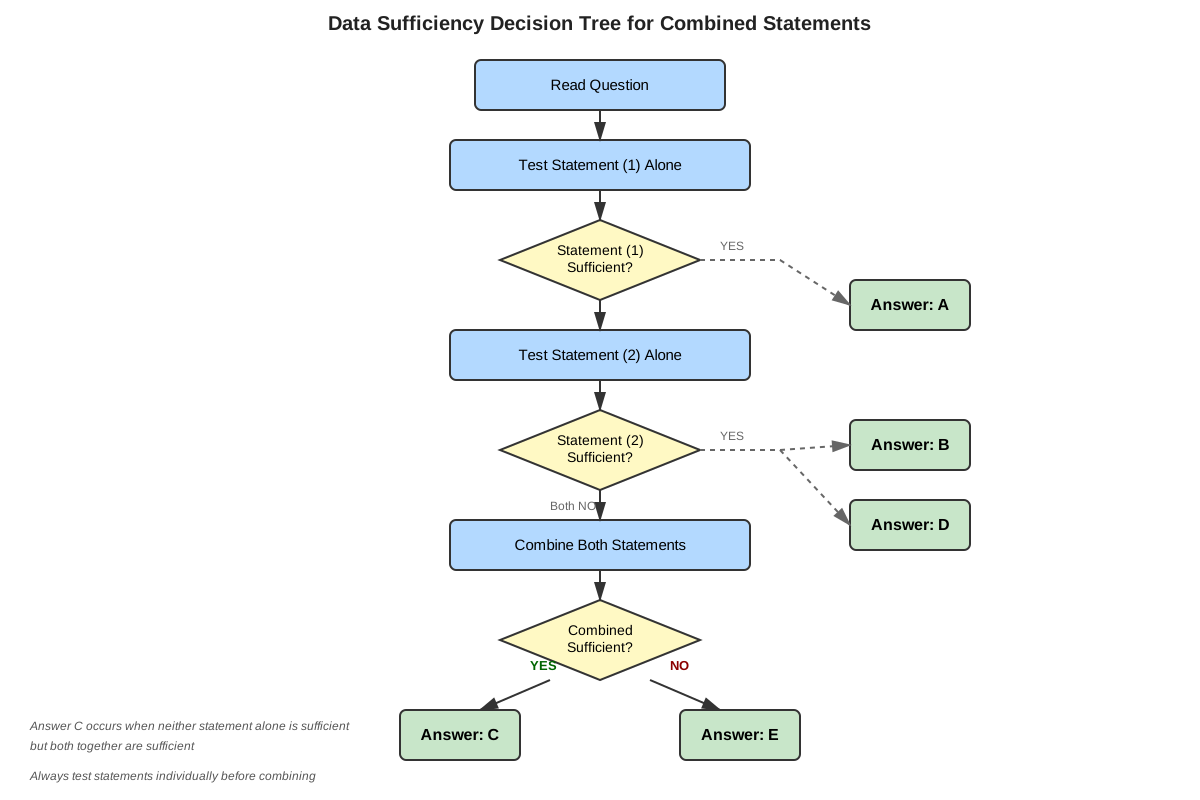
When approaching Data Sufficiency questions, test-takers must follow a systematic evaluation process. After understanding the question stem and identifying what information would be sufficient to answer it, the analysis proceeds through distinct stages. First, evaluate Statement (1) alone, completely ignoring Statement (2). If Statement (1) is sufficient, the answer must be either A or D. If Statement (1) is insufficient, the answer must be B, C, or E.
Next, evaluate Statement (2) alone, completely ignoring Statement (1). If Statement (2) is sufficient, the answer is either B (if Statement 1 was insufficient) or D (if Statement 1 was also sufficient). If Statement (2) is insufficient, the answer must be either C or E—this is where combined statements analysis becomes essential.
When both statements individually prove insufficient, test-takers must determine whether combining the information from both statements creates sufficiency. This is the critical juncture where many students make errors, either by failing to recognize how statements complement each other or by assuming combination will work when it actually doesn't.
Types of Information Combination
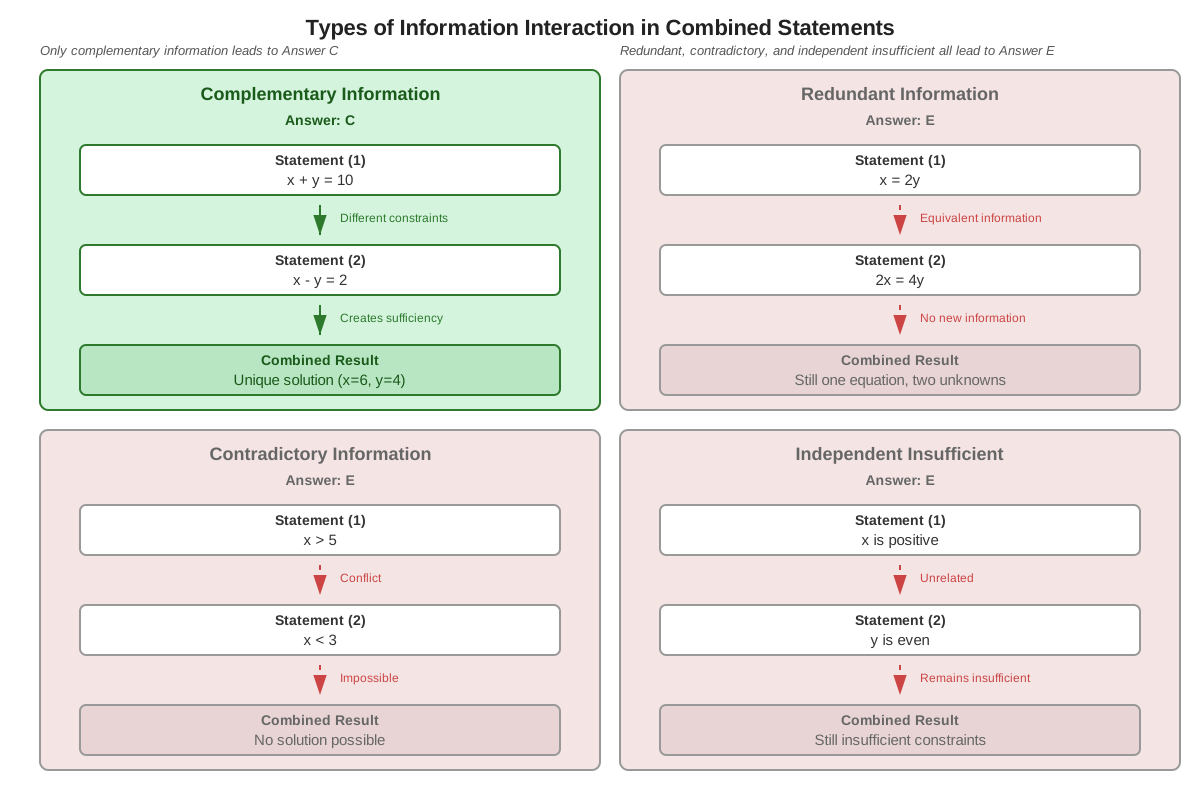
Complementary information occurs when each statement provides different pieces of information that together complete the picture. For example, if the question asks for the value of x + y, Statement (1) might provide x = 3, and Statement (2) might provide y = 5. Neither alone answers the question, but together they clearly do. This represents the most straightforward type of combined statements scenario.
Constraint-based combination involves situations where each statement provides a constraint or boundary condition, and together these constraints narrow possibilities to a unique answer. For instance, if Statement (1) tells us that x > 5 and Statement (2) tells us that x < 7, and the question asks whether x = 6 (where x must be an integer), the combined statements create sufficiency even though neither alone does.
System-solving combination appears frequently in algebraic contexts. When a question involves two variables, Statement (1) might provide one equation and Statement (2) might provide a second equation. Two distinct linear equations with two variables typically create a solvable system, making the combined statements sufficient. However, test-takers must verify that the equations are truly independent (not multiples of each other) and that they don't create contradictions.
Recognizing When Combination Is Necessary
Several patterns signal that combined statements analysis will likely be required. Questions asking for specific numerical values of variables when multiple unknowns exist almost always require either multiple equations or multiple constraints. Questions using phrases like "What is the value of x?" when x appears in complex relationships with other variables frequently need combined information.
Geometry problems asking for specific measurements when multiple dimensions are involved typically require combined statements. For example, finding the area of a rectangle requires both length and width; if Statement (1) provides length and Statement (2) provides width, combination is necessary.
Word problems that describe scenarios with multiple unknown quantities often split the information needed across both statements. A question about the ages of three people might provide information about two age relationships in Statement (1) and a third relationship in Statement (2), requiring combination to determine specific ages.
The Sufficiency Test for Combined Statements
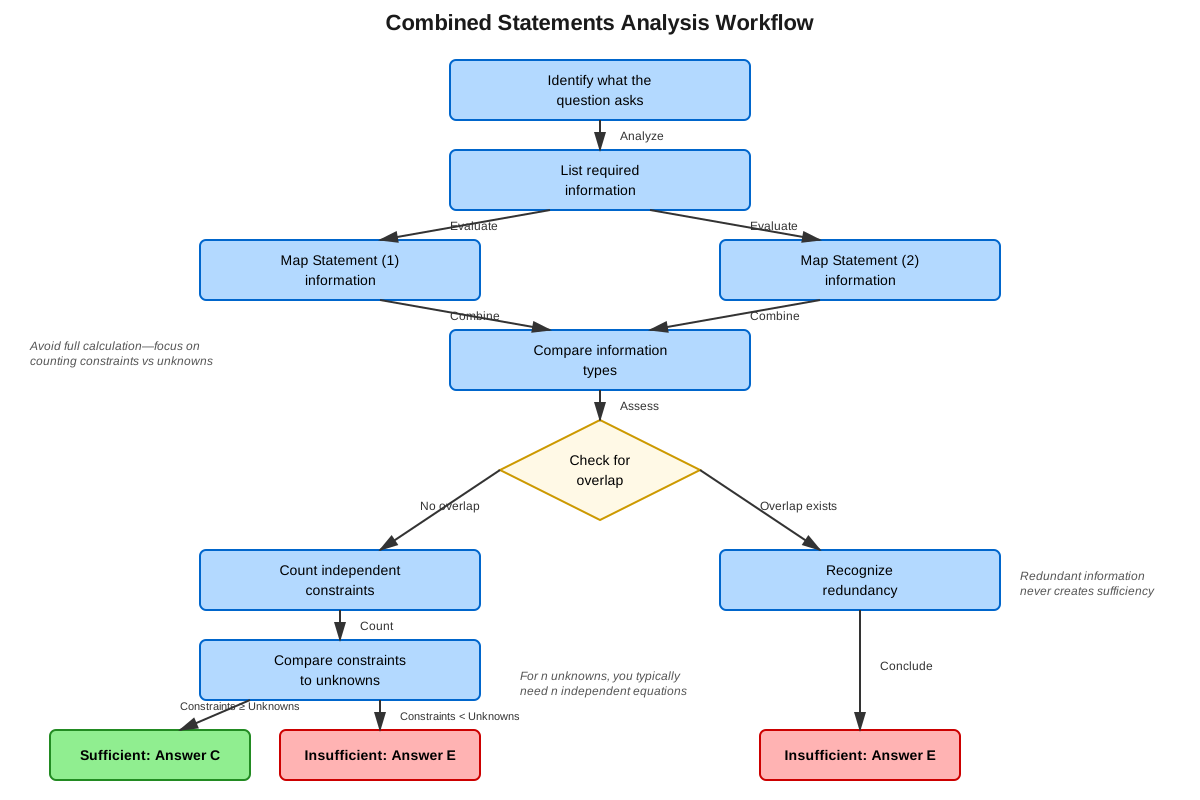
When evaluating combined statements, the key question is: "Using all information from both statements together, can I definitively answer the question?" This doesn't mean actually calculating the answer—it means determining whether enough information exists to theoretically find a unique answer.
For "What is the value of..." questions, combined statements are sufficient if they allow determination of exactly one value. For "Yes/No" questions, combined statements are sufficient if they allow a definitive "always yes" or "always no" answer (not "sometimes yes, sometimes no").
A critical distinction exists between having enough information to calculate an answer and actually performing that calculation. On the GMAT, test-takers should avoid unnecessary computation. If two independent linear equations with two variables exist, that's sufficient—no need to solve the system. If geometric constraints clearly determine a unique configuration, that's sufficient—no need to calculate exact measurements.
Common Combined Statements Scenarios
| Scenario Type | Statement (1) Provides | Statement (2) Provides | Combined Result |
|---|---|---|---|
| Two-variable system | Equation 1: x + y = 10 | Equation 2: x - y = 2 | Sufficient: unique solution exists |
| Geometric measurements | Length of rectangle = 5 | Width of rectangle = 3 | Sufficient: area = 15 |
| Constrained range | x > 10 | x < 12 (x is integer) | Sufficient: x = 11 |
| Partial set information | 60% are type A | 25% are type B | May be sufficient depending on question |
| Ratio and actual value | Ratio of x to y is 2:3 | x + y = 25 | Sufficient: can solve for both |
When Combined Statements Remain Insufficient
Not all combinations of insufficient statements create sufficiency. Several patterns indicate that even combined statements will be insufficient, leading to answer choice E. When both statements provide the same type of information without adding new constraints, combination typically fails. For example, if Statement (1) says x > 5 and Statement (2) says x > 3, the second statement adds no new information.
When statements provide information about different variables that don't interact in a way that answers the question, combination may be insufficient. If the question asks for the value of x, but Statement (1) provides information only about y and Statement (2) provides information only about z, and no relationships connect these variables, the combined statements remain insufficient.
Redundant equations represent another common insufficiency pattern. If Statement (1) provides x + y = 10 and Statement (2) provides 2x + 2y = 20, these are the same equation (the second is just double the first), so they don't create a solvable system despite appearing to be two equations with two unknowns.
Concept Relationships
The combined statements concept builds directly upon fundamental Data Sufficiency methodology. Before students can effectively evaluate combined statements, they must master the skill of evaluating individual statements in isolation. This prerequisite skill → enables → combined statements analysis, which → leads to → complete Data Sufficiency mastery.
Within the combined statements topic itself, several concepts interconnect. The framework for systematic evaluation → guides → the process of determining when combination is necessary. Understanding types of information combination → informs → recognition of common patterns. The sufficiency test → validates → whether combination actually creates sufficiency or whether answer choice E is correct.
Combined statements analysis also connects to broader mathematical concepts. Systems of equations from algebra → directly apply to → many combined statements scenarios. Geometric principles → interact with → combined statements when multiple measurements determine shapes. Number properties → influence → whether combined constraints create unique solutions or allow multiple possibilities.
The relationship between combined statements and other Data Sufficiency concepts is bidirectional. Mastering individual statement evaluation → is prerequisite for → combined statements analysis, while combined statements practice → reinforces → overall Data Sufficiency skills. Understanding when statements are insufficient alone → naturally leads to → evaluating their combination, while recognizing combination patterns → improves → efficiency in the entire Data Sufficiency process.
High-Yield Facts
⭐ Answer choice C means both statements together are sufficient, but neither statement alone is sufficient—this is the definition of a combined statements scenario
⭐ Approximately 30-35% of Data Sufficiency questions have C as the correct answer, making combined statements one of the most frequent scenarios
⭐ Two distinct linear equations with two variables create a sufficient system (assuming they're not multiples of each other)
⭐ Always evaluate Statement (1) alone first, then Statement (2) alone, before considering them together—this systematic approach prevents errors
⭐ Combined statements can be sufficient even when they seem to provide "different types" of information—complementary information is powerful
- When both individual statements are insufficient, the answer must be either C or E—no other options are possible
- Redundant information (statements saying essentially the same thing) will not create sufficiency through combination
- For Yes/No questions, combined statements are sufficient only if they always give the same answer (always yes or always no)
- Geometric problems frequently require combined statements when multiple dimensions or measurements are involved
- The goal is determining sufficiency, not calculating the actual answer—avoid unnecessary computation
- If Statement (1) gives a ratio and Statement (2) gives an actual value, combination often creates sufficiency
- Combined statements that create contradictory information indicate an error in analysis—GMAT statements never contradict
- Word problems often deliberately split necessary information across both statements to test combination skills
Quick check — test yourself on Combined statements so far.
Try Flashcards →Common Misconceptions
Misconception: If both statements are insufficient alone, they must be sufficient together (answer is always C when both fail individually)
Correction: When both statements are insufficient individually, the answer could be either C (sufficient together) or E (insufficient even together). Test-takers must actually evaluate the combined information to determine which applies.
Misconception: Combined statements require performing all calculations to verify sufficiency
Correction: The GMAT tests whether students recognize sufficiency, not whether they can complete calculations. If two independent equations with two unknowns exist, that's sufficient—no need to solve. Recognizing sufficiency patterns saves crucial time.
Misconception: Statements that provide information about different variables cannot combine to create sufficiency
Correction: Statements about different variables can absolutely create sufficiency if those variables relate to each other in the question context. For example, if the question asks about x + y, one statement about x and another about y combine perfectly.
Misconception: More information always means sufficiency—if both statements together provide more data, the answer must be C
Correction: Quantity of information doesn't guarantee sufficiency; relevance and completeness matter. Two statements might provide extensive information that still doesn't answer the specific question asked, resulting in answer choice E.
Misconception: When evaluating combined statements, information from Statement (1) can be modified or reinterpreted based on Statement (2)
Correction: Each statement provides fixed information. When combining, test-takers add the information together but don't change what either statement says. Both statements are simultaneously true in the combined scenario.
Misconception: If statements seem to contradict each other, one must be wrong
Correction: GMAT statements never contradict—they're always simultaneously true. If statements appear contradictory, the test-taker has misinterpreted one or both. This signals the need to re-read and re-analyze more carefully.
Worked Examples
Example 1: System of Equations
Question: What is the value of x?
Statement (1): 2x + 3y = 16
Statement (2): x - y = 2
Analysis:
First, evaluate Statement (1) alone: 2x + 3y = 16. This is one equation with two unknowns. Without knowing y, we cannot determine a unique value for x. For instance, if y = 0, then x = 8; if y = 2, then x = 5. Multiple solutions exist. Statement (1) alone is insufficient.
Next, evaluate Statement (2) alone: x - y = 2. This can be rewritten as x = y + 2. Again, this is one equation with two unknowns. If y = 0, then x = 2; if y = 3, then x = 5. Multiple solutions exist. Statement (2) alone is insufficient.
Now evaluate both statements together: We have two distinct linear equations with two unknowns:
- 2x + 3y = 16
- x - y = 2
These equations are independent (neither is a multiple of the other). A system of two independent linear equations with two unknowns has exactly one solution. We could solve this system: From Statement (2), x = y + 2. Substituting into Statement (1): 2(y + 2) + 3y = 16, which gives 2y + 4 + 3y = 16, so 5y = 12, and y = 12/5. Then x = 12/5 + 2 = 22/5.
However, we don't need to complete this calculation on the actual GMAT. Recognizing that two independent equations with two unknowns create a solvable system is sufficient. The combined statements are sufficient.
Answer: C (Both statements together are sufficient, but neither alone is sufficient)
Connection to Learning Objectives: This example demonstrates identifying when combined statements are necessary (both fail individually), explaining the logical framework (system of equations), and applying the concept efficiently (recognizing sufficiency without full calculation).
Example 2: Geometric Measurements
Question: What is the area of rectangle ABCD?
Statement (1): The perimeter of rectangle ABCD is 24.
Statement (2): The length of rectangle ABCD is twice its width.
Analysis:
Evaluate Statement (1) alone: Perimeter = 24. For a rectangle, perimeter = 2(length + width). So 2(l + w) = 24, meaning l + w = 12. This gives us one equation with two unknowns. Many rectangles have perimeter 24: a 10×2 rectangle (area = 20), a 9×3 rectangle (area = 27), an 8×4 rectangle (area = 32), etc. We cannot determine a unique area. Statement (1) alone is insufficient.
Evaluate Statement (2) alone: Length = 2 × width, or l = 2w. This is one equation with two unknowns. A rectangle could be 2×1 (area = 2), 4×2 (area = 8), 10×5 (area = 50), etc. We cannot determine a unique area. Statement (2) alone is insufficient.
Evaluate both statements together: We now have two equations:
- l + w = 12 (from Statement 1)
- l = 2w (from Statement 2)
Substituting the second into the first: 2w + w = 12, so 3w = 12, giving w = 4. Then l = 2(4) = 8. The area = l × w = 8 × 4 = 32.
Again, on the actual exam, we would recognize that two independent equations with two unknowns create sufficiency without completing all calculations. The combined statements are sufficient.
Answer: C (Both statements together are sufficient, but neither alone is sufficient)
Connection to Learning Objectives: This example shows how combined statements provide complementary information (one gives a constraint on the sum, the other gives a ratio relationship) and demonstrates the pattern recognition skill that accelerates Data Sufficiency performance.
Exam Strategy
When approaching Data Sufficiency questions on the GMAT, implement a systematic process that prevents errors and maximizes efficiency. Begin by thoroughly understanding the question stem—identify exactly what information would constitute sufficiency. For "What is the value of x?" questions, sufficiency means determining exactly one value. For "Is x > 5?" questions, sufficiency means being able to answer definitively yes or always no.
Trigger phrases that often signal combined statements scenarios include: questions with multiple variables, questions asking for specific values when relationships are complex, geometry problems requiring multiple measurements, and word problems where information seems deliberately split. When you see phrases like "What is the value of x + y?" or "What is the area of triangle ABC?" or "How old is person C?", anticipate that combined statements may be necessary.
Follow the AD/BCE decision tree: After reading the question, evaluate Statement (1) alone. If sufficient, write "AD" (the answer is either A or D). If insufficient, write "BCE" (the answer is either B, C, or E). Then evaluate Statement (2) alone. If you wrote "AD" and Statement (2) is also sufficient, the answer is D. If you wrote "AD" and Statement (2) is insufficient, the answer is A. If you wrote "BCE" and Statement (2) is sufficient, the answer is B. If you wrote "BCE" and Statement (2) is insufficient, the answer is either C or E—now evaluate combined statements.
Process-of-elimination for combined statements: When you've determined that both individual statements are insufficient (narrowing to C or E), ask yourself: "Do these statements provide complementary information, or redundant information?" If complementary, C is likely. If redundant or unrelated, E is likely. Check whether combining creates the right number of independent equations for the number of unknowns. Verify that the combined information actually addresses what the question asks.
Time allocation: Spend approximately 2 minutes per Data Sufficiency question. Don't waste time on unnecessary calculations—recognize sufficiency patterns. If you've determined that two independent linear equations exist, that's sufficient; move on. If geometric constraints clearly determine a unique configuration, that's sufficient; don't calculate exact values unless absolutely necessary to verify sufficiency.
Common traps to avoid: Don't evaluate statements together before checking them individually—this leads to choosing C when A, B, or D is correct. Don't assume that more information automatically means sufficiency. Don't forget to actually test combined statements when both are individually insufficient—some students incorrectly choose E without properly evaluating the combination. Don't carry information from Statement (1) when evaluating Statement (2) alone—each must be tested in isolation first.
Memory Techniques
The "AD-BCE" mnemonic: Remember the decision tree as "AD-BCE" (pronounced "ad-buh-see"). After Statement (1), you're either in the "AD world" (sufficient) or the "BCE world" (insufficient). This simple framework prevents confusion about which answer choices remain possible.
The "C-E Combo Test" acronym: When both statements are insufficient individually, remember COMBO:
- Complementary information? → Likely C
- One equation per unknown? → Likely C
- Multiple constraints narrowing? → Likely C
- Both saying same thing? → Likely E
- Off-topic information? → Likely E
Visualization for systems of equations: Picture two lines on a graph. One line = Statement (1), another line = Statement (2). If the lines intersect at exactly one point, the combined statements are sufficient (answer C). If the lines are parallel (redundant equations), they never intersect—insufficient (answer E). If the lines are the same line (identical equations), insufficient (answer E).
The "Puzzle Pieces" metaphor: Think of combined statements as puzzle pieces. Statement (1) is one piece, Statement (2) is another. If the pieces fit together to complete the picture (answer the question), choose C. If pieces are missing even when both are used, choose E. This metaphor helps remember that combination requires complementary, not redundant, information.
The "2-2 Rule" for equations: Two independent equations + two unknowns = sufficient. Three unknowns need three equations. One unknown needs one equation. This simple rule covers the majority of algebraic combined statements scenarios.
Summary
Combined statements represent a critical concept within GMAT Data Sufficiency questions, requiring test-takers to evaluate whether two individually insufficient statements become sufficient when considered together. This scenario corresponds to answer choice C and appears in approximately 30-35% of Data Sufficiency questions, making it one of the highest-yield topics for focused study. The systematic approach involves first evaluating each statement independently, then—when both prove insufficient—determining whether their combination provides enough information to answer the question definitively. Success requires recognizing patterns such as complementary information, systems of equations, and constraint-based combinations, while avoiding the trap of assuming that more information automatically creates sufficiency. The key skill is determining whether sufficiency exists without performing unnecessary calculations, which requires understanding that two independent linear equations with two unknowns create a solvable system, that geometric constraints can determine unique configurations, and that complementary pieces of information can complete the picture needed to answer the question. Mastering combined statements analysis directly improves performance on roughly half of all Data Sufficiency questions and represents essential preparation for achieving a competitive GMAT score.
Key Takeaways
- Combined statements (answer choice C) means both statements together are sufficient, but neither alone is sufficient—this occurs in approximately 30-35% of Data Sufficiency questions
- Always evaluate statements individually first using the AD/BCE decision tree before considering them together—this systematic approach prevents errors and saves time
- Two independent linear equations with two unknowns create sufficiency through combination—recognize this pattern without solving the entire system
- Complementary information (each statement providing different necessary pieces) typically creates sufficiency, while redundant information (statements saying essentially the same thing) does not
- The goal is recognizing sufficiency, not calculating answers—avoid unnecessary computation by identifying sufficiency patterns
- When both statements are insufficient individually, the answer must be either C or E—carefully evaluate whether combination actually addresses what the question asks
- Combined statements questions frequently appear in contexts involving multiple variables, geometric measurements, word problems with split information, and constraint-based scenarios
Related Topics
Individual Statement Sufficiency: Before mastering combined statements, students must develop strong skills in evaluating single statements in isolation. This foundational topic covers the techniques for determining whether Statement (1) or Statement (2) alone provides enough information, which is prerequisite knowledge for combined statements analysis.
Answer Choice D Scenarios: Understanding when both statements are individually sufficient (answer choice D) helps students recognize the contrast with combined statements scenarios. This topic explores patterns where multiple paths to sufficiency exist.
Answer Choice E Recognition: Learning when even combined statements remain insufficient complements combined statements mastery. This topic covers redundant information, unrelated statements, and scenarios where insufficient information persists despite combination.
Systems of Equations in Data Sufficiency: A deeper dive into algebraic systems specifically within the Data Sufficiency context builds upon combined statements concepts. This advanced topic covers three-variable systems, non-linear systems, and complex constraint scenarios.
Yes/No Data Sufficiency Questions: While combined statements apply to both value questions and Yes/No questions, the sufficiency criteria differ. This related topic explores how combined statements work specifically in Yes/No contexts, where sufficiency means always getting the same answer.
Practice CTA
Now that you've mastered the concepts, patterns, and strategies for combined statements, it's time to put your knowledge into action. Attempt the practice questions designed specifically for this topic—they'll challenge you to apply the systematic evaluation process, recognize common patterns, and make efficient sufficiency determinations without unnecessary calculation. Use the flashcards to reinforce the high-yield facts and patterns you've learned, ensuring that combined statements analysis becomes second nature. Remember: combined statements questions represent approximately one-third of all Data Sufficiency problems, so every minute you invest in deliberate practice directly translates to points on test day. You've built the foundation—now strengthen it through application!
Sign up free to keep reading
Create a free AnvayaPrep account to finish this GMAT guide on Combined statements — plus flashcards and practice questions.