Overview
Systems of equations represent one of the most frequently tested algebraic concepts on the GMAT Quantitative Reasoning section. A system of equations consists of two or more equations that share common variables, and solving these systems requires finding values for the variables that simultaneously satisfy all equations in the system. On the GMAT, gmat systems of equations questions typically involve two equations with two unknowns, though occasionally three equations with three unknowns may appear in more challenging problems.
Mastery of systems of equations is essential for GMAT success because these problems appear in multiple question formats, including Problem Solving and Data Sufficiency questions. The GMAT tests not only computational ability but also conceptual understanding—particularly the ability to determine whether sufficient information exists to solve a system. This topic bridges fundamental algebraic manipulation skills with higher-order reasoning about relationships between variables, making it a cornerstone of the Quantitative section.
Within the broader Quantitative Reasoning framework, systems of equations connect directly to linear equations, algebraic manipulation, and word problems. Many GMAT questions embed systems of equations within real-world scenarios involving rates, mixtures, age problems, or work problems. Understanding how to translate verbal descriptions into mathematical systems and then solve them efficiently is a critical skill that distinguishes high scorers from average performers. Additionally, the logical reasoning required for Data Sufficiency questions involving systems of equations develops analytical thinking applicable across the entire exam.
Learning Objectives
- [ ] Identify systems of equations in various GMAT question formats
- [ ] Explain the conditions under which a system of equations has a unique solution, infinite solutions, or no solution
- [ ] Apply systems of equations to GMAT questions using multiple solution methods
- [ ] Determine sufficiency of information in Data Sufficiency questions involving systems of equations
- [ ] Translate word problems into systems of equations accurately
- [ ] Select the most efficient solution method based on the structure of the system
Prerequisites
- Linear equations with one variable: Understanding how to isolate variables and perform algebraic operations is fundamental to manipulating equations within a system
- Algebraic manipulation: Skills in combining like terms, distributing, and factoring enable the transformations necessary for solving systems
- Coordinate geometry basics: Recognizing that linear equations represent lines helps visualize when systems have solutions (intersection points)
- Fractions and decimals: Many systems involve fractional coefficients, requiring comfort with fraction arithmetic
Why This Topic Matters
Systems of equations appear in approximately 10-15% of GMAT Quantitative questions, making them one of the highest-yield algebra topics. These questions span both Problem Solving and Data Sufficiency formats, with Data Sufficiency questions being particularly common because they test conceptual understanding of when sufficient information exists to determine unique solutions.
In real-world applications, systems of equations model countless scenarios: business optimization problems, resource allocation, financial planning, and supply chain management. The analytical thinking developed through solving systems—breaking complex problems into component relationships and determining what information is necessary and sufficient—directly parallels the decision-making skills valued in business school and professional contexts.
On the GMAT, systems of equations commonly appear disguised as:
- Word problems involving two unknowns (ages, prices, quantities)
- Rate problems with multiple objects or people
- Mixture problems combining substances with different concentrations
- Work problems with multiple workers completing tasks
- Data Sufficiency questions asking whether given information determines unique values
The GMAT particularly favors questions that test whether students understand the relationship between the number of equations, number of variables, and the ability to solve for specific values—a conceptual understanding that goes beyond mechanical computation.
Core Concepts
Definition and Structure of Systems of Equations
A system of equations consists of two or more equations involving the same set of variables. The solution to a system is the set of values that satisfies all equations simultaneously. For GMAT purposes, most systems involve two linear equations with two unknowns, typically written in the form:
ax + by = c
dx + ey = f
Where a, b, c, d, e, and f are constants, and x and y are variables. The goal is to find the ordered pair (x, y) that makes both equations true.
Types of Solutions
Systems of equations can have three possible outcomes:
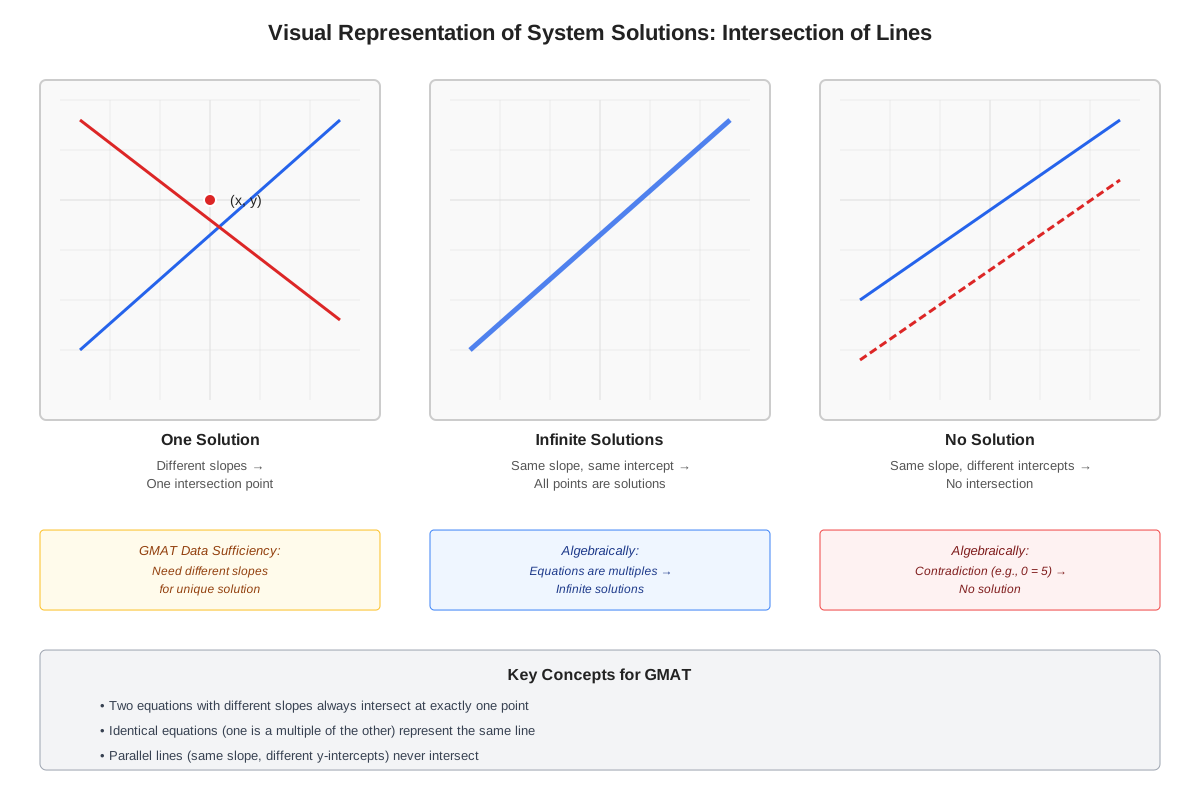
| Solution Type | Characteristics | Graphical Interpretation | Example |
|---|---|---|---|
| Unique solution | Exactly one ordered pair satisfies both equations | Two lines intersect at one point | x + y = 5 and x - y = 1 (solution: x=3, y=2) |
| Infinite solutions | Infinitely many ordered pairs satisfy both equations | Two lines are identical (same line) | 2x + 4y = 6 and x + 2y = 3 (same line) |
| No solution | No ordered pair satisfies both equations | Two lines are parallel (never intersect) | x + y = 5 and x + y = 3 (parallel lines) |
Understanding which type of solution exists is crucial for Data Sufficiency questions, where determining whether information is sufficient to find a unique solution is often the entire question.
The Substitution Method
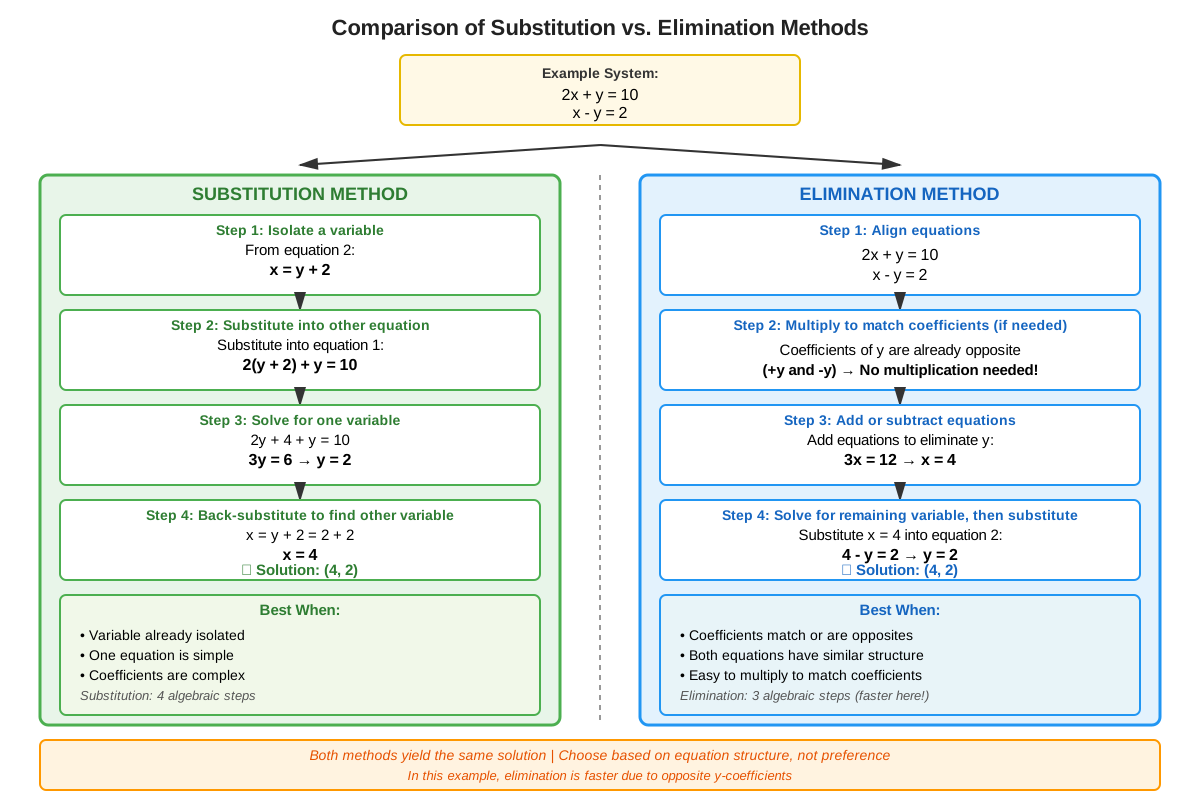
The substitution method involves solving one equation for one variable in terms of the other, then substituting this expression into the second equation. This method works particularly well when one equation is already solved for a variable or can be easily manipulated to isolate a variable.
Steps for substitution:
- Choose one equation and solve for one variable in terms of the other
- Substitute this expression into the other equation
- Solve the resulting single-variable equation
- Substitute the found value back into either original equation to find the other variable
- Verify the solution in both original equations
Example: Solve the system:
y = 2x + 1
3x + y = 11
Since the first equation already expresses y in terms of x, substitute into the second equation:
3x + (2x + 1) = 11
5x + 1 = 11
5x = 10
x = 2
Then substitute x = 2 back: y = 2(2) + 1 = 5. Solution: (2, 5)
The Elimination Method
The elimination method (also called the addition method) involves adding or subtracting equations to eliminate one variable. This method is particularly efficient when coefficients of one variable are already opposites or can be made opposites through multiplication.
Steps for elimination:
- Align equations with like terms in columns
- Multiply one or both equations by constants to make coefficients of one variable opposites
- Add the equations to eliminate that variable
- Solve the resulting single-variable equation
- Substitute back to find the other variable
Example: Solve the system:
2x + 3y = 13
4x - 3y = 5
The y-coefficients are already opposites (3 and -3), so add the equations directly:
(2x + 3y) + (4x - 3y) = 13 + 5
6x = 18
x = 3
Substitute x = 3 into the first equation: 2(3) + 3y = 13, so 6 + 3y = 13, giving y = 7/3. Solution: (3, 7/3)
Determining Sufficiency for Data Sufficiency Questions
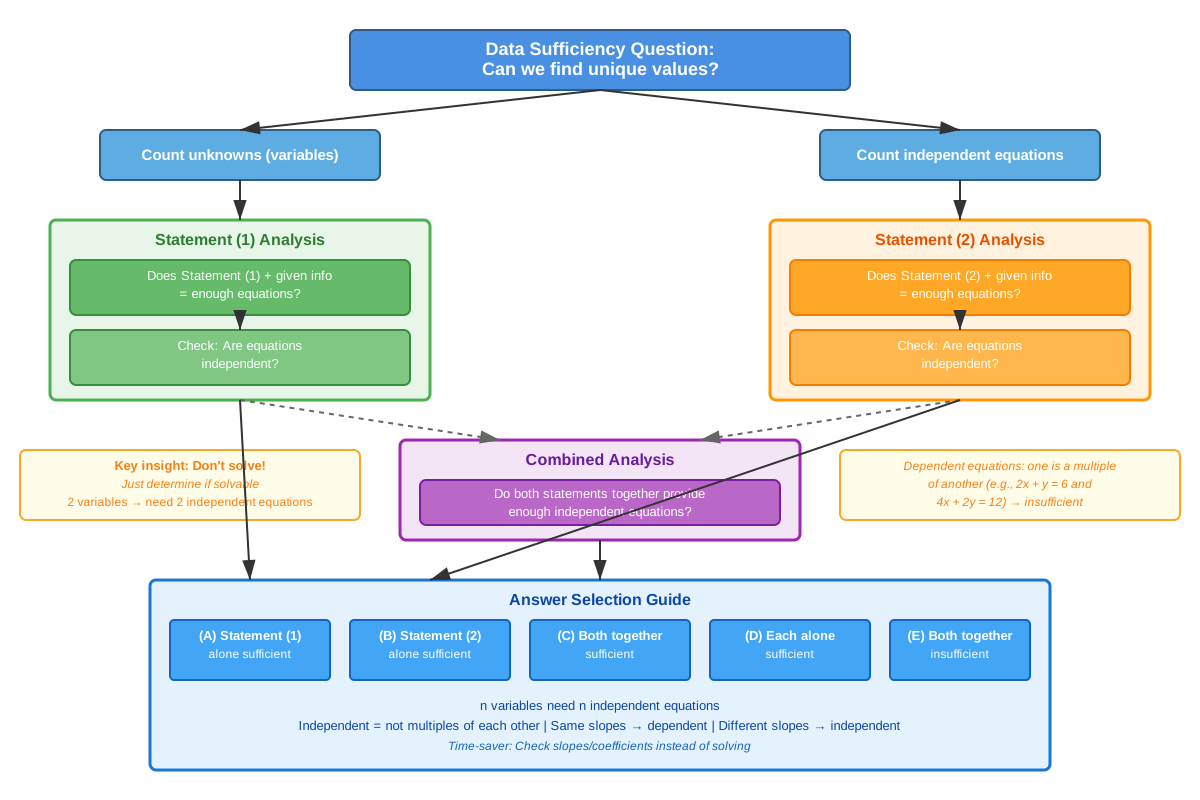
For Data Sufficiency questions involving systems of equations, the key principle is: To solve for n variables uniquely, you generally need n independent equations. Two equations are independent if one cannot be derived from the other through multiplication or addition of constants.
Critical considerations:
- Two equations with two unknowns typically provide sufficient information for a unique solution
- If equations are dependent (one is a multiple of the other), they represent the same line and provide insufficient information
- If you need to find only one variable (not both), sometimes one equation combined with a relationship between variables suffices
- Non-linear equations (quadratics, etc.) may yield multiple solutions even with two equations
Special Cases and Patterns
Dependent equations: When one equation is a multiple of another:
2x + 4y = 10
x + 2y = 5
These are the same line (multiply the second by 2 to get the first), providing infinite solutions.
Inconsistent equations: When equations represent parallel lines:
x + y = 5
x + y = 8
These can never both be true simultaneously, yielding no solution.
Systems requiring strategic manipulation: Sometimes GMAT questions ask for expressions rather than individual variables:
If 3x + 2y = 14 and x - y = 2, what is x + y?Rather than solving for x and y individually, you might add equations strategically or use substitution to find the desired expression directly.
Concept Relationships
The core concepts within systems of equations build upon each other hierarchically. Definition and structure forms the foundation → understanding types of solutions enables proper problem classification → solution methods (substitution and elimination) provide computational tools → sufficiency determination applies these tools to Data Sufficiency contexts → special cases refine understanding for edge scenarios.
Systems of equations connect backward to prerequisite topics: linear equations provide the building blocks for each equation in the system, while algebraic manipulation skills enable the transformations required by both solution methods. The concept also connects forward to more advanced topics: inequalities can form systems similar to equations, coordinate geometry represents systems graphically as intersecting lines, and word problems across various contexts (rates, mixtures, work) frequently require setting up systems of equations.
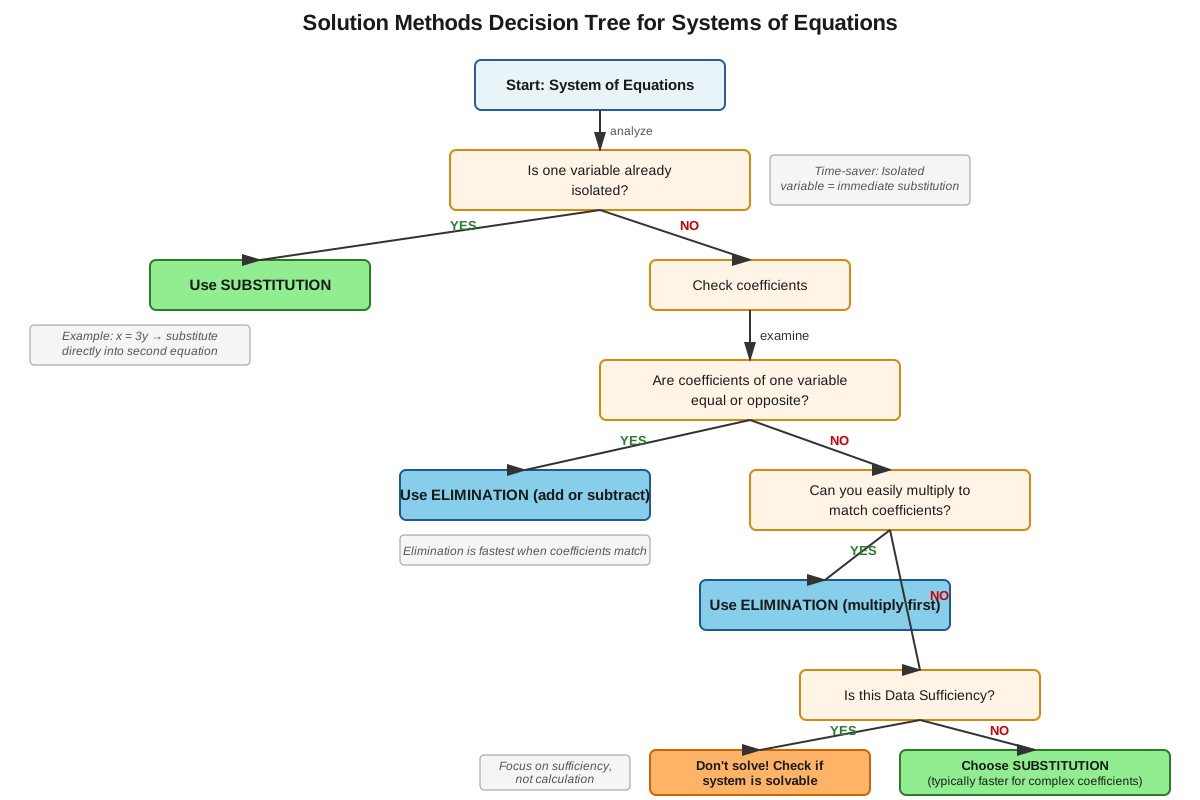
The relationship between solution methods is complementary rather than hierarchical: substitution works best when one variable is easily isolated, while elimination excels when coefficients align favorably. Recognizing which method suits a particular system improves efficiency—a critical consideration given GMAT time constraints.
High-Yield Facts
⭐ To solve for n variables uniquely, you generally need n independent linear equations
⭐ Two equations are independent if one cannot be obtained by multiplying the other by a constant
⭐ In Data Sufficiency, each statement alone providing one equation with two unknowns is typically insufficient; both together providing two independent equations is typically sufficient
⭐ When equations have the same ratio of coefficients but different constants, the system has no solution (parallel lines)
⭐ When equations have the same ratio of coefficients AND the same ratio for constants, the system has infinite solutions (identical lines)
- The substitution method is most efficient when one variable has a coefficient of 1 or -1
- The elimination method is most efficient when coefficients are already opposites or small multiples
- If asked to find an expression like x + y rather than individual values, look for ways to combine equations without fully solving
- Systems can be solved by graphing (finding intersection points), but this is rarely practical on the GMAT without a calculator
- Non-linear systems (involving x², xy, etc.) may have 0, 1, 2, or more solutions even with two equations
- When translating word problems, assign variables to the unknowns and write one equation for each distinct relationship described
Quick check — test yourself on Systems of equations so far.
Try Flashcards →Common Misconceptions
Misconception: Two equations with two unknowns always provide enough information to solve for both variables.
Correction: The equations must be independent. If one equation is a multiple of the other (dependent equations), they represent the same constraint and cannot determine unique values. For example, x + y = 5 and 2x + 2y = 10 are dependent and insufficient.
Misconception: In Data Sufficiency, if Statement 1 gives one equation and Statement 2 gives another equation, the answer is always C (both together sufficient).
Correction: The equations must be independent and the system must be consistent. If the statements provide dependent equations or contradictory equations, even both together may be insufficient or the question may be flawed.
Misconception: The substitution method and elimination method always yield the same answer, so it doesn't matter which you choose.
Correction: While both methods yield the same answer when applied correctly, one method is often significantly faster than the other depending on the system's structure. Choosing inefficiently can waste valuable time on the GMAT.
Misconception: If you can't solve for individual variables, you can't answer the question.
Correction: Many GMAT questions ask for expressions involving both variables (like x + y or 2x - y) that can be found without determining individual values. Strategic combination of equations often provides shortcuts.
Misconception: Systems of equations only appear as straightforward algebraic problems.
Correction: The GMAT frequently embeds systems within word problems about rates, ages, mixtures, or other contexts. Recognizing that a word problem requires a system of equations is itself a critical skill.
Misconception: When using elimination, you must always eliminate the same variable.
Correction: You can choose to eliminate whichever variable appears more convenient based on the coefficients. Sometimes eliminating x is easier; sometimes eliminating y is easier. Flexibility improves efficiency.
Worked Examples
Example 1: Problem Solving with Substitution
Question: If 3x - y = 11 and 2x + y = 14, what is the value of x?
Solution:
This system can be solved efficiently using elimination since the y-coefficients are opposites, but let's demonstrate substitution as well.
Method 1 (Elimination - faster for this problem):
Add the two equations to eliminate y:
(3x - y) + (2x + y) = 11 + 14
5x = 25
x = 5
Method 2 (Substitution - to demonstrate the technique):
From the first equation, solve for y:
3x - y = 11
-y = 11 - 3x
y = 3x - 11
Substitute into the second equation:
2x + (3x - 11) = 14
5x - 11 = 14
5x = 25
x = 5Answer: x = 5
Key insight: This problem demonstrates that while both methods work, elimination was more efficient because the y-coefficients were already opposites. Recognizing such patterns saves time on the GMAT.
Example 2: Data Sufficiency with Systems
Question: What is the value of x?
(1) 2x + 3y = 18
(2) 4x + 6y = 36
Solution:
This question tests understanding of dependent versus independent equations.
Analyzing Statement (1):
One equation with two unknowns. We cannot determine a unique value for x without knowing y. INSUFFICIENT
Analyzing Statement (2):
One equation with two unknowns. We cannot determine a unique value for x without knowing y. INSUFFICIENT
Analyzing Both Statements Together:
Notice that Statement (2) is exactly twice Statement (1):
2(2x + 3y) = 2(18)
4x + 6y = 36
These are dependent equations—they represent the same line. Having both statements is equivalent to having just one equation with two unknowns. We still cannot determine unique values for x and y. INSUFFICIENT
Answer: E (Statements 1 and 2 together are not sufficient)
Key insight: This problem illustrates a high-yield GMAT trap. Students who mechanically think "two equations, two unknowns = sufficient" will incorrectly choose C. The equations must be independent, which requires checking whether one is a multiple of the other.
Example 3: Word Problem Application
Question: At a fruit stand, apples cost $0.80 each and oranges cost $0.60 each. If Maria bought a total of 15 pieces of fruit for $10.80, how many apples did she buy?
Solution:
Step 1: Define variables
Let a = number of apples
Let o = number of oranges
Step 2: Write equations based on the problem
Total pieces of fruit: a + o = 15
Total cost: 0.80a + 0.60o = 10.80
Step 3: Solve the system
From the first equation: o = 15 - a
Substitute into the second equation:
0.80a + 0.60(15 - a) = 10.80
0.80a + 9 - 0.60a = 10.80
0.20a = 1.80
a = 9
Step 4: Verify
If a = 9, then o = 15 - 9 = 6
Cost check: 9(0.80) + 6(0.60) = 7.20 + 3.60 = 10.80 ✓
Answer: Maria bought 9 apples
Key insight: This problem demonstrates the complete process: translating a word problem into a system, choosing an efficient solution method (substitution was natural here), solving, and verifying. Word problems are among the most common contexts for systems of equations on the GMAT.
Exam Strategy
Approaching GMAT Systems of Equations Questions:
- Identify the question type first: Determine whether it's Problem Solving (find specific values) or Data Sufficiency (determine if information is sufficient). This fundamentally changes your approach.
- For Data Sufficiency, count equations and variables: Before doing any algebra, count how many independent equations you have and how many unknowns. This often allows you to eliminate answer choices immediately.
- Check for dependent equations: When combining statements in Data Sufficiency, always verify that equations are independent by checking if one is a multiple of the other.
- Choose your method strategically:
- Use elimination when coefficients are already opposites or small multiples
- Use substitution when one variable has a coefficient of 1 or is already isolated
- For word problems, substitution often flows naturally from the problem structure
- Look for shortcuts: If the question asks for an expression like x + y or 2x - 3y, see if you can find it without solving for individual variables by strategically adding or subtracting equations.
Trigger words and phrases:
- "How many of each..." → likely requires a system with variables for each type
- "Total" or "combined" → suggests one equation summing quantities
- "Each" or "per" → indicates rates or unit prices, often leading to a second equation
- "What is the value of x?" in Data Sufficiency → need enough independent equations to solve
Process of elimination tips:
- In Data Sufficiency, if Statement 1 gives one equation with two unknowns, eliminate A and D immediately
- If both statements together provide dependent equations, eliminate C
- If the question asks for one variable but you can only find a relationship between variables, the answer is typically insufficient
Time allocation:
- Simple systems (already set up algebraically): 1.5-2 minutes
- Word problems requiring system setup: 2-2.5 minutes
- Data Sufficiency with systems: 2 minutes (less computation, more analysis)
Exam Tip: On Data Sufficiency questions, resist the urge to fully solve the system. Once you determine that sufficient independent equations exist, you can select your answer without computing actual values. This saves significant time.
Memory Techniques
For remembering solution methods:
S.E.E. - Substitution when Easy to isolate; Elimination when coefficients align
For Data Sufficiency sufficiency:
"N equations for N unknowns" - To solve for n variables, you need n independent equations
For identifying dependent equations:
R.A.C.E. - Ratio of All Coefficients Equal means dependent equations
(If a/d = b/e = c/f, the equations are dependent or inconsistent)
For word problem setup:
V.E.S. - Variables first (define what you're looking for), Equations second (one per relationship), Solve third
Visualization strategy:
Picture systems of equations as two lines on a coordinate plane:
- Intersecting lines (different slopes) = unique solution
- Parallel lines (same slope, different intercepts) = no solution
- Identical lines (same slope, same intercept) = infinite solutions
This mental image helps quickly classify systems and predict solution types.
For remembering when to use each method:
Create a mental checklist:
- See a coefficient of 1? → Consider substitution
- See opposite coefficients? → Use elimination
- See small coefficient multiples (like 2 and 4)? → Use elimination with multiplication
- Already solved for a variable? → Use substitution
Summary
Systems of equations represent a cornerstone of GMAT Quantitative Reasoning, appearing in approximately 10-15% of questions across both Problem Solving and Data Sufficiency formats. A system consists of multiple equations sharing common variables, with the goal of finding values that simultaneously satisfy all equations. The GMAT primarily tests two-equation, two-unknown linear systems, though the equations often appear embedded within word problems involving rates, mixtures, ages, or other real-world contexts. Two primary solution methods exist: substitution (solving one equation for a variable and substituting into another) and elimination (adding or subtracting equations to eliminate a variable). Success requires not just computational ability but conceptual understanding—particularly recognizing that n independent equations are needed to solve for n unknowns, and that dependent equations (where one is a multiple of another) provide insufficient information. Data Sufficiency questions frequently test whether students understand the difference between independent and dependent equations, making this distinction critical for exam success.
Key Takeaways
- Systems of equations require finding values that satisfy all equations simultaneously—this is fundamentally different from solving single equations
- Two independent linear equations with two unknowns typically provide sufficient information for a unique solution; dependence or inconsistency changes this outcome
- Choose solution methods strategically: substitution when variables are easily isolated, elimination when coefficients align favorably
- For Data Sufficiency, count equations and variables before computing—this often reveals sufficiency without full solution
- Word problems frequently disguise systems of equations—practice translating verbal descriptions into mathematical systems
- Dependent equations (one is a multiple of another) represent the same constraint and cannot determine unique values—this is a high-yield GMAT trap
- Sometimes finding an expression (like x + y) is possible without finding individual values—look for strategic combinations of equations
Related Topics
Linear Equations: Mastery of single-variable linear equations provides the foundation for each equation within a system. Understanding how to manipulate and solve these equations is prerequisite to systems work.
Inequalities and Systems of Inequalities: Similar to systems of equations but involving inequality symbols. The solution becomes a region rather than a point, requiring understanding of boundary lines and shading.
Coordinate Geometry: Systems of equations have geometric interpretations as intersecting lines. Understanding slope, intercepts, and graphing reinforces algebraic concepts and provides alternative solution approaches.
Quadratic Equations: Non-linear systems may involve quadratic equations, requiring additional techniques like substitution combined with factoring or the quadratic formula.
Word Problems (Rates, Mixtures, Work): These application problems frequently require setting up systems of equations, making them natural extensions of systems mastery.
Matrices and Determinants: Advanced methods for solving systems (not typically tested on GMAT but relevant for graduate-level mathematics).
Practice CTA
Now that you've mastered the core concepts of systems of equations, it's time to solidify your understanding through practice. Attempt the practice questions to apply these techniques to GMAT-style problems, and use the flashcards to reinforce high-yield facts and common patterns. Remember: systems of equations appear in roughly 1-2 questions per GMAT Quantitative section, making this one of the highest-yield topics for your study time. The difference between a good score and a great score often comes down to mastering exactly these kinds of fundamental algebraic concepts. You've built the foundation—now practice until these methods become automatic!
Sign up free to keep reading
Create a free AnvayaPrep account to finish this GMAT guide on Systems of equations — plus flashcards and practice questions.