Overview
Rephrasing is one of the most powerful and essential strategic techniques for conquering Data Sufficiency questions on the GMAT. At its core, rephrasing involves transforming the question stem into a simpler, more mathematically precise form before evaluating the sufficiency of the given statements. Rather than attempting to work with the question exactly as written, skilled test-takers recognize that many Data Sufficiency questions become dramatically easier when the underlying mathematical relationship is clarified and simplified. This technique transforms what might initially appear as a complex word problem into a clear mathematical target that can be efficiently evaluated.
The importance of GMAT rephrasing cannot be overstated within the Data Insights section. Data Sufficiency questions comprise a significant portion of the quantitative reasoning tested on the GMAT, and these questions are specifically designed to reward strategic thinking over computational brute force. Students who attempt to evaluate statements without first rephrasing the question often find themselves performing unnecessary calculations, falling into trap answers, or simply running out of time. Rephrasing serves as the critical first step in the Data Sufficiency framework, establishing exactly what information is needed before determining whether the statements provide that information.
Within the broader Data Insights curriculum, rephrasing serves as the foundational skill that enables all other Data Sufficiency strategies. It connects directly to algebraic manipulation, equation solving, inequality analysis, and logical reasoning. Mastering rephrasing creates a systematic approach to Data Sufficiency that reduces errors, increases speed, and builds confidence. This technique is particularly valuable because it applies across virtually all mathematical content areas tested on the GMAT, from number properties to geometry to word problems involving rates, ratios, and statistics.
Learning Objectives
By the end of this study guide, students will be able to:
- [ ] Identify Rephrasing opportunities in Data Sufficiency questions
- [ ] Explain Rephrasing as a strategic technique and its benefits
- [ ] Apply Rephrasing to GMAT questions across various mathematical content areas
- [ ] Transform complex word problems into precise mathematical expressions
- [ ] Recognize when a question has been sufficiently simplified for efficient evaluation
- [ ] Distinguish between equivalent mathematical formulations of the same question
- [ ] Evaluate statement sufficiency more quickly after effective rephrasing
Prerequisites
Students should have mastery of the following concepts before studying rephrasing:
- Basic algebra: Ability to manipulate equations, isolate variables, and work with expressions is essential because rephrasing often involves algebraic transformation
- Data Sufficiency question format: Understanding the standard DS structure (question stem plus two statements) and answer choices (A, B, C, D, E) is necessary to apply rephrasing strategically
- Equation solving: Competence with solving linear and quadratic equations enables recognition of what information would be sufficient to answer a question
- Inequality manipulation: Many rephrasing opportunities involve converting questions into inequality form, requiring comfort with inequality properties
Why This Topic Matters
Rephrasing represents a critical competitive advantage on the GMAT because it fundamentally changes how efficiently test-takers can process Data Sufficiency questions. In real-world business and analytical contexts, the ability to reframe complex problems into simpler, more tractable forms is a hallmark of effective quantitative reasoning. Consultants, financial analysts, and business strategists regularly employ this type of thinking when breaking down multifaceted business problems into their essential components.
From an exam perspective, rephrasing appears in virtually every Data Sufficiency question on the GMAT, though the degree of benefit varies. Research on GMAT performance indicates that Data Sufficiency questions account for approximately 40% of the Quantitative section, and students who systematically rephrase questions before evaluating statements score significantly higher on these questions than those who do not. The technique is particularly valuable for questions rated at the 600-700+ difficulty level, where the question stem is deliberately constructed to obscure the underlying mathematical relationship.
Common manifestations of rephrasing opportunities on the GMAT include: questions asking "what is the value of x?" that can be rephrased to "what is x²?" or "what is x + y?"; questions about whether a number has certain properties that can be rephrased into inequality or divisibility conditions; questions about geometric measurements that can be rephrased using the Pythagorean theorem or other formulas; and word problems involving rates, ratios, or percentages that can be rephrased into algebraic equations. The GMAT test writers deliberately construct questions where the most obvious interpretation leads to more work than necessary, rewarding students who take the time to rephrase strategically.
Core Concepts
What is Rephrasing?
Rephrasing is the strategic process of transforming a Data Sufficiency question stem into an equivalent but simpler or more mathematically precise form before evaluating whether the given statements provide sufficient information to answer the question. This transformation maintains the logical equivalence of the question while making the sufficiency evaluation more transparent and efficient.
The fundamental principle underlying rephrasing is that many different questions are mathematically equivalent—they require the same information to answer, even though they appear different on the surface. For example, "What is the value of x?" and "What is the value of 2x?" are not equivalent (they require different information), but "What is the value of x²?" might be answerable even when "What is the value of x?" is not, if we know that x² = 25 but don't know whether x is positive or negative.
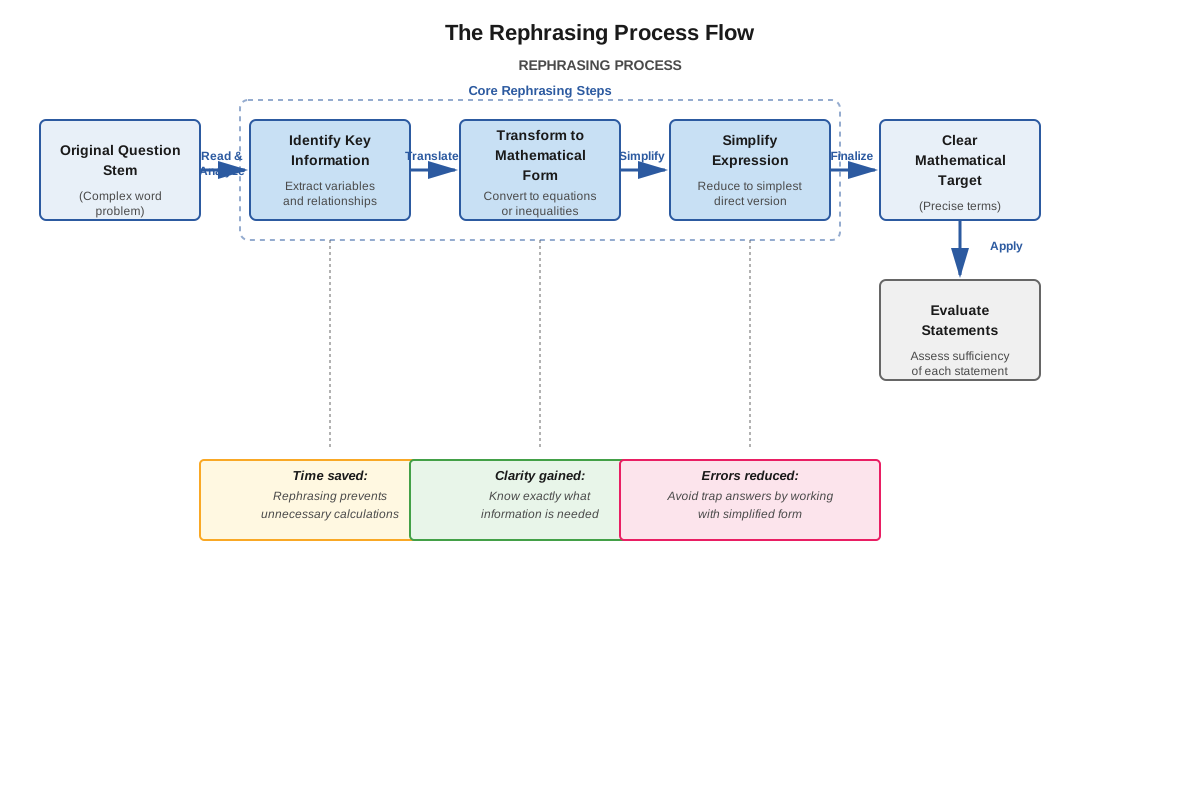
The Rephrasing Process
The systematic approach to rephrasing follows these steps:
- Read and understand the question stem completely: Identify what is being asked and what type of answer would satisfy the question
- Identify the mathematical relationships: Recognize formulas, equations, or properties that connect the given information to what's being asked
- Simplify or transform the question: Use algebraic manipulation, substitution, or formula application to create an equivalent question
- Verify equivalence: Ensure the rephrased question requires exactly the same information as the original
- Evaluate statements against the rephrased question: Use the simpler form to assess sufficiency
Types of Rephrasing
Algebraic Simplification
This most common form of rephrasing involves manipulating algebraic expressions to reveal what information is truly needed. For instance, if a question asks "What is the value of (x + 3)(x - 3)?", recognizing the difference of squares pattern allows rephrasing to "What is the value of x² - 9?", which might be directly answerable from the statements without finding x itself.
Formula Substitution
Many GMAT questions can be rephrased by recognizing that a formula connects the unknown to potentially knowable quantities. A question asking "What is the area of a circle?" can be rephrased to "What is πr²?" or even more specifically "What is the value of r²?" since π is a constant. This clarifies that we need the radius (or diameter, or circumference) to answer the question.
Inequality Conversion
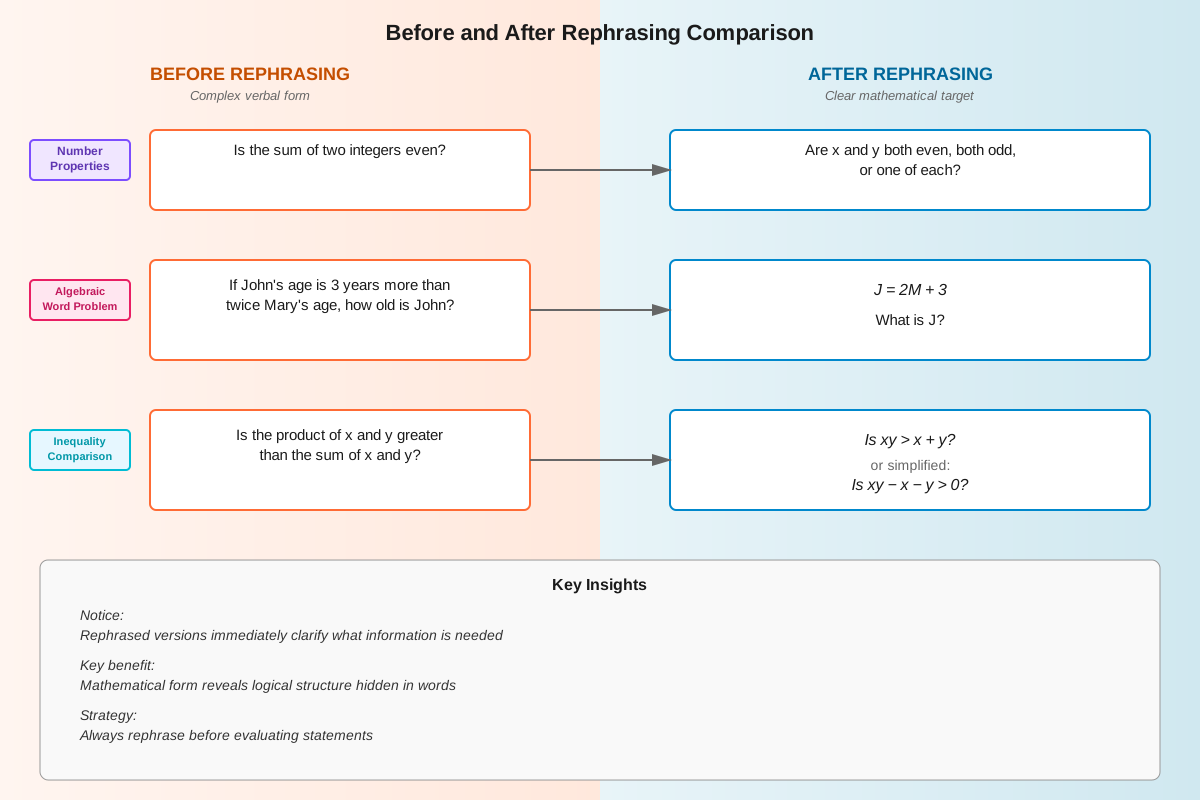
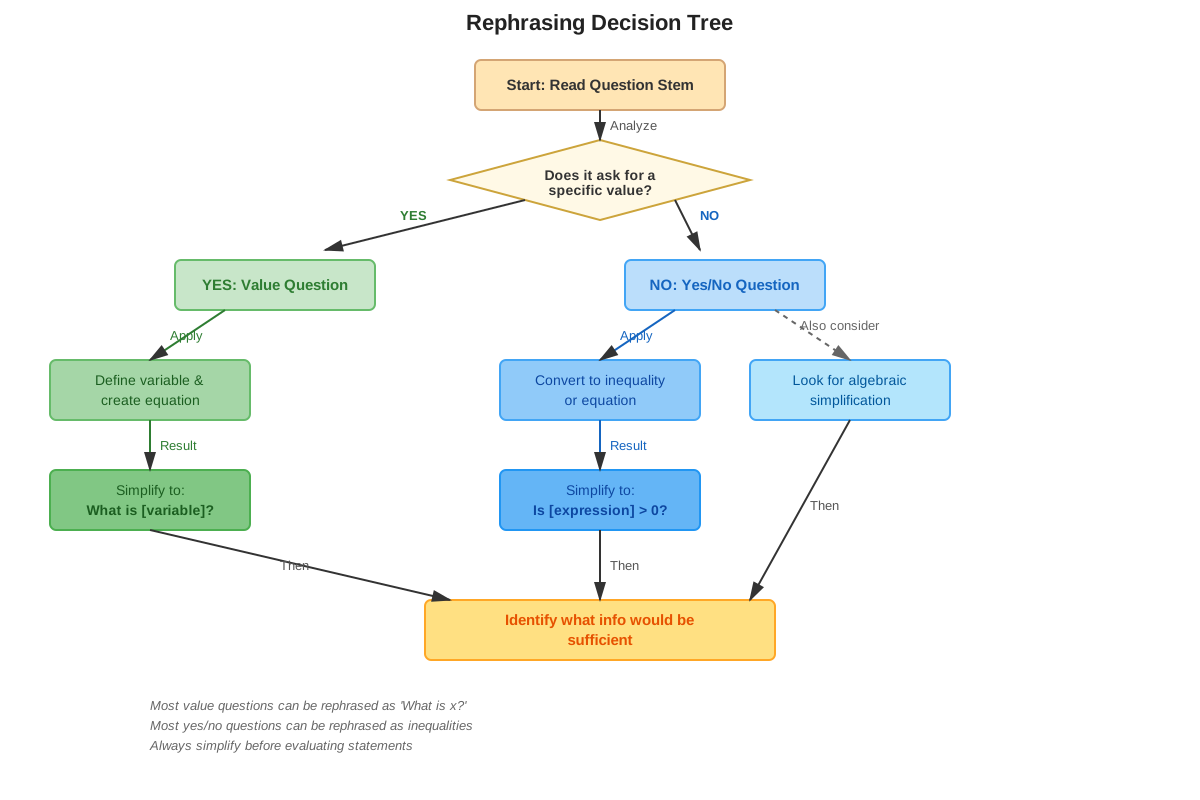
Questions asking about properties, ranges, or comparisons often benefit from rephrasing into inequality form. "Is x positive?" becomes "Is x > 0?", which immediately clarifies what type of information would be sufficient—any statement that establishes x's relationship to zero.
Equation Combination
When questions involve multiple variables, rephrasing often involves recognizing that we might not need each variable individually. "What is the value of x + y?" might be answerable without knowing x or y separately. Similarly, "What is the value of x/y?" might be determinable from statements that give ratios rather than absolute values.
Recognition Patterns
Certain question structures signal high-value rephrasing opportunities:
| Question Pattern | Rephrasing Opportunity | Example |
|---|---|---|
| "What is the value of [expression]?" | Simplify the expression algebraically | (x + y)² → x² + 2xy + y² |
| "What is [geometric measurement]?" | Apply relevant formula | Area of triangle → (1/2)bh |
| "Is [variable] [property]?" | Convert to inequality or equation | Is n even? → Is n = 2k for some integer k? |
| Questions with multiple variables | Look for combinations that might be determinable | x and y individually vs. x + y or xy |
| Percentage/ratio questions | Convert to fractional or algebraic form | "What percent of x is y?" → y/x = ? |
When Rephrasing Adds Maximum Value
Rephrasing provides the greatest benefit when:
- The question stem contains complex expressions that can be simplified
- Multiple variables appear but might not all need individual values
- The question asks about a derived quantity (area, volume, percentage) rather than a basic measurement
- The question involves a property or comparison rather than a specific value
- Algebraic patterns (factoring, difference of squares, etc.) are present
- The original question obscures what information would actually be sufficient
Common Rephrasing Transformations
Value Questions: Transform "What is x?" into what you actually need. If statements give information about x², you might rephrase to "What is x²?" or "What is |x|?"
Yes/No Questions: Convert into precise mathematical conditions. "Is the product xy positive?" becomes "Do x and y have the same sign?" which clarifies that we need information about whether both are positive or both are negative.
Geometric Questions: Apply formulas immediately. "What is the perimeter of rectangle ABCD?" becomes "What is 2(length + width)?" which clarifies we need both dimensions.
System Questions: Recognize when you need the system solution versus individual values. "If 2x + 3y = 12, what is x?" requires different information than "If 2x + 3y = 12, what is 4x + 6y?" (which is simply 24).
Concept Relationships
Rephrasing serves as the foundational technique that enables effective application of all other Data Sufficiency strategies. The relationship flows as follows:
Rephrasing → Sufficiency Evaluation: Once a question is rephrased into its simplest form, evaluating whether each statement provides sufficient information becomes more straightforward. The rephrased question serves as the target, and each statement can be checked against this target.
Algebraic Manipulation → Rephrasing → Pattern Recognition: The prerequisite skill of algebraic manipulation enables rephrasing, which in turn allows recognition of patterns in what information is sufficient. Students who master algebraic techniques can rephrase more questions, leading to faster pattern recognition across question types.
Question Analysis → Rephrasing → Statement Combination: Careful analysis of the question stem leads to effective rephrasing, which then clarifies when statements must be combined versus when one alone is sufficient. A well-rephrased question often reveals immediately whether Statement (1) or Statement (2) alone could be sufficient.
Formula Knowledge → Rephrasing → Geometric Sufficiency: Understanding geometric formulas enables rephrasing of geometric questions, which then clarifies what measurements would be sufficient. For example, knowing that the area of a triangle equals (1/2)bh allows rephrasing "What is the area?" to "What are the base and height?" or recognizing that any information determining both dimensions would be sufficient.
The connection to prerequisite topics is direct: equation solving skills enable recognition of what information would allow solving for an unknown; inequality manipulation allows rephrasing comparison questions; and basic algebra provides the tools for transforming expressions. These prerequisites are not merely helpful—they are essential for effective rephrasing.
High-Yield Facts
⭐ Rephrasing should occur before evaluating either statement—it's a question analysis technique, not a statement evaluation technique
⭐ The rephrased question must be mathematically equivalent to the original—it should require exactly the same information to answer
⭐ Many Data Sufficiency questions are designed so that the obvious interpretation requires more work than the rephrased version
⭐ Questions asking for the value of an expression often don't require finding individual variable values
⭐ Yes/No questions should be rephrased into precise mathematical conditions (equations, inequalities, or properties)
- Rephrasing is most valuable when the question stem contains multiple variables or complex expressions
- Geometric questions should almost always be rephrased using the relevant formula
- Questions about products, sums, or ratios of variables may be answerable without knowing individual values
- The rephrasing process typically takes 15-30 seconds but can save 60+ seconds in evaluation time
- Effective rephrasing reduces the likelihood of falling for trap answer choices
- Some questions have multiple valid rephrasings—choose the one that seems most useful for the given statements
- Rephrasing can reveal that a question is actually asking for less information than initially apparent
- Pattern recognition improves with practice—common question types have standard rephrasing approaches
Quick check — test yourself on Rephrasing so far.
Try Flashcards →Common Misconceptions
Misconception: Rephrasing means solving the problem before looking at the statements.
Correction: Rephrasing transforms the question into a simpler form but does not answer it. The goal is to clarify what information would be sufficient, not to find the actual answer. You're determining the target, not hitting it.
Misconception: Every Data Sufficiency question needs extensive rephrasing.
Correction: Some questions are already in their simplest form. Rephrasing is most valuable when the question stem contains complex expressions, multiple variables, or derived quantities. Simple questions like "What is x?" when statements directly give information about x may need minimal or no rephrasing.
Misconception: The rephrased question must be shorter than the original.
Correction: While rephrasing often simplifies, the goal is clarity and mathematical precision, not brevity. Sometimes the rephrased version is longer but more explicit about what information is needed. "Is n even?" might be rephrased to "Is n divisible by 2?" or "Does n = 2k for some integer k?"—not shorter, but more precise.
Misconception: If you can't immediately see how to rephrase, you should skip it and evaluate the statements.
Correction: Spending 20-30 seconds on thoughtful rephrasing almost always saves time overall. If rephrasing isn't immediately obvious, consider applying relevant formulas, looking for algebraic patterns, or converting the question to equation/inequality form. The investment in rephrasing pays dividends in faster, more accurate statement evaluation.
Misconception: Rephrasing only applies to algebra questions.
Correction: Rephrasing is valuable across all GMAT mathematical content areas. Geometry questions benefit from formula application, word problems benefit from algebraic translation, number property questions benefit from conversion to divisibility or inequality conditions, and statistics questions benefit from formula substitution.
Misconception: The rephrased question should make both statements obviously sufficient or insufficient.
Correction: Rephrasing clarifies what information is needed but doesn't predetermine the answer. After rephrasing, you still need to evaluate each statement carefully. The benefit is that evaluation becomes more efficient and accurate, not that the answer becomes obvious.
Worked Examples
Example 1: Algebraic Rephrasing with Multiple Variables
Question: If x and y are positive integers, what is the value of x + y?
(1) x² - y² = 15
(2) x - y = 3
Rephrasing Process:
The question asks for x + y. Statement (1) contains x² - y², which factors as (x + y)(x - y). This suggests a valuable rephrasing opportunity.
Rephrased Question: "What is the value of x + y?" remains the same, but recognizing the factoring pattern helps us see what information would be sufficient.
From Statement (1): x² - y² = 15 can be written as (x + y)(x - y) = 15
This means if we knew (x - y), we could find (x + y) by dividing: x + y = 15/(x - y)
Evaluating Statement (1):
(x + y)(x - y) = 15. Since x and y are positive integers, both (x + y) and (x - y) are integers. The factor pairs of 15 are: 1×15, 3×5, 5×3, 15×1. We need (x + y) > (x - y) since both are positive. Possible combinations:
- If x - y = 1, then x + y = 15
- If x - y = 3, then x + y = 5
- If x - y = 5, then x + y = 3 (but this would mean x - y > x + y, impossible when both are positive)
So we have two possibilities: x + y could be 15 or 5. Statement (1) alone is INSUFFICIENT.
Evaluating Statement (2):
x - y = 3 tells us the difference but not the sum. Many pairs satisfy this: (4,1), (5,2), (6,3), etc., giving different sums. Statement (2) alone is INSUFFICIENT.
Evaluating Both Together:
From Statement (2), x - y = 3. Substituting into the rephrased form of Statement (1):
(x + y)(3) = 15
x + y = 5
Both statements together are SUFFICIENT.
Answer: C
Learning Objective Connection: This example demonstrates applying rephrasing by recognizing the algebraic pattern (difference of squares) and using it to clarify what information would be sufficient.
Example 2: Geometric Rephrasing
Question: In triangle ABC, what is the area of the triangle?
(1) The base of the triangle is 8 and the height is 6
(2) The triangle is a right triangle with legs of length 6 and 8
Rephrasing Process:
The question asks for the area of a triangle. The formula for triangle area is A = (1/2)bh, where b is the base and h is the height.
Rephrased Question: "What is (1/2) × base × height?"
This rephrasing immediately clarifies that we need to know both the base and the height (or equivalent information that allows us to determine their product).
Evaluating Statement (1):
Base = 8, height = 6. We can directly calculate: Area = (1/2)(8)(6) = 24. Statement (1) alone is SUFFICIENT.
Evaluating Statement (2):
The triangle is a right triangle with legs 6 and 8. In a right triangle, the two legs are perpendicular, so one leg can serve as the base and the other as the height. Area = (1/2)(6)(8) = 24. Statement (2) alone is SUFFICIENT.
Answer: D
Learning Objective Connection: This example shows how rephrasing using a formula (area = ½bh) clarifies exactly what information is needed and helps recognize that Statement (2) provides sufficient information even though it doesn't explicitly mention "base" and "height."
Additional Insight: The rephrasing reveals that both statements are actually giving the same information in different forms. Recognizing this equivalence comes from understanding that in a right triangle, the legs serve as base and height.
Exam Strategy
Systematic Approach to Rephrasing on Test Day
- Read the question stem completely before looking at statements: Resist the urge to jump to the statements. Invest 15-30 seconds in understanding and rephrasing the question.
- Ask yourself "What would I need to know to answer this?": This question often reveals the rephrasing naturally. If the question asks for the area of a circle, you'd need the radius (or diameter, or circumference)—this is your rephrased target.
- Look for algebraic patterns: Difference of squares, perfect square trinomials, common factors, and other patterns signal rephrasing opportunities. Train yourself to recognize these automatically.
- Apply formulas immediately for geometric and formula-based questions: Don't wait to see if you need the formula—rephrase using it right away.
Trigger Words and Phrases
Watch for these question structures that signal high-value rephrasing opportunities:
- "What is the value of [complex expression]?": Simplify the expression algebraically before evaluating statements
- "Is [variable] [property]?": Convert to precise mathematical condition (equation or inequality)
- "What is the [geometric measurement]?": Apply the relevant formula immediately
- Questions with multiple variables: Consider whether you need individual values or just combinations
- "What percent..." or "What is the ratio...": Convert to fractional or algebraic form
Process of Elimination Tips
After rephrasing:
- Eliminate answer choices that would require information beyond what the rephrased question needs: If your rephrasing reveals you only need x + y, and a statement gives you x and y individually, that's sufficient (you can add them)—don't eliminate it thinking you need something else
- Recognize when statements give equivalent information in different forms: After rephrasing, you may see that both statements actually provide the same information, suggesting answer D
- Use the rephrased question to quickly assess "obviously insufficient" statements: If your rephrased question is "What is x²?" and a statement only tells you about x + y, you can quickly determine insufficiency
Time Allocation
- Spend 15-30 seconds on rephrasing: This upfront investment typically saves 30-60 seconds in evaluation time
- If rephrasing isn't obvious within 30 seconds, proceed with evaluation but remain alert for patterns: Sometimes the rephrasing becomes clear when you see what the statements provide
- Don't over-rephrase: The goal is clarity, not perfection. Once you have a clearer target, move to statement evaluation
Common Traps to Avoid
- Trap: Statements that seem insufficient before rephrasing but are sufficient after: The GMAT deliberately constructs questions where rephrasing reveals sufficiency
- Trap: Assuming you need more information than you actually do: Rephrasing often reveals that the question requires less information than initially apparent
- Trap: Forgetting to check if the rephrased question is truly equivalent: Ensure your rephrasing doesn't change what information is needed
Memory Techniques
The FRAME Acronym for Rephrasing
Formulas: Apply relevant formulas immediately for geometric and standard questions
Reduce: Simplify algebraic expressions using factoring, combining like terms, etc.
Ask: "What would I need to know to answer this?"
Mathematical precision: Convert words to equations, inequalities, or precise conditions
Equivalence check: Verify your rephrased question requires the same information as the original
Visualization Strategy
Picture the rephrasing process as "translating from English to Math". The original question is often in "English" (words, complex descriptions), and your job is to translate it into "Math" (equations, inequalities, simplified expressions). Just as translation makes communication clearer, rephrasing makes sufficiency evaluation clearer.
Pattern Recognition Mnemonics
"DAVE" for common rephrasing patterns:
- Difference of squares: a² - b² = (a+b)(a-b)
- Area formulas: Immediately apply for geometric questions
- Variable combinations: Look for sums, products, ratios rather than individual values
- Equations from words: Convert verbal descriptions to algebraic form
The "Target Practice" Mental Model
Think of rephrasing as defining your target before shooting. The original question might describe the target vaguely ("somewhere over there"), while the rephrased question puts a clear bullseye on it ("exactly 50 meters north"). The statements are your arrows—you can only tell if they hit the target once you know exactly where the target is.
Summary
Rephrasing is the foundational strategic technique for Data Sufficiency questions on the GMAT, involving the transformation of question stems into simpler, more mathematically precise forms before evaluating statement sufficiency. This technique leverages algebraic manipulation, formula application, and pattern recognition to clarify exactly what information would be sufficient to answer a question. The systematic rephrasing process—reading completely, identifying mathematical relationships, transforming the question, verifying equivalence, and then evaluating statements—enables faster and more accurate sufficiency determination. Common rephrasing approaches include algebraic simplification, formula substitution, inequality conversion, and recognition that variable combinations may be determinable when individual values are not. The technique provides maximum value when questions contain complex expressions, multiple variables, derived quantities, or properties rather than direct values. Mastering rephrasing requires practice recognizing patterns and developing the discipline to invest 15-30 seconds in question analysis before rushing to evaluate statements, an investment that consistently saves time and reduces errors.
Key Takeaways
- Rephrasing transforms complex Data Sufficiency questions into clearer mathematical targets before evaluating statements
- The rephrased question must be mathematically equivalent to the original—requiring exactly the same information to answer
- Invest 15-30 seconds in rephrasing before looking at statements; this upfront time investment saves significant time overall
- Common rephrasing techniques include algebraic simplification, formula application, inequality conversion, and recognizing that variable combinations may be sufficient
- Geometric questions should almost always be rephrased using the relevant formula to clarify what measurements are needed
- Questions with multiple variables often don't require individual values—look for combinations (sums, products, ratios) that might be determinable
- The GMAT deliberately constructs questions where the obvious interpretation requires more work than the rephrased version, rewarding strategic thinking
Related Topics
Algebraic Manipulation: Deepening skills in factoring, expanding, and simplifying expressions directly enhances rephrasing ability. Mastering rephrasing motivates further study of algebraic techniques.
Data Sufficiency Answer Choices: Understanding the five answer choices (A, B, C, D, E) and their meanings is essential for applying rephrasing effectively, as the rephrased question guides which answer choice is correct.
Statement Combination Strategy: After rephrasing clarifies what information is needed, systematic evaluation of whether statements must be combined becomes more efficient. Rephrasing is the prerequisite skill.
Geometric Formulas and Properties: Comprehensive knowledge of geometric formulas enables more effective rephrasing of geometric questions, revealing exactly what measurements would be sufficient.
Number Properties: Understanding divisibility, prime factorization, even/odd properties, and other number properties enables rephrasing of number property questions into precise mathematical conditions.
Inequality Manipulation: Advanced inequality techniques allow more sophisticated rephrasing of comparison and range questions, particularly for complex Data Sufficiency scenarios.
Practice CTA
Now that you understand the strategic power of rephrasing, it's time to build automaticity through practice. Attempt the practice questions for this topic, focusing on implementing the systematic rephrasing process before evaluating statements. Use the flashcards to reinforce pattern recognition for common rephrasing opportunities. Remember: rephrasing is a skill that improves dramatically with deliberate practice. Each question you rephrase strengthens your pattern recognition and builds the strategic thinking that separates good GMAT scores from great ones. Your investment in mastering this technique will pay dividends across every Data Sufficiency question you encounter!
Sign up free to keep reading
Create a free AnvayaPrep account to finish this GMAT guide on Rephrasing — plus flashcards and practice questions.