Overview
Number properties form the foundational bedrock of GMAT Quantitative Reasoning, appearing in approximately 25-30% of all quantitative questions either directly or as underlying concepts. These properties govern how integers, primes, factors, multiples, and divisibility rules interact, making them essential tools for solving problems efficiently under time pressure. Understanding GMAT number properties enables test-takers to recognize patterns, eliminate incorrect answer choices quickly, and solve complex problems through logical reasoning rather than brute-force calculation.
The GMAT tests number properties across multiple question formats, including Problem Solving and Data Sufficiency questions. These properties frequently appear disguised within word problems, algebraic expressions, and geometric scenarios, requiring students to identify when a number property concept is being tested. Mastery of this topic directly impacts performance on questions involving divisibility, remainders, prime factorization, odd/even analysis, and positive/negative number behavior—all high-frequency GMAT concepts.
Within the broader Quantitative Reasoning framework, number properties serve as the connecting tissue between pure arithmetic and more advanced algebraic problem-solving. They provide the logical rules that govern how numbers behave in equations, inequalities, and real-world scenarios. Students who master number properties gain significant advantages in speed and accuracy across the entire quantitative section, as these concepts enable pattern recognition and strategic elimination of answer choices without exhaustive calculation.
Learning Objectives
- [ ] Identify number properties in GMAT problem statements and recognize when they are being tested
- [ ] Explain the fundamental rules governing integers, divisibility, factors, multiples, and prime numbers
- [ ] Apply number properties to solve GMAT Problem Solving and Data Sufficiency questions efficiently
- [ ] Analyze odd/even and positive/negative number behavior in arithmetic operations
- [ ] Determine divisibility using standard rules without performing long division
- [ ] Evaluate the prime factorization of integers and apply it to factor/multiple problems
- [ ] Synthesize multiple number properties to solve complex multi-step GMAT questions
Prerequisites
- Basic arithmetic operations: Addition, subtraction, multiplication, and division form the foundation for understanding how number properties manifest in calculations
- Integer understanding: Familiarity with whole numbers, negative numbers, and zero is essential since number properties primarily govern integer behavior
- Algebraic notation: Ability to work with variables representing unknown numbers enables application of number properties to abstract problems
- Order of operations: PEMDAS/BODMAS knowledge ensures correct application of number properties in complex expressions
Why This Topic Matters
Number properties represent one of the highest-yield study areas for GMAT preparation because they appear across diverse question types and difficulty levels. Research on GMAT question distributions shows that number properties concepts appear in approximately 8-12 questions per exam, making them second only to algebra in frequency. More importantly, these properties often provide the fastest path to correct answers, enabling time savings that can be allocated to more challenging questions.
In real-world applications, number properties underpin computer science algorithms, cryptography, financial calculations involving interest and divisibility, and scheduling problems requiring least common multiples. Business professionals regularly encounter these concepts when analyzing data patterns, forecasting with cyclical trends, and optimizing resource allocation where divisibility constraints exist.
On the GMAT specifically, number properties appear in several distinct formats: pure number theory questions asking about factors or primes, word problems requiring divisibility analysis, Data Sufficiency questions testing understanding of odd/even rules, and complex problems combining multiple properties. The exam frequently tests whether students can recognize that a problem involves number properties even when not explicitly stated, making conceptual understanding more valuable than memorized procedures.
Core Concepts
Integers and Number Classification
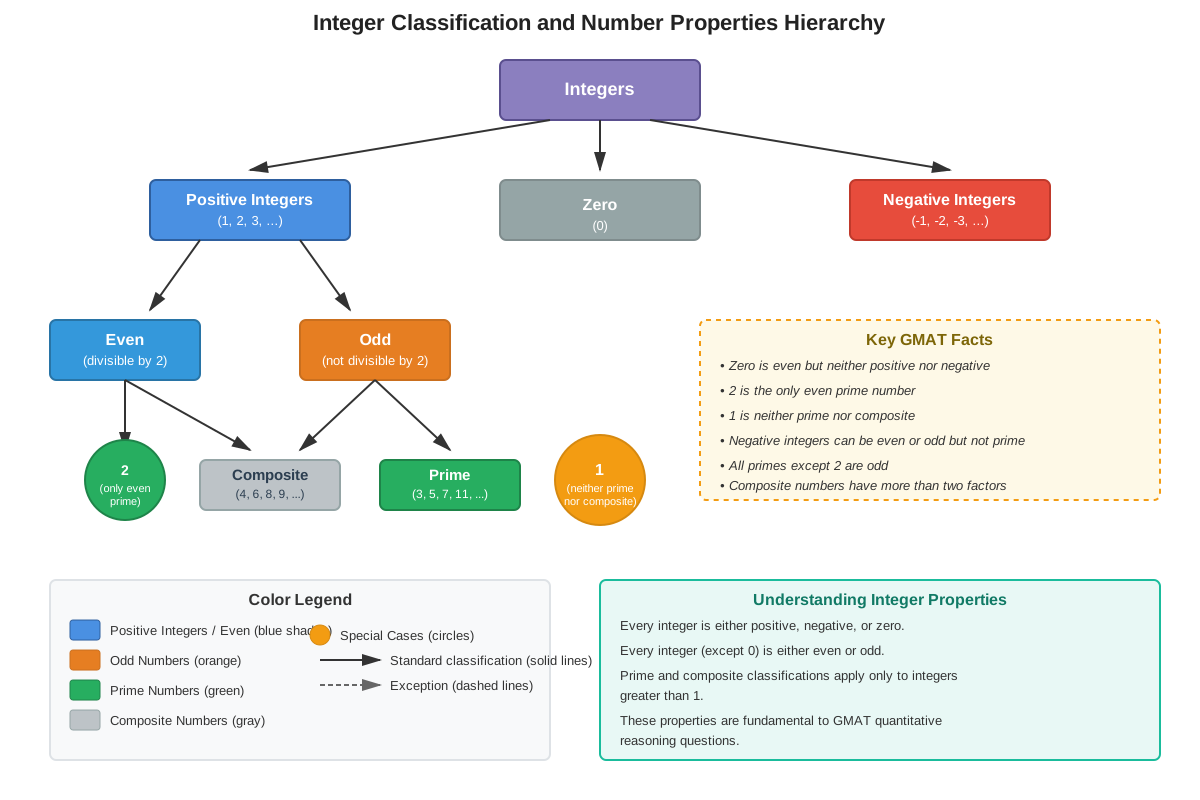
Integers are whole numbers including positive numbers, negative numbers, and zero: {..., -3, -2, -1, 0, 1, 2, 3, ...}. The GMAT distinguishes between several integer categories that behave differently under various operations. Positive integers (natural numbers) are {1, 2, 3, 4, ...}, while negative integers are {-1, -2, -3, -4, ...}. Zero is neither positive nor negative, a fact the GMAT frequently tests.
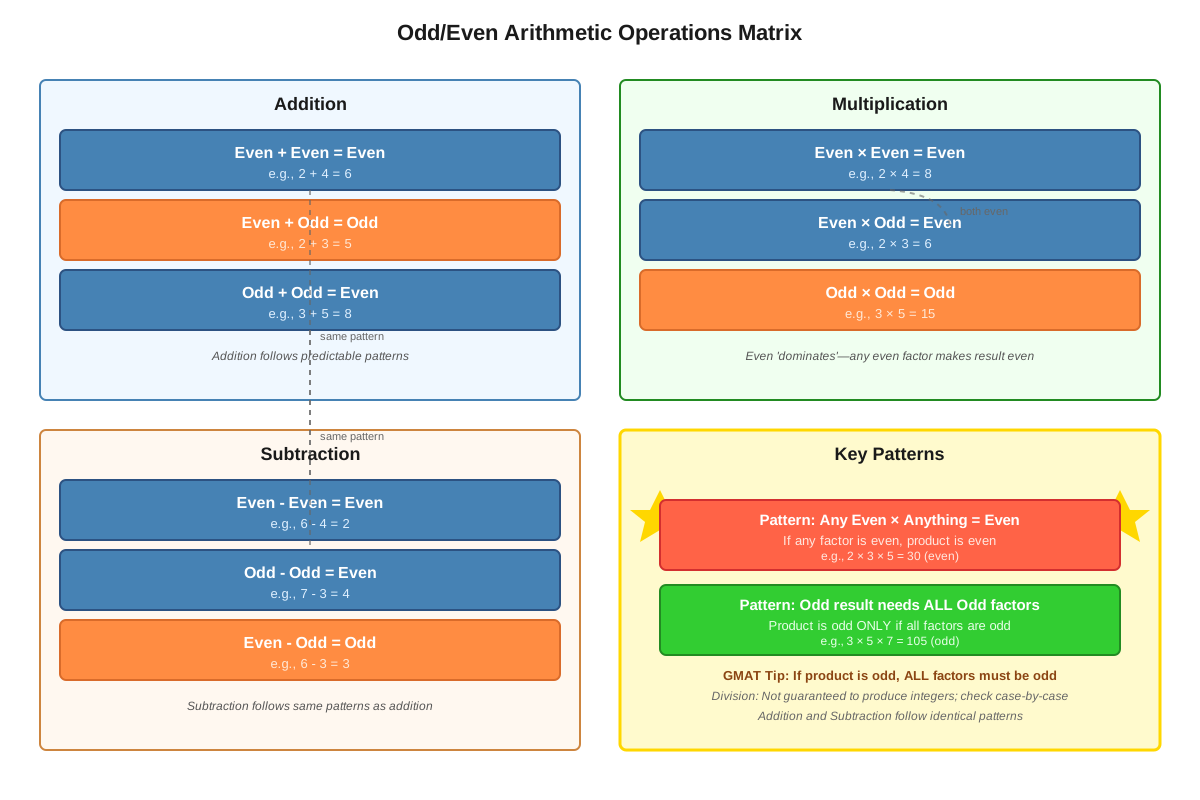
Even integers are divisible by 2 and can be expressed as 2k where k is any integer: {..., -4, -2, 0, 2, 4, 6, ...}. Odd integers leave a remainder of 1 when divided by 2 and can be expressed as 2k + 1: {..., -3, -1, 1, 3, 5, ...}. Understanding odd/even behavior under operations is crucial:
| Operation | Even ± Even | Odd ± Odd | Even ± Odd |
|---|---|---|---|
| Result | Even | Even | Odd |
| Operation | Even × Even | Odd × Odd | Even × Odd |
|---|---|---|---|
| Result | Even | Odd | Even |
The key insight: any product containing at least one even factor yields an even result, while only the product of odd numbers yields an odd result.
Divisibility and Factors
A number a is divisible by number b if a ÷ b yields an integer with no remainder. Equivalently, b is a factor (or divisor) of a. For example, 12 is divisible by 3 because 12 ÷ 3 = 4 (an integer). The factors of 12 are {1, 2, 3, 4, 6, 12}.
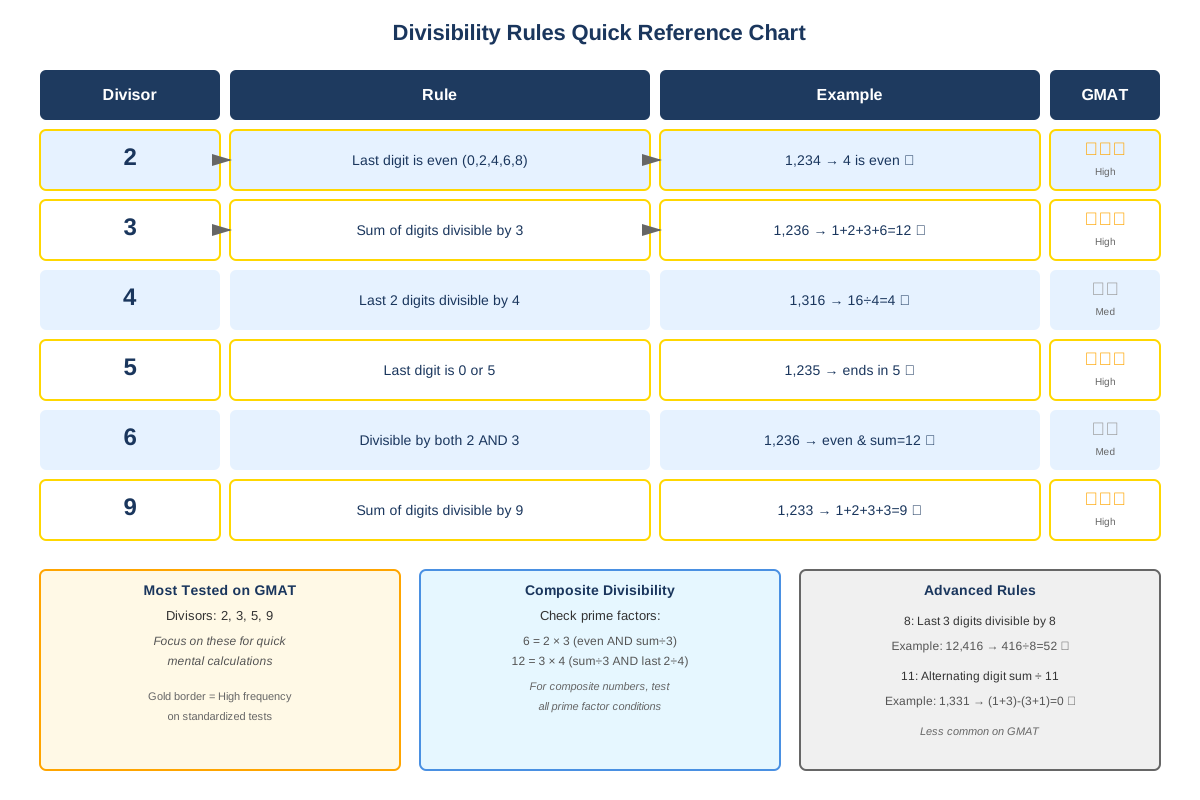
Divisibility rules enable quick determination without calculation:
- Divisibility by 2: Last digit is even (0, 2, 4, 6, 8)
- Divisibility by 3: Sum of digits is divisible by 3 (e.g., 147: 1+4+7=12, divisible by 3)
- Divisibility by 4: Last two digits form a number divisible by 4 (e.g., 316: 16÷4=4)
- Divisibility by 5: Last digit is 0 or 5
- Divisibility by 6: Number is divisible by both 2 and 3
- Divisibility by 8: Last three digits form a number divisible by 8
- Divisibility by 9: Sum of digits is divisible by 9
- Divisibility by 10: Last digit is 0
The greatest common factor (GCF) or greatest common divisor (GCD) of two numbers is the largest integer that divides both numbers. The least common multiple (LCM) is the smallest positive integer that is divisible by both numbers. These concepts frequently appear in GMAT word problems involving scheduling, grouping, and optimization.
Prime Numbers and Prime Factorization
A prime number is an integer greater than 1 that has exactly two distinct positive factors: 1 and itself. The first several primes are: 2, 3, 5, 7, 11, 13, 17, 19, 23, 29, 31, 37, 41, 43, 47... Note that 2 is the only even prime number, and 1 is NOT considered prime (it has only one factor).
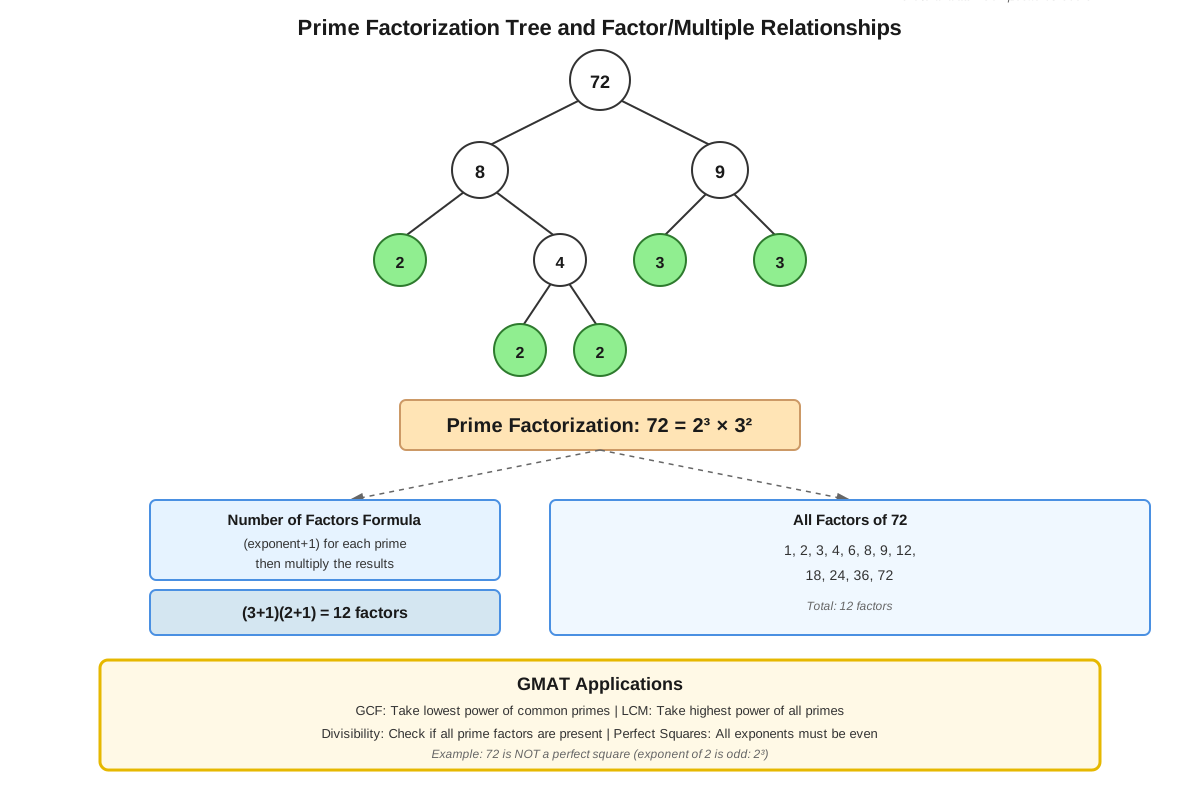
Prime factorization expresses any integer as a product of prime numbers. For example, 60 = 2² × 3 × 5. This representation is unique for each number (Fundamental Theorem of Arithmetic) and provides powerful problem-solving tools. Prime factorization enables:
- Finding GCF: Take the lowest power of each common prime factor
- Finding LCM: Take the highest power of each prime factor present in either number
- Determining the number of factors: If n = p₁^a × p₂^b × p₃^c, then the number of factors = (a+1)(b+1)(c+1)
Consecutive Integers
Consecutive integers are integers that follow in sequence with a difference of 1: {n, n+1, n+2, ...}. Consecutive even integers have the form {n, n+2, n+4, ...} where n is even, while consecutive odd integers follow {n, n+2, n+4, ...} where n is odd.
Key properties of consecutive integers:
- The sum of any set of consecutive integers is divisible by the count of integers if that count is odd
- The product of n consecutive integers is always divisible by n!
- Among any set of consecutive integers, exactly one is divisible by each integer up to the count
Remainders
When integer a is divided by integer b, the result can be expressed as: a = bq + r, where q is the quotient and r is the remainder (0 ≤ r < b). For example, 17 ÷ 5 = 3 remainder 2, so 17 = 5(3) + 2.
Remainder properties:
- If two numbers leave the same remainder when divided by n, their difference is divisible by n
- The remainder when (a + b) is divided by n equals the remainder when (remainder of a ÷ n + remainder of b ÷ n) is divided by n
- Similar addition property holds for multiplication of remainders
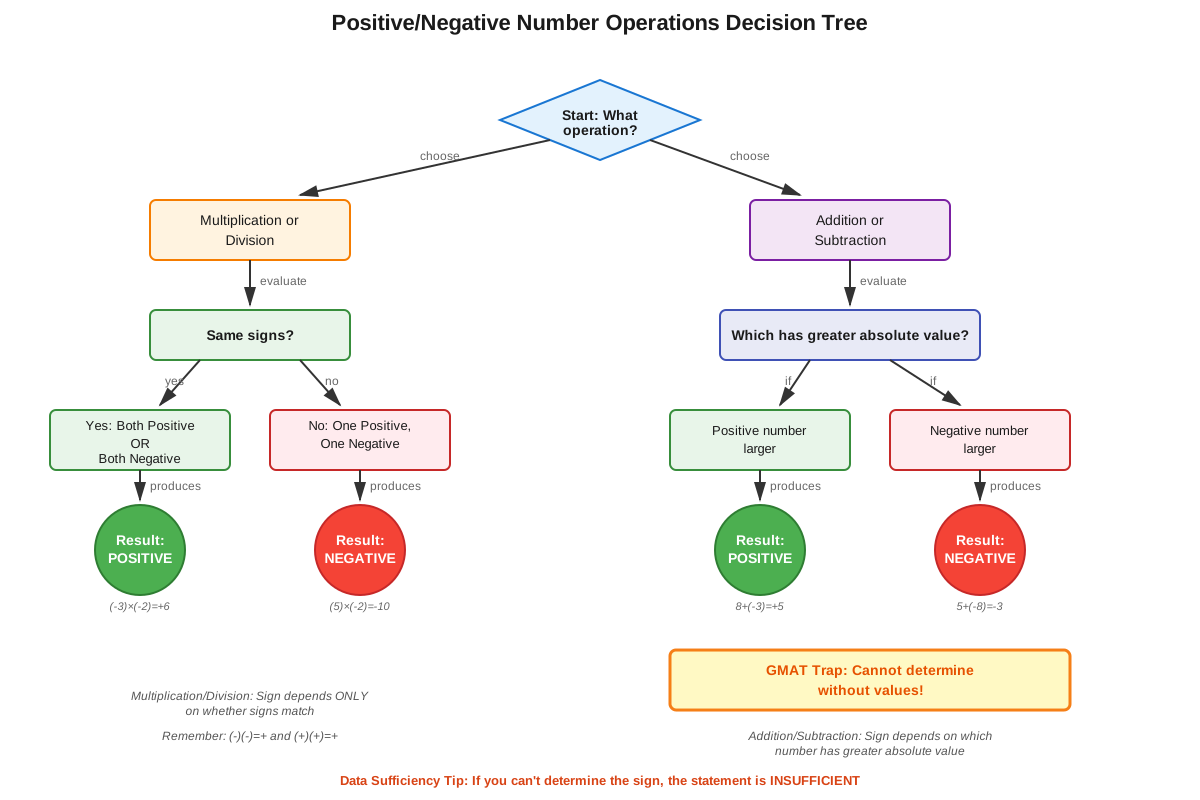
Positive and Negative Number Properties
The behavior of positive and negative numbers under operations follows specific rules:
Multiplication and Division:
- Positive × Positive = Positive
- Negative × Negative = Positive
- Positive × Negative = Negative
- Same rules apply for division
Powers:
- (Negative)^even = Positive
- (Negative)^odd = Negative
- Any positive number raised to any power remains positive
Absolute Value: The absolute value |x| represents the distance from zero, always yielding a non-negative result. For GMAT purposes: |x| = x if x ≥ 0, and |x| = -x if x < 0.
Concept Relationships
Number properties form an interconnected web where understanding one concept reinforces others. Prime factorization serves as the central hub, connecting to factors (all factors can be derived from prime factorization), multiples (LCM calculation requires prime factorization), and divisibility (a number is divisible by another if it contains all the prime factors of that divisor).
The relationship flow: Integers → classified as → Even/Odd and Positive/Negative/Zero → which determines behavior under → Arithmetic Operations → leading to → Divisibility Rules → which connect to → Factors and Multiples → analyzed through → Prime Factorization → enabling calculation of → GCF and LCM.
Consecutive integers represent a special application combining multiple properties: they involve integer classification, divisibility patterns, and factor analysis. Remainders connect back to divisibility (a remainder of 0 means divisibility) and factor analysis (the divisor is a factor only when remainder is 0).
Understanding odd/even properties enables quick elimination in Data Sufficiency questions, while positive/negative rules determine sign behavior in algebraic expressions. Both connect to the broader concept of integer classification, which underlies nearly every number properties question on the GMAT.
High-Yield Facts
⭐ Zero is even (divisible by 2: 0 = 2 × 0) and is neither positive nor negative
⭐ The number 1 is not prime (it has only one factor, not two distinct factors)
⭐ The number 2 is the only even prime number (all other even numbers are divisible by 2)
⭐ The product of any set of consecutive integers is divisible by the factorial of the count (e.g., n × (n+1) × (n+2) is divisible by 3! = 6)
⭐ Even × Anything = Even, while Odd × Odd = Odd (one even factor makes the entire product even)
- The sum of an odd count of consecutive integers is divisible by that count
- If a number is divisible by both a and b, it is divisible by LCM(a,b), not necessarily by a × b
- A number has an odd number of factors if and only if it is a perfect square
- The GCF of two numbers multiplied by their LCM equals the product of the two numbers: GCF(a,b) × LCM(a,b) = a × b
- Any integer can be expressed as either 2k (even) or 2k+1 (odd) for some integer k
- Negative numbers raised to even powers become positive; raised to odd powers remain negative
- The remainder when dividing by n is always less than n (0 ≤ remainder < n)
- Prime factorization is unique for every integer greater than 1
- Among any three consecutive integers, exactly one is divisible by 3
- The units digit of powers follows cyclical patterns (e.g., powers of 7: 7, 9, 3, 1, 7, 9, 3, 1...)
Quick check — test yourself on Number properties so far.
Try Flashcards →Common Misconceptions
Misconception: Zero is neither even nor odd → Correction: Zero is even because it is divisible by 2 (0 ÷ 2 = 0 with no remainder). The GMAT frequently tests this by asking about "all even integers" or "the smallest even integer."
Misconception: The number 1 is prime → Correction: By definition, a prime number must have exactly two distinct positive factors (1 and itself). Since 1 has only one factor (itself), it is not prime. This affects counting problems asking for "the number of prime factors."
Misconception: If a number is divisible by 6 and 4, it must be divisible by 24 → Correction: The number must be divisible by LCM(6,4) = 12, not necessarily by 6 × 4 = 24. For example, 12 is divisible by both 6 and 4 but not by 24.
Misconception: Negative numbers are always smaller than positive numbers → Correction: While negative numbers are less than positive numbers on the number line, their absolute values can be larger. For example, |-5| > |3|. This matters in questions about distance, magnitude, or absolute value.
Misconception: The sum of two primes is always even → Correction: This is only true when both primes are odd. Since 2 is prime and even, 2 + 3 = 5 (odd). However, the sum of any two odd primes is indeed even.
Misconception: A number with many factors must be large → Correction: Small numbers can have many factors. For example, 12 has six factors (1, 2, 3, 4, 6, 12), while 13 has only two factors despite being larger. The number of factors depends on prime factorization structure, not magnitude.
Misconception: All odd numbers are prime → Correction: Many odd numbers are composite (not prime). For example, 9, 15, 21, 25, 27 are all odd but not prime. Being odd is necessary but not sufficient for primality.
Misconception: The remainder when dividing by n can equal n → Correction: By definition, the remainder must be less than the divisor: 0 ≤ remainder < n. If the remainder equals n, another complete division is possible.
Worked Examples
Example 1: Factor and Divisibility Analysis
Problem: If n is a positive integer and n² is divisible by 72, what is the smallest possible value of n?
Solution:
Step 1: Find the prime factorization of 72
- 72 = 8 × 9 = 2³ × 3²
Step 2: Analyze what n² being divisible by 72 means
- If n² is divisible by 72, then n² must contain at least 2³ × 3² in its prime factorization
- Since n² = n × n, the prime factors of n² are the prime factors of n, each appearing twice
Step 3: Determine the minimum prime factorization of n
- For n² to contain 2³, n must contain at least 2² (because 2² × 2² = 2⁴, which includes 2³)
- Wait—we need exactly 2³ in n², so n needs at least 2^(3/2), but n must be an integer
- Since we need an odd power (3) in n², and powers in n² are double the powers in n, we need to round up
- For 2³ in n²: n must have at least 2² (giving 2⁴ in n², which includes 2³)
- For 3² in n²: n must have at least 3¹ (giving 3² in n²)
Step 4: Calculate minimum n
- n must contain at least 2² × 3¹ = 4 × 3 = 12
Step 5: Verify
- n = 12, so n² = 144
- 144 ÷ 72 = 2 ✓
Answer: The smallest possible value of n is 12.
Connection to Learning Objectives: This problem requires identifying that divisibility and prime factorization are being tested, explaining how prime factors behave when numbers are squared, and applying these properties to find the minimum value.
Example 2: Odd/Even and Data Sufficiency
Problem: If x and y are integers, is x + y even?
(1) x - y is odd
(2) x/y is even
Solution:
Analyze Statement (1): x - y is odd
Step 1: Recall odd/even subtraction rules
- Even - Even = Even
- Odd - Odd = Even
- Even - Odd = Odd
- Odd - Even = Odd
Step 2: Determine what makes x - y odd
- x - y is odd only when x and y have different parity (one even, one odd)
Step 3: Determine x + y when x and y have different parity
- Even + Odd = Odd
- Odd + Even = Odd
Therefore, if x - y is odd, then x + y must be odd. Statement (1) is SUFFICIENT to answer "No."
Analyze Statement (2): x/y is even
Step 1: Determine what makes x/y even
- For x/y to be an integer that is even, x must be divisible by y, and the quotient must be even
- This means x = y × (even number) = y × 2k for some integer k
- Therefore x = 2ky, which means x is even regardless of whether y is even or odd
Step 2: Determine if we can find x + y
- We know x is even, but y could be either even or odd
- If y is even: x + y = Even + Even = Even
- If y is odd: x + y = Even + Odd = Odd
Statement (2) is INSUFFICIENT because we get different answers depending on y's parity.
Answer: Statement (1) alone is sufficient, but statement (2) alone is not sufficient. The answer is A.
Connection to Learning Objectives: This problem demonstrates identifying number properties in a Data Sufficiency context, explaining odd/even behavior under operations, and applying these rules systematically to evaluate sufficiency.
Exam Strategy
When approaching GMAT number properties questions, begin by identifying which specific property is being tested: divisibility, factors/multiples, odd/even, positive/negative, primes, or remainders. Look for trigger words such as "divisible," "factor," "multiple," "consecutive," "even," "odd," "prime," "remainder," and "integer."
For Problem Solving questions, consider whether the problem can be solved more efficiently through number properties than through algebra. If a question asks about "all integers satisfying..." or "the smallest/largest integer such that...," number properties are likely the intended approach. Test small values systematically rather than attempting complex algebraic solutions.
For Data Sufficiency questions, number properties enable powerful elimination strategies:
- If a statement establishes odd/even parity, you can often determine the parity of results without knowing exact values
- If a statement provides divisibility information, consider whether that's sufficient to answer questions about factors or multiples
- Remember that statements about positive/negative signs can be sufficient even without magnitude information
Process of elimination tips:
- Eliminate answer choices that violate basic number properties (e.g., claiming an odd result from even × even)
- In Data Sufficiency, if you can construct two examples with different answers using one statement, that statement is insufficient
- For "must be true" questions, finding one counterexample eliminates that choice
Time allocation: Most number properties questions should be solvable in 1.5-2 minutes. If you're performing extensive calculations, reconsider whether there's a property-based shortcut. Prime factorization of numbers under 100 should be quick; if you're factoring larger numbers, verify that's the intended approach.
Common question patterns:
- "If n is divisible by both a and b..." → Consider LCM
- "What is the remainder when..." → Set up the division equation a = bq + r
- "How many factors does n have?" → Use prime factorization and the (a+1)(b+1)(c+1) formula
- "Is x even?" in Data Sufficiency → Look for information about x's factors, divisibility, or operations involving x
Memory Techniques
PRIME mnemonic for remembering key prime facts:
- Positive integers only (negatives aren't prime)
- Requires exactly two factors
- Includes 2 (the only even prime)
- More than 1 (1 is not prime)
- Excludes composites
"Even Wins" for multiplication: Remember that in multiplication, even numbers "win"—if there's even one even factor, the product is even. Only when all factors are odd does odd "win."
Divisibility Rules Visualization: Create a mental number line with markers at 2, 3, 5, and 10. Visualize checking the last digit(s) for 2, 5, and 10, while visualizing adding up digits for 3 and 9.
Factor Formula: For n = p₁^a × p₂^b × p₃^c, remember "Add One to Each" → (a+1)(b+1)(c+1) gives the number of factors. Visualize each prime factor as a choice: you can include it 0 times, 1 time, 2 times, ..., up to its power.
LCM vs GCF:
- LCM = Largest powers (take the highest power of each prime)
- GCF = Grab common factors (take the lowest power of only shared primes)
Consecutive Integer Products: Remember "Factorial Divisibility"—the product of n consecutive integers is divisible by n!. Visualize n consecutive boxes that must contain one multiple of each number from 1 to n.
Summary
Number properties constitute the fundamental rules governing integer behavior and represent one of the highest-yield topics for GMAT Quantitative Reasoning. Mastery requires understanding how integers are classified (even/odd, positive/negative, prime/composite), how divisibility rules enable quick analysis without calculation, and how prime factorization serves as the foundation for factor and multiple problems. The GMAT tests these concepts both directly through pure number theory questions and indirectly through word problems, Data Sufficiency scenarios, and algebraic expressions. Success depends on recognizing which property is being tested, applying the relevant rules systematically, and using properties to eliminate answer choices efficiently. The key insight is that number properties often provide faster solution paths than algebraic manipulation, making them essential tools for time management under exam conditions.
Key Takeaways
- Zero is even and neither positive nor negative—these facts appear frequently in GMAT trap answers
- Prime factorization unlocks factor, multiple, GCF, and LCM problems—invest time in quick factorization of numbers under 100
- Odd/even behavior follows predictable rules: even "wins" in multiplication, while addition/subtraction depends on whether parities match
- Divisibility rules eliminate calculation: memorize rules for 2, 3, 4, 5, 6, 8, 9, and 10 to save time
- Data Sufficiency questions often test whether property information is sufficient without requiring exact values—focus on what can be determined about parity, sign, or divisibility
- The product of n consecutive integers is always divisible by n!—this property solves many "must be divisible by" questions
- Number properties provide elimination strategies: one counterexample disproves "must be true" statements, while property violations eliminate answer choices
Related Topics
Exponents and Roots: Number properties extend naturally to exponential expressions, where understanding how primes behave under exponentiation enables simplification of complex expressions and solution of exponential equations.
Algebraic Expressions: Many algebraic factoring and simplification problems rely on number properties, particularly when determining whether expressions must be even/odd or positive/negative based on variable constraints.
Word Problems: Real-world scenarios involving grouping, scheduling, and optimization frequently require LCM and GCF calculations, making number properties essential for translating word problems into mathematical solutions.
Data Sufficiency Strategies: Advanced Data Sufficiency techniques build on number properties, using parity and divisibility analysis to determine sufficiency without calculation—a critical skill for achieving high scores efficiently.
Sequences and Series: Understanding consecutive integers and their properties provides the foundation for arithmetic sequences, where patterns in sums and products follow from number property rules.
Practice CTA
Now that you've mastered the core concepts of number properties, it's time to reinforce your understanding through active practice. Attempt the practice questions associated with this topic, focusing on recognizing which property each question tests and applying the systematic approaches outlined in this guide. Use the flashcards to drill high-yield facts until they become automatic, particularly divisibility rules and odd/even operation results. Remember: number properties questions reward pattern recognition and strategic thinking over calculation—the more you practice identifying these patterns, the faster and more accurate you'll become on test day. Your investment in mastering this foundational topic will pay dividends across the entire Quantitative Reasoning section!
Sign up free to keep reading
Create a free AnvayaPrep account to finish this GMAT guide on Number properties — plus flashcards and practice questions.