Overview
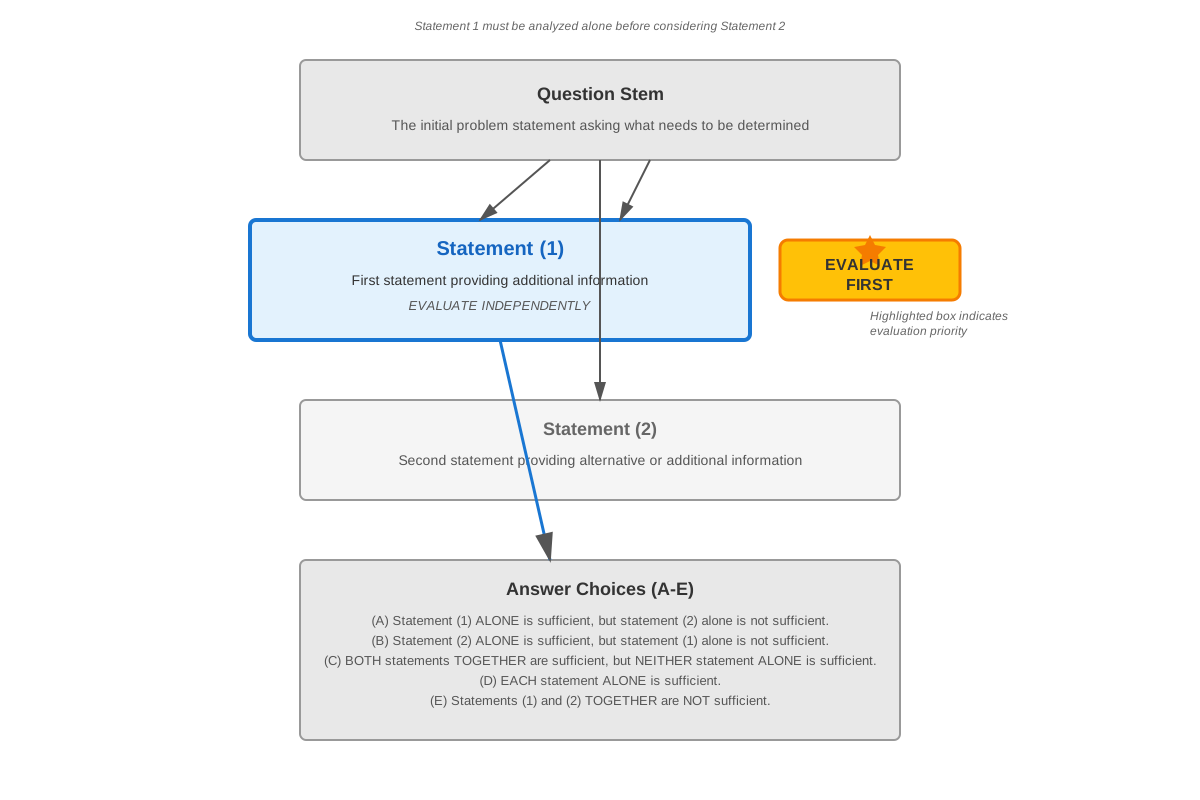
In the Data Sufficiency section of the GMAT, every question presents a problem followed by two statements labeled (1) and (2). Understanding how to properly evaluate Statement 1 is fundamental to mastering this question type, which comprises a significant portion of the Data Insights section. Statement 1 always appears first and must be analyzed independently before considering any information from Statement 2. The ability to correctly assess whether Statement 1 alone provides sufficient information to answer the question is a critical skill that separates high scorers from average test-takers.
GMAT Statement 1 evaluation requires a systematic approach that combines mathematical reasoning, logical analysis, and strategic thinking. Students must determine whether the information provided in Statement 1, when combined with the question stem, allows for a definitive answer to the posed question. This process involves identifying what information is given, what is being asked, and whether any gaps remain that would prevent reaching a unique solution. The evaluation must be thorough yet efficient, as time management is crucial on the GMAT.
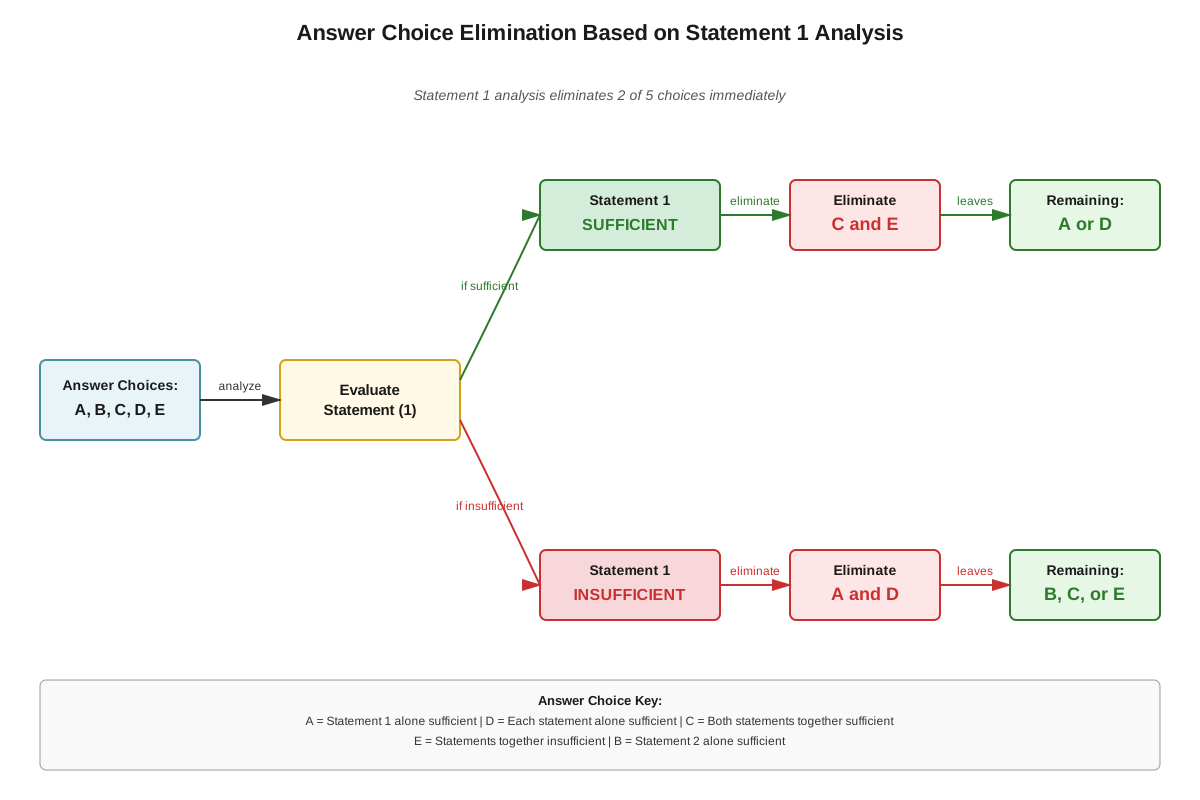
The relationship between Statement 1 and the broader Data Sufficiency framework is hierarchical and sequential. Statement 1 serves as the first decision point in the answer choice elimination process. Depending on whether Statement 1 is sufficient or insufficient, test-takers can immediately eliminate certain answer choices, making the evaluation of Statement 1 a high-leverage activity. This topic connects directly to logical reasoning, algebraic manipulation, and strategic test-taking—all essential components of GMAT success.
Learning Objectives
- [ ] Identify Statement 1 in Data Sufficiency questions
- [ ] Explain Statement 1's role in the Data Sufficiency question structure
- [ ] Apply Statement 1 evaluation techniques to GMAT questions
- [ ] Determine sufficiency of Statement 1 independently without considering Statement 2
- [ ] Eliminate answer choices based on Statement 1 analysis
- [ ] Recognize common traps and pitfalls in Statement 1 evaluation
- [ ] Execute a systematic approach to testing Statement 1 across various mathematical contexts
Prerequisites
- Basic algebra and equation solving: Essential for manipulating the information provided in Statement 1 to determine if a unique solution exists
- Understanding of Data Sufficiency question format: Necessary to recognize the structure and answer choice system that Statement 1 operates within
- Logical reasoning fundamentals: Required to assess whether given information logically leads to a definitive answer
- Number properties knowledge: Needed to evaluate whether Statement 1 provides sufficient constraints on variables (integers, positive numbers, etc.)
Why This Topic Matters
Data Sufficiency questions constitute approximately one-third of the Data Insights section on the GMAT, making Statement 1 evaluation a high-frequency skill that directly impacts overall scores. Every Data Sufficiency question requires analyzing Statement 1, meaning this skill is tested 10-15 times per exam. Unlike Problem Solving questions where computational accuracy is paramount, Data Sufficiency questions—and specifically Statement 1 analysis—test conceptual understanding and logical reasoning, skills highly valued in business school and professional contexts.
In real-world business scenarios, professionals frequently face situations where they must determine whether available information is sufficient to make informed decisions. The ability to evaluate Statement 1 mirrors the critical thinking required when assessing whether current data supports a business recommendation or whether additional information must be gathered. This skill translates directly to case analysis, strategic planning, and data-driven decision-making in MBA programs and beyond.
On the GMAT, Statement 1 appears in various mathematical contexts including algebra, geometry, word problems, statistics, and number properties. Common question types include: determining the value of a variable, establishing relationships between quantities, calculating geometric measurements, and evaluating inequalities. The exam frequently tests whether students can recognize when Statement 1 provides exactly one solution versus multiple possible solutions, or when it provides no useful information at all. Understanding these patterns is essential for efficient and accurate test performance.
Core Concepts
The Structure and Position of Statement 1
Statement 1 is the first of two statements presented in every Data Sufficiency question. It appears directly below the question stem and is always labeled with "(1)" or "Statement (1)." The physical positioning is consistent across all GMAT Data Sufficiency questions, making it easily identifiable. Statement 1 contains information that may or may not be sufficient to answer the question posed in the stem. This information can take various forms: equations, inequalities, numerical values, relationships between variables, or contextual constraints.
The critical principle governing Statement 1 evaluation is independence: Statement 1 must be analyzed completely on its own, without any consideration of Statement 2. This independence requirement is absolute and non-negotiable. Many test-takers make the error of mentally combining information from both statements during their initial Statement 1 analysis, leading to incorrect sufficiency determinations. The proper approach treats Statement 1 as if Statement 2 does not exist during the initial evaluation phase.
The Sufficiency Determination Process
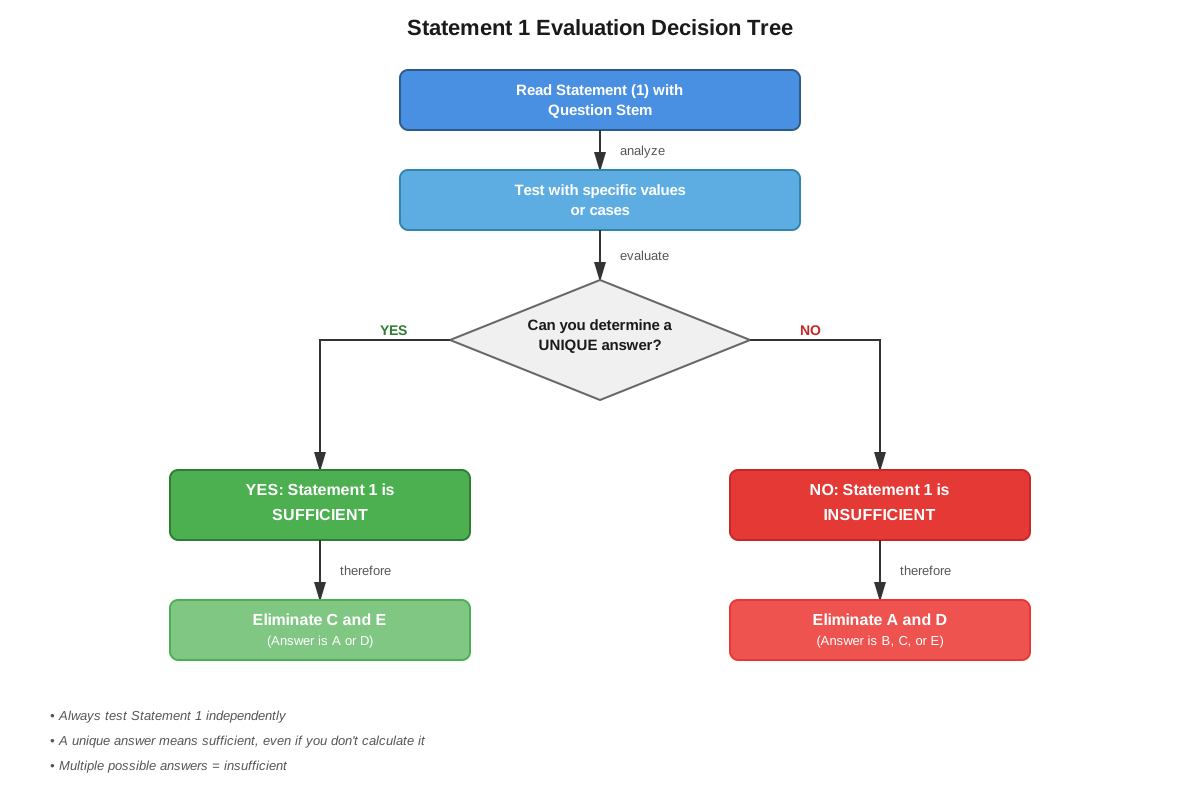
Evaluating whether Statement 1 is sufficient involves a systematic three-step process:
- Restate the question: Identify precisely what the question is asking—a specific numerical value, a yes/no answer, a relationship, or a comparison
- Incorporate Statement 1 information: Combine the information from Statement 1 with any facts given in the question stem
- Test for sufficiency: Determine whether this combined information allows for one and only one answer to the question
Sufficiency does not mean the problem must be solved completely. Instead, it means determining whether enough information exists to reach a definitive answer if one were to perform all necessary calculations. This distinction is crucial for time management—students should stop calculating once sufficiency is established.
Types of Sufficiency Outcomes
When evaluating Statement 1, three possible outcomes exist:
| Outcome | Description | Implication |
|---|---|---|
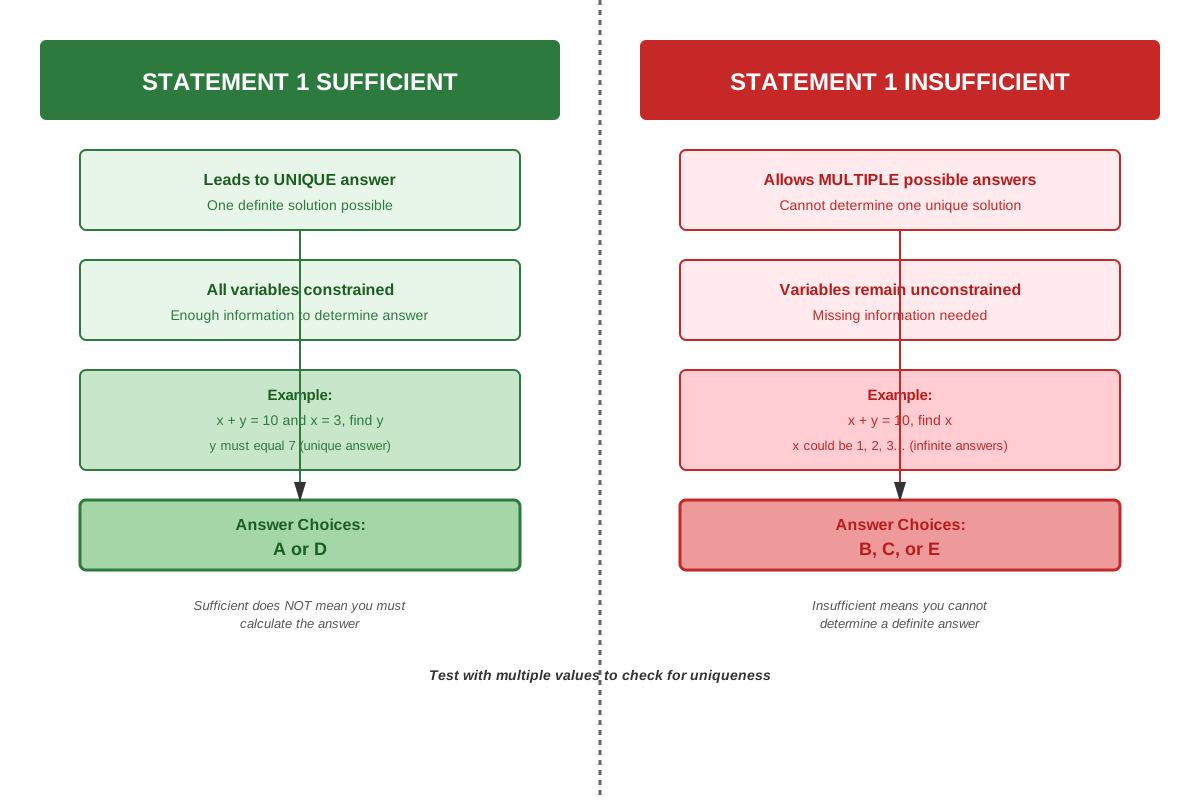
| Sufficient | Statement 1 provides enough information to answer the question definitively | Answer choices A or D remain possible |
| Insufficient | Statement 1 does not provide enough information for a definitive answer | Answer choices B, C, or E remain possible |
| Conditionally sufficient | Statement 1 is sufficient only under certain interpretations (indicates misunderstanding) | Re-evaluation needed |
The "sufficient" outcome means that using Statement 1 alone with the question stem, exactly one answer can be determined. For value questions, this means finding a unique numerical answer. For yes/no questions, this means being able to answer definitively "yes" or definitively "no" (not "sometimes yes, sometimes no").
Common Statement 1 Formats
Statement 1 appears in several standard formats across GMAT questions:
Equation format: Statement 1 provides an equation relating variables mentioned in the question stem. Example: "x + 2y = 10"
Inequality format: Statement 1 establishes bounds or constraints. Example: "x > 5"
Definitional format: Statement 1 provides additional properties or constraints. Example: "x is a prime number"
Relational format: Statement 1 describes relationships between quantities. Example: "The ratio of x to y is 3:2"
Numerical format: Statement 1 provides specific values. Example: "x = 7"
Each format requires slightly different analytical approaches, but all follow the same fundamental sufficiency evaluation principle.
The Answer Choice Elimination Strategy
Statement 1 evaluation directly determines which answer choices remain viable. The five Data Sufficiency answer choices follow a standard pattern:
- (A) Statement 1 alone is sufficient, but Statement 2 alone is not sufficient
- (B) Statement 2 alone is sufficient, but Statement 1 alone is not sufficient
- (C) Both statements together are sufficient, but neither statement alone is sufficient
- (D) Each statement alone is sufficient
- (E) Statements 1 and 2 together are not sufficient
After evaluating Statement 1:
- If Statement 1 is sufficient: Eliminate B, C, and E (only A or D possible)
- If Statement 1 is insufficient: Eliminate A and D (only B, C, or E possible)
This elimination process makes Statement 1 evaluation a high-leverage decision point that immediately narrows the answer choices by 60%.
Testing Statement 1 with Multiple Cases
A critical technique for evaluating Statement 1 involves testing multiple cases or scenarios. If Statement 1 allows for multiple different answers to the question, it is insufficient. This testing approach is particularly important for:
- Yes/no questions: Try to find one scenario where the answer is "yes" and another where it's "no"
- Value questions: Try to find two different values that satisfy Statement 1 but give different answers
- Inequality questions: Test boundary values and typical values within the allowed range
For example, if the question asks "What is the value of x?" and Statement 1 says "x² = 9," testing reveals that x could be 3 or -3, providing two different answers. Therefore, Statement 1 is insufficient.
Common Traps in Statement 1 Evaluation
The GMAT deliberately constructs Statement 1 to include common traps:
The assumption trap: Statement 1 appears to provide information but requires additional assumptions not stated. Test-takers must use only what is explicitly given.
The calculation trap: Statement 1 seems insufficient until complex calculations are performed, tempting students to conclude insufficiency prematurely.
The sufficiency illusion: Statement 1 provides impressive-looking information that feels sufficient but actually leaves critical gaps.
The negative case trap: Statement 1 works for positive numbers but fails when negative numbers, zero, or fractions are considered.
Recognizing these traps requires careful, methodical analysis rather than intuitive judgment.
Concept Relationships
The evaluation of Statement 1 serves as the foundation for the entire Data Sufficiency decision tree. The process flows as follows: Question Stem Analysis → Statement 1 Evaluation → Answer Choice Elimination → Statement 2 Evaluation → Combined Statement Analysis → Final Answer Selection
Statement 1 analysis directly connects to prerequisite knowledge of algebra, number properties, and logical reasoning. The algebraic skills enable manipulation of equations and inequalities provided in Statement 1. Number properties knowledge helps identify whether Statement 1 sufficiently constrains variables (e.g., knowing whether a variable must be an integer, positive, or prime). Logical reasoning allows for systematic case testing and recognition of sufficiency versus insufficiency.
Within the Data Sufficiency framework, Statement 1 relates to Statement 2 through the answer choice structure. The sufficiency of Statement 1 determines which half of the answer choice tree remains viable. If Statement 1 is sufficient, the question becomes whether Statement 2 is also sufficient (leading to answer D) or not (leading to answer A). If Statement 1 is insufficient, the analysis must determine whether Statement 2 alone is sufficient (answer B), whether both together are sufficient (answer C), or whether even combined they remain insufficient (answer E).
The relationship between Statement 1 and the question stem is additive: Statement 1 provides additional information beyond what the question stem contains. Both sources of information must be considered together when determining sufficiency. This relationship requires careful reading of the question stem to identify all given constraints before incorporating Statement 1's information.
High-Yield Facts
⭐ Statement 1 must always be evaluated independently, without any consideration of Statement 2's information
⭐ If Statement 1 is sufficient, only answer choices A and D remain possible
⭐ If Statement 1 is insufficient, only answer choices B, C, and E remain possible
⭐ Sufficiency means being able to determine a definitive answer, not necessarily calculating that answer completely
⭐ For yes/no questions, Statement 1 is sufficient only if it yields a consistent "yes" or consistent "no" across all possible scenarios
- Statement 1 always appears first and is labeled with "(1)" in GMAT Data Sufficiency questions
- Testing multiple cases (positive, negative, zero, fractions) is essential for thorough Statement 1 evaluation
- Statement 1 can be sufficient even if it provides an equation with multiple variables, as long as the question can be answered
- The information in the question stem applies to both Statement 1 and Statement 2 evaluation
- Statement 1 evaluation should take approximately 30-45 seconds for most questions
- A single counterexample is sufficient to prove Statement 1 is insufficient for yes/no questions
- Statement 1 may provide information that seems relevant but doesn't actually help answer the specific question asked
- Recognizing Statement 1 sufficiency patterns across question types improves speed and accuracy
- Statement 1 can be sufficient by establishing that no solution exists or that multiple solutions exist, depending on what the question asks
- The physical act of covering Statement 2 while evaluating Statement 1 helps maintain analytical independence
Quick check — test yourself on Statement 1 so far.
Try Flashcards →Common Misconceptions
Misconception: Statement 1 must provide enough information to calculate a numerical answer completely.
Correction: Statement 1 is sufficient if it provides enough information to determine that a definitive answer exists, even if performing the full calculation would be time-consuming. Recognizing sufficiency without complete calculation is a key GMAT skill.
Misconception: If Statement 1 provides one equation with two variables, it must be insufficient.
Correction: Statement 1 can be sufficient even with two variables if the question asks about a relationship, ratio, or expression involving both variables rather than individual values. For example, if the question asks for x + y and Statement 1 gives x + y = 10, that's sufficient.
Misconception: Statement 1 should be considered together with Statement 2 to save time.
Correction: Combining statements prematurely leads to incorrect sufficiency determinations. Statement 1 must be evaluated in complete isolation first. The answer choice structure requires this sequential, independent analysis.
Misconception: For yes/no questions, Statement 1 is insufficient if it sometimes gives "yes" and sometimes gives "no."
Correction: This is actually correct—the misconception is thinking that getting the same answer (always "yes" or always "no") means insufficient. Consistency in the yes/no answer indicates sufficiency, while variability indicates insufficiency.
Misconception: Statement 1 is automatically sufficient if it provides a specific numerical value.
Correction: Statement 1 providing a value is sufficient only if that value answers the specific question asked. If the question asks about a different variable or relationship, the provided value may be irrelevant or insufficient.
Misconception: Complex-looking Statement 1 information is more likely to be sufficient than simple information.
Correction: The GMAT often makes insufficient statements appear complex and impressive while making sufficient statements appear deceptively simple. Sufficiency depends on logical completeness, not complexity or length.
Misconception: If Statement 1 requires assuming additional constraints (like "x must be positive"), those assumptions are acceptable.
Correction: Only explicitly stated information can be used. If Statement 1 doesn't specify that x is positive, both positive and negative values must be considered. Making unstated assumptions is a primary cause of incorrect sufficiency determinations.
Worked Examples
Example 1: Value Question with Algebraic Statement 1
Question Stem: What is the value of x?
Statement (1): 3x + 2y = 18 and y = 3
Analysis Process:
Step 1 - Identify what's being asked: We need a specific numerical value for x.
Step 2 - Evaluate Statement 1 independently: Statement 1 provides two pieces of information: an equation relating x and y, and a specific value for y.
Step 3 - Incorporate Statement 1 information: Substituting y = 3 into the equation:
- 3x + 2(3) = 18
- 3x + 6 = 18
- 3x = 12
- x = 4
Step 4 - Determine sufficiency: Statement 1 allows us to determine that x = 4 uniquely. We don't need to verify this answer or perform additional checks because we've found exactly one value for x.
Conclusion: Statement 1 is SUFFICIENT. We can eliminate answer choices B, C, and E. Only A or D remain possible.
Learning Objective Connection: This example demonstrates applying Statement 1 evaluation to determine sufficiency through algebraic manipulation, showing that even when Statement 1 contains multiple variables, it can be sufficient if enough constraints are provided.
Example 2: Yes/No Question with Inequality Statement 1
Question Stem: Is x² greater than x?
Statement (1): x < 0
Analysis Process:
Step 1 - Identify what's being asked: This is a yes/no question. Statement 1 is sufficient if it consistently answers "yes" or consistently answers "no" for all values of x that satisfy the statement.
Step 2 - Evaluate Statement 1 independently: Statement 1 tells us x is negative.
Step 3 - Test multiple cases within Statement 1's constraint:
Case 1: Let x = -1
- x² = (-1)² = 1
- Is 1 > -1? Yes
Case 2: Let x = -2
- x² = (-2)² = 4
- Is 4 > -2? Yes
Case 3: Let x = -0.5
- x² = (-0.5)² = 0.25
- Is 0.25 > -0.5? Yes
Step 4 - Recognize the pattern: For any negative number, squaring it produces a positive result. A positive number is always greater than a negative number. Therefore, for all values satisfying Statement 1, the answer to "Is x² greater than x?" is consistently "YES."
Conclusion: Statement 1 is SUFFICIENT because it provides a consistent answer. We can eliminate answer choices B, C, and E.
Learning Objective Connection: This example illustrates the importance of testing multiple cases when evaluating Statement 1, particularly for yes/no questions, and demonstrates that sufficiency requires consistency across all possible scenarios.
Example 3: Statement 1 with Hidden Insufficiency
Question Stem: What is the value of integer n?
Statement (1): n² = 25
Analysis Process:
Step 1 - Identify what's being asked: We need a specific value for the integer n.
Step 2 - Initial evaluation of Statement 1: At first glance, n² = 25 might seem to give us enough information.
Step 3 - Test for multiple solutions:
- If n² = 25, then n could be 5 (since 5² = 25)
- But n could also be -5 (since (-5)² = 25)
Step 4 - Recognize insufficiency: Statement 1 allows for two different values of n (5 and -5), both of which are integers. Since we cannot determine a unique value for n, Statement 1 is insufficient.
Conclusion: Statement 1 is INSUFFICIENT. We can eliminate answer choices A and D. Only B, C, or E remain possible.
Key Insight: This example demonstrates a common GMAT trap where Statement 1 appears sufficient until negative values are considered. The question stem specifies that n is an integer, which doesn't eliminate the negative solution. Always test both positive and negative possibilities for even-powered equations.
Learning Objective Connection: This example shows how to identify Statement 1 and apply systematic testing to avoid common traps, reinforcing the need to consider all mathematically valid solutions.
Exam Strategy
When approaching Statement 1 on the GMAT, implement this systematic process:
Step 1 - Read and analyze the question stem first: Before looking at Statement 1, fully understand what the question asks. Identify whether it's a value question (requiring a specific number) or a yes/no question (requiring a definitive yes or no). Note any constraints or information provided in the stem itself.
Step 2 - Physically or mentally isolate Statement 1: Cover Statement 2 with your hand or noteboard to avoid accidentally incorporating its information. This physical action reinforces the independence requirement.
Step 3 - Combine Statement 1 with the question stem: Consider all information from both sources together. Write down or mentally note what you now know.
Step 4 - Test for sufficiency using the appropriate method:
- For value questions: Determine if exactly one value can be found
- For yes/no questions: Test multiple cases to see if the answer is always yes, always no, or sometimes yes/sometimes no
Step 5 - Make the sufficiency determination: Decide definitively whether Statement 1 is sufficient or insufficient.
Step 6 - Eliminate answer choices immediately: If sufficient, cross out B, C, E. If insufficient, cross out A, D. This elimination prevents second-guessing and maintains focus.
Exam Tip: Trigger words in Statement 1 that often indicate sufficiency include "exactly," "unique," "only," and specific numerical values. Words suggesting potential insufficiency include "at least," "at most," "some," and "possible."
Time allocation strategy: Spend 30-45 seconds on Statement 1 evaluation for most questions. If you cannot determine sufficiency within 60 seconds, make your best judgment and move forward. Spending excessive time on Statement 1 leaves insufficient time for Statement 2 and combined analysis.
Process of elimination specific to Statement 1:
- If Statement 1 provides a single equation with two unknowns and the question asks for one variable's value, it's likely insufficient (but verify the question isn't asking for a relationship)
- If Statement 1 provides the exact information the question asks for, verify there are no hidden multiple solutions
- If Statement 1 seems obviously insufficient, double-check that you haven't missed how it combines with question stem information
Common trigger phrases in Statement 1:
- "x is an integer" → Test positive, negative, and zero
- "x > 0" → Test small positive, large positive, and fractions
- "x² = [number]" → Remember both positive and negative roots
- "x is prime" → Consider that 2 is the only even prime
- "The ratio of x to y" → Recognize this constrains the relationship but not individual values
Memory Techniques
The "AD-BCE" Mnemonic: Remember the answer choice split based on Statement 1:
- Alone Does it = Statement 1 sufficient (answers A or D)
- Both, Combined, or Either = Statement 1 insufficient (answers B, C, or E)
The "FIRST" Acronym for Statement 1 Evaluation:
- Find what the question asks
- Isolate Statement 1 (ignore Statement 2)
- Read Statement 1 with the question stem
- Sufficiency test (one answer or multiple?)
- Toss out wrong answer choices
Visualization Strategy: Picture Statement 1 as a puzzle piece. The question stem is the puzzle frame. Ask yourself: "Does this one piece (Statement 1) complete enough of the puzzle to see the full picture?" If gaps remain, it's insufficient.
The "Two-Case Test" Memory Aid: For any Statement 1 that involves variables, always test at least two cases:
- A typical positive value
- A negative value, zero, or fraction (whichever seems most likely to produce a different result)
If both cases give the same answer to the question, Statement 1 is likely sufficient. If they give different answers, it's insufficient.
The "Independence Mantra": Before evaluating Statement 1, mentally repeat: "Statement 1 stands alone." This reinforces the critical principle of independent evaluation.
Summary
Statement 1 is the first of two statements in every GMAT Data Sufficiency question and must be evaluated independently to determine whether it provides sufficient information to answer the question posed in the stem. The evaluation process requires combining Statement 1's information with the question stem, then testing whether this combined information yields exactly one answer (for value questions) or a consistent yes/no response (for yes/no questions). The sufficiency determination for Statement 1 immediately eliminates three of the five answer choices: if sufficient, only A or D remain possible; if insufficient, only B, C, or E remain possible. This makes Statement 1 evaluation a high-leverage skill that significantly impacts both accuracy and efficiency on the GMAT. Proper Statement 1 analysis requires systematic testing of multiple cases, careful attention to avoid combining Statement 2 information prematurely, and recognition of common traps such as overlooking negative values or making unstated assumptions. Mastering Statement 1 evaluation is essential for success on Data Sufficiency questions, which constitute a significant portion of the Data Insights section.
Key Takeaways
- Statement 1 must always be evaluated completely independently, without any consideration of Statement 2's information
- Determining Statement 1's sufficiency immediately eliminates 60% of answer choices (three out of five), making it a critical decision point
- Sufficiency means being able to determine a definitive answer, not necessarily calculating that answer to completion
- Testing multiple cases (positive, negative, zero, fractions) is essential to avoid incorrectly concluding Statement 1 is sufficient when it actually allows multiple answers
- For yes/no questions, Statement 1 is sufficient only if it produces a consistent answer (always yes or always no) across all scenarios that satisfy the statement
- The answer choice elimination pattern is: Statement 1 sufficient → A or D remain; Statement 1 insufficient → B, C, or E remain
- Common traps in Statement 1 include overlooking negative solutions, making unstated assumptions, and failing to consider special cases like zero or fractions
Related Topics
Statement 2 Evaluation: After mastering Statement 1 analysis, the next logical step is learning to evaluate Statement 2 independently, following similar principles but with awareness of the answer choices already eliminated by Statement 1's sufficiency determination.
Combined Statement Analysis: When neither statement alone is sufficient, understanding how to properly combine both statements' information becomes essential. This builds directly on individual statement evaluation skills.
Data Sufficiency Answer Choice Patterns: Recognizing the standard answer choice structure (A through E) and how each choice relates to statement sufficiency creates a framework for efficient decision-making.
Yes/No Question Strategy: A specialized subset of Data Sufficiency questions that requires different sufficiency criteria than value questions, building on the foundational Statement 1 evaluation skills.
Value Question Strategy: Understanding the specific requirements for sufficiency in questions asking for numerical values, which differs from yes/no questions in important ways.
Mastering Statement 1 evaluation provides the foundation for all these related topics, as every Data Sufficiency question requires this initial analysis step before proceeding to more complex combined evaluations.
Practice CTA
Now that you understand the principles and strategies for evaluating Statement 1 in GMAT Data Sufficiency questions, it's time to apply this knowledge through deliberate practice. Attempt the practice questions associated with this topic, focusing on implementing the systematic evaluation process outlined in this guide. Use the flashcards to reinforce the key concepts, particularly the answer choice elimination patterns and common traps. Remember that Statement 1 evaluation is a skill that improves dramatically with practice—each question you analyze strengthens your pattern recognition and decision-making speed. Your investment in mastering this foundational skill will pay dividends across every Data Sufficiency question you encounter on test day. Start practicing now to build the confidence and competence that lead to top GMAT scores!
Sign up free to keep reading
Create a free AnvayaPrep account to finish this GMAT guide on Statement 1 — plus flashcards and practice questions.