Overview
In GMAT Data Sufficiency questions, Statement 2 represents the second piece of information provided after the initial question stem. Understanding how to properly evaluate Statement 2 is fundamental to mastering the Data Sufficiency question type, which comprises a significant portion of the Data Insights section. Statement 2 must be analyzed both independently and in combination with Statement 1 to determine which answer choice correctly describes the sufficiency of the given information.
The evaluation of GMAT Statement 2 requires a systematic approach that differs fundamentally from traditional problem-solving. Rather than calculating a specific answer, test-takers must determine whether Statement 2 alone provides enough information to answer the question with certainty. This analytical skill tests logical reasoning, mathematical understanding, and the ability to recognize when information is complete versus incomplete. Many students struggle with Statement 2 analysis because they fail to evaluate it independently before considering it alongside Statement 1, leading to incorrect answer selections.
Statement 2 analysis connects directly to the broader Data Sufficiency framework, which includes understanding the five standard answer choices, recognizing sufficiency patterns, and developing efficient evaluation strategies. Mastery of Statement 2 evaluation is essential because it determines whether answer choices C, D, or E are correct—three of the five possible answers. This topic builds upon fundamental mathematical concepts while requiring higher-order thinking about information completeness and logical sufficiency.
Learning Objectives
- [ ] Identify Statement 2 in GMAT Data Sufficiency questions
- [ ] Explain Statement 2 and its role in the Data Sufficiency framework
- [ ] Apply Statement 2 analysis to GMAT questions systematically
- [ ] Evaluate Statement 2 independently without influence from Statement 1
- [ ] Determine when Statement 2 alone is sufficient to answer the question
- [ ] Recognize patterns that indicate Statement 2 sufficiency or insufficiency
- [ ] Combine Statement 2 with Statement 1 when necessary to assess joint sufficiency
Prerequisites
- Understanding of Data Sufficiency question format: Statement 2 cannot be properly evaluated without knowing the five standard answer choices (A, B, C, D, E) and what each represents
- Basic algebraic manipulation skills: Statement 2 often contains equations or inequalities that must be simplified or analyzed for sufficiency
- Logical reasoning fundamentals: Determining sufficiency requires understanding the difference between necessary and sufficient conditions
- Statement 1 evaluation methodology: Since Statement 2 is evaluated using the same principles as Statement 1, familiarity with independent statement analysis is essential
Why This Topic Matters
Statement 2 evaluation is critical for GMAT success because Data Sufficiency questions appear throughout the Data Insights section, and improper Statement 2 analysis leads directly to incorrect answers. Research indicates that approximately 30-40% of Data Insights questions are Data Sufficiency problems, making this one of the highest-yield topics for score improvement. Students who master Statement 2 analysis can eliminate answer choices more efficiently and avoid the common trap of evaluating statements together prematurely.
In real-world business and analytical contexts, the skill of determining whether additional information is sufficient to solve a problem mirrors critical decision-making scenarios. Executives and analysts constantly evaluate whether they have enough data to make informed decisions or whether they need to gather more information. The GMAT tests this practical skill through Statement 2 analysis, assessing whether candidates can distinguish between complete and incomplete information sets.
On the exam, Statement 2 appears in various mathematical contexts including algebra, geometry, number properties, statistics, and word problems. Common question types include: determining whether a specific value can be calculated, whether an inequality can be resolved, whether a geometric figure can be fully defined, or whether a relationship between variables can be established. Statement 2 may provide direct information, create equations, establish constraints, or offer comparative data—each requiring different analytical approaches.
Core Concepts
Definition and Structure of Statement 2
Statement 2 is the second of two numbered statements provided in every GMAT Data Sufficiency question. It appears below Statement 1 and is labeled as "(2)" in the question format. Statement 2 provides additional information that may or may not be sufficient to answer the question posed in the stem. The fundamental principle is that Statement 2 must be evaluated independently before considering whether combining it with Statement 1 provides sufficiency.
The structural position of Statement 2 is deliberate and tests whether students can maintain analytical independence. Because Statement 2 appears after Statement 1, there is a psychological tendency to evaluate them together immediately, which leads to errors. The GMAT specifically tests the ability to compartmentalize information and assess each statement's individual contribution to answering the question.
The Independent Evaluation Principle
The most critical concept in Statement 2 analysis is independent evaluation—the requirement to assess Statement 2 without considering any information from Statement 1. This principle determines whether answer choices B or D are correct (Statement 2 alone is sufficient). Many test-takers violate this principle by unconsciously incorporating Statement 1 information when analyzing Statement 2, leading to incorrect sufficiency determinations.
To properly execute independent evaluation, students must mentally "reset" after analyzing Statement 1. This means treating Statement 2 as if it were the only additional information provided. The question stem remains constant, but Statement 1's information must be temporarily disregarded. Only after determining Statement 2's independent sufficiency should the two statements be considered together.
Sufficiency Determination for Statement 2
Determining whether Statement 2 is sufficient requires answering a specific question: "Using only the question stem and Statement 2, can I definitively answer the question?" For Yes/No questions, sufficiency means obtaining a consistent answer (always yes or always no). For value questions, sufficiency means being able to determine a unique value, even if the calculation is complex.
The sufficiency determination process involves three steps:
- Reread the question stem to ensure clarity about what is being asked
- Analyze Statement 2 in isolation, considering what information it provides
- Determine if Statement 2 alone enables a definitive answer, without performing unnecessary calculations
A common error is performing extensive calculations when a conceptual understanding of sufficiency would suffice. Statement 2 may be sufficient even if the actual calculation would be time-consuming—the test asks whether you could answer the question, not whether you should complete the calculation.
The Role of Statement 2 in Answer Choice Selection
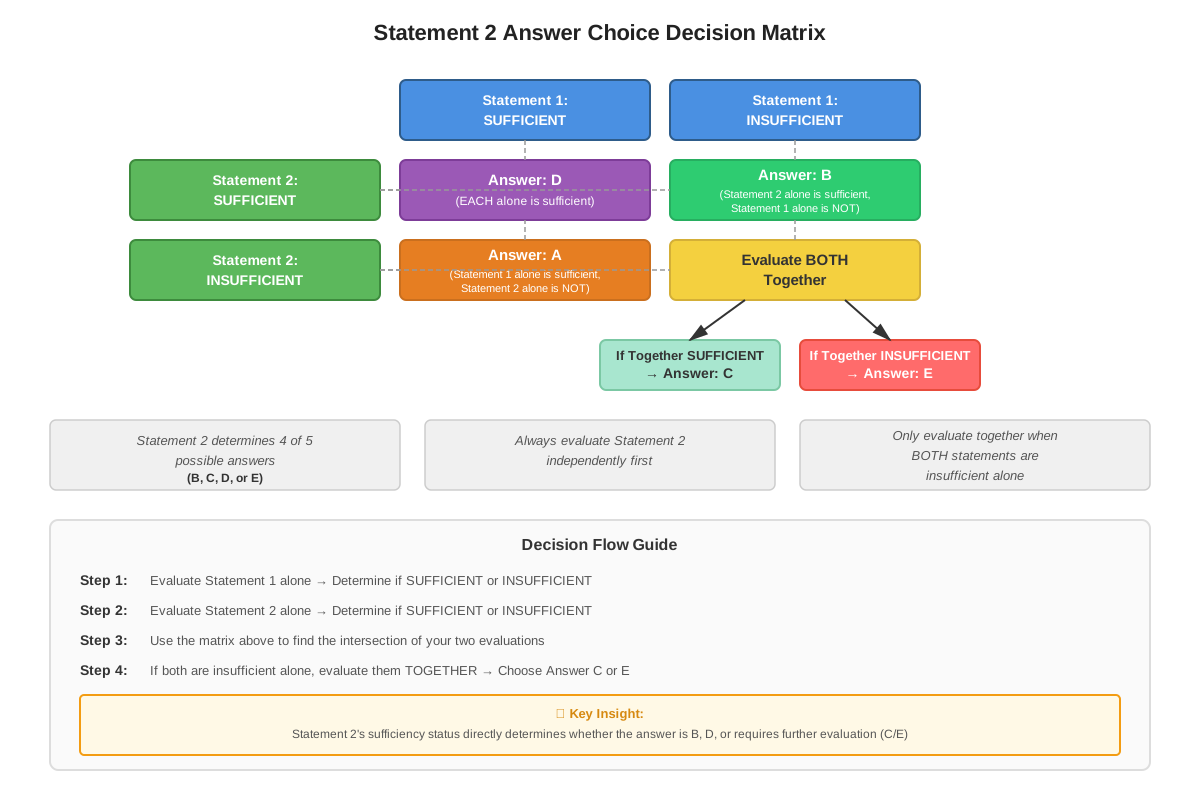
Statement 2's sufficiency status directly determines which answer choices remain viable:
| Statement 2 Status | Possible Answer Choices | Eliminated Choices |
|---|---|---|
| Sufficient alone | B or D | A, C, E |
| Not sufficient alone | A, C, or E | B, D |
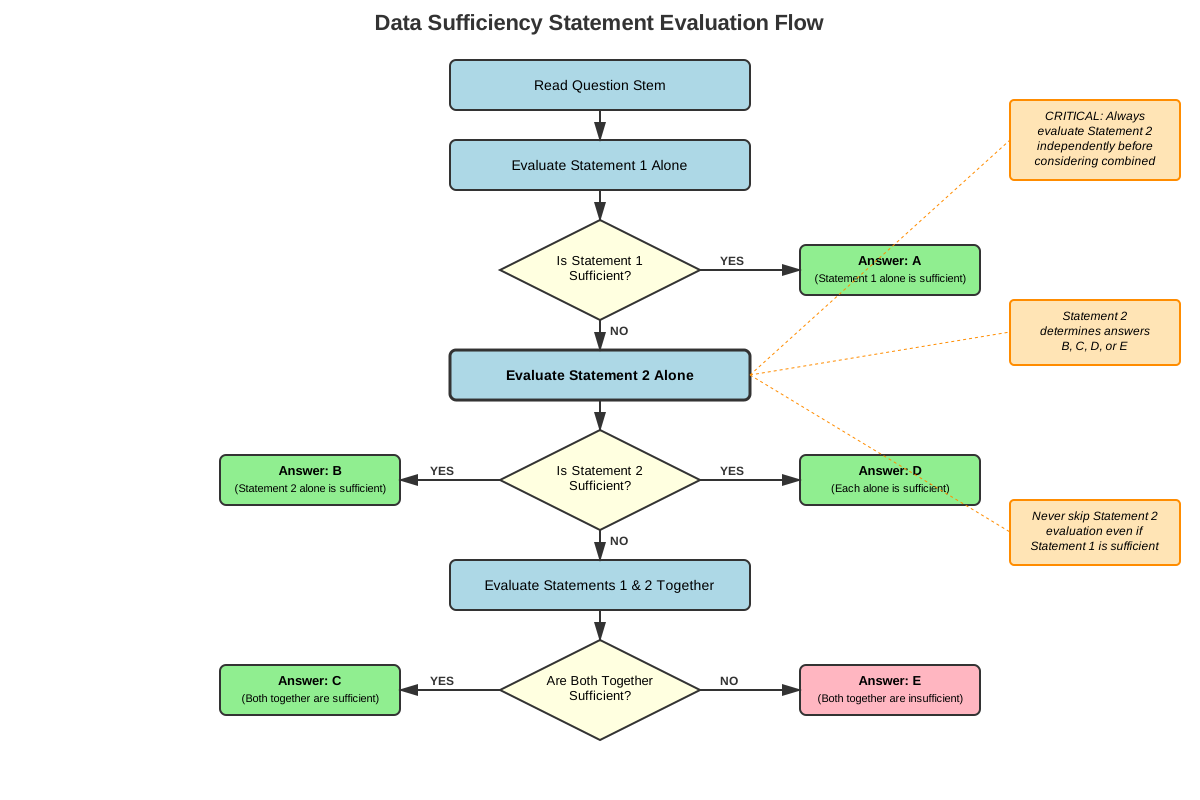
If Statement 2 alone is sufficient, the answer must be either B (Statement 2 alone is sufficient, but Statement 1 alone is not) or D (each statement alone is sufficient). If Statement 2 alone is insufficient, the answer must be A (Statement 1 alone is sufficient), C (both statements together are sufficient, but neither alone is sufficient), or E (even together, the statements are insufficient).
This decision tree structure makes Statement 2 evaluation a critical branching point in the Data Sufficiency solution process. Errors in evaluating Statement 2 eliminate the possibility of selecting the correct answer.
Combined Evaluation: When Statement 2 Matters Most
When Statement 2 alone is insufficient, the analysis proceeds to combined evaluation—determining whether Statements 1 and 2 together provide sufficient information. This step only occurs after establishing that Statement 2 alone is insufficient. The combined evaluation tests whether the two statements complement each other to create sufficiency.
In combined evaluation, Statement 2 may provide:
- A second equation when Statement 1 provided the first (enabling solution of a two-variable system)
- A constraint that limits possibilities established by Statement 1
- Additional information that completes a geometric figure or relationship
- A boundary condition that resolves an inequality
The key insight is that Statement 2's value may lie not in its independent sufficiency but in how it interacts with Statement 1 to create joint sufficiency.
Statement 2 Information Types
Statement 2 can provide information in several forms, each requiring different analytical approaches:
Direct value statements: Statement 2 directly provides a numerical value (e.g., "x = 5"). These are typically easy to evaluate for sufficiency.
Relational statements: Statement 2 establishes a relationship between variables (e.g., "x = 2y"). These require determining whether the relationship, combined with the question stem, enables a definitive answer.
Constraint statements: Statement 2 provides boundaries or limitations (e.g., "x > 0"). These narrow possibilities but may not provide complete sufficiency.
Comparative statements: Statement 2 compares quantities (e.g., "x is greater than y"). These require careful analysis of whether the comparison provides enough information.
Concept Relationships
Statement 2 analysis exists within a hierarchical framework of Data Sufficiency concepts. The evaluation process begins with understanding the question stem, which establishes what must be determined. Statement 2 analysis depends on Statement 1 evaluation having been completed first, as the sufficiency status of Statement 1 determines which answer choices remain possible when evaluating Statement 2.
The relationship flow follows this pattern: Question Stem → Statement 1 Evaluation → Statement 2 Independent Evaluation → Combined Evaluation (if needed) → Answer Selection. Each stage depends on the previous stage's conclusions. Statement 2 cannot be properly evaluated without understanding what the question asks, and combined evaluation cannot occur without first determining Statement 2's independent sufficiency status.
Statement 2 connects to broader mathematical concepts including algebraic sufficiency (whether equations can be solved), geometric completeness (whether figures can be fully defined), and logical necessity (whether conclusions can be definitively drawn). These mathematical foundations determine whether Statement 2 provides sufficient information in specific contexts.
The concept also relates to answer choice elimination strategies, as Statement 2's sufficiency status immediately eliminates three of the five possible answers. This connection makes Statement 2 evaluation a high-leverage skill for efficient test-taking.
Quick check — test yourself on Statement 2 so far.
Try Flashcards →High-Yield Facts
⭐ Statement 2 must always be evaluated independently before considering it with Statement 1—this is the most commonly violated principle in Data Sufficiency
⭐ If Statement 2 alone is sufficient, the answer is either B or D—no other answer choices are possible
⭐ Statement 2 appears in every Data Sufficiency question—making this a universal skill for the Data Insights section
⭐ The order of evaluation is always: Statement 1 alone, then Statement 2 alone, then both together (if needed)—following this sequence prevents errors
⭐ Statement 2 sufficiency does not depend on Statement 1's sufficiency status—each statement's sufficiency is independent
- Statement 2 may provide sufficient information even when Statement 1 does not, resulting in answer choice B
- For Yes/No questions, Statement 2 is sufficient if it always yields the same answer (consistently yes or consistently no)
- Statement 2 may appear simpler or more complex than Statement 1, but complexity does not correlate with sufficiency
- When Statement 2 alone is insufficient, you must still evaluate whether combining it with Statement 1 creates sufficiency
- Statement 2 can contradict Statement 1 in the sense that one is sufficient while the other is not, but they cannot provide conflicting information about the same scenario
Common Misconceptions
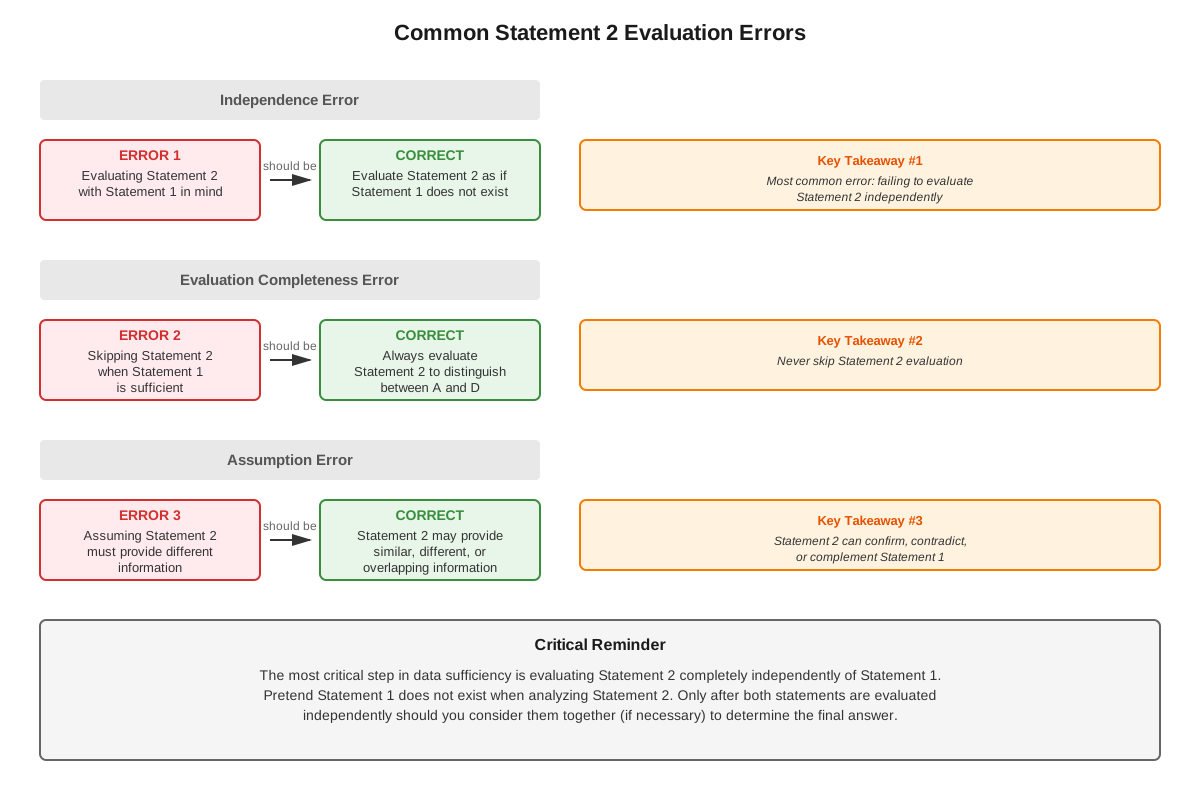
Misconception: Statement 2 should be evaluated together with Statement 1 immediately to save time → Correction: Statement 2 must first be evaluated independently to determine whether answer choices B or D are correct. Evaluating statements together prematurely eliminates the possibility of identifying when Statement 2 alone is sufficient, leading to incorrect answer selection.
Misconception: If Statement 1 was sufficient (answer choice A or D), Statement 2 doesn't matter → Correction: Even when Statement 1 is sufficient, Statement 2 must still be evaluated independently to determine whether the answer is A (only Statement 1 sufficient) or D (both statements independently sufficient). Skipping Statement 2 evaluation means choosing between two possible answers without sufficient information.
Misconception: Statement 2 provides "additional" information that builds on Statement 1 → Correction: Statement 2 is an alternative source of information, not an addition to Statement 1. When evaluating Statement 2 independently, Statement 1's information is completely disregarded. Only during combined evaluation are both statements considered together.
Misconception: A longer or more complex Statement 2 is more likely to be sufficient → Correction: The length or complexity of Statement 2 has no correlation with its sufficiency. Simple statements can be sufficient, and complex statements can be insufficient. Sufficiency depends solely on whether the information enables a definitive answer to the question.
Misconception: If Statement 2 provides a specific number, it must be sufficient → Correction: Statement 2 may provide specific numerical information that is still insufficient to answer the question. For example, if the question asks for the value of x + y, Statement 2 providing "x = 3" is insufficient without information about y.
Misconception: Statement 2 must be evaluated using the same approach as Statement 1 → Correction: While the general principle of independent evaluation applies to both statements, Statement 2 may require different analytical techniques depending on the type of information it provides. Each statement should be evaluated using the most appropriate method for the information presented.
Worked Examples
Example 1: Value Question with Statement 2 Sufficiency
Question Stem: What is the value of x?
Statement 1: x² = 16
Statement 2: x = 4
Analysis of Statement 2:
First, we evaluate Statement 2 independently, disregarding Statement 1 entirely. Statement 2 directly provides that x = 4. This is a specific, unique value for x.
Since the question asks "What is the value of x?" and Statement 2 provides exactly one value (x = 4), Statement 2 alone is sufficient to answer the question.
When Statement 2 alone is sufficient, the answer must be either B or D. To determine which, we would need to evaluate Statement 1 (which provides x² = 16, giving x = 4 or x = -4, making Statement 1 insufficient alone). Therefore, the answer is B: Statement 2 alone is sufficient, but Statement 1 alone is not sufficient.
Key Learning Point: Statement 2 providing a direct, unique value for the variable in question typically indicates sufficiency for value questions. The simplicity of Statement 2 compared to Statement 1 does not diminish its sufficiency.
Example 2: Yes/No Question Requiring Combined Evaluation
Question Stem: Is x > 0?
Statement 1: x² > 4
Statement 2: x < 3
Analysis of Statement 2:
Evaluating Statement 2 independently: "x < 3" tells us that x is less than 3, but this does not definitively answer whether x > 0.
Consider possible values: x could be 2 (which is positive, so the answer would be "yes"), or x could be -5 (which is negative, so the answer would be "no"). Since Statement 2 allows for both positive and negative values of x, it does not provide a consistent answer to the question "Is x > 0?"
Therefore, Statement 2 alone is insufficient.
Since Statement 2 alone is insufficient, we eliminate answer choices B and D. We must now consider whether combining Statements 1 and 2 provides sufficiency.
Combined Evaluation:
- Statement 1 tells us x² > 4, which means x > 2 or x < -2
- Statement 2 tells us x < 3
- Together: x must satisfy both conditions, so x is either in the range (2, 3) or x < -2
This still allows for both positive values (between 2 and 3) and negative values (less than -2), so even together, the statements are insufficient.
The answer is E: Both statements together are still insufficient.
Key Learning Point: For Yes/No questions, Statement 2 is insufficient if it allows for scenarios that produce both "yes" and "no" answers. Testing extreme or boundary values helps identify whether Statement 2 provides consistent answers.
Exam Strategy
When approaching Statement 2 on the GMAT, implement a systematic evaluation process to avoid common errors. After completing Statement 1 analysis, mentally reset and approach Statement 2 as if it were the only additional information provided. This mental reset is crucial for maintaining analytical independence.
Trigger words and phrases in Statement 2 that indicate potential sufficiency include: "exactly," "unique," "only," "must be," and specific numerical values. These words often signal that Statement 2 provides definitive information. Conversely, words like "could be," "at least," "at most," or "some" suggest that Statement 2 may provide constraints without complete sufficiency.
Process-of-elimination strategy: After evaluating Statement 2 independently, immediately eliminate three answer choices based on your sufficiency determination. If Statement 2 is sufficient, eliminate A, C, and E. If Statement 2 is insufficient, eliminate B and D. This elimination narrows your focus and reduces the cognitive load for the remaining analysis.
Time allocation: Spend approximately 30-45 seconds evaluating Statement 2 independently. Avoid the temptation to rush through Statement 2 because you've already analyzed Statement 1. Each statement deserves equal analytical attention. If Statement 2 appears complex, resist performing extensive calculations—focus on conceptual sufficiency rather than numerical computation.
Common traps to avoid: The GMAT often designs Statement 2 to appear sufficient when it is not, or vice versa. Be particularly cautious when Statement 2 seems obviously sufficient or insufficient—this may indicate a trap. Always verify your sufficiency determination by considering edge cases or alternative scenarios.
Strategic approach for combined evaluation: If Statement 2 alone is insufficient, quickly assess whether it complements Statement 1. Look for situations where Statement 2 provides a second equation, an additional constraint, or information that resolves ambiguity from Statement 1. If no clear complementary relationship exists, answer choice E becomes more likely.
Memory Techniques
The "2-B-D" Mnemonic: Remember that Statement 2 sufficiency leads to answer choices B or D. The number 2 in "Statement 2" connects to the letters B and D, which are the 2nd and 4th letters of the alphabet. This helps recall which answer choices remain when Statement 2 is sufficient.
The Independence Mantra: Before evaluating Statement 2, mentally repeat: "Statement 1 does not exist." This reinforces the independence principle and prevents unconscious incorporation of Statement 1 information.
The Reset Visualization: Visualize physically erasing or covering Statement 1 before reading Statement 2. This mental imagery helps maintain analytical separation between the statements.
The Sufficiency Checklist Acronym - DICE:
- Definitive answer possible?
- Independent from Statement 1?
- Consistent for all scenarios?
- Enough information alone?
Running through this checklist ensures thorough Statement 2 evaluation.
The Answer Choice Tree: Visualize a decision tree where Statement 2 evaluation creates a fork: one path leads to {B, D} and the other to {A, C, E}. This visual representation reinforces how Statement 2 analysis eliminates answer choices.
Summary
Statement 2 represents the second piece of information in GMAT Data Sufficiency questions and must be evaluated independently to determine whether it alone provides sufficient information to answer the question stem. The critical principle is maintaining analytical independence—evaluating Statement 2 without considering Statement 1's information. This independent evaluation determines whether answer choices B or D are correct (Statement 2 sufficient) or whether choices A, C, or E remain viable (Statement 2 insufficient). After determining Statement 2's independent sufficiency status, combined evaluation may be necessary to assess whether both statements together provide sufficiency. Mastery of Statement 2 analysis requires systematic evaluation, recognition of sufficiency patterns, and disciplined adherence to the independence principle. This skill is essential because Data Sufficiency questions comprise a significant portion of the Data Insights section, and proper Statement 2 evaluation directly determines answer choice selection in every such question.
Key Takeaways
- Statement 2 must always be evaluated independently before considering it with Statement 1—this independence is the foundation of correct Data Sufficiency analysis
- If Statement 2 alone is sufficient, the answer is either B or D; if insufficient, the answer is A, C, or E—this immediate elimination of three answer choices makes Statement 2 evaluation high-leverage
- Sufficiency means being able to definitively answer the question, not necessarily performing the complete calculation—conceptual understanding often suffices
- For Yes/No questions, Statement 2 is sufficient only if it produces a consistent answer (always yes or always no) across all possible scenarios
- The evaluation sequence is always: Statement 1 alone → Statement 2 alone → both together (if needed)—following this order prevents analytical errors
- Statement 2 may provide direct values, relationships, constraints, or comparisons—each type requires different analytical approaches to determine sufficiency
- Combined evaluation only occurs after determining that Statement 2 alone is insufficient—premature combination is a common source of errors
Related Topics
Statement 1 Evaluation: Understanding how to evaluate Statement 1 using the same independence principles applied to Statement 2, forming the foundation for complete Data Sufficiency mastery
Combined Statement Analysis: Techniques for evaluating whether Statements 1 and 2 together provide sufficient information when neither alone is sufficient, including recognizing complementary information patterns
Data Sufficiency Answer Choices: Deep understanding of what each answer choice (A, B, C, D, E) represents and how statement sufficiency maps to answer selection
Yes/No Question Strategies: Specialized approaches for Data Sufficiency questions that ask whether a condition is true, requiring consistent answers rather than unique values
Value Question Strategies: Techniques specific to Data Sufficiency questions asking for numerical values, including recognizing when unique values can be determined
Mastering Statement 2 evaluation enables progression to advanced Data Sufficiency topics including pattern recognition, rapid sufficiency assessment, and integrated reasoning across multiple statements.
Practice CTA
Now that you understand the principles and strategies for evaluating Statement 2, it's time to apply this knowledge through deliberate practice. Attempt the practice questions focusing specifically on maintaining analytical independence when evaluating Statement 2. Use the flashcards to reinforce the key concepts, particularly the relationship between Statement 2 sufficiency and answer choice elimination. Remember that mastery comes through repeated application of the systematic evaluation process—each practice question is an opportunity to strengthen your analytical discipline and improve your Data Sufficiency performance. Your ability to correctly evaluate Statement 2 will directly impact your Data Insights score, making this practice time a high-yield investment in your GMAT preparation.
Sign up free to keep reading
Create a free AnvayaPrep account to finish this GMAT guide on Statement 2 — plus flashcards and practice questions.