Overview
Scatterplots are one of the most frequently tested graphical representations in the GMAT Data Insights section, appearing in Graphics Interpretation questions where test-takers must analyze visual data and draw accurate conclusions. A scatterplot displays the relationship between two quantitative variables by plotting individual data points on a coordinate plane, with one variable on the x-axis and another on the y-axis. Understanding how to quickly interpret patterns, trends, and correlations in scatterplots is essential for success on the GMAT, as these questions test both analytical reasoning and the ability to extract precise information from visual data under time pressure.
The importance of mastering GMAT scatterplots cannot be overstated. These graphics appear regularly in the Data Insights section, often requiring test-takers to identify trends, estimate values, recognize outliers, and determine the strength and direction of relationships between variables. Unlike simple bar charts or pie graphs, scatterplots demand a more sophisticated understanding of statistical relationships and the ability to mentally process two-dimensional data distributions. Questions may ask about correlation strength, trend lines, data clusters, or specific data point characteristics.
Within the broader Data Insights framework, scatterplots connect to fundamental concepts of data analysis, statistical reasoning, and quantitative interpretation. They bridge the gap between raw numerical data and visual pattern recognition, requiring students to integrate mathematical reasoning with graphical literacy. Mastery of scatterplots also supports understanding of regression analysis, correlation coefficients, and predictive modeling—concepts that appear throughout business school curricula and real-world data analysis scenarios.
Learning Objectives
- [ ] Identify scatterplots among various graphical representations
- [ ] Explain the components, structure, and purpose of scatterplots
- [ ] Apply scatterplot interpretation skills to GMAT questions
- [ ] Determine the direction and strength of correlations from scatterplot patterns
- [ ] Recognize and interpret outliers, clusters, and data distributions in scatterplots
- [ ] Estimate values and trends from scatterplot data points accurately
- [ ] Distinguish between correlation and causation in scatterplot contexts
Prerequisites
- Basic coordinate plane understanding: Familiarity with x-axis and y-axis orientation is essential for locating and interpreting data points on scatterplots
- Fundamental statistics concepts: Knowledge of mean, median, and range helps in understanding data distribution patterns
- Correlation basics: Understanding that variables can move together (positive), move opposite (negative), or show no relationship (zero correlation)
- Graph reading skills: Ability to extract information from axes labels, scales, and legends
- Algebraic reasoning: Comfort with linear relationships and slope concepts aids in recognizing trend patterns
Why This Topic Matters
Scatterplots represent a critical intersection of visual reasoning and quantitative analysis that appears throughout business, economics, and scientific research. In real-world applications, professionals use scatterplots to identify market trends, analyze customer behavior patterns, evaluate investment correlations, assess quality control in manufacturing, and explore relationships between business metrics. The ability to quickly interpret these visualizations is a fundamental skill for data-driven decision-making in modern business environments.
On the GMAT, scatterplot questions appear with high frequency in the Data Insights section, particularly within Graphics Interpretation question types. Test statistics indicate that approximately 15-20% of Data Insights questions involve some form of graphical interpretation, with scatterplots being among the top three most common graph types tested. These questions typically appear in the medium to medium-hard difficulty range, making them critical for achieving competitive scores in the 600-700+ range.
GMAT scatterplot questions commonly present scenarios involving business metrics (sales vs. advertising spend, price vs. demand), demographic data (age vs. income, education vs. salary), or performance indicators (experience vs. productivity, investment vs. return). Questions may ask test-takers to complete statements by selecting from dropdown menus, requiring precise interpretation of correlation direction, strength, outlier identification, or trend estimation. The ability to process these graphics quickly and accurately directly impacts both score and time management during the exam.
Core Concepts
Structure and Components of Scatterplots
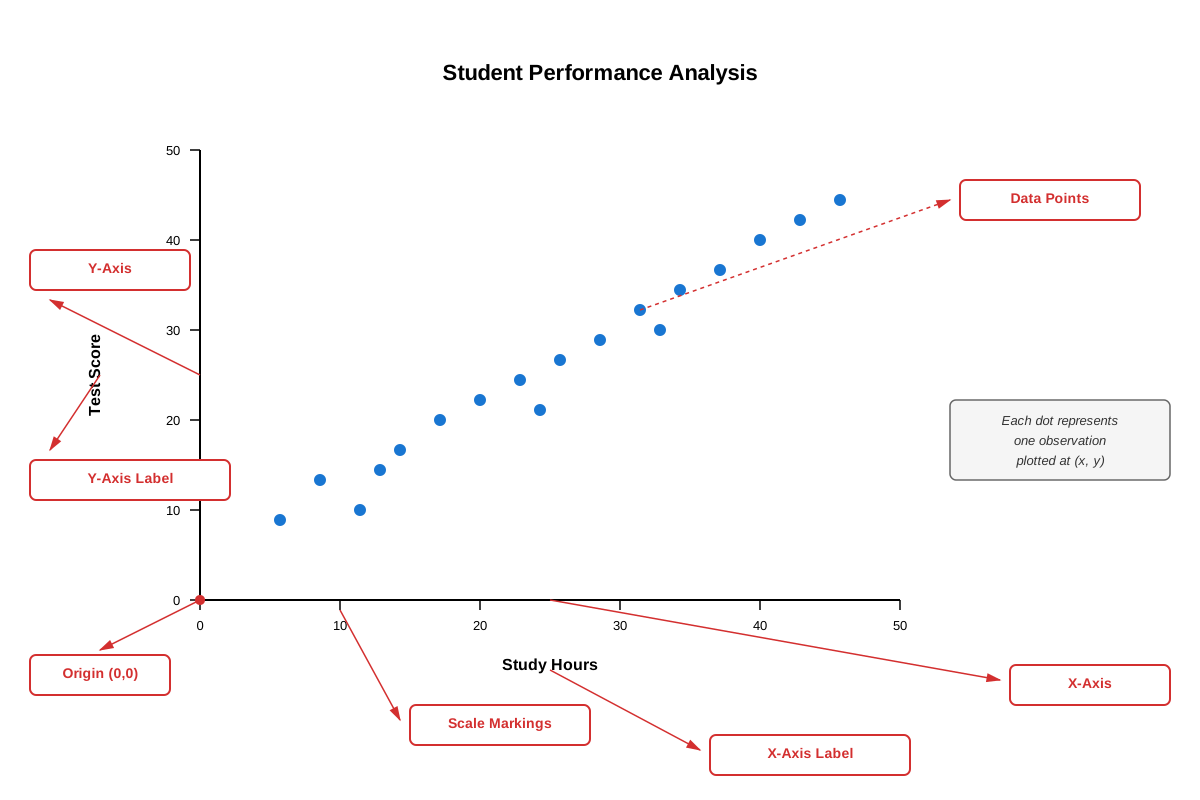
A scatterplot consists of individual data points plotted on a two-dimensional coordinate system, where each point represents a single observation with values for two different variables. The horizontal axis (x-axis) typically represents the independent or explanatory variable, while the vertical axis (y-axis) represents the dependent or response variable. Each plotted point's position is determined by its x-coordinate and y-coordinate values, creating a visual pattern that reveals the relationship between the two variables.
Key structural elements include:
- Axes labels: Clearly identify which variables are being compared
- Scale markings: Indicate the numerical values along each axis
- Data points: Individual dots or markers representing observations
- Legend (when applicable): Explains different point colors, shapes, or sizes when multiple data series are displayed
- Trend line (optional): A line of best fit that may be superimposed to show the general direction of the relationship
Types of Correlation Patterns
Understanding correlation patterns is fundamental to scatterplot interpretation. The arrangement of data points reveals the nature and strength of the relationship between variables.
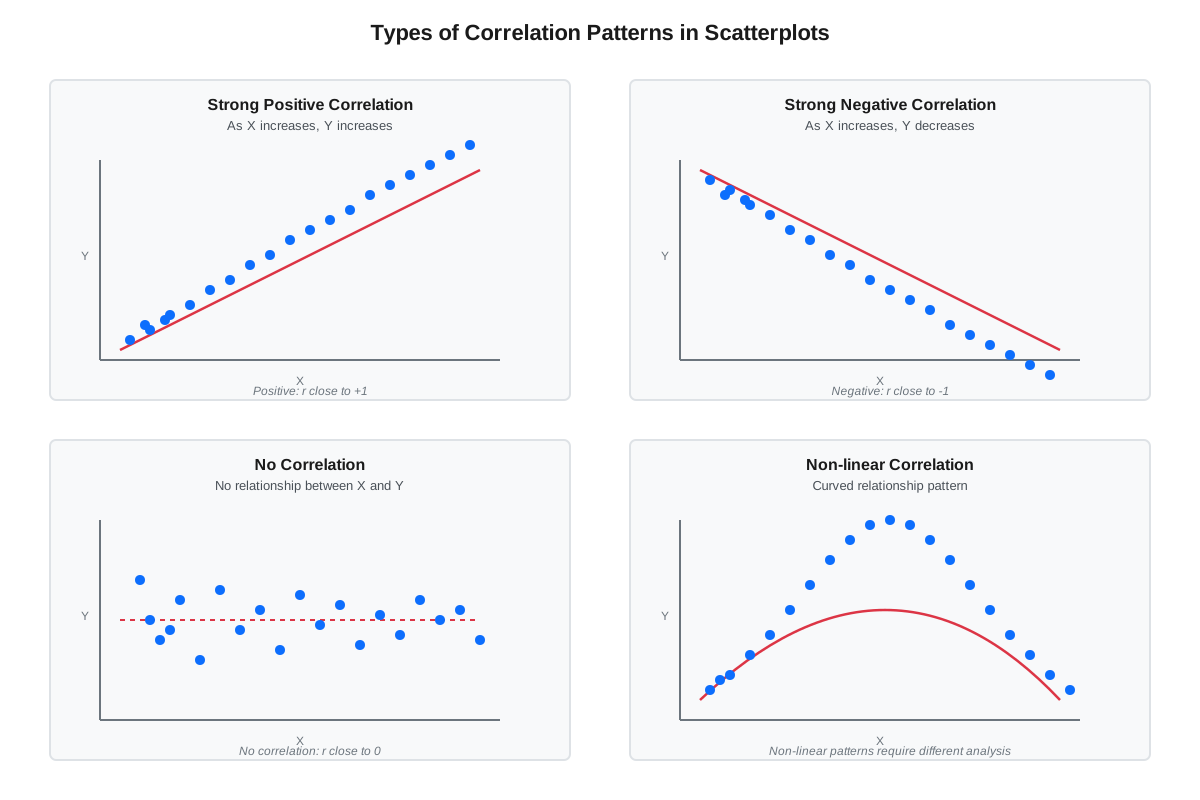
Positive Correlation: When data points form a pattern that rises from left to right, the variables have a positive relationship. As one variable increases, the other tends to increase as well. The closer the points cluster around an imaginary upward-sloping line, the stronger the positive correlation. For example, a scatterplot showing hours studied versus exam scores would typically display positive correlation.
Negative Correlation: When data points form a pattern that falls from left to right, the variables have a negative (or inverse) relationship. As one variable increases, the other tends to decrease. A scatterplot of vehicle age versus resale value would demonstrate negative correlation, with older vehicles generally commanding lower prices.
No Correlation: When data points appear randomly scattered with no discernible pattern, the variables show little or no linear relationship. The points do not cluster around any particular line or curve. For instance, a scatterplot of shoe size versus test scores would likely show no correlation.
Correlation Strength Assessment
The strength of correlation is determined by how tightly data points cluster around an imaginary trend line:
| Correlation Strength | Visual Pattern | Point Distribution |
|---|---|---|
| Strong | Points form a narrow band | Minimal scatter from trend line |
| Moderate | Points show clear direction but wider spread | Noticeable deviation from trend line |
| Weak | Points loosely follow a direction | Substantial scatter with barely discernible pattern |
| None | Random distribution | No pattern whatsoever |
On the GMAT, questions may ask test-takers to characterize correlation strength using terms like "strong," "moderate," "weak," or "negligible." The ability to quickly assess this visually is crucial for time management.
Outliers and Anomalies
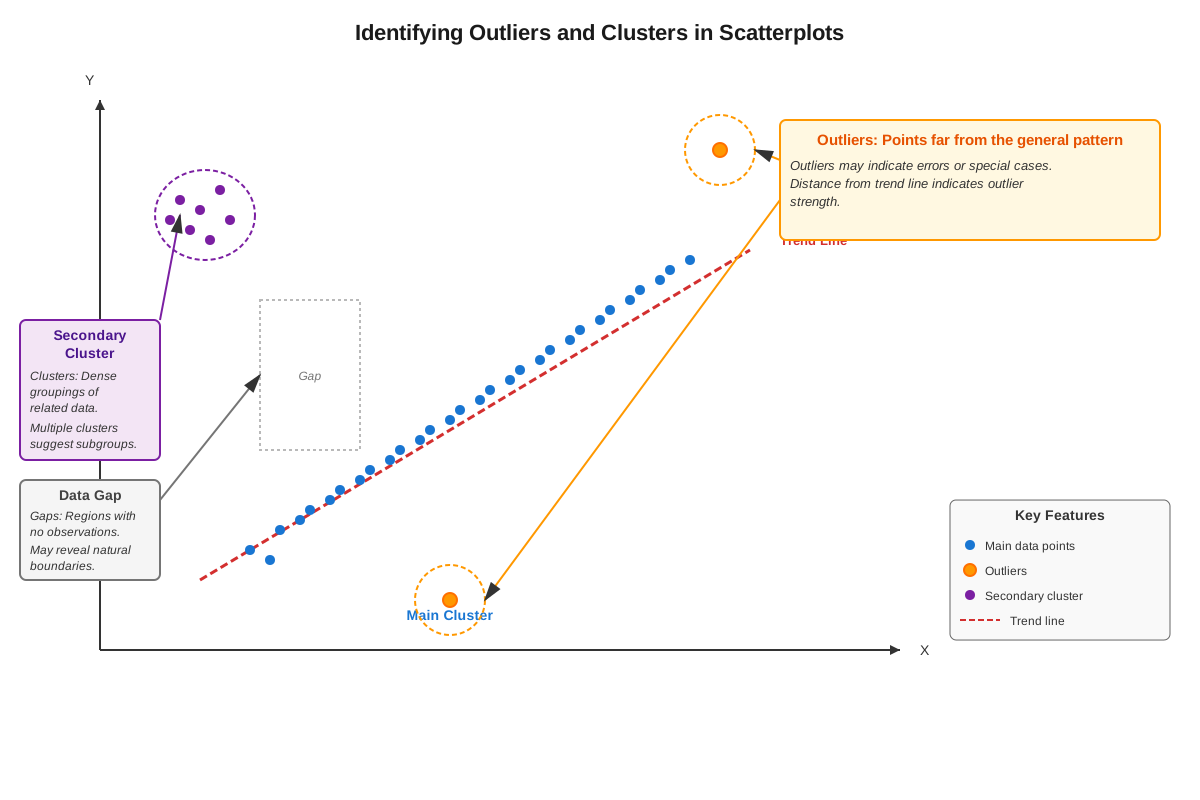
Outliers are data points that deviate significantly from the overall pattern established by the majority of observations. These points appear isolated from the main cluster and may indicate unusual cases, measurement errors, or genuinely exceptional observations. On GMAT scatterplots, identifying outliers is a common task, as questions may ask which data point represents an exception to the general trend or which observation is most unusual.
Outliers can significantly affect statistical measures and trend interpretations. A single extreme outlier can distort the apparent correlation strength or shift the position of a trend line. GMAT questions may test whether students recognize that removing an outlier would strengthen or weaken an apparent correlation.
Clusters and Data Distribution
Data points may form distinct clusters—groups of observations that are closer to each other than to other points. Clustering can indicate subgroups within the data or different categories of observations. For example, a scatterplot of income versus spending might show two distinct clusters representing different demographic groups with different spending patterns.
Understanding data distribution across the scatterplot helps in recognizing:
- Dense regions: Areas with many overlapping or closely spaced points
- Sparse regions: Areas with few or no observations
- Gaps: Ranges of values where no data exists
- Boundaries: Natural limits where data points cannot exist (e.g., negative values for inherently positive quantities)
Trend Lines and Predictions
While not always present, trend lines (or lines of best fit) are straight lines drawn through the data to represent the general direction of the relationship. These lines minimize the overall distance from all data points and provide a visual summary of the correlation. On the GMAT, trend lines help test-takers:
- Estimate values for data points not explicitly shown
- Predict outcomes for new observations
- Assess how well individual points conform to the general pattern
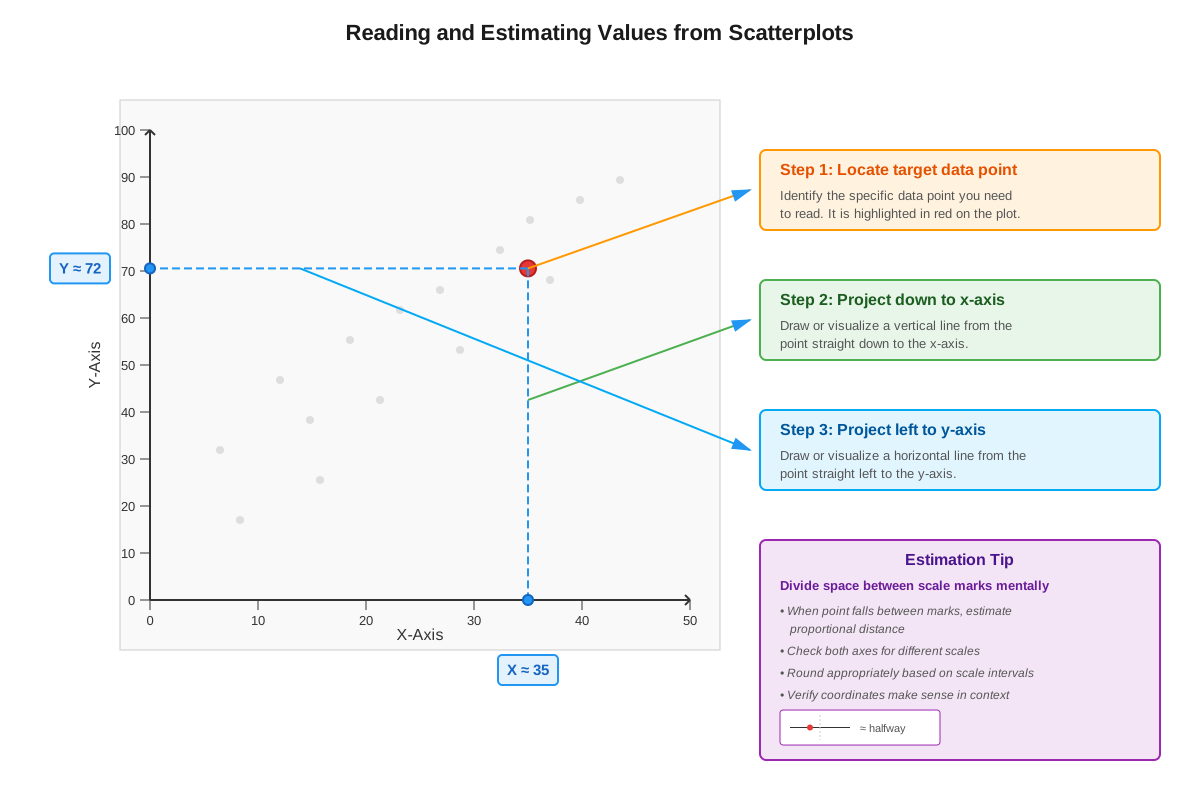
When a trend line is present, questions may ask about the approximate y-value for a given x-value, or vice versa. The ability to mentally extend or interpolate along the trend line is a valuable skill for these questions.
Non-Linear Relationships
While most GMAT scatterplots focus on linear relationships, some may display non-linear patterns such as:
- Curved relationships: Points form an arc or curve rather than a straight line
- Exponential patterns: Rapid increase or decrease that accelerates
- Logarithmic patterns: Rapid initial change that levels off
Recognizing when a relationship is non-linear prevents misinterpretation. A curved pattern does not indicate "no correlation"—it indicates a non-linear correlation that cannot be adequately described by a straight trend line.
Concept Relationships
The concepts within scatterplot interpretation form an interconnected framework where each element builds upon others. Scatterplot structure (axes, scales, points) provides the foundation → enabling pattern recognition (positive, negative, or no correlation) → which leads to correlation strength assessment (strong, moderate, weak) → while simultaneously identifying outliers and clusters → all of which inform trend analysis and prediction capabilities.
Understanding basic coordinate plane geometry (prerequisite knowledge) directly enables the ability to locate and interpret individual data points on scatterplots. Statistical concepts of mean and distribution connect to recognizing where data clusters and how spread affects correlation strength. The distinction between correlation and causation—a critical reasoning concept—prevents overinterpretation of scatterplot patterns.
Scatterplots also connect forward to more advanced Data Insights topics including regression analysis, multi-variable graphics, and integrated reasoning questions that combine multiple data sources. Mastery of scatterplot interpretation provides the visual reasoning foundation necessary for tackling complex multi-part data analysis questions that appear later in the GMAT Data Insights section.
High-Yield Facts
⭐ Scatterplots display the relationship between two quantitative variables using individual data points on a coordinate plane
⭐ Positive correlation appears as an upward-sloping pattern from left to right; negative correlation slopes downward
⭐ Correlation strength is determined by how tightly points cluster around an imaginary trend line
⭐ Outliers are data points that deviate significantly from the overall pattern and may affect correlation interpretation
⭐ No correlation means variables are independent; points appear randomly scattered with no discernible pattern
- The x-axis typically represents the independent variable, while the y-axis represents the dependent variable
- Strong correlations show points forming a narrow band; weak correlations show widely scattered points
- Clusters indicate subgroups or categories within the data that may have different characteristics
- Correlation does not imply causation—two variables can be correlated without one causing the other
- Trend lines help estimate values and make predictions but represent approximations, not exact relationships
- Non-linear patterns (curves) still represent relationships but cannot be described by straight trend lines
- Scale matters: the same data can appear to show different correlation strengths depending on axis scaling
Quick check — test yourself on Scatterplots so far.
Try Flashcards →Common Misconceptions
Misconception: A scatterplot with widely scattered points means there is no relationship between variables → Correction: Wide scatter indicates weak correlation, not necessarily zero correlation. If points still show a general directional trend (upward or downward), a weak correlation exists. Only completely random distribution indicates no correlation.
Misconception: Correlation in a scatterplot proves that one variable causes changes in the other → Correction: Correlation only indicates that variables tend to change together; it does not establish causation. Both variables might be influenced by a third factor, or the relationship might be coincidental. GMAT questions specifically test the ability to distinguish correlation from causation.
Misconception: All scatterplots should have trend lines → Correction: Trend lines are analytical tools added to help visualize patterns, but they are not inherent components of scatterplots. Many GMAT scatterplots present raw data without trend lines, requiring test-takers to mentally assess the pattern.
Misconception: Outliers should be ignored when interpreting scatterplots → Correction: Outliers are important data points that may represent exceptional cases, errors, or special circumstances. GMAT questions frequently ask about outliers specifically, testing whether students can identify them and understand their significance.
Misconception: A scatterplot with no clear pattern means the data is flawed or the graph is incorrect → Correction: No correlation is a valid finding. Many variable pairs genuinely have no relationship, and a random scatter pattern correctly represents this independence. This is different from a weak correlation, where some directional tendency exists.
Misconception: The variable on the x-axis always causes changes in the y-axis variable → Correction: While x-axis typically represents the independent variable and y-axis the dependent variable, this convention does not prove causation. The axes assignment is often arbitrary or based on convention rather than causal relationships.
Worked Examples
Example 1: Correlation Strength and Direction
Question: A scatterplot displays the relationship between years of professional experience (x-axis, ranging from 0 to 20 years) and annual salary in thousands of dollars (y-axis, ranging from 40 to 120). The data points form a pattern that rises from the lower left to the upper right, with most points falling within a relatively narrow band around an imaginary upward-sloping line. However, one point at (15 years, 55 thousand) appears well below the main cluster. Which statement is most accurate?
A) The scatterplot shows a strong negative correlation between experience and salary
B) The scatterplot shows a weak positive correlation with one significant outlier
C) The scatterplot shows a strong positive correlation with one significant outlier
D) The scatterplot shows no correlation because of the presence of an outlier
Solution:
Step 1: Identify the correlation direction. The pattern rises from lower left to upper right, indicating that as experience increases, salary tends to increase. This is positive correlation, eliminating option A.
Step 2: Assess correlation strength. The problem states that "most points fall within a relatively narrow band," which indicates strong correlation, not weak. This eliminates option B.
Step 3: Identify outliers. The point at (15 years, 55 thousand) is described as "well below the main cluster." Someone with 15 years of experience earning only $55,000 when the trend suggests they should earn significantly more represents a significant outlier.
Step 4: Evaluate the impact of the outlier. One outlier does not eliminate the correlation pattern established by the majority of data points. The overall pattern still shows strong positive correlation despite this exception. This eliminates option D.
Answer: C - The scatterplot shows a strong positive correlation (experience and salary increase together, with points tightly clustered) with one significant outlier (the person with 15 years earning only $55,000).
Learning Objective Connection: This example demonstrates the ability to identify correlation direction, assess correlation strength, recognize outliers, and understand that outliers do not negate overall patterns—all critical skills for GMAT scatterplot questions.
Example 2: Estimation and Prediction
Question: A scatterplot shows the relationship between advertising expenditure in thousands of dollars (x-axis) and monthly sales in units (y-axis) for a retail company. The data points show a clear positive correlation with a trend line drawn through them. The trend line passes through approximately (10, 200) and (30, 400). Based on this trend line, if the company spends $25,000 on advertising, approximately how many units would be expected to sell?
Solution:
Step 1: Identify the two known points on the trend line: (10, 200) and (30, 400).
Step 2: Calculate the slope of the trend line:
Slope = (y₂ - y₁) / (x₂ - x₁) = (400 - 200) / (30 - 10) = 200 / 20 = 10This means for every additional $1,000 in advertising, sales increase by approximately 10 units.
Step 3: Use the point-slope form to find the equation. Using point (10, 200):
y - 200 = 10(x - 10)
y - 200 = 10x - 100
y = 10x + 100
Step 4: Substitute x = 25 (representing $25,000):
y = 10(25) + 100 = 250 + 100 = 350Answer: Approximately 350 units would be expected to sell with $25,000 in advertising expenditure.
Alternative Approach (useful under time pressure): Since 25 is exactly halfway between 10 and 30, and the relationship is linear, the y-value should be approximately halfway between 200 and 400, which is 300. Adding a small adjustment for the positive intercept gives approximately 350.
Learning Objective Connection: This example demonstrates applying scatterplot interpretation to make predictions, estimate values from trend lines, and use mathematical reasoning to solve GMAT-style questions involving graphical data.
Exam Strategy
When approaching GMAT scatterplot questions, begin by quickly scanning the axes labels and scales to understand what variables are being compared and their ranges. This orientation takes only 5-10 seconds but prevents misinterpretation of the entire question. Pay special attention to units (thousands, millions, percentages) as these frequently appear in answer choices.
Trigger words and phrases to watch for include:
- "Strong/weak/moderate correlation" → assess how tightly points cluster
- "Positive/negative relationship" → determine pattern direction
- "Outlier" or "exception" → look for isolated points away from the main cluster
- "Approximately" or "estimate" → indicates you should use the trend line or visual approximation rather than precise calculation
- "Based on the trend" → focus on the overall pattern, not individual points
- "If this pattern continues" → requires extrapolation beyond the shown data range
For process-of-elimination, immediately eliminate answer choices that:
- Reverse the correlation direction (positive vs. negative)
- Mischaracterize correlation strength (calling a tight cluster "weak" or scattered points "strong")
- Claim causation when only correlation is shown
- Ignore obvious outliers or claim outliers where none exist
- Provide values far outside the reasonable range suggested by the trend
Time allocation for scatterplot questions should be approximately 2-2.5 minutes. Spend 15-20 seconds understanding the graph, 30-45 seconds analyzing the pattern, and the remaining time evaluating answer choices. If a question requires calculation (like estimating from a trend line), budget an extra 30 seconds but use approximation techniques rather than precise arithmetic when possible.
Exam Tip: When questions ask you to complete statements using dropdown menus, read all options for each dropdown before making selections. Sometimes the options for the second dropdown can provide clues about the correct choice for the first dropdown.
Memory Techniques
PNNS Mnemonic for correlation types:
- Positive: Points go uP from left to right
- Negative: Points go dowN from left to right
- None: No pattern, points are Nowhere in particular
- Strength: Scatter determines strength (less scatter = stronger)
Visualization Strategy: When assessing correlation strength, imagine trying to draw a straight line through the points. If you could draw a narrow tube around your line that captures most points, it's strong. If you need a wide tube, it's weak. If no tube orientation works, there's no correlation.
OUTLIER Acronym for identifying exceptional points:
- Obviously separated from the cluster
- Unusual compared to the trend
- Typically far from the imaginary trend line
- Located in sparse regions of the graph
- Isolated from neighboring points
- Exceptional in at least one dimension
- Removal would strengthen the apparent correlation
The "Handshake Test": For correlation direction, imagine the scatterplot as two people shaking hands. If the handshake goes upward (positive slope), they're agreeing (positive correlation). If it goes downward (negative slope), one is pulling away (negative correlation). If hands are all over the place, they can't agree (no correlation).
Summary
Scatterplots are essential graphical tools in GMAT Data Insights that display relationships between two quantitative variables through individual data points plotted on a coordinate plane. Mastery requires the ability to quickly identify correlation direction (positive, negative, or none), assess correlation strength (strong, moderate, or weak) based on point clustering, recognize outliers that deviate from patterns, and make accurate estimations using trend lines. The x-axis typically represents the independent variable while the y-axis shows the dependent variable, though this convention does not imply causation. GMAT questions test whether students can extract precise information from these graphics, distinguish between correlation and causation, identify exceptional data points, and make predictions based on observed patterns. Success requires both visual pattern recognition and quantitative reasoning skills, with emphasis on quick assessment techniques that support efficient time management during the exam.
Key Takeaways
- Scatterplots reveal relationships between two variables through the spatial arrangement of data points on a coordinate plane
- Positive correlation slopes upward (both variables increase together); negative correlation slopes downward (one increases as the other decreases)
- Correlation strength depends on clustering tightness—narrow bands indicate strong correlation, wide scatter indicates weak correlation
- Outliers are isolated points that deviate significantly from the overall pattern and frequently appear in GMAT questions
- Correlation does not prove causation; variables can be related without one causing changes in the other
- Trend lines enable estimation and prediction but represent approximations of the general pattern
- Quick visual assessment of direction and strength is more valuable than precise calculation for most GMAT scatterplot questions
Related Topics
Regression Analysis: Building on scatterplot interpretation, regression analysis quantifies relationships through mathematical equations and correlation coefficients. Mastering scatterplots provides the visual foundation for understanding regression concepts.
Multi-Variable Graphics: Advanced Data Insights questions may present scatterplots with additional dimensions represented by point size, color, or shape. Scatterplot mastery enables progression to these more complex visualizations.
Line Graphs and Trend Analysis: While line graphs connect sequential data points, they share with scatterplots the concept of trend identification and pattern recognition. Skills transfer between these graphic types.
Statistical Measures: Understanding mean, median, standard deviation, and variance enhances scatterplot interpretation by providing quantitative context for visual patterns of data distribution and clustering.
Integrated Reasoning Questions: Scatterplots frequently appear alongside tables, text passages, or other graphics in multi-part questions that require synthesizing information from multiple sources.
Practice CTA
Now that you've mastered the fundamentals of scatterplot interpretation, it's time to reinforce your learning through active practice. Attempt the practice questions designed specifically for this topic, focusing on applying the correlation assessment techniques, outlier identification strategies, and estimation methods covered in this guide. Use the flashcards to drill high-yield facts and test your ability to quickly recognize patterns under time pressure. Remember, consistent practice with immediate feedback is the most effective way to transform knowledge into the automatic pattern recognition skills that drive high GMAT scores. Your investment in mastering scatterplots will pay dividends throughout the Data Insights section and beyond!
Sign up free to keep reading
Create a free AnvayaPrep account to finish this GMAT guide on Scatterplots — plus flashcards and practice questions.