Overview
Trend identification is a fundamental skill within the GMAT Data Insights section, specifically under Graphics Interpretation questions. This competency requires test-takers to analyze visual data representations—such as line graphs, scatter plots, bar charts, and combination charts—and accurately describe the patterns, directions, and relationships displayed. On the GMAT, GMAT trend identification questions assess whether candidates can extract meaningful insights from graphical data and translate visual information into precise verbal or quantitative statements.
Mastering trend identification is essential because Graphics Interpretation questions appear consistently on the GMAT, and they often combine multiple analytical skills: reading axes and scales, understanding data relationships, recognizing rates of change, and distinguishing between correlation and causation. These questions typically present two dropdown statements that must be completed by selecting the correct option from several choices. The ability to quickly and accurately identify trends—whether linear, exponential, cyclical, or irregular—directly impacts both accuracy and time management during the exam.
Within the broader Data Insights framework, trend identification serves as a bridge between raw data presentation and analytical reasoning. It connects to table analysis (interpreting numerical patterns), multi-source reasoning (synthesizing information across formats), and quantitative reasoning (calculating rates and relationships). Strong trend identification skills enable test-takers to move beyond simply reading data points to understanding the story the data tells, making it one of the highest-yield skills for GMAT success.
Learning Objectives
- [ ] Identify trend identification patterns in various graphical formats (line graphs, scatter plots, bar charts)
- [ ] Explain trend identification concepts including direction, magnitude, and consistency of patterns
- [ ] Apply trend identification to GMAT questions by selecting accurate statements from dropdown menus
- [ ] Distinguish between different types of trends (linear, exponential, cyclical, constant, irregular)
- [ ] Quantify trends by calculating approximate rates of change and percentage increases/decreases
- [ ] Recognize the difference between correlation and causation in trend analysis
- [ ] Evaluate the strength and reliability of trends based on data density and variability
Prerequisites
- Basic graph reading skills: Understanding axes, scales, legends, and data point interpretation is fundamental to identifying any pattern within graphical data
- Percentage calculations: Many trend questions require calculating percentage change or growth rates to describe the magnitude of change accurately
- Ratio and proportion concepts: Comparing relative changes across different variables or time periods relies on proportional reasoning
- Basic statistical awareness: Familiarity with concepts like average, range, and outliers helps in assessing trend consistency and reliability
Why This Topic Matters
Trend identification appears in approximately 15-20% of Data Insights questions on the GMAT, making it one of the most frequently tested skills in this section. Business schools value this competency because managers, consultants, and analysts must regularly interpret performance metrics, market data, financial trends, and operational statistics presented in visual formats. The ability to quickly extract actionable insights from graphs directly translates to real-world business decision-making.
In practical applications, trend identification enables professionals to forecast future performance, identify emerging opportunities or risks, compare competitive positions, and communicate data-driven recommendations to stakeholders. Whether analyzing quarterly revenue growth, customer acquisition trends, supply chain efficiency metrics, or market share evolution, the skill of accurately reading and describing trends is indispensable in modern business environments.
On the GMAT, trend identification questions typically appear as Graphics Interpretation items with two dropdown statements. Common formats include: describing the relationship between two variables, identifying which variable shows the strongest growth, determining approximate percentage changes over time periods, or selecting statements about correlation strength. These questions often integrate multiple analytical layers—requiring test-takers to read scales accurately, perform mental calculations, and select precise language that matches the data pattern exactly.
Core Concepts
Understanding Trend Direction
The most fundamental aspect of trend identification involves determining the direction of change in data over time or across categories. Trends can be increasing (moving upward), decreasing (moving downward), or constant (remaining relatively stable). On line graphs, direction is assessed by following the line from left to right; on bar charts, by comparing successive bar heights; on scatter plots, by observing the general pattern of data point distribution.
Direction assessment must account for the scale and context. A line that appears steep may represent modest change if the y-axis scale is compressed, while a seemingly flat line might represent significant change if the scale is expanded. Always examine axis labels and intervals before drawing conclusions about trend direction.
Types of Trends
| Trend Type | Characteristics | Visual Appearance | GMAT Example |
|---|---|---|---|
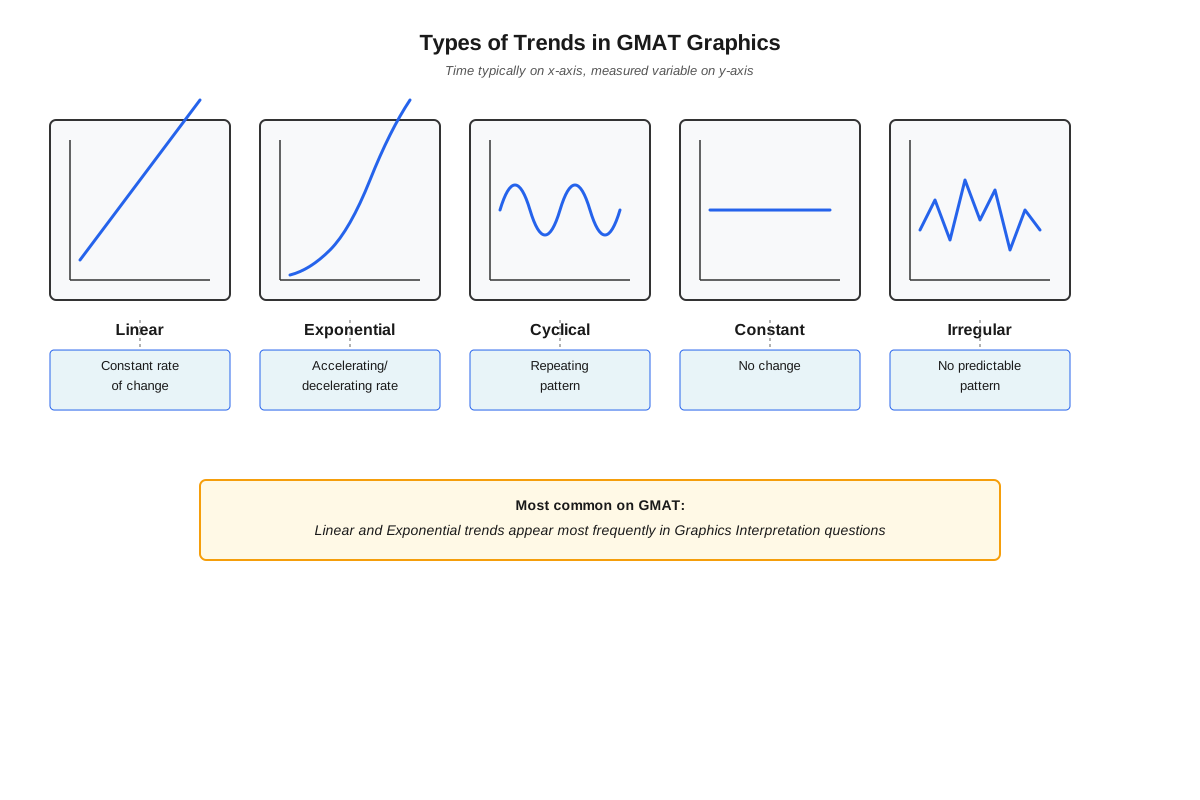
| Linear | Constant rate of change | Straight line or evenly spaced bars | Revenue increasing by $5M each quarter |
| Exponential | Accelerating rate of change | Curved line with increasing slope | User growth doubling each period |
| Logarithmic | Decelerating rate of change | Curved line with decreasing slope | Market saturation approaching limit |
| Cyclical | Repeating pattern over time | Wave-like oscillation | Seasonal sales variations |
| Constant | No significant change | Horizontal line or equal bars | Stable market share over time |
| Irregular | No consistent pattern | Erratic movements | Volatile commodity prices |
Understanding these trend types enables precise language selection in dropdown menus. GMAT questions often require distinguishing between "increasing at an increasing rate" (exponential) versus "increasing at a constant rate" (linear) versus "increasing at a decreasing rate" (logarithmic).
Quantifying Trend Magnitude
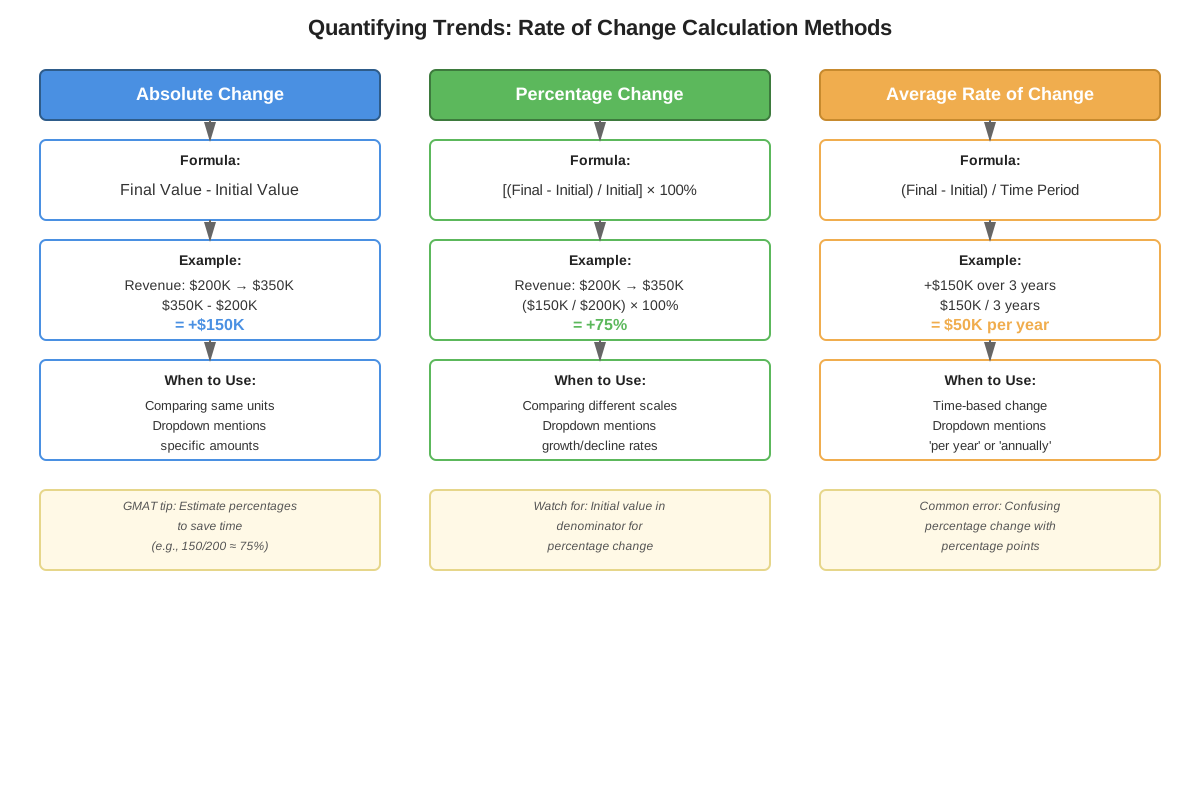
Beyond identifying direction, GMAT trend questions frequently require quantifying the magnitude of change. This involves calculating:
- Absolute change: The numerical difference between two data points (Final Value - Initial Value)
- Percentage change: ((Final Value - Initial Value) / Initial Value) × 100%
- Rate of change: Change per unit time or category (slope for linear trends)
- Relative comparison: Which variable changed more in absolute or percentage terms
When quantifying trends, approximate calculations are usually sufficient. The GMAT dropdown options typically differ enough that precise calculation isn't necessary—estimating to the nearest 5-10% often suffices.
Correlation vs. Causation
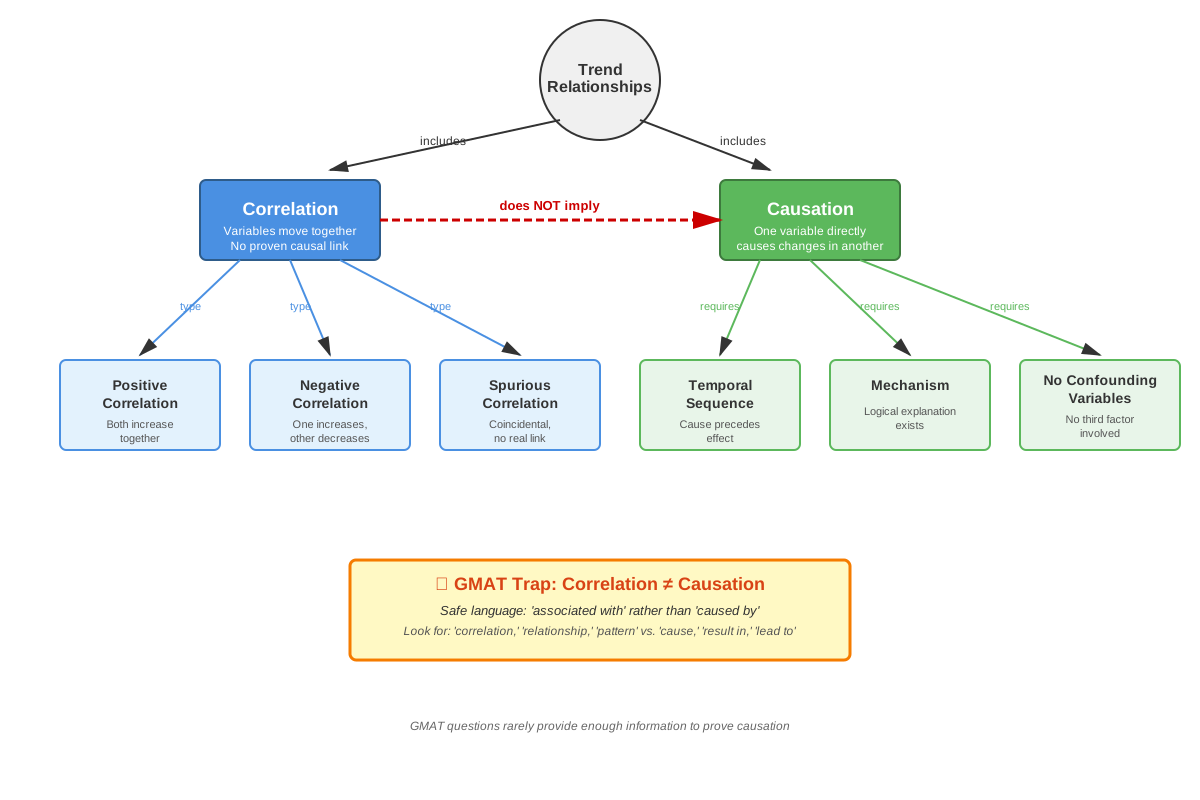
A critical distinction in GMAT trend identification involves recognizing correlation without implying causation. Two variables may trend together (positive correlation), trend in opposite directions (negative correlation), or show no relationship (no correlation). However, correlation does not establish that one variable causes changes in the other.
Positive correlation: As one variable increases, the other tends to increase (upward-sloping scatter plot pattern)
Negative correlation: As one variable increases, the other tends to decrease (downward-sloping scatter plot pattern)
No correlation: No consistent relationship between variables (random scatter plot distribution)
GMAT questions carefully word statements to avoid causal language unless the context explicitly supports it. Correct answers typically use phrases like "associated with," "corresponds to," or "tends to occur with" rather than "causes" or "results in."
Trend Consistency and Reliability
Not all trends are equally reliable. Assessing trend consistency involves evaluating:
- Data density: More data points provide stronger evidence for a trend
- Variability: High scatter around a trend line suggests lower reliability
- Time period: Longer observation periods generally indicate more stable trends
- Outliers: Extreme values that deviate significantly from the pattern
On the GMAT, questions may ask which trend is "most consistent" or which relationship is "strongest," requiring comparison of variability across different data series.
Reading Complex Graphics
GMAT Graphics Interpretation questions often present complex visualizations combining multiple elements:
- Dual-axis graphs: Different scales for different variables on left and right y-axes
- Combination charts: Bars and lines on the same graph representing different metrics
- Multiple data series: Several lines or bar groups requiring comparison
- Logarithmic scales: Where equal distances represent equal percentage changes rather than equal absolute changes
For dual-axis graphs, carefully match each data series to its corresponding axis. For combination charts, understand what each visual element represents. Always read all labels, legends, and footnotes before attempting to identify trends.
Time-Based vs. Category-Based Trends
Trends can be analyzed across time (temporal trends) or across categories (cross-sectional comparisons):
Temporal trends show how a variable changes over time periods (years, quarters, months). These reveal growth patterns, cyclical behavior, or long-term trajectories.
Category-based trends compare values across different groups, products, regions, or segments at a single point in time or averaged over time. These reveal relative performance or market structure.
GMAT questions may ask about either type, so identify whether the x-axis represents time or categories before analyzing the pattern.
Concept Relationships
Trend identification builds directly on fundamental graph reading skills, requiring accurate interpretation of axes, scales, and data points before patterns can be recognized. The direction and type of trend (linear, exponential, cyclical) determines which quantification method is most appropriate—linear trends use constant rates of change, while exponential trends require percentage-based analysis.
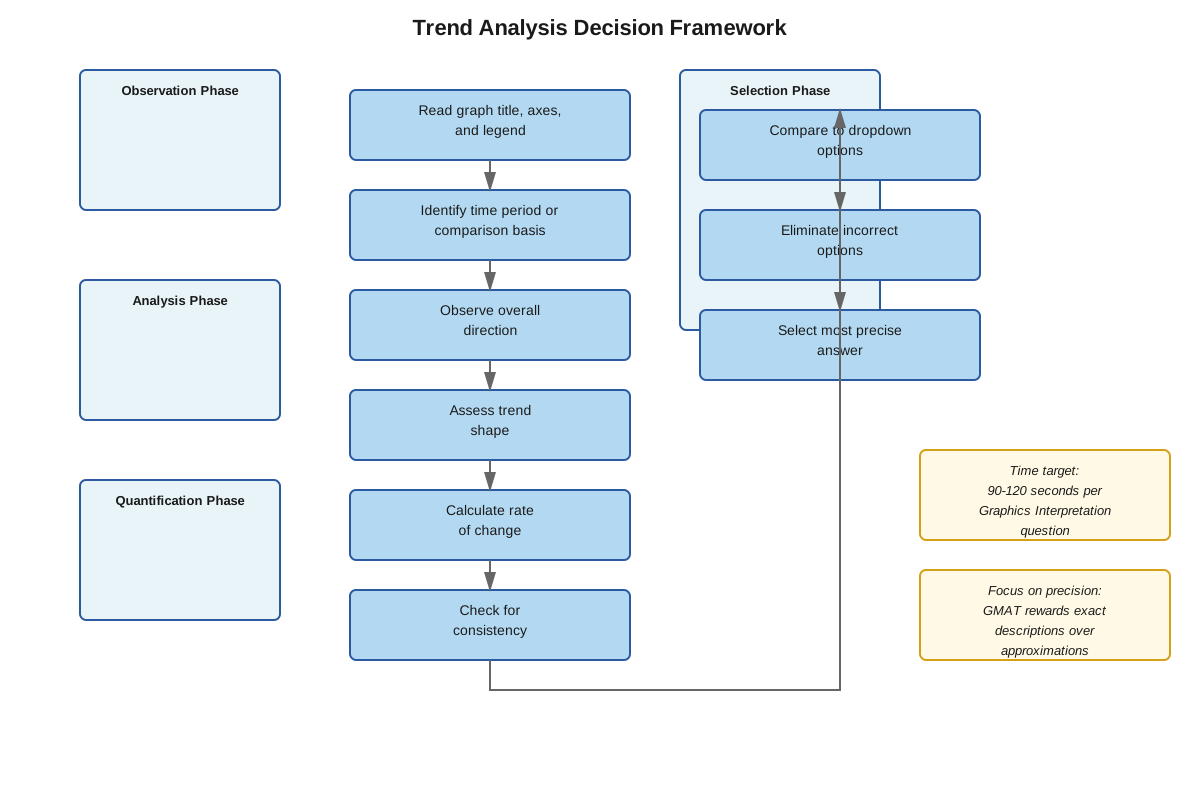
The relationship flows as follows: Basic graph reading → Trend direction identification → Trend type classification → Magnitude quantification → Correlation assessment → Reliability evaluation. Each step depends on the previous one; misreading the scale undermines all subsequent analysis.
Trend identification connects to table analysis through shared quantification skills—both require calculating percentage changes and comparing magnitudes. It links to multi-source reasoning when trends from different data sources must be synthesized. The skill also underpins two-part analysis questions where trend-based predictions or comparisons drive answer selection.
Within Graphics Interpretation specifically, trend identification often combines with other sub-skills: reading specific data point values, interpolating between points, extrapolating beyond the data range, and comparing multiple variables simultaneously. Strong trend identification enables more efficient analysis of complex, multi-variable graphics.
High-Yield Facts
- ⭐ Linear trends show constant absolute change per period; exponential trends show constant percentage change per period
- ⭐ On dual-axis graphs, always verify which y-axis corresponds to each data series before identifying trends
- ⭐ Percentage change = ((New Value - Old Value) / Old Value) × 100%; this formula appears frequently in trend quantification
- ⭐ Positive correlation means variables move in the same direction; negative correlation means they move in opposite directions
- ⭐ "Increasing at an increasing rate" describes exponential growth (upward-curving line); "increasing at a decreasing rate" describes logarithmic growth (upward-curving but flattening line)
- Scatter plots with tightly clustered points around a trend line indicate strong correlation; widely scattered points indicate weak correlation
- Cyclical trends repeat at regular intervals; irregular trends show no consistent pattern
- When comparing trends across multiple variables, focus on relative rates of change rather than absolute values
- Logarithmic scales compress large ranges; equal vertical distances represent equal percentage changes, not equal absolute changes
- Outliers can distort trend perception; assess whether extreme values represent genuine pattern or anomalies
- Constant trends appear as horizontal lines on line graphs or bars of equal height on bar charts
- The steepness of a line indicates the rate of change only when the scale is considered; always check axis intervals
- Correlation strength is assessed by how closely data points cluster around a trend line, not by the slope of that line
- Temporal trends require time on the x-axis; category-based comparisons can use any categorical variable on the x-axis
- GMAT dropdown options often differ by key qualifiers like "approximately," "more than," "less than," or "about"—precise reading is essential
Quick check — test yourself on Trend identification so far.
Try Flashcards →Common Misconceptions
Misconception: A steep line always indicates rapid change.
Correction: Steepness is relative to the scale. A line that appears steep with a compressed y-axis (e.g., ranging from 98-100) may represent minimal absolute change, while a seemingly flat line with an expanded scale (e.g., ranging from 0-1000) could represent substantial change. Always examine the axis scale before assessing magnitude.
Misconception: Correlation between two variables means one causes the other.
Correction: Correlation indicates variables tend to change together but does not establish causation. Both variables might be influenced by a third factor, or the relationship might be coincidental. GMAT correct answers carefully avoid causal language unless the context explicitly supports it.
Misconception: All upward-sloping lines represent the same type of growth.
Correction: Upward trends can be linear (constant rate), exponential (accelerating rate), or logarithmic (decelerating rate). The curvature and rate of change distinguish these types. "Increasing" alone is insufficient—the GMAT requires identifying whether the increase is at a constant, increasing, or decreasing rate.
Misconception: The variable with the highest final value shows the strongest growth.
Correction: Growth strength is measured by percentage change or rate of change, not absolute final value. A variable starting at 10 and reaching 30 (200% increase) shows stronger growth than one starting at 100 and reaching 150 (50% increase), despite the latter having a higher final value.
Misconception: Scatter plots with negative slopes always indicate negative correlation.
Correction: While a downward-sloping trend line does indicate negative correlation (as one variable increases, the other decreases), the term "negative" refers to the direction of the relationship, not the values themselves. Both variables might have positive values throughout.
Misconception: Trends can be reliably extrapolated indefinitely into the future.
Correction: Trends identified within a data range may not continue beyond that range. External factors, market saturation, or changing conditions can alter patterns. GMAT questions asking about extrapolation typically include qualifiers like "if the trend continues" or limit predictions to near-term periods.
Worked Examples
Example 1: Line Graph with Multiple Variables
Question Setup: A line graph shows quarterly revenue (in millions) for three product lines from Q1 2020 to Q4 2021. Product A starts at $20M in Q1 2020 and reaches $32M in Q4 2021, following a relatively straight upward path. Product B starts at $15M and reaches $45M, with the line curving upward more steeply in later quarters. Product C fluctuates between $18M and $22M throughout the period.
Dropdown Statement 1: "From Q1 2020 to Q4 2021, Product B revenue increased at ________."
Options: (a) a constant rate (b) an increasing rate (c) a decreasing rate
Dropdown Statement 2: "The product line showing the most consistent trend is ________."
Options: (a) Product A (b) Product B (c) Product C
Solution Process:
For Statement 1, examine Product B's line shape. The line curves upward, becoming steeper in later quarters. This indicates the rate of change is accelerating—each successive quarter shows a larger absolute increase than the previous quarter. Calculate approximate quarterly changes: Q1-Q2 might show +$3M, Q2-Q3 shows +$5M, Q3-Q4 shows +$7M (estimates based on "curving upward more steeply"). This acceleration pattern matches "increasing rate."
Answer for Statement 1: (b) an increasing rate
For Statement 2, assess consistency by evaluating variability. Product A follows a straight path with minimal deviation—highly consistent linear growth. Product B, while showing clear growth, has an accelerating pattern that represents consistent exponential growth but more variability in quarterly changes. Product C fluctuates without clear direction—highly inconsistent. The "most consistent trend" is Product A, which maintains steady, predictable growth.
Answer for Statement 2: (a) Product A
Key Takeaway: Distinguish between trend type (linear vs. exponential) by observing line curvature, and assess consistency by evaluating how closely data follows a predictable pattern.
Example 2: Scatter Plot with Correlation Assessment
Question Setup: A scatter plot displays 30 companies, with annual marketing spend (x-axis, $0-$10M) and annual revenue growth percentage (y-axis, -5% to 25%). The data points show a general upward trend from lower-left to upper-right, but with considerable scatter. Most points cluster between $2M-$8M spend and 5%-20% growth. A few outliers appear: one company with $9M spend and 2% growth, another with $3M spend and 23% growth.
Dropdown Statement 1: "The relationship between marketing spend and revenue growth shows ________."
Options: (a) strong positive correlation (b) weak positive correlation (c) no correlation (d) negative correlation
Dropdown Statement 2: "Based on the data, a company increasing marketing spend from $4M to $8M would most likely experience ________."
Options: (a) revenue growth exceeding 20% (b) revenue growth between 10% and 20% (c) revenue growth below 10% (d) declining revenue
Solution Process:
For Statement 1, assess correlation by observing the overall pattern. The general upward trend (as x increases, y tends to increase) indicates positive correlation. However, the considerable scatter—many points far from any potential trend line—suggests the correlation is not strong. If correlation were strong, points would cluster tightly around a clear line. The presence of outliers and wide vertical spread at any given x-value indicates weak positive correlation.
Answer for Statement 1: (b) weak positive correlation
For Statement 2, examine the data range between $4M and $8M spend. Most companies in this range show growth between 8% and 18%, with the majority clustering in the 10%-20% range. While some outliers exist, the most likely outcome based on the data concentration is growth between 10% and 20%. Option (a) is too optimistic given that few companies exceed 20% even at higher spend levels. Options (c) and (d) contradict the positive correlation observed.
Answer for Statement 2: (b) revenue growth between 10% and 20%
Key Takeaway: Correlation strength depends on data clustering tightness, not just the presence of a general trend. Predictions based on trends should reflect the most common outcomes within the relevant data range, not extreme values.
Exam Strategy
When approaching GMAT Graphics Interpretation questions focused on trend identification, follow this systematic process:
Step 1: Invest 15-20 seconds reading the graph completely before attempting the dropdown statements. Identify what each axis represents, note the scale and units, read the legend, and understand what each visual element (line, bar, point) represents. This upfront investment prevents misinterpretation errors.
Step 2: For each dropdown statement, identify the specific comparison or calculation required. Trigger phrases include:
- "Increased/decreased by approximately" → Calculate percentage or absolute change
- "At a constant/increasing/decreasing rate" → Assess line curvature or bar spacing pattern
- "Strongest/weakest correlation" → Compare scatter tightness across variables
- "Most consistent trend" → Evaluate variability and pattern regularity
Step 3: Perform rough calculations mentally or on your noteboard. GMAT dropdown options typically differ by 10-20%, so precise calculation is unnecessary. Round values to simplify: $4.7M becomes $5M, 23% becomes 25%. This approximation saves time without sacrificing accuracy.
Step 4: Eliminate obviously incorrect options first. If a line clearly slopes upward, eliminate any option suggesting decrease. If two variables move in opposite directions, eliminate positive correlation options. Process of elimination often narrows choices to two options, making the final selection easier.
Step 5: Watch for qualifier words that distinguish similar options: "approximately," "more than," "less than," "about," "nearly," "exceeds." These qualifiers often differentiate correct from incorrect answers when magnitudes are close.
Time allocation: Spend 90-120 seconds per Graphics Interpretation question. If a calculation seems complex, estimate aggressively—the GMAT rewards efficient approximation over precise calculation in Data Insights.
Exam Tip: When comparing multiple trends, create a simple mental or written table noting the direction and approximate magnitude for each variable. This organized approach prevents confusion when dropdown statements require cross-variable comparisons.
Memory Techniques
LINE mnemonic for trend types:
- Linear: Straight line, constant rate
- Increasing rate: Curves upward (exponential)
- Negative correlation: Downward slope
- Exponential: Accelerating change
SCALE reminder: Always check Scale before Concluding Any Line's Extent. This prevents the common error of misjudging magnitude based on visual steepness alone.
Correlation strength visualization: Picture a "scatter sandwich"—strong correlation means points are tightly packed between two imaginary parallel lines (thin sandwich), weak correlation means points spread widely (thick sandwich), no correlation means points scattered randomly (no sandwich shape).
Rate of change hand gesture: For "increasing at an increasing rate," curve your hand upward with fingers pointing up and curving away (exponential). For "increasing at a decreasing rate," curve your hand upward but with fingers curving back toward you (logarithmic). For "constant rate," keep your hand straight at an angle (linear).
Percentage change formula memory: "New minus Old, divided by Old, times 100" can be remembered as "NO/O×100" where NO = New minus Old, O = Old value.
Summary
Trend identification is a high-yield GMAT Data Insights skill requiring the ability to analyze graphical data and accurately describe patterns, directions, and relationships. Success depends on systematically reading graphs (axes, scales, legends), distinguishing trend types (linear, exponential, logarithmic, cyclical, constant, irregular), quantifying magnitude through percentage and absolute change calculations, and recognizing correlation without implying causation. The GMAT tests this skill through Graphics Interpretation questions with dropdown menus requiring precise language selection. Key competencies include assessing trend direction and consistency, comparing multiple variables, performing mental approximations efficiently, and avoiding common pitfalls like scale misinterpretation and correlation-causation confusion. Mastery requires understanding that steepness is scale-dependent, that correlation strength depends on data clustering tightness, and that trend type is revealed by line curvature or bar spacing patterns. By following a systematic approach—reading thoroughly, identifying required comparisons, approximating calculations, and eliminating incorrect options—test-takers can efficiently and accurately answer trend identification questions, which appear in 15-20% of Data Insights items.
Key Takeaways
- Trend identification requires systematic graph reading: always examine axes, scales, and legends before analyzing patterns
- Distinguish trend types by curvature: straight lines indicate linear (constant rate), upward curves indicate exponential (increasing rate), flattening curves indicate logarithmic (decreasing rate)
- Percentage change = ((New - Old) / Old) × 100% is the most frequently used calculation in trend quantification questions
- Correlation describes relationships, not causation: use language like "associated with" rather than "causes" unless context explicitly supports causality
- Scale determines magnitude perception: always check axis intervals before judging whether change is substantial or minimal
- Approximation is sufficient and efficient: GMAT dropdown options differ enough that rounding to nearest 5-10% saves time without sacrificing accuracy
- Consistency assessment requires evaluating variability: the most consistent trend shows minimal deviation from a predictable pattern, not necessarily the strongest growth
Related Topics
Table Analysis: Builds on trend identification by requiring pattern recognition in numerical tables rather than graphs; mastering visual trend identification makes tabular pattern recognition more intuitive.
Multi-Source Reasoning: Combines trend identification across multiple data sources (graphs, tables, text); strong graphics interpretation skills enable faster synthesis of information from varied formats.
Two-Part Analysis: Often requires trend-based predictions or comparisons to select correct answer pairs; trend identification skills directly support the analytical reasoning needed for these questions.
Quantitative Reasoning - Rates and Percentages: The mathematical foundation for quantifying trends; deeper understanding of percentage calculations and rate comparisons enhances trend analysis accuracy.
Data Sufficiency - Graphical Information: Some Data Sufficiency questions present graphical information requiring trend assessment to determine sufficiency; trend identification skills transfer directly to this question type.
Practice CTA
Now that you've mastered the core concepts of trend identification, it's time to apply these skills to authentic GMAT-style questions. The practice questions and flashcards will reinforce your ability to quickly recognize trend types, quantify changes accurately, and select precise language under time pressure. Remember: trend identification is one of the highest-yield skills in Data Insights—consistent practice will build the pattern recognition speed and calculation efficiency that separate good scores from great scores. Challenge yourself to complete the practice set, focusing on systematic graph reading and efficient approximation. You've built the foundation; now strengthen it through deliberate practice!
Sign up free to keep reading
Create a free AnvayaPrep account to finish this GMAT guide on Trend identification — plus flashcards and practice questions.