Overview
Rates represent one of the most fundamental and frequently tested concepts in GMAT Quantitative Reasoning. At its core, a rate describes the relationship between two different quantities, expressing how one quantity changes relative to another. The most familiar example is speed—distance traveled per unit of time—but GMAT rates problems extend far beyond simple motion scenarios to include work rates, production rates, flow rates, and combined rates involving multiple entities working together or in opposition.
Understanding rates is essential for GMAT success because these problems appear consistently across multiple question types, including Problem Solving and Data Sufficiency questions. Rate problems test not only computational ability but also logical reasoning, the capacity to set up equations correctly, and the skill to manipulate algebraic relationships. The GMAT frequently disguises rate problems within word problems that require careful translation from English into mathematical expressions, making conceptual clarity absolutely critical.
Within the broader Quantitative Reasoning framework, rates connect directly to fundamental arithmetic operations, ratio and proportion concepts, algebraic equation solving, and even geometry when dealing with area or volume rates. Mastery of rates provides a foundation for tackling complex multi-step problems and serves as a gateway to understanding more advanced topics like optimization and efficiency calculations. The ability to recognize rate relationships, set up appropriate equations, and solve systematically distinguishes high-scoring test-takers from those who struggle with quantitative sections.
Learning Objectives
- [ ] Identify rates in various problem contexts and formats
- [ ] Explain rates conceptually and distinguish between different types of rate problems
- [ ] Apply rates to GMAT questions using systematic problem-solving approaches
- [ ] Convert between different rate units and manipulate rate equations algebraically
- [ ] Solve combined rate problems involving multiple workers, machines, or processes
- [ ] Analyze Data Sufficiency questions involving rates to determine statement sufficiency
- [ ] Recognize and avoid common rate problem traps and calculation errors
Prerequisites
- Basic algebra: Ability to set up and solve linear equations is essential for translating rate problems into mathematical expressions
- Fractions and decimals: Rate calculations frequently involve fractional relationships and require comfort with fraction arithmetic
- Ratio and proportion: Rates are fundamentally ratios, and understanding proportional relationships enables proper equation setup
- Unit conversion: Converting between different measurement units (hours to minutes, miles to kilometers) appears regularly in rate problems
- Basic arithmetic operations: Multiplication, division, and working with reciprocals form the computational foundation of rate problems
Why This Topic Matters
Rate problems appear in approximately 15-20% of GMAT Quantitative Reasoning questions, making them one of the highest-yield topics for focused study. These problems test multiple competencies simultaneously: reading comprehension (understanding what the problem asks), logical setup (translating words to equations), algebraic manipulation (solving for unknowns), and numerical reasoning (evaluating answer choices). The GMAT particularly favors rate problems because they effectively differentiate between test-takers who truly understand mathematical relationships versus those who merely memorize formulas.
In real-world applications, rate concepts underpin countless business and analytical scenarios: productivity analysis, resource allocation, project timeline estimation, cost-per-unit calculations, and efficiency optimization. Business school curricula heavily emphasize these applications, making rate proficiency not just an exam requirement but a practical skill for future coursework and professional success.
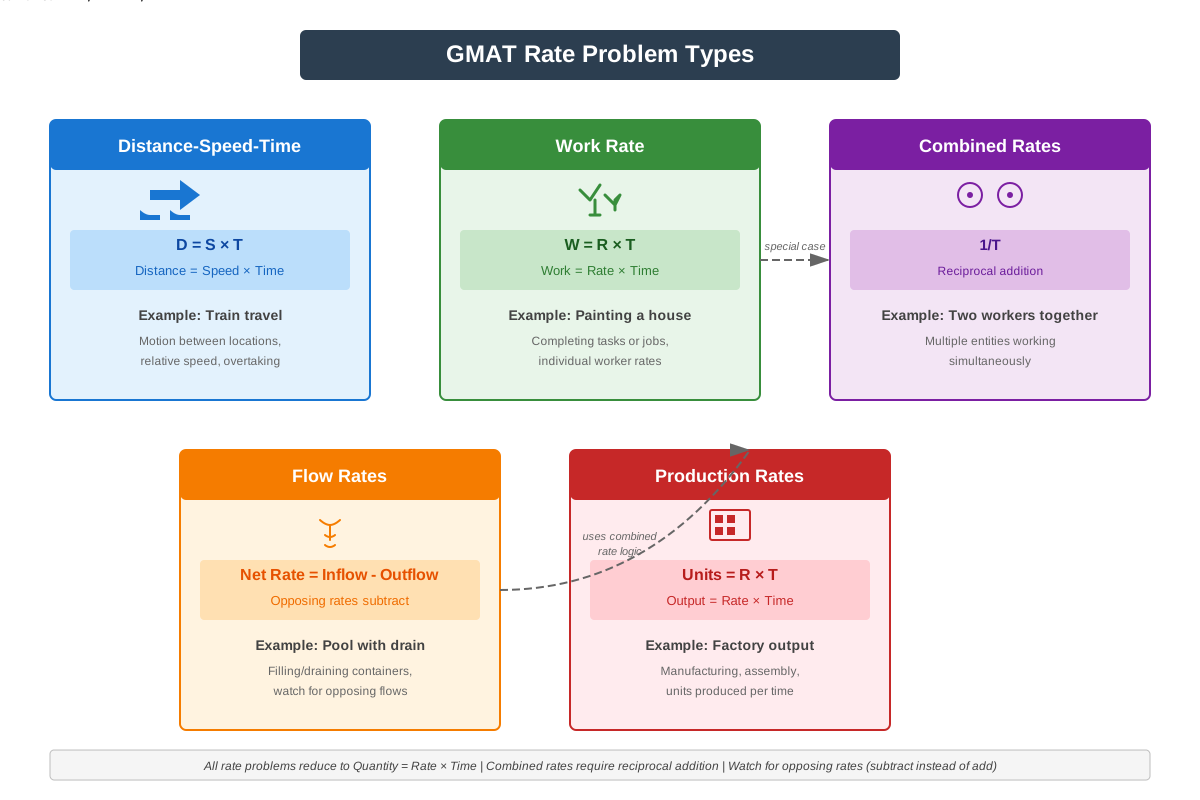
On the GMAT, rate problems commonly appear as: distance-rate-time scenarios involving travel in opposite directions or with/against currents; work rate problems where multiple workers complete tasks at different speeds; filling/draining problems with pipes or tanks; production rate scenarios in manufacturing contexts; and combined rate problems requiring addition or subtraction of individual rates. Data Sufficiency questions frequently test whether students understand what information is truly necessary to solve rate problems, making conceptual understanding more important than computational speed.
Core Concepts
Fundamental Rate Formula
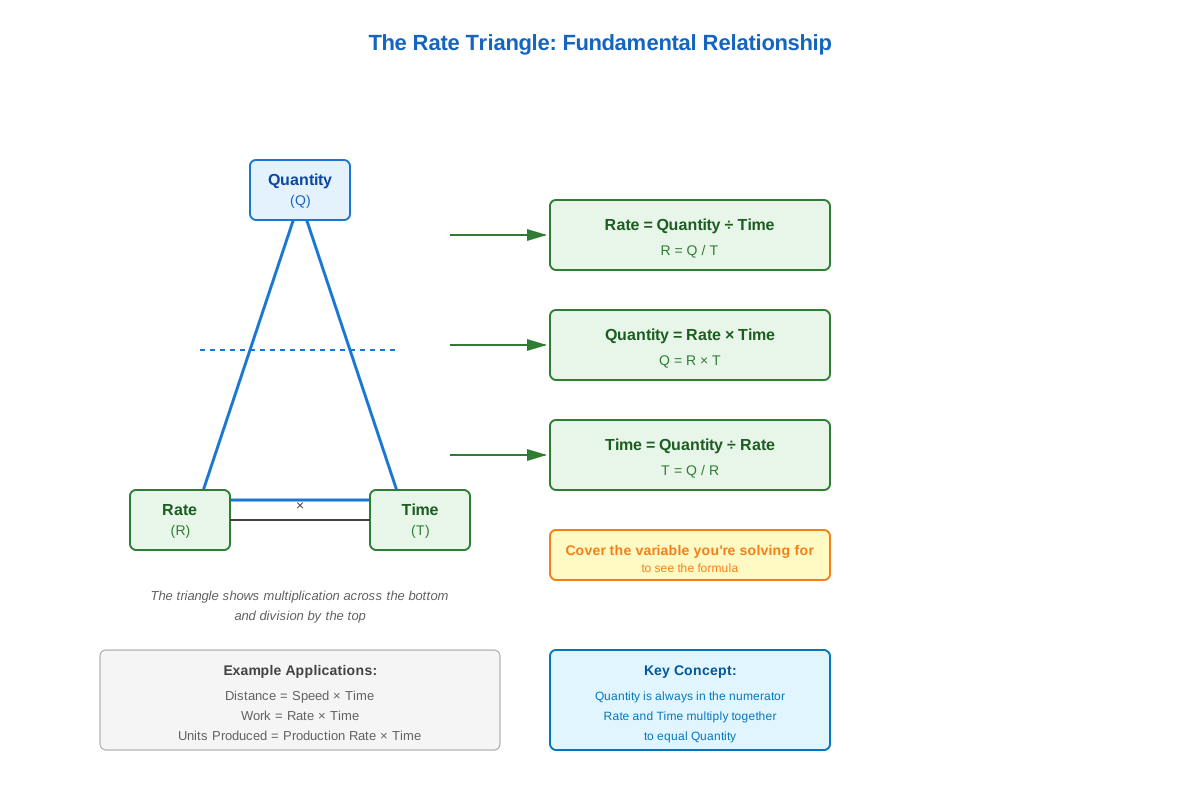
The foundational relationship for all rates is expressed as:
Rate = Quantity / TimeThis can be rearranged into three equivalent forms:
- Quantity = Rate × Time
- Time = Quantity / Rate
The rate represents how much of something (quantity) occurs per unit of time. Understanding that these three variables are interconnected and that knowing any two allows calculation of the third is crucial for GMAT success. The most common application is the distance formula: Distance = Rate × Time (often abbreviated as D = RT).
Types of Rates
Distance-Rate-Time Problems form the most recognizable category. These involve objects moving at constant speeds, often with complications like:
- Two objects moving toward each other (relative rates add)
- Two objects moving in the same direction (relative rates subtract)
- Travel with and against currents or winds (add/subtract current speed to/from object speed)
- Round-trip scenarios with different speeds in each direction
Work Rate Problems describe how quickly tasks are completed. The key insight is that work rate equals the reciprocal of time to complete the task. If a worker completes a job in 6 hours, their rate is 1/6 of the job per hour. When multiple workers collaborate, their rates add:
Combined Rate = Rate₁ + Rate₂ + Rate₃ + ...Production and Flow Rates involve manufacturing items, filling containers, or processing units. These follow the same mathematical principles as work rates but often involve concrete quantities rather than abstract "jobs."
Rate Unit Consistency
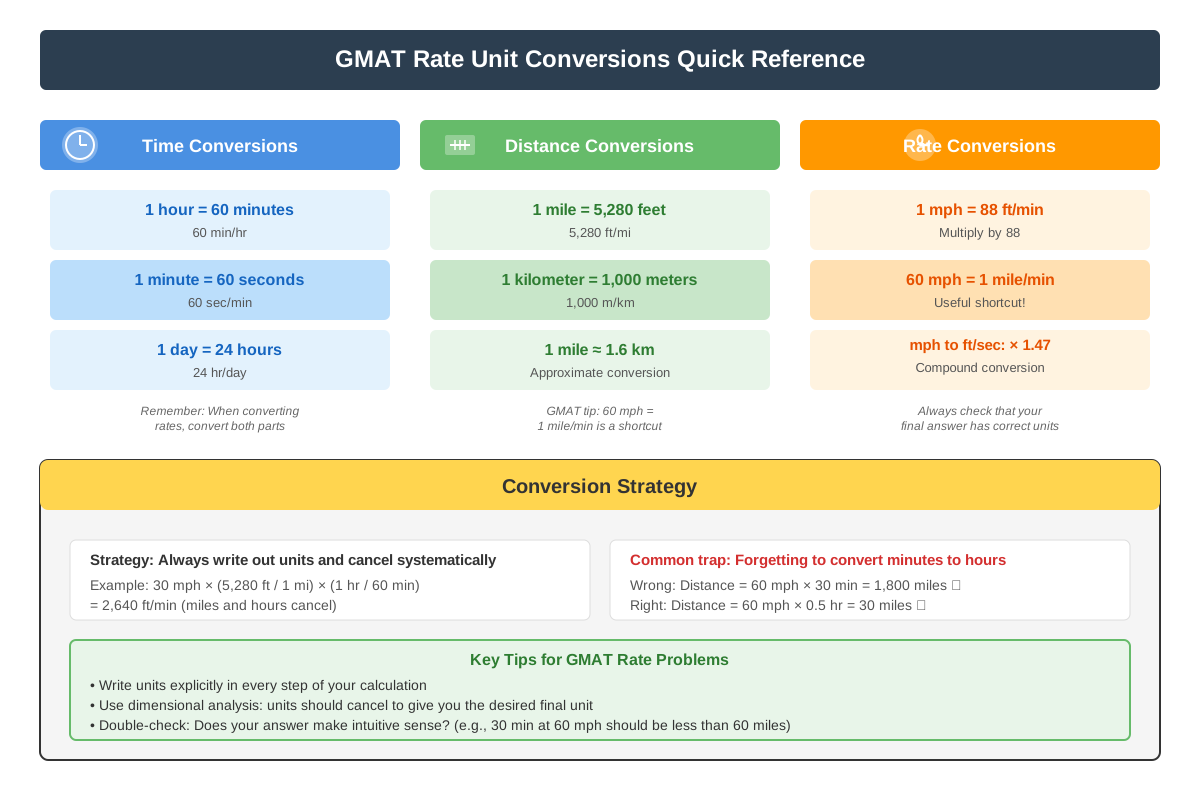
A critical requirement in rate problems is unit consistency. All quantities must use compatible units before calculation. If a rate is given in miles per hour and time in minutes, conversion is necessary. Common conversions include:
- 1 hour = 60 minutes
- 1 minute = 60 seconds
- Speed in mph × time in hours = distance in miles
The GMAT frequently tests whether students recognize unit inconsistencies and make appropriate conversions.
Combined Rate Scenarios
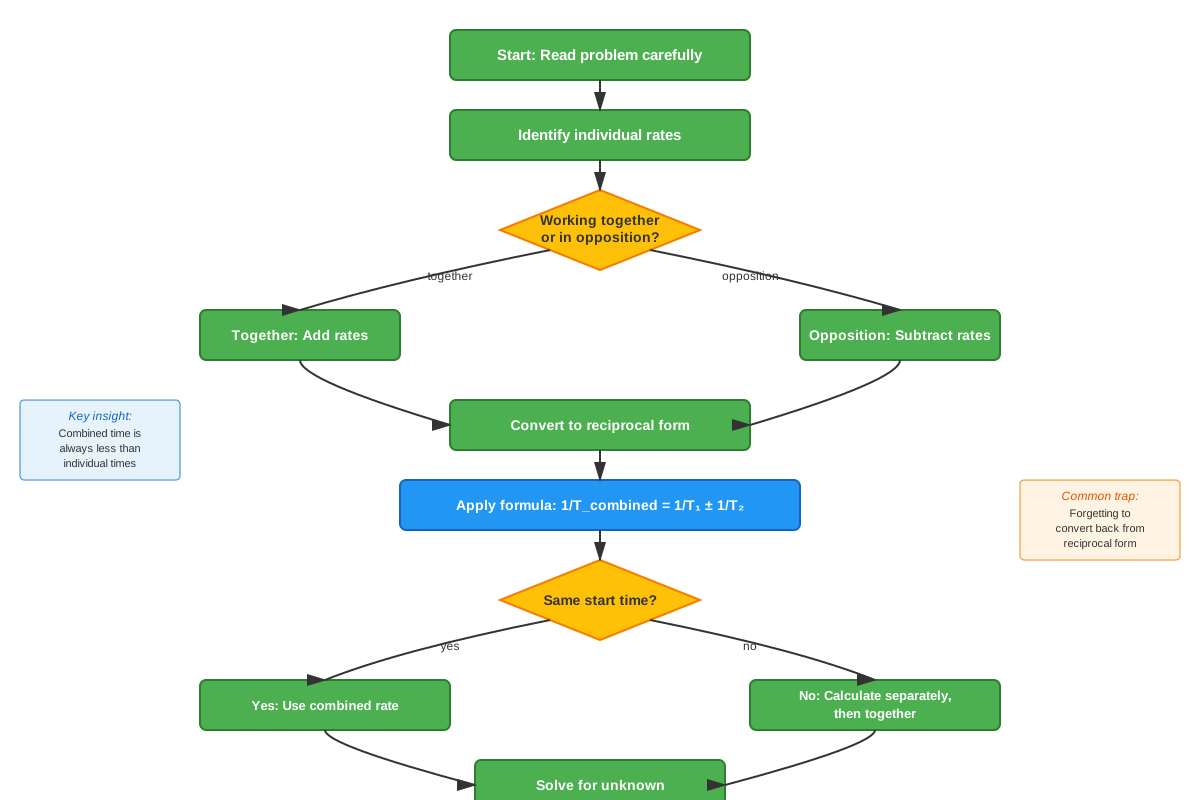
When multiple entities work together toward the same goal, their rates combine additively:
Time to complete together = Total Work / (Rate₁ + Rate₂)For example, if Worker A completes a job in 4 hours (rate = 1/4 per hour) and Worker B completes it in 6 hours (rate = 1/6 per hour), together they work at rate 1/4 + 1/6 = 5/12 per hour, completing the job in 12/5 = 2.4 hours.
Opposing Rates
When rates work against each other (one filling while another drains, for instance), subtract the rates:
Net Rate = Rate_filling - Rate_drainingThis concept appears in problems involving leaks in tanks being filled, or workers whose efforts partially undo each other's work.
Average Rate vs. Average Speed
A common GMAT trap involves distinguishing between average rate and the arithmetic mean of two rates. For round trips with different speeds each direction:
Average Speed = Total Distance / Total TimeThis is NOT the same as (Speed₁ + Speed₂)/2. The GMAT exploits this misconception regularly. The correct approach requires calculating total distance and total time separately, then dividing.
Relative Rate
When two objects move relative to each other, their relative rate depends on direction:
- Moving toward each other: Relative rate = Rate₁ + Rate₂
- Moving in same direction: Relative rate = |Rate₁ - Rate₂|
- Circular track problems: Use relative rate to find when faster object "laps" slower one
Rate Tables
Organizing information systematically prevents errors. A standard rate table format:
| Entity | Rate | Time | Work/Distance |
|---|---|---|---|
| A | r₁ | t₁ | r₁ × t₁ |
| B | r₂ | t₂ | r₂ × t₂ |
| Combined | r₁ + r₂ | t | (r₁ + r₂) × t |
This visual organization helps identify what's known and what needs calculation.
Concept Relationships
The core rate formula (Rate = Quantity/Time) serves as the foundation from which all other rate concepts derive. This fundamental relationship → leads to → specialized applications in distance, work, and production contexts. Each application maintains the same mathematical structure but interprets "quantity" differently (distance, jobs completed, items produced).
Distance-rate-time problems → connect to → relative rate concepts when multiple moving objects interact. Understanding how to add or subtract rates depending on direction of motion builds directly on the foundational formula while adding logical reasoning about physical scenarios.
Work rate problems → utilize → the reciprocal relationship between time and rate. Recognizing that a 4-hour job corresponds to a 1/4-per-hour rate → enables → solving combined work problems by adding individual rates. This reciprocal thinking → extends to → understanding why slower workers have smaller rate fractions.
Unit consistency → underlies → all rate calculations and → connects back to → prerequisite knowledge of conversions and dimensional analysis. Failure to maintain unit consistency → causes → the majority of calculation errors in rate problems.
Average rate calculations → distinguish themselves from → simple arithmetic means, requiring → return to → the fundamental definition of rate as total quantity divided by total time. This concept → relates to → weighted averages when different portions of a journey occur at different rates.
Combined and opposing rates → represent → algebraic operations on the fundamental rate formula, where addition models cooperation and subtraction models opposition. These → connect to → real-world scenarios involving multiple simultaneous processes.
High-Yield Facts
⭐ The fundamental rate formula can be expressed three ways: Rate = Quantity/Time, Quantity = Rate × Time, and Time = Quantity/Rate
⭐ When workers/machines work together toward the same goal, add their individual rates to find the combined rate
⭐ Average speed for a round trip is NOT the arithmetic mean of the two speeds; it equals total distance divided by total time
⭐ If a task takes T hours to complete, the work rate is 1/T per hour
⭐ When two objects move toward each other, their relative rate is the sum of their individual rates
- When two objects move in the same direction, their relative rate is the difference of their individual rates
- All quantities in a rate equation must use consistent units before calculation
- In work problems, the total work can be represented as 1 (one complete job) for easier calculation
- For opposing rates (filling and draining), subtract the smaller rate from the larger to find net rate
- Distance-rate-time problems with currents or winds: add the current/wind speed when moving with it, subtract when moving against it
- In Data Sufficiency rate problems, you need enough information to determine two of the three variables (rate, quantity, time) to find the third
- Rate problems often require setting up equations where the total work or distance equals the sum of individual contributions
Quick check — test yourself on Rates so far.
Try Flashcards →Common Misconceptions
Misconception: Average speed equals the arithmetic mean of two speeds → Correction: Average speed equals total distance divided by total time. For a 60-mile round trip at 30 mph one way and 60 mph returning, the average speed is NOT 45 mph. Total time = 60/30 + 60/60 = 3 hours, so average speed = 120/3 = 40 mph.
Misconception: When workers work together, divide their times to find combined time → Correction: Convert times to rates first (using reciprocals), add the rates, then convert back to time. If Worker A takes 3 hours and Worker B takes 6 hours, the combined time is NOT 3/2 = 1.5 hours. Combined rate = 1/3 + 1/6 = 1/2 per hour, so combined time = 2 hours.
Misconception: In relative rate problems, always add the rates → Correction: Add rates only when objects move toward each other or work together. Subtract rates when objects move in the same direction or when one process opposes another (filling vs. draining).
Misconception: The faster rate in a combined work problem contributes more to reducing total time → Correction: While true, the relationship is not proportional. A worker twice as fast doesn't reduce combined time by half when working with another worker; the effect depends on the specific rate values.
Misconception: Rate problems always involve constant rates → Correction: While GMAT problems typically assume constant rates unless stated otherwise, some problems involve changing rates or average rates over different time periods. Read carefully to identify whether rates remain constant.
Misconception: In Data Sufficiency, knowing the combined rate and one individual rate is always sufficient to find the other individual rate → Correction: This is true for additive combined rates (working together) but requires careful analysis for other scenarios. Always verify that the mathematical relationship allows solving for the unknown.
Worked Examples
Example 1: Combined Work Rate Problem
Problem: Machine A can complete a production run in 6 hours. Machine B can complete the same production run in 9 hours. If both machines work together, how long will it take to complete the production run?
Solution:
Step 1: Identify what we know and what we need to find.
- Machine A's time: 6 hours
- Machine B's time: 9 hours
- Need: Combined time
Step 2: Convert times to rates.
- Machine A's rate: 1/6 of the job per hour
- Machine B's rate: 1/9 of the job per hour
Step 3: Add the rates to find combined rate.
Combined rate = 1/6 + 1/9
To add these fractions, find common denominator (18):
Combined rate = 3/18 + 2/18 = 5/18 of the job per hour
Step 4: Convert combined rate back to time.
If they complete 5/18 of the job per hour, the time to complete 1 full job is:
Time = 1 ÷ (5/18) = 1 × (18/5) = 18/5 = 3.6 hours
Answer: 3.6 hours or 3 hours 36 minutes
Connection to Learning Objectives: This problem demonstrates identifying rates (Step 2), explaining the relationship between time and rate (reciprocals), and applying the combined rate formula to solve a GMAT-style question.
Example 2: Distance-Rate-Time with Relative Motion
Problem: Two trains start from stations 450 miles apart and travel toward each other. Train A travels at 60 mph and Train B travels at 75 mph. How long will it take until the trains meet?
Solution:
Step 1: Identify the scenario type.
This is a relative rate problem with objects moving toward each other.
Step 2: Determine the relative rate.
When moving toward each other, add the rates:
Relative rate = 60 + 75 = 135 mph
This means the distance between the trains decreases at 135 mph.
Step 3: Apply the rate formula.
Distance = Rate × Time
450 = 135 × Time
Time = 450/135 = 10/3 hours = 3 hours 20 minutes
Alternative approach (setting up equations):
Let t = time until meeting
Distance covered by Train A: 60t
Distance covered by Train B: 75t
Total distance: 60t + 75t = 450
135t = 450
t = 10/3 hours
Answer: 3 hours 20 minutes (or 10/3 hours)
Connection to Learning Objectives: This demonstrates identifying a relative rate scenario, explaining why rates add when objects move toward each other, and applying systematic problem-solving to reach the correct answer.
Exam Strategy
When approaching GMAT rates questions, begin by identifying the rate type: distance-rate-time, work rate, production rate, or flow rate. This classification immediately suggests which formulas and relationships apply. Look for trigger words that signal rate problems: "per hour," "speed," "together," "working simultaneously," "how long," "how far," "complete a task," "fill a tank," or "produce items."
Create a systematic organization structure before calculating. For work problems, set up a table with columns for rate, time, and work completed. For distance problems, draw a simple diagram showing starting positions, directions of travel, and where/when objects meet. This visual organization prevents setup errors and makes the mathematical relationships clearer.
Unit consistency deserves immediate attention. Before performing any calculations, verify that all rates, times, and quantities use compatible units. If a problem gives speed in miles per hour and time in minutes, convert immediately. Many GMAT wrong answers result from unit inconsistency, making this a high-value error-prevention step.
For Data Sufficiency rate problems, remember that you need two of the three variables (rate, time, quantity) to determine the third. Evaluate each statement by asking: "Does this give me a second piece of information that, combined with what's in the question stem, allows me to set up a solvable equation?" Often, statements that seem insufficient actually provide enough information through algebraic relationships.
Process of elimination works effectively when you can estimate reasonable answer ranges. If two workers complete a job together, the time must be less than the faster worker's individual time but more than half that time (unless the workers have identical rates). Use this logic to eliminate unreasonable answer choices before calculating precisely.
Time allocation: Straightforward rate problems should take 1.5-2 minutes. Complex combined rate or multi-step problems may require 2.5-3 minutes. If you're exceeding these times, consider whether you've misidentified the problem type or made a setup error. Sometimes starting over with a clearer organizational structure saves time compared to continuing down an incorrect path.
Watch for the average rate trap: when a problem involves different rates for different portions of a journey, resist the temptation to average the rates arithmetically. Always return to total distance divided by total time.
Memory Techniques
"RTQ" Triangle: Visualize a triangle with Rate, Time, and Quantity at each point. Cover the variable you're solving for; the remaining two show the operation (multiply if side-by-side, divide if one is above the other). This helps remember: Q = R × T, R = Q/T, T = Q/R.
"Add Together, Subtract Apart": For relative rates, remember that objects moving toward each other (together) means add rates; objects moving in the same direction (apart) means subtract rates.
"Reciprocal for Work": The phrase "flip the time" reminds you that work rate is the reciprocal of completion time. A 5-hour job = 1/5 per hour rate.
"TDT for Average Speed": Total Distance over Total Time (TDT) gives average speed. This acronym prevents the arithmetic mean error.
"WART" for Work Problems: Work = (Add Rates) × Time. When workers combine efforts, add their rates, then multiply by time to find work completed.
Visualization for Motion: Always draw a simple diagram for distance-rate-time problems. Visual representation of starting points, directions, and meeting points prevents conceptual errors and makes relative rate relationships obvious.
"Same Units, Same Answer": Before calculating, chant "same units" to trigger the unit consistency check. Mismatched units = wrong answer, every time.
Summary
Rates represent the relationship between quantity and time, forming one of the most tested concepts in GMAT Quantitative Reasoning. The fundamental formula—Rate = Quantity/Time—can be rearranged to solve for any of the three variables when the other two are known. GMAT rate problems appear in multiple contexts: distance-rate-time scenarios involving relative motion, work rate problems with combined or opposing rates, and production/flow rate situations. Success requires recognizing problem types, maintaining unit consistency, understanding that work rates are reciprocals of completion times, and knowing when to add rates (working together, moving toward each other) versus subtract them (opposing processes, same-direction motion). The average rate trap—confusing arithmetic mean with total quantity divided by total time—appears frequently and must be avoided. Systematic organization through tables or diagrams, combined with algebraic equation setup, provides the most reliable path to correct answers within GMAT time constraints.
Key Takeaways
- The fundamental rate relationship (Rate = Quantity/Time) underlies all rate problems and can be rearranged to solve for any variable
- Combined rates for entities working together equal the sum of individual rates; convert completion times to rates using reciprocals
- Average speed equals total distance divided by total time, NOT the arithmetic mean of individual speeds
- Relative rates add when objects move toward each other and subtract when moving in the same direction
- Unit consistency is non-negotiable; convert all quantities to compatible units before calculating
- Work rate problems benefit from representing total work as "1 complete job" and expressing rates as fractions per time unit
- Systematic organization through tables or diagrams prevents setup errors and clarifies mathematical relationships
Related Topics
Ratios and Proportions: Rates are specialized ratios comparing different units; mastering rates builds directly on ratio concepts and enables solving complex proportion problems involving changing quantities over time.
Linear Equations and Systems: Many rate problems require setting up and solving linear equations or systems of equations, particularly when multiple unknowns exist or when Data Sufficiency questions test equation solvability.
Word Problem Translation: Rate problems exemplify the broader skill of translating verbal descriptions into mathematical expressions, a competency that applies across all GMAT Quantitative Reasoning question types.
Optimization Problems: Advanced applications of rates involve finding maximum or minimum values (fastest completion time, minimum cost per unit), connecting rate concepts to optimization strategies.
Mixture Problems: These combine rate concepts with concentration and proportion, involving rates of mixing different substances or combining solutions with different properties.
Practice CTA
Now that you've mastered the conceptual framework for rates, it's time to solidify your understanding through active practice. Attempt the practice questions associated with this topic, focusing on applying the systematic approaches outlined in this guide. Use the flashcards to reinforce key formulas and relationships until they become automatic. Remember that rate problems reward methodical setup and careful unit checking more than computational speed—accuracy stems from understanding, not memorization. Each practice problem you solve strengthens your pattern recognition and builds the confidence needed to tackle any rate question the GMAT presents. Your investment in deliberate practice now will pay dividends in both speed and accuracy on test day.
Sign up free to keep reading
Create a free AnvayaPrep account to finish this GMAT guide on Rates — plus flashcards and practice questions.