Overview
Business scenarios represent a critical component of the GMAT Data Insights section, particularly within Multi-Source Reasoning questions. These scenarios present realistic corporate situations involving financial performance, operational decisions, marketing strategies, human resources challenges, or strategic planning dilemmas. Students encounter multi-tabbed interfaces containing text passages, data tables, charts, and email correspondence that collectively describe a business problem requiring analysis and decision-making.
The GMAT uses GMAT business scenarios to assess a candidate's ability to synthesize information from multiple sources, identify relevant data points, perform quantitative analysis, and draw logical conclusions—skills essential for success in graduate business programs and professional management roles. Unlike traditional problem-solving questions that test isolated skills, business scenarios demand integrated reasoning that mirrors real-world business analysis. Students must navigate between different information sources, reconcile potentially conflicting data, and apply business acumen alongside analytical skills.
Understanding business scenarios connects directly to broader Data Insights competencies, including data interpretation, table analysis, and graphics interpretation. These scenarios serve as the contextual framework within which other analytical skills operate. Mastery of business scenarios enables students to quickly identify the business problem at hand, determine which data sources contain relevant information, and efficiently extract insights needed to answer questions. This topic appears with high frequency on the GMAT and often determines whether students achieve competitive scores in the Data Insights section.
Learning Objectives
- [ ] Identify business scenarios in GMAT Multi-Source Reasoning questions
- [ ] Explain the structure and components of typical business scenarios
- [ ] Apply business scenario analysis techniques to GMAT questions
- [ ] Synthesize information from multiple data sources within a business context
- [ ] Evaluate the relevance of different information sources to specific business questions
- [ ] Distinguish between quantitative and qualitative elements in business scenarios
- [ ] Formulate logical conclusions based on incomplete or ambiguous business information
Prerequisites
- Basic business terminology: Understanding fundamental concepts like revenue, profit, market share, and operational efficiency enables quick comprehension of scenario contexts
- Data interpretation skills: The ability to read tables, charts, and graphs forms the foundation for extracting quantitative information from business scenarios
- Reading comprehension: Strong reading skills allow students to quickly process text-heavy passages describing business situations and identify key information
- Basic arithmetic and percentages: Performing calculations with business metrics requires comfort with fundamental mathematical operations
Why This Topic Matters
Business scenarios reflect the authentic analytical challenges that MBA graduates face in consulting, finance, operations, and general management roles. The GMAT uses these scenarios to predict a candidate's readiness for case-based business school curricula and their potential effectiveness in data-driven decision-making environments. Employers increasingly value professionals who can navigate complex information landscapes, and business scenario questions directly assess this capability.
From an exam perspective, business scenarios appear in approximately 30-40% of Data Insights questions, making them one of the highest-yield topics for focused preparation. Multi-Source Reasoning questions, which exclusively use business scenarios, typically present 3-4 questions per scenario set, meaning that understanding the initial business context efficiently pays dividends across multiple questions. Students who master business scenarios often report significant score improvements because these questions reward systematic analysis rather than specialized technical knowledge.
Common manifestations include: company performance analysis comparing multiple years or divisions; market entry decisions requiring evaluation of demographic and competitive data; operational improvement scenarios involving cost-benefit analysis; merger and acquisition situations requiring financial statement interpretation; and marketing campaign effectiveness assessments combining sales data with customer research. The scenarios typically span 2-3 tabs of information, with each tab containing 150-300 words of text, 1-2 data tables or charts, and occasionally email correspondence or meeting notes that provide additional context or constraints.
Core Concepts
Structure of Business Scenarios
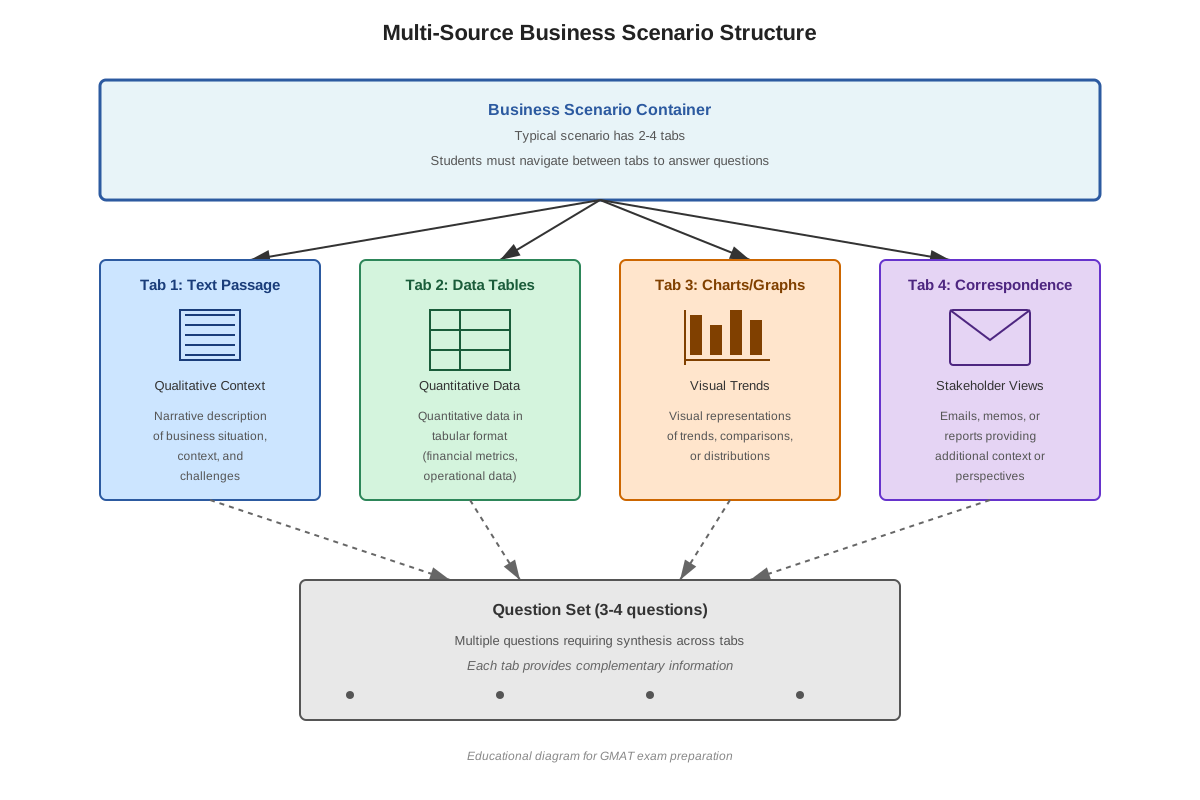
Business scenarios on the GMAT follow a predictable architecture designed to simulate realistic business analysis tasks. The typical structure includes three primary components: a contextual introduction, multiple information sources, and a series of questions requiring synthesis. The contextual introduction, usually 100-200 words, establishes the company, industry, and business challenge. This section identifies the stakeholders, timeframe, and decision context that frames the entire scenario.
The multi-source component presents information across 2-4 tabs, each serving a distinct purpose. Tab 1 typically contains narrative background—company history, market conditions, strategic objectives, or problem description. Tab 2 usually presents quantitative data in tables or charts showing financial performance, operational metrics, market research results, or comparative benchmarks. Tab 3 often includes supplementary information such as email exchanges between executives, consultant recommendations, customer feedback summaries, or regulatory constraints. This distributed information architecture deliberately requires students to navigate between sources, mirroring how business professionals gather intelligence from various departments and documents.
Types of Business Scenarios
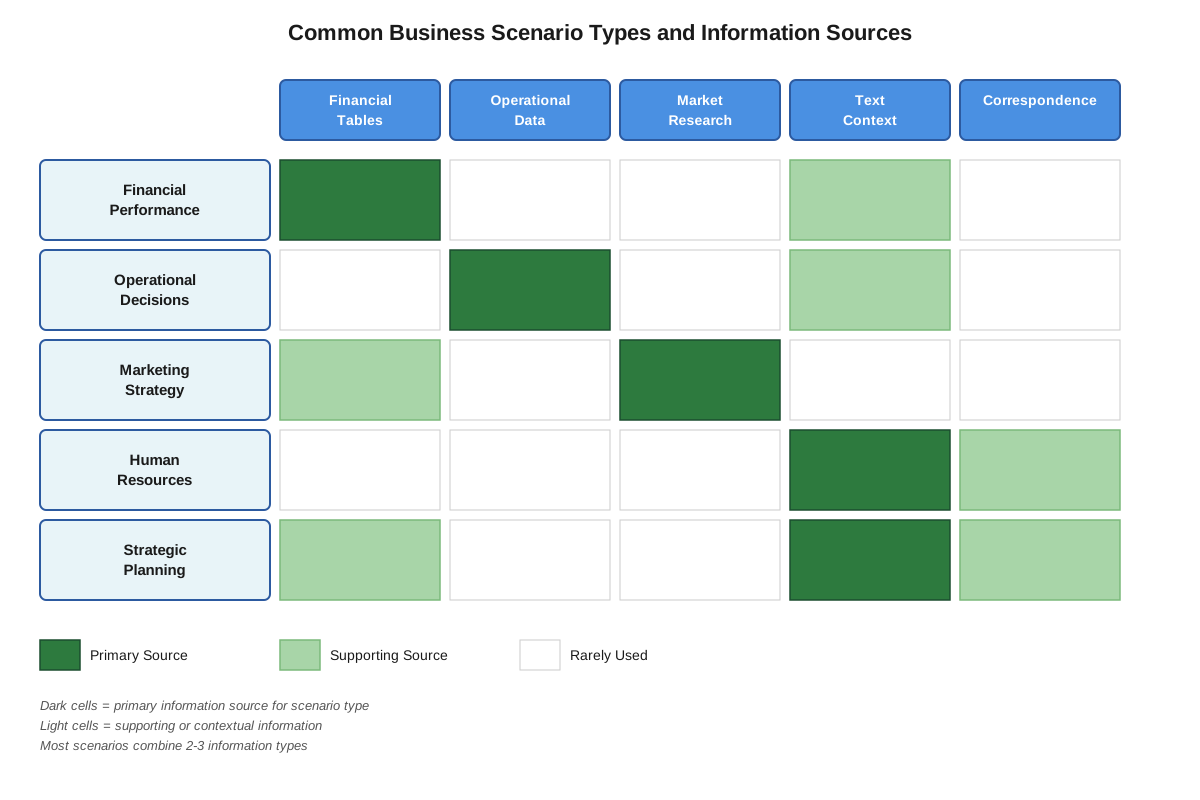
Financial Performance Analysis scenarios present company financial statements, revenue breakdowns, cost structures, or profitability metrics across time periods or business units. Students must identify trends, calculate financial ratios, compare performance against benchmarks, or evaluate the impact of proposed changes. These scenarios test understanding of fundamental business metrics like gross margin, operating income, return on investment, and break-even analysis.
Market Analysis and Strategy scenarios describe competitive landscapes, customer segments, market sizing opportunities, or positioning decisions. Information sources include market research data, competitor comparisons, demographic trends, and customer preference surveys. Questions require students to evaluate market attractiveness, recommend target segments, assess competitive advantages, or predict market share outcomes.
Operational Decision-Making scenarios focus on process improvements, capacity planning, supply chain optimization, or resource allocation. Data sources present production volumes, efficiency metrics, cost structures, quality indicators, or capacity constraints. Students must evaluate trade-offs, calculate operational impacts, or recommend process changes based on quantitative analysis.
Human Resources and Organizational scenarios address workforce planning, compensation structures, training investments, or organizational design. Information includes employee demographics, performance metrics, compensation data, turnover statistics, or survey results. Questions test the ability to analyze workforce trends, evaluate HR program effectiveness, or recommend talent management strategies.
Information Source Types
Business scenarios integrate multiple information formats that students must interpret and synthesize:
| Information Type | Typical Content | Analysis Required |
|---|---|---|
| Narrative Text | Company background, problem description, strategic context | Identify key facts, constraints, objectives |
| Data Tables | Financial statements, operational metrics, survey results | Extract specific values, calculate derived metrics |
| Charts/Graphs | Trend lines, comparisons, distributions | Identify patterns, compare magnitudes, spot outliers |
| Email/Correspondence | Stakeholder perspectives, additional constraints, recommendations | Understand viewpoints, identify assumptions, note limitations |
| Meeting Notes | Discussion summaries, decision criteria, action items | Extract decision factors, understand priorities |
Question Types in Business Scenarios
Fact-Based Questions require locating specific information within the scenario sources. These questions test careful reading and navigation skills: "According to the financial data, what was the company's revenue in 2022?" Success requires knowing which tab contains the relevant information and accurately extracting the data point.
Calculation Questions demand performing arithmetic operations on data from one or more sources. Students might calculate percentage changes, weighted averages, ratios, or projections: "If the company implements the proposed cost reduction, what will be the new operating margin?" These questions test both quantitative skills and the ability to identify which data points are relevant.
Inference Questions require drawing logical conclusions from the presented information, often combining data from multiple sources: "Based on the market research and financial performance, which customer segment offers the greatest growth opportunity?" These questions reward synthesis and business judgment.
Evaluation Questions ask students to assess the validity of statements, recommendations, or conclusions: "Would the following statement be supported by the information provided?" These questions test critical thinking and the ability to distinguish between supported and unsupported claims.
Analytical Approach Framework
Effective business scenario analysis follows a systematic process:
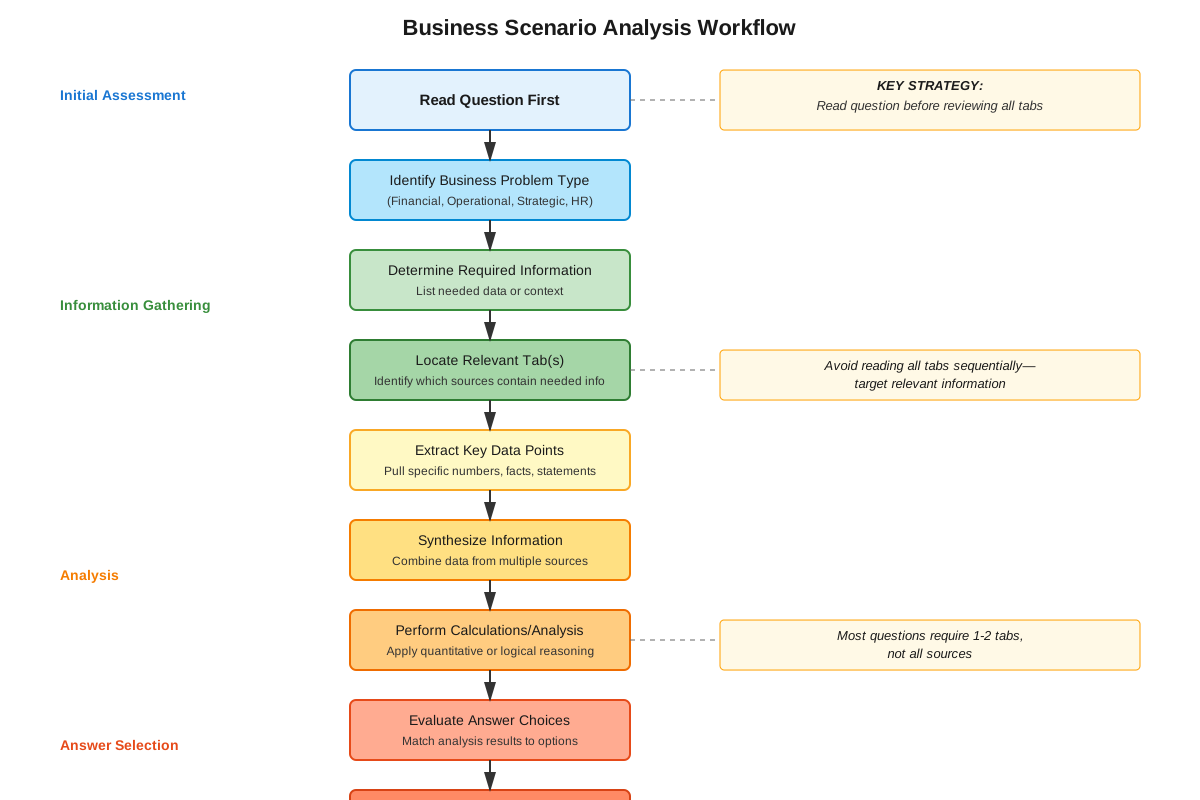
- Initial Orientation (30-45 seconds): Quickly scan all tabs to understand the business context, identify information types, and note the general structure
- Question Analysis (15-20 seconds per question): Read the question carefully to determine what information is needed and which sources likely contain it
- Targeted Information Gathering (30-60 seconds): Navigate to relevant tabs and extract specific data points or facts
- Synthesis and Calculation (30-90 seconds): Combine information, perform necessary calculations, or draw logical inferences
- Answer Evaluation (15-30 seconds): Verify the answer against the question requirements and check for calculation errors
Concept Relationships
Business scenarios serve as the integrating framework that connects multiple Data Insights skills. The scenario provides the context → which determines the relevant data sources → which require interpretation skills (table analysis, graphics interpretation) → leading to quantitative analysis (calculations, comparisons) → culminating in logical reasoning (inferences, evaluations).
The relationship between scenario components is hierarchical: the narrative context establishes the business problem, which determines which quantitative data is relevant, which in turn drives what calculations or comparisons are meaningful. Understanding this hierarchy prevents students from getting lost in irrelevant details or performing unnecessary calculations.
Business scenarios also connect to broader GMAT skills. The reading comprehension required mirrors Critical Reasoning passages but with a business focus. The quantitative analysis resembles Quantitative Reasoning problems but embedded in realistic contexts. The multi-source navigation and synthesis represent unique skills specific to Data Insights that distinguish it from other GMAT sections.
Within the Multi-Source Reasoning question type, business scenarios represent the most common context, appearing more frequently than scientific research scenarios or policy analysis scenarios. Mastering business scenarios therefore provides the highest return on study investment for this question type.
High-Yield Facts
⭐ Business scenarios typically span 2-4 tabs with each tab containing distinct information types (narrative, data tables, charts, or correspondence)
⭐ Approximately 30-40% of Data Insights questions use business scenario contexts, making them the highest-frequency topic
⭐ Each business scenario set includes 3-4 questions, so understanding the initial context efficiently benefits multiple questions
⭐ Questions require synthesizing information from multiple tabs approximately 60% of the time, not just single-source analysis
⭐ The most common business scenario types are financial performance analysis, market strategy, and operational decision-making
- Business scenarios always present realistic situations that could occur in actual companies, not hypothetical or abstract problems
- Email correspondence and meeting notes, when included, typically reveal constraints, stakeholder perspectives, or decision criteria not found in quantitative data
- Charts and tables in business scenarios always contain information necessary to answer at least one question—no decorative data is included
- The narrative context tab usually contains qualitative information that frames how to interpret quantitative data in other tabs
- Calculation questions in business scenarios rarely require complex mathematics; the challenge lies in identifying which numbers to use, not performing difficult computations
Quick check — test yourself on Business scenarios so far.
Try Flashcards →Common Misconceptions
Misconception: All information provided in a business scenario is necessary to answer every question → Correction: Each question typically requires information from only 1-2 tabs. Part of the skill being tested is identifying which information is relevant to each specific question, while ignoring irrelevant data. Reading everything in detail before approaching questions wastes valuable time.
Misconception: Business scenarios require specialized business knowledge or MBA-level expertise → Correction: All necessary information to answer questions is contained within the scenario itself. While basic business terminology helps with reading efficiency, the GMAT does not test specialized knowledge of accounting, finance, or marketing. Students with no business background can achieve perfect scores by carefully analyzing the provided information.
Misconception: The tabs should be read in sequential order from left to right → Correction: Efficient test-takers read the questions first to understand what information they need, then navigate directly to relevant tabs. The tab order is arbitrary and does not reflect a logical reading sequence. Question-driven navigation saves significant time.
Misconception: Numerical data is always more important than narrative text in business scenarios → Correction: Narrative context often contains critical constraints, objectives, or assumptions that determine how to interpret quantitative data. For example, text might reveal that a company prioritizes market share over profitability, completely changing how financial data should be evaluated.
Misconception: If a calculation seems complex, there must be a simpler approach → Correction: While GMAT business scenarios avoid truly complex mathematics, some questions legitimately require multi-step calculations involving percentages, weighted averages, or ratio analysis. Students should be prepared to perform these calculations accurately rather than searching for shortcuts that don't exist.
Misconception: Email correspondence and meeting notes are less important than formal data presentations → Correction: Informal communication sources often contain the most critical information for answering inference and evaluation questions. These sources reveal stakeholder priorities, decision criteria, and constraints that aren't captured in formal reports or data tables.
Worked Examples
Example 1: Market Entry Decision
Scenario Context: TechFlow, a software company, is considering entering the European market. Tab 1 describes the company's current North American operations, generating $50 million in annual revenue with a 20% operating margin. Tab 2 presents market research showing the European software market is $200 million annually, growing at 15% per year, with three established competitors holding 60%, 25%, and 15% market share respectively. Tab 3 contains an email from the CFO noting that European entry would require $8 million in initial investment and $2 million in annual fixed costs, with variable costs expected to be 60% of revenue.
Question: If TechFlow captures 5% market share in the European market in Year 1, what would be the operating income from European operations?
Solution Process:
Step 1: Identify needed information
- European market size: $200 million (Tab 2)
- Expected market share: 5% (given in question)
- Variable cost percentage: 60% of revenue (Tab 3)
- Annual fixed costs: $2 million (Tab 3)
Step 2: Calculate revenue
- European revenue = $200 million × 5% = $10 million
Step 3: Calculate variable costs
- Variable costs = $10 million × 60% = $6 million
Step 4: Calculate operating income
- Operating income = Revenue - Variable costs - Fixed costs
- Operating income = $10 million - $6 million - $2 million = $2 million
Note: The initial investment of $8 million is not included in operating income calculation as it's a capital expenditure, not an operating expense. This demonstrates how business context (understanding the difference between capital and operating expenses) guides proper analysis.
Connection to Learning Objectives: This example demonstrates applying business scenarios to GMAT questions by synthesizing information from multiple tabs (market size from Tab 2, cost structure from Tab 3) and performing relevant calculations while ignoring irrelevant information (North American operations from Tab 1, competitor market shares beyond confirming market fragmentation).
Example 2: Operational Efficiency Analysis
Scenario Context: ManufactureCo operates two production facilities. Tab 1 describes the company's goal to reduce per-unit production costs by 10% within one year. Tab 2 presents a table showing Facility A produces 10,000 units monthly with total costs of $500,000 ($300,000 fixed, $200,000 variable), while Facility B produces 15,000 units monthly with total costs of $600,000 ($250,000 fixed, $350,000 variable). Tab 3 contains meeting notes indicating that management is considering consolidating all production at one facility, which would increase that facility's fixed costs by 40% but reduce variable cost per unit by 15% due to economies of scale.
Question: If production is consolidated at Facility B, would the company achieve its 10% cost reduction goal?
Solution Process:
Step 1: Calculate current per-unit costs
- Total current production = 10,000 + 15,000 = 25,000 units
- Total current costs = $500,000 + $600,000 = $1,100,000
- Current per-unit cost = $1,100,000 ÷ 25,000 = $44.00
Step 2: Calculate target per-unit cost
- Target cost = $44.00 × (1 - 0.10) = $39.60
Step 3: Calculate consolidated costs at Facility B
- New fixed costs = $250,000 × 1.40 = $350,000
- Current Facility B variable cost per unit = $350,000 ÷ 15,000 = $23.33
- New variable cost per unit = $23.33 × (1 - 0.15) = $19.83
- Total new variable costs = $19.83 × 25,000 = $495,750
- Total consolidated costs = $350,000 + $495,750 = $845,750
Step 4: Calculate new per-unit cost and compare
- New per-unit cost = $845,750 ÷ 25,000 = $33.83
- Comparison: $33.83 < $39.60, so YES, the goal would be achieved
Connection to Learning Objectives: This example illustrates identifying business scenarios (operational efficiency improvement), explaining the scenario structure (goal statement in Tab 1, current data in Tab 2, proposed solution in Tab 3), and applying systematic analysis to evaluate whether a proposed action meets stated objectives. The solution requires synthesizing information from all three tabs and performing multi-step calculations.
Exam Strategy
Pre-Question Orientation Strategy: Spend 30-45 seconds performing an initial scan of all tabs before reading any questions. Note the general business context (company, industry, problem), identify what type of information each tab contains (narrative vs. data vs. correspondence), and observe the structure of any tables or charts. This investment creates a mental map that enables efficient navigation when answering questions.
Question-First Approach: After initial orientation, read each question completely before diving into detailed analysis. Identify what the question is asking (fact retrieval, calculation, inference, or evaluation) and which tab(s) likely contain relevant information. This targeted approach prevents wasting time reading irrelevant details.
Trigger Words and Phrases: Watch for these high-value signals:
- "According to..." indicates a fact-retrieval question requiring location of specific information
- "If... then what would be..." signals a calculation or projection question
- "Based on the information provided..." suggests an inference question requiring synthesis
- "Would the following be supported..." indicates an evaluation question testing logical reasoning
- "Which of the following can be concluded..." requires drawing inferences from multiple sources
Process of Elimination Tips:
- Eliminate answers that require information not provided in the scenario (the GMAT never expects outside knowledge)
- Eliminate answers that contradict explicit statements in the scenario text
- For calculation questions, eliminate answers that are orders of magnitude different from reasonable estimates
- For inference questions, eliminate extreme statements (always, never, must) unless strongly supported by data
Time Allocation: Budget approximately 2.5-3 minutes per question within a business scenario set. Since the initial orientation benefits all questions in the set, the first question may take 3-3.5 minutes while subsequent questions take 2-2.5 minutes. If a question requires extensive calculation, consider flagging it and returning after completing easier questions in the set.
Tab Navigation Efficiency: Develop a consistent clicking pattern. Many students find it helpful to keep the narrative context tab (usually Tab 1) as their "home base," returning there between questions to reorient. When a question clearly requires specific data, navigate directly to the relevant tab rather than re-reading all tabs.
Calculation Accuracy: For questions requiring calculations, write down intermediate steps on your noteboard. Business scenario calculations often involve multiple steps, and tracking your work prevents errors and enables quick verification. Round strategically—if answer choices are widely spaced, rough calculations suffice; if choices are close, precise calculation is necessary.
Memory Techniques
SCENARIO Mnemonic for systematic analysis:
- Scan all tabs initially (30-45 seconds)
- Consider what each question asks
- Extract relevant information only
- Navigate to appropriate tabs
- Analyze and calculate as needed
- Review answer against question
- Ignore irrelevant details
- Organize multi-step calculations
The Three C's of Business Scenarios: Context (what's the business situation?), Content (what information is provided?), Conclusion (what does the question ask me to determine?). Mentally answering these three questions before detailed analysis ensures proper orientation.
Tab Type Visualization: Picture business scenarios as a three-drawer filing cabinet:
- Top drawer (Tab 1): Background files—company story, problem description, objectives
- Middle drawer (Tab 2): Data files—numbers, charts, tables, metrics
- Bottom drawer (Tab 3): Communication files—emails, notes, recommendations
This visualization helps remember where different information types typically reside.
FIND Formula for calculation questions:
- Figures needed (identify which numbers)
- Identify the operation (add, subtract, multiply, divide, percentage)
- Navigate to data source
- Determine and verify answer
Summary
Business scenarios represent the primary context for GMAT Data Insights Multi-Source Reasoning questions, presenting realistic corporate situations that require synthesizing information from multiple sources including narrative text, data tables, charts, and correspondence. These scenarios test integrated analytical skills—reading comprehension, data interpretation, quantitative reasoning, and logical inference—that mirror authentic business decision-making. The typical structure includes 2-4 tabs of information with 3-4 questions per scenario set, covering domains such as financial performance analysis, market strategy, operational decisions, and organizational challenges. Success requires systematic orientation to understand the business context, question-driven navigation to locate relevant information efficiently, accurate synthesis of data from multiple sources, and appropriate calculations or logical reasoning to reach conclusions. Students must distinguish between relevant and irrelevant information, recognize that all necessary facts are provided within the scenario, and apply basic business understanding without requiring specialized expertise. The high frequency of business scenarios in Data Insights (30-40% of questions) makes this topic essential for competitive GMAT scores, and mastery delivers compounding benefits since understanding the initial scenario context efficiently enables faster, more accurate responses across multiple questions in each set.
Key Takeaways
- Business scenarios appear in 30-40% of Data Insights questions, making them the highest-yield topic for focused preparation in Multi-Source Reasoning
- Each scenario set includes 3-4 questions sharing the same context, so efficient initial orientation (30-45 seconds) pays dividends across multiple questions
- Success requires synthesizing information from multiple tabs approximately 60% of the time, not just analyzing single sources in isolation
- Read questions before detailed analysis to enable targeted navigation and prevent wasting time on irrelevant information
- All necessary information is provided within the scenario—no specialized business knowledge beyond basic terminology is required or expected
- The five main scenario types are financial performance, market analysis, operational decisions, human resources, and strategic planning
- Systematic approaches (scan, identify question type, navigate to relevant tabs, synthesize, calculate, verify) significantly improve accuracy and speed
Related Topics
Table Analysis: Business scenarios frequently incorporate data tables requiring sorting, filtering, and comparative analysis skills. Mastering table analysis enhances the ability to extract quantitative information efficiently from business scenario data sources.
Graphics Interpretation: Charts and graphs appear in approximately 60% of business scenarios. Strong graphics interpretation skills enable quick pattern recognition and magnitude comparison essential for scenario analysis.
Two-Part Analysis: Some business scenario questions use two-part analysis format, requiring students to make two related determinations simultaneously. Understanding business scenarios provides the contextual foundation for these complex question types.
Quantitative Reasoning: The calculations required in business scenarios—percentages, ratios, weighted averages, projections—directly apply quantitative reasoning skills in realistic contexts, reinforcing mathematical concepts through practical application.
Critical Reasoning: The logical inference and evaluation skills developed through business scenario analysis transfer directly to Critical Reasoning questions, particularly those involving business contexts, assumptions, and evidence evaluation.
Practice CTA
Now that you've mastered the framework for analyzing business scenarios, it's time to apply these strategies to authentic GMAT-style questions. The practice questions and flashcards will reinforce your ability to quickly identify scenario types, navigate efficiently between information sources, and synthesize data to reach accurate conclusions. Remember that business scenarios reward systematic approaches over rushed analysis—invest the time to orient yourself properly, and you'll find that subsequent questions become significantly more manageable. Each practice scenario you complete builds pattern recognition that accelerates your performance on test day. Begin your practice now to transform these concepts into automatic skills!
Sign up free to keep reading
Create a free AnvayaPrep account to finish this GMAT guide on Business scenarios — plus flashcards and practice questions.