Overview
Comparing sources is a critical skill within the Multi-Source Reasoning (MSR) section of the GMAT Data Insights module. This competency requires test-takers to synthesize information from multiple documents, tables, emails, reports, or other data presentations to identify consistencies, contradictions, and complementary information. Unlike traditional reading comprehension that focuses on a single passage, GMAT comparing sources questions demand that students navigate between two or three distinct information sources, extract relevant data points, and make informed judgments about how these sources relate to one another.
The ability to compare sources effectively is essential for GMAT success because it mirrors real-world business scenarios where decision-makers must evaluate multiple reports, reconcile conflicting data, and synthesize information from various stakeholders. On the GMAT, these questions typically present business scenarios involving market research, financial reports, operational data, or strategic communications. Students must quickly identify which source contains specific information, recognize when sources agree or disagree, and determine what conclusions can be drawn when combining information across sources.
Within the broader Data Insights framework, comparing sources represents an integration of several analytical skills: reading comprehension, quantitative reasoning, and logical analysis. This topic builds upon foundational skills in data interpretation and critical reasoning while preparing students for more complex integrated reasoning tasks. Mastery of source comparison enables efficient navigation of the MSR interface, where students must toggle between tabs or windows to access different information sources while maintaining focus on the question requirements.
Learning Objectives
- [ ] Identify comparing sources questions and recognize their structural characteristics on the GMAT
- [ ] Explain the methodology for systematically comparing information across multiple data sources
- [ ] Apply comparing sources strategies to GMAT questions involving conflicting or complementary information
- [ ] Evaluate the reliability and relevance of information from different sources within a single question set
- [ ] Synthesize data from multiple sources to draw valid conclusions that no single source supports independently
- [ ] Distinguish between explicit contradictions and apparent inconsistencies that can be reconciled through careful analysis
Prerequisites
- Basic reading comprehension skills: Essential for understanding the content within each individual source before attempting comparison
- Quantitative data interpretation: Necessary for comparing numerical information presented in tables, charts, or text across sources
- Logical reasoning fundamentals: Required to identify when sources contradict, support, or remain neutral relative to each other
- Familiarity with business terminology: Helps with rapid comprehension of common GMAT scenarios involving corporate communications, financial reports, and market analysis
- Tab navigation and interface management: Students should be comfortable with the GMAT's digital interface for switching between information sources
Why This Topic Matters
In professional environments, executives and managers rarely make decisions based on a single information source. They must reconcile quarterly reports with market forecasts, compare customer feedback with sales data, and evaluate competing recommendations from different departments. The GMAT's comparing sources questions directly assess this real-world competency, making it one of the most practically relevant skills tested on the exam.
From an exam perspective, Multi-Source Reasoning questions, which heavily feature source comparison, typically constitute approximately 20-25% of the Data Insights section. These questions are considered high-difficulty items that effectively discriminate between mid-range and high-scoring test-takers. According to GMAT test specifications, MSR questions often appear in sets of three questions based on the same source materials, making efficient source comparison strategies essential for time management.
Common manifestations of this topic on the GMAT include: business scenarios where an email contradicts a financial report, market research data that partially supports or refutes a strategic memo, operational statistics that must be reconciled with management commentary, and situations where combining information from two sources enables conclusions that neither source alone supports. Questions may ask students to identify statements that are supported by both sources, find contradictions between sources, or determine what additional information would be needed to reconcile apparent discrepancies.
Core Concepts
Understanding Source Types and Structures
The GMAT presents information through various source formats, each with distinct characteristics that affect comparison strategies. Common source types include: business correspondence (emails, memos), financial statements (balance sheets, income statements), research reports (market analysis, survey results), operational data (production statistics, sales figures), and strategic documents (proposals, recommendations). Each format has conventional structures and purposes that skilled test-takers recognize quickly.
When approaching multiple sources, students must first conduct a rapid source inventory: identifying what type of document each source represents, who authored it, what time period it covers, and what primary purpose it serves. This inventory creates a mental framework for understanding why sources might differ—for example, a sales manager's optimistic email versus conservative financial projections from the CFO represent different perspectives rather than contradictory facts.
Types of Source Relationships
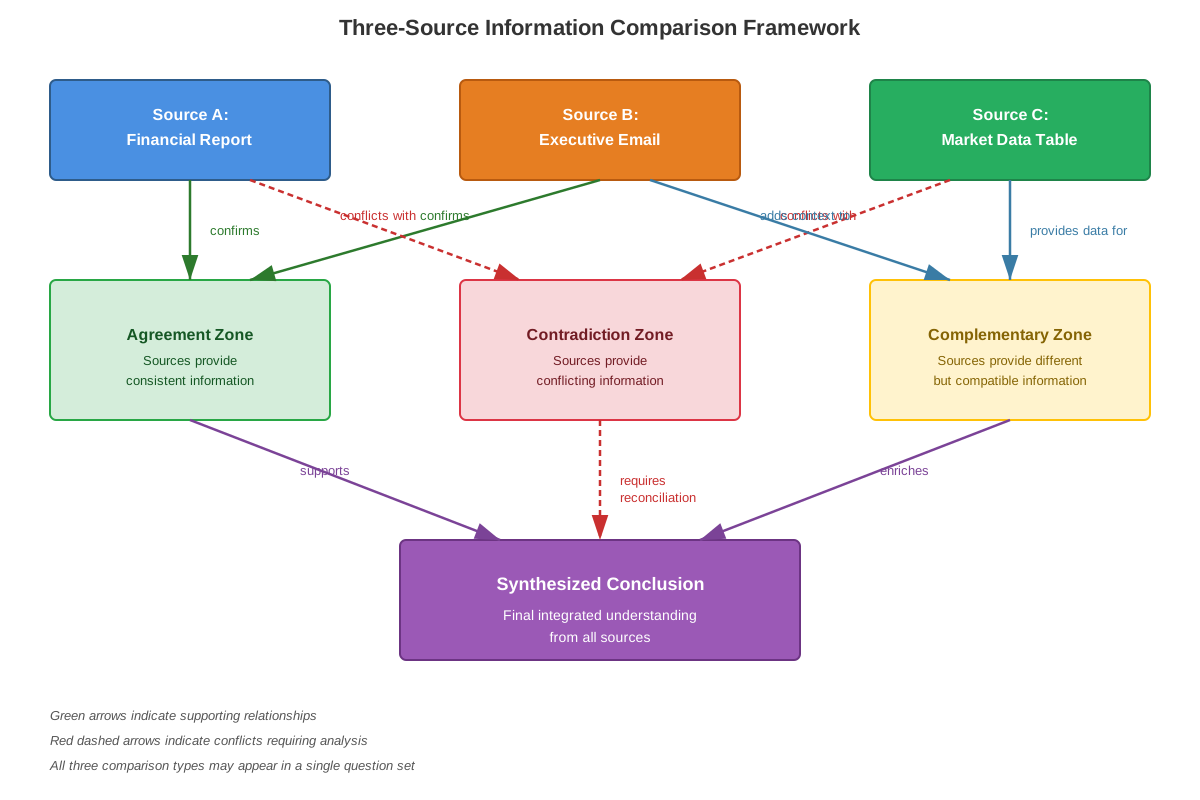
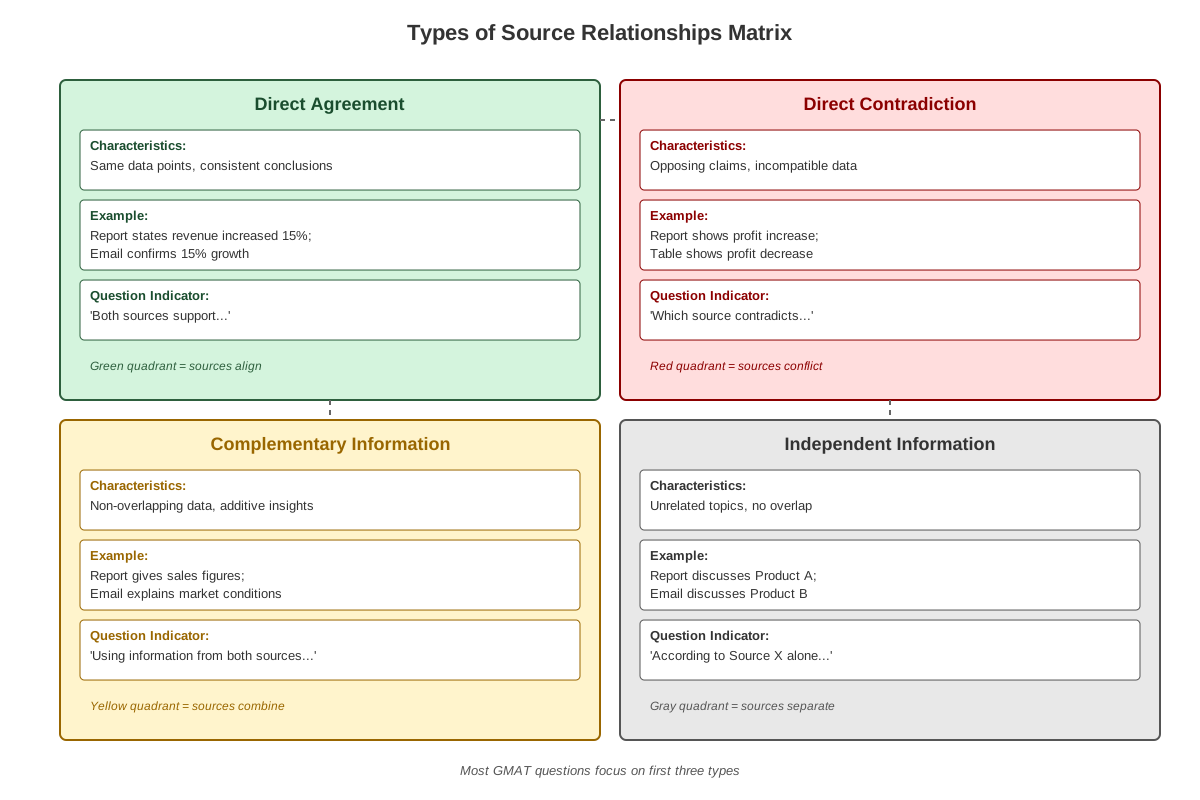
Sources can relate to each other in several distinct ways, and recognizing these relationships is fundamental to comparing sources effectively:
| Relationship Type | Description | GMAT Example |
|---|---|---|
| Complementary | Sources provide different information about the same topic without contradiction | Source 1 shows Q1 sales; Source 2 shows Q2 sales |
| Corroborating | Sources independently support the same conclusion | Both market report and sales data indicate growth |
| Contradictory | Sources make incompatible claims about the same fact | Email states 15% growth; table shows 12% growth |
| Qualifying | One source adds conditions or limitations to another's claims | Report shows profit increase; memo notes one-time gain |
| Independent | Sources address different aspects with no direct relationship | Product specs and employee satisfaction survey |
Systematic Comparison Methodology
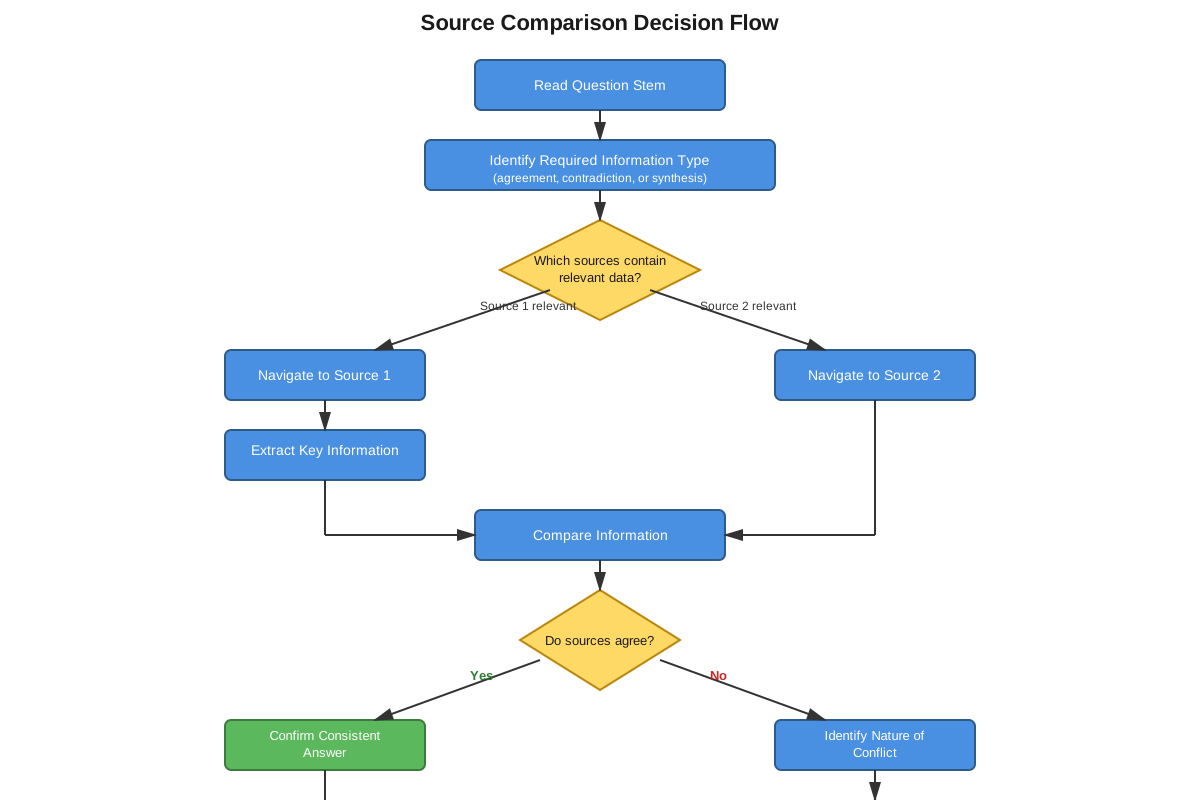
Effective source comparison follows a structured process rather than random back-and-forth reading. The systematic comparison methodology involves:
- Initial source scan: Quickly review each source to understand its basic content, structure, and purpose (15-20 seconds per source)
- Question analysis: Read the question carefully to determine exactly what comparison is required
- Targeted information location: Identify which sources likely contain relevant information for the specific question
- Direct comparison: Place the relevant information side-by-side mentally or using scratch paper
- Relationship determination: Classify how the information relates (complementary, contradictory, etc.)
- Answer evaluation: Test each answer choice against the comparison findings
Identifying Explicit vs. Implicit Information
A critical distinction in source comparison involves explicit information (directly stated facts) versus implicit information (conclusions that can be inferred). The GMAT frequently tests whether students can recognize that two sources actually agree when one states something explicitly and another implies it, or conversely, that sources contradict each other even when the contradiction requires inference.
For example, if Source 1 explicitly states "Revenue increased 20% to $60 million" and Source 2 states "Last year's revenue was $48 million," these sources corroborate each other through calculation ($48M × 1.20 = $57.6M, approximately $60M). Students must perform this reconciliation rather than assuming the sources are independent.
Handling Contradictions and Discrepancies
When sources appear to contradict each other, skilled test-takers follow a contradiction resolution protocol:
- Check scope and timeframe: Ensure both sources discuss the same metric for the same period
- Verify units and scales: Confirm both use the same measurement units (thousands vs. millions, percentages vs. absolute numbers)
- Consider perspective differences: Recognize that projections differ from actual results, or that different departments may report different aspects
- Look for qualifying language: Words like "approximately," "projected," or "excluding" may explain apparent discrepancies
- Accept genuine contradictions: Sometimes sources truly conflict, and the question asks students to recognize this
Synthesis and Integration
The highest-level skill in comparing sources involves synthesis: drawing conclusions that require information from multiple sources combined. For instance, if Source 1 provides unit sales by product and Source 2 provides price per unit, students might need to calculate total revenue by combining both sources. Or if Source 1 describes a company's strategy and Source 2 shows market conditions, students might need to evaluate whether the strategy aligns with the conditions.
Synthesis questions often use language like "Based on both sources..." or "If the information in both sources is accurate..." These signal that neither source alone contains the answer—integration is required.
Concept Relationships
The core concepts within comparing sources build upon each other hierarchically. Understanding source types and structures forms the foundation, enabling students to quickly orient themselves to new information. This understanding directly supports the systematic comparison methodology, which provides the procedural framework for all source comparison tasks.
The types of source relationships concept connects bidirectionally with handling contradictions and discrepancies—recognizing that sources are contradictory (a relationship type) triggers the contradiction resolution protocol (a handling strategy). Similarly, distinguishing explicit vs. implicit information is essential for accurately determining source relationships, as apparent contradictions may actually be complementary information when implicit content is properly inferred.
Synthesis and integration represents the apex skill that depends on all other concepts. Students cannot effectively synthesize information without first understanding source structures, identifying relationships, distinguishing explicit from implicit content, and resolving apparent discrepancies.
This topic connects to prerequisite knowledge through its dependence on reading comprehension (for understanding individual sources) and quantitative reasoning (for comparing numerical data). It relates to other Data Insights topics by sharing analytical frameworks with Table Analysis (comparing data across rows/columns) and Graphics Interpretation (comparing visual data representations). Mastery of comparing sources also enhances performance on Integrated Reasoning questions that combine multiple data types.
Relationship map: Source Type Recognition → Systematic Methodology → Relationship Classification → Explicit/Implicit Distinction → Contradiction Resolution → Synthesis & Integration
High-Yield Facts
- ⭐ Multi-Source Reasoning questions typically present 2-3 sources with 3 questions per set, making efficient source navigation critical for time management
- ⭐ Approximately 60% of comparing sources questions involve numerical data comparison, requiring both reading comprehension and quantitative skills
- ⭐ The GMAT frequently tests whether students can recognize that sources agree when one explicitly states information and another implies it, not just when both state it directly
- ⭐ Contradictions between sources are often explained by different timeframes, scopes, or measurement units rather than representing genuine errors
- ⭐ Questions asking "Which statement is supported by both sources?" require finding information that appears in or can be inferred from each source independently
- Sources authored by different stakeholders (CEO vs. operations manager) often reflect different perspectives rather than contradictory facts
- The GMAT interface allows toggling between sources, but information from one source disappears when viewing another, requiring strong working memory or note-taking
- Approximately 30% of comparing sources questions require synthesis—combining information from multiple sources to reach a conclusion
- Questions using "If both sources are accurate..." signal that students should look for ways to reconcile apparent contradictions
- Sources presented in chronological order (earlier date first) often show progression or change over time, which is frequently tested
- The most common error in comparing sources questions is failing to check whether sources discuss the same metric, timeframe, or population
- Answer choices that use absolute language ("always," "never," "all") are rarely correct when comparing sources with qualified statements
Quick check — test yourself on Comparing sources so far.
Try Flashcards →Common Misconceptions
Misconception: If two sources discuss the same topic, they must either completely agree or completely contradict each other.
Correction: Sources frequently have complementary relationships, where each provides different information about the same topic without contradiction. They can also partially agree while differing on specific details.
Misconception: When sources appear to contradict each other, one must be wrong or contain an error.
Correction: Apparent contradictions often result from different timeframes, scopes, measurement units, or perspectives. The GMAT expects students to recognize these differences and understand that both sources can be accurate within their respective contexts.
Misconception: Comparing sources means reading all sources completely before looking at any questions.
Correction: Efficient strategy involves a quick initial scan of sources followed by question-driven targeted reading. Reading everything in detail before seeing questions wastes time and overloads working memory.
Misconception: If information appears in only one source, it cannot be the correct answer to a comparing sources question.
Correction: Many questions ask what can be determined from the sources collectively. Information stated in one source and not contradicted by others is often the correct answer, especially for synthesis questions.
Misconception: Numerical data from different sources can be directly compared without checking units, scales, or definitions.
Correction: The GMAT frequently presents data in different units (thousands vs. millions), different scales (percentages vs. absolute numbers), or with different definitions (gross vs. net, domestic vs. international). These must be reconciled before comparison.
Misconception: Sources presented by the GMAT are always internally consistent and factually accurate.
Correction: While individual sources are internally consistent, the GMAT sometimes presents scenarios where sources genuinely conflict, and questions ask students to identify these contradictions or determine what additional information would resolve them.
Worked Examples
Example 1: Reconciling Apparent Contradictions
Scenario: You are presented with two sources:
Source 1 (Email from Sales Director, dated March 15): "I'm pleased to report that our Q1 sales exceeded projections by 8%. We sold 54,000 units, generating strong momentum for the year."
Source 2 (Financial Summary Table, Q1 Results):
Product Line | Units Sold | Revenue
Alpha        | 32,000     | $1.6M
Beta         | 18,000     | $1.26M
Gamma        | 6,000      | $420K
Total | 56,000 | $3.28MQuestion: Based on the sources, which statement is most accurate?
A) The sources contradict each other regarding Q1 unit sales
B) The Sales Director's email contains an error in the units sold figure
C) The Financial Summary includes products not mentioned in the email
D) The sources agree that Q1 sales exceeded 50,000 units
Solution Process:
Step 1 - Identify the comparison point: Both sources discuss Q1 unit sales, so this is the relevant comparison metric.
Step 2 - Extract explicit information:
- Email states: 54,000 units sold
- Table shows: 56,000 total units sold
Step 3 - Analyze the discrepancy: The numbers differ by 2,000 units (approximately 3.6% difference).
Step 4 - Consider possible explanations:
- Different timeframes? No—both clearly state Q1
- Different scopes? Possibly—the email might exclude certain product lines
- Rounding or approximation? The email doesn't use qualifying language like "approximately"
- Measurement error? Both sources appear authoritative
Step 5 - Evaluate answer choices:
- (A) "Contradict each other" - This is technically true but doesn't explain why
- (B) "Contains an error" - Too strong; we cannot conclude there's an error without more information
- (C) "Includes products not mentioned" - The email doesn't specify which products, so the table could include all products the director referenced
- (D) "Agree that sales exceeded 50,000" - Both sources support this statement (54K and 56K both exceed 50K)
Answer: D
Key Insight: This question demonstrates that sources can "agree" on broader conclusions even when specific numbers differ. The GMAT rewards students who recognize common ground rather than focusing exclusively on discrepancies. Both sources independently support the conclusion that sales exceeded 50,000 units, making this the most defensible statement.
Example 2: Synthesis Across Sources
Scenario: You are presented with three sources:
Source 1 (Market Research Report): "Consumer preference surveys indicate that 68% of target demographic prefers eco-friendly packaging, with 45% willing to pay a 10-15% premium for sustainable options."
Source 2 (Cost Analysis Memo): "Transitioning to biodegradable packaging would increase per-unit costs by $0.18. Current packaging costs $1.20 per unit. Our average retail price is $12.00 per unit."
Source 3 (Sales Projection Email): "If we maintain current pricing, we project selling 500,000 units next year. However, market research suggests eco-friendly positioning could increase volume by 20-25%."
Question: Based on the sources, if the company transitions to eco-friendly packaging and increases retail price by 12% to offset costs, which conclusion is best supported?
A) The price increase falls within the premium range consumers indicated willingness to pay
B) The company's profit margin will decrease compared to current operations
C) Sales volume will definitely increase by at least 20%
D) The new packaging cost will exceed the revenue from the price increase
Solution Process:
Step 1 - Identify required information from each source:
- Source 1: Consumer willingness to pay 10-15% premium
- Source 2: Cost increase ($0.18), current costs ($1.20), current price ($12.00)
- Source 3: Potential volume increase (20-25%)
Step 2 - Calculate the proposed price increase:
- 12% of $12.00 = $1.44
- New price: $13.44
- Price increase as percentage: $1.44/$12.00 = 12%
Step 3 - Evaluate each answer choice through synthesis:
(A) Falls within premium range consumers will pay:
- Source 1 states consumers will pay 10-15% premium
- Proposed increase is 12%
- 12% falls within the 10-15% range
- This is directly supported by combining Sources 1 and 2
(B) Profit margin will decrease:
- Cost increases by $0.18
- Revenue increases by $1.44
- Net effect: +$1.26 per unit (margin increases, not decreases)
- This contradicts the calculation
(C) Sales volume will definitely increase by at least 20%:
- Source 3 says "could increase" and gives a range (20-25%)
- "Definitely" and "at least" are too strong given the qualified language
- Not supported
(D) New packaging cost will exceed revenue from price increase:
- New packaging cost increase: $0.18
- Revenue increase: $1.44
- $0.18 < $1.44, so this is false
Answer: A
Key Insight: This synthesis question requires combining specific data points from multiple sources and performing calculations. The correct answer integrates the consumer willingness data (Source 1) with the pricing calculation (Source 2). Students must recognize that the 12% price increase falls within the 10-15% premium range consumers indicated they would accept, making this the best-supported conclusion.
Exam Strategy
When approaching GMAT comparing sources questions, implement this strategic framework:
Initial Approach (30-45 seconds):
- Conduct a rapid scan of all sources to understand the general topic and source types
- Note the author, date, and purpose of each source
- Identify whether sources are primarily quantitative (tables, numbers) or qualitative (text, descriptions)
- Do NOT attempt to memorize details during this initial scan
Question-Driven Reading:
- Read the question stem carefully before diving into detailed source analysis
- Identify trigger words that indicate the type of comparison required: "both sources," "contradicts," "supported by," "if combined," etc.
- Determine which sources are likely to contain relevant information based on the question
- Use the tab/navigation system efficiently to toggle between sources as needed
Trigger Words and Phrases to Watch For:
"According to both sources..." signals that information must appear in or be inferable from each source independently
"Which statement is contradicted by..." requires finding explicit disagreement between sources
"If the information in both sources is accurate..." suggests apparent contradictions that can be reconciled
"Based on Source 1 and Source 2 together..." indicates a synthesis question requiring information combination
Process of Elimination Tips:
- Eliminate answers that reference information from only one source when the question asks about "both sources"
- Eliminate answers using absolute language ("always," "never," "must") when sources use qualified language ("may," "could," "typically")
- Eliminate answers that require assumptions not supported by either source
- When sources appear to contradict, eliminate answers that claim one source is "wrong" unless the question explicitly asks about errors
Time Allocation:
- Spend 30-45 seconds on initial source scan
- Allocate 60-90 seconds per question within the set
- If a question requires extensive calculation or synthesis, consider flagging it and returning after completing easier questions in the set
- Remember that all three questions in an MSR set use the same sources, so time invested understanding sources pays dividends across multiple questions
Common Traps to Avoid:
- Don't assume sources must completely agree or completely disagree—partial agreement is common
- Don't select answers based on real-world knowledge; use only information provided in sources
- Don't confuse correlation with causation when synthesizing information across sources
- Don't overlook qualifying language like "projected," "estimated," or "approximately" that explains apparent discrepancies
Memory Techniques
COMPARE Acronym for Systematic Analysis:
- Check the source type and author
- Orient to timeframe and scope
- Match relevant information to the question
- Pinpoint explicit vs. implicit content
- Analyze relationships (complementary, contradictory, etc.)
- Reconcile apparent discrepancies
- Evaluate answer choices against findings
The "Three R's" for Contradiction Resolution:
- Recheck units and scales
- Review timeframes and scope
- Recognize perspective differences
Visualization Strategy for Source Relationships:
Picture sources as puzzle pieces:
- Complementary sources = pieces that fit together side-by-side
- Corroborating sources = pieces with the same pattern overlapping
- Contradictory sources = pieces that cannot fit together
- Qualifying sources = one piece that adds a border or frame to another
SYNTHESIS Mnemonic for Integration Questions:
- Sources identified
- Yield relevant data points
- Numbers calculated if needed
- Test logical connections
- Harmonize information
- Evaluate combined meaning
- Select answer supported by integration
Summary
Comparing sources is a fundamental skill in GMAT Data Insights that requires students to navigate multiple information sources, identify relationships between them, and synthesize information to answer complex questions. Success depends on recognizing the five primary source relationships (complementary, corroborating, contradictory, qualifying, and independent) and applying a systematic methodology rather than random back-and-forth reading. The most critical competencies include distinguishing explicit from implicit information, reconciling apparent contradictions by checking timeframes and units, and synthesizing data across sources to reach conclusions that no single source supports independently. Students must resist the misconception that sources either completely agree or completely disagree, instead recognizing that partial agreement and complementary information are common. Efficient strategy involves a quick initial source scan followed by question-driven targeted reading, with careful attention to trigger words that signal the type of comparison required. Mastery of comparing sources enables students to handle the Multi-Source Reasoning questions that constitute approximately 20-25% of the Data Insights section and represent high-difficulty items that effectively discriminate between mid-range and high-scoring test-takers.
Key Takeaways
- Comparing sources requires systematic methodology, not random reading—scan sources initially, then use question-driven targeted analysis
- Sources relate in five primary ways: complementary, corroborating, contradictory, qualifying, and independent—recognizing these relationships is essential
- Apparent contradictions often result from different timeframes, units, scopes, or perspectives rather than actual errors—always check these factors before concluding sources conflict
- Synthesis questions require combining information from multiple sources to reach conclusions that neither source alone supports—these represent the highest-level skill tested
- Efficient navigation between sources and strong working memory or note-taking are critical since the GMAT interface shows only one source at a time
- Trigger words like "both sources," "contradicts," and "if combined" signal the specific type of comparison required and should guide your analysis approach
- The most common errors involve failing to verify that sources discuss the same metric, timeframe, or population before comparing them directly
Related Topics
Table Analysis: Builds on comparing sources by requiring students to compare data across rows and columns within a single complex table, using similar analytical frameworks for identifying patterns and contradictions.
Graphics Interpretation: Extends source comparison skills to visual data representations, requiring students to extract information from graphs and charts and compare it with textual information.
Two-Part Analysis: Applies source comparison logic to questions requiring simultaneous evaluation of two related decisions or conclusions, often drawing on information from multiple sources.
Integrated Reasoning - Combined Question Types: Represents the apex of Data Insights skills, combining source comparison with quantitative problem-solving and logical reasoning in complex business scenarios.
Mastering comparing sources provides the analytical foundation necessary for all advanced Data Insights question types and significantly improves performance on the verbal reasoning section by enhancing critical reading and synthesis skills.
Practice CTA
Now that you've mastered the core concepts and strategies for comparing sources, it's time to put your knowledge into action. Access the practice questions and flashcards specifically designed to reinforce these skills. Focus on applying the COMPARE systematic analysis framework and the Three R's for contradiction resolution as you work through problems. Remember that comparing sources is a high-yield topic that appears frequently on the GMAT—every minute you invest in deliberate practice directly translates to improved performance on test day. Challenge yourself with timed practice sets to build both accuracy and speed, and review your errors carefully to identify patterns in your reasoning. You've built a strong foundation; now transform that knowledge into consistent, confident performance!
Sign up free to keep reading
Create a free AnvayaPrep account to finish this GMAT guide on Comparing sources — plus flashcards and practice questions.