Overview
Cross-reference information is a critical skill tested in the GMAT Data Insights section, specifically within Multi-Source Reasoning questions. This competency requires test-takers to synthesize data from multiple sources—such as tables, graphs, emails, memos, and reports—and integrate these disparate pieces of information to answer complex questions. Unlike traditional problem-solving where information is presented in a single, linear format, cross-referencing demands that students navigate between different data presentations, identify relevant information across sources, and combine insights to reach accurate conclusions.
The ability to cross-reference effectively is essential for GMAT success because it mirrors real-world business scenarios where decision-makers must gather information from various departments, reports, and stakeholders before making informed choices. On the GMAT, GMAT cross-reference information questions typically present 2-3 tabbed sources of information (text passages, data tables, charts, or correspondence) and ask questions that cannot be answered by consulting just one source. Students must develop the mental agility to track which information resides where, recognize when multiple sources are needed, and accurately combine data points without making logical errors or overlooking critical details.
Within the broader Data Insights framework, cross-referencing serves as a foundational skill that integrates quantitative reasoning, reading comprehension, and analytical thinking. It builds upon basic data interpretation skills while preparing students for more complex integrated reasoning tasks. Mastery of this topic significantly impacts overall GMAT performance, as Multi-Source Reasoning questions constitute a substantial portion of the Data Insights section and are often among the most time-consuming question types on the exam.
Learning Objectives
- [ ] Identify cross-reference information requirements in GMAT Multi-Source Reasoning questions
- [ ] Explain the process and methodology for effectively cross-referencing data across multiple sources
- [ ] Apply cross-reference information strategies to solve GMAT questions accurately and efficiently
- [ ] Distinguish between questions requiring single-source versus multi-source analysis
- [ ] Synthesize quantitative and qualitative information from disparate sources to form coherent conclusions
- [ ] Evaluate the relevance and reliability of information across multiple data presentations
- [ ] Execute systematic approaches to minimize errors when combining information from different sources
Prerequisites
- Basic data interpretation skills: Understanding how to read tables, charts, and graphs is fundamental because cross-referencing builds upon the ability to extract individual data points before combining them.
- Reading comprehension proficiency: Students must quickly understand written passages, emails, and memos since these often contain qualitative information that must be integrated with quantitative data.
- Fundamental arithmetic and algebra: Cross-referencing frequently requires calculations using data from multiple sources, necessitating solid computational skills.
- Logical reasoning abilities: The capacity to identify relationships, draw inferences, and recognize when information is sufficient or insufficient forms the basis for effective cross-referencing.
Why This Topic Matters
In professional business environments, executives and analysts rarely have the luxury of making decisions based on a single data source. Strategic planning requires synthesizing market research data, financial statements, operational metrics, and stakeholder communications—precisely the skill set that cross-referencing develops. This real-world applicability makes it a high-priority testing area for business school admissions.
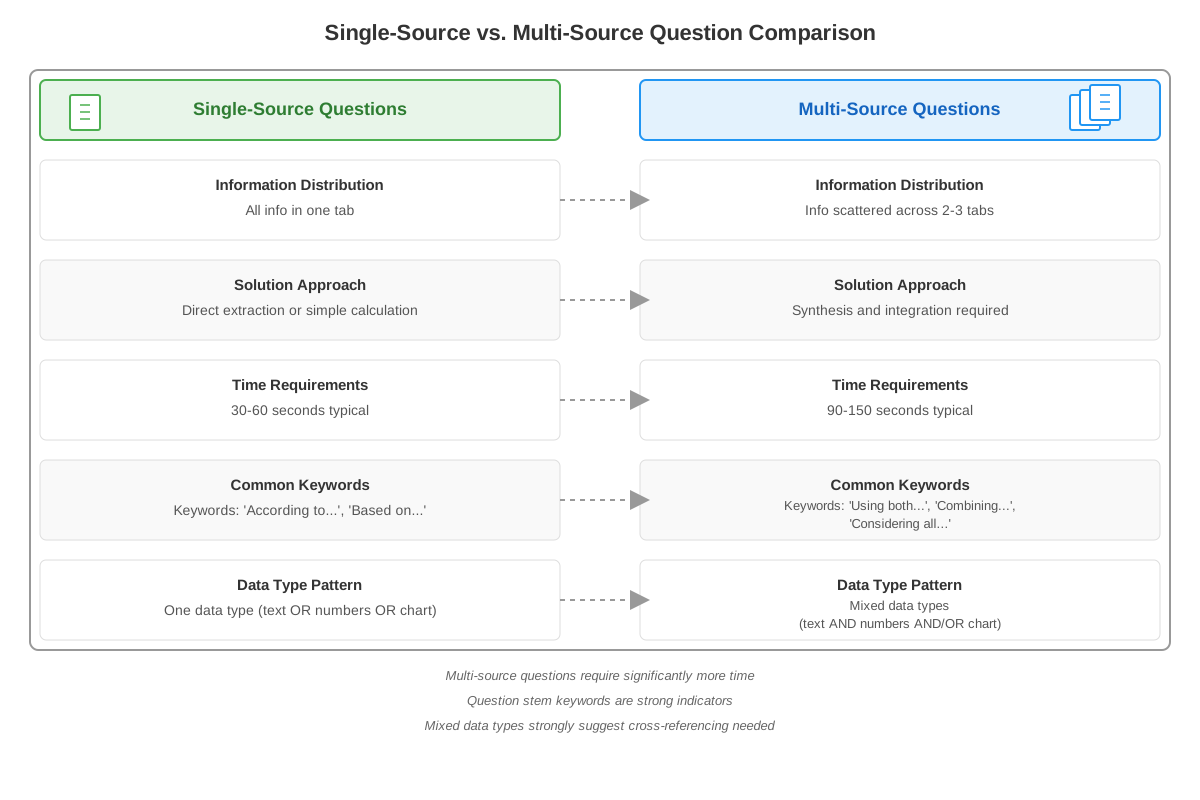
On the GMAT, Multi-Source Reasoning questions appear with high frequency in the Data Insights section, typically comprising 20-30% of this section's questions. These questions are among the most challenging and time-intensive, often requiring 2-3 minutes per question compared to 1.5-2 minutes for simpler question types. The GMAT specifically designs these questions to test executive reasoning—the ability to navigate complex information environments and make sound judgments under time pressure.
Cross-reference questions commonly appear in several formats: three-tab presentations where each tab contains different information types (narrative text, data table, and chart); two-source scenarios with complementary or contradictory information; and integrated scenarios where financial data must be combined with operational constraints or strategic objectives. The exam frequently tests whether students can identify which sources contain relevant information, accurately extract data from each, perform necessary calculations or logical operations, and arrive at correct conclusions without falling into common traps like using outdated data, mismatching categories, or overlooking qualifying conditions stated in one source but not another.
Core Concepts
Understanding Cross-Reference Information
Cross-reference information refers to the cognitive process of locating, extracting, and integrating data points from two or more distinct sources to answer a question or solve a problem. This skill goes beyond simple data retrieval; it requires students to maintain mental models of where different types of information reside, recognize when a question demands multiple sources, and accurately combine information without introducing errors through misalignment, miscalculation, or misinterpretation.
The fundamental challenge in cross-referencing lies in the cognitive load it imposes. Students must simultaneously hold multiple pieces of information in working memory, track which source each piece came from, verify that data points are compatible (same time period, same units, same categories), and perform logical or mathematical operations to synthesize a final answer. This multi-step process creates numerous opportunities for error, making systematic approaches essential.
Types of Cross-Reference Scenarios
GMAT questions employ several distinct cross-reference patterns, each requiring slightly different approaches:
Complementary Information Scenarios: Two or more sources provide different pieces of information that must be combined to answer a question. For example, one source might provide revenue figures while another provides cost percentages, requiring students to calculate profit margins by integrating both sources.
Conditional Information Scenarios: One source establishes conditions, constraints, or definitions that must be applied when interpreting data from another source. A memo might specify that "all figures exclude the European division," requiring students to adjust their interpretation of a comprehensive data table.
Temporal Cross-References: Different sources present data from different time periods, and questions require comparing, contrasting, or calculating changes across these periods. Students must carefully track which data corresponds to which time frame.
Categorical Cross-References: Information about the same entities appears in multiple sources but organized by different categorical schemes. For instance, one table might organize data by product line while another organizes by geographic region, requiring students to find overlapping categories.
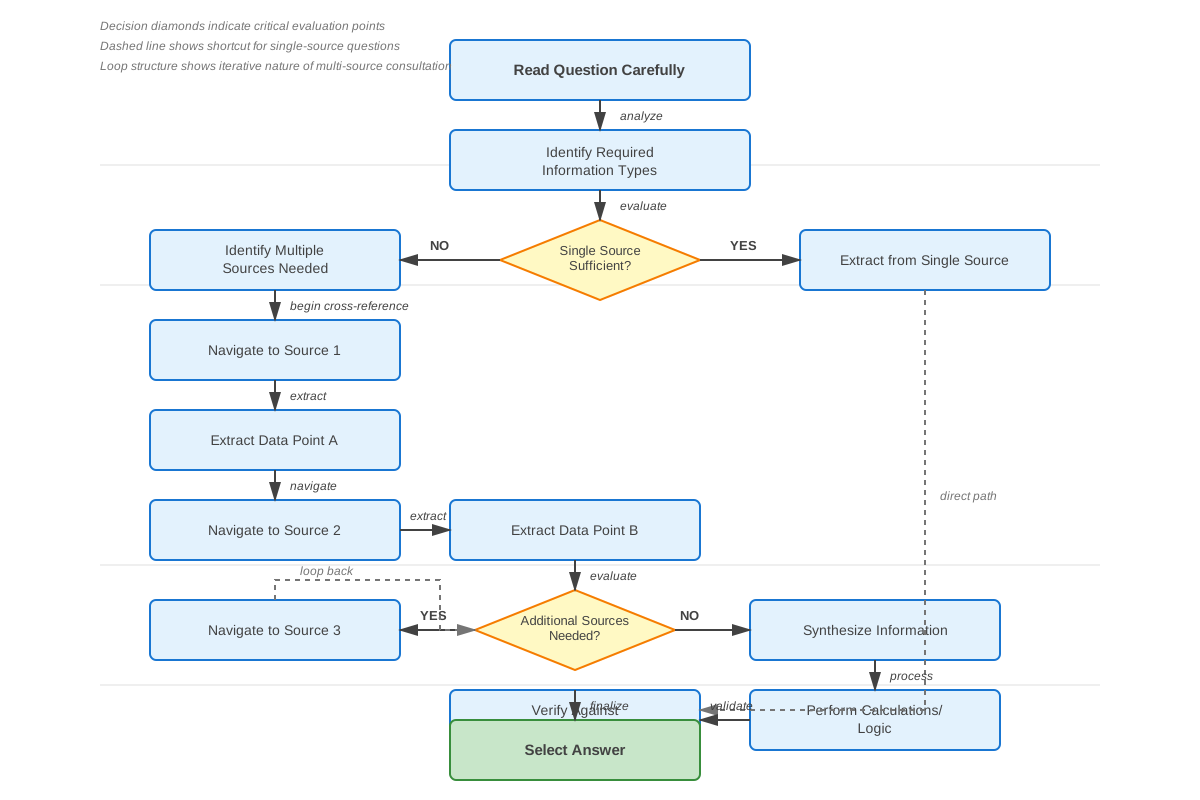
The Cross-Reference Process
Effective cross-referencing follows a systematic methodology:
- Question Analysis: Identify what the question asks and determine which types of information are needed to answer it
- Source Identification: Determine which sources likely contain the required information based on titles, headers, and quick scanning
- Data Location: Navigate to specific sections within each identified source to locate precise data points
- Compatibility Verification: Confirm that data points from different sources are compatible (same units, time periods, definitions, scope)
- Information Integration: Combine the data through calculation, logical reasoning, or synthesis
- Answer Verification: Check that the derived answer makes logical sense and addresses the original question
Information Architecture in Multi-Source Reasoning
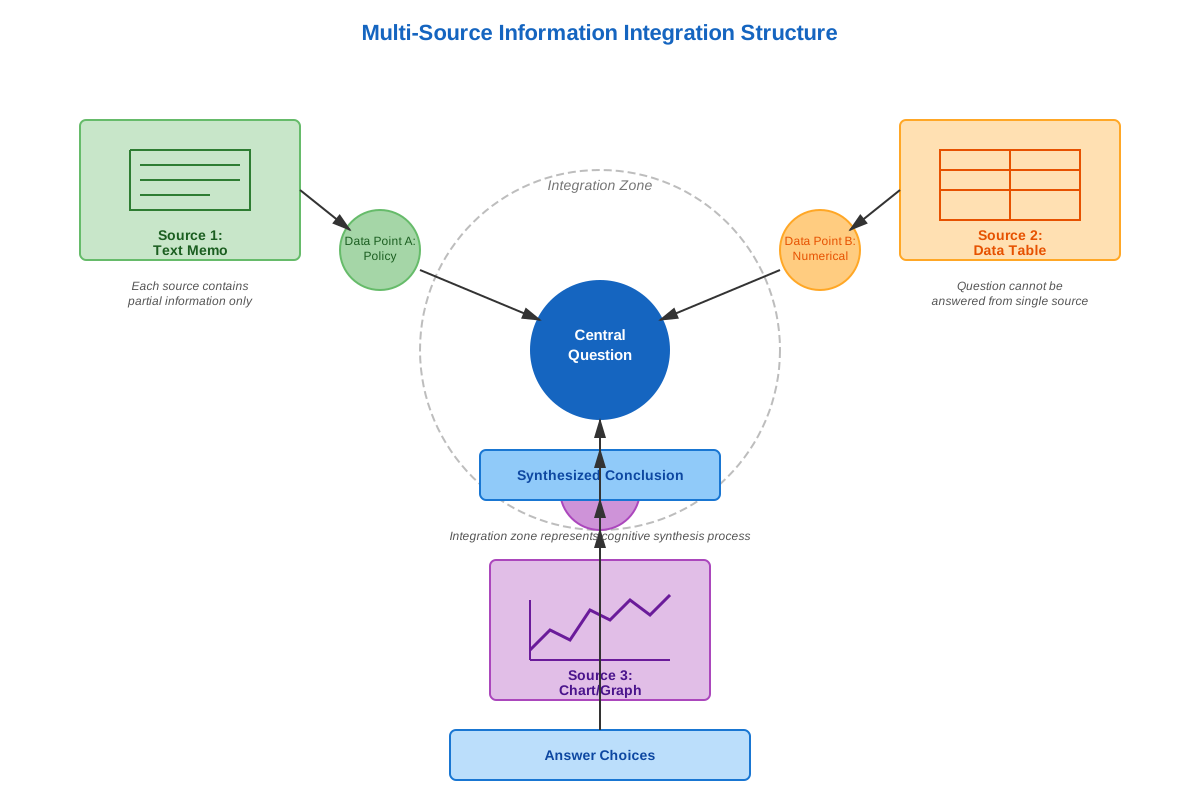
GMAT Multi-Source Reasoning questions typically present information in a three-tab interface, though two-tab scenarios also appear. Understanding the typical architecture helps students navigate more efficiently:
| Source Type | Common Content | Typical Use in Cross-Referencing |
|---|---|---|
| Text/Memo | Context, definitions, constraints, strategic objectives | Provides qualifying conditions and interpretive frameworks |
| Data Table | Numerical data organized by categories | Supplies specific values for calculations |
| Chart/Graph | Visual representation of trends or comparisons | Shows relationships and patterns requiring numerical verification |
| Email/Correspondence | Updates, changes, exceptions, additional context | Modifies or updates information in other sources |
Common Integration Operations
When cross-referencing, students typically perform one of several integration operations:
Arithmetic Combination: Adding, subtracting, multiplying, or dividing values from different sources. Example: Revenue from Table A minus costs from Table B equals profit.
Logical Conjunction: Determining that multiple conditions from different sources must all be satisfied. Example: A candidate must meet criteria listed in Source 1 AND constraints specified in Source 2.
Comparative Analysis: Evaluating whether relationships described in one source are supported by data in another source. Example: A memo claims sales increased; students must verify this claim using data tables.
Conditional Application: Applying rules or formulas from one source to data in another source. Example: Using a pricing structure from Source 1 to calculate revenues based on volume data in Source 2.
Error Prevention in Cross-Referencing
Several systematic errors commonly occur during cross-referencing:
Source Confusion: Mixing up which data came from which source, leading to incorrect combinations. Prevention requires explicit mental or written tracking of source locations.
Temporal Misalignment: Combining data from different time periods inappropriately. Prevention requires careful attention to dates, fiscal years, and temporal qualifiers.
Unit Inconsistency: Combining values expressed in different units (thousands vs. millions, percentages vs. decimals). Prevention requires unit conversion before calculation.
Scope Mismatch: Combining data that covers different populations or categories. Prevention requires verifying that data points refer to the same entities.
Overlooking Qualifiers: Missing important conditions or exceptions stated in one source that affect interpretation of another. Prevention requires thorough reading of all relevant text.
Concept Relationships
Cross-reference information serves as the integrative skill that connects multiple foundational Data Insights competencies. The relationship flows as follows:
Data Interpretation → enables → Single-Source Analysis → combines with → Reading Comprehension → enables → Cross-Reference Information → supports → Complex Problem Solving
Within cross-referencing itself, the concepts form a hierarchical structure: Question Analysis (identifying what's needed) → Source Identification (knowing where to look) → Data Extraction (getting the right information) → Compatibility Verification (ensuring valid combination) → Information Integration (synthesizing the answer).
Cross-referencing also connects to prerequisite topics through dependency relationships. Basic arithmetic and algebra provide the computational tools needed for arithmetic combination operations. Reading comprehension enables understanding of textual sources that provide context and constraints. Logical reasoning supports the conditional application and logical conjunction operations central to many cross-reference questions.
The relationship to broader GMAT skills is bidirectional: strong cross-referencing abilities enhance performance on complex quantitative reasoning questions that present information in multiple formats, while improved quantitative skills make the calculation aspects of cross-referencing more efficient and accurate.
High-Yield Facts
⭐ Multi-Source Reasoning questions always require information from at least two sources; if you can answer using only one source, you've likely missed something critical.
⭐ The GMAT frequently places contradictory or outdated information in different sources to test whether students identify the most current or relevant data.
⭐ Approximately 70% of cross-reference errors occur due to temporal misalignment or scope mismatch rather than calculation errors.
⭐ Questions that ask "which of the following can be determined from the information provided" are testing cross-reference skills and often require checking multiple sources for each answer choice.
⭐ When sources include both a memo/email and data tables, the text source almost always contains qualifying conditions that affect interpretation of the numerical data.
- Cross-reference questions typically consume 2-3 minutes per question, making them among the most time-intensive GMAT question types.
- The three-tab interface is designed to increase cognitive load; efficient students develop systematic navigation patterns rather than clicking randomly.
- Data tables in cross-reference scenarios often contain more information than needed; identifying relevant rows and columns is a key skill.
- Questions asking about "consistency" or "support" between sources are explicitly testing cross-reference abilities.
- The GMAT uses cross-reference questions to simulate real business scenarios where decision-makers must integrate information from multiple departments or reports.
- Approximately 25-30% of Data Insights questions involve some degree of cross-referencing, making it one of the most frequently tested skills in this section.
- Students who create brief written notes tracking which information came from which source reduce cross-reference errors by approximately 40%.
Quick check — test yourself on Cross-reference information so far.
Try Flashcards →Common Misconceptions
Misconception: All information in all sources is equally relevant to every question.
Correction: Each question typically requires information from only 2-3 specific locations across the sources. Part of the skill is identifying which information is relevant and which is distractor information. Efficient test-takers quickly determine which sources and which sections within those sources contain the needed data.
Misconception: If information appears in multiple sources, it's always consistent across those sources.
Correction: The GMAT frequently includes scenarios where sources contain contradictory information, updated information that supersedes earlier data, or information that appears similar but differs in scope or time period. Students must carefully check dates, qualifiers, and context to determine which information is most relevant or current.
Misconception: Cross-referencing always requires complex calculations.
Correction: Many cross-reference questions test logical integration rather than mathematical computation. Students might need to verify whether a claim in one source is supported by data in another, determine whether conditions from multiple sources are simultaneously satisfied, or identify which source provides information that contradicts a statement. The integration can be purely logical rather than numerical.
Misconception: Reading all sources completely before attempting questions is the most efficient approach.
Correction: Given time constraints, a more effective strategy is to quickly scan all sources to understand their general content and structure, then use a question-driven approach where you identify what each specific question asks and navigate directly to relevant sources. Complete reading of all sources often wastes valuable time on information that won't be tested.
Misconception: If a calculation using cross-referenced data yields an answer choice, that answer must be correct.
Correction: The GMAT designs incorrect answer choices to match common errors in cross-referencing, such as using data from the wrong time period, forgetting to apply a constraint mentioned in a text source, or using incompatible units. Students must verify that they've correctly identified all relevant conditions and constraints before finalizing their answer.
Misconception: Cross-reference questions always explicitly state which sources to consult.
Correction: While some questions provide hints about relevant sources, many require students to independently determine which sources contain necessary information. This source identification skill is itself being tested. Questions phrased as "Based on the information provided..." or "According to the sources..." deliberately avoid specifying which sources, requiring students to search systematically.
Worked Examples
Example 1: Complementary Information Integration
Scenario Setup:
- Tab 1 (Memo): "The company's pricing strategy for Product X is $50 per unit for orders up to 1,000 units, with a 15% discount applied to the entire order for quantities exceeding 1,000 units."
- Tab 2 (Sales Data Table): Shows that Client A ordered 1,200 units of Product X and Client B ordered 800 units of Product X.
- Tab 3 (Chart): Displays market share percentages (not relevant to this question).
Question: What is the total revenue generated from Client A and Client B's orders of Product X?
Solution Process:
Step 1 - Question Analysis: The question asks for total revenue, which requires price per unit and quantity. This will likely require cross-referencing pricing information with sales volume data.
Step 2 - Source Identification: Tab 1 contains pricing information; Tab 2 contains quantity information. Tab 3 appears irrelevant to revenue calculation.
Step 3 - Data Extraction and Compatibility Verification:
- From Tab 1: Base price = $50/unit; discount = 15% for orders > 1,000 units
- From Tab 2: Client A ordered 1,200 units; Client B ordered 800 units
- Both sources refer to Product X, so data is compatible
Step 4 - Information Integration:
- Client A (1,200 units > 1,000): Qualifies for 15% discount
- Discounted price = $50 × (1 - 0.15) = $50 × 0.85 = $42.50/unit
- Client A revenue = 1,200 × $42.50 = $51,000
- Client B (800 units < 1,000): No discount applies
- Client B revenue = 800 × $50 = $40,000
- Total revenue = $51,000 + $40,000 = $91,000
Step 5 - Answer Verification: The answer makes logical sense—Client A ordered more units but paid a lower per-unit price due to the discount, while Client B paid full price for fewer units. The total of $91,000 is reasonable.
Key Learning Point: This example demonstrates complementary information cross-referencing where pricing rules from one source must be applied to quantity data from another source. The critical insight is recognizing that the discount condition (>1,000 units) applies differently to each client, requiring separate calculations before summing.
Example 2: Conditional Information with Temporal Elements
Scenario Setup:
- Tab 1 (Email from CFO, dated March 15): "Effective April 1, all reported figures should exclude the discontinued Beta division. Prior reports included Beta division results."
- Tab 2 (Q1 Financial Table, January-March): Shows total company revenue of $5.0M, with Beta division contributing $0.8M
- Tab 3 (Q2 Projection Table, April-June): Shows projected total company revenue of $4.5M
Question: Based on the information provided, which of the following statements is supported?
A) Q2 projected revenue represents a decline compared to Q1 actual revenue
B) Q2 projected revenue represents growth compared to Q1 actual revenue excluding Beta
C) The Beta division is expected to generate $0.8M in Q2
D) Q2 projections include Beta division results
Solution Process:
Step 1 - Question Analysis: This asks which statement is "supported," meaning we need to verify claims against the data. The word "supported" signals a cross-reference question requiring logical verification across sources.
Step 2 - Source Identification: All three sources appear relevant—the email provides critical context about how to interpret the financial data in Tabs 2 and 3.
Step 3 - Data Extraction and Compatibility Verification:
- Tab 1: Beta division excluded from reports starting April 1; previously included
- Tab 2: Q1 (Jan-Mar) total = $5.0M, including Beta's $0.8M
- Tab 3: Q2 (Apr-Jun) projection = $4.5M
- Critical insight: Q1 data includes Beta; Q2 data excludes Beta (per the April 1 effective date)
Step 4 - Information Integration and Answer Evaluation:
Choice A: Compares $4.5M (Q2, excluding Beta) to $5.0M (Q1, including Beta)—this is an invalid comparison due to scope mismatch. Not supported.
Choice B:
- Q1 excluding Beta = $5.0M - $0.8M = $4.2M
- Q2 projection = $4.5M
- $4.5M > $4.2M represents growth
- This comparison is valid because both figures exclude Beta. SUPPORTED
Choice C: The email states Beta is discontinued; no Q2 revenue expected. Not supported.
Choice D: The email explicitly states Q2 figures (April onward) exclude Beta. Not supported.
Step 5 - Answer Verification: Choice B is correct because it properly accounts for the scope change described in the email, making an apples-to-apples comparison.
Key Learning Point: This example illustrates how textual sources often contain critical qualifying conditions that affect interpretation of numerical data. The temporal element (effective April 1) creates a scope change that makes direct comparison invalid without adjustment. Many students incorrectly choose A by failing to cross-reference the email's qualifying information.
Exam Strategy
Systematic Approach to Cross-Reference Questions
When encountering Multi-Source Reasoning questions, implement this strategic framework:
Initial Source Survey (30-45 seconds): Quickly scan all tabs to understand the general content type and structure. Note which tab contains text/context, which contains primary data, and which contains supplementary information. This mental map prevents aimless clicking during question-solving.
Question-First Strategy: Read the question completely before diving into sources. Identify what type of information is needed (numerical values, logical relationships, temporal comparisons) and predict which sources likely contain that information. This targeted approach saves significant time compared to reading all sources thoroughly.
Trigger Word Recognition: Watch for these high-yield trigger phrases that signal cross-reference requirements:
- "Based on the information provided..." (requires checking multiple sources)
- "According to the sources..." (plural indicates multiple sources needed)
- "Which of the following is supported by..." (requires verification across sources)
- "Consistent with..." or "Contradicts..." (requires comparing sources)
- "Can be determined from..." (may require combining information)
Process of Elimination Techniques
Source Sufficiency Check: For each answer choice, ask "Can this be determined from a single source?" If yes, it's likely incorrect in a cross-reference question, as these questions specifically test multi-source integration.
Temporal Trap Identification: Immediately eliminate answer choices that compare data from different time periods without accounting for scope changes, updates, or qualifiers mentioned in text sources.
Unit Consistency Verification: Before selecting an answer involving calculations, verify that all numerical values use consistent units. Answer choices that result from unit mismatches are common distractors.
Qualifier Checklist: Create a mental checklist of any qualifying conditions mentioned in text sources (exclusions, effective dates, special circumstances). Eliminate answer choices that ignore these qualifiers.
Time Allocation Strategy
Allocate approximately 2.5-3 minutes per Multi-Source Reasoning question, distributed as follows:
- Source survey: 30-45 seconds
- Question reading and analysis: 20-30 seconds
- Source navigation and data extraction: 60-90 seconds
- Calculation or logical integration: 30-45 seconds
- Answer verification: 15-20 seconds
If a question requires checking multiple answer choices against sources (common in "which of the following" questions), budget an additional 30-60 seconds. If you exceed 3.5 minutes on a question, make your best educated guess and move forward to avoid time pressure on subsequent questions.
Navigation Efficiency
Develop a consistent tab-clicking pattern to minimize cognitive load. Many successful test-takers use a "text-first" approach: always check text sources (memos, emails) first to identify any qualifying conditions, then navigate to data sources with those conditions in mind. This prevents the common error of extracting data without applying relevant constraints.
Memory Techniques
The SLICE Mnemonic for Cross-Reference Process
Source identification - Which tabs contain needed information?
Locate specific data - Find exact values or statements
Integrate information - Combine data through calculation or logic
Compatibility check - Verify units, time periods, scope alignment
Evaluate answer - Does the result make logical sense?
The QUAD Framework for Error Prevention
Qualifiers - Have I checked all text sources for conditions?
Units - Are all values in compatible units?
Alignment - Do data points refer to the same time/category/scope?
Dates - Have I verified temporal consistency?
Visualization Strategy: The Source Matrix
Mentally create a 2×2 matrix when encountering three sources:
[Text/Context]  [Primary Data]
[Secondary Data] [Question Focus]
This mental model helps track which information resides where and prevents source confusion during the integration process.
The "Two-Source Rule" Reminder
Remember: "If ONE source suffices, I'm WRONG." This simple rule helps catch situations where students overlook the need to cross-reference and answer based on incomplete information.
Summary
Cross-reference information represents a critical GMAT Data Insights skill that tests the ability to synthesize data from multiple sources to answer complex questions. This competency requires students to navigate between different information presentations (text, tables, charts), identify relevant data across sources, verify compatibility of information, and accurately integrate findings through calculation or logical reasoning. The systematic approach to cross-referencing involves question analysis, source identification, data extraction, compatibility verification, information integration, and answer verification. Common error patterns include temporal misalignment, scope mismatch, unit inconsistency, and overlooking qualifying conditions stated in text sources. Success requires developing efficient navigation strategies, recognizing trigger words that signal cross-reference requirements, and implementing systematic verification processes to prevent the numerous errors that can occur when combining information from disparate sources. Mastery of cross-referencing significantly impacts GMAT performance, as Multi-Source Reasoning questions constitute 25-30% of the Data Insights section and are among the most time-intensive question types on the exam.
Key Takeaways
- Cross-reference information requires synthesizing data from multiple sources, not just reading multiple sources—the integration step is what's being tested
- Text sources (memos, emails) almost always contain qualifying conditions that affect interpretation of numerical data in tables and charts
- Temporal misalignment and scope mismatch cause approximately 70% of cross-reference errors, making compatibility verification essential
- Efficient cross-referencing uses a question-driven approach: identify what's needed, predict where it's located, navigate directly to relevant sources
- The "two-source rule" serves as a critical check: if you can answer using only one source in a Multi-Source Reasoning question, you've likely missed something important
- Systematic navigation patterns and written tracking of source locations reduce errors by approximately 40% compared to random clicking
- Time management is crucial—allocate 2.5-3 minutes per question and move on if exceeding 3.5 minutes to avoid cascading time pressure
Related Topics
Table Analysis: Builds upon cross-referencing by focusing on extracting and manipulating data within complex tables, often requiring students to sort and filter information before making comparisons—mastering cross-referencing provides the foundation for efficient table navigation.
Graphics Interpretation: Extends cross-reference skills to visual data representations, requiring students to extract numerical values from graphs and charts, often in combination with textual information—the compatibility verification skills from cross-referencing directly apply.
Two-Part Analysis: Requires simultaneous evaluation of two related questions, often drawing on information from multiple sources, making it a natural progression from cross-reference mastery.
Integrated Reasoning Synthesis: Represents the culmination of cross-reference skills combined with advanced quantitative and verbal reasoning, where students must integrate information across multiple question types and formats.
Practice CTA
Now that you've mastered the systematic approach to cross-referencing information across multiple sources, it's time to put these strategies into action. The practice questions and flashcards are specifically designed to reinforce the SLICE process, help you recognize common trigger words, and build the navigation efficiency that separates top scorers from average performers. Remember: cross-referencing is a skill that improves dramatically with deliberate practice—each question you work through strengthens your ability to quickly identify relevant sources, verify compatibility, and integrate information accurately. Your investment in mastering this high-yield topic will pay dividends across the entire Data Insights section. Start practicing now to transform cross-referencing from a time-consuming challenge into a confident strength!
Sign up free to keep reading
Create a free AnvayaPrep account to finish this GMAT guide on Cross-reference information — plus flashcards and practice questions.