Overview
Eliminating contradictions is a critical reasoning skill tested extensively in the GMAT Data Insights section, particularly within Multi-Source Reasoning questions. This technique requires test-takers to analyze multiple sources of information—such as tables, emails, memos, and reports—and identify which statements or answer choices are inconsistent with the provided data. The ability to spot contradictions efficiently separates high scorers from average performers, as it demands careful attention to detail, logical reasoning, and the capacity to synthesize information across different formats and sources.
On the GMAT, GMAT eliminating contradictions questions typically present three tabs of information (text, tables, graphs, or combinations thereof) and ask test-takers to evaluate statements for accuracy or consistency. Rather than requiring complex calculations or advanced analytical techniques, these questions test whether candidates can meticulously cross-reference data points and identify logical inconsistencies. A single overlooked detail or misread number can lead to selecting a contradictory statement, making this skill essential for achieving competitive scores in the Data Insights section.
This topic sits at the intersection of critical reasoning and data interpretation within the broader Data Insights framework. While Multi-Source Reasoning questions may also test inference-making, calculation, and synthesis skills, eliminating contradictions forms the foundation for all these higher-order tasks. Without the ability to accurately identify what the data does and does not support, test-takers cannot reliably make valid inferences or solve complex multi-step problems. Mastering this skill creates a solid foundation for tackling the most challenging Data Insights questions with confidence and accuracy.
Learning Objectives
- [ ] Identify eliminating contradictions in Multi-Source Reasoning questions
- [ ] Explain the logical process of eliminating contradictions using multiple data sources
- [ ] Apply eliminating contradictions to GMAT questions efficiently and accurately
- [ ] Distinguish between statements that are contradicted by data versus those that are merely unsupported
- [ ] Systematically cross-reference information across multiple tabs and formats
- [ ] Recognize common patterns in how GMAT constructs contradictory statements
- [ ] Execute a time-efficient process for verifying statement accuracy against source material
Prerequisites
- Basic data interpretation skills: Ability to read tables, charts, and graphs accurately is essential since eliminating contradictions requires extracting specific data points from visual representations.
- Logical reasoning fundamentals: Understanding basic logical relationships (if-then statements, necessary vs. sufficient conditions) helps identify when statements conflict with given information.
- Reading comprehension proficiency: Multi-Source Reasoning passages contain dense business or academic text that must be understood before contradictions can be identified.
- Attention to detail: The capacity to notice small discrepancies in numbers, dates, names, or conditions is crucial for spotting contradictions.
- Time management basics: Understanding how to allocate time across GMAT sections ensures sufficient attention to multi-step verification processes.
Why This Topic Matters
In real-world business and academic contexts, the ability to identify contradictions in data is invaluable. Executives must reconcile conflicting reports from different departments, researchers must identify inconsistencies in experimental data, and analysts must spot discrepancies in financial statements. The GMAT tests this skill because graduate business programs require students who can critically evaluate information from multiple sources and make sound decisions based on accurate data interpretation.
From an exam perspective, Multi-Source Reasoning questions constitute approximately 30% of the Data Insights section, and eliminating contradictions appears in roughly 40-50% of these questions. This translates to 2-3 questions per exam that directly test this skill, with many additional questions requiring it as a foundational competency. The GMAT frequently presents these questions in formats where test-takers must evaluate three statements and determine which are supported, contradicted, or neither supported nor contradicted by the source material.
Common question formats include: "For each of the following statements, select Yes if the statement is supported by the information provided; otherwise select No," or "Select the statement that is contradicted by the information in the sources." These questions appear with business scenarios (company performance reports, project proposals, market analyses), academic contexts (research summaries, experimental results), or general analytical situations (survey results, demographic data). The ability to efficiently eliminate contradictions directly impacts both accuracy and time management, as these questions can be time-consuming if approached without a systematic strategy.
Core Concepts
Understanding Contradictions vs. Lack of Support
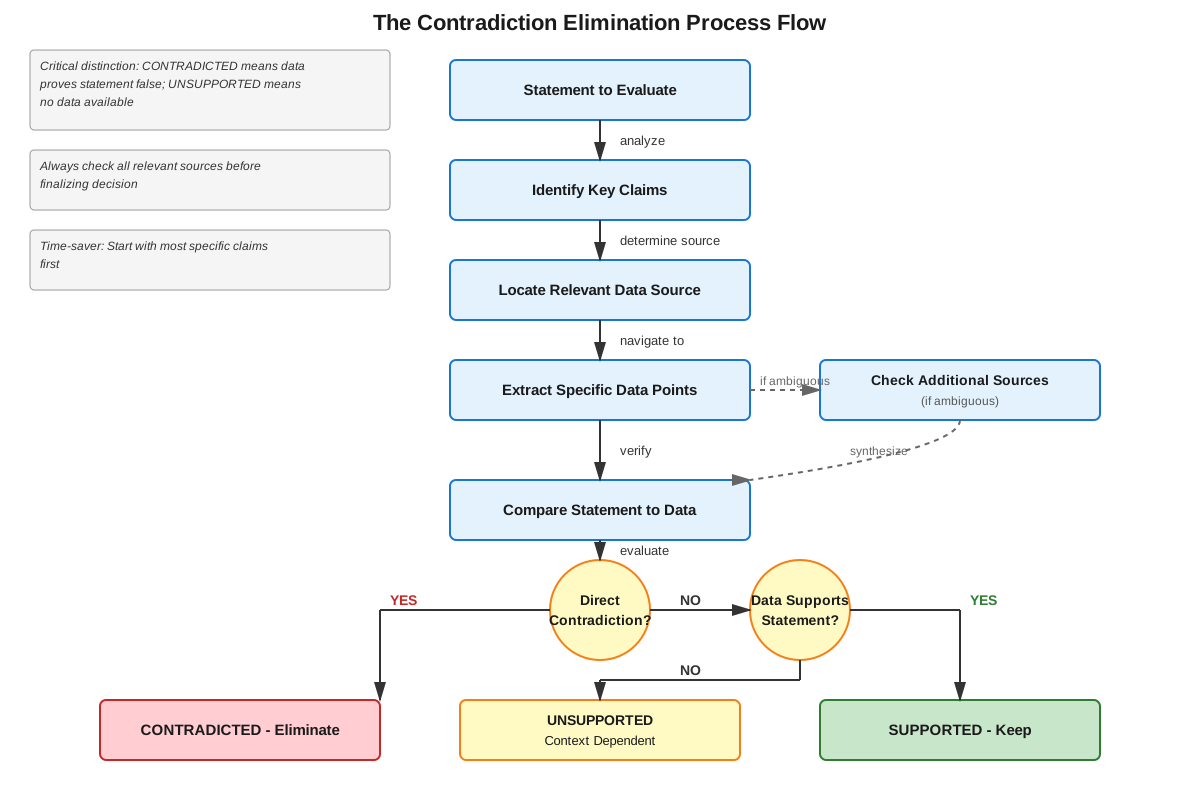
A contradiction occurs when a statement directly conflicts with information provided in the source material. This differs fundamentally from a statement that is merely unsupported or unverifiable. For example, if a table shows that Company A's revenue was $5 million in 2022, the statement "Company A's revenue was $3 million in 2022" is contradicted. However, the statement "Company A's revenue will increase in 2023" is simply unsupported—the data doesn't address future performance, but it doesn't contradict the claim either.
The GMAT exploits this distinction by including answer choices that fall into three categories:
| Category | Definition | Example |
|---|---|---|
| Supported | Directly confirmed by source data | "Revenue was $5M" when table shows $5M |
| Contradicted | Directly conflicts with source data | "Revenue was $3M" when table shows $5M |
| Unsupported | Neither confirmed nor contradicted | "Revenue will grow" when only past data exists |
Understanding these distinctions prevents test-takers from incorrectly marking unsupported statements as contradicted, a common error that costs points.
The Multi-Source Verification Process
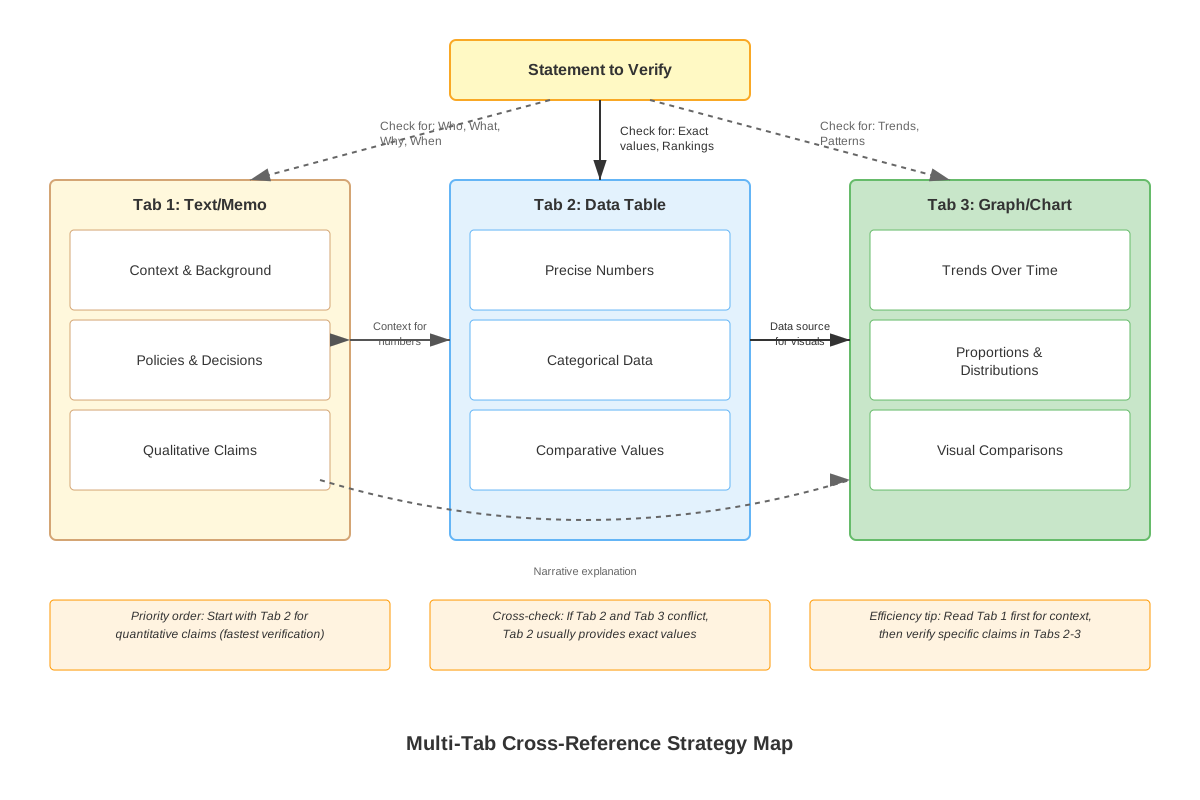
Eliminating contradictions requires a systematic approach to cross-referencing information across multiple tabs. The typical GMAT Multi-Source Reasoning question presents three tabs of information, which might include:
- Text-based sources: Emails, memos, reports, articles, or proposals containing qualitative information and context
- Quantitative sources: Tables, charts, or graphs displaying numerical data
- Mixed sources: Combinations of text and data that require integrating both types of information
The verification process follows these steps:
- Identify the claim's key elements: Break down each statement into its component parts (who, what, when, where, how much)
- Locate relevant source material: Determine which tab(s) contain information related to the claim
- Extract precise data points: Find the specific numbers, dates, names, or facts needed for verification
- Compare claim to source: Check whether the statement matches, contradicts, or lacks support from the data
- Verify across all sources: Ensure no information in other tabs contradicts your initial finding
Types of Contradictions on the GMAT
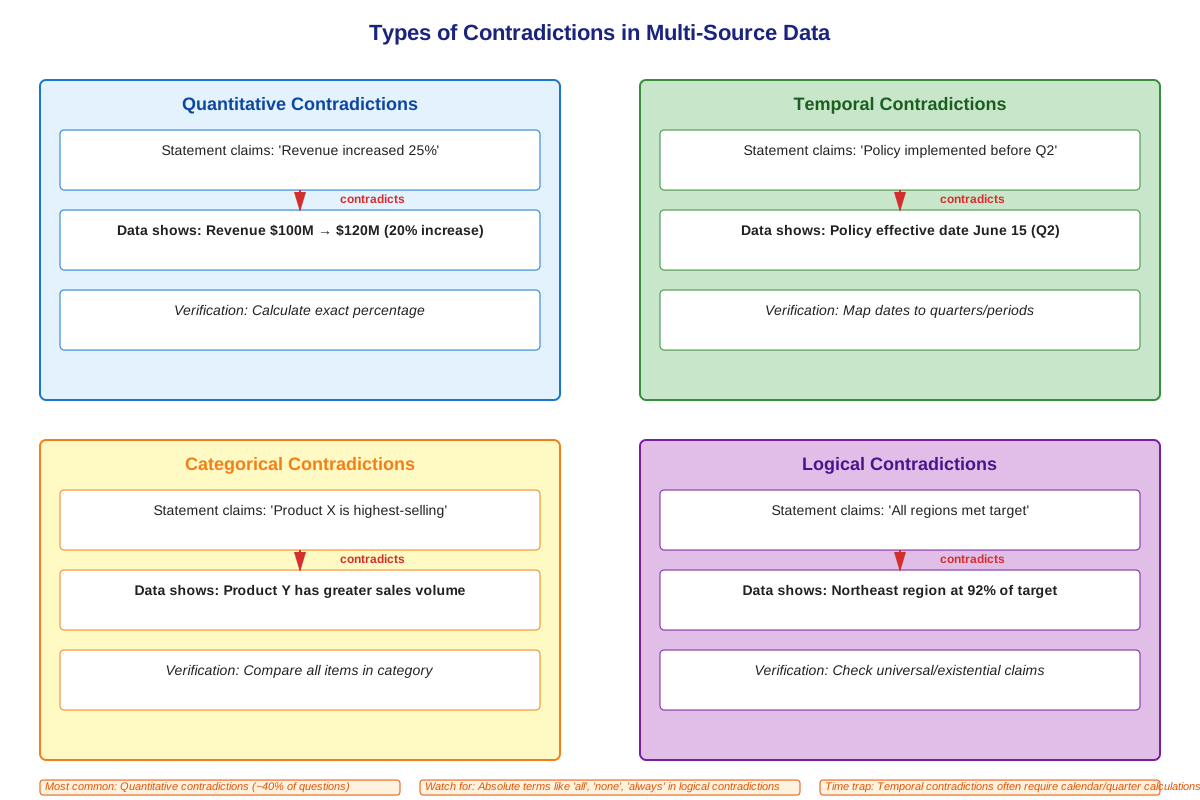
The GMAT constructs contradictions in predictable patterns. Recognizing these patterns accelerates the elimination process:
Numerical contradictions: The most straightforward type, where a statement provides a different number than appears in the source material. Example: Statement claims "15% growth" when the table shows "12% growth."
Temporal contradictions: Statements that misrepresent when something occurred or will occur. Example: Statement claims an event happened "in Q3" when the source indicates "Q4."
Comparative contradictions: Statements that incorrectly rank or compare entities. Example: Statement claims "Product A outsold Product B" when data shows the opposite.
Categorical contradictions: Statements that misclassify information or assign wrong attributes. Example: Statement claims a project was "completed" when the source indicates it's "in progress."
Scope contradictions: Statements that overgeneralize or undergeneralize from the data. Example: Statement claims "all regions" when data covers only "three regions."
Logical contradictions: Statements that violate logical relationships established in the sources. Example: If Source 1 states "Only projects with budgets over $1M require board approval" and Source 2 shows "Project X has a $800K budget and received board approval," these contradict each other.
Cross-Tab Integration
Many GMAT questions require synthesizing information from multiple tabs to identify contradictions. For example:
- Tab 1 (Email) states: "Our sales team exceeded targets in every region except the Northeast."
- Tab 2 (Table) shows: Northeast sales at 95% of target, all other regions at 100%+ of target.
- Tab 3 (Memo) claims: "The sales team met or exceeded targets in all regions."
Tab 3 contradicts the information in Tab 1, even though Tab 2 supports Tab 1. This requires reading all sources and recognizing that "met or exceeded" in Tab 3 conflicts with "except the Northeast" in Tab 1.
Precision in Language
The GMAT uses precise language to create or avoid contradictions. Small words carry significant meaning:
- "Only" vs. "All": "Only managers attended" means no non-managers attended; "All managers attended" means every manager attended but doesn't exclude non-managers
- "At least" vs. "Exactly": "At least 50 employees" allows for 50 or more; "Exactly 50 employees" means precisely 50
- "May" vs. "Must": "May increase" indicates possibility; "Must increase" indicates certainty
- "Some" vs. "Most": "Some products" means one or more; "Most products" means more than half
Contradictions often hinge on these linguistic distinctions. A statement using "all" when the source says "most" represents a contradiction.
Concept Relationships
The skill of eliminating contradictions builds directly on foundational data interpretation abilities. Before identifying contradictions, test-takers must accurately extract information from tables, graphs, and text—making data literacy the prerequisite skill. Once information is accurately extracted, eliminating contradictions becomes the first-level analytical task, which then enables higher-order skills like making valid inferences and solving complex multi-step problems.
The relationship flows as follows:
Data Extraction → Eliminating Contradictions → Making Valid Inferences → Solving Complex Problems
Within the topic itself, understanding the distinction between contradicted and unsupported statements forms the conceptual foundation. This understanding enables the multi-source verification process, which requires recognizing different types of contradictions. Cross-tab integration represents the most complex application, requiring all previous concepts working together. Precision in language interpretation supports every stage of this process, as misreading qualifiers or scope indicators leads to incorrect contradiction identification.
The concept also connects to broader critical reasoning skills tested in the GMAT Verbal section. The logical reasoning required to spot contradictions in data mirrors the reasoning needed to identify flawed arguments or inconsistent premises in Critical Reasoning questions. Both require careful attention to logical relationships and the ability to recognize when statements conflict with established facts or principles.
High-Yield Facts
⭐ A contradiction requires direct conflict with source material, not merely lack of support—unsupported statements are not contradicted statements.
⭐ Always verify statements against ALL tabs before concluding—information in one tab may contradict or support information in another.
⭐ Numerical contradictions are the most common type—carefully compare exact figures, percentages, and rankings.
⭐ Small qualifier words (only, all, some, most, at least, exactly) frequently create or prevent contradictions—read these words with extreme care.
⭐ Temporal mismatches (wrong quarter, year, or sequence) are high-yield contradiction sources—verify all time references.
- Comparative statements (larger than, more than, exceeded) require checking relative values, not just absolute numbers.
- Scope contradictions occur when statements claim broader or narrower applicability than sources support.
- The GMAT often places contradictory information in different formats (text vs. table) to increase difficulty.
- Statements using future tense ("will increase") are typically unsupported rather than contradicted unless sources explicitly address future plans.
- When a question asks which statement is contradicted, exactly one answer choice will directly conflict with the sources—the others may be unsupported but not contradicted.
- Contradictions can be implicit—if Source A says "Only X" and Source B describes Y doing the same thing, this creates a contradiction even without explicit conflict.
- Reading all sources before evaluating statements saves time by building a complete mental model of the information.
Quick check — test yourself on Eliminating contradictions so far.
Try Flashcards →Common Misconceptions
Misconception: If a statement cannot be verified from the sources, it is contradicted by them.
Correction: Unsupported statements are not contradicted. A contradiction requires direct conflict. If sources provide no information about a topic, statements about that topic are unsupported, not contradicted.
Misconception: Statements that seem unlikely or unreasonable based on general knowledge are contradicted.
Correction: Only information explicitly provided in the sources matters. External knowledge or assumptions about what "should" be true are irrelevant. Base all judgments solely on the given material.
Misconception: If most of a statement is accurate but one detail is wrong, the statement is supported.
Correction: A single contradicted element makes the entire statement contradicted. If a statement claims "Revenue was $5M in Q3 with 10% growth," but the source shows 12% growth (with $5M and Q3 correct), the statement is still contradicted.
Misconception: Rounding or approximation means numbers don't contradict.
Correction: Unless the question explicitly allows for approximation, treat numbers as exact. "Approximately 50" might not contradict "48," but "50" does contradict "48" unless context indicates rounding is acceptable.
Misconception: Information in later tabs overrides information in earlier tabs.
Correction: All tabs are equally valid sources unless explicitly stated otherwise (e.g., "updated report"). If tabs contradict each other, this typically indicates that a statement claiming consistency across sources is itself contradicted.
Misconception: Complex calculations are required to identify contradictions.
Correction: Most contradictions involve direct comparison of stated values. If complex calculation is needed, verify your approach—GMAT eliminating contradictions questions typically test careful reading, not computational ability.
Worked Examples
Example 1: Multi-Tab Numerical Contradiction
Sources Provided:
Tab 1 - Email from Sales Director:
"Our Q4 performance exceeded expectations across all product lines. Product A sales reached $2.3 million, representing our strongest quarter this year. Product B maintained steady performance at $1.8 million, while Product C showed modest growth to $1.5 million."
Tab 2 - Q4 Sales Table:
| Product | Q4 Sales | Q3 Sales | Growth |
|---|---|---|---|
| A | $2.3M | $2.1M | 9.5% |
| B | $1.6M | $1.6M | 0% |
| C | $1.5M | $1.4M | 7.1% |
Tab 3 - Annual Summary:
"Product B's consistent performance throughout the year, maintaining $1.6 million in quarterly sales for Q3 and Q4, provided stability during market fluctuations."
Question: For each statement, indicate whether it is supported, contradicted, or unsupported by the sources.
Statement 1: "Product B generated $1.8 million in Q4 sales."
Analysis:
- Step 1: Identify key elements—Product B, Q4, $1.8 million
- Step 2: Locate relevant sources—Tab 1 mentions Product B at $1.8M; Tab 2 shows Product B at $1.6M; Tab 3 confirms $1.6M
- Step 3: Extract data—Tab 2 (quantitative source) shows $1.6M; Tab 3 confirms $1.6M
- Step 4: Compare—Statement claims $1.8M, but two sources show $1.6M
- Step 5: Verify across sources—Tab 1 appears to contain an error, as both Tab 2 and Tab 3 consistently show $1.6M
Answer: CONTRADICTED—The statement directly conflicts with the numerical data in Tab 2 and the confirmation in Tab 3. This demonstrates that when sources conflict, quantitative data typically takes precedence, and multiple sources showing the same figure confirm the contradiction.
Statement 2: "Product A will exceed $2.5 million in Q1 of the following year."
Analysis:
- Step 1: Identify key elements—Product A, future quarter (Q1 next year), $2.5 million
- Step 2: Locate relevant sources—No tab provides information about future performance
- Step 3: Extract data—Sources only cover past performance (Q3, Q4)
- Step 4: Compare—No information exists to confirm or contradict future projections
Answer: UNSUPPORTED—The sources provide no information about future quarters. This is not contradicted because nothing in the sources states Product A will NOT exceed $2.5M; the information simply doesn't exist.
Example 2: Cross-Tab Logical Contradiction
Sources Provided:
Tab 1 - Project Requirements Memo:
"All projects with budgets exceeding $500,000 must receive approval from both the Finance Committee and the Executive Board before proceeding to implementation. Projects under this threshold require only departmental approval."
Tab 2 - Current Projects Table:
| Project | Budget | Finance Committee | Executive Board | Status |
|---|---|---|---|---|
| Alpha | $650,000 | Approved | Approved | Implementation |
| Beta | $425,000 | Not Required | Not Required | Implementation |
| Gamma | $550,000 | Approved | Pending | Planning |
| Delta | $480,000 | Not Required | Not Required | Implementation |
Tab 3 - Status Update Email:
"Project Gamma has received Finance Committee approval and is proceeding to implementation while awaiting Executive Board review. Project Delta received expedited approval from the Executive Board due to its strategic importance and is now in implementation."
Question: Which statement is contradicted by the information provided?
Statement A: "Project Beta did not require Executive Board approval."
Statement B: "Project Gamma is in the implementation phase."
Statement C: "Project Delta received Executive Board approval."
Analysis:
Statement A:
- Budget is $425,000 (under $500,000 threshold)
- Tab 1 indicates projects under $500,000 require only departmental approval
- Tab 2 shows "Not Required" for Executive Board
- Result: SUPPORTED, not contradicted
Statement B:
- Tab 2 shows Gamma status as "Planning"
- Tab 3 states Gamma is "proceeding to implementation"
- However, Tab 3 also says "while awaiting Executive Board review"
- Tab 1 requires BOTH approvals before "proceeding to implementation"
- Tab 2 shows Executive Board status as "Pending"
- Result: CONTRADICTED—Tab 3 claims implementation is proceeding, but Tab 1's requirements aren't met (Executive Board approval still pending)
Statement C:
- Tab 2 shows "Not Required" for Delta's Executive Board approval
- Tab 3 claims Delta "received expedited approval from the Executive Board"
- Budget is $480,000 (under $500,000 threshold)
- Tab 1 indicates Executive Board approval is not required for projects under $500,000
- Result: CONTRADICTED—Tab 3 claims Executive Board approval was received, but Tab 1 indicates this approval is not required for projects under $500,000, and Tab 2 shows "Not Required." The statement contradicts the established requirement structure.
Answer: Both Statement B and Statement C contain contradictions, but if forced to choose the most clearly contradicted, Statement B directly conflicts with Tab 2's explicit status designation. This example demonstrates how contradictions can exist across multiple tabs and require synthesizing procedural rules (Tab 1) with specific data (Tab 2) and narrative updates (Tab 3).
Exam Strategy
When approaching GMAT eliminating contradictions questions, implement this systematic process:
Before reading statements:
- Spend 60-90 seconds surveying all three tabs to understand what information is available and where
- Note the type of information in each tab (quantitative vs. qualitative, procedural vs. descriptive)
- Identify any obvious relationships between tabs (e.g., Tab 1 provides context for Tab 2's data)
When evaluating each statement:
- Underline or mentally note key elements: specific numbers, dates, names, comparisons, and qualifiers
- Predict which tab(s) likely contain relevant information before clicking through
- Find the exact data point or text that relates to the statement
- Make a definitive comparison: Does it match exactly, conflict directly, or neither?
- If information appears in multiple tabs, verify consistency across all sources
Trigger words and phrases to watch for:
Absolute qualifiers: "all," "every," "none," "never," "always," "only"—these create strict conditions that are easily contradicted
Comparative terms: "more than," "less than," "exceeded," "below," "highest," "lowest"—verify the comparison is accurate
Temporal indicators: "before," "after," "during," "by the end of," specific quarters or years—check timing precisely
Scope indicators: "some," "most," "several," "many," "few"—ensure the statement's scope matches the source
Process-of-elimination tips:
- In "Yes/No" format questions (statement is supported: Yes or No), eliminate statements you can definitively verify first, then focus on ambiguous ones
- In "which statement is contradicted" questions, eliminate clearly supported statements immediately, then carefully examine remaining options
- If two statements seem contradicted, recheck both—usually only one has a direct contradiction while the other is merely unsupported
- When stuck between "contradicted" and "unsupported," ask: "Does the source explicitly state something that conflicts with this claim?" If no, it's unsupported
Time allocation:
- Allocate 2.5-3 minutes per Multi-Source Reasoning question
- Spend no more than 30 seconds per statement evaluation
- If verification takes longer than 45 seconds, mark your best answer and move on—don't let one statement consume excessive time
- Practice the survey-predict-verify process until it becomes automatic, reducing decision time
Memory Techniques
SCAN Method for Eliminating Contradictions:
- Survey all sources first
- Compare statement to specific data
- Analyze qualifiers and scope
- Note contradictions vs. unsupported claims
The "EXACT" Rule for Numerical Contradictions:
- Extract the precise number from the source
- X-reference with the statement's claim
- Assess whether they match exactly
- Confirm no rounding or approximation issues
- Test against all relevant tabs
Qualifier Hierarchy (memorize this order):
Remember that contradictions often involve shifting between these levels:
- ALL (100%)
- MOST (>50%)
- SOME (≥1)
- NONE (0%)
A statement claiming "all" when the source says "most" is contradicted. A statement claiming "some" when the source says "most" is supported (since "most" includes "some").
Visual Memory Technique:
Imagine three file folders (representing the three tabs) on a desk. When evaluating a statement, visualize pulling out the relevant folder(s) and placing them side-by-side with the statement. This mental image reinforces the cross-referencing process.
The "Red Flag" Acronym for Contradiction-Prone Elements:
Comparisons (bigger, smaller, more, less)
Only/all statements (absolute qualifiers)
Numbers (specific figures and percentages)
Time references (quarters, years, before/after)
Rankings (first, last, highest, lowest)
All-encompassing claims (every, none, always)
Definitive statements (must, will, cannot)
When you see CONRAD elements in a statement, increase your verification scrutiny.
Summary
Eliminating contradictions is a foundational skill for GMAT Data Insights Multi-Source Reasoning questions that requires systematically cross-referencing statements against multiple information sources to identify direct conflicts. Success depends on distinguishing between statements that are contradicted (directly conflict with sources), supported (confirmed by sources), and unsupported (neither confirmed nor contradicted). The most common contradiction types involve numerical discrepancies, temporal mismatches, incorrect comparisons, and scope errors. Test-takers must pay careful attention to qualifier words like "all," "only," "some," and "most," as these frequently determine whether contradictions exist. The optimal approach involves surveying all tabs before evaluating statements, predicting which sources contain relevant information, extracting precise data points, and verifying findings across all available sources. Time management is crucial—spending 2.5-3 minutes per question with no more than 30-45 seconds per statement evaluation ensures adequate coverage without sacrificing accuracy. Mastering this skill provides the foundation for more complex Data Insights tasks and directly impacts GMAT performance, as these questions appear frequently and test the critical thinking abilities essential for graduate business education.
Key Takeaways
- Contradicted ≠ Unsupported: A contradiction requires direct conflict with source material; lack of information means a statement is unsupported, not contradicted
- Verify across ALL tabs: Information may appear in multiple sources, and contradictions often require synthesizing data from different tabs
- Precision matters: Small qualifier words (all, only, some, most, at least, exactly) frequently determine whether statements are contradicted
- Quantitative data takes precedence: When text and tables conflict, the numerical data in tables typically represents the authoritative source
- Follow the SCAN method: Survey sources, Compare to data, Analyze qualifiers, Note the distinction between contradicted and unsupported
- Watch for CONRAD elements: Comparisons, Only/all statements, Numbers, Time references, Rankings, All-encompassing claims, and Definitive statements are high-yield contradiction sources
- Time management is essential: Allocate 2.5-3 minutes per question and move on if verification exceeds 45 seconds per statement
Related Topics
Making Valid Inferences in Multi-Source Reasoning: After mastering contradiction elimination, the next skill involves drawing logical conclusions that are supported but not explicitly stated in the sources. This builds on the verification skills developed through eliminating contradictions.
Data Sufficiency: The logical reasoning required to identify contradictions directly supports Data Sufficiency questions, where test-takers must determine whether information is adequate to answer a question—a skill that requires recognizing what data does and doesn't support.
Integrated Reasoning Table Analysis: Similar cross-referencing and verification skills apply to Table Analysis questions, where test-takers sort data and evaluate statements, though typically with a single source rather than multiple tabs.
Critical Reasoning - Resolve the Paradox: The ability to spot contradictions in data sources parallels the skill of identifying apparent contradictions in argument-based passages and determining how to resolve them.
Two-Part Analysis: These questions often require evaluating whether combinations of answers satisfy multiple conditions simultaneously, which builds on the multi-source verification process used in eliminating contradictions.
Practice CTA
Now that you've mastered the concepts and strategies for eliminating contradictions, it's time to put your knowledge into practice. Attempt the practice questions designed specifically for this topic, focusing on applying the SCAN method and watching for CONRAD elements. Use the flashcards to reinforce high-yield facts and common contradiction patterns. Remember: eliminating contradictions is a skill that improves dramatically with deliberate practice. Each question you work through strengthens your ability to quickly identify conflicts and verify information across sources. Your investment in mastering this skill will pay dividends not only on test day but throughout your graduate business education and professional career. Start practicing now—you've got this!
Sign up free to keep reading
Create a free AnvayaPrep account to finish this GMAT guide on Eliminating contradictions — plus flashcards and practice questions.