Overview
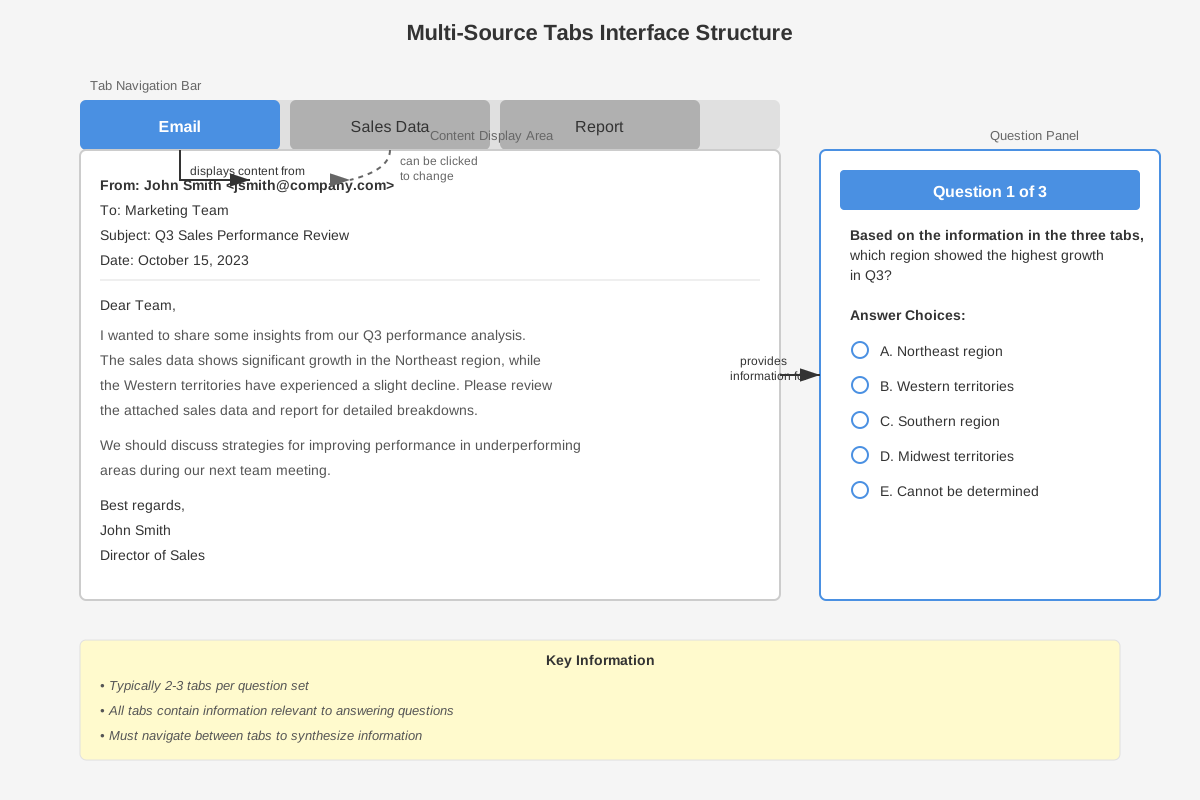
Multi-source tabs represent one of the most distinctive and challenging question formats within the GMAT Data Insights section. Unlike traditional single-passage questions, GMAT multi-source tabs present information across multiple tabbed pages—typically two to three tabs—that students must navigate, synthesize, and analyze to answer a series of related questions. Each tab may contain different types of information: text passages, data tables, charts, emails, memos, or other business documents. The format simulates real-world business scenarios where decision-makers must gather information from various sources before reaching conclusions.
This question type is essential for GMAT success because it tests multiple cognitive skills simultaneously: information synthesis, data interpretation, critical reasoning, and the ability to toggle between different information sources efficiently. Multi-source reasoning questions typically appear in sets of three questions per prompt, making them high-value opportunities to maximize scoring efficiency. Students who master this format gain a significant competitive advantage, as these questions reward organized thinking and systematic information processing rather than pure computational ability.
Within the broader Data Insights section, multi-source tabs serve as an integrative assessment tool that combines elements from reading comprehension, quantitative reasoning, and analytical thinking. They represent the GMAT's evolution toward testing skills that directly mirror the information-dense, multi-format decision-making environments that business school graduates will encounter in their careers. Understanding how to efficiently navigate and extract relevant information from multiple sources is foundational to success across all Data Insights question types.
Learning Objectives
- [ ] Identify Multi-source tabs in the GMAT Data Insights section
- [ ] Explain the structure, format, and purpose of Multi-source tabs questions
- [ ] Apply systematic strategies to Multi-source tabs GMAT questions
- [ ] Synthesize information across multiple tabs to answer integrated questions
- [ ] Distinguish between relevant and irrelevant information within multi-source formats
- [ ] Evaluate the credibility and relationship between different information sources
- [ ] Execute time-efficient navigation strategies across tabbed interfaces
Prerequisites
- Basic data interpretation skills: Ability to read tables, charts, and graphs is essential since tabs frequently contain quantitative data displays
- Reading comprehension fundamentals: Multi-source tabs require extracting key information from business-style passages and documents
- Critical reasoning foundations: Students must evaluate arguments, identify assumptions, and draw inferences across multiple information sources
- Basic business vocabulary: Familiarity with common business terms (revenue, profit margin, stakeholder, etc.) helps with rapid comprehension of scenario contexts
Why This Topic Matters
Multi-source reasoning questions appear with high frequency in the GMAT Data Insights section, typically comprising 15-20% of all Data Insights questions. Each multi-source set presents three questions based on the same tabbed information, meaning that efficient mastery of the source material yields multiple correct answers. This format offers exceptional return on time investment compared to standalone questions.
In real-world business contexts, professionals constantly synthesize information from emails, reports, spreadsheets, and presentations before making decisions. Multi-source tabs directly simulate these scenarios, testing whether candidates can handle information overload, prioritize relevant data, and integrate insights from disparate sources—skills that business schools value highly. The format mirrors case study analysis, a cornerstone of MBA pedagogy.
On the GMAT, multi-source tabs commonly appear as business scenarios involving company performance analysis, project evaluations, strategic decisions, or operational challenges. Typical presentations include: an introductory memo or email on one tab, supporting data tables or financial information on a second tab, and additional context or stakeholder perspectives on a third tab. Questions may ask students to identify discrepancies, calculate metrics using information from multiple tabs, evaluate proposals based on integrated evidence, or determine what additional information would be necessary for decision-making.
Core Concepts
Structure of Multi-Source Tab Questions
Multi-source tabs present information across 2-3 clickable tabs at the top of the screen interface. Each tab contains distinct but related information about a single scenario or business situation. The tabs remain accessible throughout all questions in the set, allowing students to switch between them as needed. Unlike traditional passages where all information appears on one screen, this format requires active navigation and information retrieval.
The typical structure includes:
- Tab 1: Contextual information, often a memo, email, or narrative description establishing the scenario
- Tab 2: Quantitative data such as tables, charts, or financial statements
- Tab 3: Additional perspectives, constraints, proposals, or supplementary information
Each multi-source set generates exactly three questions, which may include various formats: multiple-choice, yes/no/cannot determine, or two-part analysis questions. All three questions draw upon the same tabbed information, though individual questions may require information from one, two, or all three tabs.
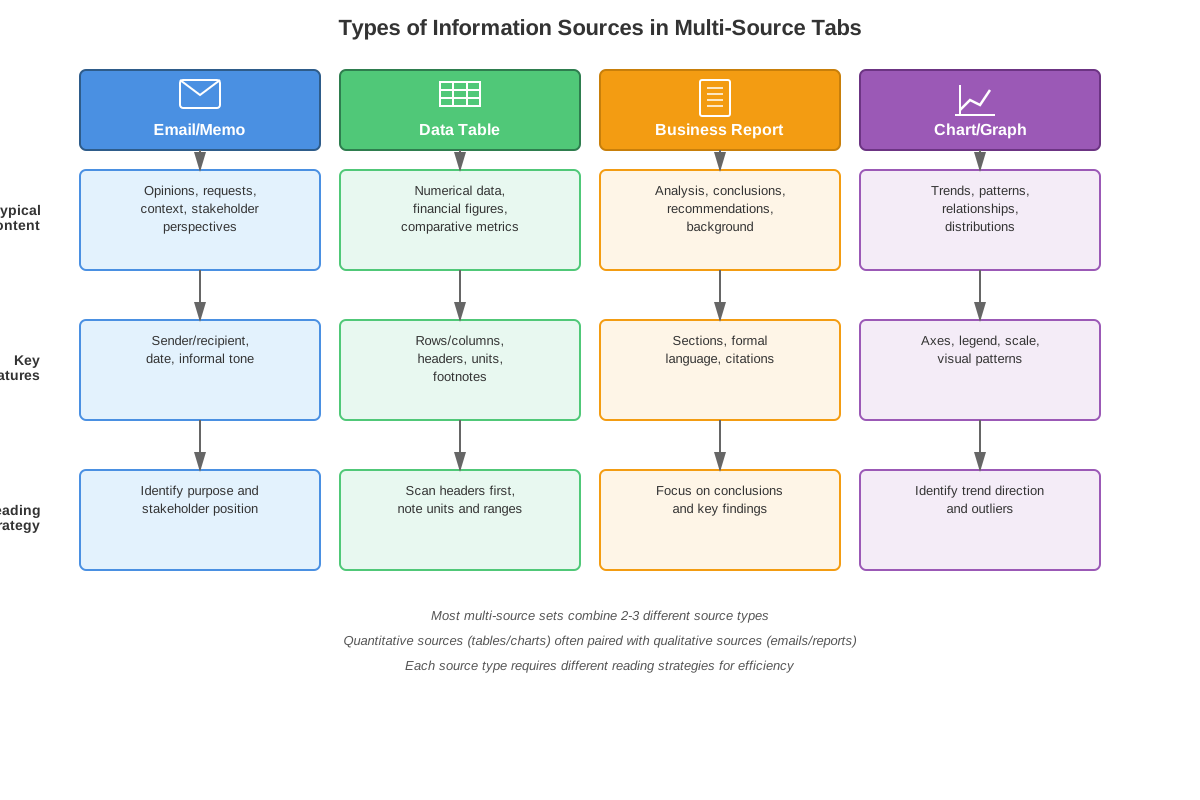
Information Types Across Tabs
Understanding the common information types helps students quickly orient themselves and develop retrieval strategies:
| Tab Position | Common Content Types | Primary Purpose |
|---|---|---|
| First Tab | Memos, emails, executive summaries, scenario descriptions | Establish context, objectives, and key stakeholders |
| Second Tab | Data tables, financial statements, charts, performance metrics | Provide quantitative evidence and measurable information |
| Third Tab | Additional proposals, constraints, expert opinions, historical data | Offer comparative information or complicating factors |
The information across tabs is deliberately designed to require synthesis. A question might ask about the feasibility of a proposal (Tab 3) based on budget constraints mentioned in an email (Tab 1) and actual expenditure data (Tab 2). This integration requirement distinguishes multi-source reasoning from simple data sufficiency or reading comprehension questions.
Question Types Within Multi-Source Sets
Multi-source reasoning questions employ several distinct formats:
- Inference questions: Require drawing conclusions by combining information from multiple tabs
- Calculation questions: Demand finding relevant numbers across tabs and performing computations
- Evaluation questions: Ask students to assess proposals, identify discrepancies, or determine information gaps
- Yes/No/Cannot Determine tables: Present multiple statements requiring verification against the tabbed sources
Navigation and Information Retrieval Strategy
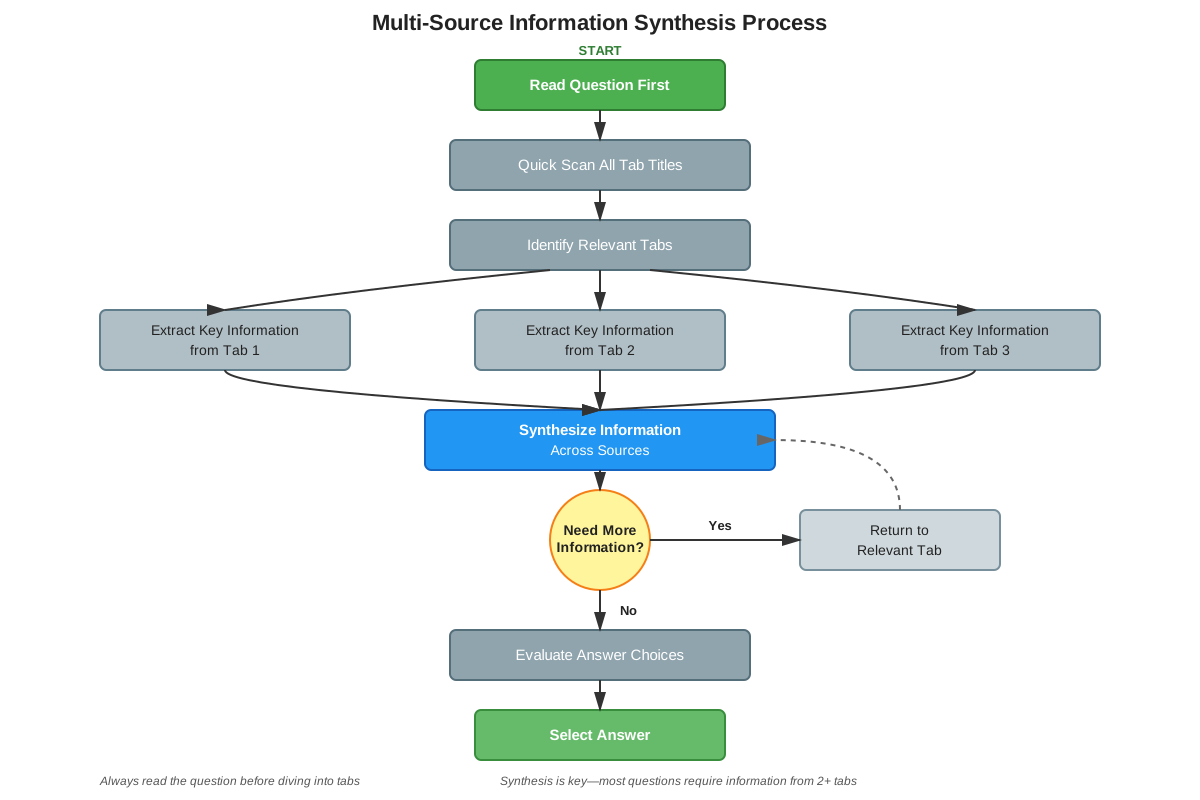
Efficient navigation is critical for time management. The systematic approach includes:
- Initial orientation phase (60-90 seconds): Quickly click through all tabs to understand the overall scenario, information types, and relationships between sources
- Question-driven retrieval: Read each question first, then navigate to relevant tabs rather than attempting to memorize all information upfront
- Cross-referencing: Identify when questions require information from multiple tabs and develop a mental map of where specific data types reside
- Annotation awareness: Note contradictions, key numbers, or critical constraints during the orientation phase
Synthesis Requirements
The defining characteristic of multi-source tabs is the synthesis requirement—the need to integrate information from different sources to reach conclusions. This differs fundamentally from questions where all necessary information appears in one location. Synthesis skills include:
- Reconciling apparent contradictions: Information in one tab may seem to conflict with another until properly contextualized
- Applying constraints across sources: A limitation mentioned in one tab must be considered when evaluating options presented in another
- Building complete pictures: Understanding that each tab provides partial information requiring integration for full comprehension
Time Allocation Considerations
With three questions per set and multiple tabs to navigate, time management becomes crucial. The recommended allocation is approximately 6-7 minutes per complete multi-source set (2-2.5 minutes per question), including initial orientation time. This pacing allows for:
- Initial orientation: 60-90 seconds
- Question 1: 90-120 seconds
- Question 2: 90-120 seconds
- Question 3: 90-120 seconds
- Buffer for complex calculations or re-checking: 30-60 seconds
Concept Relationships
Multi-source tabs integrate several foundational GMAT skills into a unified assessment format. The relationship begins with basic reading comprehension → which enables information extraction from individual tabs → leading to cross-tab synthesis → ultimately supporting integrated reasoning and decision-making.
Within the topic itself, the concepts connect as follows: Understanding the structure of multi-source tabs provides the foundation for developing efficient navigation strategies. These navigation strategies enable effective information retrieval, which is necessary for synthesis across sources. Synthesis capabilities then support answering the various question types that appear in multi-source sets.
The connection to prerequisite topics is direct: data interpretation skills allow students to extract information from quantitative tabs, reading comprehension enables processing of text-based tabs, and critical reasoning supports the evaluation and synthesis processes. These prerequisites don't merely support multi-source reasoning—they are actively integrated and tested simultaneously within each question set.
Multi-source tabs also connect forward to other Data Insights question types. The synthesis skills developed here transfer directly to two-part analysis questions and table analysis questions, both of which require integrating multiple pieces of information. The navigation and time management strategies apply broadly across the entire Data Insights section.
High-Yield Facts
⭐ Multi-source reasoning questions always appear in sets of exactly three questions based on the same tabbed information
⭐ Each multi-source set contains 2-3 tabs that remain accessible throughout all questions in the set
⭐ Questions within a set typically require information from multiple tabs, not just a single source
⭐ The first tab usually provides contextual/qualitative information while subsequent tabs contain quantitative data
⭐ Reading the question first before navigating tabs is more time-efficient than attempting to memorize all tab content
- Multi-source sets comprise approximately 15-20% of Data Insights questions on the GMAT
- The three questions in a set are independent—getting one wrong doesn't affect the others
- Tabs may contain apparently contradictory information that requires careful contextualization to reconcile
- Common tab content includes emails, memos, data tables, charts, proposals, and expert opinions
- Time allocation should be approximately 6-7 minutes per complete three-question set
- Questions may ask what additional information would be needed, testing recognition of information gaps
- The interface allows unlimited switching between tabs during the question set
- Some questions can be answered using only one or two tabs, while others require all available sources
- Multi-source scenarios typically simulate realistic business decision-making situations
- Effective annotation during the orientation phase significantly improves retrieval speed
Quick check — test yourself on Multi-source tabs so far.
Try Flashcards →Common Misconceptions
Misconception: All information across tabs is equally important and must be memorized before attempting questions.
Correction: Multi-source tabs are designed for question-driven retrieval, not memorization. Students should conduct a brief orientation to understand the overall scenario, then navigate to specific tabs based on what each question asks. Attempting to memorize all details wastes time and cognitive resources.
Misconception: If information appears in multiple tabs, there must be a contradiction or error to identify.
Correction: Information repetition across tabs often serves to provide context or confirmation rather than signal an error. The GMAT presents information across multiple sources to simulate real-world scenarios where the same fact might appear in both a summary memo and a detailed data table. Only identify contradictions when information genuinely conflicts.
Misconception: The three questions in a multi-source set must be answered in order and build upon each other.
Correction: Questions within a set are independent and can be approached in any order. If a particular question seems time-consuming or complex, students can skip to the next question in the set and return later. Each question stands alone and doesn't depend on correctly answering previous questions.
Misconception: Multi-source tabs test primarily quantitative skills since they often include data tables.
Correction: Multi-source reasoning integrates quantitative, verbal, and analytical skills equally. While calculations may be required, the primary challenge is synthesis—combining qualitative context from text tabs with quantitative evidence from data tabs. Pure computational ability without synthesis skills will not lead to success.
Misconception: The tab order indicates the sequence in which information should be processed.
Correction: Tab order is arbitrary and doesn't necessarily reflect logical information flow or importance. Students should navigate based on question requirements rather than assuming left-to-right processing is optimal. The most relevant information for a particular question might be in the third tab.
Misconception: "Cannot Determine" answers in yes/no/cannot determine questions indicate missing information across all tabs.
Correction: "Cannot Determine" is correct when the available information is insufficient or ambiguous, but this doesn't mean information is missing from the tabs. It means the specific question cannot be definitively answered with the provided information, which itself is a valid and testable conclusion.
Worked Examples
Example 1: Business Expansion Decision
Scenario Setup:
Tab 1 - Memo from CEO
"Our company is considering expanding into the Southeast Asian market. The Board has allocated $5 million for this expansion. We need to achieve profitability within 18 months. Market research suggests strong demand for our products in this region."
Tab 2 - Financial Projections
| Item | Year 1 | Year 2 |
|---|---|---|
| Initial Investment | $3.2M | - |
| Operating Costs | $1.8M | $2.1M |
| Projected Revenue | $2.5M | $5.8M |
| Projected Profit | -$3.1M | $3.7M |
Tab 3 - Regional Manager's Report
"Infrastructure setup requires $3.2M initially. Local regulations mandate a 6-month approval process before operations begin. Competitor analysis shows three established players with 60% combined market share."
Question 1: Based on the information in the tabs, does the expansion plan meet the CEO's profitability timeline requirement?
Solution Process:
- Identify requirement from Tab 1: Profitability within 18 months
- Navigate to Tab 2 to find profitability data
- Analyze: Year 1 shows -$3.1M (loss), Year 2 shows $3.7M (profit)
- Consider Tab 3 context: 6-month approval delay means operations don't begin immediately
- Calculate: If approval takes 6 months, Year 1 operations only run for 6 months, pushing profitability beyond 18 months
- Synthesis: The plan does NOT meet the timeline when accounting for regulatory delays
Answer: No, because the 6-month approval process delays the start of operations, meaning profitability in "Year 2" actually occurs beyond the 18-month requirement.
Learning Objective Connection: This question requires applying multi-source tabs by synthesizing timeline information from Tab 1, financial data from Tab 2, and operational constraints from Tab 3.
Example 2: Resource Allocation Analysis
Scenario Setup:
Tab 1 - Project Proposal Email
"We have three potential projects: Project Alpha (marketing initiative), Project Beta (technology upgrade), and Project Gamma (facility expansion). Each requires different resource commitments and offers different returns."
Tab 2 - Resource Requirements and Returns
| Project | Budget Needed | Staff Required | Expected ROI |
|---|---|---|---|
| Alpha | $800K | 5 people | 15% |
| Beta | $1.2M | 3 people | 22% |
| Gamma | $1.5M | 8 people | 18% |
Tab 3 - Available Resources
"Current available budget: $2.5 million. Available staff: 10 people. CFO note: We must maintain at least $500K in reserve funds. All selected projects must begin simultaneously."
Question 2: Which combination of projects can be undertaken given the constraints?
Solution Process:
- Identify constraints from Tab 3: $2.5M budget minus $500K reserve = $2M available; 10 staff available
- Review requirements from Tab 2 for each project
- Test combinations:
- Alpha + Beta: $800K + $1.2M = $2M ✓ budget; 5 + 3 = 8 staff ✓
- Alpha + Gamma: $800K + $1.5M = $2.3M ✗ exceeds budget
- Beta + Gamma: $1.2M + $1.5M = $2.7M ✗ exceeds budget
- All three: $3.5M ✗ exceeds budget
- Any single project: Possible but question asks for combination
- Verify: Alpha + Beta meets both budget ($2M ≤ $2M) and staff (8 ≤ 10) constraints
Answer: Only Projects Alpha and Beta can be undertaken together, as this is the only combination that satisfies both the budget constraint ($2M after reserves) and staff availability (10 people).
Learning Objective Connection: This demonstrates applying multi-source tabs through systematic constraint checking across all three tabs and evaluating multiple scenarios against integrated criteria.
Exam Strategy
Systematic Approach to Multi-Source Questions
When encountering a multi-source set, implement this proven four-phase strategy:
Phase 1: Rapid Orientation (60-90 seconds)
Click through each tab quickly to understand the scenario type, identify information categories, and note the general structure. Don't attempt to memorize details—simply build a mental map of where different information types reside.
Phase 2: Question-First Reading
Always read the question completely before navigating tabs. This focuses attention on relevant information and prevents wasting time on irrelevant details. Identify which tab(s) likely contain the needed information based on your orientation.
Phase 3: Targeted Retrieval
Navigate directly to the relevant tab(s) and extract only the information needed for the current question. Use the tab structure to your advantage—if a question asks about financial performance, go straight to the data table tab.
Phase 4: Cross-Tab Verification
For questions requiring synthesis, systematically check each relevant tab and note how information connects. Watch for constraints in one tab that affect interpretations of data in another tab.
Trigger Words and Phrases
Certain question language signals specific navigation strategies:
- "According to the [specific source]": Navigate only to that tab; answer doesn't require synthesis
- "Based on all the information provided": Requires checking all tabs for relevant data
- "Would be sufficient to determine": Look for information gaps across tabs
- "Consistent with" or "supported by": Verify against multiple sources
- "Additional information needed": Identify what's missing despite checking all tabs
- "Discrepancy" or "contradiction": Compare similar information types across different tabs
Process of Elimination Strategies
For multi-source questions, elimination is particularly powerful:
- Single-tab elimination: If an answer choice contradicts information in any single tab, eliminate it immediately
- Constraint violation: Eliminate choices that violate constraints mentioned in any tab, even if they seem attractive based on other information
- Incomplete synthesis: Eliminate answers that rely on only one tab when the question clearly requires integration
- Scope creep: Eliminate answers that introduce information not present in any tab, even if logically plausible
Time Management Tactics
Exam Tip: If you spend more than 2.5 minutes on a single question within a multi-source set, make your best guess and move to the next question. The three questions are independent, and struggling with one shouldn't compromise the others.
Allocate time strategically:
- Spend slightly more time on the orientation phase (90 seconds vs. 60) if the scenario is complex—this investment pays dividends across all three questions
- If one question requires extensive calculation, consider attempting the other two questions first
- Use the tab interface efficiently: minimize unnecessary clicking by remembering where key information resides
Common Trap Patterns
Be alert for these recurring trap patterns:
- Partial information traps: Answer choices that are correct based on one tab but wrong when other tabs are considered
- Assumption traps: Choices requiring assumptions beyond what the tabs explicitly state
- Calculation traps: Using numbers from the wrong tab or time period
- Scope traps: Answers that address a broader or narrower question than what's actually asked
Memory Techniques
The "SOURCE" Framework for Multi-Source Navigation
Scan all tabs quickly during orientation
Orient to the question before retrieving information
Use tab structure to predict information location
Retrieve targeted information, not everything
Cross-reference when synthesis is required
Eliminate based on single-tab contradictions first
Tab Content Prediction Mnemonic: "CoDaP"
Remember typical tab content patterns:
- Context (Tab 1): Usually qualitative, narrative, objectives
- Data (Tab 2): Usually quantitative, tables, metrics
- Perspectives (Tab 3): Usually additional viewpoints, constraints, proposals
The "Three-Question Rule"
Visualize multi-source sets as three independent opportunities sharing one information pool. This mental model prevents the mistake of treating them as sequential or dependent questions. Think: "Same pool, different dives."
Synthesis Checkpoint Acronym: "MATCH"
Before finalizing answers requiring synthesis:
Multiple tabs consulted?
All constraints considered?
Timelines aligned correctly?
Context from qualitative tabs applied?
Have I verified no contradictions?
Summary
Multi-source tabs represent a distinctive GMAT Data Insights question format that presents information across 2-3 clickable tabs, requiring students to navigate, synthesize, and analyze diverse information sources to answer three related questions per set. Success depends on efficient navigation strategies, systematic information retrieval, and the ability to integrate qualitative context with quantitative data. Rather than memorizing all tab content, effective test-takers use a question-driven approach: conducting brief orientation to understand the scenario structure, reading questions first to focus retrieval efforts, and navigating directly to relevant tabs. The format tests real-world business skills—synthesizing information from multiple sources, identifying constraints across documents, and making evidence-based decisions. Time management is critical, with approximately 6-7 minutes allocated per complete set. The key to mastery is recognizing that multi-source reasoning integrates reading comprehension, data interpretation, and critical reasoning simultaneously, requiring a holistic approach rather than isolated skill application.
Key Takeaways
- Multi-source tabs always present information across 2-3 tabs with exactly three questions per set, making them high-value opportunities for efficient scoring
- Question-driven navigation is more effective than attempting to memorize all tab content—read the question first, then retrieve targeted information
- Synthesis across tabs is the defining challenge: questions typically require integrating qualitative context from one tab with quantitative data from another
- The first tab usually provides scenario context, the second contains data/metrics, and the third offers additional perspectives or constraints
- Time allocation should be approximately 6-7 minutes per three-question set, including 60-90 seconds for initial orientation
- Effective elimination strategies include checking answer choices against constraints mentioned in any tab and removing options that require information not present in the sources
- The three questions within a set are independent—struggling with one question shouldn't compromise performance on the others
Related Topics
Table Analysis: Builds on multi-source skills by requiring students to sort and analyze data tables, often requiring similar synthesis of row and column information to answer multiple related questions.
Two-Part Analysis: Extends the synthesis requirement by presenting scenarios where students must simultaneously satisfy two different criteria, similar to how multi-source questions require integrating information from different tabs.
Graphics Interpretation: Develops complementary skills in extracting information from visual data representations, which frequently appear as one of the tabs in multi-source sets.
Data Sufficiency: Shares the information evaluation component with multi-source reasoning, as both question types require determining whether available information is sufficient to answer specific questions.
Mastering multi-source tabs provides a foundation for all integrated reasoning tasks on the GMAT, as the navigation, synthesis, and time management skills transfer directly to other Data Insights question formats.
Practice CTA
Now that you understand the structure, strategy, and synthesis requirements of multi-source tabs, it's time to apply these concepts to actual GMAT-style questions. The practice questions and flashcards will reinforce your navigation strategies, test your ability to integrate information across sources, and build the time management skills essential for exam success. Remember: multi-source reasoning rewards systematic thinking and efficient information retrieval—skills that improve dramatically with focused practice. Each practice set you complete strengthens your ability to handle information-dense scenarios with confidence. Begin your practice now to transform these strategies into automatic, test-day-ready skills!
Sign up free to keep reading
Create a free AnvayaPrep account to finish this GMAT guide on Multi-source tabs — plus flashcards and practice questions.