Overview
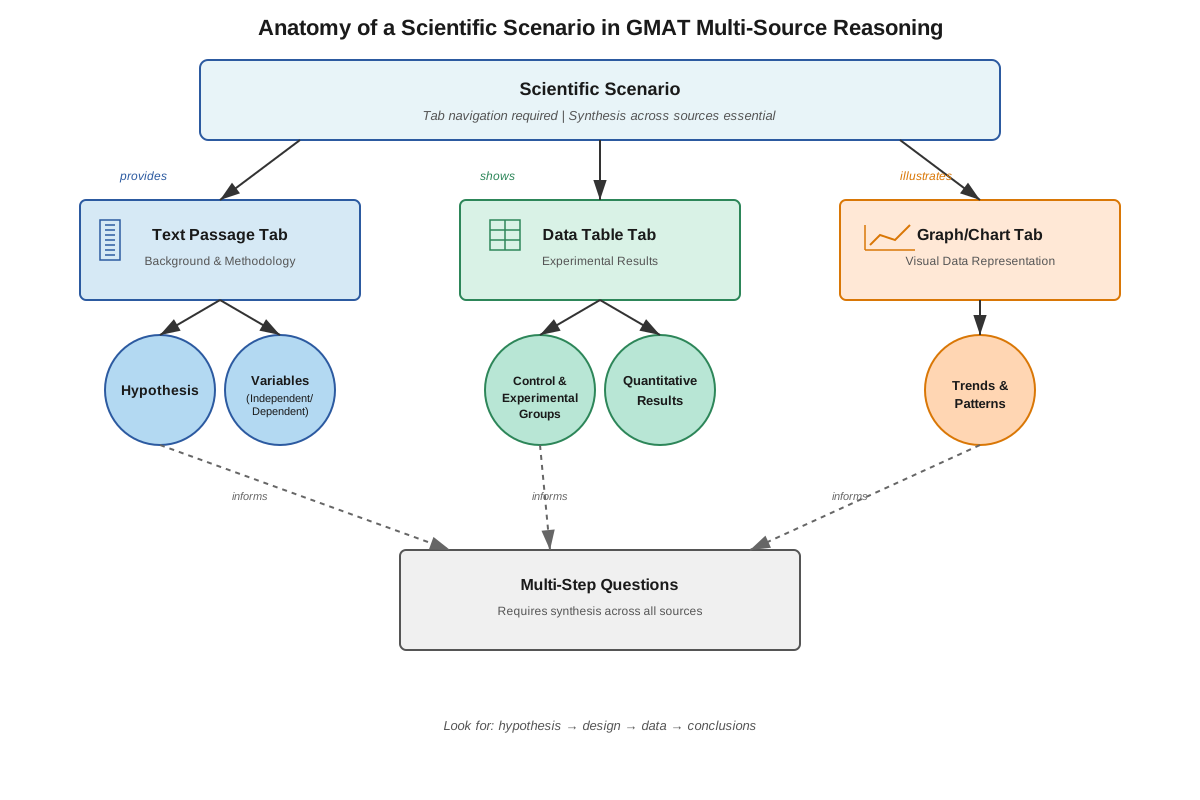
Scientific scenarios are a critical component of the GMAT Data Insights section, particularly within Multi-Source Reasoning questions. These scenarios present students with complex scientific information drawn from fields such as biology, chemistry, physics, environmental science, and medicine. Unlike traditional quantitative problems, GMAT scientific scenarios require test-takers to synthesize information from multiple sources—including text passages, data tables, graphs, and experimental descriptions—to answer questions that assess both analytical reasoning and data interpretation skills.
The GMAT does not test specific scientific knowledge; rather, it evaluates the ability to understand scientific reasoning, interpret experimental designs, analyze data relationships, and draw logical conclusions from presented information. Scientific scenarios typically involve controlled experiments, observational studies, hypotheses, variables, and data analysis—all presented in a business-relevant or research context. Students must quickly identify key information, understand cause-and-effect relationships, and evaluate the strength of evidence supporting various conclusions.
Mastering scientific scenarios is essential because they represent a significant portion of Multi-Source Reasoning questions and integrate multiple Data Insights skills simultaneously. Success requires combining reading comprehension, quantitative analysis, logical reasoning, and the ability to navigate between different information sources efficiently. This topic connects directly to other Data Insights concepts such as table analysis, graphics interpretation, and two-part analysis, making it a foundational skill for achieving a competitive GMAT score.
Learning Objectives
- [ ] Identify scientific scenarios in GMAT Multi-Source Reasoning questions
- [ ] Explain the structure and components of scientific scenarios including hypotheses, variables, and experimental designs
- [ ] Apply scientific scenarios to GMAT questions by synthesizing information from multiple sources
- [ ] Distinguish between independent and dependent variables in experimental contexts
- [ ] Evaluate the validity of conclusions based on presented scientific evidence
- [ ] Analyze control groups and experimental groups to assess study design quality
- [ ] Interpret data tables and graphs within scientific contexts to answer multi-step questions
Prerequisites
- Basic reading comprehension skills: Essential for understanding complex scientific passages that form the foundation of these scenarios
- Fundamental data interpretation: Required to extract information from tables, charts, and graphs that accompany scientific scenarios
- Logical reasoning abilities: Necessary to evaluate cause-and-effect relationships and assess the strength of arguments
- Basic mathematical operations: Needed to perform calculations involving percentages, ratios, and simple statistical comparisons
- Familiarity with Multi-Source Reasoning format: Understanding how to navigate between tabs and integrate information from multiple sources
Why This Topic Matters
Scientific scenarios appear in approximately 30-40% of Multi-Source Reasoning questions on the GMAT, making them one of the highest-yield topics within Data Insights. These questions test skills that are directly relevant to business school success and professional careers: the ability to analyze research findings, evaluate evidence quality, make data-driven decisions, and communicate complex information effectively.
In real-world business contexts, professionals regularly encounter scientific and technical information—from pharmaceutical companies analyzing clinical trial data to technology firms evaluating research and development outcomes, from consulting firms assessing environmental impact studies to marketing teams interpreting consumer behavior research. The analytical skills developed through mastering scientific scenarios translate directly to these professional applications.
On the GMAT, scientific scenarios typically appear as three-tab presentations where students must navigate between a text passage describing an experiment or study, data tables showing results, and supplementary information such as methodology details or additional findings. Questions may ask students to identify which conclusion is supported by the data, determine what additional information would strengthen or weaken an argument, calculate specific values from presented data, or evaluate the experimental design's validity. The complexity lies not in requiring specialized scientific knowledge but in demanding careful attention to detail, precise logical reasoning, and the ability to synthesize information efficiently under time pressure.
Core Concepts
Structure of Scientific Scenarios
Scientific scenarios on the GMAT follow predictable structural patterns that, once recognized, significantly improve efficiency and accuracy. A typical scenario includes several key components: a research question or problem statement, a hypothesis (proposed explanation or prediction), an experimental design describing how the study was conducted, data presentation showing results, and often a discussion of implications or limitations.
The research question establishes the context and purpose of the investigation. For example, a scenario might explore whether a new manufacturing process reduces defect rates or whether a particular marketing strategy increases customer retention. The hypothesis represents a testable prediction about the relationship between variables. Understanding the hypothesis is crucial because GMAT questions frequently ask whether the data supports, contradicts, or is insufficient to evaluate the proposed hypothesis.
Variables and Experimental Design
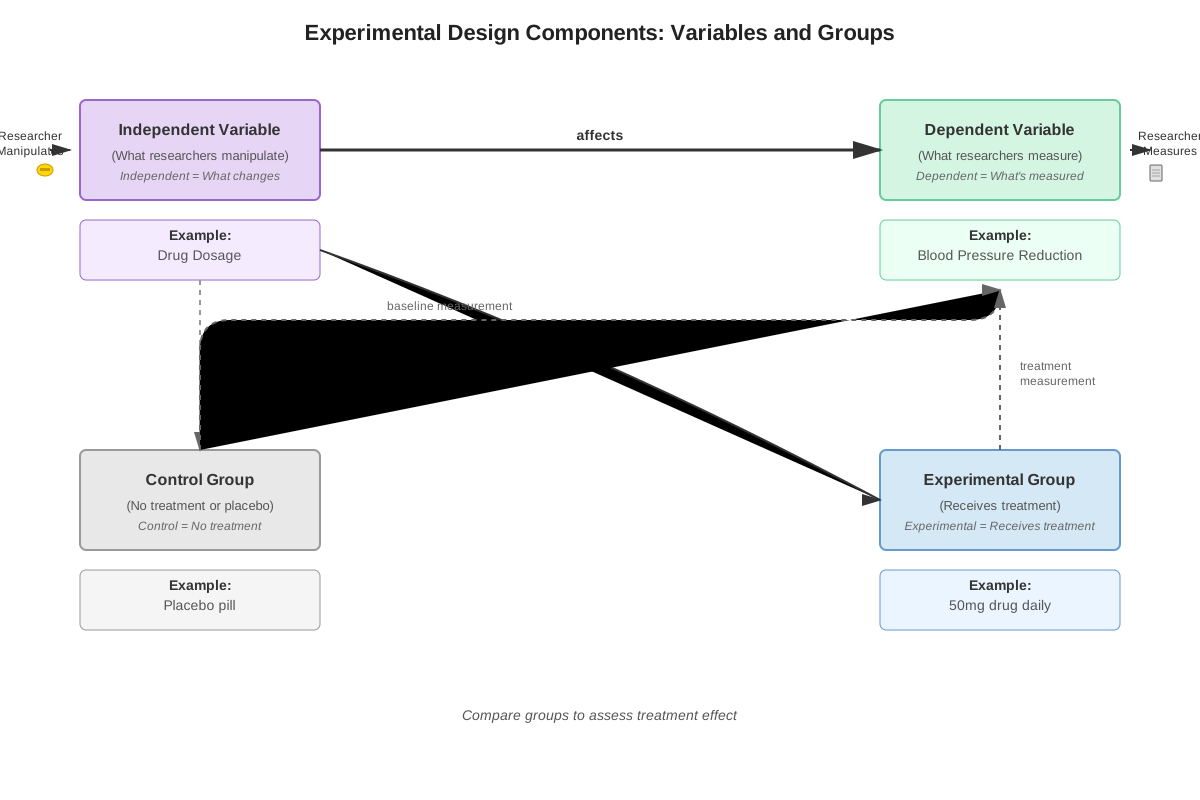
Every scientific scenario involves variables—factors that can change or be measured. The independent variable (also called the manipulated or predictor variable) is what researchers deliberately change or control. The dependent variable (also called the outcome or response variable) is what researchers measure to see if it changes in response to the independent variable. For instance, in a study testing whether employee training duration affects productivity, training duration is the independent variable and productivity is the dependent variable.
Control groups and experimental groups form the foundation of rigorous experimental design. The control group receives no treatment or a standard treatment, providing a baseline for comparison. The experimental group receives the treatment being tested. GMAT questions often assess whether students can identify flaws in experimental design, such as the absence of an appropriate control group, confounding variables that weren't controlled, or sample sizes too small to draw reliable conclusions.
Data Interpretation in Scientific Contexts
Scientific scenarios present data in various formats: tables showing numerical results across different conditions, line graphs displaying trends over time, bar charts comparing groups, or scatter plots showing relationships between variables. The key skill is extracting relevant information efficiently and recognizing patterns that support or contradict specific claims.
When interpreting data, students must distinguish between correlation and causation. Two variables may change together (correlation) without one causing the other. GMAT questions frequently test this distinction by asking whether data proves a causal relationship or merely shows an association. Additional factors such as sample size, statistical significance, and the presence of confounding variables all affect the strength of conclusions that can be drawn from presented data.
Types of Scientific Studies
GMAT scenarios may present different study types, each with distinct characteristics and limitations. Controlled experiments involve researchers manipulating variables and using control groups to establish causation. Observational studies involve researchers collecting data without manipulating variables, which can identify correlations but cannot definitively establish causation. Longitudinal studies track subjects over extended periods, while cross-sectional studies examine subjects at a single point in time.
Understanding study type helps evaluate the strength of conclusions. For example, if a scenario describes an observational study showing that companies using a particular software have higher profits, students should recognize that this doesn't prove the software caused the profit increase—other factors might explain both the software adoption and the profitability.
Evaluating Evidence and Drawing Conclusions
A critical skill in scientific scenarios is determining what conclusions the evidence actually supports. GMAT questions often present several possible conclusions and ask which one is most strongly supported by the data. The correct answer will be directly supported by specific data points or patterns, while incorrect answers may overstate the evidence, introduce unsupported assumptions, or confuse correlation with causation.
Students must also recognize when evidence is insufficient to support a conclusion. This occurs when data is incomplete, sample sizes are too small, confounding variables aren't controlled, or the study design has fundamental flaws. Questions may ask what additional information would be needed to evaluate a claim or what assumption is necessary for a conclusion to be valid.
Concept Relationships
The concepts within scientific scenarios form an interconnected framework where understanding one element enhances comprehension of others. The relationship flows as follows:
Research Question → Hypothesis → Experimental Design → Variables (Independent/Dependent) → Data Collection → Data Presentation → Analysis → Conclusions
The research question determines what hypothesis will be tested, which in turn dictates the experimental design. The experimental design specifies which variables will be manipulated (independent) and measured (dependent), how control and experimental groups will be structured, and what data will be collected. The data presentation format (tables, graphs, charts) must align with the variables being measured. Finally, the analysis evaluates whether the data supports the hypothesis, leading to conclusions about the research question.
This topic connects to prerequisite knowledge of basic data interpretation by adding layers of scientific reasoning and experimental logic. It relates to other Multi-Source Reasoning topics by requiring navigation between multiple information sources and synthesis of diverse data types. The skills developed here—identifying relevant information, evaluating evidence quality, and drawing logical conclusions—transfer directly to other Data Insights question types such as Table Analysis and Graphics Interpretation.
Understanding scientific scenarios also builds toward more advanced analytical skills needed in business school, where case studies often require evaluating research findings, assessing methodology quality, and making recommendations based on imperfect or incomplete information.
High-Yield Facts
⭐ The GMAT never requires specialized scientific knowledge—all necessary information is provided in the scenario itself
⭐ Independent variables are manipulated by researchers; dependent variables are measured outcomes
⭐ Control groups provide the baseline for comparison in experiments and are essential for establishing causation
⭐ Correlation does not prove causation—two variables may change together without one causing the other
⭐ Sample size affects the reliability of conclusions—larger samples generally provide stronger evidence
- Confounding variables are factors not controlled in the study that might affect results and weaken conclusions
- Observational studies can identify correlations but cannot definitively establish causal relationships
- Questions often ask what would strengthen or weaken a conclusion, requiring identification of assumptions
- Data tables typically appear on a separate tab from the text description, requiring navigation between sources
- The correct answer to "which conclusion is supported" questions will have direct evidence in the data, not require assumptions
Quick check — test yourself on Scientific scenarios so far.
Try Flashcards →Common Misconceptions
Misconception: Scientific scenarios require memorizing scientific facts or formulas from biology, chemistry, or physics.
Correction: The GMAT provides all necessary information within the scenario. Success depends on analytical reasoning and data interpretation skills, not prior scientific knowledge. Students should focus on understanding the logical structure of experiments and the relationships between variables rather than memorizing scientific content.
Misconception: If two variables change together in the data, one must cause the other.
Correction: Correlation does not establish causation. Variables may be associated due to a third factor (confounding variable), coincidence, or reverse causation. GMAT questions specifically test the ability to distinguish between correlation and causation, and correct answers often acknowledge this distinction.
Misconception: Larger numbers in data tables always indicate better outcomes or stronger effects.
Correction: The meaning of numerical values depends entirely on context. A larger number might represent a worse outcome (e.g., higher defect rates, increased costs, more adverse events). Students must carefully read what each variable measures before interpreting whether increases or decreases are favorable.
Misconception: The control group is always the group that receives no treatment whatsoever.
Correction: Control groups may receive a standard treatment, placebo, or current best practice rather than no treatment at all. The key characteristic is that the control group provides a baseline for comparison with the experimental group, which receives the treatment being tested.
Misconception: If a study has any limitations or doesn't control every possible variable, its conclusions are worthless.
Correction: All studies have limitations, and the GMAT tests the ability to evaluate the strength of evidence on a continuum rather than in absolute terms. A study may provide moderate or suggestive evidence even with limitations. Questions often ask which conclusion is "most supported" rather than "proven," acknowledging that evidence can be strong without being perfect.
Worked Examples
Example 1: Pharmaceutical Study Analysis
Scenario: A pharmaceutical company tested a new medication for reducing blood pressure. The study included 200 participants divided into two groups. Group A (100 participants) received the new medication daily for 12 weeks. Group B (100 participants) received a placebo daily for 12 weeks. Neither participants nor researchers knew who received which treatment. Blood pressure was measured at the beginning and end of the study.
Data Table:
| Group | Average Initial BP (mmHg) | Average Final BP (mmHg) | Average Change |
|---|---|---|---|
| A (Medication) | 145 | 132 | -13 |
| B (Placebo) | 144 | 141 | -3 |
Question: Which of the following conclusions is most strongly supported by the study results?
A) The medication causes blood pressure reduction in all patients
B) The medication is associated with greater blood pressure reduction than placebo
C) The placebo has no effect on blood pressure
D) The medication will reduce blood pressure by exactly 13 mmHg in future patients
Solution:
Step 1: Identify the study design elements. This is a controlled experiment with an experimental group (Group A receiving medication) and a control group (Group B receiving placebo). The study is double-blind (neither participants nor researchers knew group assignments), which strengthens the design by reducing bias.
Step 2: Analyze the data. Group A showed an average reduction of 13 mmHg, while Group B showed an average reduction of 3 mmHg. Both groups started with similar baseline blood pressure (145 vs. 144 mmHg), making them comparable.
Step 3: Evaluate each answer choice:
- Choice A overstates the conclusion by claiming the medication works for "all patients." The data shows average effects, and individual responses may vary.
- Choice B accurately reflects the data: the medication group showed greater reduction than the placebo group. This is supported by the 13 mmHg vs. 3 mmHg comparison.
- Choice C is incorrect because the placebo group did show a 3 mmHg reduction (possibly due to placebo effect or regression to the mean).
- Choice D overstates precision. The 13 mmHg is an average for this sample and won't be "exactly" replicated in all future patients.
Answer: B is correct because it accurately describes what the data shows without overstating the conclusions. This example demonstrates the importance of distinguishing between what data proves versus what it suggests, and avoiding answers that claim absolute or universal effects.
Example 2: Environmental Study Evaluation
Scenario: Researchers investigated whether a new water filtration system reduces bacterial contamination in municipal water supplies. They collected water samples from 10 cities that installed the new system and 10 cities that continued using traditional filtration. Samples were tested for bacterial count (colonies per milliliter) six months after installation.
Data Table:
| Filtration Type | Average Bacterial Count | Range |
|---|---|---|
| New System | 12 colonies/mL | 8-18 |
| Traditional | 28 colonies/mL | 22-35 |
Question: Which of the following, if true, would most weaken the conclusion that the new filtration system is more effective at reducing bacterial contamination?
A) The cities with new systems had lower initial contamination levels before installation
B) The new filtration system costs twice as much as traditional systems
C) Some cities with traditional systems have older infrastructure
D) Bacterial counts vary seasonally in all cities
Solution:
Step 1: Identify what conclusion we're evaluating. The implied conclusion is that the new system causes lower bacterial counts (is more effective).
Step 2: Recognize this is an observational study, not a controlled experiment. The researchers didn't randomly assign cities to filtration types; they compared cities that happened to use different systems.
Step 3: Consider what would weaken a causal conclusion. We need to identify a confounding variable or alternative explanation for the observed difference.
Step 4: Evaluate each choice:
- Choice A identifies a critical confounding variable. If cities with new systems started with lower contamination, the difference might reflect pre-existing conditions rather than system effectiveness. This directly challenges the causal interpretation.
- Choice B addresses cost but doesn't affect whether the system is effective at reducing contamination—effectiveness and cost are separate considerations.
- Choice C mentions infrastructure age, which could be relevant, but it's less direct than Choice A and doesn't clearly explain the observed difference.
- Choice D states that bacterial counts vary seasonally, but this affects all cities equally and doesn't explain why one group has consistently lower counts.
Answer: A is correct because it provides an alternative explanation for the observed difference, weakening the causal conclusion. This example illustrates how GMAT questions test the ability to identify confounding variables and evaluate the strength of causal claims in observational studies.
Exam Strategy
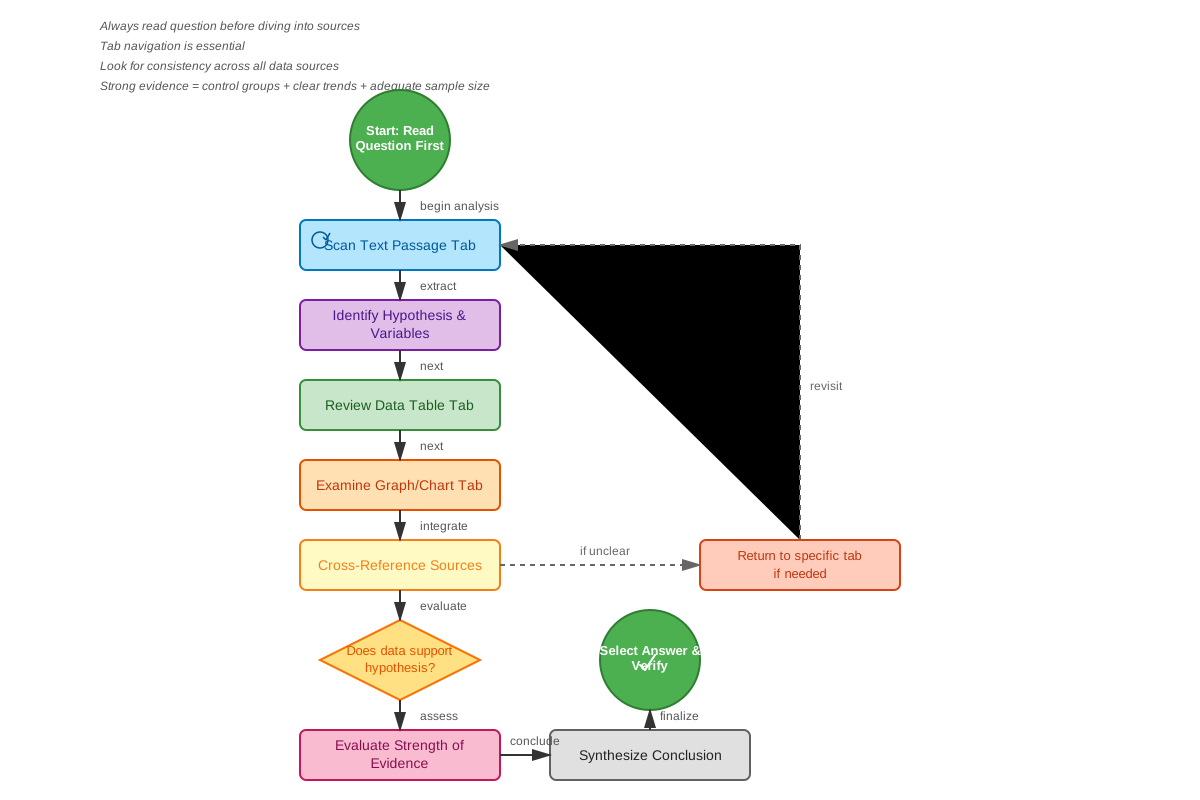
When approaching scientific scenarios on the GMAT, implement a systematic process to maximize efficiency and accuracy. Begin by quickly scanning all tabs to understand the overall structure: identify where the text description, data tables, and supplementary information are located. This initial orientation prevents wasted time searching for information later.
Trigger words to watch for include "hypothesis," "control group," "independent variable," "dependent variable," "correlation," "causation," "suggests," "proves," "demonstrates," and "indicates." These words signal important logical relationships and the strength of claims being made. Pay particular attention to qualifiers like "may," "might," "suggests," versus stronger claims like "proves" or "demonstrates"—the GMAT frequently tests whether students recognize appropriate levels of certainty.
For questions asking which conclusion is supported, use process of elimination by checking each answer choice against the specific data provided. Eliminate answers that:
- Overstate the evidence (claiming proof when data only suggests)
- Introduce information not present in the scenario
- Confuse correlation with causation
- Make absolute claims ("all," "none," "always") when data shows averages or trends
- Contradict specific data points
For questions about strengthening or weakening arguments, identify the conclusion's underlying assumptions. What must be true for the conclusion to hold? What alternative explanations might exist? Correct answers typically address these assumptions or alternatives directly.
Time allocation: Spend approximately 60-90 seconds initially reading and understanding the scenario structure, then 60-90 seconds per question. If a question requires extensive calculation or cross-referencing multiple data points, consider flagging it and returning after completing quicker questions. The ability to navigate efficiently between tabs is crucial—practice this skill specifically.
Memory Techniques
VICED - Remember the key components of experimental design:
- Variables (independent and dependent)
- Intervention (what's being tested)
- Control group (baseline for comparison)
- Experimental group (receives treatment)
- Data (measurements and results)
"Correlation Caution" - Visualize a yellow caution sign whenever you see two variables changing together. This reminds you to question whether causation has been established or only correlation observed.
The Three C's of Conclusions: When evaluating what conclusions data supports, check:
- Consistent with data (directly supported by numbers/patterns)
- Cautious in claims (appropriate level of certainty)
- Clear about causation vs. correlation (doesn't overstate relationships)
Independent = Input, Dependent = Outcome - The independent variable is what researchers put IN (manipulate), and the dependent variable is what comes OUT (measured outcome). This simple input/output framework prevents confusion about which variable is which.
Summary
Scientific scenarios in GMAT Multi-Source Reasoning questions assess the ability to analyze experimental designs, interpret data, and evaluate conclusions without requiring specialized scientific knowledge. Success depends on understanding the structure of scientific investigations: research questions lead to hypotheses, which are tested through experimental designs involving independent variables (manipulated) and dependent variables (measured), with control groups providing baselines for comparison. Students must efficiently navigate between text passages, data tables, and supplementary information to synthesize evidence and determine which conclusions are supported. Critical skills include distinguishing correlation from causation, identifying confounding variables, evaluating study design quality, and recognizing when evidence is insufficient to support strong claims. The GMAT tests analytical reasoning applied to scientific contexts rather than memorized scientific facts, making this a highly learnable skill set that improves with systematic practice and strategic approach.
Key Takeaways
- All necessary information is provided in the scenario—no outside scientific knowledge is required or beneficial
- Independent variables are manipulated by researchers; dependent variables are measured outcomes
- Control groups are essential for establishing causation by providing comparison baselines
- Correlation between variables does not prove causation; always consider alternative explanations and confounding variables
- Correct answers to "which conclusion is supported" questions have direct evidence in the data without requiring assumptions
- Study design quality affects conclusion strength: larger samples, proper controls, and elimination of confounding variables strengthen evidence
- Navigate efficiently between tabs by scanning structure first, then targeting specific information as questions require
Related Topics
Table Analysis: Builds directly on scientific scenario skills by focusing specifically on extracting and manipulating information from complex data tables, often in business contexts rather than scientific ones.
Graphics Interpretation: Extends data interpretation skills to various graph types (scatter plots, line graphs, bar charts) that frequently appear within scientific scenarios.
Two-Part Analysis: Applies logical reasoning skills developed through scientific scenarios to questions requiring simultaneous evaluation of two related components or variables.
Integrated Reasoning - Research Summaries: In other standardized tests, similar skills apply to evaluating research methodology and conclusions, making scientific scenario mastery transferable.
Mastering scientific scenarios provides a foundation for these related topics because the core skills—synthesizing information from multiple sources, evaluating evidence quality, and drawing appropriate conclusions—transfer across all Data Insights question types.
Practice CTA
Now that you've mastered the conceptual framework for scientific scenarios, it's time to apply these skills to authentic GMAT-style questions. Complete the practice questions associated with this topic, focusing on implementing the systematic approach outlined in the Exam Strategy section. Pay particular attention to distinguishing between correlation and causation, identifying confounding variables, and selecting conclusions that match the strength of evidence provided. Use the flashcards to reinforce key terminology and concepts, especially the distinctions between independent and dependent variables and the characteristics of strong experimental designs. Remember: scientific scenarios become significantly easier with practice as you internalize the common patterns and question types. Your investment in deliberate practice now will pay dividends in both speed and accuracy on test day!
Sign up free to keep reading
Create a free AnvayaPrep account to finish this GMAT guide on Scientific scenarios — plus flashcards and practice questions.