Overview
Conditional tables are a specialized form of data presentation that appears frequently in the GMAT Data Insights section, particularly within Table Analysis questions. Unlike standard tables that display raw data, conditional tables present information that depends on specific conditions, criteria, or scenarios being met. These tables require test-takers to evaluate relationships between variables, apply logical reasoning, and determine whether statements are true or false based on the data presented under various conditions.
Understanding GMAT conditional tables is essential because they test multiple cognitive skills simultaneously: data interpretation, logical reasoning, conditional logic application, and quantitative analysis. These tables often present probability data, survey results with multiple conditions, financial scenarios with different assumptions, or scientific data under varying experimental conditions. The GMAT uses conditional tables to assess whether candidates can navigate complex business scenarios where outcomes depend on multiple factors—a critical skill for graduate management education.
Conditional tables represent a convergence point within Data Insights, combining elements from Table Analysis, Two-Part Analysis, and even aspects of Quantitative Reasoning. Mastering this topic strengthens overall analytical capabilities and provides a framework for approaching other complex data presentation formats. The ability to quickly identify conditions, trace their implications through data, and evaluate statements accurately under time pressure distinguishes high-scoring candidates from average performers.
Learning Objectives
- [ ] Identify conditional tables in GMAT Data Insights questions
- [ ] Explain the structure and logic underlying conditional tables
- [ ] Apply conditional tables to solve GMAT questions efficiently
- [ ] Distinguish between dependent and independent conditions within table data
- [ ] Evaluate multiple statements simultaneously using conditional table data
- [ ] Recognize common conditional table formats and their variations
- [ ] Calculate derived values from conditional relationships in tables
Prerequisites
- Basic table reading skills: Understanding rows, columns, headers, and how to locate specific data points is fundamental to working with any table format
- Percentage and ratio calculations: Conditional tables frequently require converting between percentages, fractions, and absolute values to evaluate conditions
- Logical reasoning fundamentals: The ability to understand "if-then" relationships and evaluate conditional statements is essential for interpreting table conditions
- Basic probability concepts: Many conditional tables present probability data or require calculating conditional probabilities from the given information
Why This Topic Matters
Conditional tables appear in approximately 15-20% of Data Insights questions on the GMAT, making them one of the most frequently tested data presentation formats. These questions typically appear as Table Analysis items where test-takers must evaluate three statements as true, false, or cannot be determined based on the conditional data provided. The format directly mirrors real-world business scenarios where managers must make decisions based on data that varies under different conditions—market scenarios, budget constraints, resource availability, or strategic alternatives.
In professional contexts, conditional tables are ubiquitous in business intelligence dashboards, financial modeling, market research reports, and strategic planning documents. MBA programs value this skill because graduates must regularly interpret conditional data to make recommendations: "If we enter Market A with Product X, what are the projected returns?" or "Under what conditions does Strategy B outperform Strategy A?" The GMAT tests this capability because it predicts success in case-based learning and data-driven decision-making.
Common manifestations in GMAT passages include: survey results broken down by demographic segments and response categories; financial performance data across different time periods and business units; experimental results under varying conditions; market data segmented by region, product line, and time period; and probability distributions for different scenarios. The questions typically require evaluating whether specific statements can be confirmed, refuted, or remain indeterminate based on the conditional relationships in the table.
Core Concepts
Structure of Conditional Tables
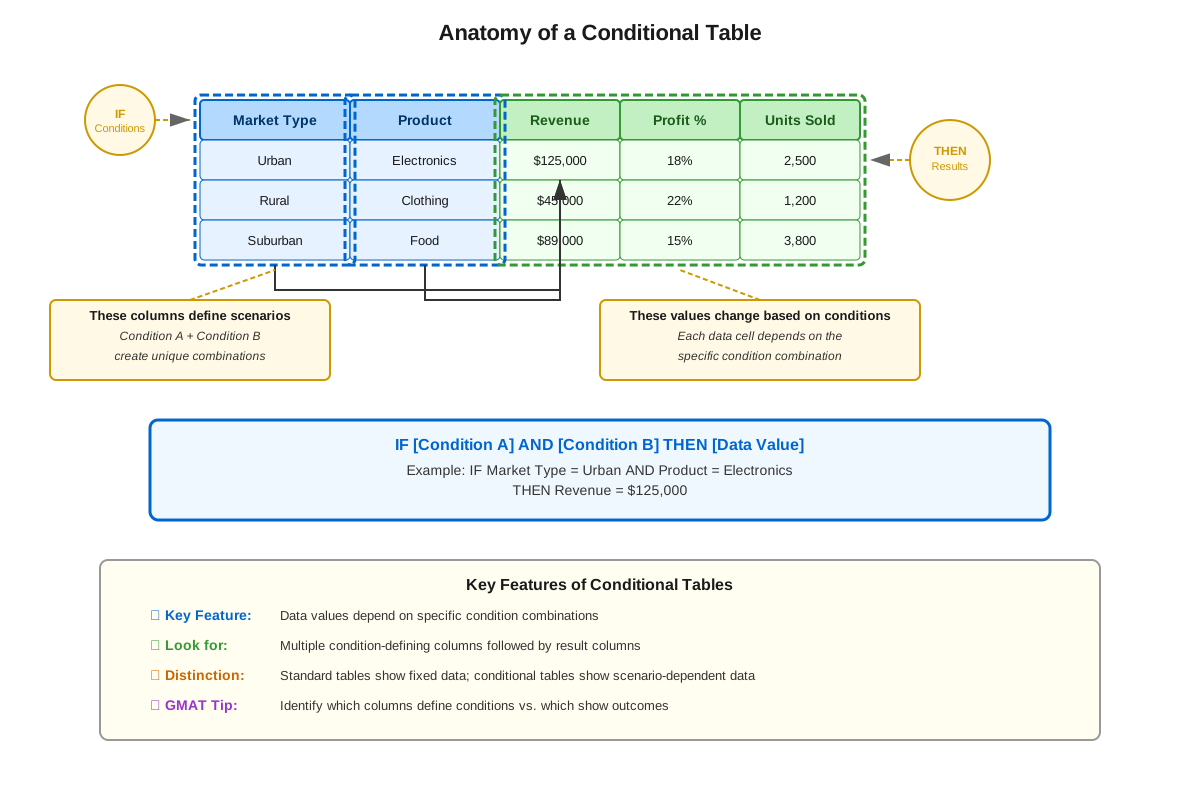
A conditional table organizes data where values depend on one or more conditions being satisfied. The table structure typically features condition variables as row headers, column headers, or both, with cell values representing outcomes when those specific conditions are met. Unlike simple data tables that merely list values, conditional tables encode logical relationships: "When Condition X is true AND Condition Y is true, the result is Z."
The anatomy of a conditional table includes: primary conditions (the main variables being analyzed), secondary conditions (additional factors that modify outcomes), conditional values (the data points that result from specific condition combinations), and totals or aggregates (summary statistics that may or may not reflect simple sums, depending on whether conditions are mutually exclusive).
Types of Conditional Relationships
Mutually exclusive conditions occur when only one condition from a set can be true at any given time. For example, a customer can be classified as "New," "Returning," or "Inactive"—but not multiple categories simultaneously. In these tables, row or column totals equal the sum of individual cells because there's no overlap.
Non-mutually exclusive conditions allow multiple conditions to be true simultaneously. A product might be both "Discounted" AND "High-Rated," creating overlapping categories. These tables require careful attention because simple addition leads to double-counting. The GMAT frequently tests whether students recognize this distinction.
Dependent conditions exist when one condition's value or probability depends on another condition being true. These create conditional probability scenarios where P(A|B) ≠ P(A). For example, the probability of purchase given that a customer viewed a product differs from the overall purchase probability.
Independent conditions occur when one condition's outcome doesn't affect another's probability or value. Recognizing independence allows for multiplication of probabilities and simplifies calculations.
Reading Conditional Table Questions
GMAT conditional table questions follow a specific format. The table appears with a sortable interface (though sorting is often unnecessary for solving). Below the table, three statements appear, each requiring evaluation as True, False, or Cannot Be Determined based solely on the table data.
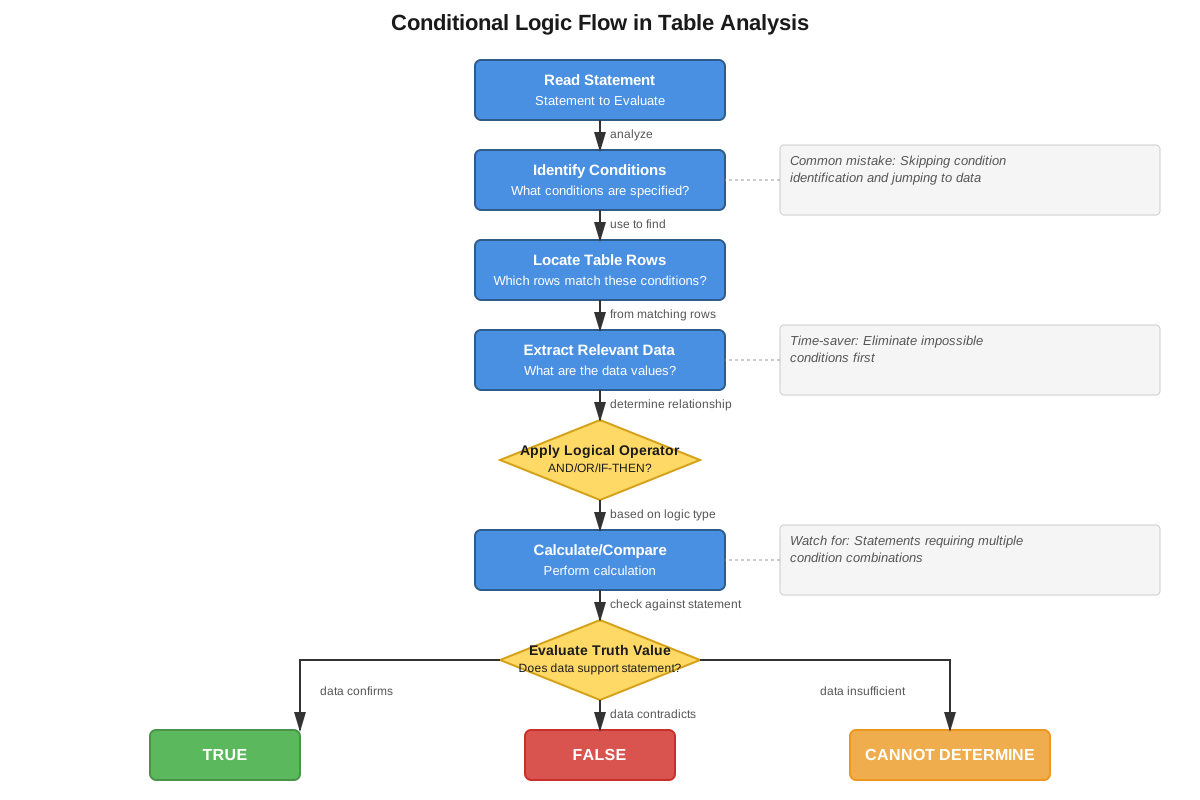
The evaluation process requires: (1) identifying what conditions the statement specifies, (2) locating the relevant data cells that correspond to those conditions, (3) performing any necessary calculations, (4) comparing the calculated result to the statement's claim, and (5) determining whether the table provides sufficient information for a definitive answer.
Common Conditional Table Formats
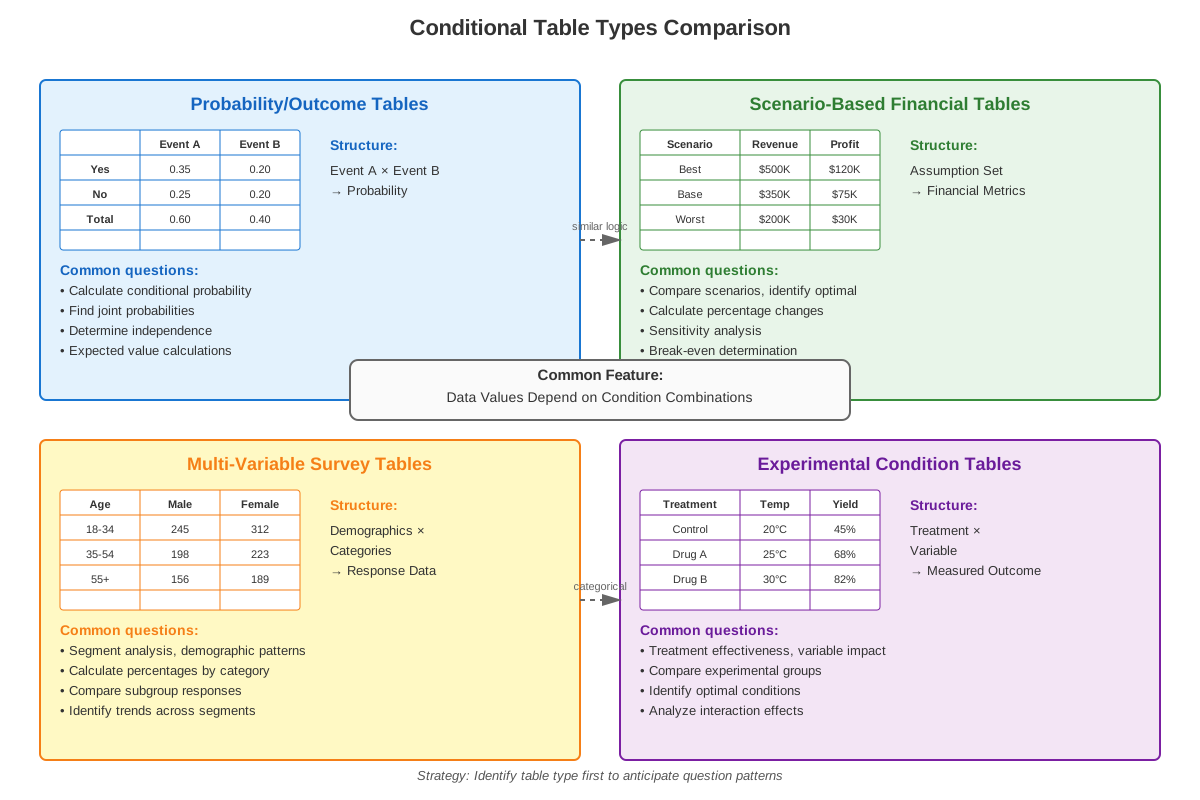
Cross-tabulation tables (contingency tables) display the relationship between two categorical variables, with one variable defining rows and another defining columns. Cell values show counts or percentages for each combination. These frequently appear in survey data or market segmentation scenarios.
Scenario analysis tables present outcomes under different assumed conditions—optimistic, base case, and pessimistic scenarios for business projections, or different strategic alternatives with their associated metrics.
Segmented performance tables break down overall results by multiple dimensions: sales by region and product line, customer satisfaction by service type and customer segment, or financial metrics by division and time period.
Probability distribution tables show probabilities or frequencies for different outcomes under specified conditions, often requiring calculation of conditional probabilities, expected values, or cumulative probabilities.
Calculation Techniques for Conditional Tables
Conditional percentage calculations require identifying the correct denominator based on the condition. "What percentage of X are also Y?" uses X as the denominator, while "What percentage of Y are also X?" uses Y as the denominator—these yield different results unless X and Y have equal totals.
Weighted averages become necessary when combining data across conditions with different frequencies or sample sizes. Simply averaging percentages without considering the underlying populations leads to incorrect conclusions.
Derived metrics often require combining multiple cells. Calculating growth rates, ratios, or differences between conditional scenarios demands careful attention to which cells correspond to which conditions.
Logical Evaluation Framework
When evaluating statements, apply this framework:
- Sufficient information test: Does the table contain all data needed to evaluate the statement, or are critical values missing?
- Condition matching: Do the statement's conditions exactly match available table categories, or is there ambiguity?
- Calculation verification: If calculations are required, can they be performed with certainty, or do assumptions introduce uncertainty?
- Boundary analysis: For inequality statements, check whether the data supports the claimed relationship with appropriate strictness (>, ≥, <, ≤)
Concept Relationships
The core concepts within conditional tables build hierarchically. Understanding table structure forms the foundation, enabling recognition of condition types (mutually exclusive vs. overlapping, dependent vs. independent). This classification determines which calculation techniques apply—simple addition for mutually exclusive conditions, overlap adjustments for non-exclusive conditions, and conditional probability formulas for dependent conditions. The logical evaluation framework synthesizes all previous concepts, applying them to determine statement validity.
Conditional tables connect to prerequisite knowledge by extending basic table reading with logical conditions, applying percentage calculations within conditional contexts, and implementing logical reasoning through data interpretation. The topic bridges to broader Data Insights concepts: Multi-Source Reasoning questions may present conditional tables alongside text and graphics requiring integration; Two-Part Analysis questions may ask for values that satisfy multiple conditions simultaneously; and Graphics Interpretation questions may present conditional relationships visually rather than in tabular form.
The relationship map flows: Basic Table Structure → Condition Identification → Condition Classification (mutually exclusive/overlapping, dependent/independent) → Appropriate Calculation Method Selection → Statement Evaluation → True/False/Indeterminate Determination
High-Yield Facts
- ⭐ Conditional tables always require identifying what conditions apply before locating relevant data—never start by scanning numbers randomly
- ⭐ When calculating percentages from conditional tables, the denominator changes based on the condition specified ("percent of X" vs. "percent of total")
- ⭐ Mutually exclusive categories allow simple addition; overlapping categories require inclusion-exclusion principles to avoid double-counting
- ⭐ "Cannot Be Determined" is correct when the table lacks necessary data, when conditions don't match table categories exactly, or when multiple interpretations are possible
- ⭐ Conditional probability P(A|B) requires dividing the intersection by the condition total: P(A|B) = (A AND B) / B
- Totals in conditional tables may appear in margins (row totals, column totals, grand total) and provide crucial information for percentage calculations
- Sorting functionality in GMAT table analysis questions is often unnecessary—most questions can be solved by identifying the relevant cells directly
- When a statement uses "all," "none," "every," or "no," a single counterexample in the table makes it false
- Statements comparing two conditional scenarios require calculating both values separately before comparing
- Time-based conditional tables (quarterly data, year-over-year comparisons) require careful attention to which time periods are being compared
- Weighted averages differ from simple averages when combining data across conditions with unequal frequencies
Quick check — test yourself on Conditional tables so far.
Try Flashcards →Common Misconceptions
Misconception: All table totals equal the sum of their parts → Correction: Only mutually exclusive categories sum to totals; overlapping categories create double-counting if simply added. Always check whether categories can overlap before assuming additivity.
Misconception: "Cannot Be Determined" means the calculation is too complex → Correction: This answer choice indicates missing information, ambiguous conditions, or insufficient data—not computational difficulty. If all necessary data exists and conditions are clear, a definitive answer is possible regardless of calculation complexity.
Misconception: Percentages in different rows or columns can be directly compared → Correction: Percentages represent proportions of potentially different totals. A higher percentage doesn't necessarily mean a higher absolute value if the denominators differ significantly.
Misconception: Conditional probability P(A|B) equals P(B|A) → Correction: These are generally different values. P(A|B) asks "given B occurred, what's the probability of A?" while P(B|A) reverses the condition. They're only equal in special symmetric cases.
Misconception: If most data supports a statement, it's true → Correction: GMAT statements require universal truth based on the data. If even one data point contradicts an "all" or "every" statement, it's false. Partial support doesn't make a categorical statement true.
Misconception: Sorting the table is necessary to answer questions efficiently → Correction: While sorting is available, most conditional table questions are solved more efficiently by identifying relevant conditions and locating corresponding cells directly, without sorting.
Worked Examples
Example 1: Market Segmentation Conditional Table
Table: A company's customer base is analyzed by Region (North, South, East, West) and Customer Type (New, Returning, Inactive). The table shows customer counts:
| New | Returning | Inactive | Total | |
|---|---|---|---|---|
| North | 120 | 280 | 50 | 450 |
| South | 90 | 180 | 30 | 300 |
| East | 150 | 320 | 80 | 550 |
| West | 140 | 260 | 100 | 500 |
| Total | 500 | 1,040 | 260 | 1,800 |
Statement 1: More than 60% of customers in the North region are Returning customers.
Solution Process:
- Identify conditions: Region = North, Customer Type = Returning
- Locate relevant data: North Returning = 280, North Total = 450
- Calculate conditional percentage: 280/450 = 0.622... = 62.2%
- Evaluate: 62.2% > 60%
- Answer: TRUE
Statement 2: The percentage of Inactive customers is higher in the West than in the East.
Solution Process:
- Identify conditions: Two separate conditional percentages to calculate
- West Inactive percentage: 100/500 = 20%
- East Inactive percentage: 80/550 = 14.5%
- Compare: 20% > 14.5%
- Answer: TRUE
Statement 3: New customers represent more than 30% of the total customer base in regions where Returning customers exceed 300.
Solution Process:
- Identify compound condition: First find regions where Returning > 300
- Check Returning customers: North (280) - No, South (180) - No, East (320) - Yes, West (260) - No
- Only East qualifies: East New customers = 150, East Total = 550
- Calculate: 150/550 = 27.3%
- Evaluate: 27.3% is NOT more than 30%
- Answer: FALSE
Learning Objective Connection: This example demonstrates identifying conditional tables, applying conditional logic to evaluate statements, and calculating conditional percentages with correct denominators.
Example 2: Scenario Analysis Conditional Table
Table: A project's financial outcomes (in millions) under different market conditions and strategic choices:
| Strategy | Strong Market | Moderate Market | Weak Market |
|---|---|---|---|
| Aggressive | $45M | $20M | -$15M |
| Balanced | $30M | $25M | $10M |
| Conservative | $20M | $18M | $15M |
Market probability estimates: Strong (30%), Moderate (50%), Weak (20%)
Statement 1: The Balanced strategy has a higher expected value than the Aggressive strategy.
Solution Process:
- Recognize this requires expected value calculation: E(X) = Σ(probability × outcome)
- Aggressive expected value: 0.30(45) + 0.50(20) + 0.20(-15) = 13.5 + 10 - 3 = $20.5M
- Balanced expected value: 0.30(30) + 0.50(25) + 0.20(10) = 9 + 12.5 + 2 = $23.5M
- Compare: $23.5M > $20.5M
- Answer: TRUE
Statement 2: Under all market conditions, at least one strategy yields a positive return.
Solution Process:
- Check each market condition column for positive values
- Strong Market: All positive (45, 30, 20)
- Moderate Market: All positive (20, 25, 18)
- Weak Market: Two positive (10, 15), one negative (-15)
- In Weak Market, Conservative and Balanced are positive
- Every condition has at least one positive outcome
- Answer: TRUE
Statement 3: The difference between best and worst outcomes is smallest for the Conservative strategy.
Solution Process:
- Calculate range for each strategy
- Aggressive: 45 - (-15) = 60
- Balanced: 30 - 10 = 20
- Conservative: 20 - 15 = 5
- Conservative has the smallest range (5 < 20 < 60)
- Answer: TRUE
Learning Objective Connection: This example shows applying conditional tables to complex scenarios, performing calculations across multiple conditions, and evaluating comparative statements.
Exam Strategy
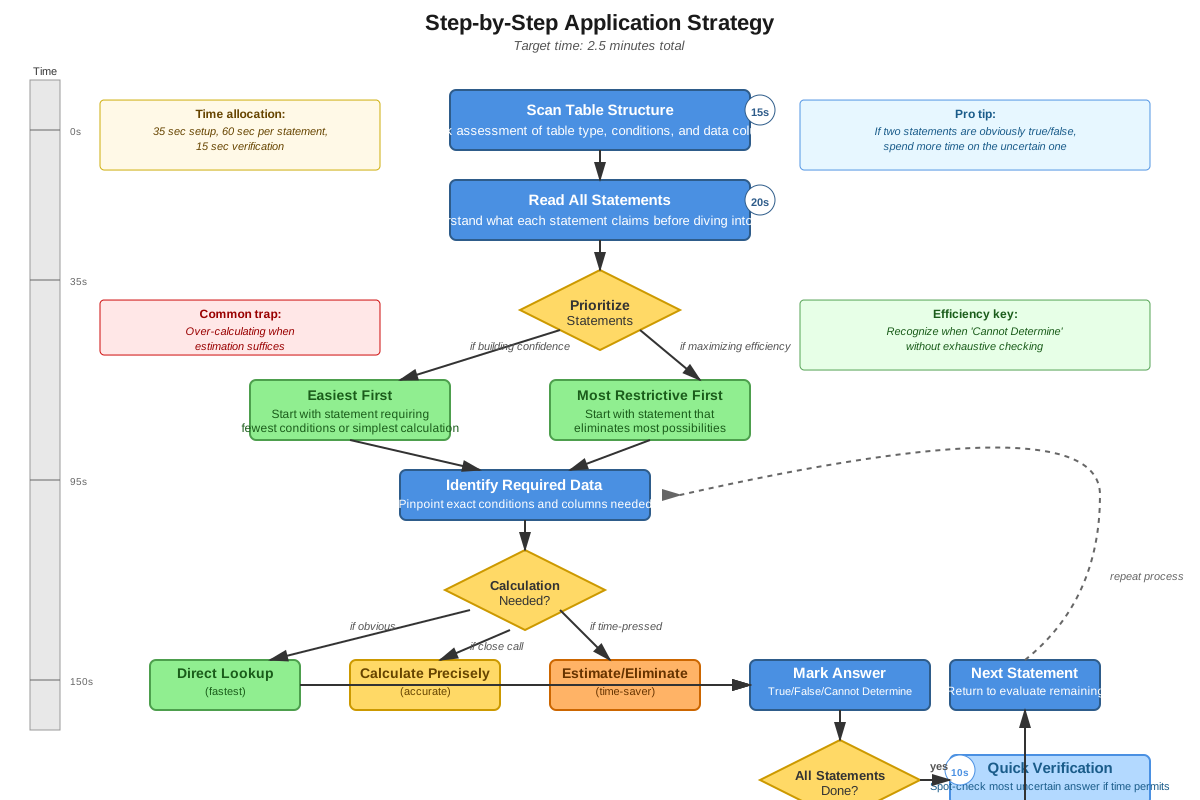
Initial approach: Spend 15-20 seconds scanning the table structure before reading statements. Identify what variables define rows and columns, whether categories appear mutually exclusive, and where totals are located. This orientation prevents misreading conditions later.
Trigger words to watch for:
- "Given that" or "among those" signals conditional probability or conditional percentage calculations
- "All," "every," "none," "no" require checking every relevant data point—one exception makes the statement false
- "At least," "more than," "exceeds" indicate inequality comparisons requiring precise calculation
- "Cannot be determined from the information given" appears as an option when data is insufficient
Statement evaluation order: Start with statements that appear simplest—often those requiring single cell lookups or straightforward comparisons. Save complex multi-step calculations for last. However, if one statement's calculation provides information useful for another, solve strategically rather than sequentially.
Process of elimination: If a statement requires data not present in the table (external information, undefined categories, or ambiguous conditions), immediately select "Cannot Be Determined." If a calculation yields a definitive numerical result, eliminate "Cannot Be Determined" and focus on True/False based on the comparison.
Time allocation: Budget approximately 2-2.5 minutes per Table Analysis question. Spend 20 seconds on initial table review, 30-45 seconds per statement evaluation, and 15 seconds for final verification. If a statement requires more than 60 seconds, flag it and return after completing others.
Verification technique: For True answers, confirm the calculation supports the statement's direction and magnitude. For False answers, verify that the data definitively contradicts the claim, not merely fails to support it (which would be "Cannot Be Determined"). For "Cannot Be Determined," confirm that necessary information is genuinely absent, not merely requiring additional calculation steps.
Common traps: The GMAT often presents statements where intuitive answers are wrong. A category with the highest percentage might not have the highest absolute count. A strategy that performs best in one scenario might have the worst expected value. Always calculate rather than estimate when precision matters.
Memory Techniques
DICE mnemonic for conditional table evaluation:
- Determine the conditions specified in the statement
- Identify the relevant table cells matching those conditions
- Calculate any required values (percentages, differences, ratios)
- Evaluate whether the statement is supported, contradicted, or indeterminate
"Denominator Detective" for percentage calculations: Always ask "Percentage of WHAT?" The answer identifies the denominator. "Percentage of North customers" uses North total; "percentage of Returning customers" uses Returning total; "percentage of all customers" uses grand total.
Venn Diagram Visualization: For overlapping conditions, mentally visualize a Venn diagram. If categories can overlap, the union doesn't equal the sum of parts. If mutually exclusive, visualize separate circles that don't touch—these sum correctly.
"SAME" acronym for comparing conditional probabilities:
- Specify both conditions clearly
- Apply the formula to each separately
- Match denominators to conditions
- Evaluate the comparison only after calculating both
The "Total Check": Before finalizing any answer, verify whether your calculation used the appropriate total. Row total? Column total? Grand total? Conditional subset total? This single check prevents the majority of conditional table errors.
Summary
Conditional tables present data where values depend on specific conditions being met, requiring test-takers to identify conditions, locate corresponding data, perform conditional calculations, and evaluate statement validity. These tables appear frequently in GMAT Data Insights, testing the ability to navigate complex scenarios where outcomes vary based on multiple factors. Success requires distinguishing between mutually exclusive and overlapping conditions, calculating conditional percentages with correct denominators, recognizing when data is insufficient for definitive conclusions, and applying logical reasoning to evaluate whether statements are universally true, definitively false, or indeterminate. The key to mastering conditional tables lies in systematic condition identification, careful attention to what each calculation's denominator should be, and rigorous verification that conclusions are supported by the data rather than assumptions or intuition.
Key Takeaways
- Conditional tables encode logical relationships where cell values depend on specific condition combinations being satisfied
- Always identify the exact conditions specified in a statement before locating data—the denominator for percentage calculations changes based on the condition
- Mutually exclusive categories sum to totals; overlapping categories require inclusion-exclusion principles to avoid double-counting
- "Cannot Be Determined" indicates missing information or ambiguous conditions, not computational complexity
- Conditional probability P(A|B) divides the intersection by the condition total: (A AND B) / B, and generally differs from P(B|A)
- Statements with universal quantifiers ("all," "every," "none") are false if even one data point contradicts them
- Expected value calculations for scenario analysis require multiplying each outcome by its probability and summing across all conditions
Related Topics
Multi-Source Reasoning: Builds on conditional table skills by requiring integration of conditional data from tables with information from text passages and graphics, testing the ability to synthesize conditions across multiple sources.
Two-Part Analysis: Extends conditional thinking by presenting scenarios where two values must simultaneously satisfy different conditions, often requiring evaluation of conditional relationships without explicit tabular presentation.
Graphics Interpretation: Presents conditional relationships visually through segmented bar charts, stacked area graphs, or scatter plots with categorical groupings, requiring translation between visual and logical conditional representations.
Probability and Statistics: Deepens understanding of conditional probability, independence, and expected value calculations that frequently appear in conditional table contexts, providing the mathematical foundation for advanced conditional reasoning.
Mastering conditional tables provides the analytical framework for these advanced topics, as the core skill—evaluating outcomes under specified conditions—transfers across all Data Insights question types.
Practice CTA
Now that you understand the structure, logic, and evaluation techniques for conditional tables, reinforce your mastery through deliberate practice. Attempt the practice questions associated with this topic, focusing on applying the DICE framework systematically to each statement. Use the flashcards to internalize high-yield facts and common calculation patterns until condition identification and denominator selection become automatic. Remember: conditional table mastery isn't about memorizing specific tables—it's about developing a systematic approach to any conditional data scenario you encounter. Your ability to navigate these tables efficiently under time pressure will directly impact your Data Insights score. Start practicing now to transform understanding into performance.
Sign up free to keep reading
Create a free AnvayaPrep account to finish this GMAT guide on Conditional tables — plus flashcards and practice questions.