Overview
Probability is one of the most frequently tested topics in the GMAT Quantitative Reasoning section, appearing in approximately 10-15% of all quant questions. This mathematical concept measures the likelihood of an event occurring, expressed as a ratio between 0 (impossible) and 1 (certain), or equivalently as a percentage between 0% and 100%. Understanding probability is essential not only for direct probability questions but also for data sufficiency problems, combinatorics questions, and integrated reasoning scenarios that require evaluating uncertain outcomes.
The GMAT tests probability through various question formats: calculating simple probabilities, determining compound probabilities involving multiple events, understanding conditional probability, and applying probability concepts to real-world business scenarios. Questions often combine probability with other quantitative concepts such as ratios, fractions, percentages, and combinatorics, making it a highly integrative topic. Mastering GMAT probability requires both conceptual understanding and the ability to quickly identify which probability rules apply to different scenarios.
Within the broader Quantitative Reasoning framework, probability connects directly to statistics (particularly data interpretation), combinatorics (counting methods), and set theory (overlapping groups). The topic builds upon fundamental arithmetic skills including fractions, ratios, and percentages, while also requiring logical reasoning to break down complex scenarios into manageable probability calculations. Strong probability skills enhance performance across multiple GMAT question types and demonstrate the analytical thinking that business schools value.
Learning Objectives
- [ ] Identify Probability scenarios and distinguish them from other quantitative problem types
- [ ] Explain Probability concepts including basic probability, compound probability, and conditional probability
- [ ] Apply Probability to GMAT questions using appropriate formulas and problem-solving strategies
- [ ] Calculate probabilities for independent and dependent events accurately
- [ ] Determine complementary probabilities and use them to simplify complex calculations
- [ ] Analyze "at least one" probability scenarios using efficient solution methods
- [ ] Evaluate conditional probability situations and apply Bayes' theorem concepts when appropriate
Prerequisites
- Basic fractions and fraction operations: Probability values are expressed as fractions, requiring comfort with multiplication, division, and simplification of fractions
- Ratios and proportions: Probability represents the ratio of favorable outcomes to total possible outcomes
- Percentages and decimal conversions: Probability can be expressed in multiple formats, requiring fluency in converting between fractions, decimals, and percentages
- Basic counting principles: Understanding how to count total possible outcomes and favorable outcomes is fundamental to probability calculations
- Set theory basics: Concepts like union, intersection, and complement relate directly to probability operations
Why This Topic Matters
Probability has profound real-world applications in business decision-making, risk assessment, quality control, financial modeling, and strategic planning. Business professionals regularly use probability to evaluate investment risks, forecast market outcomes, assess project success likelihood, and make data-driven decisions under uncertainty. Understanding probability enables managers to quantify uncertainty, compare alternatives objectively, and communicate risk effectively to stakeholders.
On the GMAT, probability questions appear with high frequency and typically carry medium to high difficulty ratings. Approximately 3-5 questions per exam directly test probability concepts, while additional questions integrate probability with other topics. The GMAT favors probability questions because they efficiently assess multiple competencies simultaneously: mathematical reasoning, logical thinking, attention to detail, and the ability to break complex problems into simpler components. Questions often appear as problem-solving items requiring direct calculation or as data sufficiency questions testing whether students understand what information is necessary to determine a probability.
Common GMAT probability scenarios include: selecting items from groups (with or without replacement), determining outcomes from multiple independent events (like coin flips or dice rolls), calculating conditional probabilities based on given information, finding "at least one" probabilities in repeated trials, and analyzing probability in business contexts such as defect rates, customer behavior, or project outcomes. The exam particularly favors questions that combine probability with combinatorics, requiring students to first count possibilities before calculating probabilities.
Core Concepts
Basic Probability Definition and Formula
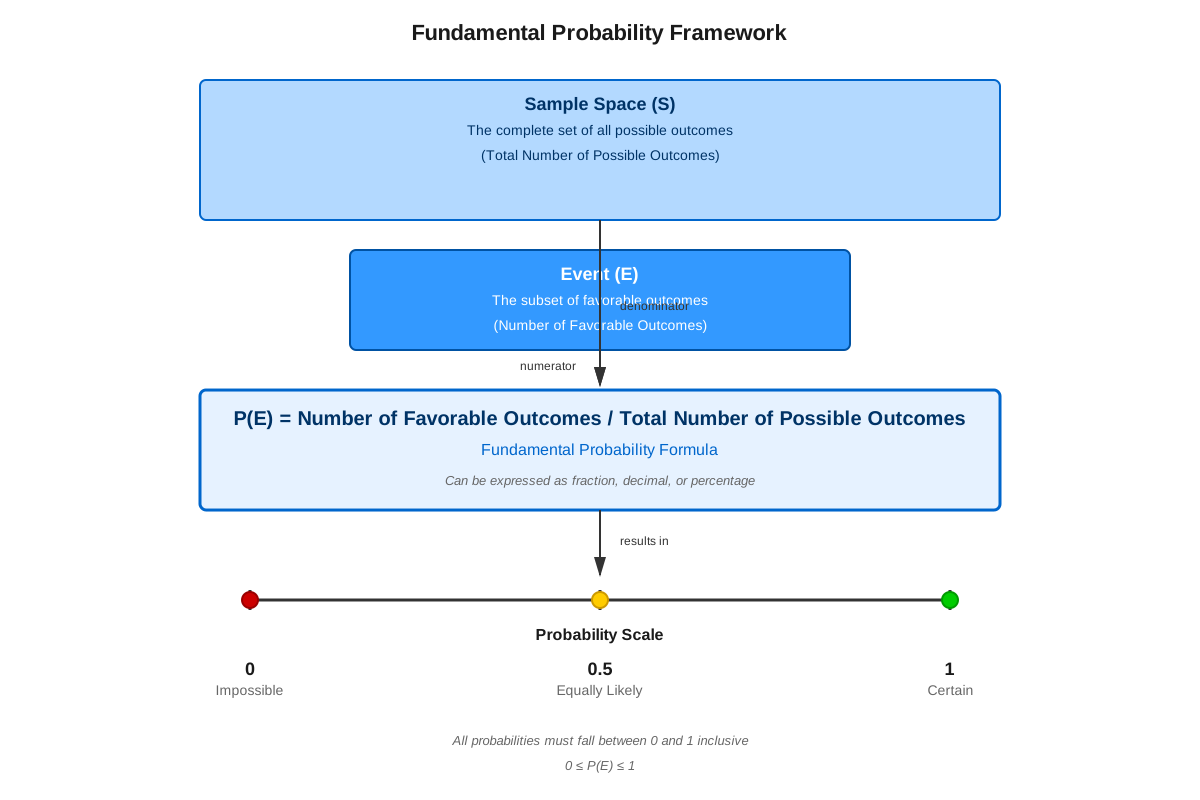
Probability measures the likelihood of a specific event occurring among all possible outcomes. The fundamental probability formula is:
P(Event) = Number of Favorable Outcomes / Total Number of Possible OutcomesThis ratio always produces a value between 0 and 1, inclusive. A probability of 0 means the event is impossible, while a probability of 1 means the event is certain. Most GMAT questions involve probabilities between these extremes. For example, when rolling a standard six-sided die, the probability of rolling a 4 is 1/6, since there is one favorable outcome (rolling a 4) among six total possible outcomes (rolling 1, 2, 3, 4, 5, or 6).
Independent vs. Dependent Events
Understanding the distinction between independent and dependent events is crucial for GMAT probability questions.
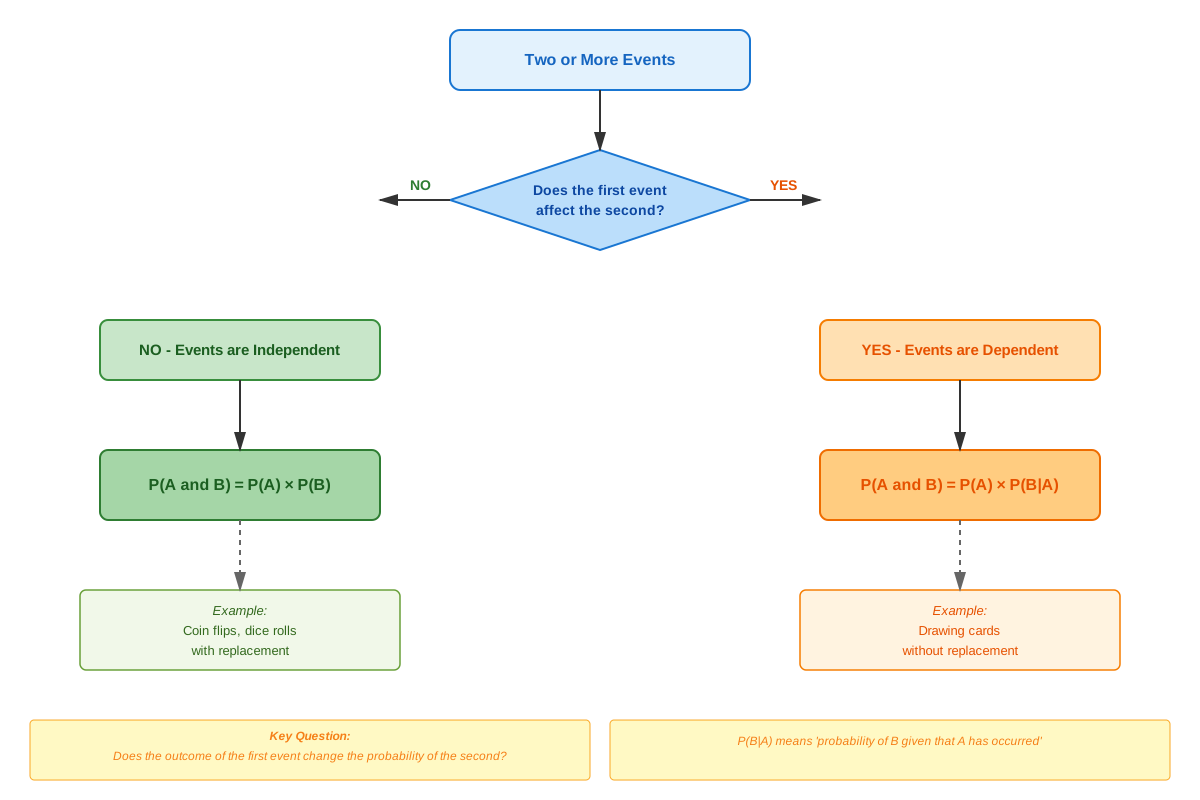
Independent events are events where the outcome of one event does not affect the probability of the other event. When calculating the probability of multiple independent events all occurring, multiply their individual probabilities:
P(A and B) = P(A) × P(B)For example, when flipping a coin twice, the probability of getting heads on the first flip is 1/2, and this doesn't change the probability of getting heads on the second flip (also 1/2). The probability of getting heads both times is 1/2 × 1/2 = 1/4.
Dependent events are events where the outcome of one event affects the probability of subsequent events. This commonly occurs in "without replacement" scenarios. When calculating probabilities for dependent events, adjust the probability for each subsequent event based on previous outcomes.
For example, if a bag contains 3 red balls and 2 blue balls, and you draw two balls without replacement:
- Probability of drawing a red ball first: 3/5
- Probability of drawing a red ball second (given the first was red): 2/4 = 1/2
- Probability of both being red: 3/5 × 1/2 = 3/10
Complementary Probability
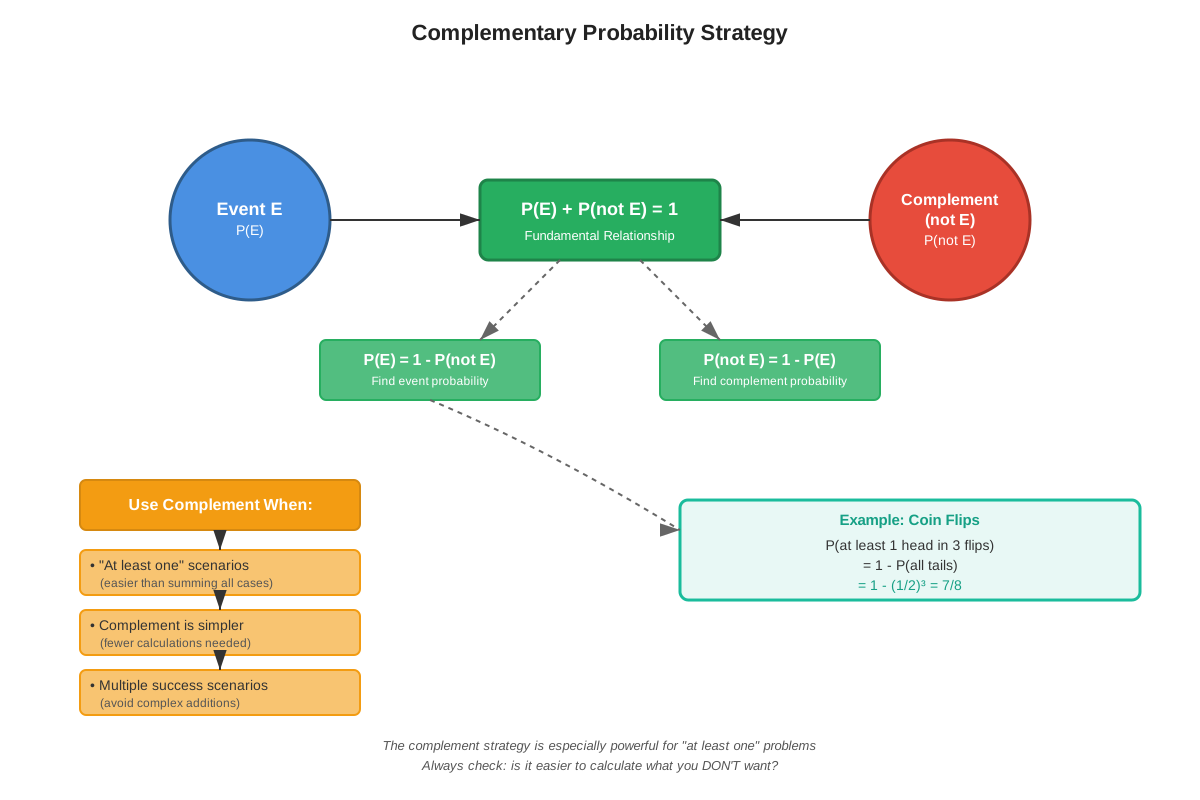
The complement of an event A, denoted as "not A" or A', represents all outcomes where event A does not occur. A fundamental rule states:
P(A) + P(not A) = 1Therefore:
P(not A) = 1 - P(A)This concept is particularly powerful for "at least one" problems. Instead of calculating all the ways at least one event can occur (which might involve many scenarios), calculate the probability that the event never occurs, then subtract from 1.
For example, to find the probability of getting at least one head in three coin flips:
- P(at least one head) = 1 - P(no heads)
- P(no heads) = P(all tails) = 1/2 × 1/2 × 1/2 = 1/8
- P(at least one head) = 1 - 1/8 = 7/8
Compound Probability: "AND" vs. "OR"
GMAT probability questions often involve compound events using "and" or "or" logic.
"AND" probability (intersection): When finding the probability that event A AND event B both occur:
- For independent events: P(A and B) = P(A) × P(B)
- For dependent events: P(A and B) = P(A) × P(B|A), where P(B|A) means "probability of B given A occurred"
"OR" probability (union): When finding the probability that event A OR event B occurs (or both):
P(A or B) = P(A) + P(B) - P(A and B)The subtraction of P(A and B) prevents double-counting outcomes where both events occur. For mutually exclusive events (events that cannot both occur), P(A and B) = 0, so the formula simplifies to P(A or B) = P(A) + P(B).
Conditional Probability
Conditional probability measures the probability of an event occurring given that another event has already occurred. The notation P(B|A) reads as "the probability of B given A."
P(B|A) = P(A and B) / P(A)This formula can be rearranged to find joint probabilities:
P(A and B) = P(A) × P(B|A)GMAT questions often present conditional probability scenarios through word problems. For example: "If a student is selected from those who passed the exam, what is the probability the student studied for more than 5 hours?" This requires identifying the conditional relationship and applying the appropriate formula.
Probability with Replacement vs. Without Replacement
This distinction significantly affects probability calculations in selection problems.
With replacement: After selecting an item, it is returned to the pool before the next selection. Each selection is independent, and probabilities remain constant across trials.
Without replacement: After selecting an item, it is not returned. Each selection is dependent on previous selections, and probabilities change with each draw.
| Scenario | First Draw | Second Draw | Events |
|---|---|---|---|
| With Replacement | P(A) = favorable/total | P(A) = favorable/total | Independent |
| Without Replacement | P(A) = favorable/total | P(A) = (favorable-1)/(total-1) | Dependent |
Probability in Combinatorics Problems
Many GMAT probability questions require first using combinatorics (combinations or permutations) to count outcomes, then calculating probability. The general approach:
- Determine total possible outcomes using appropriate counting methods
- Determine favorable outcomes using counting methods
- Calculate probability as favorable/total
For example: "What is the probability that a committee of 3 people selected from 5 men and 4 women contains exactly 2 men?"
- Total ways to select 3 from 9 people: C(9,3) = 84
- Favorable ways (2 men from 5, 1 woman from 4): C(5,2) × C(4,1) = 10 × 4 = 40
- Probability: 40/84 = 10/21
Concept Relationships
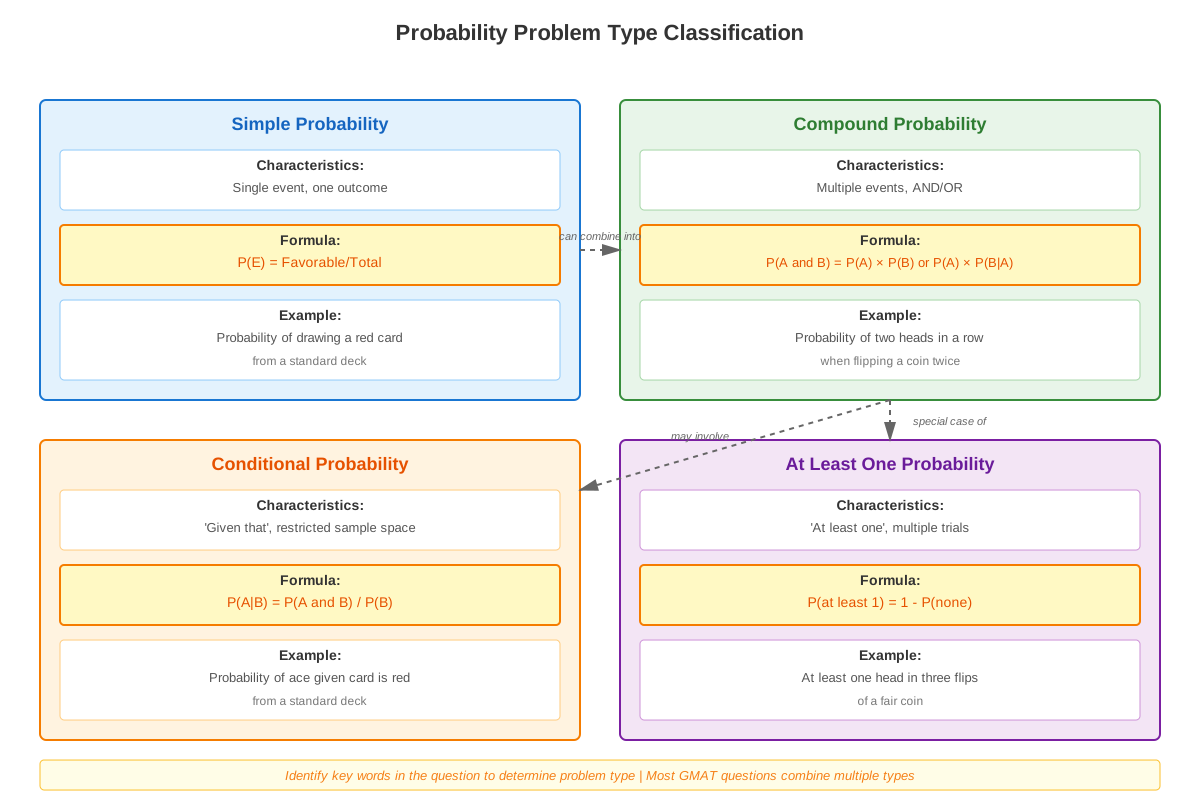
The core probability concepts form an interconnected framework where basic probability serves as the foundation for all other concepts. Basic probability (favorable outcomes/total outcomes) → leads to → understanding of independent and dependent events, which determines whether to multiply probabilities directly or adjust for changing conditions.
Independent events → connects to → compound probability with "AND", where multiplication of individual probabilities applies. Meanwhile, complementary probability → provides an alternative approach to → "at least one" problems, which would otherwise require calculating multiple compound probabilities and adding them together.
Conditional probability → builds upon → dependent events, formalizing how to calculate probabilities when prior information affects outcomes. This concept → relates back to → compound probability, as P(A and B) = P(A) × P(B|A) provides an alternative formulation of joint probability.
The distinction between with replacement and without replacement → determines whether → events are independent or dependent, which then dictates the calculation method. Finally, probability with combinatorics → integrates → counting principles with probability formulas, requiring students to first determine the sample space before calculating probabilities.
These concepts also connect to prerequisite knowledge: fractions enable probability expression and calculation, ratios provide the conceptual foundation for probability as a comparison, and percentages offer an alternative representation. The topic also connects forward to statistics, where probability distributions and expected values build on these foundational concepts.
Quick check — test yourself on Probability so far.
Try Flashcards →High-Yield Facts
⭐ The fundamental probability formula is P(Event) = Favorable Outcomes / Total Possible Outcomes, always yielding a value between 0 and 1
⭐ For independent events occurring together, multiply their individual probabilities: P(A and B) = P(A) × P(B)
⭐ The complement rule states P(A) + P(not A) = 1, making it efficient to calculate "at least one" probabilities as 1 - P(none)
⭐ For "OR" probabilities, use P(A or B) = P(A) + P(B) - P(A and B) to avoid double-counting overlapping outcomes
⭐ Without replacement scenarios create dependent events where probabilities change after each selection
- Conditional probability P(B|A) represents the probability of B occurring given that A has already occurred
- With replacement scenarios maintain constant probabilities across multiple selections, creating independent events
- Mutually exclusive events cannot occur simultaneously, so P(A and B) = 0 for such events
- The sum of all probabilities in a complete probability distribution equals 1
- When combining probability with combinatorics, calculate total outcomes and favorable outcomes separately before forming the ratio
- Probability can be expressed as a fraction, decimal, or percentage, and GMAT questions may require conversion between formats
- For multiple independent trials, the probability of a specific sequence equals the product of individual probabilities for each position
Common Misconceptions
Misconception: When calculating P(A or B), simply add P(A) + P(B) without considering overlap → Correction: Must subtract P(A and B) to avoid double-counting outcomes where both events occur. Only for mutually exclusive events does P(A or B) = P(A) + P(B).
Misconception: Independent events mean the events are unrelated or have nothing to do with each other → Correction: Independence specifically means the outcome of one event does not affect the probability of the other event. Events can be related contextually but still be statistically independent (like consecutive coin flips).
Misconception: In "without replacement" problems, the total number of outcomes stays the same for each draw → Correction: Both the numerator (favorable outcomes) and denominator (total outcomes) typically decrease after each selection without replacement, creating dependent events with changing probabilities.
Misconception: P(A|B) equals P(B|A) → Correction: Conditional probabilities are not symmetric. P(A|B) asks "what's the probability of A given B occurred?" while P(B|A) asks the reverse. These are generally different values unless special conditions exist.
Misconception: "At least one" problems require calculating and adding probabilities for exactly one, exactly two, exactly three, etc. → Correction: The complement approach is far more efficient: P(at least one) = 1 - P(none). This single calculation replaces multiple complex calculations.
Misconception: Probability of 1/2 means the event will occur exactly half the time in any small sample → Correction: Probability describes long-run frequency, not guaranteed short-term results. With a fair coin, getting 5 heads in 5 flips is unlikely but possible; probability describes likelihood, not certainty.
Misconception: When an event hasn't occurred recently, it's "due" to happen (gambler's fallacy) → Correction: For independent events, past outcomes don't affect future probabilities. A coin that has shown heads five times in a row still has exactly 1/2 probability of heads on the next flip.
Worked Examples
Example 1: Compound Probability with Dependent Events
Problem: A box contains 5 red marbles, 3 blue marbles, and 2 green marbles. If two marbles are drawn randomly without replacement, what is the probability that both marbles are red?
Solution:
Step 1: Identify the scenario type. This is a "without replacement" problem, creating dependent events. We need both events to occur (first marble red AND second marble red).
Step 2: Calculate the probability of the first event.
- Total marbles initially: 5 + 3 + 2 = 10
- Red marbles: 5
- P(first marble is red) = 5/10 = 1/2
Step 3: Calculate the probability of the second event, given the first occurred.
- After removing one red marble: 4 red marbles remain
- Total marbles remaining: 9
- P(second marble is red | first was red) = 4/9
Step 4: Apply the multiplication rule for dependent events.
- P(both red) = P(first red) × P(second red | first red)
- P(both red) = 1/2 × 4/9 = 4/18 = 2/9
Answer: 2/9
This problem demonstrates the application of dependent event probability, requiring adjustment of both numerator and denominator after the first selection. This connects to Learning Objective: Apply Probability to GMAT questions using appropriate formulas.
Example 2: Complementary Probability for "At Least One" Scenario
Problem: A quality control test has a 95% accuracy rate (correctly identifies defective items 95% of the time). If three items are tested independently, what is the probability that at least one defective item is correctly identified?
Solution:
Step 1: Recognize this as an "at least one" problem, ideal for the complement approach.
- "At least one" means one, two, or all three are correctly identified
- Calculating each scenario separately would be tedious
Step 2: Identify the complement event.
- Complement of "at least one correct identification" is "zero correct identifications"
- This means all three tests fail to identify the defect
Step 3: Calculate the probability of the complement.
- P(single test fails) = 1 - 0.95 = 0.05
- Since tests are independent: P(all three fail) = 0.05 × 0.05 × 0.05 = 0.000125
Step 4: Apply the complement rule.
- P(at least one correct) = 1 - P(none correct)
- P(at least one correct) = 1 - 0.000125 = 0.999875
Step 5: Convert to percentage if needed.
- 0.999875 = 99.9875%
Answer: 0.999875 or approximately 99.99%
This problem illustrates the power of complementary probability for "at least one" scenarios, avoiding the need to calculate P(exactly 1) + P(exactly 2) + P(exactly 3). This addresses Learning Objective: Determine complementary probabilities and use them to simplify complex calculations.
Exam Strategy
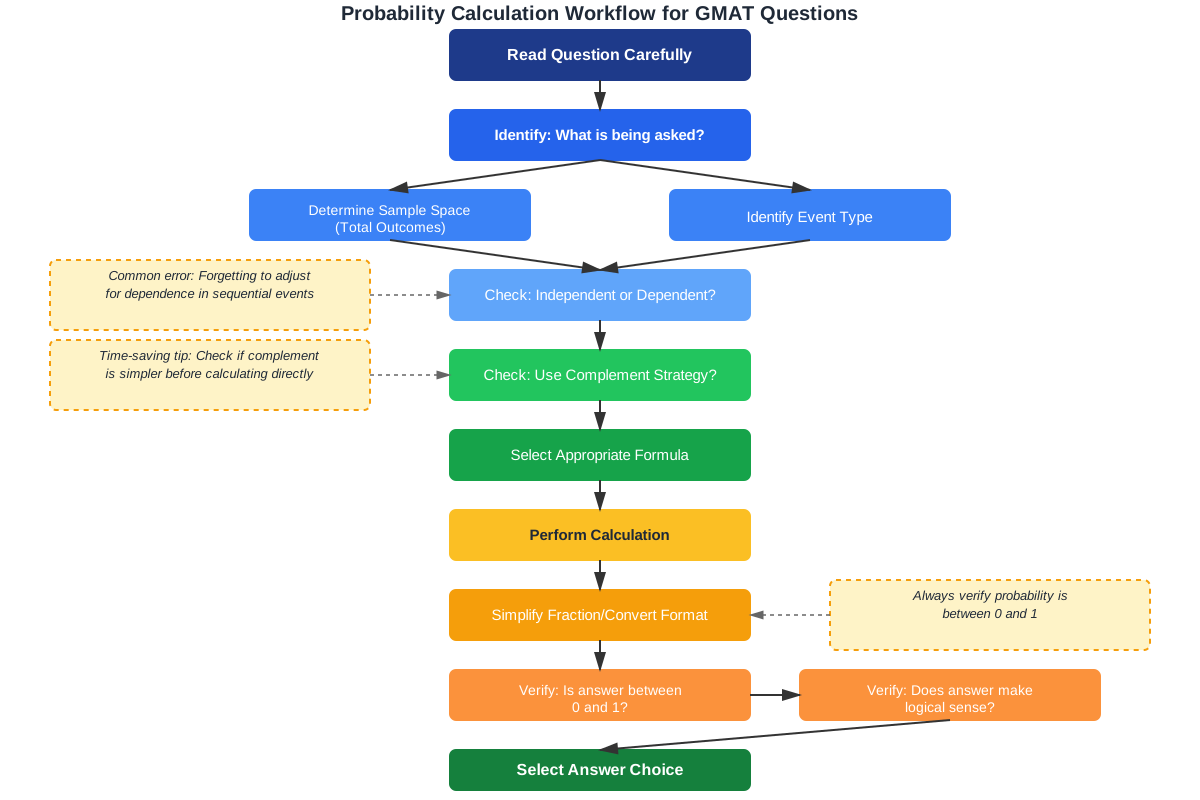
When approaching GMAT probability questions, begin by carefully reading the problem to identify key characteristics: Are events independent or dependent? Is this a "with replacement" or "without replacement" scenario? Does the question ask for "and" (intersection) or "or" (union) probability? Look for trigger phrases like "at least one" (suggesting complement approach), "given that" (indicating conditional probability), or "without replacement" (signaling dependent events).
Trigger words and phrases to watch for:
- "At least one" → Use complement: 1 - P(none)
- "Without replacement" → Dependent events, adjust probabilities
- "With replacement" → Independent events, constant probabilities
- "Given that" or "if" → Conditional probability
- "And" → Multiply probabilities (with appropriate adjustments)
- "Or" → Add probabilities, subtract overlap
- "Exactly" → Calculate specific scenario, not complement
Process-of-elimination strategies:
- Eliminate answers outside the 0-1 range (or 0%-100% for percentages)
- Check if the answer should be less than or greater than individual event probabilities
- For "and" problems with probabilities less than 1, the result must be smaller than either individual probability
- For "or" problems with non-overlapping events, the result must be larger than either individual probability but not exceed 1
- Verify that "at least one" probabilities should be relatively high (close to 1) when individual event probabilities are moderate to high
Time allocation advice: Spend 15-20 seconds identifying the problem type and determining which probability rules apply before beginning calculations. This upfront investment prevents mid-problem corrections. For complex problems, sketch a quick probability tree or list outcomes systematically. If a problem requires extensive combinatorics calculations, ensure you're using the most efficient counting method. Budget approximately 2 minutes for standard probability questions, up to 2.5 minutes for complex problems combining probability with combinatorics.
Common strategic approaches:
- For selection problems, always clarify whether order matters (permutation) or doesn't matter (combination)
- When probabilities involve fractions, keep them as fractions throughout calculations rather than converting to decimals, which maintains precision
- Double-check whether you're calculating P(A and B) or P(A or B), as these are frequently confused
- For data sufficiency questions, determine what information would allow you to calculate total outcomes and favorable outcomes
Memory Techniques
Mnemonic for probability rules - "MACS":
- Multiply for "and" (intersection)
- Add for "or" (union)
- Complement for "at least one"
- Subtract overlap when adding "or" probabilities
Visualization for dependent vs. independent events: Picture a bag of marbles. If you reach in, pull one out, look at it, and put it back (with replacement), the bag looks the same for the next draw—independent. If you keep the marble out (without replacement), the bag has changed—dependent.
Acronym for conditional probability - "GIVEN":
- Given information changes the sample space
- Identify what's already occurred
- Verify the new total outcomes
- Evaluate probability within the restricted space
- Numerator and denominator both adjust
Memory aid for complement rule: "The whole pie equals 1" - visualize a complete pie chart representing all possible outcomes (probability = 1). Any slice you remove (event A) leaves the remaining pie (not A), and together they must equal the whole pie.
Rhyme for "at least one": "At least one is easily done: one minus none gets it done!" This reminds students to calculate 1 - P(none) rather than adding multiple scenarios.
Summary
Probability is a foundational GMAT Quantitative Reasoning topic that measures the likelihood of events occurring, expressed as a ratio between 0 and 1. Mastery requires understanding the fundamental probability formula (favorable outcomes divided by total outcomes), distinguishing between independent and dependent events, and knowing when to multiply probabilities (for "and" scenarios) versus when to add them (for "or" scenarios, remembering to subtract overlap). The complement rule provides an efficient method for "at least one" problems by calculating 1 minus the probability of none. Conditional probability addresses situations where given information restricts the sample space, while the distinction between with-replacement and without-replacement scenarios determines whether events are independent or dependent. GMAT probability questions frequently integrate combinatorics, requiring students to count total and favorable outcomes before calculating probabilities. Success on probability questions demands careful problem analysis to identify the scenario type, systematic application of appropriate formulas, and strategic use of complement approaches when they simplify calculations.
Key Takeaways
- Probability always falls between 0 (impossible) and 1 (certain), calculated as favorable outcomes divided by total possible outcomes
- Independent events multiply: P(A and B) = P(A) × P(B); dependent events require adjusted probabilities for subsequent events
- The complement rule P(A) = 1 - P(not A) is essential for efficiently solving "at least one" probability problems
- "OR" probabilities require adding individual probabilities and subtracting the overlap: P(A or B) = P(A) + P(B) - P(A and B)
- Without replacement creates dependent events where both numerator and denominator change after each selection
- Conditional probability P(B|A) represents probability within a restricted sample space where event A has already occurred
- Many GMAT probability questions combine probability with combinatorics, requiring counting methods before probability calculations
Related Topics
Combinatorics and Counting Principles: Directly supports probability calculations by providing methods to count total outcomes and favorable outcomes. Mastering probability enables more sophisticated analysis of selection and arrangement problems.
Statistics and Data Interpretation: Builds on probability concepts to analyze data distributions, expected values, and statistical inference. Strong probability skills are prerequisite for understanding probability distributions and statistical measures.
Ratios, Rates, and Proportions: Shares the fundamental concept of comparing parts to wholes. Probability expertise enhances understanding of how ratios represent relationships and how proportional reasoning applies across contexts.
Set Theory and Venn Diagrams: Provides visual and conceptual tools for understanding probability unions, intersections, and complements. Probability mastery deepens comprehension of set operations and overlapping groups.
Expected Value and Decision Analysis: Extends probability concepts to weighted outcomes and risk assessment. Probability serves as the foundation for calculating expected values in business scenarios.
Practice CTA
Now that you've mastered the core concepts of probability, it's time to solidify your understanding through active practice. Attempt the practice questions associated with this topic, focusing on identifying problem types quickly and applying the appropriate probability rules systematically. Use the flashcards to reinforce key formulas, definitions, and strategic approaches until they become automatic. Remember that probability questions reward careful analysis and methodical problem-solving—skills that improve dramatically with deliberate practice. Each problem you solve strengthens your pattern recognition and builds the confidence you need to excel on test day. Your investment in mastering probability will pay dividends across multiple GMAT question types!
Sign up free to keep reading
Create a free AnvayaPrep account to finish this GMAT guide on Probability — plus flashcards and practice questions.