Overview
Case analysis is a critical component of the GMAT Data Insights section, specifically within Two-Part Analysis questions. This question type presents students with a complex business scenario, scientific study, or analytical problem that requires evaluating multiple variables simultaneously and selecting two interdependent answers from a single table of options. Unlike traditional multiple-choice questions where each answer stands alone, GMAT case analysis demands that test-takers understand how different elements of a problem interact and identify solutions that satisfy multiple constraints at once.
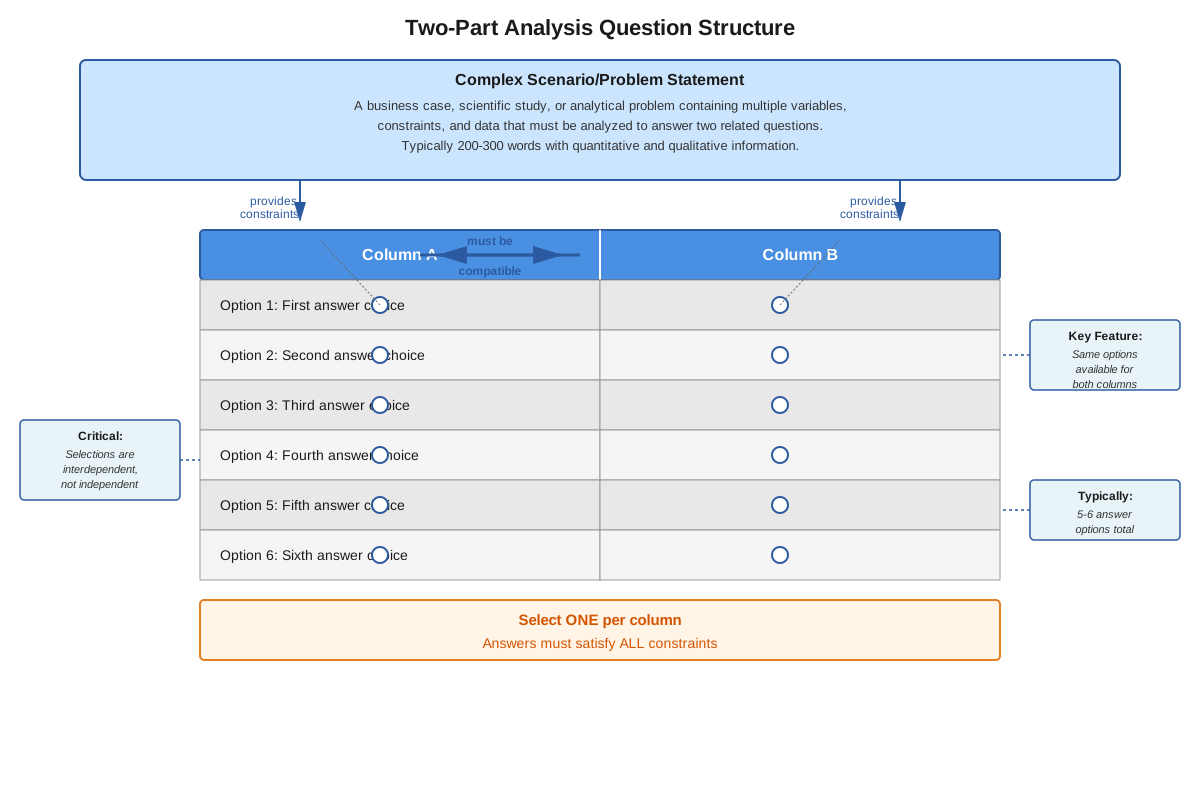
The importance of case analysis on the GMAT cannot be overstated. These questions assess a candidate's ability to synthesize information, evaluate trade-offs, and make decisions under constraints—skills that directly mirror the analytical demands of graduate business education and professional management roles. Case analysis questions typically present 5-6 answer options in rows, with two columns representing different aspects of the problem (such as "Product A" and "Product B," or "Statement 1" and "Statement 2"). Students must select one option for each column, and these selections often must work together to satisfy the conditions presented in the scenario.
Within the broader Data Insights framework, case analysis serves as a bridge between pure quantitative reasoning and integrated reasoning skills. It requires students to move beyond simple calculation or data interpretation and instead engage in multi-dimensional problem-solving. This topic connects closely with other Data Insights concepts such as table analysis, graphics interpretation, and multi-source reasoning, as all require synthesizing information from complex presentations. However, case analysis is unique in its emphasis on finding complementary solutions that address different facets of a single problem simultaneously.
Learning Objectives
- [ ] Identify Case analysis questions in the GMAT Data Insights section
- [ ] Explain the structure and requirements of Case analysis problems
- [ ] Apply Case analysis strategies to GMAT questions efficiently and accurately
- [ ] Evaluate multiple constraints simultaneously to determine valid answer combinations
- [ ] Distinguish between independent and interdependent answer choices in two-part formats
- [ ] Synthesize quantitative and qualitative information to solve complex business scenarios
- [ ] Prioritize which column to solve first based on constraint analysis
Prerequisites
- Basic algebra and equation solving: Essential for manipulating variables and solving for unknowns when case analysis involves quantitative constraints
- Reading comprehension skills: Necessary to extract relevant information from complex scenario descriptions and identify key constraints
- Logical reasoning fundamentals: Required to evaluate conditional statements and understand how different problem elements relate to one another
- Basic business terminology: Helpful for quickly understanding common case analysis contexts involving profit, cost, revenue, and operational decisions
- Table interpretation: Needed to navigate the answer format where options are presented in rows with two selectable columns
Why This Topic Matters
Case analysis questions represent a significant portion of the Data Insights section, typically comprising 15-20% of the questions students encounter. These questions are considered high-difficulty items that effectively discriminate between mid-range and high-scoring test-takers. Business schools value the skills assessed by case analysis because they directly parallel the case method teaching approach used in MBA programs, where students must analyze complex business situations and recommend courses of action.
In real-world applications, case analysis mirrors the decision-making processes that managers face daily: allocating limited resources between competing priorities, selecting complementary strategies that work together, or identifying solutions that satisfy multiple stakeholder requirements simultaneously. The ability to hold multiple constraints in mind while evaluating options is fundamental to strategic planning, operations management, and financial analysis.
On the GMAT, case analysis appears in several common formats: optimization problems where students must maximize or minimize an objective while satisfying constraints; scenario evaluation where two different statements or conclusions must be assessed; paired decision problems where choices for two related variables must be determined; and constraint satisfaction problems where selections must meet multiple specified conditions. The scenarios often involve business contexts such as production planning, pricing strategies, investment decisions, or resource allocation, though they may also present scientific experiments, logical puzzles, or abstract mathematical relationships.
Core Concepts
Structure of Case Analysis Questions
Case analysis questions follow a distinctive format that sets them apart from other GMAT question types. The question presents a scenario or problem statement, typically 3-6 sentences long, that establishes a context and defines constraints or objectives. Below this scenario, students encounter a table with 5-6 rows (answer options) and exactly two columns. Each column represents a different aspect of the problem that must be solved. Students must select exactly one option from each column, and these selections may be from the same row or different rows.
The two columns typically represent one of several relationship types:
| Column Relationship Type | Description | Example |
|---|---|---|
| Two separate variables | Independent quantities that must both be determined | "Value of x" and "Value of y" |
| Two related decisions | Choices that affect the same system | "Product to expand" and "Product to discontinue" |
| Two statements to evaluate | Claims that must be assessed as true/false or supported/unsupported | "Statement 1" and "Statement 2" |
| Two time periods or scenarios | Comparisons across conditions | "Year 1 strategy" and "Year 2 strategy" |
Constraint Analysis Framework
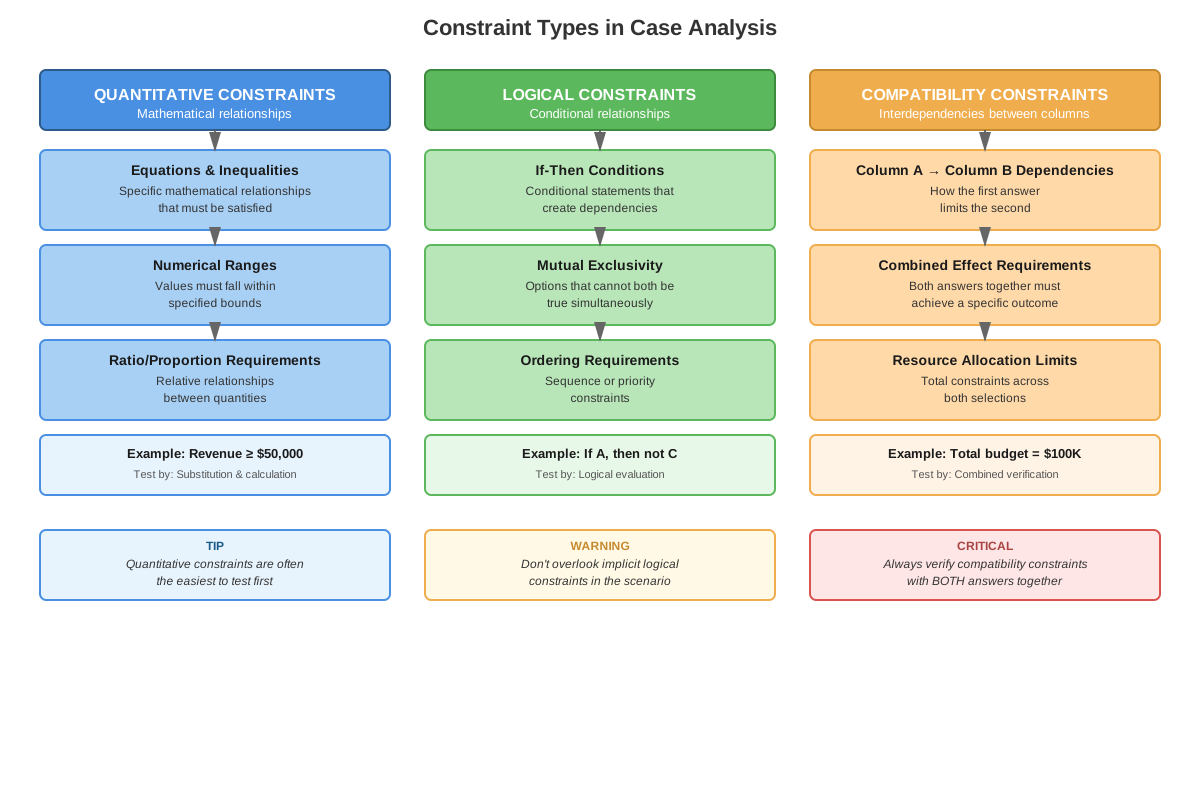
The foundation of solving case analysis problems lies in identifying and categorizing constraints. Constraints are the conditions, requirements, or limitations explicitly stated or implied in the scenario. Effective constraint analysis involves three steps:
- Extract explicit constraints: Read the scenario carefully and list every stated requirement, limitation, or objective. These might include numerical bounds (e.g., "budget cannot exceed $50,000"), logical conditions (e.g., "if Product A is selected, Product B cannot be"), or optimization goals (e.g., "maximize profit").
- Identify implicit constraints: Recognize unstated but necessary conditions based on the problem context. For example, if a problem involves selecting two different products, there's an implicit constraint that the same product cannot be selected for both columns.
- Categorize constraints by column: Determine which constraints apply to the first column, which apply to the second column, and which apply to the relationship between the two selections. This categorization guides the solution strategy.
Solution Strategies: Sequential vs. Simultaneous
Two primary approaches exist for solving case analysis questions, and selecting the appropriate strategy significantly impacts efficiency:
Sequential solving involves determining the answer for one column first, then using that information to solve the second column. This approach works best when:
- One column has fewer viable options due to tighter constraints
- One column's answer directly determines or limits the other column's possibilities
- The problem explicitly states a dependency relationship
Simultaneous solving involves evaluating both columns together, testing combinations to find the pair that satisfies all constraints. This approach is necessary when:
- The constraints create interdependencies between both columns
- Neither column can be definitively solved without considering the other
- The problem involves optimization where the combination matters more than individual values
Testing and Elimination Methodology
Given the finite number of answer combinations (typically 25-36 possible pairs from 5-6 options), systematic testing becomes a viable strategy. The key is to eliminate efficiently:
- Column-specific elimination: First, eliminate any options that violate constraints specific to one column, regardless of what's selected in the other column.
- Combination testing: For remaining options, test combinations systematically. Start with the most constrained column or the column with fewer remaining options.
- Constraint prioritization: Test the most restrictive constraints first, as these eliminate the most combinations quickly.
- Verification: Once a candidate pair is identified, verify it against ALL constraints before finalizing the answer.
Quantitative vs. Qualitative Case Analysis
Case analysis questions divide into two broad categories based on the nature of reasoning required:
Quantitative case analysis involves numerical calculations, algebraic manipulation, or mathematical optimization. These questions require:
- Setting up equations based on scenario constraints
- Solving for specific numerical values
- Comparing calculated results against thresholds or objectives
- Performing arithmetic to verify constraint satisfaction
Qualitative case analysis involves logical reasoning, statement evaluation, or conceptual understanding. These questions require:
- Assessing whether statements are supported by given information
- Evaluating logical consistency between claims
- Understanding causal relationships described in the scenario
- Applying business or scientific principles to draw conclusions
Many case analysis questions blend both quantitative and qualitative elements, requiring students to calculate values and then interpret what those values mean in context.
Concept Relationships
The core concepts within case analysis build upon each other in a logical progression. Understanding the structure of case analysis questions provides the foundation for all subsequent work—students must recognize the format before they can solve effectively. This structural understanding leads directly to constraint analysis, as the unique two-column format exists specifically to test the ability to satisfy multiple constraints simultaneously.
Constraint analysis serves as the bridge between understanding the question format and developing a solution approach. By categorizing constraints as column-specific or combination-dependent, students can determine whether sequential or simultaneous solving is more appropriate. This strategic decision then guides the application of testing and elimination methodology, which provides the tactical steps for working through answer options efficiently.
The distinction between quantitative and qualitative case analysis cuts across all other concepts—it's not a sequential step but rather a characterization that influences how each other concept is applied. Quantitative problems require mathematical constraint analysis and numerical testing, while qualitative problems demand logical constraint analysis and conceptual evaluation.
The relationship map flows as follows:
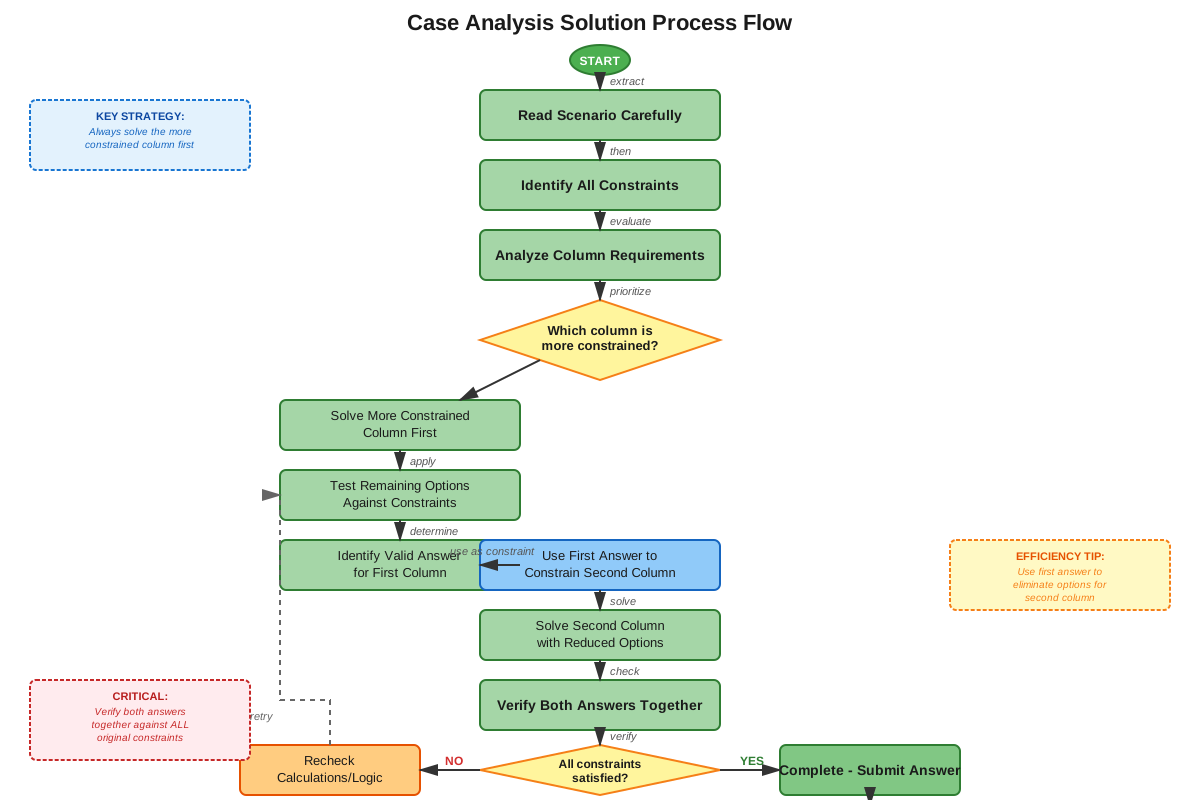
Question Structure Recognition → Constraint Identification & Categorization → Strategy Selection (Sequential vs. Simultaneous) → Systematic Testing & Elimination → Answer Verification
This topic connects to prerequisite knowledge of algebra (for quantitative case analysis), logical reasoning (for qualitative case analysis), and table interpretation (for navigating the answer format). It relates to other Data Insights topics by sharing the emphasis on synthesizing multiple information sources, similar to multi-source reasoning, and by requiring careful data interpretation, similar to table analysis questions.
High-Yield Facts
- ⭐ Case analysis questions always present exactly two columns, and you must select exactly one answer from each column
- ⭐ The two selections may come from the same row or different rows—there is no inherent preference or pattern
- ⭐ Constraints may apply to one column independently, the other column independently, or to the relationship between both selections
- ⭐ Approximately 60% of case analysis questions involve some quantitative calculation, while 40% are primarily qualitative reasoning
- ⭐ The most efficient approach is usually to solve the more constrained column first, then use that answer to limit options for the second column
- Case analysis questions typically take 2.5-3 minutes to solve, slightly longer than average Data Insights questions
- Wrong answer options are often designed to satisfy some but not all constraints—partial solutions are common traps
- The scenario description always contains all necessary information; no outside knowledge beyond basic business concepts is required
- When both columns represent numerical values, they often must satisfy an equation or inequality together
- If a problem states "different" products, strategies, or items must be selected, the same row cannot be chosen for both columns
- ⭐ Testing extreme values (highest, lowest) or boundary cases often quickly eliminates incorrect options
- Many case analysis questions involve optimization (maximize profit, minimize cost) which requires comparing all viable combinations
- The answer options are typically arranged in numerical or logical order to facilitate systematic evaluation
- Some case analysis questions present statements to evaluate as "supported/not supported" or "true/false" based on the scenario
- Calculation errors are the most common mistake on quantitative case analysis questions—always verify arithmetic
Quick check — test yourself on Case analysis so far.
Try Flashcards →Common Misconceptions
Misconception: Both answers must come from the same row in the answer table.
Correction: The two selections are completely independent regarding which row they come from. They may be in the same row or different rows—what matters is that each selection satisfies the constraints for its respective column.
Misconception: If one column's answer is determined, the other column's answer must be in the same row.
Correction: While some problems do result in both answers being in the same row, this is coincidental, not a rule. Each column must be evaluated based on its own constraints and the relationship between the columns, not on row alignment.
Misconception: Case analysis questions always require complex calculations.
Correction: Many case analysis questions test logical reasoning, reading comprehension, and the ability to evaluate statements rather than mathematical skills. Approximately 40% of case analysis questions involve minimal or no calculation.
Misconception: You should always solve the left column first, then the right column.
Correction: The optimal strategy is to solve the more constrained column first, regardless of its position. The more constrained column typically has fewer viable options, making it easier to determine and reducing the number of combinations to test for the second column.
Misconception: All constraints are explicitly stated in the scenario.
Correction: Some constraints are implicit based on context or logical necessity. For example, if a problem asks for "two different products," the constraint that the same product cannot be selected twice is implicit. Similarly, real-world constraints (like non-negative quantities) may not be explicitly stated.
Misconception: The answer options are arranged randomly, so testing order doesn't matter.
Correction: Answer options are typically arranged in a logical order (numerical, alphabetical, or by magnitude). This arrangement allows for strategic testing—starting with extreme values or boundary cases often eliminates multiple options quickly.
Misconception: If an option satisfies most constraints, it's probably correct even if one constraint seems unclear.
Correction: The correct answer pair must satisfy ALL constraints without exception. GMAT case analysis questions are designed so that only one combination fully satisfies every stated and implied constraint. Partial solutions are intentional distractors.
Worked Examples
Example 1: Quantitative Case Analysis with Resource Allocation
Scenario: A company produces two products, Alpha and Beta. Each unit of Alpha requires 3 hours of labor and generates $50 profit. Each unit of Beta requires 5 hours of labor and generates $70 profit. The company has 120 hours of labor available this week. To maintain customer relationships, the company must produce at least 10 units of Alpha and at least 8 units of Beta. The production manager needs to determine how many units of each product to produce to maximize profit while satisfying all constraints.
In the table below, select the number of Alpha units that should be produced and the number of Beta units that should be produced to maximize profit while meeting all constraints. Make only one selection in each column.
| Option | Alpha Units | Beta Units |
|---|---|---|
| A | 10 | 18 |
| B | 15 | 15 |
| C | 20 | 12 |
| D | 25 | 9 |
| E | 30 | 8 |
Solution Process:
Step 1: Identify constraints
- Labor constraint: 3(Alpha) + 5(Beta) ≤ 120
- Minimum Alpha: Alpha ≥ 10
- Minimum Beta: Beta ≥ 8
- Objective: Maximize profit = 50(Alpha) + 70(Beta)
Step 2: Test each option against the labor constraint
Option A: 3(10) + 5(18) = 30 + 90 = 120 ✓ (uses exactly all labor)
Option B: 3(15) + 5(15) = 45 + 75 = 120 ✓
Option C: 3(20) + 5(12) = 60 + 60 = 120 ✓
Option D: 3(25) + 5(9) = 75 + 45 = 120 ✓
Option E: 3(30) + 5(8) = 90 + 40 = 130 ✗ (exceeds labor available)
Step 3: Verify minimum production constraints
All remaining options (A-D) satisfy Alpha ≥ 10 and Beta ≥ 8.
Step 4: Calculate profit for each viable combination
Option A: 50(10) + 70(18) = 500 + 1,260 = $1,760
Option B: 50(15) + 70(15) = 750 + 1,050 = $1,800
Option C: 50(20) + 70(12) = 1,000 + 840 = $1,840
Option D: 50(25) + 70(9) = 1,250 + 630 = $1,880
Step 5: Select the combination that maximizes profit
Option D provides the highest profit at $1,880.
Answer: Alpha Units: 25 (Option D), Beta Units: 9 (Option D)
Key Insight: This problem demonstrates sequential solving—first eliminating options that violate hard constraints (labor availability), then optimizing among remaining options. The profit-maximizing solution uses all available labor while meeting minimum production requirements.
Example 2: Qualitative Case Analysis with Statement Evaluation
Scenario: A research study examined the relationship between daily coffee consumption and productivity in office workers. The study found that workers who consumed 1-2 cups of coffee per day reported 15% higher productivity scores than those who consumed no coffee. However, workers who consumed 3 or more cups per day reported productivity scores that were not significantly different from those who consumed no coffee. The study controlled for factors including sleep duration, job type, and work experience. The researchers noted that the study measured self-reported productivity rather than objective performance metrics.
In the table below, select whether each statement is supported or not supported by the information provided. Make only one selection in each column.
| Option | Statement 1: Moderate coffee consumption causes increased productivity | Statement 2: The study provides definitive evidence for workplace coffee policies |
|---|---|---|
| A | Supported | Supported |
| B | Supported | Not Supported |
| C | Not Supported | Supported |
| D | Not Supported | Not Supported |
Solution Process:
Step 1: Analyze Statement 1
The statement claims coffee "causes" increased productivity. Key considerations:
- The study found a correlation (association) between 1-2 cups and higher productivity scores
- The study controlled for confounding variables, strengthening the relationship
- However, the study design (observational, not experimental) cannot definitively establish causation
- The use of self-reported rather than objective measures introduces potential bias
- The statement uses the word "causes," which requires experimental evidence
Conclusion for Statement 1: Not Supported. The study shows correlation but does not establish causation.
Step 2: Analyze Statement 2
The statement claims the study provides "definitive evidence" for workplace policies. Key considerations:
- The study used self-reported productivity, not objective performance metrics
- "Definitive evidence" suggests conclusive proof suitable for policy decisions
- The study shows mixed results (benefit at 1-2 cups, no benefit at 3+ cups)
- Policy decisions typically require stronger evidence than a single correlational study
Conclusion for Statement 2: Not Supported. The study provides suggestive but not definitive evidence.
Step 3: Select the appropriate combination
Both statements are Not Supported, corresponding to Option D.
Answer: Statement 1: Not Supported (Option D), Statement 2: Not Supported (Option D)
Key Insight: This problem demonstrates the importance of precise language in qualitative case analysis. Words like "causes" (vs. "is associated with") and "definitive" (vs. "suggestive") are critical. The correct answer requires distinguishing between correlation and causation, and between preliminary findings and conclusive evidence.
Exam Strategy
When approaching case analysis questions on the GMAT, implement this systematic process:
Initial Reading Strategy: Read the scenario twice. The first read-through should focus on understanding the general context and situation. The second read-through should focus on identifying and underlining specific constraints, requirements, and objectives. Pay special attention to words like "must," "at least," "no more than," "different," and "maximize/minimize."
Trigger Words to Watch For:
- Constraint indicators: "must," "required," "at least," "no more than," "cannot exceed," "minimum," "maximum"
- Relationship indicators: "different," "same," "both," "either," "neither," "if...then"
- Optimization indicators: "maximize," "minimize," "optimal," "best," "most," "least"
- Evaluation indicators: "supported," "justified," "concluded," "inferred," "assumed"
Column Prioritization Strategy: Before attempting to solve, determine which column to address first:
- Identify which column has more explicit constraints
- Determine which column has fewer viable options after initial elimination
- Check if one column's answer directly determines or limits the other column
- Solve the more constrained or determinative column first
Process of Elimination Tactics:
- Eliminate options that violate any single constraint before testing combinations
- For quantitative problems, test boundary cases (minimum/maximum values) first
- For optimization problems, calculate the objective function only for combinations that satisfy all constraints
- If stuck between two combinations, re-read the scenario to identify overlooked constraints
Time Management: Allocate approximately 2.5-3 minutes per case analysis question. If you haven't identified a clear answer path within 90 seconds, switch to systematic testing of all combinations rather than continuing to analyze abstractly. With 5-6 options per column, testing all combinations takes less time than prolonged analysis.
Verification Protocol: Before confirming your answer, verify that your selected combination:
- Satisfies every explicitly stated constraint
- Satisfies any implicit constraints based on context
- Addresses the question's objective (if optimization is required)
- Makes logical sense in the context of the scenario
Exam Tip: If a case analysis question seems to have multiple valid answers, you've likely missed a constraint. Re-read the scenario specifically looking for limiting conditions you may have overlooked.
Memory Techniques
CASE Acronym for Solution Process:
- Constraints: Identify all constraints (explicit and implicit)
- Approach: Decide on sequential vs. simultaneous solving
- Systematic: Test options systematically, eliminating as you go
- Evaluate: Verify your answer against all constraints
Two-Column Decision Framework - "FIRST":
- Fewer options: Solve the column with fewer viable options first
- Independent: If one column can be solved independently, start there
- Restrictive: Begin with the column that has more restrictive constraints
- Specific: Prioritize the column with more specific numerical requirements
- Ties: If columns are equally constrained, start with the left column for consistency
Constraint Categories - "QROL":
- Quantitative: Numerical bounds, equations, inequalities
- Relational: Dependencies between the two columns
- Optimization: Maximize/minimize objectives
- Logical: If-then conditions, mutual exclusivity
Visualization Strategy: For complex case analysis problems, create a simple two-column checklist on your noteboard:
Column 1: [Label]    |    Column 2: [Label]
Constraints:         |    Constraints:
- [list]            |    - [list]
                    |
Viable options:     |    Viable options:
- [list]            |    - [list]
This visual organization prevents confusion and ensures systematic evaluation.
Summary
Case analysis represents a distinctive and high-value question type within the GMAT Data Insights section, requiring students to solve two interdependent aspects of a complex problem simultaneously. Success on these questions depends on mastering a systematic approach: identifying all constraints (both explicit and implicit), determining whether sequential or simultaneous solving is more efficient, eliminating options that violate individual constraints, testing remaining combinations systematically, and verifying that the selected pair satisfies all requirements. The two-column format tests the ability to hold multiple constraints in mind while evaluating options—a skill directly applicable to business decision-making. Whether the problem involves quantitative optimization or qualitative statement evaluation, the fundamental strategy remains consistent: thorough constraint analysis followed by systematic testing. Students who develop proficiency in case analysis gain a significant advantage on the GMAT, as these questions effectively discriminate between mid-range and high-scoring test-takers while assessing skills that business schools value highly.
Key Takeaways
- Case analysis questions require selecting one answer from each of two columns, with selections potentially coming from the same or different rows
- The most efficient approach is to solve the more constrained column first, then use that answer to limit options for the second column
- Every constraint must be satisfied—partial solutions that meet most but not all requirements are intentional wrong answers
- Approximately 60% of case analysis questions involve quantitative reasoning, while 40% focus on qualitative evaluation
- Systematic elimination based on individual column constraints before testing combinations saves significant time
- Words like "causes," "definitive," "must," and "different" carry precise meanings that determine correct answers
- The correct answer pair always satisfies ALL stated and implied constraints without exception
Related Topics
Multi-Source Reasoning: Builds on case analysis skills by requiring synthesis of information from multiple tabs or sources, with similar emphasis on identifying constraints and evaluating combinations of information.
Table Analysis: Shares the requirement to navigate tabular data efficiently and extract relevant information, though typically involves sorting and filtering rather than selecting complementary answers.
Graphics Interpretation: Develops complementary skills in extracting quantitative information from visual presentations, which often appears within case analysis scenarios.
Optimization Problems in Problem Solving: Provides additional practice with maximization and minimization objectives that frequently appear in quantitative case analysis questions.
Logical Reasoning: Strengthens the qualitative analysis skills needed for statement evaluation case analysis questions, particularly regarding causation vs. correlation and evidence evaluation.
Mastering case analysis creates a strong foundation for these related topics, as the constraint analysis and systematic evaluation skills transfer directly to other Data Insights question types.
Practice CTA
Now that you've mastered the concepts and strategies for case analysis, it's time to put your knowledge into action. Attempt the practice questions to reinforce your understanding and build the speed and accuracy needed for test day. Focus on applying the systematic approach outlined in this guide: identify constraints, prioritize which column to solve first, eliminate systematically, and verify your answers. The flashcards will help you internalize key concepts and trigger words. Remember, case analysis questions are high-value opportunities to demonstrate the analytical skills that business schools seek—approach each practice question as a chance to refine your technique and build confidence. Your investment in mastering this topic will pay dividends across the entire Data Insights section!
Sign up free to keep reading
Create a free AnvayaPrep account to finish this GMAT guide on Case analysis — plus flashcards and practice questions.