Overview
Optimization is a critical quantitative reasoning skill tested extensively in the GMAT Data Insights section, particularly within Two-Part Analysis questions. At its core, optimization involves finding the best possible solution to a problem given specific constraints—whether that means maximizing profit, minimizing cost, determining the most efficient allocation of resources, or identifying optimal production levels. This mathematical concept bridges algebra, linear programming, and logical reasoning, requiring test-takers to analyze multiple variables simultaneously and make strategic decisions based on competing objectives.
The GMAT frequently presents optimization scenarios in business contexts: a company must decide how many units of two products to manufacture given limited resources, or a manager must allocate budget across departments to maximize return on investment. These questions test not just computational ability but also strategic thinking—the capacity to recognize trade-offs, understand constraints, and systematically evaluate options. GMAT optimization problems often appear as Two-Part Analysis questions where students must identify two related values that together satisfy multiple conditions while optimizing a particular outcome.
Understanding optimization is essential for success on the GMAT because it represents a convergence point for multiple Data Insights skills. It requires interpreting complex scenarios, translating word problems into mathematical relationships, working with systems of inequalities, and making logical inferences about which combinations of values are feasible and which are optimal. Mastery of optimization demonstrates the analytical sophistication that business schools seek in candidates, as these problems mirror real-world decision-making scenarios that MBA graduates will encounter throughout their careers.
Learning Objectives
- [ ] Identify optimization problems and distinguish them from other quantitative reasoning question types
- [ ] Explain the fundamental components of optimization: objective function, decision variables, and constraints
- [ ] Apply optimization techniques to solve GMAT Two-Part Analysis questions efficiently
- [ ] Construct and interpret constraint inequalities from verbal descriptions in business scenarios
- [ ] Evaluate multiple candidate solutions systematically to determine which satisfies all constraints while optimizing the objective
- [ ] Recognize when a problem requires maximization versus minimization and adjust solution strategy accordingly
- [ ] Translate complex word problems into mathematical optimization frameworks within 2-3 minutes
Prerequisites
- Basic algebra and equation manipulation: Essential for setting up and solving constraint equations and inequalities that define feasible regions
- Understanding of inequalities: Required to interpret "at least," "no more than," and similar constraint language that defines boundaries
- Systems of equations: Optimization often involves multiple simultaneous constraints that must all be satisfied
- Basic arithmetic and mental math: Necessary for quickly evaluating whether candidate solutions meet numerical constraints
- Reading comprehension: Critical for extracting relevant information from dense business scenarios and identifying what needs to be optimized
Why This Topic Matters
Optimization represents one of the highest-yield topics in GMAT Data Insights because it appears frequently and tests multiple competencies simultaneously. According to GMAT question analysis, optimization problems constitute approximately 15-20% of Two-Part Analysis questions and regularly appear in Multi-Source Reasoning scenarios. These questions typically carry medium to high difficulty ratings, making them excellent opportunities for competitive test-takers to distinguish themselves.
In real-world business applications, optimization is fundamental to operations management, financial planning, supply chain logistics, marketing budget allocation, and strategic decision-making. MBA programs value candidates who can think systematically about resource allocation under constraints—exactly what optimization problems assess. Whether determining optimal pricing strategies, production schedules, or investment portfolios, business professionals apply optimization principles daily.
On the GMAT, optimization questions commonly appear in several formats: production planning scenarios (how many units of Product A and Product B to manufacture), resource allocation problems (how to distribute limited budget or materials), scheduling questions (optimal time allocation across activities), and mixture problems (combining ingredients or investments to achieve target characteristics). The Two-Part Analysis format is particularly well-suited to optimization because it requires identifying two interdependent values—such as quantities of two products—that together optimize an outcome while satisfying all constraints.
Core Concepts
Understanding Optimization Problems
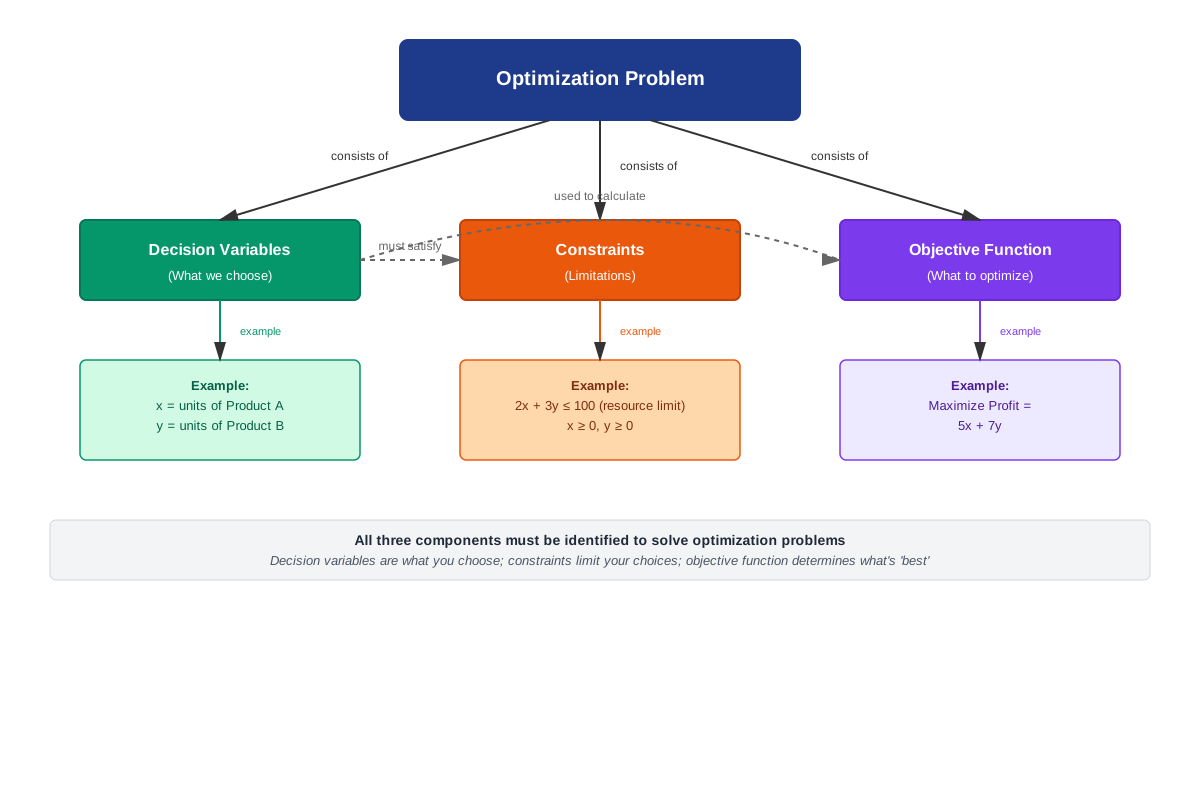
Optimization is the mathematical process of finding the best solution from all feasible solutions to a problem. In GMAT contexts, "best" typically means either maximizing a desirable quantity (profit, revenue, efficiency, output) or minimizing an undesirable one (cost, time, waste, risk). Every optimization problem contains three essential components that must be identified before solving.
The objective function is the quantity being optimized—what you're trying to maximize or minimize. In a business scenario, this might be "total profit" or "total cost." The objective function is expressed as a mathematical formula involving the decision variables. For example, if Product A generates $50 profit per unit and Product B generates $75 profit per unit, the objective function for total profit would be: Profit = 50A + 75B, where A and B represent quantities produced.
Decision variables are the quantities you can control or choose—the unknowns you're solving for. In Two-Part Analysis questions, these are typically the two values you must select from the answer choices. Decision variables might represent quantities to produce, amounts to invest, hours to allocate, or any other controllable inputs to the system.
Constraints are the limitations or requirements that restrict which solutions are feasible. Constraints typically involve limited resources (budget, materials, time, labor), minimum requirements (must produce at least X units), maximum capacities (warehouse can hold no more than Y items), or logical restrictions (cannot produce negative quantities). Mathematically, constraints are expressed as inequalities or equations that the decision variables must satisfy.
Types of Constraints
Understanding constraint types is crucial for correctly interpreting GMAT optimization scenarios:
| Constraint Type | Mathematical Form | Example Language | Interpretation |
|---|---|---|---|
| Resource limitation | aX + bY ≤ C | "No more than," "at most," "maximum" | Total usage cannot exceed available amount |
| Minimum requirement | aX + bY ≥ M | "At least," "minimum," "no fewer than" | Total must meet or exceed threshold |
| Exact requirement | aX + bY = E | "Exactly," "must equal," "total of" | Total must precisely equal specified value |
| Non-negativity | X ≥ 0, Y ≥ 0 | "Cannot be negative" | Implicit in most real-world scenarios |
| Integer constraint | X, Y ∈ integers | "Whole units," "complete items" | Often implicit when dealing with discrete items |
The Optimization Solution Process
Solving GMAT optimization problems systematically involves a structured approach:
- Identify the objective: Determine what quantity needs to be maximized or minimized. Look for phrases like "greatest possible profit," "minimum cost," or "maximize revenue."
- Define decision variables: Identify the two quantities you need to determine. In Two-Part Analysis, these correspond to the two columns of answer choices.
- Extract all constraints: Carefully read the problem to identify every limitation. Create a list of inequalities or equations representing each constraint.
- Determine the feasible region: The feasible region consists of all combinations of decision variables that satisfy every constraint simultaneously. In two-variable problems, this is often visualized as a region on a coordinate plane, though GMAT questions typically don't require graphing.
- Evaluate candidate solutions: For Two-Part Analysis questions, systematically test answer choices against all constraints. Eliminate options that violate any constraint.
- Optimize among feasible solutions: Among remaining feasible options, calculate the objective function value for each and select the one that best achieves the optimization goal.
Recognizing Optimization Scenarios
GMAT optimization problems often disguise themselves within business narratives. Key trigger phrases include:
- "Maximize profit/revenue/output/efficiency"
- "Minimize cost/time/waste/expense"
- "Greatest possible," "largest amount," "highest total"
- "Least possible," "smallest number," "lowest cost"
- "Subject to the following constraints/limitations/requirements"
- "Given that" followed by resource limitations
- "Must produce at least" or "cannot exceed"
Common Optimization Frameworks
Production Optimization: A company manufactures two products using shared resources (labor hours, raw materials, machine time). Each product requires different amounts of each resource and generates different profit. The goal is determining how many units of each product to produce to maximize profit while not exceeding resource availability.
Budget Allocation: An organization must distribute limited funds across multiple categories or projects, each with different returns or requirements. Constraints might include minimum spending requirements in certain areas and maximum allocations in others.
Mixture Problems: Combining two components (investments, ingredients, materials) to achieve target characteristics (return rate, concentration, properties) while optimizing cost or another objective.
Concept Relationships
Optimization problems integrate multiple mathematical and logical reasoning skills, creating a web of interconnected concepts. The foundation begins with algebraic expression → which enables formulation of the objective function → which defines what to optimize. Simultaneously, inequality interpretation → leads to constraint formulation → which defines the feasible region → within which the optimal solution must lie.
The relationship between constraints and the objective function is crucial: constraints narrow the solution space from infinite possibilities to a finite feasible region, while the objective function provides the criterion for selecting the single best solution from that region. This represents a filtering then optimizing process: first eliminate infeasible options, then optimize among what remains.
Within the GMAT Data Insights section, optimization connects to quantitative reasoning (performing calculations), analytical reasoning (evaluating logical relationships), and integrated reasoning (synthesizing information from multiple sources). Two-Part Analysis questions specifically leverage optimization because the format naturally accommodates problems with two decision variables that must be determined simultaneously.
The concept also relates to trade-off analysis: when resources are limited, producing more of Product A necessarily means producing less of Product B. Understanding these inverse relationships helps identify which combinations are feasible and which maximize the objective. This connects to opportunity cost thinking—choosing one option means forgoing alternatives—a fundamental business concept.
High-Yield Facts
⭐ Every optimization problem has three components: objective function (what to optimize), decision variables (what to choose), and constraints (limitations on choices).
⭐ In Two-Part Analysis optimization questions, the two columns represent the two decision variables that must be determined simultaneously.
⭐ A solution is only optimal if it satisfies ALL constraints; violating even one constraint makes a solution infeasible regardless of objective function value.
⭐ "At least" translates to ≥ (greater than or equal to); "no more than" translates to ≤ (less than or equal to).
⭐ When maximizing profit or revenue, evaluate the objective function at each feasible solution and select the highest value; when minimizing cost or time, select the lowest value.
- Non-negativity constraints (variables cannot be negative) are often implicit in real-world scenarios involving quantities, even if not explicitly stated.
- Integer constraints matter when dealing with discrete items (cannot produce 7.5 cars), but GMAT questions usually make this clear through context.
- The optimal solution often occurs at the boundary of the feasible region where constraints are binding (satisfied as equalities rather than inequalities).
- If two constraints directly conflict (one requires X ≥ 100 while another requires X ≤ 50), the problem has no feasible solution.
- Optimization problems with two decision variables can theoretically be solved graphically, but GMAT Two-Part Analysis questions are designed to be solved by testing answer choices systematically.
- Resource constraints typically use all available resources at the optimal solution—if resources remain unused, you could potentially increase production and improve the objective.
- When a problem asks for "maximum possible" or "minimum possible," it's explicitly an optimization problem requiring comparison of multiple feasible options.
Quick check — test yourself on Optimization so far.
Try Flashcards →Common Misconceptions
Misconception: The solution with the highest individual value for one variable is automatically optimal.
Correction: Optimization considers the combined effect of both variables on the objective function. A solution with lower individual values might produce a higher total profit if the profit coefficients favor that combination.
Misconception: All answer choices in Two-Part Analysis optimization questions are feasible solutions.
Correction: Many answer choices violate one or more constraints and are infeasible. Part of the solution process involves eliminating infeasible options before optimizing among what remains.
Misconception: If a solution satisfies most constraints, it's "close enough" to optimal.
Correction: A solution must satisfy ALL constraints to be feasible. Violating even one constraint disqualifies a solution entirely, regardless of how well it performs on the objective function.
Misconception: "Maximize" and "minimize" problems use the same solution approach.
Correction: While the process of identifying constraints and feasible solutions is identical, the final selection differs: maximization chooses the highest objective function value, while minimization chooses the lowest.
Misconception: Optimization problems always have a unique optimal solution.
Correction: Some problems have multiple optimal solutions (different variable combinations yielding identical objective function values), while others might have no feasible solution if constraints conflict.
Misconception: The objective function and constraints are interchangeable.
Correction: The objective function defines what you're trying to optimize (maximize or minimize), while constraints define what's possible. Confusing these leads to solving the wrong problem entirely.
Misconception: Optimization requires advanced calculus or linear programming techniques.
Correction: GMAT optimization questions are designed to be solved using systematic evaluation of answer choices, basic algebra, and logical reasoning—no calculus required.
Worked Examples
Example 1: Production Optimization
Problem: A furniture manufacturer produces tables and chairs. Each table requires 4 hours of labor and 8 board-feet of wood. Each chair requires 3 hours of labor and 5 board-feet of wood. The manufacturer has 120 hours of labor and 200 board-feet of wood available this week. Tables generate $80 profit each, and chairs generate $50 profit each. In the table below, identify the number of tables and the number of chairs that would maximize total profit while satisfying all resource constraints. Make only one selection in each column.
| Tables | Chairs |
|---|---|
| 10 | 20 |
| 15 | 16 |
| 20 | 12 |
| 25 | 0 |
Solution:
Step 1: Identify components
- Objective function: Maximize Profit = 80T + 50C (where T = tables, C = chairs)
- Decision variables: T (number of tables), C (number of chairs)
- Constraints:
- Labor: 4T + 3C ≤ 120 hours
- Wood: 8T + 5C ≤ 200 board-feet
- Non-negativity: T ≥ 0, C ≥ 0
Step 2: Test each option against constraints
Option 1: T = 10, C = 20
- Labor: 4(10) + 3(20) = 40 + 60 = 100 ≤ 120 ✓
- Wood: 8(10) + 5(20) = 80 + 100 = 180 ≤ 200 ✓
- Feasible! Profit = 80(10) + 50(20) = 800 + 1,000 = $1,800
Option 2: T = 15, C = 16
- Labor: 4(15) + 3(16) = 60 + 48 = 108 ≤ 120 ✓
- Wood: 8(15) + 5(16) = 120 + 80 = 200 ≤ 200 ✓
- Feasible! Profit = 80(15) + 50(16) = 1,200 + 800 = $2,000
Option 3: T = 20, C = 12
- Labor: 4(20) + 3(12) = 80 + 36 = 116 ≤ 120 ✓
- Wood: 8(20) + 5(12) = 160 + 60 = 220 > 200 ✗
- Infeasible! Violates wood constraint.
Option 4: T = 25, C = 0
- Labor: 4(25) + 3(0) = 100 ≤ 120 ✓
- Wood: 8(25) + 5(0) = 200 ≤ 200 ✓
- Feasible! Profit = 80(25) + 50(0) = $2,000
Step 3: Compare feasible options
- Option 1: $1,800
- Option 2: $2,000 (tied for highest)
- Option 3: Infeasible
- Option 4: $2,000 (tied for highest)
Both Options 2 and 4 maximize profit at $2,000. However, examining the question format, if only one answer is required per column, Option 2 (T = 15, C = 16) represents a more balanced production mix and would typically be the expected answer, though both are mathematically optimal.
Answer: Tables = 15, Chairs = 16
Example 2: Investment Allocation
Problem: An investor has $50,000 to allocate between two funds: Fund A and Fund B. Fund A requires a minimum investment of $5,000 and has an expected annual return of 8%. Fund B requires a minimum investment of $10,000 and has an expected annual return of 12%. The investor wants to invest at least twice as much in Fund B as in Fund A to maintain portfolio balance. What allocation maximizes expected annual return?
| Fund A | Fund B |
|---|---|
| $5,000 | $45,000 |
| $10,000 | $40,000 |
| $15,000 | $35,000 |
| $16,000 | $34,000 |
Solution:
Step 1: Identify components
- Objective function: Maximize Return = 0.08A + 0.12B
- Decision variables: A (amount in Fund A), B (amount in Fund B)
- Constraints:
- Total budget: A + B = 50,000 (must invest all funds)
- Minimum A: A ≥ 5,000
- Minimum B: B ≥ 10,000
- Balance requirement: B ≥ 2A
Step 2: Test each option
Option 1: A = $5,000, B = $45,000
- Budget: 5,000 + 45,000 = 50,000 ✓
- Min A: 5,000 ≥ 5,000 ✓
- Min B: 45,000 ≥ 10,000 ✓
- Balance: 45,000 ≥ 2(5,000) = 10,000 ✓
- Feasible! Return = 0.08(5,000) + 0.12(45,000) = 400 + 5,400 = $5,800
Option 2: A = $10,000, B = $40,000
- Budget: 10,000 + 40,000 = 50,000 ✓
- Min A: 10,000 ≥ 5,000 ✓
- Min B: 40,000 ≥ 10,000 ✓
- Balance: 40,000 ≥ 2(10,000) = 20,000 ✓
- Feasible! Return = 0.08(10,000) + 0.12(40,000) = 800 + 4,800 = $5,600
Option 3: A = $15,000, B = $35,000
- Budget: 15,000 + 35,000 = 50,000 ✓
- Min A: 15,000 ≥ 5,000 ✓
- Min B: 35,000 ≥ 10,000 ✓
- Balance: 35,000 ≥ 2(15,000) = 30,000 ✓
- Feasible! Return = 0.08(15,000) + 0.12(35,000) = 1,200 + 4,200 = $5,400
Option 4: A = $16,000, B = $34,000
- Budget: 16,000 + 34,000 = 50,000 ✓
- Min A: 16,000 ≥ 5,000 ✓
- Min B: 34,000 ≥ 10,000 ✓
- Balance: 34,000 ≥ 2(16,000) = 32,000 ✓
- Feasible! Return = 0.08(16,000) + 0.12(34,000) = 1,280 + 4,080 = $5,360
Step 3: Optimize
All options are feasible. Option 1 yields the highest return at $5,800. This makes intuitive sense: since Fund B has a higher return rate (12% vs. 8%), maximizing investment in Fund B while satisfying all constraints produces the best outcome.
Answer: Fund A = $5,000, Fund B = $45,000
Exam Strategy
When approaching GMAT optimization questions in Two-Part Analysis format, employ this systematic strategy:
Initial Reading (30-45 seconds): Read the entire problem once to understand the scenario. Identify the optimization goal immediately—look for "maximize," "minimize," "greatest," or "least." Underline or mentally note this objective.
Component Extraction (45-60 seconds): On your second read, extract and list:
- What quantity is being optimized (objective function)
- What two values you need to find (decision variables)
- Every constraint mentioned (create a quick list)
Constraint Translation (30-45 seconds): Convert verbal constraints into mathematical inequalities. Pay special attention to:
- "At least" → ≥
- "No more than" / "at most" → ≤
- "Exactly" → =
- Implicit non-negativity (quantities can't be negative)
Systematic Elimination (90-120 seconds): Test each answer choice against ALL constraints in order. As soon as an option violates any constraint, eliminate it immediately and move to the next option. Don't waste time calculating the objective function for infeasible solutions.
Optimization Selection (30 seconds): Among remaining feasible options, calculate the objective function value for each. Select the maximum (for maximization problems) or minimum (for minimization problems).
Exam Tip: If you're running short on time, start by testing the most extreme answer choices first. Optimal solutions often occur at boundaries where constraints are binding.
Trigger Words to Watch For:
- Optimization indicators: "maximize," "minimize," "greatest possible," "least possible," "optimal," "best"
- Constraint indicators: "subject to," "given that," "must," "cannot exceed," "at least," "no more than," "limited to"
- Resource language: "available," "capacity," "budget," "hours," "materials," "space"
Time Management: Allocate approximately 2.5-3 minutes for optimization Two-Part Analysis questions. If you exceed 3.5 minutes, make your best educated guess and move on. These questions are time-intensive by design, so practice efficient constraint checking.
Process of Elimination Tips:
- Eliminate options that obviously violate explicit constraints first (easiest to check)
- Check budget/total constraints next (simple addition)
- Verify ratio or proportion constraints last (require more calculation)
- If two options yield identical objective function values, re-check your constraint evaluation—you may have missed eliminating one
Memory Techniques
OCD Mnemonic for optimization components:
- Objective function (what to optimize)
- Constraints (limitations)
- Decision variables (what to choose)
"FETO" Process for solving:
- Find the objective (what to maximize/minimize)
- Extract constraints (list all limitations)
- Test options (check feasibility)
- Optimize (select best among feasible)
Inequality Translation Memory Aid:
- "At LEAST" = "≥" (the "L" in LEAST looks like an L-shaped greater-than symbol turned)
- "NO MORE" = "≤" (NO means stop/limit, so less-than-or-equal)
Visualization Strategy: Picture constraints as fences that create a bounded area (feasible region). The optimal solution is the best point within that fenced area. Options outside the fence are infeasible no matter how attractive they look.
Constraint Checking Acronym - "BRAIN":
- Budget constraints (total available resources)
- Ratio requirements (proportional relationships)
- Absolute minimums (must have at least X)
- Integer restrictions (whole units only)
- Non-negativity (can't be negative)
Summary
Optimization is a high-yield GMAT Data Insights topic that tests the ability to find the best solution among feasible alternatives given multiple constraints. Every optimization problem consists of three essential components: an objective function defining what to maximize or minimize, decision variables representing the quantities to determine, and constraints limiting which solutions are feasible. The systematic solution process involves identifying these components, translating verbal constraints into mathematical inequalities, testing answer choices to eliminate infeasible options, and selecting the optimal solution from remaining feasible alternatives. GMAT optimization questions typically appear in Two-Part Analysis format with business contexts like production planning, resource allocation, or investment decisions. Success requires careful constraint interpretation, methodical evaluation of options, and clear understanding of the difference between feasibility (satisfying all constraints) and optimality (achieving the best objective function value among feasible solutions). Mastering optimization demonstrates integrated quantitative reasoning, analytical thinking, and strategic decision-making skills essential for business school success.
Key Takeaways
- Optimization requires identifying three components: objective function (what to optimize), decision variables (what to choose), and constraints (what limits choices)
- A solution is feasible only if it satisfies ALL constraints simultaneously; violating even one constraint makes a solution infeasible regardless of objective function value
- Systematic evaluation is essential: test each answer choice against every constraint before calculating objective function values
- Constraint translation is critical: "at least" means ≥, "no more than" means ≤, and implicit constraints like non-negativity must be recognized
- The optimal solution maximizes (or minimizes) the objective function among all feasible solutions—not necessarily the option with the highest individual variable value
- Time management matters: allocate 2.5-3 minutes per optimization Two-Part Analysis question and use systematic elimination to work efficiently
- Business context provides clues: production, allocation, and investment scenarios follow predictable patterns that help identify constraints and objectives quickly
Related Topics
Linear Programming: Advanced optimization techniques involving graphical solution methods and the simplex algorithm; mastering basic optimization prepares students for these more sophisticated approaches in quantitative courses.
Systems of Inequalities: The mathematical foundation underlying constraint analysis; strong optimization skills reinforce understanding of how multiple inequalities interact to define feasible regions.
Cost-Benefit Analysis: Business decision-making framework that applies optimization thinking to evaluate trade-offs; optimization provides the quantitative tools to formalize cost-benefit comparisons.
Multi-Source Reasoning: Another Data Insights question type that frequently incorporates optimization scenarios across multiple information sources; optimization mastery enables efficient synthesis of complex data.
Quantitative Problem Solving: Broader category encompassing word problems, algebraic reasoning, and applied mathematics; optimization represents an advanced application integrating multiple quantitative skills.
Practice CTA
Now that you've mastered the core concepts of optimization, it's time to reinforce your learning through active practice. Attempt the practice questions designed specifically for this topic, focusing on applying the systematic FETO process (Find, Extract, Test, Optimize) to each problem. Use the flashcards to drill constraint translation and component identification until these skills become automatic. Remember: optimization questions are high-yield opportunities to demonstrate the analytical sophistication that distinguishes top GMAT performers. Your investment in mastering this topic will pay dividends not only on test day but throughout your business school career and beyond. Approach each practice problem methodically, learn from mistakes, and build the confidence that comes from systematic preparation. You've got this!
Sign up free to keep reading
Create a free AnvayaPrep account to finish this GMAT guide on Optimization — plus flashcards and practice questions.