Overview
Constraint satisfaction is a fundamental problem-solving framework that appears frequently in GMAT Data Insights questions, particularly within the Two-Part Analysis section. At its core, constraint satisfaction involves finding solutions that simultaneously meet multiple conditions, restrictions, or requirements. Students must identify variables, understand the limitations placed on those variables, and determine values or combinations that satisfy all given constraints without violating any single condition.
This topic is essential for the GMAT because it tests logical reasoning, systematic thinking, and the ability to work with multiple interdependent conditions—skills that business schools value highly. GMAT constraint satisfaction problems require test-takers to navigate complex scenarios where decisions are interconnected, mirroring real-world business situations such as resource allocation, scheduling, budgeting, and operational planning. These questions assess whether candidates can think analytically under time pressure while managing multiple moving parts.
Within the broader Data Insights section, constraint satisfaction connects directly to quantitative reasoning, logical analysis, and data interpretation. It builds upon foundational mathematical concepts while requiring strategic thinking that extends beyond pure calculation. Students who master constraint satisfaction develop a systematic approach to complex problems that serves them well across all GMAT question types, particularly in Multi-Source Reasoning and Table Analysis questions where multiple data points must be reconciled simultaneously.
Learning Objectives
- [ ] Identify constraint satisfaction problems in GMAT Two-Part Analysis questions
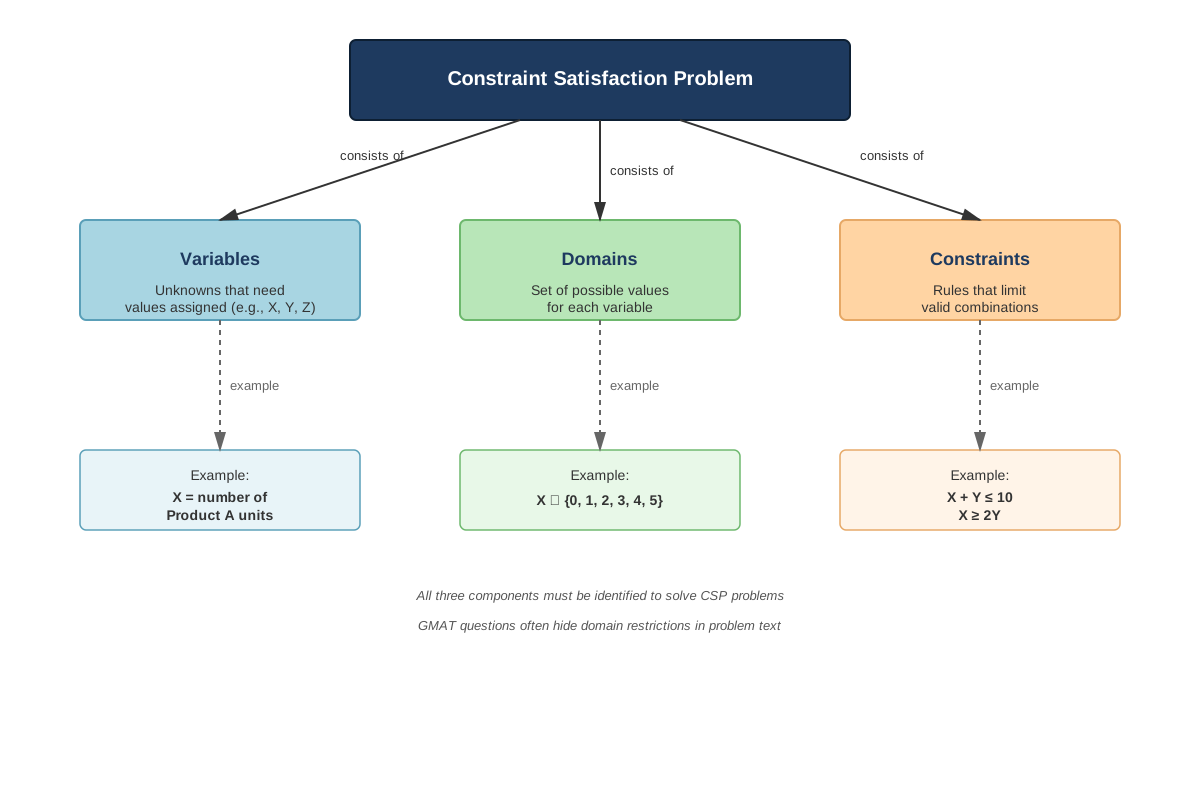
- [ ] Explain the components of constraint satisfaction frameworks (variables, domains, constraints)
- [ ] Apply constraint satisfaction methodologies to solve GMAT questions efficiently
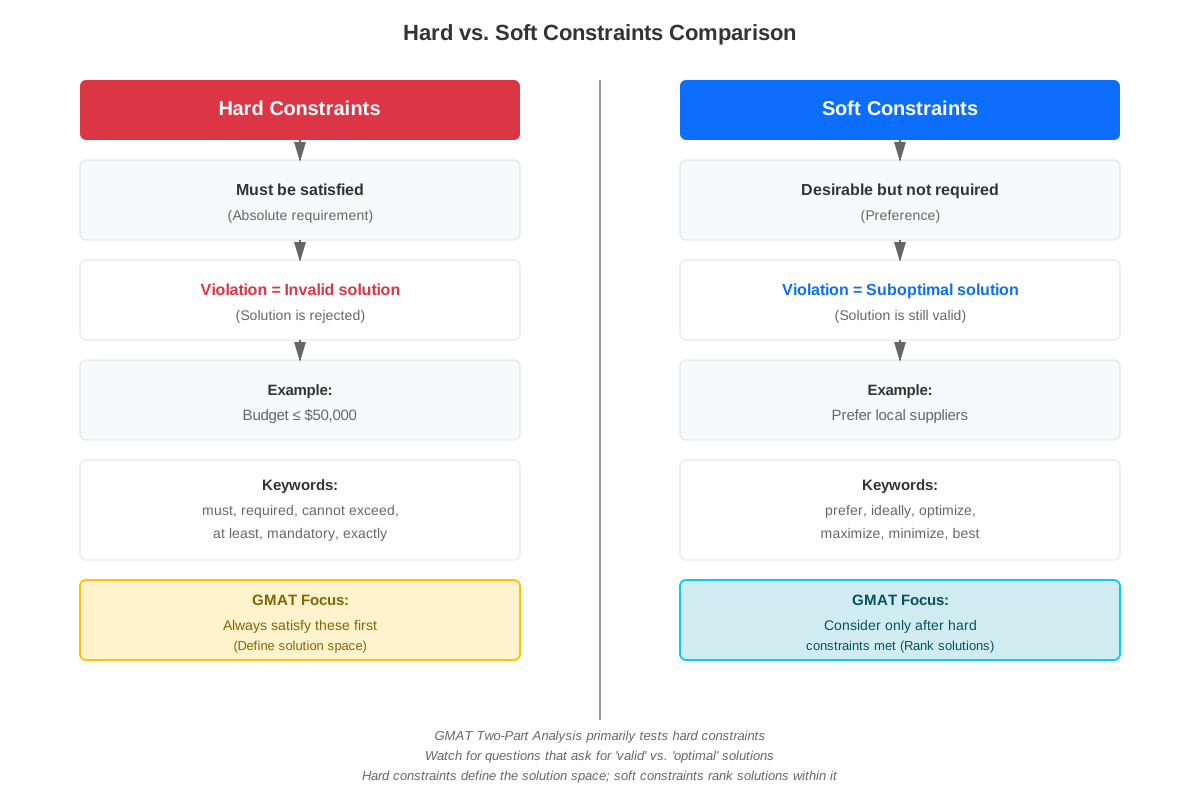
- [ ] Distinguish between hard constraints (must be satisfied) and soft constraints (preferences)
- [ ] Develop systematic approaches to eliminate invalid solutions based on constraint violations
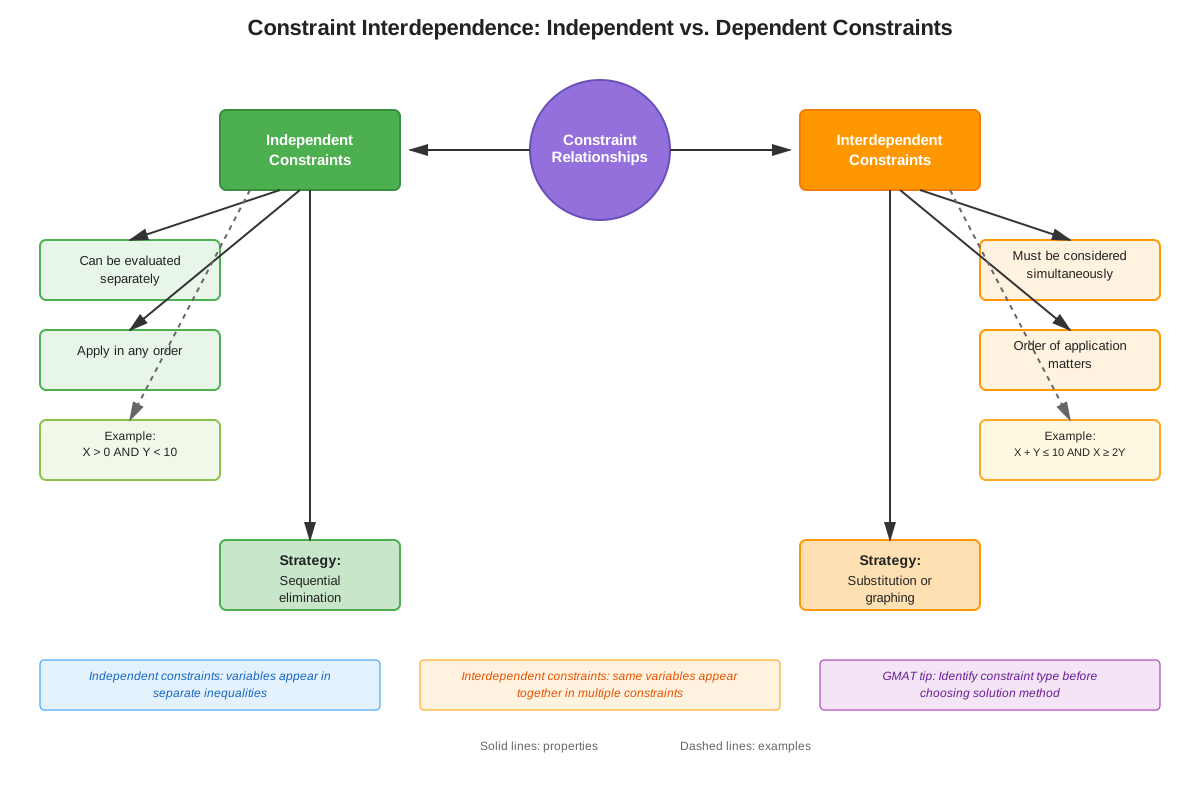
- [ ] Recognize when constraints are independent versus interdependent
- [ ] Optimize solution strategies by identifying the most restrictive constraints first
Prerequisites
- Basic algebra and equation solving: Essential for translating word problems into mathematical relationships and manipulating constraint equations
- Logical reasoning fundamentals: Required to understand conditional statements, implications, and logical operators that form the basis of constraints
- Set theory basics: Necessary for understanding domains (possible values) and how constraints restrict solution spaces
- Reading comprehension: Critical for extracting constraint information from complex problem statements and identifying implicit restrictions
Why This Topic Matters
Constraint satisfaction problems appear in approximately 15-20% of Data Insights questions on the GMAT, making them one of the highest-yield topics for focused study. These questions test skills that directly translate to business decision-making: evaluating trade-offs, managing limited resources, and finding optimal solutions within real-world limitations. MBA programs value these competencies because managers constantly face scenarios where multiple requirements must be balanced simultaneously—from project management to financial planning to strategic resource allocation.
In the business world, constraint satisfaction manifests in supply chain optimization, employee scheduling, budget allocation, production planning, and investment portfolio construction. A marketing manager might need to allocate a fixed budget across multiple channels while meeting minimum spend requirements for each platform. An operations director might schedule shifts while respecting labor laws, employee preferences, and coverage requirements. These real-world applications make constraint satisfaction one of the most practically relevant GMAT topics.
On the exam, constraint satisfaction appears most commonly in Two-Part Analysis questions where students must select two values that jointly satisfy multiple conditions. It also appears in Table Analysis questions requiring identification of rows that meet specific criteria, and in Multi-Source Reasoning where information from multiple tabs must be synthesized. The questions typically present 3-5 constraints with 2-4 variables, requiring systematic evaluation of possibilities. Recognizing the constraint satisfaction framework immediately helps students organize their approach and avoid random trial-and-error.
Core Concepts
Understanding Constraint Satisfaction Problems
A constraint satisfaction problem (CSP) consists of three fundamental components: variables, domains, and constraints. Variables represent the unknown quantities or decisions that need to be determined. Each variable has a domain—the set of possible values it can take. Constraints are the conditions, rules, or restrictions that limit which combinations of variable values are acceptable solutions.
For example, if a company must hire two employees from a pool of five candidates, the variables are "Employee 1" and "Employee 2," the domain for each variable is the set of five candidates, and constraints might include "both employees must have different skill sets" or "total salary cannot exceed $150,000."
Types of Constraints
Constraints fall into several categories that affect solution strategies:
Hard constraints are non-negotiable requirements that must be satisfied for any valid solution. These create absolute boundaries that cannot be violated. Examples include "the total must equal exactly 100" or "variable X must be greater than variable Y."
Soft constraints represent preferences or optimization goals rather than absolute requirements. While GMAT questions typically focus on hard constraints, understanding this distinction helps when questions ask for "best" or "optimal" solutions.
Unary constraints restrict a single variable (e.g., "X must be positive"). Binary constraints involve relationships between two variables (e.g., "X must be greater than Y"). Global constraints involve multiple variables simultaneously (e.g., "the sum of all variables must equal 50").
Constraint Propagation and Domain Reduction
Constraint propagation is the process of using one constraint to narrow the possible values for variables, which then triggers further narrowing through other constraints. This cascading effect is crucial for efficient problem-solving on the GMAT.
Consider this example: If X + Y = 10, X must be positive, and both X and Y must be integers, then knowing X = 8 immediately tells us Y = 2. This information might then trigger additional constraints. Effective test-takers use constraint propagation to systematically eliminate impossible values rather than testing every combination.
Solution Strategies for GMAT Constraint Problems
| Strategy | When to Use | Advantage | Limitation |
|---|---|---|---|
| Identify most restrictive constraint first | Multiple constraints present | Eliminates maximum options quickly | Requires quick constraint assessment |
| Systematic enumeration | Small domain sizes | Guarantees finding all solutions | Time-consuming with large domains |
| Substitution method | Constraints form equations | Reduces variables systematically | May be algebraically complex |
| Elimination by contradiction | Complex interdependencies | Proves impossibility efficiently | Requires careful logical tracking |
| Boundary testing | Numerical constraints | Quickly identifies feasible ranges | May miss interior solutions |
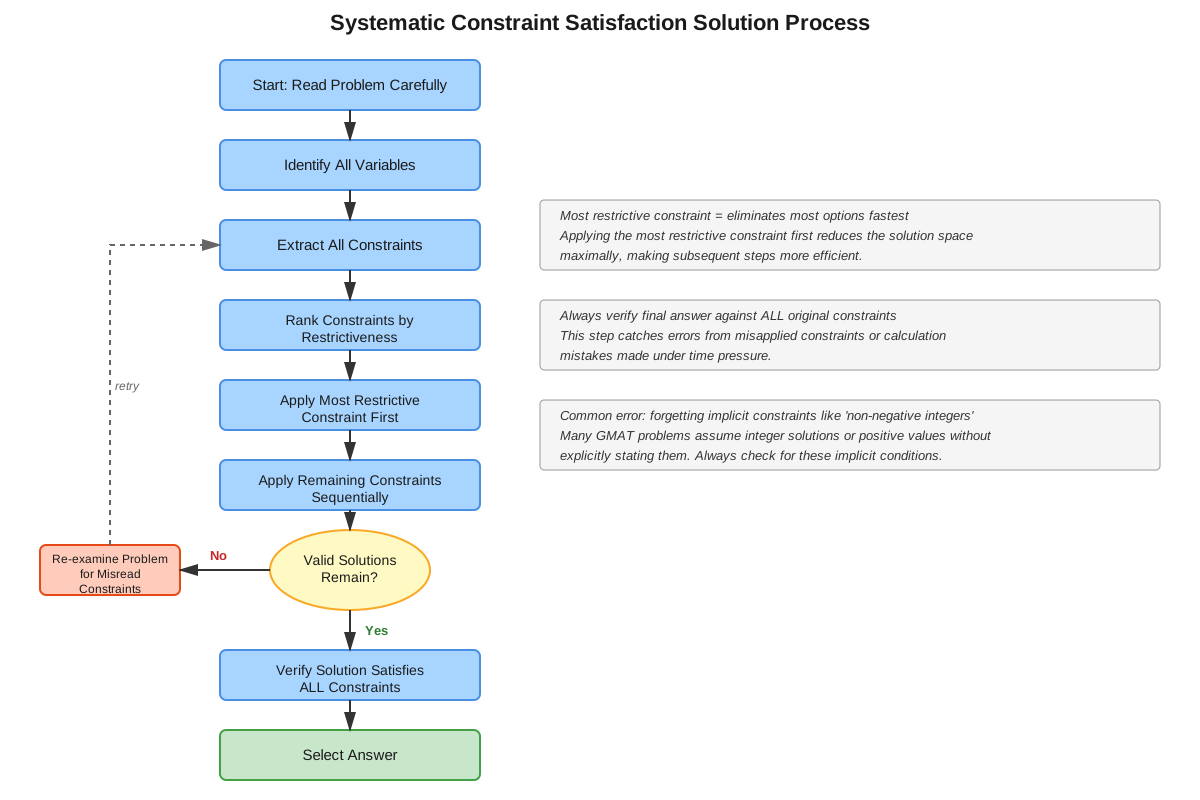
The Constraint Satisfaction Process
- Identify all variables: Determine what unknowns need to be found
- Define domains: Establish the possible values for each variable
- Extract all constraints: List every condition, including implicit ones
- Classify constraints: Determine which are most restrictive
- Apply constraint propagation: Use restrictive constraints to narrow domains
- Test remaining possibilities: Systematically verify candidates against all constraints
- Validate solution: Confirm the answer satisfies every single constraint
Common Constraint Types in GMAT Questions
Equality constraints specify exact relationships (X + Y = 100, 2X = 3Y). These are highly restrictive and often provide the most leverage for solving problems.
Inequality constraints establish ranges or orderings (X > Y, total ≤ 500). These define boundaries but leave more flexibility than equalities.
Logical constraints use conditional relationships (if X is selected, then Y cannot be selected). These create interdependencies that require careful tracking.
Distinctness constraints require variables to take different values (all employees must be different people). These are common in selection and assignment problems.
Membership constraints specify that values must come from particular sets (X must be prime, Y must be even). These directly restrict domains.
Concept Relationships
The core concepts within constraint satisfaction form a hierarchical problem-solving framework. The foundation begins with identifying variables and domains, which establishes the solution space. This leads to extracting and classifying constraints, which restrict that solution space. Constraint propagation then systematically narrows possibilities by applying restrictions in sequence, creating a cascade effect where each constraint application enables further narrowing.
The relationship flows: Variables + Domains → Constraints Applied → Domain Reduction → Constraint Propagation → Solution Identification → Validation. Understanding this flow prevents random trial-and-error and enables systematic problem-solving.
Constraint satisfaction connects to prerequisite topics through its reliance on algebraic manipulation (for equation-based constraints), logical reasoning (for conditional constraints), and set theory (for understanding domains and valid value spaces). It extends these foundations by requiring simultaneous consideration of multiple conditions rather than isolated problem-solving.
Within Data Insights, constraint satisfaction relates closely to optimization problems (finding best solutions within constraints), data sufficiency (determining whether constraints provide enough information), and table analysis (identifying rows satisfying multiple criteria). Mastering constraint satisfaction provides transferable skills for these related question types.
High-Yield Facts
- ⭐ Every valid solution must satisfy ALL constraints simultaneously—violating even one constraint makes a solution invalid
- ⭐ The most restrictive constraint should be applied first to eliminate the maximum number of possibilities quickly
- ⭐ GMAT constraint problems typically have exactly one or two valid solutions for each part of Two-Part Analysis questions
- ⭐ Implicit constraints are as important as explicit ones—watch for unstated assumptions like "values must be positive" or "variables must be distinct"
- ⭐ Constraint propagation creates cascading effects—applying one constraint often triggers automatic narrowing through other constraints
- Equality constraints are more restrictive than inequality constraints and should generally be prioritized
- Testing boundary values often reveals whether solutions exist in inequality-constrained problems
- Interdependent constraints require simultaneous consideration—solving for one variable in isolation may lead to contradictions
- Domain size directly affects solution strategy—small domains favor enumeration, large domains require analytical approaches
- Validation is mandatory—always verify final answers against every single constraint before selecting
- Time management requires recognizing constraint satisfaction patterns quickly—identifying the problem type saves 30-45 seconds per question
Quick check — test yourself on Constraint satisfaction so far.
Try Flashcards →Common Misconceptions
Misconception: Testing random values until finding one that works is an efficient strategy.
Correction: Random testing wastes time and risks missing solutions. Systematic constraint application, starting with the most restrictive constraint, eliminates invalid options efficiently and guarantees finding all valid solutions.
Misconception: If a value satisfies most constraints, it's probably correct even if one constraint seems violated.
Correction: A solution must satisfy ALL constraints without exception. Violating even a single constraint makes the solution completely invalid. GMAT questions are designed to include tempting options that satisfy all but one constraint.
Misconception: Constraints can be applied in any order without affecting efficiency.
Correction: Applying the most restrictive constraint first dramatically reduces the solution space, making subsequent constraints easier to evaluate. Starting with weak constraints leaves too many possibilities to track efficiently.
Misconception: All constraints are explicitly stated in the problem.
Correction: GMAT questions often include implicit constraints such as "values must be integers," "variables must be distinct," or "quantities must be non-negative." Missing implicit constraints leads to invalid solutions.
Misconception: Once you find one solution that works, you can stop checking.
Correction: Two-Part Analysis questions require finding values for BOTH parts, and each must be independently verified. Additionally, understanding why other options fail helps avoid careless errors and builds confidence in the selected answer.
Misconception: Algebraic manipulation alone is sufficient for solving constraint problems.
Correction: While algebra is important, constraint satisfaction requires logical reasoning, systematic enumeration, and strategic thinking about which constraints to apply first. Pure algebraic approaches often miss the most efficient solution path.
Worked Examples
Example 1: Employee Scheduling with Multiple Constraints
Problem: A manager must schedule two employees, one for the morning shift and one for the afternoon shift, from five available candidates: Alice, Bob, Carol, David, and Emma. The constraints are:
- Alice and Bob cannot work on the same day
- Carol can only work the morning shift
- David must work the afternoon shift if Emma works the morning shift
- The afternoon shift employee must have at least 2 years of experience
- Only Bob, David, and Emma have at least 2 years of experience
Who can work the morning shift, and who can work the afternoon shift?
Solution Process:
Step 1: Identify variables and domains
- Variable 1: Morning shift employee
- Variable 2: Afternoon shift employee
- Initial domain for both: {Alice, Bob, Carol, David, Emma}
Step 2: Apply the most restrictive constraints first
Constraint: "Carol can only work the morning shift" → Carol cannot work afternoon
Constraint: "Afternoon shift requires 2+ years experience" → Only {Bob, David, Emma} can work afternoon
This is highly restrictive! Afternoon domain is now {Bob, David, Emma}
Step 3: Apply constraint propagation
If Carol works morning, afternoon must be {Bob, David, Emma} ✓ (consistent)
If Alice works morning, afternoon must be {Bob, David, Emma} ✓ (consistent)
If Bob works morning, afternoon must be {David, Emma} (Bob excluded from afternoon)
If David works morning, afternoon must be {Bob, Emma} (David excluded from afternoon)
If Emma works morning, afternoon must be {Bob, David} (Emma excluded from afternoon)
Step 4: Apply remaining constraints
"Alice and Bob cannot work the same day":
- If Alice works morning, Bob cannot work afternoon → afternoon is {David, Emma}
- If Bob works morning, Alice cannot work afternoon (already excluded by experience requirement)
"David must work afternoon if Emma works morning":
- If Emma works morning, David MUST work afternoon (forced assignment)
Step 5: Systematic evaluation
Valid combinations:
- Morning: Alice, Afternoon: David ✓ (all constraints satisfied)
- Morning: Alice, Afternoon: Emma ✓ (all constraints satisfied)
- Morning: Bob, Afternoon: David ✓ (all constraints satisfied)
- Morning: Bob, Afternoon: Emma ✓ (all constraints satisfied)
- Morning: Carol, Afternoon: Bob ✓ (all constraints satisfied)
- Morning: Carol, Afternoon: David ✓ (all constraints satisfied)
- Morning: Carol, Afternoon: Emma ✓ (all constraints satisfied)
- Morning: David, Afternoon: Bob ✓ (all constraints satisfied)
- Morning: David, Afternoon: Emma ✓ (all constraints satisfied)
- Morning: Emma, Afternoon: David ✓ (forced by conditional constraint)
Key Insight: The experience constraint was most restrictive, immediately eliminating Alice and Carol from afternoon consideration. The conditional constraint (Emma → David) creates a forced pairing that must be recognized.
Example 2: Budget Allocation with Numerical Constraints
Problem: A company must allocate its $100,000 marketing budget between digital advertising (D) and traditional media (T). The constraints are:
- Total budget must be exactly $100,000
- Digital advertising must receive at least $40,000
- Traditional media must receive at least $25,000
- Digital advertising must receive at least 1.5 times what traditional media receives
- Both amounts must be multiples of $5,000
In a Two-Part Analysis format: What amount should be allocated to digital advertising, and what amount to traditional media?
Solution Process:
Step 1: Translate constraints into mathematical form
- D + T = 100,000 (equality constraint—most restrictive)
- D ≥ 40,000
- T ≥ 25,000
- D ≥ 1.5T
- D and T must be multiples of 5,000
Step 2: Use the equality constraint for substitution
D + T = 100,000 → D = 100,000 - T
Step 3: Substitute into inequality constraints
- 100,000 - T ≥ 40,000 → T ≤ 60,000
- T ≥ 25,000
- 100,000 - T ≥ 1.5T → 100,000 ≥ 2.5T → T ≤ 40,000
Step 4: Combine constraints to find T's domain
T must satisfy: 25,000 ≤ T ≤ 40,000 AND T is a multiple of 5,000
Possible values for T: {25,000, 30,000, 35,000, 40,000}
Step 5: Test each possibility against ALL constraints
T = 25,000 → D = 75,000
- Check: 75,000 ≥ 40,000 ✓
- Check: 75,000 ≥ 1.5(25,000) = 37,500 ✓
- Valid solution ✓
T = 30,000 → D = 70,000
- Check: 70,000 ≥ 40,000 ✓
- Check: 70,000 ≥ 1.5(30,000) = 45,000 ✓
- Valid solution ✓
T = 35,000 → D = 65,000
- Check: 65,000 ≥ 40,000 ✓
- Check: 65,000 ≥ 1.5(35,000) = 52,500 ✓
- Valid solution ✓
T = 40,000 → D = 60,000
- Check: 60,000 ≥ 40,000 ✓
- Check: 60,000 ≥ 1.5(40,000) = 60,000 ✓
- Valid solution ✓
Key Insight: The equality constraint enabled substitution, reducing two variables to one. The ratio constraint (D ≥ 1.5T) was the most restrictive inequality, establishing the upper bound for T. In a GMAT question, the answer choices would further narrow which of these valid solutions is correct for each part.
Exam Strategy
When approaching GMAT constraint satisfaction questions, begin by identifying the problem type immediately. Trigger phrases include "must satisfy," "subject to the following conditions," "given these restrictions," and "which combination meets all requirements." Recognizing these signals activates the systematic constraint satisfaction framework.
Read the entire problem before attempting to solve. Extract all constraints and list them explicitly, including implicit ones. GMAT questions deliberately hide constraints in complex sentence structures or bury them in the middle of long paragraphs. Missing even one constraint leads to incorrect answers.
Prioritize constraints by restrictiveness. Equality constraints are most restrictive, followed by narrow inequalities, then broad inequalities, then conditional statements. Apply the most restrictive constraint first to eliminate the maximum number of possibilities immediately. This strategy saves 30-60 seconds per question by avoiding unnecessary calculations.
Use the answer choices strategically. In Two-Part Analysis questions, the answer choices define the domain for each variable. If only five options are provided for each part, testing these specific values is often faster than solving algebraically. However, always verify against ALL constraints—GMAT questions include tempting wrong answers that satisfy all but one constraint.
Watch for interdependencies. When constraints involve multiple variables simultaneously, changing one variable affects others. Track these relationships carefully and avoid solving for variables in isolation. If the problem states "if X, then Y," remember that selecting X forces Y, but selecting Y doesn't necessarily force X.
Eliminate systematically using process of elimination. For each answer choice, identify which constraint it violates. If you can eliminate four of five options for one part of a Two-Part Analysis question, the remaining option must be correct (after verification). This approach is faster and more reliable than solving from scratch.
Time allocation: Spend 15-20 seconds reading and extracting constraints, 45-60 seconds applying constraints and narrowing possibilities, and 15-20 seconds validating your final answer. If you exceed 90 seconds total, you're likely not using the most efficient strategy—consider which constraint should have been applied first.
Memory Techniques
VDCPS Mnemonic for the constraint satisfaction process:
- Variables: Identify what you're solving for
- Domains: Determine possible values
- Constraints: Extract all restrictions
- Propagate: Apply constraints to narrow domains
- Solve: Test remaining possibilities and validate
"RESTRICT First" reminds you to apply the most Restrictive constraint first, which Eliminates the most possibilities, Saves Time, Reduces Invalid Choices, and Targets the solution efficiently.
The "ALL or FALL" rule: A solution must satisfy ALL constraints, or it will FALL (fail). This memorable phrase reinforces that partial satisfaction is insufficient.
Visualization strategy: Draw a simple table with variables as columns and possible values as rows. Cross out rows as constraints eliminate them. This visual representation prevents losing track of eliminated possibilities and makes the narrowing process concrete.
The "3-2-1 Check": Before selecting your answer, verify it against (3) the most restrictive constraint, (2) any conditional constraints, and (1) the constraint you're most likely to have overlooked. This three-step validation catches 90% of careless errors.
Summary
Constraint satisfaction is a systematic problem-solving framework essential for GMAT Data Insights success, particularly in Two-Part Analysis questions. It requires identifying variables, defining their possible values (domains), extracting all constraints (both explicit and implicit), and finding solutions that simultaneously satisfy every restriction. The key to efficiency lies in applying the most restrictive constraints first, using constraint propagation to create cascading elimination effects, and systematically validating solutions against all conditions. GMAT constraint problems typically involve 2-4 variables with 3-5 constraints, requiring test-takers to balance multiple interdependent conditions while managing time pressure. Success depends on recognizing the problem type quickly, avoiding random trial-and-error in favor of strategic constraint application, and remembering that valid solutions must satisfy ALL constraints without exception. This topic appears in 15-20% of Data Insights questions and directly tests analytical skills valued in business decision-making, making it one of the highest-yield areas for focused preparation.
Key Takeaways
- Constraint satisfaction problems require finding solutions that simultaneously satisfy ALL given restrictions—violating even one constraint invalidates the solution
- Apply the most restrictive constraint first to eliminate the maximum number of possibilities quickly and efficiently
- Constraint propagation creates cascading effects where applying one constraint automatically narrows possibilities for other variables
- Both explicit and implicit constraints matter—watch for unstated assumptions about integer values, positive quantities, or distinct variables
- Systematic validation is mandatory—always verify final answers against every single constraint before selecting
- Recognition speed is critical—identifying constraint satisfaction problems immediately saves 30-45 seconds per question
- GMAT questions deliberately include tempting wrong answers that satisfy all but one constraint, making thorough checking essential
Related Topics
Optimization Problems: Building on constraint satisfaction, optimization questions ask for the "best" or "maximum" solution within given constraints, adding an objective function to the framework. Mastering constraint satisfaction provides the foundation for understanding feasible solution spaces before optimizing.
Linear Programming: An advanced application of constraint satisfaction involving multiple linear inequalities and optimization objectives, occasionally appearing in higher-difficulty Data Insights questions.
Logic Games and Sequencing: These problems use constraint satisfaction principles applied to ordering, grouping, and assignment tasks, common in analytical reasoning sections.
Data Sufficiency: Understanding constraints helps determine whether given information is sufficient to uniquely determine a solution, a core skill for Data Sufficiency questions.
Multi-Source Reasoning: These questions require synthesizing information from multiple sources, often involving constraint satisfaction when data from different tabs must be reconciled.
Practice CTA
Now that you've mastered the framework for constraint satisfaction, it's time to apply these strategies to real GMAT-style questions. The practice questions and flashcards will reinforce your ability to identify constraints quickly, apply them systematically, and validate solutions efficiently. Remember: constraint satisfaction is one of the highest-yield topics in Data Insights, and consistent practice transforms these systematic approaches into automatic responses under test conditions. Challenge yourself to complete the practice set, focusing on speed and accuracy. Each question you solve strengthens the neural pathways that will serve you on test day. You've got this!
Sign up free to keep reading
Create a free AnvayaPrep account to finish this GMAT guide on Constraint satisfaction — plus flashcards and practice questions.