Overview
Inequalities are mathematical statements that compare two expressions using symbols such as greater than (>), less than (<), greater than or equal to (≥), or less than or equal to (≤). Unlike equations that assert equality, inequalities describe a range of possible values that satisfy a given condition. On the GMAT, GMAT inequalities represent one of the most frequently tested algebraic concepts, appearing in approximately 15-20% of Quantitative Reasoning questions across both Problem Solving and Data Sufficiency formats.
Mastering inequalities is essential for GMAT success because they form the foundation for understanding ranges, constraints, and optimization problems that appear throughout the exam. Inequality questions test not only computational skills but also logical reasoning, particularly the ability to manipulate algebraic expressions while preserving the direction of inequality relationships. The GMAT specifically targets common conceptual errors, such as forgetting to flip the inequality sign when multiplying or dividing by negative numbers, making this topic a high-yield area for score improvement.
Within the broader Quantitative Reasoning framework, inequalities connect directly to absolute value problems, number properties, coordinate geometry, and word problems involving constraints. They also appear frequently in Data Sufficiency questions where test-takers must determine whether given information is sufficient to establish a specific range or relationship. Understanding inequalities provides the analytical tools needed to tackle complex multi-step problems and to recognize when seemingly different mathematical statements are actually equivalent.
Learning Objectives
- [ ] Identify inequalities in various mathematical contexts and problem formats
- [ ] Explain the properties and rules governing inequality manipulation
- [ ] Apply inequalities to GMAT questions in both Problem Solving and Data Sufficiency formats
- [ ] Solve compound inequalities and systems involving multiple inequality constraints
- [ ] Determine when to reverse inequality signs during algebraic manipulation
- [ ] Analyze Data Sufficiency questions involving inequalities to assess statement sufficiency
- [ ] Recognize and avoid common inequality manipulation errors under time pressure
Prerequisites
- Basic algebraic manipulation: Understanding how to add, subtract, multiply, and divide algebraic expressions is essential for performing valid operations on both sides of an inequality
- Number line concepts: Visualizing numbers on a number line helps interpret inequality solutions and understand the meaning of "greater than" and "less than" relationships
- Equation solving: Since inequalities follow similar manipulation rules to equations (with key exceptions), proficiency in solving linear equations provides the foundation for inequality work
- Negative number properties: Recognizing how operations with negative numbers affect inequality directions is critical for avoiding the most common errors
Why This Topic Matters
Inequalities appear in numerous real-world contexts, from business constraints (budget limitations, minimum production requirements) to scientific applications (acceptable ranges for measurements, tolerance levels). In finance, inequalities describe profit thresholds, break-even analysis, and investment constraints. Understanding inequalities develops critical thinking skills about ranges, boundaries, and optimization—capabilities that extend far beyond standardized testing.
On the GMAT specifically, inequality questions appear in approximately 3-5 questions per exam, making them one of the highest-frequency algebra topics. They manifest in multiple question types: direct inequality solving, word problems with constraints, absolute value problems, Data Sufficiency questions about ranges, and optimization scenarios. The GMAT particularly favors questions that combine inequalities with other concepts such as number properties (testing whether x is positive or negative), absolute values, or systems of equations.
Data Sufficiency questions involving inequalities are especially common and challenging because they require understanding not just how to solve inequalities, but also what information is necessary and sufficient to determine a specific range or relationship. These questions often test whether a student can recognize that knowing "x > 5" is fundamentally different from knowing "x = 6," and whether given statements narrow down possibilities sufficiently to answer the question asked.
Core Concepts
Basic Inequality Symbols and Notation
The four fundamental inequality symbols form the basis of all inequality work:
- > (greater than): indicates the left expression has a larger value than the right
- < (less than): indicates the left expression has a smaller value than the right
- ≥ (greater than or equal to): indicates the left expression is either larger than or equal to the right
- ≤ (less than or equal to): indicates the left expression is either smaller than or equal to the right
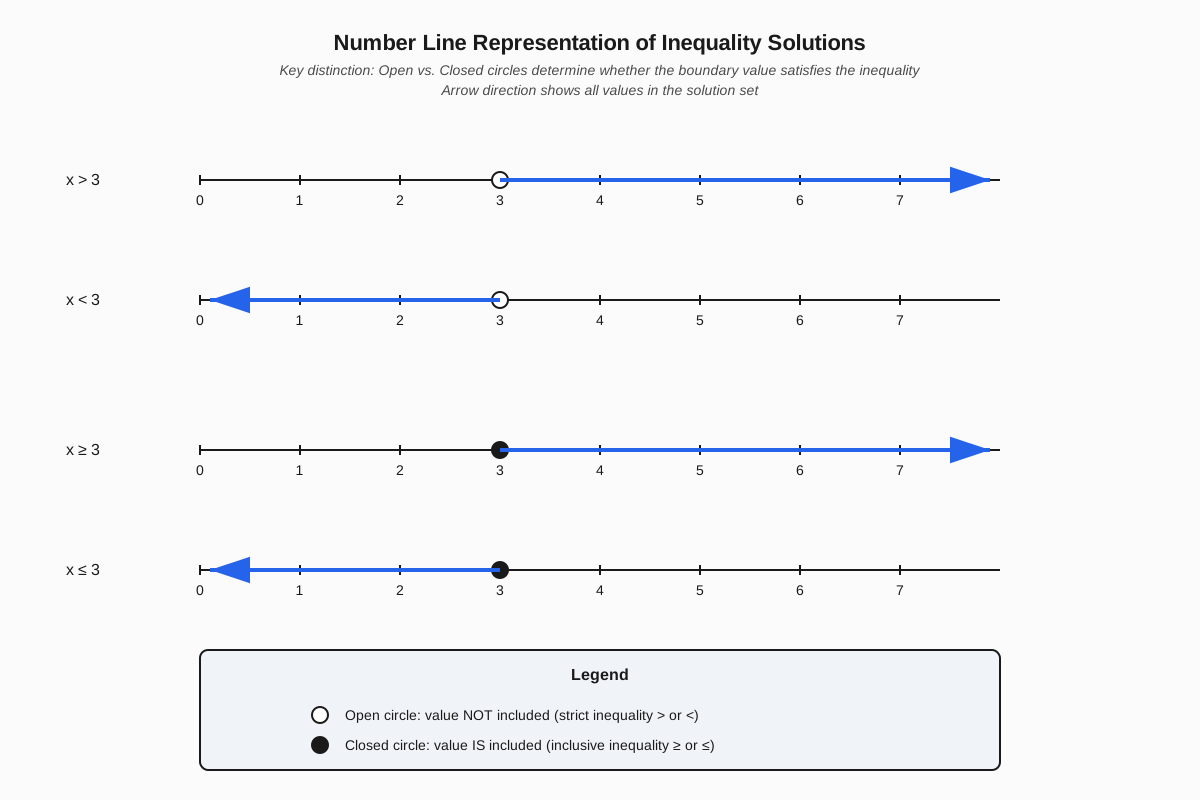
The distinction between strict inequalities (> and <) and non-strict inequalities (≥ and ≤) is crucial on the GMAT. Strict inequalities exclude the boundary value, while non-strict inequalities include it. For example, x > 3 means x could be 3.1, 4, or 100, but not 3 itself, whereas x ≥ 3 includes 3 as a valid solution.
Fundamental Properties of Inequalities
Addition and Subtraction Property: Adding or subtracting the same value to both sides of an inequality preserves the inequality direction. If a > b, then a + c > b + c and a - c > b - c for any real number c.
Example: If x + 5 > 12, subtracting 5 from both sides yields x > 7.
Multiplication and Division by Positive Numbers: Multiplying or dividing both sides by a positive number preserves the inequality direction. If a > b and c > 0, then ac > bc and a/c > b/c.
Example: If 3x < 15, dividing both sides by 3 yields x < 5.
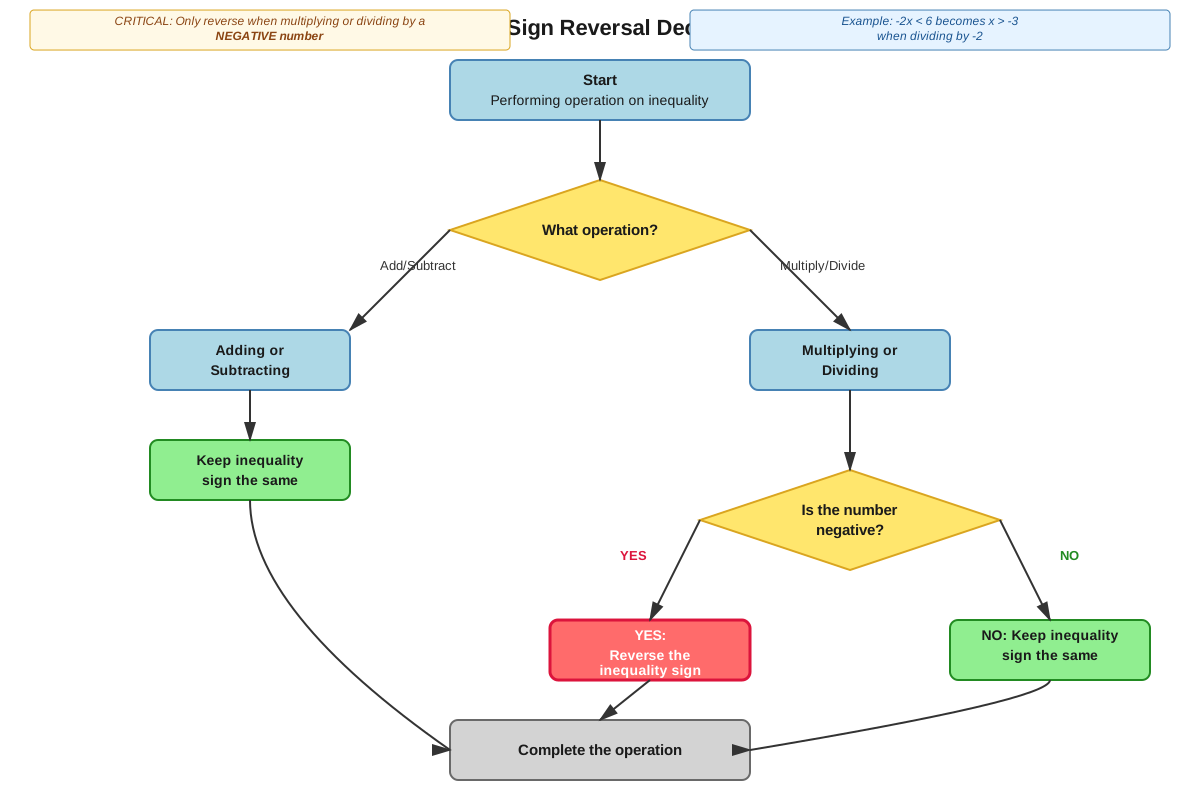
Multiplication and Division by Negative Numbers: This is the most critical rule for GMAT success. When multiplying or dividing both sides of an inequality by a negative number, the inequality sign must be reversed. If a > b and c < 0, then ac < bc and a/c < b/c.
Example: If -2x > 10, dividing both sides by -2 requires flipping the sign: x < -5.
Transitive Property: If a > b and b > c, then a > c. This property allows chaining of inequalities and is frequently tested in Data Sufficiency questions.
Reciprocal Property: When taking reciprocals of both sides, the inequality reverses if both numbers are positive or both are negative. If 0 < a < b, then 1/a > 1/b. However, if a and b have different signs, the relationship becomes more complex and requires careful analysis.
Solving Linear Inequalities
Solving linear inequalities follows a process nearly identical to solving linear equations, with careful attention to sign reversal rules:
- Simplify both sides by combining like terms
- Isolate the variable term on one side using addition/subtraction
- Isolate the variable by multiplying/dividing, reversing the sign if multiplying/dividing by a negative
- Express the solution in interval notation or inequality notation
Example: Solve 3(x - 4) ≤ 2x + 7
3(x - 4) ≤ 2x + 7
3x - 12 ≤ 2x + 7
3x - 2x ≤ 7 + 12
x ≤ 19
Compound Inequalities
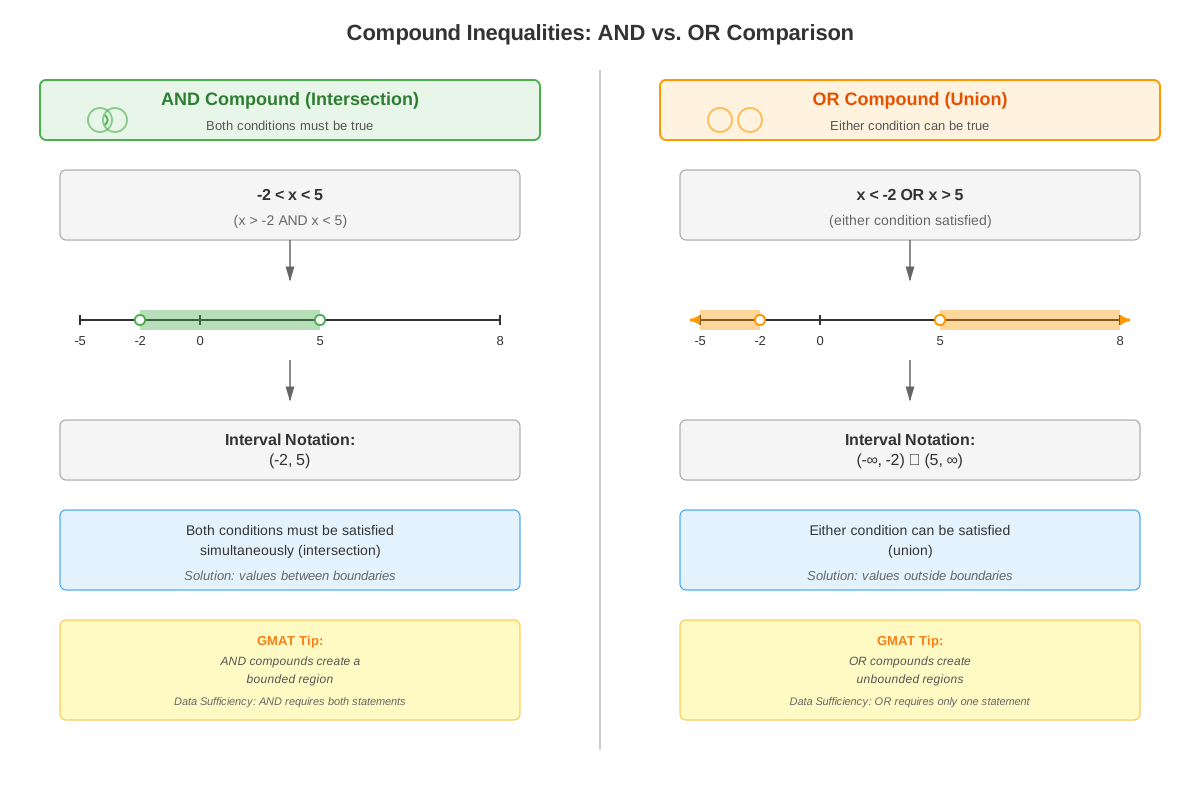
Compound inequalities involve two inequality statements connected by "and" or "or." The most common GMAT format is the "and" type, written as a three-part inequality: a < x < b, meaning x is simultaneously greater than a and less than b.
To solve compound inequalities like 2 < 3x - 4 ≤ 11:
- Treat this as two separate inequalities: 2 < 3x - 4 AND 3x - 4 ≤ 11
- Solve each part: 6 < 3x AND 3x ≤ 15
- Simplify: 2 < x AND x ≤ 5
- Combine: 2 < x ≤ 5
Alternatively, perform the same operation on all three parts simultaneously:
2 < 3x - 4 ≤ 11
6 < 3x ≤ 15
2 < x ≤ 5
Inequalities with Absolute Values
Absolute value inequalities require splitting into cases based on the definition of absolute value. For |x| < a (where a > 0), the solution is -a < x < a. For |x| > a, the solution is x < -a OR x > a.
Example: Solve |2x - 3| < 5
This means -5 < 2x - 3 < 5, which solves to -2 < 2x < 8, yielding -1 < x < 4.
Systems of Inequalities
When multiple inequalities must be satisfied simultaneously, the solution is the intersection of all individual solution sets. Graphically, this represents the overlapping region of all constraints.
Example: If x > 3 AND x ≤ 7, the solution is 3 < x ≤ 7.
Special Cases and Boundary Conditions
Testing boundary values is crucial for GMAT Data Sufficiency questions. When an inequality includes variables in denominators or under even roots, domain restrictions apply. For instance, in the inequality 1/x > 2, x must be positive (if x were negative, 1/x would be negative and couldn't be greater than 2). Solving yields x < 1/2, but combined with the requirement that x > 0, the solution is 0 < x < 1/2.
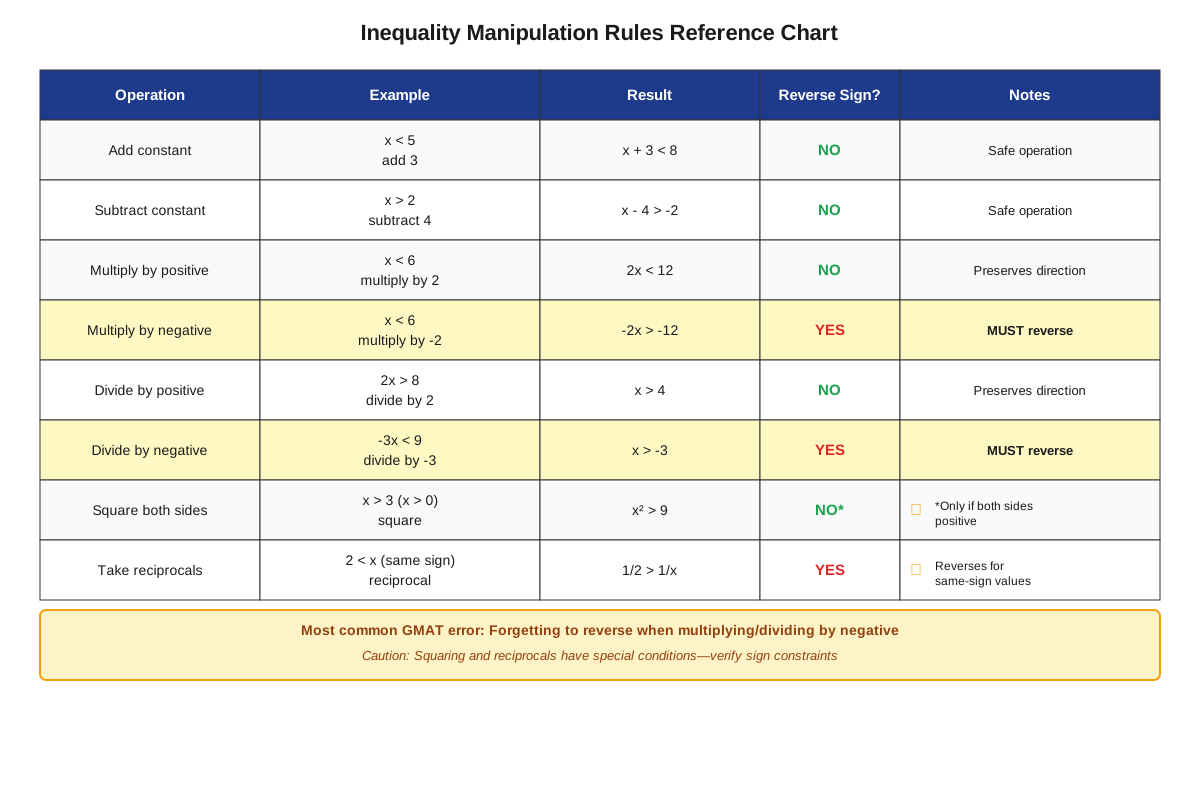
| Operation | Effect on Inequality | Example |
|---|---|---|
| Add/subtract any number | No change in direction | x > 5 → x + 3 > 8 |
| Multiply/divide by positive | No change in direction | x > 5 → 2x > 10 |
| Multiply/divide by negative | Reverse direction | x > 5 → -x < -5 |
| Square both sides (both positive) | No change if both sides positive | x > 5 → x² > 25 (valid only if x > 0) |
| Take reciprocals (both positive) | Reverse direction | 0 < x < 5 → 1/x > 1/5 |
Concept Relationships
The core concepts within inequalities build upon each other in a logical progression. Basic inequality symbols and notation form the foundation → which enables understanding of fundamental properties → which are then applied to solving linear inequalities → which extend to compound inequalities when multiple constraints exist simultaneously → and further generalize to absolute value inequalities and systems of inequalities.
The critical connection point is the multiplication/division by negative numbers rule, which appears in nearly every other concept. Understanding when and why to reverse inequality signs connects directly to solving linear inequalities, compound inequalities, and systems. This rule also links to prerequisite knowledge of negative number properties.
Inequalities connect to other GMAT topics extensively. They relate to number properties when determining whether expressions are positive or negative, to absolute value problems which are essentially compound inequalities in disguise, to coordinate geometry where inequalities define regions of the plane, and to word problems where constraints naturally express as inequalities. In Data Sufficiency, inequalities connect to logical reasoning because determining sufficiency often requires understanding what ranges of values are possible versus what specific values are known.
The relationship map: Basic Symbols → Properties → Linear Solving → Compound Forms → Absolute Value Applications → Systems → Data Sufficiency Analysis → Integration with Number Properties and Word Problems.
Quick check — test yourself on Inequalities so far.
Try Flashcards →High-Yield Facts
⭐ When multiplying or dividing both sides of an inequality by a negative number, the inequality sign must be reversed.
⭐ For Data Sufficiency, knowing a range (x > 5) is fundamentally different from knowing a specific value (x = 6); assess whether the question requires a specific value or just a range.
⭐ The solution to |x| < a is -a < x < a (a compound "and" inequality), while |x| > a yields x < -a OR x > a (two separate regions).
⭐ When solving compound inequalities like a < bx + c < d, perform the same operation to all three parts simultaneously to maintain the relationships.
⭐ Adding inequalities in the same direction is valid (if a > b and c > d, then a + c > b + d), but subtracting requires reversing one inequality first.
- Multiplying both sides of an inequality by zero yields 0 = 0, losing all information about the original relationship.
- When both sides of an inequality are positive, squaring preserves the direction; when signs are unknown or mixed, squaring can reverse relationships.
- The reciprocal of a positive number less than 1 is greater than 1; the reciprocal of a positive number greater than 1 is less than 1.
- In Data Sufficiency, if a statement provides an inequality and the question asks "Is x > 5?", the statement is sufficient only if it definitively proves x > 5 (always yes) or definitively proves x ≤ 5 (always no).
- Inequalities with variables in denominators require considering domain restrictions; x/y > 2 has different solutions depending on whether y is positive or negative.
- When testing whether an inequality is true for specific values, boundary values (the endpoints) are the most revealing test cases.
Common Misconceptions
Misconception: When dividing both sides by a variable, the inequality sign stays the same regardless of the variable's value.
Correction: Dividing by a variable requires considering two cases—one where the variable is positive (sign stays the same) and one where it's negative (sign reverses). This is why GMAT Data Sufficiency questions often hinge on whether you know the sign of a variable.
Misconception: If x² > 25, then x > 5.
Correction: If x² > 25, then x > 5 OR x < -5. Squaring creates two possibilities because both positive and negative numbers can have squares greater than 25. For example, x = -6 satisfies x² > 25 but not x > 5.
Misconception: The solution to |x| > -3 is x > 3 or x < -3.
Correction: Since absolute values are always non-negative, |x| ≥ 0 for all real x. Therefore, |x| > -3 is true for all real numbers. The solution is all real numbers, not a split case.
Misconception: In Data Sufficiency, if Statement 1 gives x > 5 and the question asks "What is the value of x?", Statement 1 is sufficient.
Correction: Statement 1 is insufficient because it provides a range of infinitely many possible values, not a single specific value. Sufficiency requires being able to answer the question definitively, which means determining one unique value when asked "what is the value."
Misconception: You can multiply both sides of an inequality by (x - 3) without considering whether (x - 3) is positive or negative.
Correction: Multiplying by an expression containing a variable requires case analysis. If x > 3, then (x - 3) is positive and the sign stays the same. If x < 3, then (x - 3) is negative and the sign must reverse. If x = 3, you're multiplying by zero, which is invalid for solving.
Misconception: If a > b, then a² > b².
Correction: This is only true when both a and b are positive. If a = 1 and b = -2, then a > b but a² = 1 < 4 = b². The relationship between squares depends on the signs and magnitudes of the original numbers.
Misconception: Solving 1/x < 1/y means x > y.
Correction: The relationship depends on the signs of x and y. If both are positive, then 1/x < 1/y implies x > y. If both are negative, the relationship still holds. But if they have different signs, the inequality relationship is more complex and requires careful analysis of which is positive and which is negative.
Worked Examples
Example 1: Linear Inequality with Negative Coefficient
Problem: Solve for x: -3(2x - 5) ≥ 4x + 7
Solution:
Step 1: Distribute the -3 on the left side.
-6x + 15 ≥ 4x + 7Step 2: Collect variable terms on one side by subtracting 4x from both sides.
-6x - 4x + 15 ≥ 7
-10x + 15 ≥ 7
Step 3: Isolate the variable term by subtracting 15 from both sides.
-10x ≥ 7 - 15
-10x ≥ -8
Step 4: Divide both sides by -10. Critical step: Since we're dividing by a negative number, we must reverse the inequality sign.
x ≤ -8/-10
x ≤ 4/5Answer: x ≤ 0.8 or x ≤ 4/5
This problem directly addresses the learning objective of applying inequality manipulation rules, specifically the sign-reversal rule when dividing by negatives. The GMAT frequently tests whether students remember this crucial step under time pressure.
Example 2: Data Sufficiency with Compound Inequality
Problem: Is x > 10?
Statement (1): 3x - 7 > 23
Statement (2): 2x + 5 < 35
Solution:
Analyzing Statement (1):
3x - 7 > 23
3x > 30
x > 10
Statement (1) tells us definitively that x > 10, which directly answers "yes" to the question. Statement (1) is SUFFICIENT.
Analyzing Statement (2):
2x + 5 < 35
2x < 30
x < 15
Statement (2) tells us x < 15, which means x could be 11 (making the answer "yes") or x could be 9 (making the answer "no"). Since we cannot definitively answer the question, Statement (2) is INSUFFICIENT.
Answer: A (Statement 1 alone is sufficient, but Statement 2 alone is not sufficient)
This example demonstrates the critical Data Sufficiency skill of recognizing that sufficiency requires a definitive answer, not just information about x. Statement (1) proves x must be greater than 10 (always "yes"), while Statement (2) leaves the question ambiguous. This addresses the learning objective of applying inequalities to GMAT questions and assessing statement sufficiency.
Example 3: Absolute Value Inequality
Problem: For what values of x is |3x - 6| < 12?
Solution:
Step 1: Recognize this is an absolute value inequality of the form |expression| < positive number, which translates to a compound inequality.
|3x - 6| < 12 means -12 < 3x - 6 < 12Step 2: Solve the compound inequality by performing the same operations on all three parts.
Add 6 to all parts:
-12 + 6 < 3x - 6 + 6 < 12 + 6
-6 < 3x < 18
Step 3: Divide all parts by 3 (positive number, so no sign reversal).
-2 < x < 6Answer: -2 < x < 6, or in interval notation: (-2, 6)
This can be verified by testing boundary and interior values. At x = 0 (inside the range): |3(0) - 6| = |-6| = 6 < 12 ✓. At x = -2 (boundary): |3(-2) - 6| = |-12| = 12, which is not less than 12 ✓. At x = 7 (outside the range): |3(7) - 6| = |15| = 15, which is not less than 12 ✓.
Exam Strategy
When approaching GMAT inequalities questions, begin by identifying the question type: Problem Solving requires finding a specific solution or range, while Data Sufficiency requires determining whether given information is sufficient to answer the question. This distinction fundamentally changes your approach.
Trigger words and phrases to watch for include: "at least" (≥), "at most" (≤), "more than" (>), "less than" (<), "between" (compound inequality), "range of values," "maximum," "minimum," and "constraint." In Data Sufficiency, phrases like "what is the value" versus "what is the range" signal whether you need a specific number or just boundary information.
Process-of-elimination strategies specific to inequalities:
- Sign checking: Immediately eliminate answer choices that violate sign rules. If you divided by a negative and an answer choice doesn't reflect a reversed inequality, eliminate it.
- Boundary testing: For Problem Solving, test the boundary values of answer choices in the original inequality. If an answer claims x > 5, test x = 5 and x = 6 to verify.
- Special value testing: In Data Sufficiency, test extreme values (very large positive, very large negative, zero, fractions between 0 and 1) to see if they yield different answers to the question.
- Domain awareness: Eliminate choices that ignore domain restrictions (like dividing by zero or taking square roots of negative numbers).
Time allocation advice: Straightforward linear inequality problems should take 60-90 seconds. Data Sufficiency questions with inequalities typically require 90-120 seconds because you must analyze two statements and potentially combine them. If you find yourself doing extensive algebraic manipulation beyond 2 minutes, you may be missing a conceptual shortcut—consider whether you can test values instead of solving algebraically.
For Data Sufficiency specifically, remember the sufficiency threshold: a statement is sufficient only if it allows you to answer the question with certainty (always "yes" or always "no"), not just sometimes. Many incorrect answers result from thinking "I have information about x" means "I have sufficient information," when the question requires a specific value but you only have a range.
Memory Techniques
FLIP mnemonic for the sign-reversal rule: Flip the Less-than or greater-than sign when you Involve a Product or quotient with a negative number. This reminds you that multiplication and division by negatives require flipping the inequality direction.
"Absolute value splits" visualization: Picture absolute value inequalities as splitting into two scenarios. For |x| < a, imagine the number line with a fence at -a and +a, and x is trapped between them. For |x| > a, imagine x escaping beyond both fences—either far left or far right.
SAND acronym for inequality operations: Same direction when Adding or subtracting, No change when multiplying/dividing by positive, Direction reverses when multiplying/dividing by negative.
The Reciprocal Flip: Remember that reciprocals flip both the inequality direction AND the relative positions. If 0 < a < b, then 1/a > 1/b. Visualize this: smaller positive numbers have bigger reciprocals (1/2 = 0.5, but 1/10 = 0.1, so 2 < 10 but 1/2 > 1/10).
Data Sufficiency Range vs. Value: Create a mental image of a target. A specific value hits the bullseye (sufficient for "what is the value" questions), while a range is like hitting somewhere on the target (insufficient for "what is the value" but potentially sufficient for "is x in this range" questions).
Summary
Inequalities represent mathematical relationships where one expression is greater than, less than, or equal to another, forming a critical component of GMAT Quantitative Reasoning. The fundamental skill is manipulating inequalities while preserving their truth—adding or subtracting any value maintains the direction, multiplying or dividing by positive numbers maintains the direction, but multiplying or dividing by negative numbers requires reversing the inequality sign. Compound inequalities combine multiple constraints simultaneously, while absolute value inequalities split into two cases based on the definition of absolute value. On the GMAT, inequalities appear in both Problem Solving (requiring solution of ranges) and Data Sufficiency (requiring assessment of whether information is sufficient to determine a range or specific value). Success requires not just computational accuracy but also conceptual understanding of when inequalities provide sufficient information versus when they leave ambiguity. The most common errors involve forgetting to reverse signs when multiplying/dividing by negatives, incorrectly handling absolute values, and misjudging sufficiency in Data Sufficiency questions by confusing range information with specific values.
Key Takeaways
- Inequalities describe ranges of values rather than specific solutions, requiring different analytical approaches than equations
- The cardinal rule: reverse the inequality sign when multiplying or dividing both sides by a negative number—this is the most frequently tested concept
- Absolute value inequalities split into compound forms: |x| < a becomes -a < x < a, while |x| > a becomes x < -a OR x > a
- In Data Sufficiency, a range of values (x > 5) is fundamentally different from a specific value (x = 6); assess what the question actually requires
- Test boundary values and special cases (negative numbers, fractions, zero) to verify solutions and eliminate incorrect answer choices
- Compound inequalities can be solved by performing the same operation on all parts simultaneously while respecting sign-reversal rules
- Domain restrictions matter: variables in denominators or under even roots create constraints that must be incorporated into final solutions
Related Topics
Absolute Value Equations and Inequalities: Building directly on inequality foundations, this topic explores the geometric interpretation of absolute value as distance and develops advanced techniques for solving complex absolute value problems that appear frequently on the GMAT.
Systems of Linear Equations and Inequalities: Extends single-inequality concepts to multiple simultaneous constraints, connecting to optimization problems and graphical representations in the coordinate plane—essential for higher-level GMAT questions.
Quadratic Inequalities: Applies inequality principles to quadratic expressions, requiring understanding of parabola behavior and sign analysis across different regions—a more advanced topic that builds on linear inequality mastery.
Number Properties and Inequalities: Integrates inequality reasoning with divisibility, prime numbers, and integer constraints, creating the complex hybrid problems that distinguish high scorers on the GMAT.
Optimization and Word Problems: Translates real-world constraint scenarios into mathematical inequalities, developing the critical skill of converting verbal descriptions into algebraic representations—the ultimate application of inequality concepts.
Practice CTA
Now that you've mastered the core concepts of inequalities, it's time to solidify your understanding through active practice. Attempt the practice questions to apply these principles under exam-like conditions, focusing on both computational accuracy and strategic decision-making. Use the flashcards to reinforce the critical rules—especially the sign-reversal rule—until they become automatic. Remember, the difference between a good GMAT score and a great one often comes down to mastering high-frequency topics like inequalities. Every practice problem you solve builds the pattern recognition and confidence you'll need on test day. You've got this!
Sign up free to keep reading
Create a free AnvayaPrep account to finish this GMAT guide on Inequalities — plus flashcards and practice questions.