Overview
The two-part strategy represents a systematic approach to solving GMAT Two-Part Analysis questions, one of the most distinctive question types in the Data Insights section. Unlike traditional multiple-choice questions that require selecting a single answer, Two-Part Analysis questions present scenarios where test-takers must simultaneously solve for two related but distinct components. These questions assess the ability to analyze complex relationships, manage multiple constraints, and make interdependent decisions—skills that mirror real-world business and analytical challenges.
Mastering the GMAT two-part strategy is essential because these questions appear regularly in the Data Insights section and often combine quantitative reasoning, logical analysis, and verbal interpretation within a single problem. The strategic approach involves understanding the relationship between the two parts, determining whether they are independent or interdependent, and systematically evaluating answer choices to ensure both selections satisfy all given conditions. Students who develop a structured methodology for these questions significantly improve their accuracy and efficiency.
Within the broader Data Insights framework, Two-Part Analysis questions bridge multiple analytical skills. They require the integration of problem-solving techniques from quantitative reasoning, the logical evaluation skills from critical reasoning, and sometimes the data interpretation abilities from table analysis and graphics interpretation. The two-part strategy serves as a unifying framework that helps test-takers navigate these multifaceted problems with confidence and precision.
Learning Objectives
- [ ] Identify Two-part strategy and recognize when to apply it in GMAT questions
- [ ] Explain Two-part strategy components and the systematic approach to solving two-part problems
- [ ] Apply Two-part strategy to GMAT questions across various content domains
- [ ] Distinguish between independent and interdependent two-part relationships
- [ ] Evaluate answer choices systematically using constraint-based elimination
- [ ] Synthesize information from multiple sources (text, tables, graphs) to solve two-part problems
- [ ] Optimize time management when approaching complex two-part scenarios
Prerequisites
- Basic algebra and equation solving: Required to manipulate variables and solve for unknown quantities in quantitative two-part problems
- Logical reasoning fundamentals: Necessary to understand conditional statements and evaluate whether answer choices satisfy given constraints
- Data interpretation skills: Essential for extracting relevant information from tables, charts, and text-based scenarios
- Arithmetic operations and number properties: Needed to perform calculations and verify numerical relationships between the two parts
- Reading comprehension: Critical for understanding complex scenarios and identifying what each part of the question is asking
Why This Topic Matters
Two-Part Analysis questions represent approximately 15-20% of the Data Insights section, making them a high-frequency question type that significantly impacts overall GMAT scores. These questions are particularly valuable for business schools because they simulate real-world decision-making scenarios where multiple interdependent factors must be considered simultaneously—such as optimizing both cost and quality, balancing risk and return, or satisfying multiple stakeholder requirements.
In professional contexts, the analytical skills tested by two-part problems appear constantly: financial analysts must simultaneously consider revenue and expense projections, operations managers must balance capacity and demand, and consultants must evaluate multiple solution dimensions. The GMAT uses these questions to assess whether candidates can handle the complexity of multivariable decision-making under time pressure.
On the exam, Two-Part Analysis questions commonly appear in several formats: quantitative problems requiring two numerical solutions, verbal logic problems requiring two conclusions or inferences, integrated reasoning scenarios combining numerical and categorical selections, and optimization problems where two variables must be determined. The questions typically present a scenario followed by a table with answer choices in the left column and two selection columns on the right, where test-takers must select one answer for each part. Understanding the strategic approach to these questions is crucial because random guessing yields only a 1-in-25 chance of getting both parts correct (assuming five answer choices), making systematic problem-solving essential for success.
Core Concepts
Understanding Two-Part Analysis Structure
Two-Part Analysis questions present a unique format that distinguishes them from all other GMAT question types. The standard structure includes a scenario or problem statement that provides context and constraints, followed by a question stem that explicitly defines what must be determined for Part 1 and Part 2. Below this appears a table format with answer choices listed in rows and two columns for selections—one for each part of the question.
The critical insight is that both parts must be answered from the same set of answer choices, but each choice can only be selected once (one for Part 1, one for Part 2). This constraint means that if a particular value or option is selected for Part 1, it cannot also be selected for Part 2, even if it might otherwise satisfy the requirements. This structural feature fundamentally shapes the strategic approach to these questions.
Independent vs. Interdependent Relationships
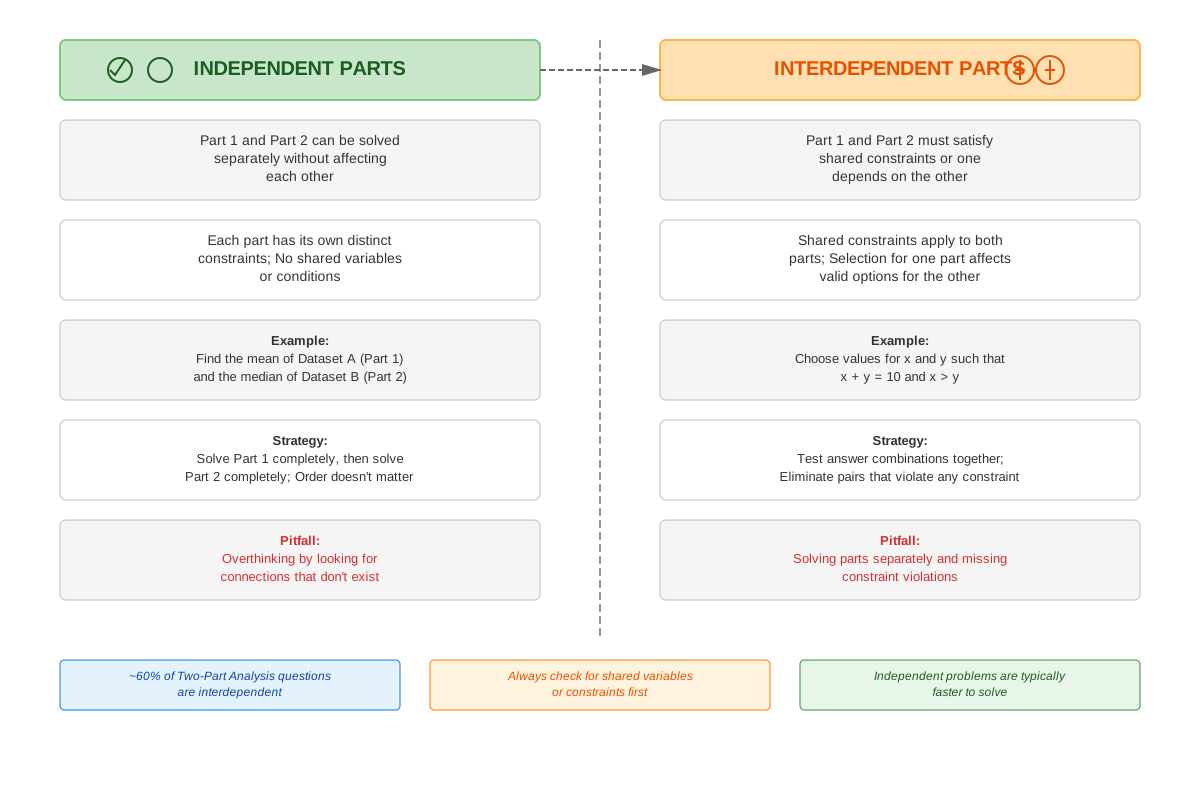
The relationship between the two parts represents the most important strategic consideration. Independent two-part questions ask for two separate pieces of information that do not directly affect each other. For example, a question might ask for the minimum value that satisfies one condition (Part 1) and the maximum value that satisfies a different condition (Part 2). These can often be solved sequentially, determining each part separately.
Interdependent two-part questions require selections where the two parts directly influence each other or must work together to satisfy a combined constraint. For example, finding two numbers that sum to a specific value, or identifying a cause-and-effect pair, or selecting two components that together optimize an outcome. These questions require simultaneous consideration of both parts and often necessitate testing combinations of answer choices.
| Relationship Type | Characteristics | Strategic Approach |
|---|---|---|
| Independent | Parts can be solved separately; no direct interaction | Solve each part individually, then verify no conflict |
| Interdependent | Parts must work together; combined constraint exists | Test combinations systematically; use elimination |
| Partially Dependent | One part constrains the other, but not vice versa | Solve the constraining part first, then the dependent part |
The Systematic Evaluation Process
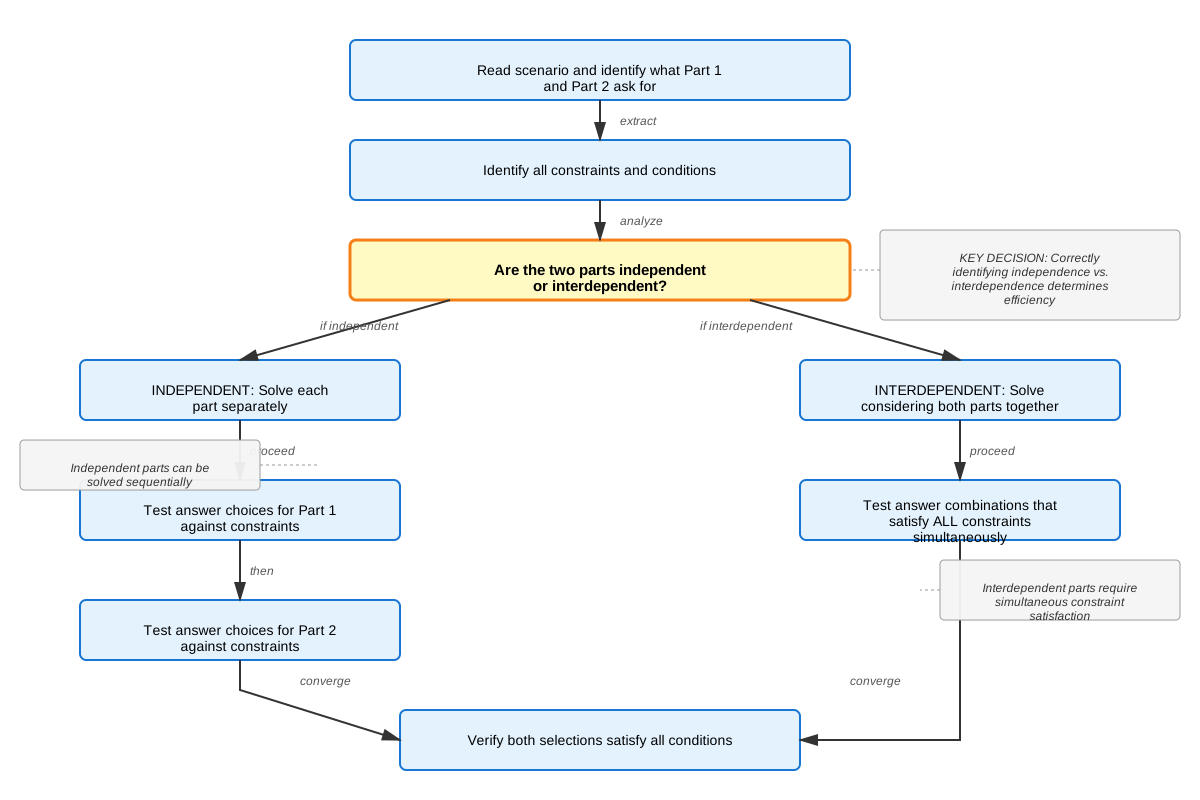
The core of the two-part strategy involves a structured five-step process:
- Analyze the scenario thoroughly: Read the problem statement carefully, identifying all given information, constraints, and relationships. Note any numerical data, logical conditions, or definitional statements that will govern the solution.
- Clarify what each part asks: Distinguish precisely what Part 1 requires versus Part 2. Determine whether the parts are independent or interdependent by examining whether they reference each other or share constraints.
- Identify constraints and conditions: List all requirements that the answers must satisfy. This includes explicit constraints stated in the problem and implicit constraints from the question structure (such as the requirement that the two selections must be different).
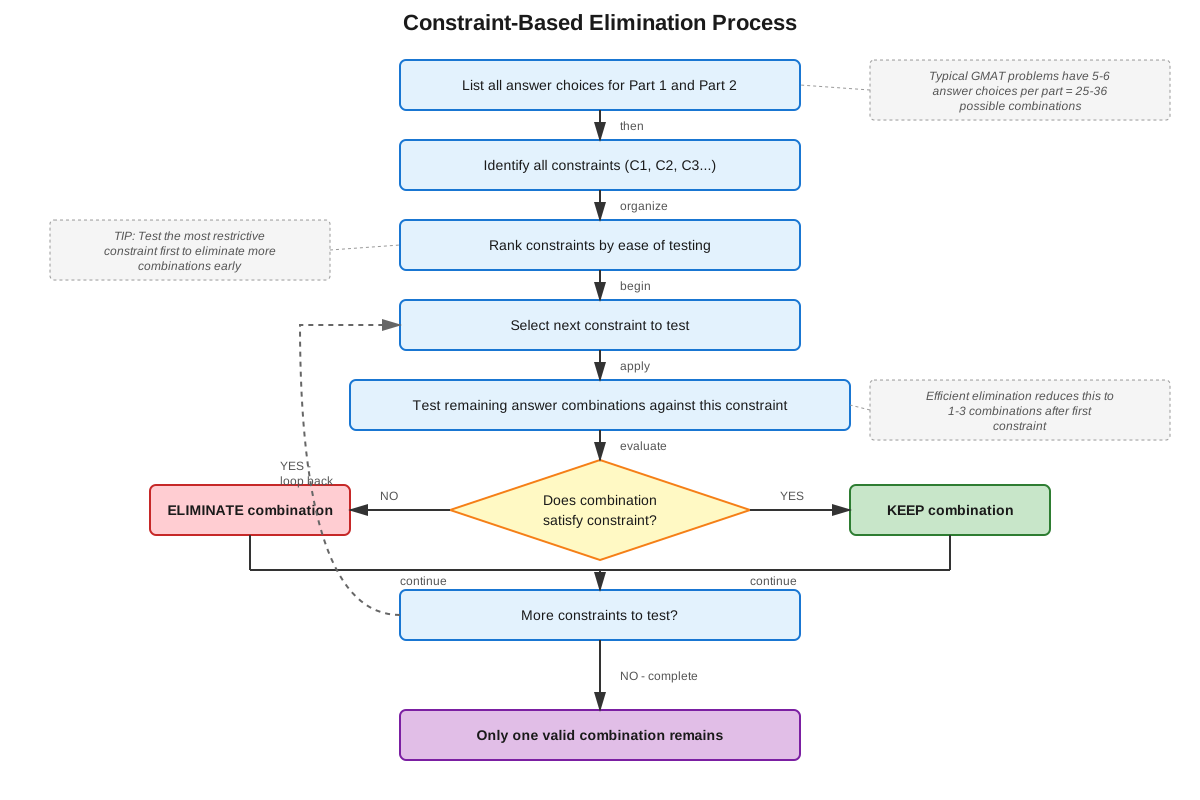
- Evaluate answer choices strategically: Rather than testing all possible combinations (which could mean 25 possibilities with five choices), use constraint-based elimination. Determine which choices can be immediately eliminated for each part based on the stated requirements.
- Verify the complete solution: After selecting answers for both parts, check that the combination satisfies all stated conditions and that no constraint has been violated.
Constraint-Based Elimination
Constraint-based elimination represents the most powerful technique within the two-part strategy. This approach involves identifying specific requirements that allow immediate elimination of answer choices without extensive calculation. For quantitative problems, constraints might include: must be positive, must be an integer, must be less than a certain value, or must satisfy a specific equation. For verbal/logical problems, constraints might include: must be a cause (not an effect), must be supported by the passage, or must be consistent with stated assumptions.
The strategic advantage emerges when constraints eliminate different choices for each part. If a constraint eliminates choices A and B for Part 1, but only choice C for Part 2, the problem space rapidly narrows. Effective test-takers develop a systematic notation method to track which choices remain viable for each part as they apply successive constraints.
Testing Combinations Efficiently
When interdependent relationships require testing combinations, efficiency becomes critical. Rather than randomly testing pairs, the strategic approach involves:
- Starting with the most constrained part: If one part has fewer viable options after initial elimination, solve that part first
- Using mathematical relationships: If the parts must sum to a value, selecting one immediately determines what the other must be
- Leveraging answer choice properties: If answer choices are ordered numerically, use that structure to guide systematic testing
- Recognizing patterns: Common relationships (sum, difference, ratio, product) often appear, and recognizing them accelerates solution
Integrated Reasoning Elements
Two-Part Analysis questions frequently integrate multiple data sources. A single question might present a text scenario, a data table, and a graph, requiring synthesis across all three. The strategic approach must include:
- Prioritizing information sources: Determine which source contains the critical constraints
- Cross-referencing data: Verify consistency across sources and identify where each piece of required information resides
- Managing cognitive load: Use scratch paper to extract and organize key data points rather than repeatedly referring back to complex displays
Concept Relationships
The two-part strategy builds directly upon fundamental problem-solving skills while introducing unique strategic considerations. The relationship flow follows this pattern:
Problem Comprehension → Constraint Identification → Relationship Classification (Independent vs. Interdependent) → Strategic Approach Selection → Systematic Elimination → Solution Verification
Within this framework, constraint identification serves as the foundation for all subsequent steps. The classification of the relationship between parts determines whether a sequential or simultaneous approach is optimal. For independent relationships, the strategy branches into two parallel solution paths that converge at verification. For interdependent relationships, the strategy requires iterative testing where each potential selection for one part immediately constrains the possibilities for the other.
The connection to prerequisite topics is direct: algebraic manipulation enables solving for unknown values, logical reasoning provides the framework for evaluating conditional statements, and data interpretation skills allow extraction of relevant information from complex displays. The two-part strategy synthesizes these foundational skills into a cohesive approach specifically designed for the unique demands of this question format.
Looking forward, mastery of the two-part strategy enhances performance on other Data Insights question types. The systematic constraint-based elimination transfers directly to Multi-Source Reasoning questions, while the skill of managing interdependent variables applies to Table Analysis and Graphics Interpretation questions involving multiple data points.
High-Yield Facts
⭐ Two-Part Analysis questions require selecting two answers from the same set of choices, with each choice used at most once
⭐ The relationship between parts (independent vs. interdependent) determines the optimal solution strategy
⭐ Constraint-based elimination is more efficient than testing all possible combinations
⭐ Both parts must be correct to receive credit; there is no partial credit for getting only one part right
⭐ The most constrained part should typically be solved first to narrow the solution space
- Two-Part Analysis questions appear in both quantitative and qualitative formats within Data Insights
- Answer choices are presented in a table format with rows for choices and columns for Part 1 and Part 2 selections
- Time management is critical; spending more than 2.5-3 minutes per question reduces time available for other Data Insights items
- Some questions explicitly state that the two parts are independent, while others require inference about the relationship
- Verification of the complete solution against all stated constraints is essential before finalizing selections
- Common question formats include finding two values that satisfy different conditions, identifying cause and effect, selecting optimal combinations, and determining minimum and maximum values
- The answer choices may be numerical values, categorical options, or statements that must be evaluated
- Strategic guessing should focus on eliminating impossible combinations rather than random selection
- Scratch paper organization significantly impacts efficiency; creating a systematic notation for tracking viable options is recommended
Common Misconceptions
Misconception: Both parts of the question are always asking for the same type of information.
Correction: Two-Part Analysis questions frequently ask for different types of information in each part. Part 1 might ask for a numerical value while Part 2 asks for a categorical selection, or one part might ask for a minimum while the other asks for a maximum. Carefully distinguish what each part requires.
Misconception: If an answer choice satisfies the requirements for one part, it can be selected for both parts.
Correction: The structural constraint of Two-Part Analysis questions prohibits selecting the same answer choice for both parts. Each choice can be used at most once across both selections, even if it technically satisfies the requirements for both parts.
Misconception: The two parts must always be solved in the order presented (Part 1 first, then Part 2).
Correction: Strategic efficiency often requires solving the more constrained or simpler part first, regardless of the order presented. If Part 2 has fewer viable options after initial constraint application, solving it first narrows the possibilities for Part 1.
Misconception: All possible combinations of answer choices must be tested to ensure the correct solution.
Correction: Systematic constraint-based elimination typically reduces the viable combinations to a small number, often just 2-4 possibilities. Testing all combinations (potentially 20-25 pairs) is inefficient and unnecessary when strategic elimination is applied.
Misconception: Two-Part Analysis questions are primarily quantitative and require complex calculations.
Correction: While many Two-Part Analysis questions involve numerical reasoning, a substantial portion are qualitative, requiring logical analysis, verbal reasoning, or interpretation of relationships. Some questions combine both quantitative and qualitative elements, requiring different analytical approaches for each part.
Misconception: Partial credit is awarded for getting one part correct.
Correction: GMAT scoring awards credit only when both parts are answered correctly. Getting one part right and one part wrong yields the same score as getting both parts wrong, making verification of the complete solution essential.
Quick check — test yourself on Two-part strategy so far.
Try Flashcards →Worked Examples
Example 1: Quantitative Two-Part Problem (Interdependent)
Scenario: A company produces two products, X and Y. Each unit of Product X requires 2 hours of labor and generates $50 profit. Each unit of Product Y requires 3 hours of labor and generates $60 profit. The company has 120 hours of labor available. The company wants to maximize profit while using exactly all available labor hours.
Question: In the table below, select the number of units of Product X that should be produced to maximize profit while using all available labor (Part 1), and select the number of units of Product Y that should be produced (Part 2). Make only two selections, one in each column.
| Choice | Part 1: Product X | Part 2: Product Y |
|---|---|---|
| 0 units | ||
| 10 units | ||
| 20 units | ||
| 30 units | ||
| 40 units |
Solution Process:
Step 1 - Analyze the scenario: We have a constraint equation: 2X + 3Y = 120 (where X = units of Product X, Y = units of Product Y). We need to maximize profit: P = 50X + 60Y.
Step 2 - Identify the relationship: This is an interdependent problem because the two parts must work together to satisfy the labor constraint. The selection for one part directly determines what the other must be.
Step 3 - Apply constraints: Both X and Y must be non-negative integers. The labor constraint must be satisfied exactly: 2X + 3Y = 120.
Step 4 - Test combinations systematically: Rather than testing all 25 combinations, use the constraint equation. For each possible X value, calculate the required Y value:
- If X = 0: 3Y = 120, so Y = 40 ✓ (viable)
- If X = 10: 2(10) + 3Y = 120, so 3Y = 100, Y = 33.33 ✗ (not an integer)
- If X = 20: 2(20) + 3Y = 120, so 3Y = 80, Y = 26.67 ✗ (not an integer)
- If X = 30: 2(30) + 3Y = 120, so 3Y = 60, Y = 20 ✓ (viable)
- If X = 40: 2(40) + 3Y = 120, so 3Y = 40, Y = 13.33 ✗ (not an integer)
Step 5 - Optimize: Only two combinations satisfy the constraint: (X=0, Y=40) and (X=30, Y=20). Calculate profit for each:
- (0, 40): P = 50(0) + 60(40) = $2,400
- (30, 20): P = 50(30) + 60(20) = $1,500 + $1,200 = $2,700
Step 6 - Verify: The combination (30, 20) maximizes profit. Check: 2(30) + 3(20) = 60 + 60 = 120 ✓
Answer: Part 1 (Product X) = 30 units; Part 2 (Product Y) = 20 units
Key Insight: This example demonstrates how the interdependent constraint (labor hours) immediately eliminates most combinations, and the optimization criterion (maximize profit) determines the final selection from the remaining viable options.
Example 2: Qualitative Two-Part Problem (Independent)
Scenario: A research study examined the relationship between exercise frequency and stress levels among office workers. The study found that workers who exercised at least three times per week reported significantly lower stress levels than those who exercised less frequently. However, the study also noted that workers who exercised frequently were more likely to have flexible work schedules, which independently correlated with lower stress levels.
Question: In the table below, select the statement that identifies a potential confounding variable in the study (Part 1), and select the statement that represents a valid conclusion that can be drawn from the study (Part 2). Make only two selections, one in each column.
| Choice | Part 1: Confounding Variable | Part 2: Valid Conclusion |
|---|---|---|
| Exercise frequency causes reduced stress | ||
| Flexible work schedules may influence both exercise frequency and stress levels | ||
| Workers who exercise frequently have lower stress | ||
| Office workers should exercise at least three times weekly | ||
| The study proves that exercise reduces stress |
Solution Process:
Step 1 - Analyze the scenario: The study found a correlation between exercise and lower stress, but also identified that flexible schedules correlate with both exercise frequency and lower stress.
Step 2 - Clarify what each part asks: Part 1 asks for a confounding variable (a factor that influences both the independent and dependent variables, potentially explaining the observed relationship). Part 2 asks for a valid conclusion (a statement supported by the evidence without overgeneralization).
Step 3 - Identify the relationship: These parts are independent—identifying the confounding variable doesn't determine what conclusion is valid, and vice versa. We can solve each separately.
Step 4 - Evaluate Part 1 (Confounding Variable): A confounding variable must influence both exercise frequency and stress levels. Examining the choices:
- "Exercise frequency causes reduced stress" - This is a causal claim, not a confounding variable ✗
- "Flexible work schedules may influence both exercise frequency and stress levels" - This fits the definition perfectly ✓
- "Workers who exercise frequently have lower stress" - This is an observation, not a confounding variable ✗
- "Office workers should exercise at least three times weekly" - This is a recommendation, not a confounding variable ✗
- "The study proves that exercise reduces stress" - This is a conclusion claim, not a confounding variable ✗
Step 5 - Evaluate Part 2 (Valid Conclusion): A valid conclusion must be supported by the evidence without claiming causation that wasn't established:
- "Exercise frequency causes reduced stress" - Causation not established due to confounding ✗
- "Flexible work schedules may influence both exercise frequency and stress levels" - Already selected for Part 1, cannot reuse ✗
- "Workers who exercise frequently have lower stress" - This correlation was observed in the study ✓
- "Office workers should exercise at least three times weekly" - This is a prescriptive recommendation beyond what the data supports ✗
- "The study proves that exercise reduces stress" - "Proves" is too strong; causation not established ✗
Step 6 - Verify: Part 1 identifies flexible work schedules as a confounding variable (correct because it influences both variables). Part 2 states the observed correlation without claiming causation (valid conclusion). The selections are different choices, satisfying the structural constraint.
Answer: Part 1 = "Flexible work schedules may influence both exercise frequency and stress levels"; Part 2 = "Workers who exercise frequently have lower stress"
Key Insight: This example demonstrates independent parts where each can be solved separately using different analytical frameworks (identifying confounding variables vs. evaluating conclusion validity), but both require careful attention to what the evidence actually supports.
Exam Strategy
When approaching Two-Part Analysis questions on the GMAT, implement this strategic framework:
Initial Assessment (15-20 seconds): Quickly scan the question to determine whether it's primarily quantitative, qualitative, or integrated. Note the number of answer choices and whether they're numerical, categorical, or statement-based. This initial assessment guides time allocation and approach selection.
Trigger Words to Watch For:
- "Independently" or "separately" suggests independent parts
- "Together," "combined," or "total" suggests interdependent parts
- "Minimum" and "maximum" often appear in optimization problems
- "Must be true" indicates logical deduction requirements
- "Could be true" allows for multiple valid scenarios
- "Assumption," "conclusion," "evidence" signal logical reasoning elements
Strategic Approach Selection:
For Independent Parts: Solve the simpler or more constrained part first. Use your scratch paper to mark which choices are eliminated for Part 1 and which for Part 2. The answer for one part doesn't affect the other, but remember that the same choice cannot be selected twice.
For Interdependent Parts: Identify the mathematical or logical relationship connecting the parts. If it's an equation (like sum, difference, or ratio), use algebraic manipulation to reduce the solution space before testing combinations. If it's a logical relationship (like cause-effect), use the constraint to eliminate impossible pairings.
Process-of-Elimination Tips:
- Apply absolute constraints first: Eliminate choices that violate explicit requirements (wrong sign, wrong magnitude, logically impossible)
- Use the "different choice" constraint strategically: If you're certain about one part's answer, that choice is automatically eliminated for the other part
- Look for extreme values: In optimization problems, the answer often involves boundary values or extreme cases from the available choices
- Check unit consistency: In quantitative problems, ensure your selections produce results with appropriate units and magnitudes
- Verify logical consistency: In qualitative problems, ensure both selections are consistent with all information provided in the scenario
Time Allocation Advice:
Allocate 2.5-3 minutes maximum per Two-Part Analysis question. If you haven't identified a clear solution path within 90 seconds, employ strategic guessing:
- Eliminate obviously wrong choices for each part
- If one part seems more solvable, solve it definitively and make an educated guess on the other
- Avoid spending excessive time testing all combinations; use constraint-based reasoning to narrow options quickly
Scratch Paper Organization:
Create a simple notation system:
Part 1: A B C D E  (cross out eliminated choices)
Part 2: A B C D E  (cross out eliminated choices)
As you apply constraints, physically cross out eliminated options. This visual tracking prevents errors and helps you see when the solution space has narrowed sufficiently.
Memory Techniques
The "CRAVE" Mnemonic for Two-Part Strategy:
- Clarify what each part asks (distinguish Part 1 from Part 2 requirements)
- Relationship identification (independent vs. interdependent)
- Apply constraints systematically (eliminate impossible choices)
- Verify the complete solution (check both parts together)
- Eliminate efficiently (don't test all combinations)
Visualization Strategy: Picture two interconnected gears when approaching interdependent problems. When one gear (Part 1) turns to a specific position, it forces the other gear (Part 2) into a corresponding position. This mental image reinforces that the selections must work together as a system.
The "Same Set, Different Choice" Rule: Remember the phrase "Same menu, different dishes" to recall that both parts select from the same answer choices, but each choice can only be selected once. This prevents the common error of selecting the same answer for both parts.
Constraint Hierarchy Acronym - "MUST":
- Mathematical requirements (equations, inequalities)
- Unit and magnitude consistency
- Structural constraints (different choices for each part)
- Text-based conditions (explicitly stated requirements)
Apply constraints in this order for maximum efficiency.
The "Solve the Boss First" Principle: In interdependent problems, identify which part "bosses" the other (which one constrains the other more severely). Solve the "boss" part first, then the constrained part becomes easier. Visualize a manager-employee relationship to remember this hierarchy.
Summary
The two-part strategy provides a systematic framework for approaching GMAT Two-Part Analysis questions, which require selecting two related answers from a single set of choices. The core of this strategy involves four critical elements: distinguishing whether the two parts are independent or interdependent, applying constraint-based elimination to narrow the solution space efficiently, solving the more constrained part first when appropriate, and verifying that the complete solution satisfies all stated requirements. Independent parts can be solved sequentially using separate analytical approaches for each, while interdependent parts require simultaneous consideration of how the selections work together to satisfy combined constraints. The most efficient approach avoids testing all possible combinations by systematically eliminating choices that violate explicit or implicit constraints, reducing the problem space to a manageable number of viable options. Success on these questions requires integrating quantitative reasoning, logical analysis, and data interpretation skills while maintaining strict attention to the structural requirement that each answer choice can be selected at most once across both parts. Mastery of the two-part strategy significantly improves both accuracy and time management on this high-frequency Data Insights question type.
Key Takeaways
- Two-Part Analysis questions require selecting two different answers from the same set of choices, with no partial credit for getting only one part correct
- Identifying whether the parts are independent or interdependent determines the optimal solution strategy and dramatically affects efficiency
- Constraint-based elimination is the most powerful technique, allowing rapid reduction of the solution space without testing all possible combinations
- The most constrained part should typically be solved first, as it narrows the possibilities for the other part and reduces overall problem complexity
- Verification of the complete solution against all stated constraints is essential before finalizing selections, as overlooking a single requirement invalidates the entire answer
- Time management is critical; spending more than 2.5-3 minutes per question compromises performance on other Data Insights items
- Strategic organization of scratch paper and systematic notation of eliminated choices prevents errors and enhances efficiency under time pressure
Related Topics
Multi-Source Reasoning: Builds on the two-part strategy by requiring synthesis of information from multiple tabs or sources, often involving more than two interdependent decisions. Mastering two-part strategy provides the foundation for managing the increased complexity of multi-source problems.
Table Analysis: Extends constraint-based elimination techniques to sortable data tables where multiple conditions must be evaluated. The systematic approach to identifying and applying constraints transfers directly from two-part strategy.
Graphics Interpretation: Applies the skill of extracting precise information from visual displays to answer two-part questions, often requiring interpretation of graphs or charts to determine numerical values or relationships.
Optimization Problems: Deepens the application of two-part strategy to scenarios involving maximization or minimization under constraints, a common business application that frequently appears in interdependent two-part questions.
Logical Reasoning and Critical Thinking: Enhances the qualitative dimension of two-part strategy, particularly for questions involving assumptions, conclusions, evidence evaluation, and argument structure.
Practice CTA
Now that you've mastered the conceptual framework and strategic approach to Two-Part Analysis questions, it's time to solidify your understanding through deliberate practice. Attempt the practice questions associated with this topic, applying the CRAVE framework systematically to each problem. Use the flashcards to reinforce high-yield facts and common question patterns. Remember that mastery comes not from passive reading but from active application—each practice question you work through strengthens your pattern recognition and strategic decision-making. The two-part strategy is a skill that improves rapidly with focused practice, and your investment in mastering this approach will yield significant score improvements on the Data Insights section. Approach each practice problem as an opportunity to refine your technique and build the confidence that comes from systematic preparation.
Sign up free to keep reading
Create a free AnvayaPrep account to finish this GMAT guide on Two-part strategy — plus flashcards and practice questions.