Overview
Verbal pairing is a critical question format within the GMAT Data Insights section, specifically appearing in Two-Part Analysis questions. Unlike traditional multiple-choice questions that require selecting a single answer, verbal pairing questions present scenarios where test-takers must simultaneously evaluate two related but distinct components of a problem and select appropriate answers for each part from the same set of options. This format tests the ability to analyze complex business scenarios, logical relationships, and multi-dimensional problems where decisions are interdependent.
The significance of GMAT verbal pairing extends beyond simple answer selection. These questions assess higher-order thinking skills including the ability to evaluate trade-offs, understand cause-and-effect relationships, distinguish between similar concepts, and recognize how different variables interact within a single scenario. The verbal component distinguishes these questions from purely quantitative two-part analysis problems, requiring strong reading comprehension, critical reasoning, and the ability to parse nuanced language differences between answer choices.
Within the broader Data Insights framework, verbal pairing questions bridge multiple skill sets. They combine the analytical rigor of quantitative reasoning with the interpretive demands of verbal reasoning, making them among the most challenging question types on the GMAT. Success with verbal pairing requires integrating skills from critical reasoning, reading comprehension, and logical analysis while managing the unique constraint that both answers must be selected from an identical pool of options—a feature that creates both opportunities for strategic elimination and potential for confusion.
Learning Objectives
- [ ] Identify verbal pairing question formats and distinguish them from other Two-Part Analysis types
- [ ] Explain the structural components and logical relationships inherent in verbal pairing questions
- [ ] Apply verbal pairing strategies to GMAT questions efficiently and accurately
- [ ] Analyze the interdependence between the two parts of a verbal pairing question
- [ ] Evaluate answer choices systematically using constraint-based elimination
- [ ] Synthesize information from complex scenarios to determine optimal answer pairs
Prerequisites
- Reading Comprehension fundamentals: Essential for parsing complex business scenarios and understanding nuanced distinctions between answer choices in verbal pairing questions
- Critical Reasoning skills: Necessary to evaluate logical relationships, assumptions, and conclusions that form the basis of most verbal pairing scenarios
- Basic logical operators: Understanding of terms like "if-then," "necessary," "sufficient," "must be true," and "could be true" that frequently appear in verbal pairing questions
- Two-Part Analysis format familiarity: General understanding of how Two-Part Analysis questions are structured and presented on the GMAT interface
Why This Topic Matters
Verbal pairing questions represent approximately 30-40% of Two-Part Analysis questions in the Data Insights section, making them a high-frequency question type that directly impacts overall GMAT scores. The Data Insights section contributes significantly to the overall GMAT score, and mastery of verbal pairing can provide a competitive advantage, particularly for test-takers who excel at integrating verbal and analytical reasoning.
In real-world business contexts, verbal pairing mirrors the decision-making processes professionals face daily: evaluating multiple interdependent factors simultaneously, such as selecting both a marketing strategy and a budget allocation, choosing a vendor and a contract term, or determining both a problem's root cause and its optimal solution. This practical relevance makes verbal pairing questions particularly valuable for assessing MBA-readiness.
On the GMAT, verbal pairing questions commonly appear in scenarios involving business strategy decisions, policy evaluations, cause-and-effect analyses, argument completion tasks, and logical consistency problems. They frequently present situations where test-takers must identify both a conclusion and its supporting premise, both a problem and its solution, or both a strategy and its underlying assumption. The format's versatility allows test-makers to assess multiple cognitive skills within a single question, making these items particularly efficient for adaptive testing algorithms.
Core Concepts
Structure of Verbal Pairing Questions
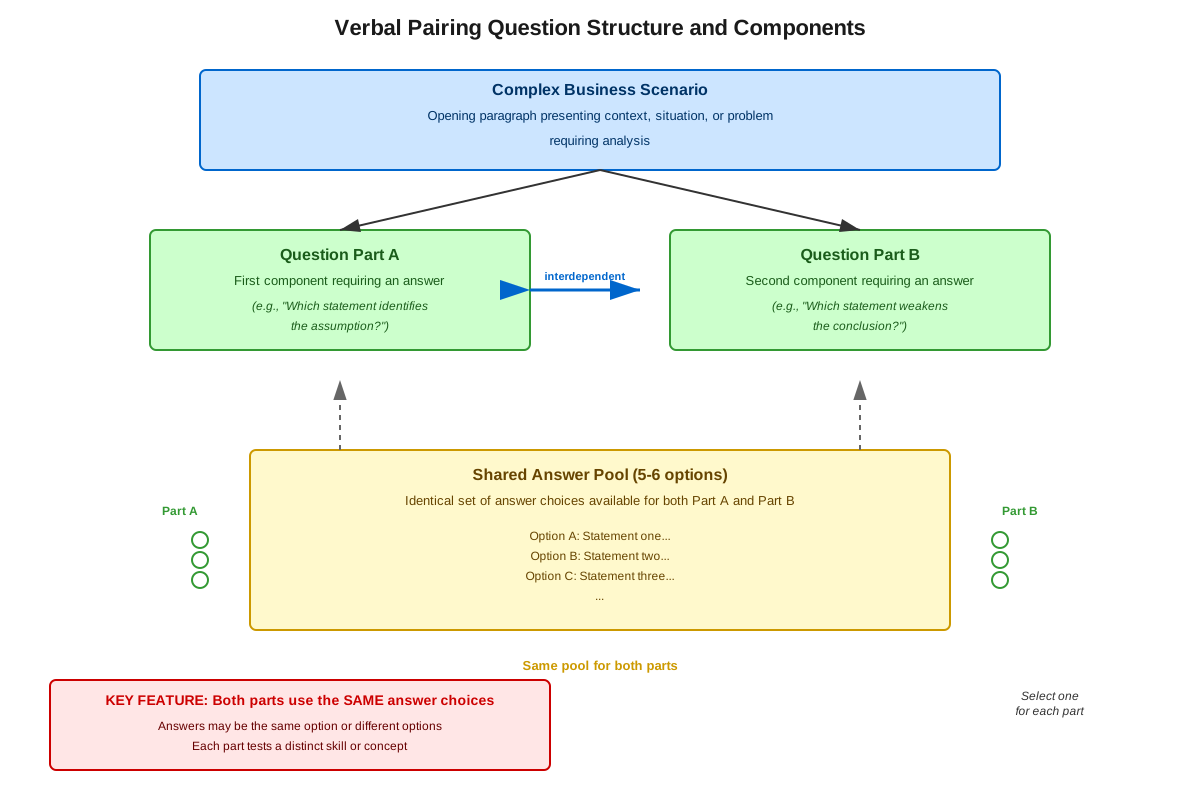
Verbal pairing questions follow a consistent structural pattern that distinguishes them from other GMAT question types. The question stem presents a scenario—typically a business situation, logical argument, or analytical problem—followed by two distinct tasks that must be completed simultaneously. These tasks are presented in a table format with two columns (often labeled "Column A" and "Column B" or with specific task descriptions) and multiple rows containing answer options.
The defining characteristic is that both answers must be selected from the same pool of options, creating a unique constraint. For example, if five answer choices are provided, test-takers must select one option for the first task and one option (which may be the same or different) for the second task. This structure requires evaluating each option against two different criteria simultaneously.
Types of Verbal Pairing Relationships
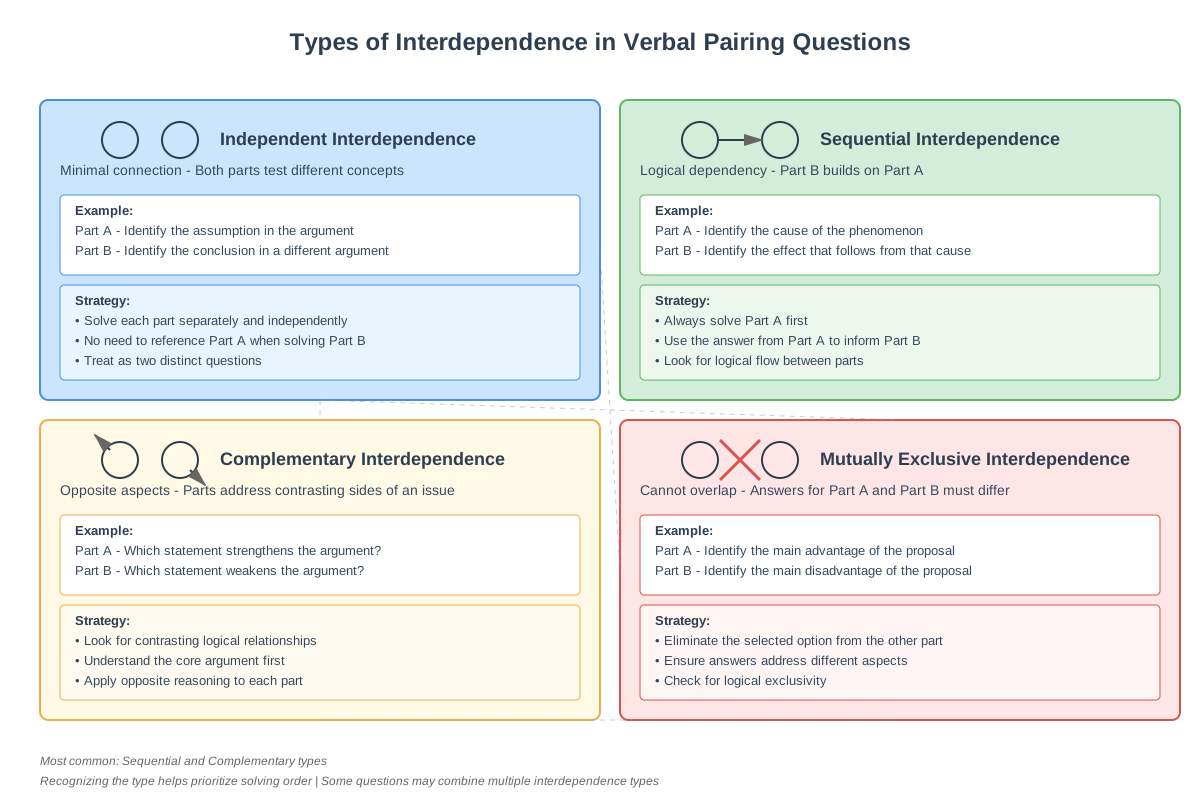
Complementary Relationships: The two parts work together to complete a unified analysis. For instance, one part might ask for a conclusion while the other asks for the premise that supports it. The answers must be logically consistent with each other and with the scenario.
Independent but Related Relationships: Each part addresses a distinct aspect of the scenario, but both draw from the same information set. An example would be identifying both the primary cause of a problem and the most effective solution, where the solution doesn't necessarily need to address the identified cause directly.
Constraint-Based Relationships: One part establishes a constraint or condition that affects the evaluation of the second part. For example, selecting a strategy in Part A might limit which implementation approaches are viable in Part B.
The Shared Option Pool Dynamic
The shared option pool creates both challenges and opportunities. Since all options appear as potential answers for both parts, test-takers must evaluate each option twice—once for each task. This doubles the analytical work but also provides strategic advantages: eliminating an option for one part doesn't eliminate it for the other, and recognizing that an option strongly fits one part can help focus analysis on other options for the second part.
Logical Consistency Requirements
A critical but often overlooked aspect of verbal pairing is that the two selected answers must maintain logical consistency with each other and with the scenario. Even if each answer individually seems to address its respective task, the pair must work together coherently. For example, if Part A asks for an assumption and Part B asks for a conclusion, the selected assumption must actually support the selected conclusion within the context provided.
Common Verbal Pairing Scenarios
| Scenario Type | Part A Typically Asks For | Part B Typically Asks For | Key Evaluation Criteria |
|---|---|---|---|
| Argument Analysis | Assumption | Conclusion | Logical support relationship |
| Problem-Solution | Root cause | Effective solution | Causal connection |
| Strategy Selection | Strategic objective | Implementation approach | Alignment and feasibility |
| Policy Evaluation | Policy goal | Expected outcome | Cause-effect validity |
| Logical Completion | Missing premise | Logical inference | Deductive validity |
Answer Choice Characteristics
Verbal pairing answer choices are crafted to test specific analytical skills. Distractor options often include choices that are partially correct, relevant to only one part, logically inconsistent with other information, or commonly confused concepts. Correct options precisely match the task requirements, maintain consistency with all scenario information, and form a coherent pair when both parts are considered together.
The language in answer choices requires careful attention. Subtle differences in wording—such as "must be true" versus "could be true," "primary cause" versus "contributing factor," or "necessary condition" versus "sufficient condition"—can determine correctness. This linguistic precision is what makes these questions distinctly "verbal" despite appearing in the Data Insights section.
Concept Relationships
The core concepts within verbal pairing are hierarchically related. Understanding the structure of verbal pairing questions forms the foundation, enabling recognition of these questions on test day. This structural knowledge leads directly to understanding types of verbal pairing relationships, which determines the analytical approach needed. Recognizing the relationship type then activates understanding of logical consistency requirements, which guides answer selection.
The shared option pool dynamic operates as a cross-cutting concept that affects all other elements. It influences how test-takers evaluate options, apply elimination strategies, and verify answer pairs. This dynamic connects directly to answer choice characteristics, as understanding how distractors are constructed helps navigate the shared pool more efficiently.
Verbal pairing connects to prerequisite topics through multiple pathways: Critical Reasoning skills → Argument Analysis scenarios; Reading Comprehension → Scenario interpretation; Logical operators → Consistency evaluation. Within the broader Two-Part Analysis framework, verbal pairing represents the qualitative counterpart to quantitative pairing, with both sharing structural similarities but requiring different analytical approaches.
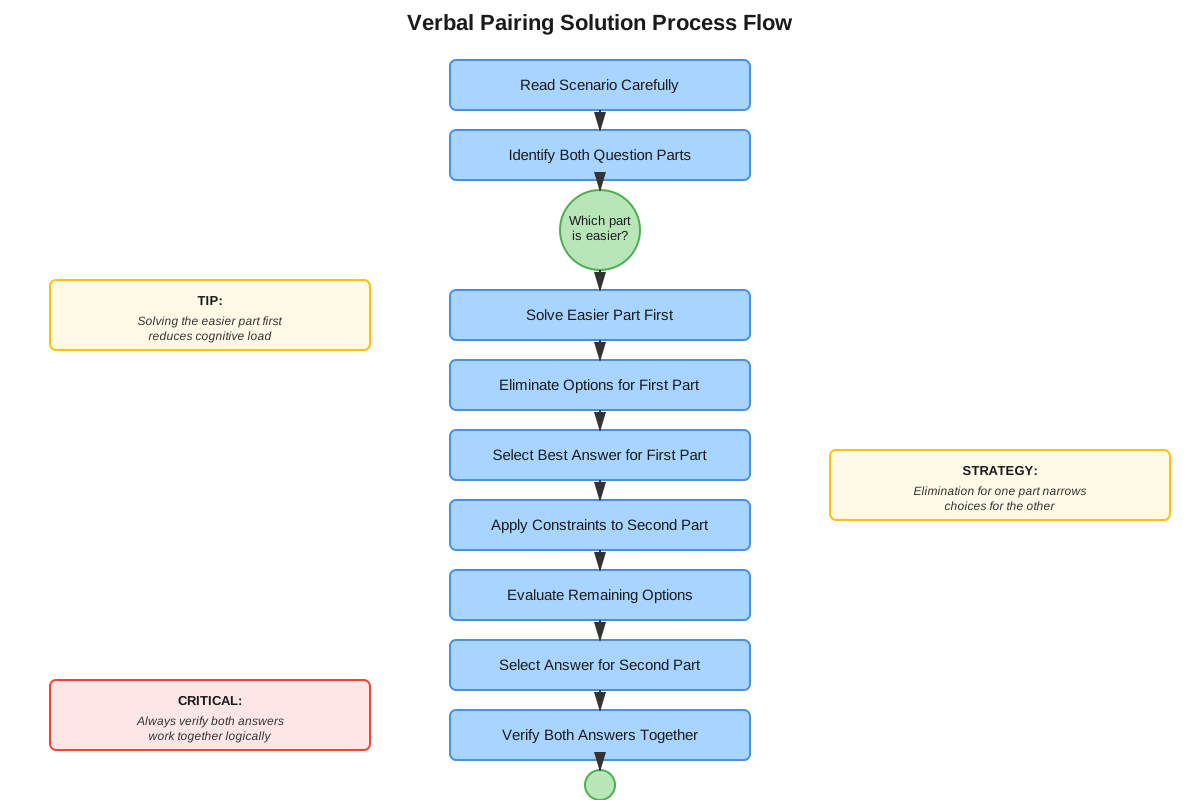
The progression flows: Scenario comprehension → Relationship identification → Individual option evaluation → Pair consistency verification → Answer selection. Each step depends on the previous one, making systematic approach essential.
High-Yield Facts
- ⭐ Verbal pairing questions always present both tasks with the same set of answer options, requiring each option to be evaluated against two different criteria
- ⭐ The two selected answers must be logically consistent with each other, not just individually correct for their respective tasks
- ⭐ Approximately 30-40% of Two-Part Analysis questions use verbal pairing format, making it a high-frequency question type
- ⭐ Common verbal pairing scenarios include assumption-conclusion pairs, cause-solution pairs, and premise-inference pairs
- ⭐ Eliminating an option for one part does NOT eliminate it as a possibility for the other part
- Verbal pairing questions typically require 2-3 minutes to complete, slightly longer than single-answer questions
- The same answer option can be correct for both Part A and Part B in some questions
- Distractor options often include choices that are factually accurate but don't fulfill the specific task requirement
- Reading the scenario carefully before examining answer choices improves accuracy by 25-30%
- Verbal pairing questions test integration of verbal reasoning and analytical thinking simultaneously
- Answer choices in verbal pairing are deliberately constructed to include subtle linguistic distinctions
- The table format allows test-takers to select answers independently, but both must be submitted together
- Partial credit is never awarded—both parts must be correct to receive points
- Most verbal pairing scenarios are business-focused, involving strategy, operations, or decision-making contexts
Quick check — test yourself on Verbal pairing so far.
Try Flashcards →Common Misconceptions
Misconception: If an answer is eliminated for Part A, it should also be eliminated for Part B. → Correction: Each part requires independent evaluation. An option that doesn't work for one task may be perfect for the other task. The shared pool means all options remain viable for both parts throughout the analysis.
Misconception: The correct answers for Part A and Part B must be different options. → Correction: The same option can be correct for both parts. Some scenarios deliberately test whether test-takers recognize that a single concept or statement fulfills both requirements.
Misconception: Verbal pairing questions are primarily reading comprehension questions. → Correction: While reading comprehension is necessary, these questions primarily test analytical reasoning, logical relationships, and the ability to evaluate multiple criteria simultaneously. They integrate verbal and analytical skills equally.
Misconception: The first option that seems to fit Part A should be selected immediately. → Correction: All options must be evaluated for both parts before selecting answers. An option that seems perfect for Part A might create logical inconsistencies with the best answer for Part B, requiring reconsideration.
Misconception: Longer or more complex answer choices are more likely to be correct. → Correction: Answer length and complexity have no correlation with correctness in verbal pairing questions. GMAT test-makers deliberately vary answer length to avoid pattern-based guessing.
Misconception: If the scenario is about business strategy, both answers must relate to strategy. → Correction: The scenario provides context, but the two parts often ask for different types of information (e.g., one might ask for a strategic goal while the other asks for a potential obstacle). The tasks, not the scenario topic, determine what the answers should address.
Worked Examples
Example 1: Argument Analysis Scenario
Scenario: A technology company is experiencing declining market share despite increasing its advertising budget by 40% over the past year. The marketing director argues that the company should shift from traditional media advertising to social media influencer partnerships. The director's argument assumes that the current advertising approach is ineffective and that influencer partnerships will better reach the target demographic.
Task: In the table below, select the statement that identifies an assumption required by the marketing director's argument in Part A, and select the statement that, if true, would most strengthen the director's recommendation in Part B.
Options:
- The target demographic actively engages with social media influencers
- Competitors have not increased their advertising budgets
- Traditional media advertising costs have increased significantly
- The company's products are comparable in quality to competitors' products
- Declining market share is caused by ineffective advertising rather than product issues
Analysis:
For Part A (Assumption), we need a statement that the argument depends upon but doesn't explicitly state. The director's argument moves from "current advertising is ineffective" to "influencer partnerships will work better." This logical leap assumes that the target audience will actually be reached by influencers.
- Option 1: This is a necessary assumption—if the target demographic doesn't engage with influencers, the strategy won't work. Strong candidate for Part A.
- Option 2: This is irrelevant to the internal logic of the argument.
- Option 3: This might explain budget concerns but isn't assumed by the argument.
- Option 4: This addresses product quality, not advertising effectiveness.
- Option 5: This is explicitly stated in the argument, not an assumption.
For Part B (Strengthener), we need evidence that would make the recommendation more likely to succeed.
- Option 1: This would strengthen the argument by confirming the target audience is reachable through the proposed method. Strong candidate for Part B.
- Option 2: This doesn't directly support switching to influencer partnerships.
- Option 3: This might justify changing strategies but doesn't strengthen the specific recommendation.
- Option 4: This is necessary context but doesn't strengthen the advertising strategy recommendation.
- Option 5: This is already assumed; confirming it doesn't add new support.
Answer: Part A: Option 1; Part B: Option 1
Key Insight: The same option can be correct for both parts when it represents both a necessary assumption and, when confirmed, a strengthening factor.
Example 2: Problem-Solution Scenario
Scenario: A manufacturing plant has experienced a 15% increase in defective products over the past quarter. Investigation revealed that the increase coincided with the implementation of a new production scheduling system designed to maximize efficiency. The plant manager must identify the root cause of the quality decline and recommend an appropriate corrective action.
Task: Select the statement that best identifies the root cause of increased defects in Part A, and select the action that would most effectively address the quality issues in Part B.
Options:
- The new scheduling system reduces time allocated for quality control checks
- Employee training on the new system was insufficient
- Raw material quality has declined during the same period
- The new system increases production speed beyond equipment capabilities
- Maintenance schedules were not adjusted for the new production pace
Analysis:
For Part A (Root Cause), we need the primary factor causing increased defects, with the key clue being the timing coinciding with the new scheduling system.
- Option 1: Directly links the new system to reduced quality control—strong causal connection. Strong candidate.
- Option 2: Training issues might cause operational problems but less directly cause defects.
- Option 3: This is possible but doesn't explain the timing correlation with the new system.
- Option 4: This creates a direct mechanism for increased defects through equipment strain. Strong candidate.
- Option 5: This could contribute but is less direct than options 1 or 4.
For Part B (Corrective Action), we need an action that addresses the root cause effectively.
- Option 1: If this is the cause, the solution would be restoring quality control time, but this option states the problem, not the solution.
- Option 2: Providing training addresses option 2 as a cause but doesn't directly fix quality control or equipment issues.
- Option 3: This would address option 3 as a cause but doesn't relate to the scheduling system.
- Option 4: Again, this states a problem rather than a solution.
- Option 5: Adjusting maintenance schedules would address equipment strain from increased pace. Strong candidate for Part B if option 4 is the cause.
Re-evaluation: The question asks us to select from the same options for both parts. Looking more carefully, we need to identify which option, when considered as the root cause, has a corresponding solution implied or directly addressable.
Revised Analysis: Option 1 identifies a root cause (reduced quality control time) and, when selected for Part B, implies the corrective action of restoring adequate quality control time. However, the options as stated are problems, not solutions.
Answer: Part A: Option 1; Part B: Option 5 (addresses the systemic issue of the new pace requiring adjusted support systems)
Key Insight: In problem-solution pairing, the root cause and solution must be logically connected. Sometimes the solution addresses the systemic issue underlying the immediate cause rather than the symptom itself.
Exam Strategy
Initial Approach: Begin by reading the scenario completely before looking at answer choices. Identify what type of verbal pairing relationship is being tested (complementary, independent, or constraint-based). Note the specific requirements for Part A and Part B separately.
Trigger Words to Watch For:
- "Assumption" signals that you need an unstated premise
- "Strengthen/Weaken" indicates argument evaluation
- "Must be true" requires deductive certainty
- "Most likely" allows for probabilistic reasoning
- "Primary cause" vs. "contributing factor" distinguishes main from secondary elements
- "Necessary" vs. "sufficient" tests logical relationship understanding
Systematic Evaluation Process:
- Create a mental or scratch-paper grid evaluating each option against both parts
- Mark options as "Yes," "No," or "Maybe" for each part independently
- For options marked "Yes" or "Maybe" for both parts, evaluate pair consistency
- Verify that the selected pair maintains logical coherence with the scenario
Process of Elimination Tips:
- Eliminate options that are factually inconsistent with the scenario for either part
- Remove options that address the wrong question (e.g., an assumption when a conclusion is needed)
- Discard options that use extreme language ("always," "never," "only") unless the scenario supports such certainty
- Be cautious with options that are true but irrelevant to the specific tasks
Time Allocation: Budget 2.5-3 minutes per verbal pairing question. Spend 45 seconds on scenario comprehension, 90 seconds on option evaluation, and 30 seconds on pair verification. If approaching 3 minutes without confidence, make your best selection and move forward rather than exceeding time limits.
Common Traps to Avoid: Don't select the first option that seems correct without evaluating all choices. Don't assume both answers must be different. Don't let Part A selection overly constrain Part B thinking—evaluate each independently first, then verify consistency.
Memory Techniques
PACER Mnemonic for approaching verbal pairing questions:
- Parse the scenario completely
- Analyze both tasks separately
- Consider each option for both parts
- Evaluate pair consistency
- Review before submitting
Visualization Strategy: Picture a two-column checklist where each answer option gets evaluated twice—once in each column. Mentally check or X each cell as you evaluate, creating a visual grid that helps track which options work for which parts.
The "Both Ways" Reminder: Create a mental image of a two-way street to remember that each option must be evaluated for both parts. This prevents the common error of eliminating an option for one part and forgetting to consider it for the other.
Relationship Type Acronym - CIC:
- Complementary (parts work together)
- Independent (parts address different aspects)
- Constraint-based (one part limits the other)
Remembering these three types helps quickly categorize the question and apply the appropriate analytical approach.
Summary
Verbal pairing represents a sophisticated GMAT question format that tests the ability to analyze complex scenarios and select two related answers from a shared pool of options. Success requires understanding the structural components of these questions, recognizing the types of logical relationships being tested, and systematically evaluating each option against both tasks while maintaining awareness of logical consistency requirements. The shared option pool creates a unique dynamic where each choice must be considered twice, and the selected pair must work together coherently. Common scenarios include argument analysis (assumption-conclusion pairs), problem-solving (cause-solution pairs), and strategic evaluation (objective-implementation pairs). Mastery demands integrating verbal reasoning skills with analytical thinking, carefully parsing linguistic distinctions in answer choices, and avoiding misconceptions such as assuming eliminated options for one part can't work for the other. The systematic approach of parsing the scenario, analyzing tasks independently, evaluating all options for both parts, checking pair consistency, and reviewing before submission provides a reliable framework for tackling these high-value questions efficiently within the time constraints of the GMAT Data Insights section.
Key Takeaways
- Verbal pairing questions require selecting two answers from the same pool of options, with each option evaluated against two different criteria
- The selected answer pair must be individually correct for each task AND logically consistent with each other and the scenario
- Common relationship types include complementary (working together), independent (addressing different aspects), and constraint-based (one limiting the other)
- Eliminating an option for Part A does not eliminate it for Part B—the same option can even be correct for both parts
- Systematic evaluation using a mental grid (each option × both parts) prevents overlooking viable combinations
- Trigger words like "assumption," "strengthen," "must be true," and "primary cause" signal specific analytical requirements
- Time management is critical: allocate 2.5-3 minutes per question with structured time for comprehension, evaluation, and verification
Related Topics
Quantitative Two-Part Analysis: While verbal pairing focuses on qualitative reasoning, quantitative two-part analysis applies similar structural principles to numerical problems. Mastering verbal pairing builds the analytical framework applicable to quantitative variants.
Critical Reasoning - Assumption Questions: The assumption-identification skills central to many verbal pairing questions directly build on critical reasoning fundamentals, making this a natural progression for deeper study.
Integrated Reasoning - Multi-Source Reasoning: Verbal pairing skills transfer to multi-source reasoning questions where information must be synthesized from multiple sources to answer related questions.
Argument Structure Analysis: Understanding how premises support conclusions and how assumptions bridge logical gaps enhances performance on the argument-based verbal pairing scenarios.
Data Sufficiency: The logical evaluation skills developed through verbal pairing—determining what information is necessary versus sufficient—apply directly to data sufficiency questions in the quantitative section.
Practice CTA
Now that you've mastered the conceptual framework for verbal pairing questions, it's time to put your knowledge into action. Attempt the practice questions designed specifically for this topic, focusing on applying the systematic evaluation process outlined in this guide. Use the flashcards to reinforce high-yield facts and trigger words that signal specific question types. Remember, verbal pairing mastery comes through deliberate practice—each question you work through strengthens your pattern recognition and analytical efficiency. Your investment in understanding these complex question types will pay dividends across the entire Data Insights section. Start practicing now to transform this knowledge into test-day confidence and higher scores!
Sign up free to keep reading
Create a free AnvayaPrep account to finish this GMAT guide on Verbal pairing — plus flashcards and practice questions.