Overview
Argument structure is the foundational framework that underlies every Critical Reasoning question on the GMAT. Understanding how arguments are constructed—identifying their components, recognizing how premises support conclusions, and spotting logical relationships—is essential for success on approximately 30% of the Verbal Reasoning section. The GMAT argument structure refers specifically to the way test makers organize logical reasoning passages, typically presenting a conclusion supported by evidence, often with underlying assumptions that connect the two. Mastering this topic enables students to quickly dissect complex passages, identify logical flaws, and select correct answers with confidence.
The ability to analyze argument structure transcends individual question types. Whether facing a Strengthen, Weaken, Assumption, Evaluate, or Inference question, recognizing the skeleton of the argument—what the author claims and why—provides the strategic foundation for approaching the question systematically. This skill directly impacts performance on 12-14 questions per exam, making it one of the highest-yield topics in GMAT preparation.
Within the broader context of Verbal Reasoning, argument structure serves as the bridge between Reading Comprehension and Critical Reasoning. While Reading Comprehension tests understanding of longer passages with multiple viewpoints, Critical Reasoning focuses on shorter arguments where identifying the precise logical structure determines success. This topic also connects to formal logic, inference patterns, and evidence evaluation—all critical skills that the GMAT tests repeatedly across multiple question formats.
Learning Objectives
- [ ] Identify argument structure in GMAT Critical Reasoning passages
- [ ] Explain the components of argument structure and their relationships
- [ ] Apply argument structure analysis to GMAT questions across multiple question types
- [ ] Distinguish between premises, conclusions, background information, and counterarguments within 30 seconds
- [ ] Recognize common argument patterns and structural templates used in GMAT passages
- [ ] Evaluate the strength of logical connections between argument components
Prerequisites
- Basic logical reasoning: Understanding cause-and-effect relationships and the difference between facts and opinions is necessary to distinguish premises from conclusions
- Reading comprehension fundamentals: The ability to identify main ideas and supporting details in short passages enables quick structural analysis
- Familiarity with GMAT question formats: Knowing the basic structure of Critical Reasoning questions helps focus attention on relevant argument components
Why This Topic Matters
Understanding argument structure has profound real-world applications beyond standardized testing. Business professionals analyze arguments daily when evaluating proposals, assessing market research, or making strategic decisions. Legal professionals dissect arguments to build cases or identify weaknesses in opposing counsel's reasoning. Scientists structure their research findings as arguments with hypotheses (conclusions) supported by experimental data (premises). The analytical skills developed through mastering argument structure transfer directly to graduate-level coursework, where critical evaluation of academic arguments is essential.
On the GMAT specifically, argument structure appears in approximately 12-14 of the 36 Verbal Reasoning questions, representing roughly 33-39% of the section. Every single Critical Reasoning question—regardless of specific type—requires structural analysis as the first step. The test makers consistently use argument structure as the foundation for Strengthen questions (appearing 3-4 times per exam), Weaken questions (3-4 times), Assumption questions (2-3 times), and Evaluate questions (1-2 times). Additionally, some Inference and Boldface questions directly test structural understanding.
Common manifestations in GMAT passages include: arguments with explicitly stated conclusions introduced by indicator words like "therefore" or "thus"; arguments with implicit conclusions that must be inferred from context; multi-layered arguments where one conclusion serves as a premise for another; and arguments containing counterarguments or opposing viewpoints that must be distinguished from the author's main claim. The test makers frequently embed structural complexity by placing conclusions at the beginning, middle, or end of passages, requiring students to identify them regardless of position.
Core Concepts
Components of Argument Structure
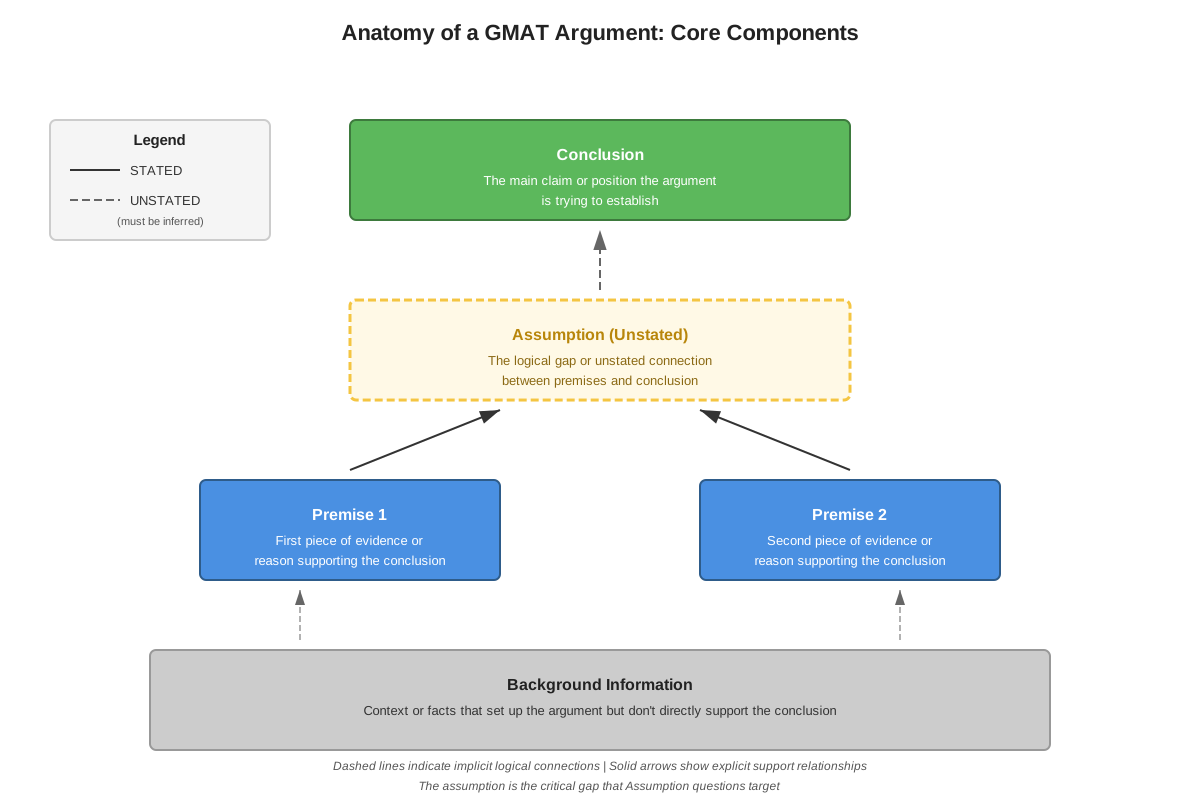
Every GMAT argument consists of distinct building blocks that serve specific logical functions. The conclusion represents the main claim, assertion, or position that the author wants the reader to accept. It answers the question "What is the author trying to prove?" Conclusions can appear anywhere in a passage—first sentence, last sentence, or embedded in the middle—and are often (but not always) preceded by conclusion indicators like "therefore," "thus," "consequently," "hence," or "so."
Premises are the evidence, reasons, facts, or data offered to support the conclusion. They answer "Why should we believe the conclusion?" Premises provide the logical foundation upon which the argument rests. Premise indicators include words like "because," "since," "given that," "as evidenced by," and "for the reason that." A single argument may contain one premise or multiple premises working together to support the conclusion.
Background information or context provides setting, definitions, or general information that frames the argument but doesn't directly support the conclusion. This component often appears at the beginning of GMAT passages and can be mistaken for premises by inexperienced test-takers. The key distinction: background information could be removed without weakening the logical connection between premises and conclusion.
Assumptions are unstated premises—the missing links between explicit premises and the conclusion. While not physically present in the passage text, assumptions are logically necessary for the argument to hold. Identifying assumptions is crucial because they represent the argument's vulnerabilities, the points where the logic can be strengthened or weakened.
Counterarguments or opposing viewpoints present positions contrary to the author's conclusion. When present, they're typically introduced with phrases like "some argue that," "critics contend," or "opponents believe." Distinguishing counterarguments from the author's actual position is essential for accurate structural analysis.
Structural Patterns and Templates
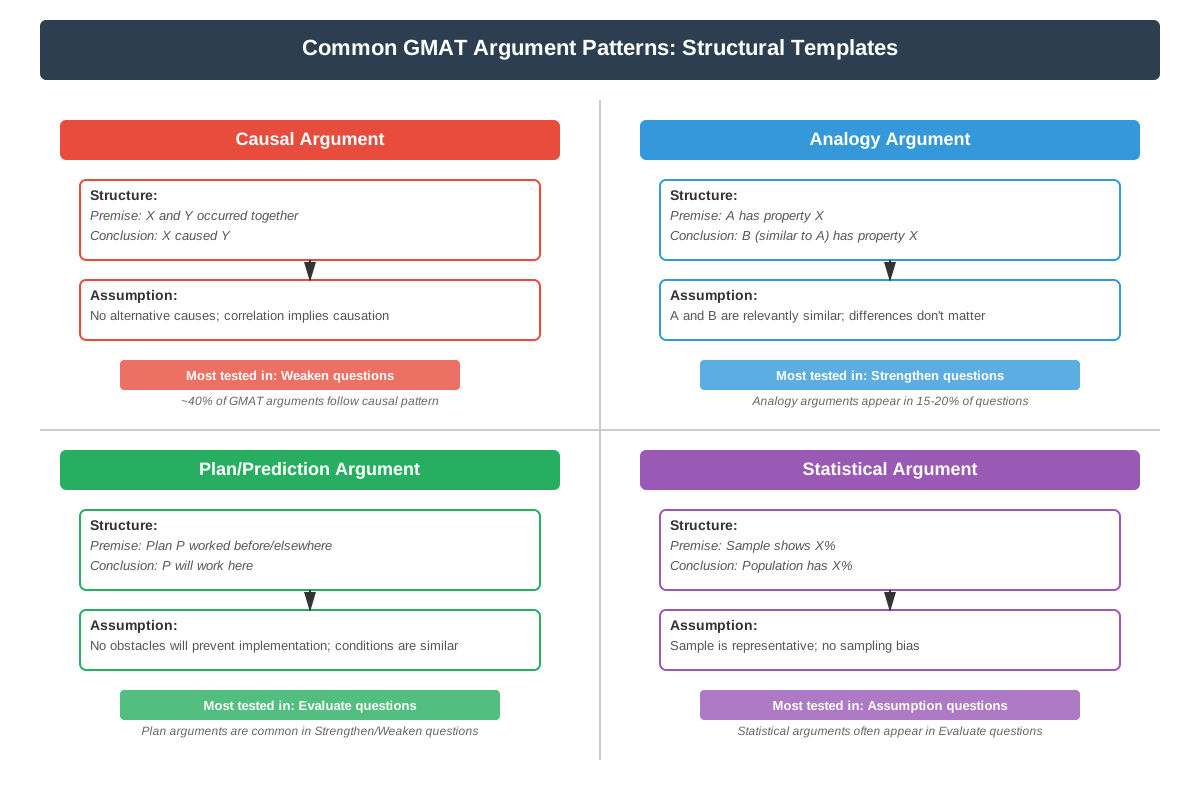
GMAT arguments follow recognizable patterns that, once learned, accelerate analysis. The simple linear structure presents premises followed by a conclusion: "Premise 1. Premise 2. Therefore, Conclusion." This straightforward pattern appears in approximately 40% of GMAT arguments.
The conclusion-first structure states the main claim immediately, then provides supporting evidence: "Conclusion. This is true because Premise 1 and Premise 2." This pattern tests whether students can identify conclusions regardless of position, appearing in roughly 30% of arguments.
The complex layered structure contains intermediate conclusions that serve as premises for the final conclusion: "Premise 1 and Premise 2 support Intermediate Conclusion, which in turn supports Final Conclusion." These arguments require careful mapping to avoid confusing intermediate and final conclusions.
The counterargument structure presents an opposing view before stating the author's position: "Some believe X. However, Y is actually true because Premise 1 and Premise 2." This pattern appears frequently in Weaken and Strengthen questions, where the counterargument may be the target for attack or support.
Logical Relationships and Connectors
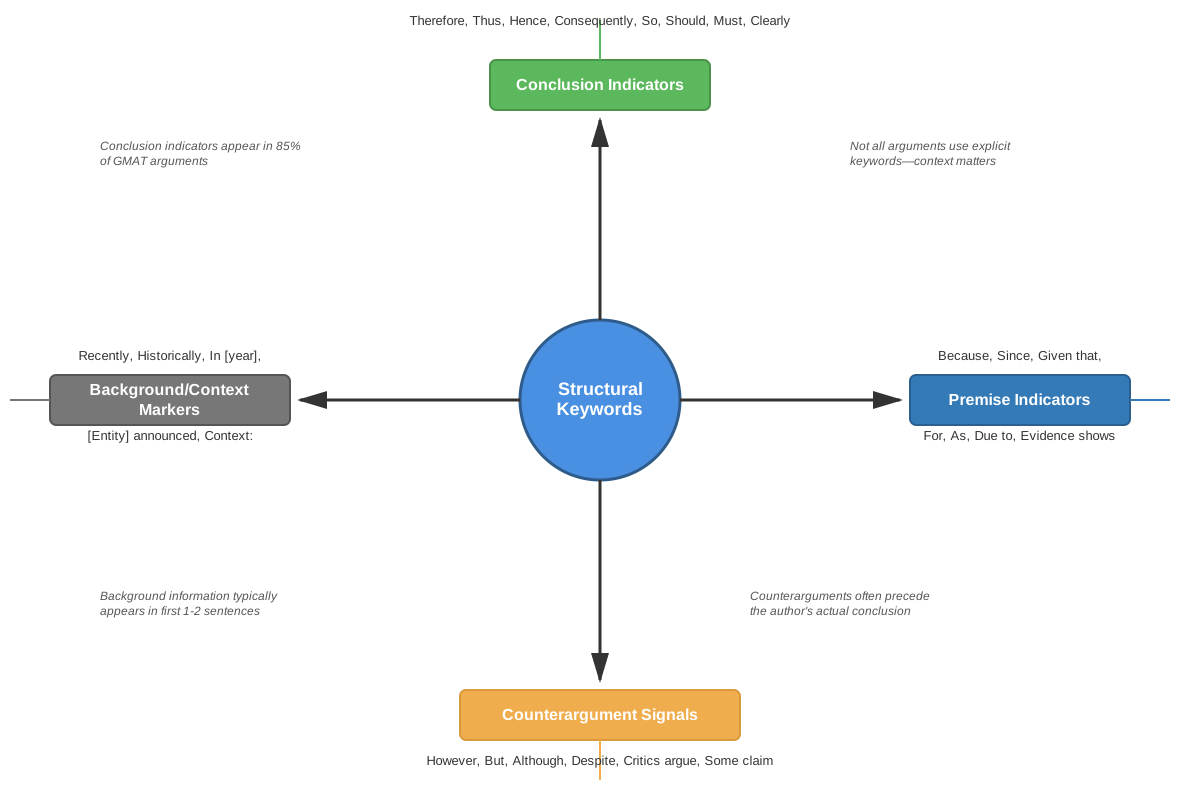
Understanding how argument components relate requires recognizing logical connectors—words and phrases that signal relationships between ideas. These fall into distinct categories:
| Connector Type | Examples | Function |
|---|---|---|
| Conclusion Indicators | therefore, thus, hence, consequently, so, accordingly | Signal that what follows is the main claim |
| Premise Indicators | because, since, given that, as, for, as evidenced by | Signal that what follows is supporting evidence |
| Contrast Indicators | however, but, yet, although, despite, nevertheless | Signal opposing viewpoints or limitations |
| Continuation Indicators | moreover, furthermore, additionally, also | Signal additional supporting evidence |
| Causation Indicators | causes, leads to, results in, produces, brings about | Signal cause-effect relationships |
The logical flow of an argument describes how premises connect to conclusions. In a sufficient relationship, the premises, if true, guarantee the conclusion. In a necessary relationship, the premises must be true for the conclusion to hold, but don't guarantee it. Most GMAT arguments involve necessary relationships, where premises support but don't definitively prove conclusions, creating space for assumptions.
Mapping Argument Structure
Argument mapping is the process of visually or mentally organizing argument components to reveal logical relationships. The basic mapping process involves four steps:
- Identify the conclusion by asking "What is the author's main point?" and looking for conclusion indicators
- Locate all premises by asking "What evidence supports this conclusion?" and identifying premise indicators
- Note background information that provides context but doesn't directly support the conclusion
- Identify assumptions by asking "What must be true for the premises to support the conclusion?"
A mapped argument might look like: [Background: Context] → [Premise 1] + [Premise 2] → [Assumption: Unstated link] → [Conclusion: Main claim]
This mapping reveals the argument's logical skeleton, making vulnerabilities and strengths immediately apparent. For example, if premises discuss correlation but the conclusion claims causation, the assumption that correlation implies causation becomes visible and targetable.
Argument Scope and Precision
Scope refers to the breadth of an argument's conclusion. GMAT test makers frequently create wrong answers by shifting scope—making conclusions broader or narrower than the premises support. A premise about "some companies" cannot support a conclusion about "all companies" without an additional assumption. Similarly, premises about past events may not support conclusions about future events without assuming continuity.
Precision involves the specific language used in conclusions versus premises. An argument might present premises about "increased sales" but conclude "increased profits"—a scope shift requiring the assumption that increased sales lead to increased profits. Recognizing these subtle shifts is essential for Assumption, Strengthen, and Weaken questions.
Concept Relationships
The components of argument structure exist in a hierarchical relationship: Background information sets the stage → Premises provide evidence → Assumptions bridge logical gaps → Conclusion states the main claim. This flow represents the logical progression from context through reasoning to final assertion.
Within this hierarchy, premises and assumptions work together to support conclusions. Multiple premises may independently support a conclusion (parallel reasoning) or may work sequentially where one premise supports an intermediate conclusion that becomes a premise for the final conclusion (serial reasoning). Understanding these relationships determines how to strengthen or weaken arguments effectively.
Argument structure connects directly to every Critical Reasoning question type. For Assumption questions, identifying the gap between premises and conclusion reveals the necessary assumption. For Strengthen questions, understanding the argument's structure shows where additional evidence would reinforce the logical connection. For Weaken questions, structural analysis reveals vulnerabilities—points where contrary evidence would damage the argument. For Evaluate questions, recognizing the argument's assumptions indicates what information would help assess the argument's validity.
The relationship map flows: Identify Structure → Recognize Assumptions → Determine Vulnerabilities → Select Answer Choice. This sequence applies universally across Critical Reasoning question types, making argument structure the foundational skill upon which all others build.
High-Yield Facts
⭐ The conclusion is the author's main claim and can appear anywhere in the passage—first sentence, last sentence, or middle—not just at the end
⭐ Premises are always stated explicitly in the passage; assumptions are never stated but are logically necessary for the argument to work
⭐ Background information can be removed without affecting the logical connection between premises and conclusion
⭐ Conclusion indicators (therefore, thus, hence) and premise indicators (because, since, given that) are the fastest way to identify argument structure
⭐ Every GMAT argument contains at least one assumption—an unstated premise that bridges the gap between evidence and conclusion
- Arguments with multiple premises may have each premise independently support the conclusion or work together sequentially
- Counterarguments represent positions the author opposes, not the author's actual conclusion
- Intermediate conclusions serve as both conclusions (supported by earlier premises) and premises (supporting the final conclusion)
- Scope shifts between premises and conclusions often indicate where assumptions exist
- The strength of an argument depends on the validity of its assumptions, not the truth of its stated premises
- Causal arguments (X causes Y) require the assumption that correlation indicates causation and that no alternative explanations exist
- Analogical arguments (X is like Y) require the assumption that the compared items are similar in relevant ways
- Statistical arguments require assumptions about sample representativeness and data collection methodology
- Prediction arguments (X will happen) require the assumption that past patterns will continue or that current trends will persist
- Most GMAT arguments are inductive (premises support but don't guarantee the conclusion) rather than deductive (premises definitively prove the conclusion)
Quick check — test yourself on Argument structure so far.
Try Flashcards →Common Misconceptions
Misconception: The conclusion always appears at the end of the passage → Correction: Conclusions can appear anywhere—beginning, middle, or end. GMAT test makers deliberately vary conclusion placement to test whether students can identify it regardless of position. Always look for conclusion indicators and ask "What is the author's main point?" rather than assuming position determines function.
Misconception: Longer sentences or more complex language indicate the conclusion → Correction: Conclusions can be stated simply while premises may be complex, or vice versa. Grammatical complexity doesn't correlate with logical function. Focus on logical indicators and the role each statement plays in the argument's reasoning.
Misconception: Background information and premises are the same thing → Correction: Background provides context but doesn't directly support the conclusion. Premises offer specific evidence for the conclusion. Test this by asking: "If I removed this statement, would the argument be weaker?" If yes, it's a premise. If no, it's background.
Misconception: All statements in an argument support the conclusion → Correction: Arguments may contain counterarguments, background information, or intermediate conclusions that don't directly support the main conclusion. Some statements may even oppose the conclusion before the author refutes them. Careful analysis distinguishes supporting from non-supporting elements.
Misconception: Assumptions are the same as inferences → Correction: Assumptions are unstated premises necessary for the argument to work—they must be true for the conclusion to follow from the premises. Inferences are conclusions that can be drawn from stated information. Assumptions fill gaps in reasoning; inferences extend reasoning to new conclusions.
Misconception: Identifying argument structure is only necessary for Assumption questions → Correction: Every Critical Reasoning question type requires structural analysis as the first step. Strengthen, Weaken, Evaluate, Inference, and Boldface questions all depend on understanding which statements are premises, which is the conclusion, and what assumptions connect them.
Misconception: The author's opinion is always explicitly stated → Correction: Sometimes the conclusion must be inferred from the overall thrust of the argument, especially when the passage presents evidence pointing toward an unstated claim. The conclusion may be implicit, requiring students to identify what the premises collectively support.
Worked Examples
Example 1: Basic Structural Analysis
Passage: "Company X's sales increased by 15% after implementing a new marketing strategy. The company's market share also grew during this period. Therefore, the new marketing strategy was responsible for Company X's improved performance."
Step 1 - Identify the Conclusion: The conclusion is "the new marketing strategy was responsible for Company X's improved performance." The indicator word "therefore" signals this is the main claim the author wants us to accept.
Step 2 - Identify the Premises:
- Premise 1: "Company X's sales increased by 15% after implementing a new marketing strategy"
- Premise 2: "The company's market share also grew during this period"
Step 3 - Identify Background Information: There is no pure background information in this argument; both statements about sales and market share serve as evidence.
Step 4 - Identify Assumptions: The argument assumes:
- The timing of the marketing strategy and improved performance indicates causation, not mere correlation
- No other factors (economic conditions, competitor failures, product improvements) caused the improved performance
- The marketing strategy was the primary or sole cause of the improvements
Step 5 - Map the Structure:
[Premise 1: Sales increased after new strategy] + [Premise 2: Market share grew] → [Assumption: Correlation = Causation, No alternative causes] → [Conclusion: Strategy caused improved performance]
Application to Question Types:
- A Weaken question might present evidence of alternative causes (economic boom, competitor bankruptcy)
- A Strengthen question might eliminate alternative explanations or show the strategy preceded improvements
- An Assumption question might ask what must be true for the conclusion to follow (no other factors caused the improvement)
Example 2: Complex Structure with Counterargument
Passage: "Some analysts believe that increasing interest rates will slow economic growth. However, historical data from the past three recessions shows that interest rate increases preceded economic recoveries. Additionally, higher interest rates encourage saving, which provides capital for business investment. Thus, increasing interest rates will likely stimulate rather than slow economic growth."
Step 1 - Identify the Conclusion: The conclusion is "increasing interest rates will likely stimulate rather than slow economic growth." The indicator "thus" signals this main claim. Note that this conclusion appears at the end but contradicts the opening statement.
Step 2 - Identify the Counterargument: "Some analysts believe that increasing interest rates will slow economic growth" is a counterargument—a position the author opposes. This is not the author's conclusion but rather a view the author argues against.
Step 3 - Identify the Premises:
- Premise 1: "Historical data from the past three recessions shows that interest rate increases preceded economic recoveries"
- Premise 2: "Higher interest rates encourage saving, which provides capital for business investment"
Step 4 - Identify Background/Context: The word "However" signals a shift from counterargument to the author's actual position.
Step 5 - Identify Assumptions:
- The past three recessions are representative of future economic conditions
- The correlation between rate increases and recoveries indicates causation
- The time lag between rate increases and recoveries is relevant
- Increased saving actually translates to increased business investment
- The positive effects of saving outweigh any negative effects of higher borrowing costs
Step 6 - Map the Structure:
[Counterargument: Rates slow growth] → [Contrast: However] → [Premise 1: Historical correlation] + [Premise 2: Saving provides capital] → [Multiple Assumptions about causation and future similarity to past] → [Conclusion: Rates will stimulate growth]
Application to Question Types:
- A Weaken question might show that past recessions differed from current conditions, or that other factors caused the recoveries
- A Strengthen question might provide evidence that current conditions match past recession conditions
- An Assumption question might ask whether the author assumes past patterns will continue
- An Evaluate question might ask what information would help determine whether the conclusion is justified (e.g., "Were other economic factors present during past recoveries?")
Exam Strategy
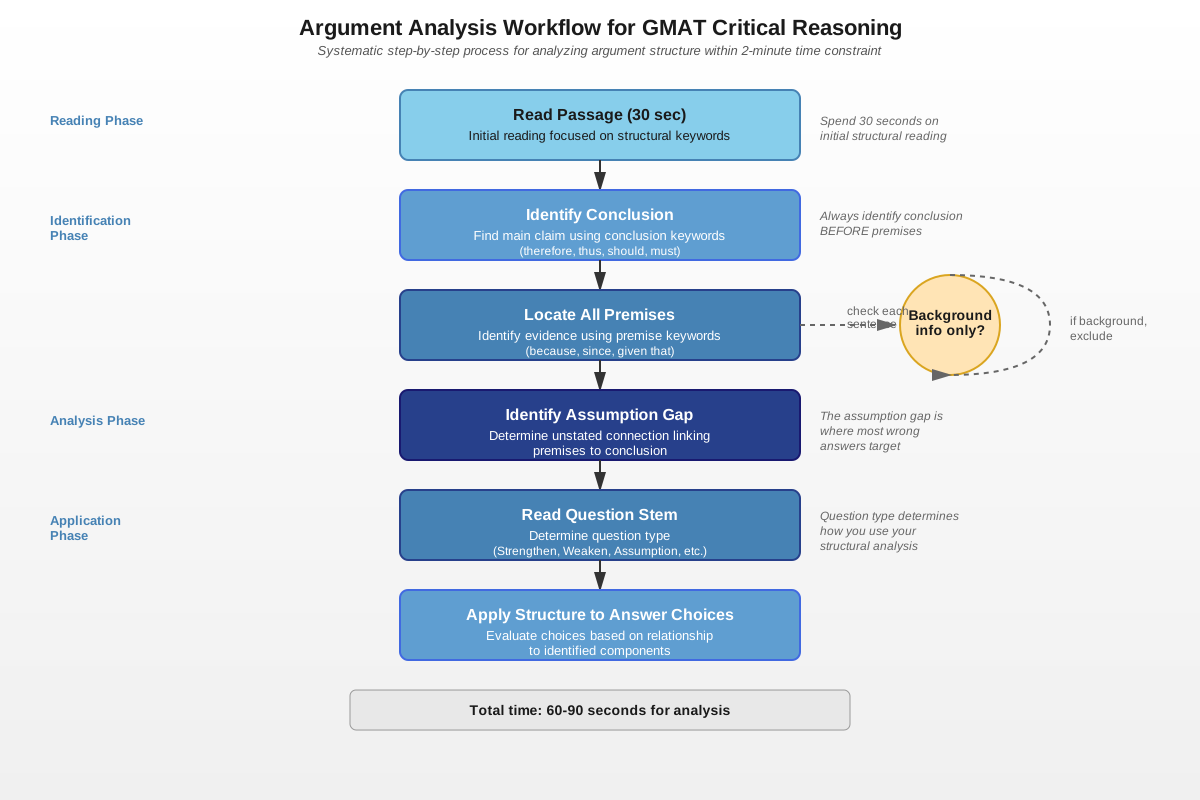
When approaching GMAT Critical Reasoning questions, implement this systematic process within 60-90 seconds:
Step 1 (15-20 seconds): Read the question stem first. Knowing whether you'll need to strengthen, weaken, identify an assumption, or perform another task focuses your structural analysis on relevant elements. For Assumption questions, pay special attention to gaps in reasoning. For Strengthen/Weaken questions, note the conclusion you'll need to support or attack.
Step 2 (30-40 seconds): Read the passage and identify structure. As you read, actively mark or mentally note:
- Conclusion (underline or mark with "C")
- Premises (mark with "P1," "P2," etc.)
- Background information (mark with "B")
- Counterarguments (mark with "CA")
- Logical connectors (circle indicator words)
Step 3 (10-15 seconds): Identify the assumption(s). Before looking at answer choices, determine what unstated premise connects the evidence to the conclusion. Ask: "What must be true for this conclusion to follow from these premises?"
Step 4 (20-30 seconds): Evaluate answer choices. Use process of elimination, actively looking for:
- Scope shifts (answers that are too broad or too narrow)
- Irrelevant information (answers that don't connect to the argument's logic)
- Opposite answers (especially common in Strengthen/Weaken questions)
- Extreme language that doesn't match the argument's scope
Trigger words and phrases to watch for:
Conclusion indicators: therefore, thus, hence, consequently, so, accordingly, as a result, it follows that, which means that, which implies that, clearly, obviously
Premise indicators: because, since, given that, as, for, as evidenced by, as indicated by, for the reason that, may be inferred from, in light of
Contrast indicators: however, but, yet, although, though, even though, despite, nevertheless, nonetheless, on the other hand, conversely
Causation language: causes, leads to, results in, produces, brings about, is responsible for, accounts for, explains—these often signal assumptions about causation
Prediction language: will, will likely, probably, is expected to—these signal assumptions about future similarity to past or present
Process-of-elimination tips specific to argument structure:
- Eliminate answers that address the wrong conclusion (especially in complex arguments with intermediate conclusions)
- Eliminate answers that strengthen when you need to weaken, or vice versa
- Eliminate answers that state premises already in the argument (for Assumption questions)
- Eliminate answers that are irrelevant to the logical connection between the specific premises and conclusion
- Eliminate answers that introduce new topics not connected to the argument's scope
Time allocation: Spend more time on structural analysis (40-50 seconds) and less time on answer evaluation (20-30 seconds). Students who rush through reading and then struggle with answer choices typically perform worse than those who invest time in thorough structural understanding upfront.
Memory Techniques
CPAC Mnemonic for argument components:
- Conclusion: The main claim
- Premises: The evidence
- Assumptions: The unstated links
- Context: The background information
"Therefore/Because" Test: When uncertain whether a statement is a premise or conclusion, try inserting "therefore" before it and "because" after it. If "therefore [statement]" sounds logical, it's likely a conclusion. If "[statement] because" sounds logical (expecting evidence to follow), it's likely a premise.
The Bridge Visualization: Picture the conclusion as an island you're trying to reach and premises as the land you're starting from. Assumptions are the bridge connecting them. If the bridge has gaps (weak assumptions), the argument is vulnerable. This visualization helps identify where Strengthen or Weaken answer choices should target.
SCAN Acronym for reading passages:
- Spot the conclusion first
- Circle indicator words
- Analyze the premises
- Note the assumptions
The "So What?" Test for distinguishing background from premises: After reading a statement, ask "So what? How does this support the conclusion?" If you can't articulate a clear connection, it's likely background information rather than a premise.
Assumption Formula: Assumption = What's needed to get from Premises to Conclusion. Visualize this as a mathematical equation: Premises + Assumption = Conclusion. This formula helps identify the missing piece.
Summary
Argument structure forms the foundation of GMAT Critical Reasoning success, appearing in every single CR question regardless of type. Mastering structural analysis means quickly identifying the conclusion (the author's main claim), premises (the supporting evidence), background information (context that doesn't directly support the conclusion), and assumptions (unstated premises necessary for the argument to work). GMAT arguments follow recognizable patterns—simple linear, conclusion-first, complex layered, and counterargument structures—that can be mapped to reveal logical relationships. The key to efficient analysis is recognizing logical connectors (therefore, because, however) that signal relationships between components. Every argument contains at least one assumption, representing the gap between stated premises and the conclusion, and these assumptions are where arguments are most vulnerable to being strengthened or weakened. Successful test-takers spend 40-50 seconds on thorough structural analysis before evaluating answer choices, using this understanding to eliminate wrong answers that shift scope, introduce irrelevant information, or misidentify the argument's logical core. The ability to dissect argument structure within 60-90 seconds per question directly determines performance on approximately one-third of the Verbal Reasoning section.
Key Takeaways
- Argument structure consists of four components: conclusions (main claims), premises (stated evidence), assumptions (unstated necessary premises), and background information (context)
- Conclusions can appear anywhere in a passage—beginning, middle, or end—and must be identified by their logical function, not their position
- Every GMAT argument contains at least one assumption, representing the logical gap between premises and conclusion, and this gap is where arguments are most vulnerable
- Logical indicators are the fastest route to structural analysis: "therefore/thus/hence" signal conclusions, while "because/since/given that" signal premises
- Structural analysis is the first step for every Critical Reasoning question type, not just Assumption questions—Strengthen, Weaken, Evaluate, and Inference questions all require identifying the argument's skeleton
- Scope precision matters critically: wrong answers frequently shift the scope of premises or conclusions, making claims broader or narrower than the argument supports
- Invest time in structural analysis upfront (40-50 seconds) rather than rushing to answer choices, as thorough understanding accelerates elimination and improves accuracy
Related Topics
Assumption Questions: Building directly on argument structure, this topic focuses specifically on identifying unstated premises necessary for arguments to work. Mastering argument structure is the essential prerequisite for Assumption question success.
Strengthen and Weaken Questions: These question types require identifying argument structure first, then determining what additional evidence would reinforce or damage the logical connection between premises and conclusion.
Evaluate Questions: This advanced topic asks what information would help assess an argument's validity, requiring deep understanding of assumptions and structural vulnerabilities.
Causal Reasoning: Many GMAT arguments involve cause-and-effect claims, requiring specific structural analysis of how premises support causal conclusions and what assumptions about causation exist.
Formal Logic: Understanding conditional statements (if-then relationships), necessary versus sufficient conditions, and logical operators builds on structural analysis skills to handle more complex reasoning patterns.
Practice CTA
Now that you understand the fundamental components and patterns of argument structure, it's time to apply these concepts to actual GMAT questions. The practice questions and flashcards will reinforce your ability to quickly identify conclusions, premises, and assumptions under timed conditions. Each practice question you complete strengthens your pattern recognition and speeds your analysis. Remember: argument structure is a skill that improves dramatically with deliberate practice. Approach each practice question systematically using the SCAN method, and you'll find that structural analysis becomes automatic, freeing your mental energy for evaluating answer choices. Your investment in mastering this foundational topic will pay dividends across every Critical Reasoning question you encounter on test day.
Sign up free to keep reading
Create a free AnvayaPrep account to finish this GMAT guide on Argument structure — plus flashcards and practice questions.