Overview
Arithmetic word problems represent one of the most frequently tested question types on the GMAT Quantitative Reasoning section, appearing in approximately 20-30% of all quantitative questions. These problems translate real-world scenarios into mathematical expressions and equations, requiring test-takers to decode verbal information, identify relevant numerical relationships, and apply fundamental arithmetic operations to reach a solution. Unlike straightforward computational questions, GMAT arithmetic word problems demand both mathematical proficiency and strong reading comprehension skills, making them a critical area for focused preparation.
The challenge of arithmetic word problems lies not merely in performing calculations, but in the translation process—converting narrative descriptions into mathematical models. Test-takers must parse through contextual information, distinguish between relevant and extraneous details, and recognize underlying mathematical structures hidden within everyday language. This skill set extends beyond basic arithmetic to encompass proportional reasoning, rate calculations, percentage applications, and multi-step problem solving. Mastery of these problems directly correlates with overall GMAT performance, as they serve as foundational building blocks for more complex quantitative concepts.
Within the broader Quantitative Reasoning framework, arithmetic word problems serve as the practical application layer for abstract mathematical principles. They bridge the gap between pure computation and analytical reasoning, preparing test-takers for the integrated reasoning demands of business school curricula. These problems frequently combine multiple arithmetic concepts—such as percentages, ratios, and averages—within a single scenario, testing both conceptual understanding and strategic problem-solving abilities. Success with arithmetic word problems establishes the foundation for tackling advanced topics in algebra, geometry, and data interpretation that appear later in the GMAT.
Learning Objectives
- [ ] Identify arithmetic word problems by recognizing their characteristic structure and language patterns
- [ ] Explain the mathematical relationships embedded within word problem narratives
- [ ] Apply systematic problem-solving strategies to GMAT arithmetic word problems
- [ ] Translate verbal descriptions into mathematical expressions and equations efficiently
- [ ] Distinguish between relevant and irrelevant information in complex word problem scenarios
- [ ] Execute multi-step solutions while maintaining accuracy under time pressure
- [ ] Verify solutions by checking reasonableness and applying alternative solution methods
Prerequisites
- Basic arithmetic operations (addition, subtraction, multiplication, division): Essential for executing calculations once the problem structure is identified
- Order of operations (PEMDAS): Required for correctly evaluating multi-step expressions and avoiding calculation errors
- Fractions, decimals, and percentages: Fundamental for interpreting and manipulating quantities in various formats commonly used in word problems
- Ratio and proportion concepts: Necessary for understanding comparative relationships between quantities described in problem narratives
- Unit conversion principles: Important for working with different measurement systems and ensuring dimensional consistency
Why This Topic Matters
Arithmetic word problems constitute a cornerstone of GMAT quantitative assessment because they mirror the analytical challenges business professionals encounter daily. Whether calculating profit margins, determining optimal pricing strategies, analyzing workforce productivity, or projecting financial outcomes, business leaders must constantly translate real-world situations into quantitative frameworks. The GMAT uses arithmetic word problems to evaluate candidates' readiness for the quantitative demands of MBA programs and subsequent business careers.
From an exam perspective, arithmetic word problems appear in multiple formats throughout the GMAT Quantitative section. They constitute approximately 8-12 questions per test, appearing as both Problem Solving and Data Sufficiency question types. These problems frequently integrate multiple arithmetic concepts within a single scenario—a question might simultaneously test percentage calculations, ratio reasoning, and average computations. The adaptive nature of the GMAT means that consistent performance on arithmetic word problems significantly influences overall quantitative scores, as correct answers lead to progressively more challenging questions.
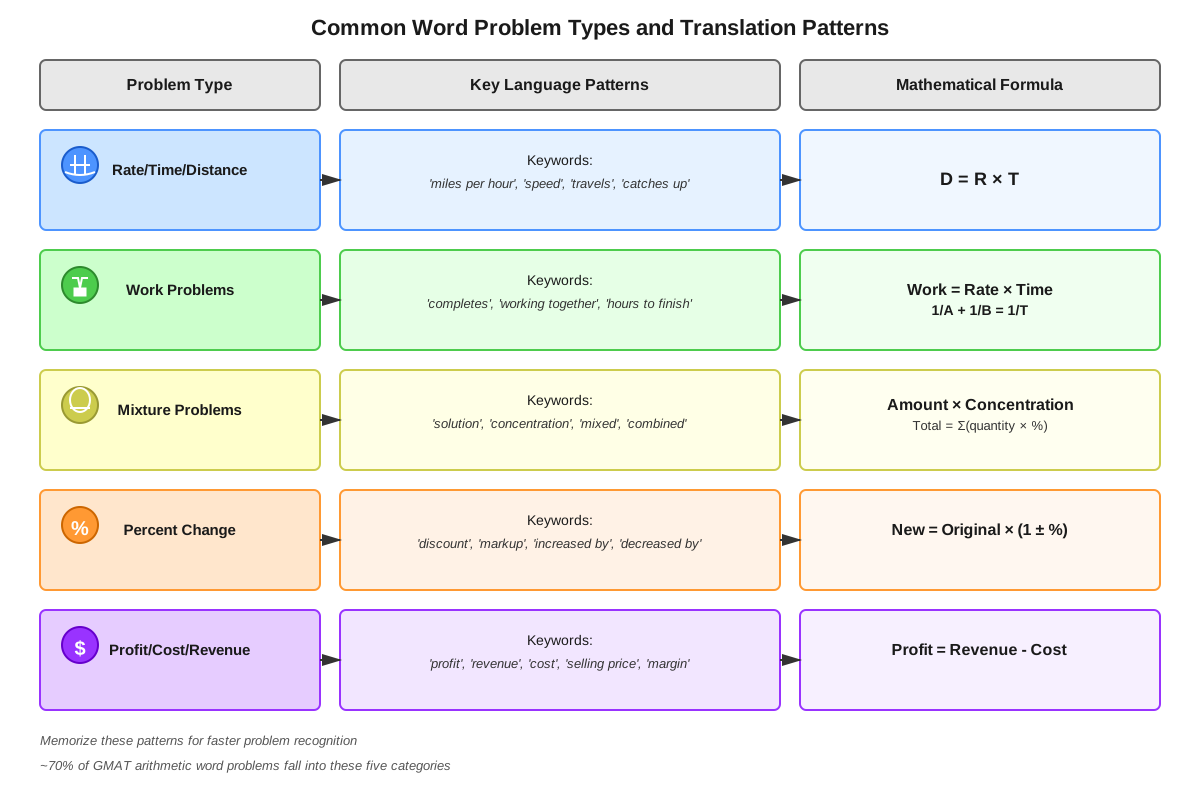
Common manifestations include work-rate problems (individuals completing tasks at different speeds), mixture problems (combining solutions with different concentrations), age problems (relationships between people's ages at different times), distance-rate-time scenarios (travel problems involving multiple legs or travelers), profit and loss calculations (business scenarios involving costs, revenues, and margins), and consecutive integer problems (finding sets of numbers with specific properties). The GMAT particularly favors problems requiring multi-step reasoning, where the solution to one component becomes the input for subsequent calculations, testing both computational accuracy and logical sequencing abilities.
Core Concepts
Problem Structure Recognition
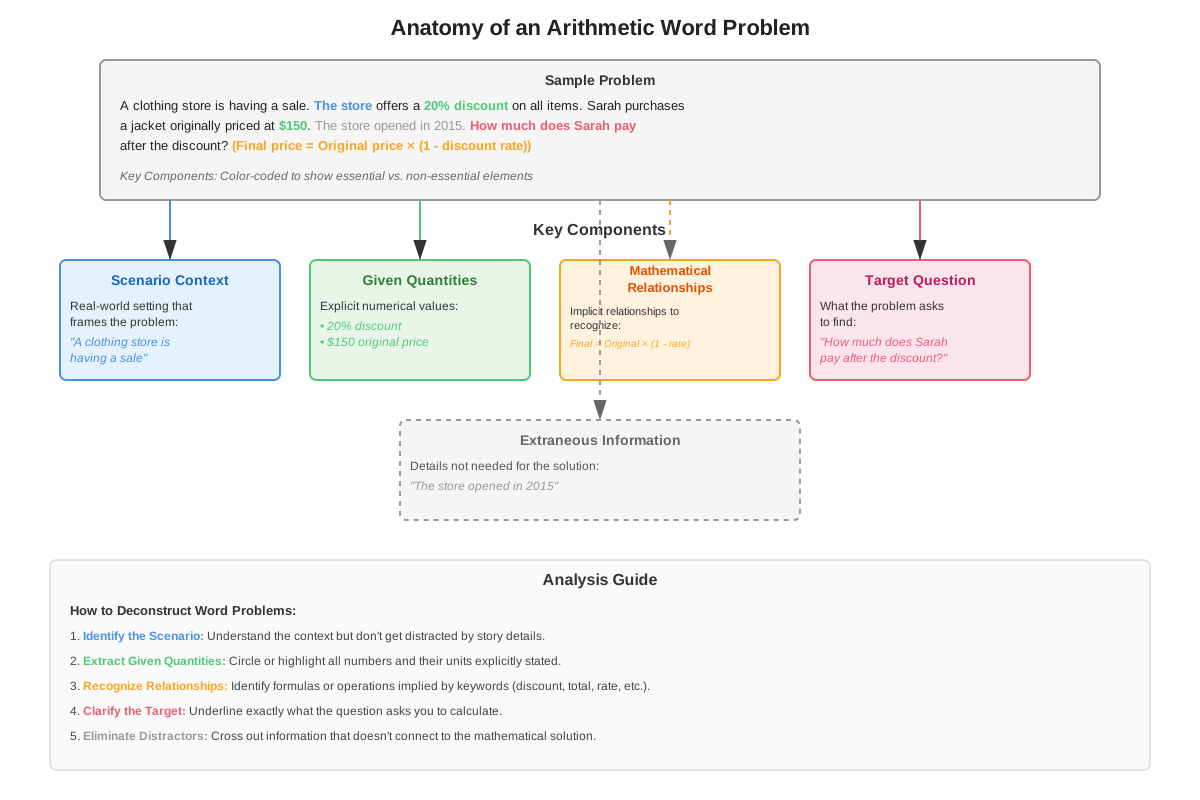
Every arithmetic word problem follows a predictable architecture consisting of three essential components: the given information (known quantities and relationships), the unknown quantity (what the problem asks you to find), and the constraints or relationships (how the given information connects to the unknown). Developing the ability to quickly identify these components transforms seemingly complex narratives into manageable mathematical structures.
The given information typically appears embedded within descriptive sentences, often mixed with contextual details that add realism but don't contribute to the mathematical solution. Skilled test-takers learn to extract numerical values and their associated units while noting any qualitative relationships (such as "twice as much" or "30% more than"). The unknown quantity usually appears in the question stem, though sometimes it requires inference from phrases like "how many," "what is the value of," or "determine the total."
Constraints and relationships represent the mathematical core of the problem—they describe how quantities interact through operations, equations, or proportional relationships. These might be explicitly stated ("the sum of three consecutive integers equals 72") or implicitly described through context ("if John works twice as fast as Mary"). Recognizing these relationship patterns accelerates problem-solving by activating relevant solution strategies.
Translation Strategies
The translation process converts verbal descriptions into mathematical notation, serving as the critical bridge between reading comprehension and quantitative analysis. Certain phrases consistently map to specific operations: "sum," "total," and "combined" indicate addition; "difference," "less than," and "remaining" suggest subtraction; "product," "times," and "of" (when used with fractions or percentages) signal multiplication; "quotient," "per," and "ratio" point toward division.
Comparative language requires particular attention. "More than" and "less than" create directional relationships that must be carefully translated. For example, "x is 5 more than y" translates to x = y + 5, while "x is 5 less than y" becomes x = y - 5. The phrase "x is 20% more than y" means x = y + 0.20y = 1.20y, demonstrating how percentage language combines multiplication and addition.
Proportional relationships appear frequently in GMAT arithmetic word problems. Phrases like "directly proportional," "varies directly with," or "increases proportionally" indicate that two quantities maintain a constant ratio. Inverse relationships, signaled by "inversely proportional" or "varies inversely," mean that as one quantity increases, the other decreases such that their product remains constant. Recognizing these patterns immediately suggests appropriate solution approaches.
Common Problem Categories
Work-rate problems involve individuals or machines completing tasks at specified rates, often working together or sequentially. The fundamental principle states that rate × time = work completed. When multiple workers collaborate, their individual rates add together. For example, if Worker A completes a job in 6 hours (rate = 1/6 job per hour) and Worker B completes it in 4 hours (rate = 1/4 job per hour), working together their combined rate equals 1/6 + 1/4 = 5/12 job per hour.
Mixture problems combine substances with different properties (concentrations, prices, or qualities) to create a blend with intermediate characteristics. These problems rely on the principle that the total amount of a specific component equals the sum of that component from each source. A classic example involves mixing solutions: combining 3 liters of 20% salt solution with 2 liters of 50% salt solution yields (3 × 0.20 + 2 × 0.50) = 1.6 liters of pure salt in 5 total liters, creating a 32% solution.
Distance-rate-time problems apply the fundamental relationship distance = rate × time, often involving multiple travelers, vehicles, or journey segments. These problems may ask about meeting times (two objects traveling toward each other), overtaking scenarios (one object catching another), or round-trip calculations (different speeds in different directions). The key insight is that time remains the connecting variable when multiple distance-rate relationships exist simultaneously.
Age problems establish relationships between people's ages at different points in time. These problems exploit the fact that everyone ages at the same rate—if Person A is currently 5 years older than Person B, this 5-year difference persists forever. Setting up equations with variables representing current ages and adding or subtracting years to represent past or future ages provides the solution framework.
Profit and loss problems involve business scenarios with costs, selling prices, revenues, and profit margins. Key relationships include: profit = revenue - cost, profit margin = (profit/cost) × 100%, and markup = (selling price - cost)/cost × 100%. These problems often require calculating one quantity given information about others, testing understanding of how these business metrics interrelate.
Multi-Step Problem Solving
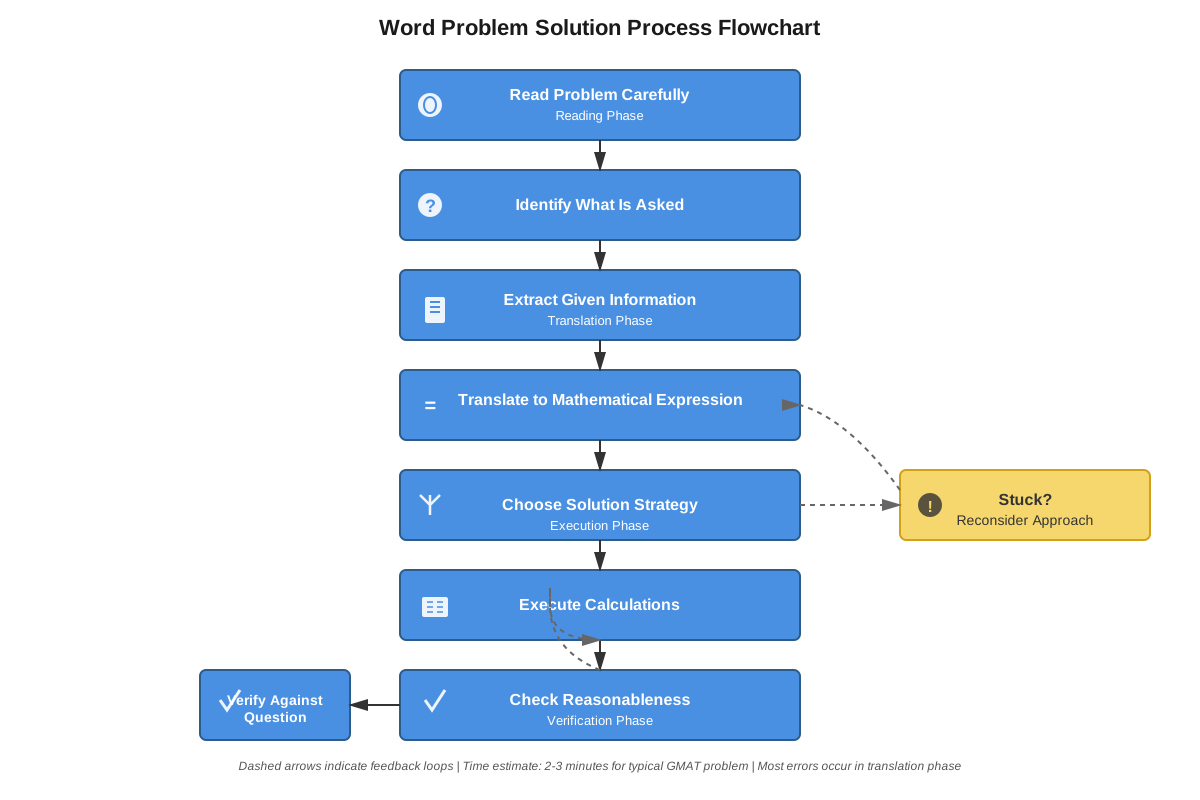
Complex GMAT arithmetic word problems require sequential reasoning, where solving for one unknown provides information needed for subsequent calculations. The strategic approach involves: (1) identifying the ultimate question, (2) determining what intermediate information is needed to answer it, (3) working backward to identify which given information can produce those intermediate results, and (4) executing calculations in the proper sequence.
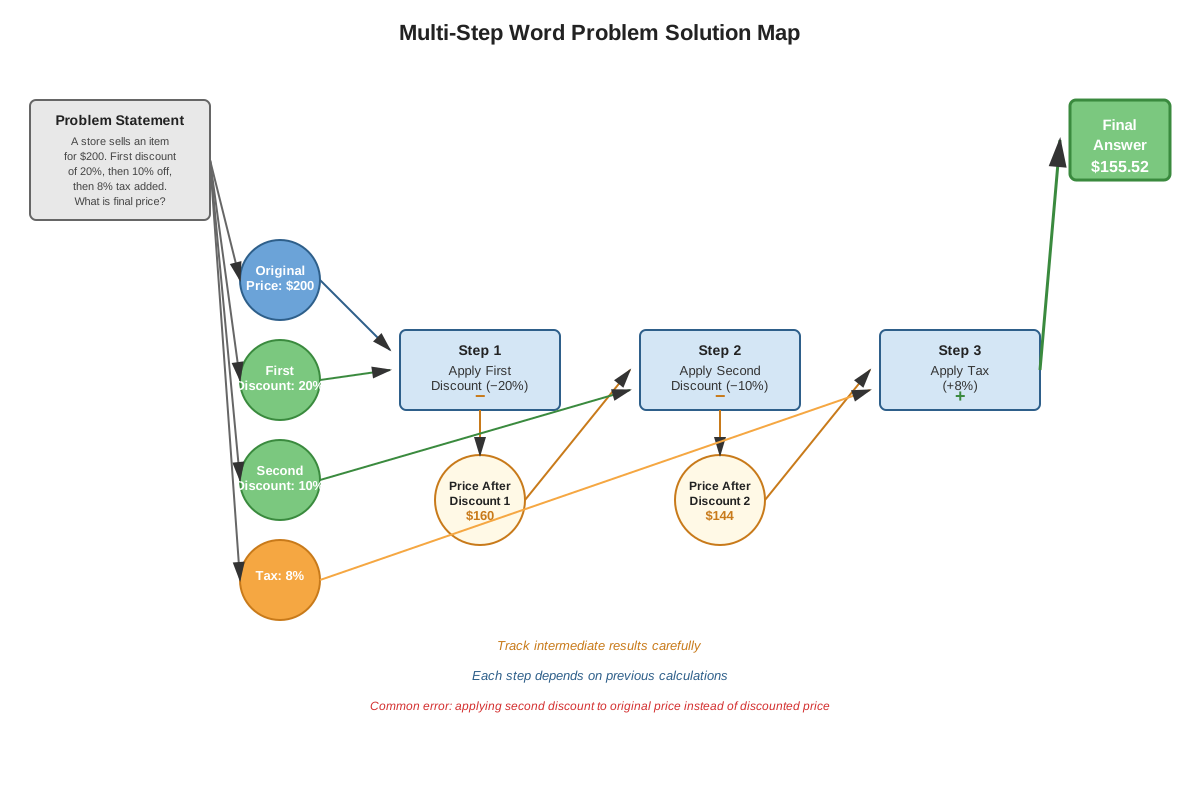
Consider a problem asking for the total cost of a purchase after successive discounts and tax. The solution sequence requires: first calculating the price after the initial discount, then applying the second discount to that reduced price, and finally adding tax to the twice-discounted amount. Each step depends on the previous result, making calculation accuracy and logical sequencing essential.
Tracking units throughout multi-step problems prevents errors and ensures dimensional consistency. If a problem provides speeds in miles per hour but asks for distance in feet, conversion must occur at an appropriate step. Similarly, when working with percentages, maintaining awareness of whether calculations use decimal (0.15) or percentage (15%) format prevents multiplication errors.
Variable Assignment and Equation Setup
Effective variable assignment simplifies complex problems by creating algebraic representations of unknown quantities. The general principle: assign variables to the most fundamental unknowns, then express other quantities in terms of these variables using the relationships described in the problem. This approach minimizes the number of variables and creates equations that are easier to solve.
For example, in a problem stating "John has three times as many books as Mary, and together they have 48 books," assigning M = Mary's books allows expressing John's books as 3M. The equation M + 3M = 48 contains only one variable, yielding M = 12 immediately. Alternatively, assigning separate variables J and M would require solving the system J = 3M and J + M = 48, which is more complex though ultimately equivalent.
Choosing appropriate variables also aids in avoiding sign errors and maintaining clarity. Using descriptive variable names (like r for rate or t for time) rather than arbitrary letters helps prevent confusion in complex problems. When multiple similar quantities exist (like speeds of different travelers), subscripts (v₁, v₂) or distinct letters with mnemonic value maintain organization.
Concept Relationships
The concepts within arithmetic word problems form an interconnected web where problem structure recognition enables effective translation strategies, which in turn facilitate appropriate variable assignment and equation setup. This sequence—recognize → translate → formulate → solve—represents the standard workflow for tackling any arithmetic word problem efficiently.
Understanding common problem categories (work-rate, mixture, distance-rate-time, age, profit-loss) provides pattern recognition that accelerates both the translation and solution phases. Each category has characteristic relationships and standard solution approaches that, once mastered, transfer across numerous specific problems. For instance, recognizing a work-rate problem immediately activates the rate-addition principle for combined work, eliminating the need to derive this relationship from first principles each time.
Multi-step problem solving integrates all other concepts, requiring facility with translation, equation setup, and category-specific solution methods while adding the complexity of sequential reasoning. Success with multi-step problems indicates mastery of the entire arithmetic word problem framework, as it demands both conceptual understanding and procedural fluency.
The relationship to prerequisite topics is direct and essential: basic arithmetic operations provide the computational tools, while ratio and percentage concepts supply the mathematical relationships most frequently embedded in word problem narratives. Order of operations ensures accurate evaluation of the expressions created through translation, and unit conversion maintains dimensional consistency throughout multi-step solutions.
Arithmetic word problems also serve as the foundation for more advanced GMAT topics. Algebraic word problems extend these same translation and setup skills to scenarios requiring more sophisticated equation-solving techniques. Geometry word problems apply identical structural analysis to spatial scenarios. Data interpretation questions require the same ability to extract relevant information from complex presentations and apply appropriate calculations. Thus, mastering arithmetic word problems develops transferable skills that enhance performance across the entire Quantitative Reasoning section.
Quick check — test yourself on Arithmetic word problems so far.
Try Flashcards →High-Yield Facts
- ⭐ Work-rate principle: When workers collaborate, their individual rates add together; if Worker A completes a job in a hours and Worker B in b hours, together they complete it in 1/(1/a + 1/b) hours
- ⭐ Distance-rate-time relationship: d = rt applies universally; when two objects travel toward each other, their rates add; when traveling in the same direction, rates subtract
- ⭐ Percentage change formula: New value = Original value × (1 ± percentage change as decimal); successive percentage changes multiply, not add
- ⭐ Mixture principle: The amount of a component in the mixture equals the sum of that component from each source; (concentration₁ × volume₁) + (concentration₂ × volume₂) = concentration_final × volume_total
- ⭐ Age problem constant: The age difference between two people remains constant over time; if A is currently x years older than B, this x-year difference persists at all past and future times
- Average formula application: Total = Average × Number of items; this relationship allows finding any one quantity given the other two
- Profit relationships: Profit = Revenue - Cost; Profit margin = Profit/Cost × 100%; Revenue = Price × Quantity
- Consecutive integer properties: For n consecutive integers, the sum equals n × (middle value) or n × (first + last)/2
- Rate conversion: When converting rates, multiply by conversion factors as fractions; 60 mph = 60 miles/hour × 5280 feet/mile × 1 hour/3600 seconds = 88 feet/second
- Inverse proportion: If y is inversely proportional to x, then xy = k (constant); when x doubles, y halves
- Percent of percent: To find x% of y%, multiply the decimals: 20% of 30% = 0.20 × 0.30 = 0.06 = 6%
- Combined percentage change: After successive changes of a% and b%, the net change is not (a + b)%; instead, final = original × (1 + a/100) × (1 + b/100)
Common Misconceptions
Misconception: In work-rate problems, if Person A takes 3 hours and Person B takes 6 hours, working together they take 9 hours (adding the times). → Correction: Rates add, not times. Person A's rate is 1/3 job/hour and Person B's rate is 1/6 job/hour, so together they work at 1/3 + 1/6 = 1/2 job/hour, completing the job in 2 hours.
Misconception: "x is 20% less than y" means y is 20% more than x. → Correction: These are not symmetric relationships. If x = 0.80y (x is 20% less than y), then y = x/0.80 = 1.25x, meaning y is 25% more than x, not 20%.
Misconception: Successive discounts of 20% and 30% equal a total discount of 50%. → Correction: Percentage changes multiply, not add. After a 20% discount, the price is 0.80 × original. A subsequent 30% discount applies to this reduced price: 0.70 × 0.80 × original = 0.56 × original, representing a 44% total discount, not 50%.
Misconception: In distance-rate-time problems, average speed equals the average of the speeds. → Correction: Average speed equals total distance divided by total time, not the arithmetic mean of speeds. If you travel 60 mph for 1 hour and 30 mph for 1 hour, you've gone 90 miles in 2 hours, averaging 45 mph—which happens to equal the mean of speeds only because times were equal. With unequal times, the average speed differs from the mean of speeds.
Misconception: In mixture problems, mixing equal volumes of 20% and 40% solutions yields a 30% solution. → Correction: This is actually correct for equal volumes, but the misconception extends to unequal volumes—many students incorrectly average concentrations without weighting by volume. Mixing 1 liter of 20% with 3 liters of 40% yields (1 × 20 + 3 × 40)/(1 + 3) = 35%, not 30%.
Misconception: The phrase "5 less than x" translates to 5 - x. → Correction: "5 less than x" means x - 5, not 5 - x. The quantity mentioned first (x) is the starting point from which you subtract. Similarly, "5 more than x" means x + 5.
Misconception: When a problem involves multiple unknowns, you need multiple variables and a system of equations. → Correction: Often, expressing all unknowns in terms of a single variable using the given relationships simplifies the problem significantly. If "x is twice y" and "y is three times z," you can express everything in terms of z: y = 3z and x = 6z, requiring only one variable.
Worked Examples
Example 1: Work-Rate Problem
Problem: Machine A can complete a production run in 6 hours. Machine B can complete the same run in 4 hours. If both machines work together for 2 hours, then Machine A continues alone, how long does Machine A work alone to finish the job?
Solution:
Step 1: Identify the problem type and relevant formula
This is a work-rate problem. The key principle is that rate × time = work completed, and when machines work together, their rates add.
Step 2: Determine individual rates
- Machine A's rate: 1/6 of the job per hour
- Machine B's rate: 1/4 of the job per hour
Step 3: Calculate work completed during collaboration
Combined rate = 1/6 + 1/4 = 2/12 + 3/12 = 5/12 of the job per hour
Work completed in 2 hours = (5/12) × 2 = 10/12 = 5/6 of the job
Step 4: Determine remaining work
Remaining work = 1 - 5/6 = 1/6 of the job
Step 5: Calculate time for Machine A to complete remaining work
Time = Work / Rate = (1/6) / (1/6) = 1 hour
Answer: Machine A works alone for 1 additional hour.
Connection to learning objectives: This example demonstrates identifying a work-rate problem (Objective 1), explaining the rate-addition principle (Objective 2), and applying systematic problem-solving with sequential calculations (Objective 3).
Example 2: Multi-Step Percentage Problem
Problem: A store marks up the wholesale cost of an item by 60% to set the retail price. During a sale, the store offers a 25% discount off the retail price. If a customer pays $72 for the item during the sale, what was the wholesale cost?
Solution:
Step 1: Identify the problem structure
This is a multi-step percentage problem requiring working backward from the final price through successive percentage changes.
Step 2: Set up the relationship chain
Let W = wholesale cost
Retail price = W + 60% of W = W(1 + 0.60) = 1.60W
Sale price = Retail price - 25% of retail price = 1.60W(1 - 0.25) = 1.60W(0.75) = 1.20W
Step 3: Create equation using the known sale price
1.20W = 72
Step 4: Solve for wholesale cost
W = 72 / 1.20 = 60
Step 5: Verify the solution
Wholesale cost: $60
Retail price: $60 × 1.60 = $96
Sale price: $96 × 0.75 = $72 ✓
Answer: The wholesale cost was $60.
Connection to learning objectives: This example illustrates translating verbal percentage descriptions into mathematical expressions (Objective 4), executing multi-step calculations in proper sequence (Objective 6), and verifying solutions for reasonableness (Objective 6).
Exam Strategy
When approaching GMAT arithmetic word problems, begin by reading the entire problem carefully to understand the scenario before attempting any calculations. Identify the ultimate question first—what exactly is being asked—then work backward to determine what intermediate information is needed. This reverse-engineering approach prevents wasted effort on irrelevant calculations.
Trigger words and phrases signal specific problem types and operations. Watch for "combined," "together," or "total" (suggesting addition or rate combination); "difference" or "remaining" (indicating subtraction); "per," "each," or "rate" (pointing toward division or rate calculations); "of" in percentage contexts (meaning multiplication); and comparative language like "more than," "less than," "twice," or "half" (establishing proportional relationships). Recognizing these triggers activates appropriate solution strategies immediately.
For process of elimination in Problem Solving questions, quickly assess answer choice reasonableness before detailed calculations. If a problem asks for a time duration and one answer choice is negative, eliminate it immediately. If calculating a percentage increase and one choice represents a decrease, it cannot be correct. Use estimation to eliminate choices that are orders of magnitude wrong—if your rough calculation suggests an answer near 50, eliminate choices like 5 or 500.
Time allocation for arithmetic word problems should average 2 minutes per question, though complex multi-step problems may warrant up to 2.5 minutes. If a problem requires more than 3 minutes, consider making an educated guess and moving forward rather than exhausting time on a single question. Develop the discipline to recognize when you're stuck and employ strategic guessing rather than persisting unproductively.
Variable assignment strategy: When setting up equations, choose variables that minimize complexity. If a problem describes relationships between quantities, assign a variable to the simplest or most fundamental quantity, then express others in terms of it. This approach often yields single-variable equations that solve more quickly than systems of equations.
Unit tracking prevents careless errors. Circle or underline units in the problem, and write units next to every quantity in your calculations. If the problem provides speeds in miles per hour but asks for distance in feet, flag this immediately and plan the conversion step. Dimensional analysis—ensuring units cancel appropriately in calculations—catches many errors before they propagate through multi-step solutions.
Exam Tip: On Data Sufficiency questions involving arithmetic word problems, don't solve completely unless necessary. Often you can determine sufficiency by setting up the equation and recognizing whether the given information provides enough constraints to solve for the unknown, without actually calculating the numerical answer.
Memory Techniques
DIRT mnemonic for distance-rate-time problems: Distance Is Rate Times time (D = RT). Visualize a dirt road to remember this fundamental relationship, and recall that you can rearrange to find any variable: R = D/T or T = D/R.
WART mnemonic for work-rate problems: Work Achieves Rate Times time (W = RT). Similar structure to DIRT, emphasizing that work completed equals rate multiplied by time. When workers combine, remember "Rates Add" (RA).
For percentage change direction, visualize a number line: "more than" means moving right (adding), "less than" means moving left (subtracting). The phrase "x is 20% more than y" means starting at y and moving right, so x = y + 0.20y. The phrase "x is 20% less than y" means starting at y and moving left, so x = y - 0.20y.
Mixture problems visualization: Picture two containers pouring into a third. The amount of "pure stuff" (salt, alcohol, active ingredient) in the final container must equal the sum of "pure stuff" from the two source containers. This mental image reinforces the principle: (concentration₁ × volume₁) + (concentration₂ × volume₂) = concentration_final × volume_total.
Age problem constant: Imagine two people walking parallel paths at the same speed—the distance between them never changes. Similarly, the age gap between two people remains constant over time. If you're currently 5 years older than your sibling, you were 5 years older when you were born, and you'll be 5 years older in 50 years.
Successive percentage changes: Remember "Multiply, Not Add" (MNA). When applying multiple percentage changes, multiply the factors: (1 ± first change) × (1 ± second change). A 20% increase followed by 30% increase means multiplying by 1.20 × 1.30 = 1.56, representing a 56% total increase, not 50%.
Summary
Arithmetic word problems constitute a high-yield GMAT topic that tests the ability to translate real-world scenarios into mathematical models and execute accurate calculations under time pressure. Success requires mastering problem structure recognition—identifying given information, unknowns, and relationships—and developing fluent translation skills that convert verbal descriptions into mathematical expressions. The five major problem categories (work-rate, mixture, distance-rate-time, age, and profit-loss) each have characteristic patterns and solution approaches that, once internalized, dramatically accelerate problem-solving. Multi-step problems demand sequential reasoning, where intermediate results feed into subsequent calculations, testing both computational accuracy and logical organization. Strategic variable assignment minimizes equation complexity, while careful unit tracking prevents dimensional errors. The key to GMAT success with arithmetic word problems lies not merely in computational ability but in pattern recognition, systematic approach, and the discipline to verify solutions for reasonableness before finalizing answers.
Key Takeaways
- Arithmetic word problems require both mathematical computation and reading comprehension skills, making systematic translation from verbal to mathematical language essential
- The five major problem categories—work-rate, mixture, distance-rate-time, age, and profit-loss—account for the vast majority of GMAT arithmetic word problems and each has standard solution approaches
- In work-rate problems, rates add when workers collaborate; the combined rate equals the sum of individual rates
- Percentage changes multiply, not add; successive changes of a% and b% yield a total change of (1 + a/100)(1 + b/100) - 1, not simply a + b
- Strategic variable assignment—expressing all unknowns in terms of a single variable using given relationships—often simplifies problems significantly compared to setting up systems of equations
- Multi-step problems require working backward from the ultimate question to identify necessary intermediate calculations, then executing them in proper sequence
- Verification through reasonableness checks and alternative solution methods catches errors and builds confidence in answers under exam pressure
Related Topics
Algebraic Word Problems: Extends arithmetic word problem skills to scenarios requiring equation-solving techniques beyond basic arithmetic, including quadratic equations and systems of equations. Mastering arithmetic word problems provides the translation and setup foundation necessary for these more complex problems.
Ratio and Proportion Applications: Deepens understanding of comparative relationships between quantities, building on the proportional reasoning developed through arithmetic word problems. Many advanced ratio problems combine multiple concepts tested in arithmetic word problems.
Data Interpretation: Applies arithmetic word problem skills to information presented in tables, graphs, and charts, requiring extraction of relevant data and appropriate calculations. The same translation and calculation skills transfer directly to this question type.
Rate Problems (Advanced): Explores more complex scenarios involving variable rates, relative motion, and optimization, extending the distance-rate-time and work-rate concepts from arithmetic word problems to more sophisticated applications.
Statistics and Averages: Builds on the average calculations frequently appearing in arithmetic word problems, introducing weighted averages, standard deviation, and other statistical measures commonly tested on the GMAT.
Practice CTA
Now that you've mastered the core concepts, strategies, and common patterns in arithmetic word problems, it's time to solidify your understanding through deliberate practice. Attempt the practice questions associated with this topic, focusing on applying the systematic approach outlined in this guide: identify the problem type, translate verbal descriptions into mathematical expressions, set up equations strategically, and verify your solutions. Use the flashcards to reinforce high-yield facts and common formulas until they become automatic. Remember, GMAT success comes not from passive reading but from active problem-solving—each practice question you work through builds the pattern recognition and procedural fluency that will serve you on test day. You've built a strong foundation; now apply it with confidence!
Sign up free to keep reading
Create a free AnvayaPrep account to finish this GMAT guide on Arithmetic word problems — plus flashcards and practice questions.