Overview
Interest is a fundamental concept in GMAT Quantitative Reasoning that appears regularly across multiple question types, particularly in problem-solving and data sufficiency formats. At its core, interest represents the cost of borrowing money or the return earned on invested capital, expressed as a percentage of the principal amount over a specified time period. Understanding GMAT interest problems requires mastery of both simple and compound interest calculations, along with the ability to manipulate formulas, work backward from given information, and solve multi-step word problems under time pressure.
The GMAT tests interest concepts not merely as isolated calculations but as integrated problems that combine algebraic manipulation, percentage reasoning, and logical thinking. Questions may involve determining unknown variables (principal, rate, time, or final amount), comparing different investment scenarios, or analyzing the relationship between simple and compound interest over various time periods. These problems frequently incorporate real-world contexts such as savings accounts, loans, investments, and financial planning scenarios that require candidates to translate verbal descriptions into mathematical relationships.
Interest problems connect directly to broader Quantitative Reasoning skills including percentage calculations, exponential growth, algebraic equation solving, and ratio analysis. Mastery of this topic strengthens overall mathematical fluency and provides a foundation for understanding more complex financial mathematics. The ability to quickly recognize interest problem structures and apply appropriate formulas efficiently is essential for maximizing performance on the GMAT's quantitative section, where time management and accuracy determine success.
Learning Objectives
- [ ] Identify Interest problems in various GMAT question formats
- [ ] Explain Interest concepts including simple interest and compound interest formulas
- [ ] Apply Interest formulas to GMAT questions involving principal, rate, time, and amount calculations
- [ ] Distinguish between simple interest and compound interest scenarios and select appropriate solution methods
- [ ] Solve for unknown variables in interest problems using algebraic manipulation
- [ ] Compare investment or loan scenarios involving different interest rates, time periods, or compounding frequencies
- [ ] Analyze data sufficiency questions to determine what information is necessary to solve interest problems
Prerequisites
- Percentage calculations: Interest rates are expressed as percentages, and converting between percentages and decimals is essential for all interest calculations
- Basic algebra: Solving for unknown variables in interest formulas requires equation manipulation and substitution skills
- Exponential expressions: Compound interest involves exponential growth, requiring comfort with exponent rules and calculations
- Word problem translation: Interest problems are presented in verbal contexts that must be converted into mathematical expressions
Why This Topic Matters
Interest calculations form the mathematical foundation of personal finance, business operations, and investment analysis. In real-world applications, understanding interest enables informed decision-making about loans, mortgages, credit cards, savings accounts, retirement planning, and business financing. The ability to calculate and compare interest scenarios empowers individuals and organizations to optimize financial outcomes and evaluate opportunity costs.
On the GMAT, interest problems appear with moderate to high frequency, typically comprising 2-4 questions per exam administration. These questions test not only computational ability but also logical reasoning, as they often require multi-step solutions or involve data sufficiency formats where determining what information is needed becomes as important as performing calculations. Interest problems appear in both problem-solving questions (where candidates must calculate specific values) and data sufficiency questions (where candidates must determine whether given information is sufficient to solve the problem).
The GMAT presents interest problems in various disguises: straightforward calculation questions, comparison problems requiring analysis of multiple scenarios, questions involving partial time periods, problems combining simple and compound interest, and complex scenarios where interest must be calculated iteratively or where variables must be solved algebraically. Recognition of these patterns and fluency with the underlying formulas enables efficient problem-solving and reduces the likelihood of computational errors under exam pressure.
Core Concepts
Simple Interest
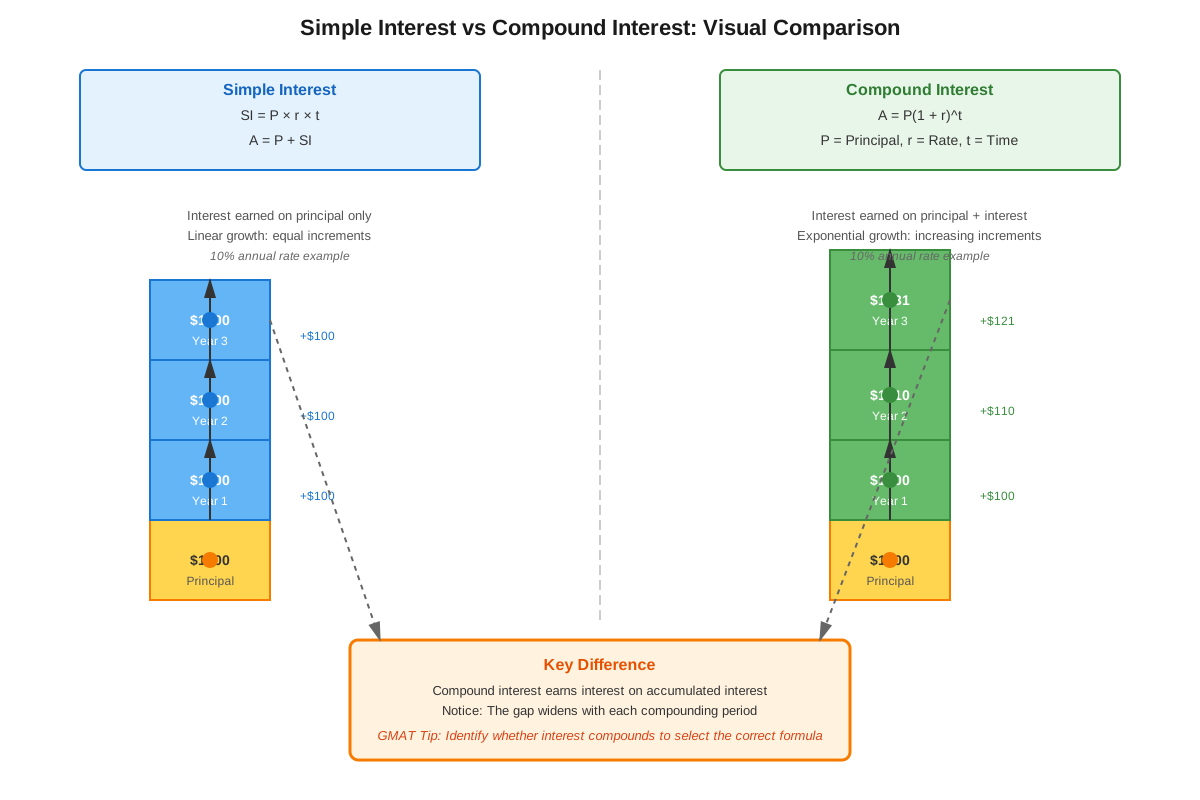
Simple interest is calculated only on the original principal amount throughout the entire investment or loan period. The interest earned or paid remains constant for each time period because it is always computed as a percentage of the initial principal, never on accumulated interest.
The simple interest formula is:
Simple Interest (SI) = P × r × tWhere:
- P = Principal (initial amount invested or borrowed)
- r = Annual interest rate (expressed as a decimal)
- t = Time period (in years)
The total amount (A) after time t is:
A = P + SI = P + (P × r × t) = P(1 + rt)Example: If $5,000 is invested at 6% simple interest per year for 3 years:
- SI = 5,000 × 0.06 × 3 = $900
- Total Amount = 5,000 + 900 = $5,900
Simple interest problems on the GMAT often require solving for unknown variables. If any three of the four variables (P, r, t, or A) are known, the fourth can be calculated through algebraic manipulation.
Compound Interest
Compound interest is calculated on both the principal and the accumulated interest from previous periods. This creates exponential growth, as interest earns interest over time. Compound interest always yields a higher return than simple interest over the same period (except for the first compounding period, where they are equal).
The compound interest formula is:
A = P(1 + r/n)^(nt)Where:
- A = Final amount
- P = Principal
- r = Annual interest rate (as a decimal)
- n = Number of times interest is compounded per year
- t = Time in years
The compound interest earned is:
CI = A - P = P(1 + r/n)^(nt) - PCommon compounding frequencies:
| Compounding Frequency | n value | Meaning |
|---|---|---|
| Annually | 1 | Once per year |
| Semi-annually | 2 | Twice per year |
| Quarterly | 4 | Four times per year |
| Monthly | 12 | Twelve times per year |
| Daily | 365 | Every day |
For annual compounding (n = 1), the formula simplifies to:
A = P(1 + r)^tExample: If $5,000 is invested at 6% interest compounded annually for 3 years:
- A = 5,000(1 + 0.06)³ = 5,000(1.06)³ = 5,000(1.191016) = $5,955.08
- CI = 5,955.08 - 5,000 = $955.08
Notice that compound interest ($955.08) exceeds simple interest ($900) for the same scenario.
Comparing Simple and Compound Interest
The difference between simple and compound interest grows larger as time increases and as the interest rate increases. For a single period, simple and compound interest are identical. The GMAT frequently tests understanding of this relationship through comparison questions.
Key differences:
| Aspect | Simple Interest | Compound Interest |
|---|---|---|
| Calculation base | Original principal only | Principal + accumulated interest |
| Growth pattern | Linear | Exponential |
| Formula complexity | Linear equation | Exponential equation |
| Interest earned | Constant per period | Increasing per period |
Solving for Unknown Variables
GMAT interest problems frequently require solving for variables other than the final amount. This requires algebraic manipulation of the interest formulas.
Solving for Principal (P):
- Simple interest: P = A / (1 + rt)
- Compound interest: P = A / (1 + r/n)^(nt)
Solving for Rate (r):
- Simple interest: r = (A - P) / (Pt)
- Compound interest: r = n[(A/P)^(1/nt) - 1]
Solving for Time (t):
- Simple interest: t = (A - P) / (Pr)
- Compound interest: t = [log(A/P)] / [n × log(1 + r/n)]
While the GMAT rarely requires logarithmic calculations for compound interest time problems, understanding the relationships helps with estimation and data sufficiency questions.
Partial Year Calculations
Interest problems may involve time periods that are not whole years. Time must be converted to years as a fraction or decimal:
- 6 months = 0.5 years
- 3 months = 0.25 years
- 9 months = 0.75 years
- 18 months = 1.5 years
Example: $2,000 invested at 8% simple interest for 9 months:
- t = 9/12 = 0.75 years
- SI = 2,000 × 0.08 × 0.75 = $120
Interest Rate Conversions
Interest rates may be stated in various forms, and conversion between them is essential:
- Annual Percentage Rate (APR): The stated annual rate
- Effective rate: The actual rate earned after compounding
- Rate per period: APR divided by number of periods
When interest is compounded more frequently than annually, the effective annual rate exceeds the stated APR due to the compounding effect.
Concept Relationships
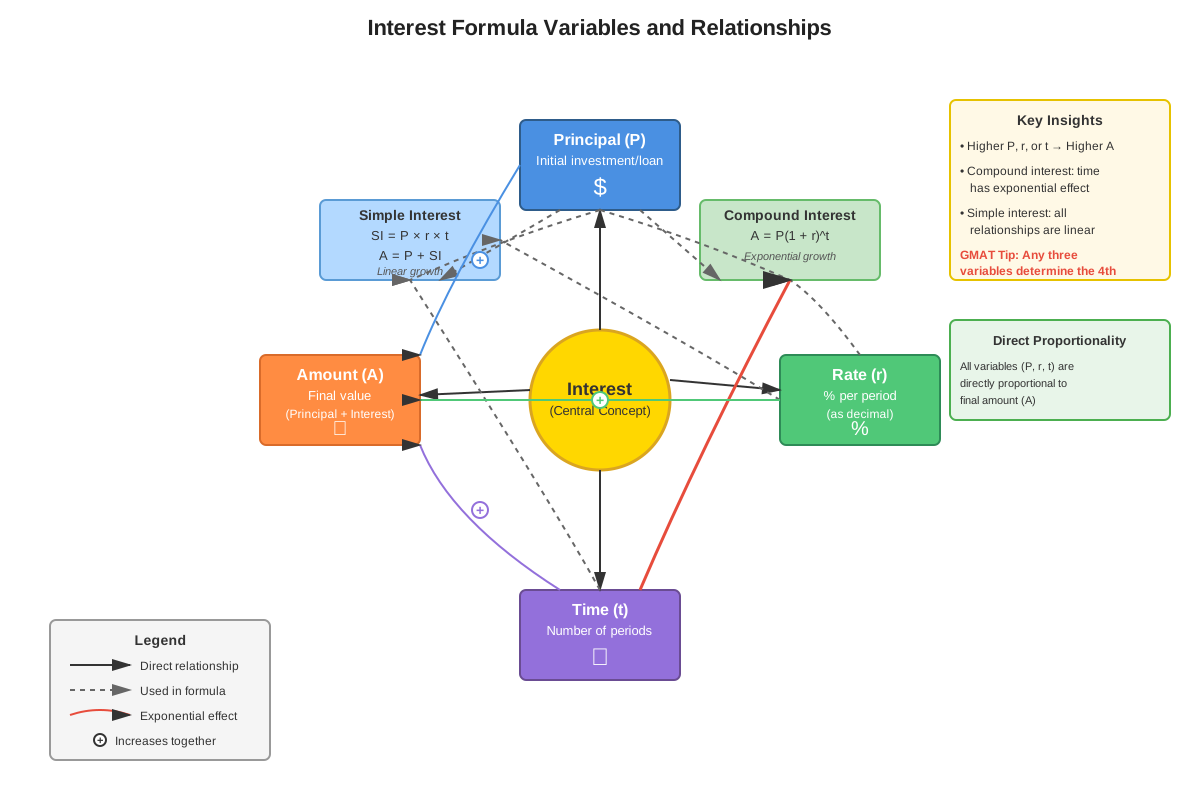
The core interest concepts form an interconnected framework where simple interest serves as the foundation for understanding compound interest. Simple interest represents linear growth and provides the baseline calculation method, while compound interest extends this concept by introducing exponential growth through the reinvestment of earned interest. The relationship between these two concepts is hierarchical: compound interest reduces to simple interest when n = 1 and t = 1.
Within compound interest calculations, the compounding frequency (n) directly affects the final amount, creating a spectrum of outcomes between simple interest (no compounding) and continuous compounding (theoretical maximum). As compounding frequency increases, the effective return approaches but never exceeds the continuous compounding limit.
The concept of solving for unknown variables connects all interest formulas to broader algebraic principles. Each interest problem can be viewed as a system where knowing any three variables allows determination of the fourth. This relationship enables the GMAT to create diverse problem types from the same underlying formulas.
Relationship map:
Principal (P) → Combined with rate (r) and time (t) → Generates Simple Interest (SI) → Produces Total Amount (A)
Principal (P) → Combined with rate (r), time (t), and compounding frequency (n) → Generates Compound Interest (CI) through exponential growth → Produces Total Amount (A)
Simple Interest ← Compared with → Compound Interest → Difference increases with time and rate
All interest concepts ← Connect to → Percentage calculations, algebraic manipulation, and exponential functions
High-Yield Facts
⭐ Simple interest formula: SI = P × r × t, where interest is calculated only on the principal
⭐ Compound interest formula: A = P(1 + r/n)^(nt), where interest is calculated on principal plus accumulated interest
⭐ For the same principal, rate, and time, compound interest always exceeds simple interest (except for the first compounding period)
⭐ Time must be expressed in years in standard interest formulas; convert months to years by dividing by 12
⭐ Interest rates must be converted to decimals before using in formulas (6% becomes 0.06)
- The difference between compound and simple interest increases as time increases
- When compounding frequency increases, the total amount increases but with diminishing returns
- For annual compounding, the formula simplifies to A = P(1 + r)^t
- Simple interest grows linearly while compound interest grows exponentially
- In data sufficiency questions, you need three of four variables (P, r, t, A) to solve for the fourth
- The principal can be calculated by working backward from the final amount using the appropriate formula
- Interest earned in the first period is identical for simple and compound interest
- Doubling the time period doubles simple interest but more than doubles compound interest
- The effective annual rate exceeds the stated APR when compounding occurs more than once per year
- Zero interest rate means the final amount equals the principal regardless of time
Quick check — test yourself on Interest so far.
Try Flashcards →Common Misconceptions
Misconception: Simple interest and compound interest produce the same result over multiple periods.
Correction: Compound interest always produces a higher return than simple interest over multiple periods because interest earns additional interest. They are equal only for a single period.
Misconception: The interest rate can be used directly as a percentage in formulas.
Correction: Interest rates must be converted to decimal form before using in formulas. A 5% rate must be expressed as 0.05, not 5.
Misconception: Time periods in months can be used directly in standard interest formulas.
Correction: Standard interest formulas require time to be expressed in years. Six months must be converted to 0.5 years, not used as 6.
Misconception: Doubling the time period doubles the final amount in compound interest.
Correction: Doubling the time period doubles the simple interest but more than doubles the compound interest due to exponential growth. The final amount increases by more than double.
Misconception: In compound interest, n represents the number of years.
Correction: In the compound interest formula, n represents the number of compounding periods per year (not total periods), while t represents the number of years. The exponent nt gives the total number of compounding periods.
Misconception: Higher compounding frequency always significantly increases returns.
Correction: While higher compounding frequency does increase returns, the effect diminishes as frequency increases. The difference between monthly and daily compounding is much smaller than the difference between annual and monthly compounding.
Misconception: The principal is the final amount after interest is added.
Correction: The principal (P) is the initial amount invested or borrowed, before any interest is added. The final amount (A) equals principal plus interest.
Worked Examples
Example 1: Simple Interest Calculation with Unknown Principal
Problem: Sarah earned $720 in simple interest over 3 years at an annual interest rate of 8%. What was her initial investment?
Solution:
Step 1: Identify the known variables and what we're solving for.
- SI = $720
- t = 3 years
- r = 8% = 0.08
- P = ? (unknown)
Step 2: Write the simple interest formula.
SI = P × r × t
Step 3: Substitute known values.
720 = P × 0.08 × 3
720 = P × 0.24
Step 4: Solve for P.
P = 720 / 0.24
P = 3,000
Step 5: Verify the answer.
SI = 3,000 × 0.08 × 3 = 720 ✓
Answer: Sarah's initial investment was $3,000.
Connection to learning objectives: This problem demonstrates the ability to identify an interest problem, apply the simple interest formula, and solve for an unknown variable through algebraic manipulation.
Example 2: Comparing Simple and Compound Interest
Problem: John invests $10,000 at 6% annual interest for 2 years. Calculate both the simple interest and compound interest (compounded annually), and find the difference between them.
Solution:
Part A: Simple Interest
Step 1: Identify variables.
- P = $10,000
- r = 6% = 0.06
- t = 2 years
Step 2: Calculate simple interest.
SI = P × r × t
SI = 10,000 × 0.06 × 2
SI = 1,200
Step 3: Calculate total amount.
A = P + SI = 10,000 + 1,200 = $11,200
Part B: Compound Interest (Annual Compounding)
Step 1: Use compound interest formula with n = 1 (annual compounding).
A = P(1 + r)^t
A = 10,000(1 + 0.06)²
A = 10,000(1.06)²
Step 2: Calculate (1.06)².
(1.06)² = 1.1236
Step 3: Calculate final amount.
A = 10,000 × 1.1236 = $11,236
Step 4: Calculate compound interest.
CI = A - P = 11,236 - 10,000 = $1,236
Part C: Find the Difference
Difference = CI - SI = 1,236 - 1,200 = $36
Answer: Simple interest yields $1,200, compound interest yields $1,236, and compound interest exceeds simple interest by $36.
Analysis: The $36 difference represents the "interest on interest" earned in the second year. In year 1, both methods earn $600. In year 2, simple interest again earns $600 (on the original $10,000), but compound interest earns $636 (6% on $10,600), creating the $36 difference.
Connection to learning objectives: This problem demonstrates the ability to explain the difference between simple and compound interest, apply both formulas correctly, and analyze the relationship between the two methods.
Example 3: Data Sufficiency with Compound Interest
Problem: What is the compound interest earned on a principal amount invested for 2 years at an annual interest rate, compounded annually?
Statement 1: The principal amount is $5,000.
Statement 2: The annual interest rate is 10%.
Solution:
Step 1: Determine what information is needed.
To calculate compound interest, we need: P, r, t, and n.
We already know: t = 2 years, n = 1 (compounded annually)
We need: P and r
Step 2: Analyze Statement 1 alone.
Statement 1 gives us P = $5,000.
We still don't know r.
Statement 1 alone is INSUFFICIENT.
Step 3: Analyze Statement 2 alone.
Statement 2 gives us r = 10% = 0.10.
We still don't know P.
Statement 2 alone is INSUFFICIENT.
Step 4: Analyze both statements together.
Combined, we have: P = $5,000, r = 0.10, t = 2, n = 1
We can calculate: A = 5,000(1.10)² = 5,000(1.21) = $6,050
CI = 6,050 - 5,000 = $1,050
Both statements together are SUFFICIENT.
Answer: C (Both statements together are sufficient, but neither alone is sufficient)
Connection to learning objectives: This problem demonstrates the ability to identify what information is necessary to solve interest problems and apply logical reasoning to data sufficiency questions.
Exam Strategy
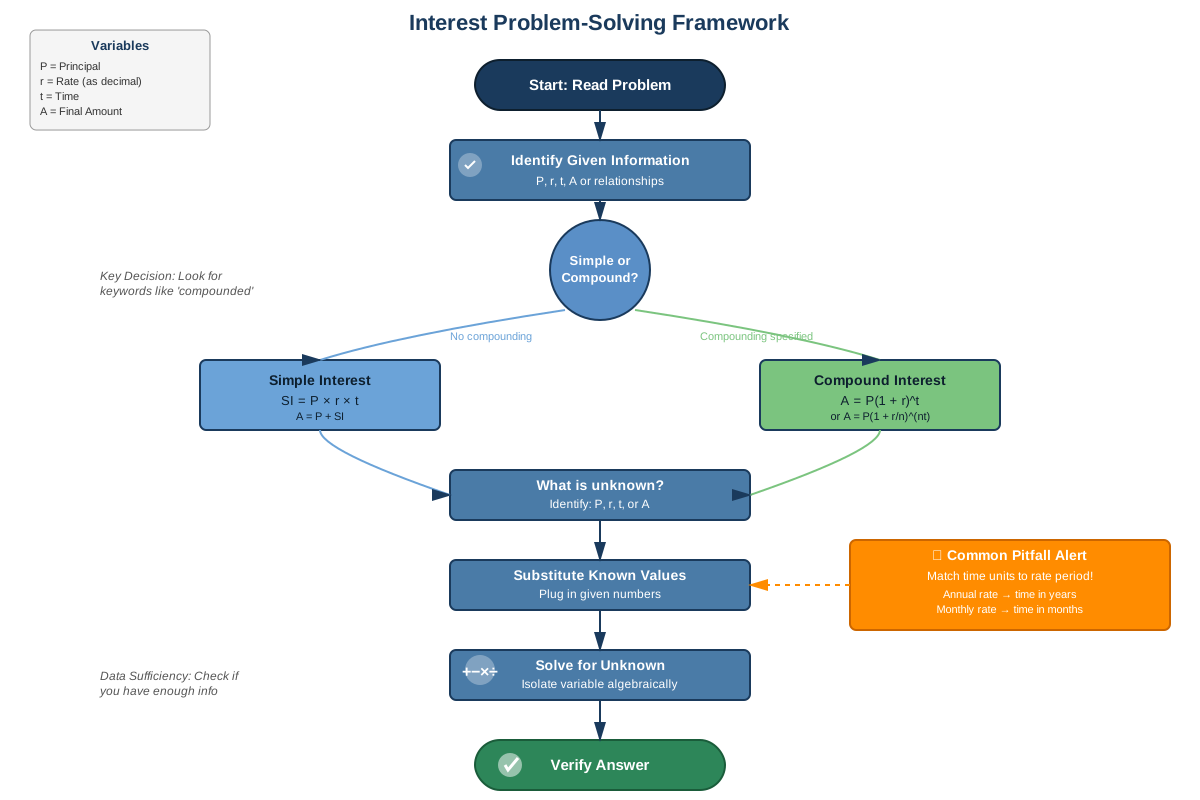
When approaching GMAT interest questions, begin by identifying the type of interest (simple or compound) through careful reading of the problem statement. Look for keywords such as "compounded," "annually," "quarterly," or phrases indicating that interest is calculated on accumulated amounts. If no compounding is mentioned, assume simple interest unless context suggests otherwise.
Trigger words and phrases to watch for:
- "Simple interest" → Use SI = P × r × t
- "Compounded annually/quarterly/monthly" → Use compound interest formula with appropriate n value
- "What was the principal/initial investment" → Solve for P
- "What interest rate" → Solve for r
- "How long" or "how many years" → Solve for t
- "Total amount" → Calculate A, not just interest
- "Interest earned" → Calculate SI or CI, not total amount
- "Difference between" → Calculate both types and subtract
Step-by-step approach:
- Read carefully to identify all given information and what the question asks for
- Determine the interest type (simple or compound)
- List known variables (P, r, t, n, A, SI, or CI)
- Select the appropriate formula based on interest type and what you're solving for
- Convert percentages to decimals and time periods to years
- Substitute values into the formula
- Solve algebraically for the unknown variable
- Verify that your answer makes logical sense (e.g., interest should be positive, final amount should exceed principal)
Process-of-elimination tips:
- Eliminate answers where compound interest is less than simple interest for the same scenario
- Eliminate answers where the final amount is less than the principal (assuming positive interest rates)
- For comparison questions, eliminate answers that violate the exponential growth principle of compound interest
- Check whether the question asks for interest earned or total amount—many wrong answers result from this confusion
Time allocation advice:
Allocate approximately 2 minutes for straightforward calculation problems and up to 2.5 minutes for complex comparison or data sufficiency questions. If a problem requires extensive calculation (such as computing compound interest with quarterly compounding over multiple years), consider whether estimation or answer choice elimination can save time. For data sufficiency questions, avoid actually calculating the answer—determine only whether sufficient information exists.
Exam Tip: When dealing with compound interest calculations involving exponents, remember that (1.05)² = 1.1025, (1.10)² = 1.21, and (1.20)² = 1.44. Memorizing these common values can save valuable calculation time.
Memory Techniques
Mnemonic for Simple Interest formula components: "PeRiod Time" (P × r × t)
- Person invests the Principal
- Receives a rate
- Over Time (t)
Mnemonic for distinguishing Simple vs. Compound: "Simple Stays, Compound Climbs"
- Simple interest Stays constant each period (linear growth)
- Compound interest Climbs exponentially (grows faster over time)
Visualization strategy for compound interest: Picture a snowball rolling downhill. The snowball (principal) picks up more snow (interest) as it rolls. The larger it gets, the more snow it picks up with each rotation (compounding period). This represents how compound interest accelerates over time.
Acronym for solving interest problems: "WRITE"
- What is the question asking for?
- Read and identify all given information
- Identify the interest type (simple or compound)
- Translate into the appropriate formula
- Execute the calculation and verify
Memory aid for time conversion: "Twelve Months Make a Year"
- To convert months to years: divide by 12
- 6 months = 6/12 = 0.5 years
- 3 months = 3/12 = 0.25 years
- 9 months = 9/12 = 0.75 years
Pattern recognition for compounding frequency:
- Annually = 1 time (A is the 1st letter)
- Semi-annually = 2 times (S looks like 2 when flipped)
- Quarterly = 4 times (Quarter = 1/4 of year, so 4 quarters)
- Monthly = 12 times (12 Months)
Summary
Interest represents the cost of borrowing or the return on investment, calculated as a percentage of the principal over time. The GMAT tests two primary types: simple interest, which is calculated only on the original principal using the formula SI = P × r × t, and compound interest, which is calculated on both principal and accumulated interest using A = P(1 + r/n)^(nt). Simple interest produces linear growth with constant returns each period, while compound interest produces exponential growth with increasing returns over time. For any given scenario with the same principal, rate, and time, compound interest always exceeds simple interest after the first period. GMAT questions require not only formula application but also algebraic manipulation to solve for unknown variables, comparison of different scenarios, and analysis of what information is sufficient to solve problems. Success requires converting percentages to decimals, expressing time in years, selecting the appropriate formula based on problem context, and verifying that answers are logically consistent with the problem parameters.
Key Takeaways
- Simple interest (SI = P × r × t) calculates interest only on the principal, producing linear growth, while compound interest (A = P(1 + r/n)^(nt)) calculates interest on principal plus accumulated interest, producing exponential growth
- Compound interest always exceeds simple interest for the same principal, rate, and time period (except for the first compounding period where they are equal)
- Interest rates must be converted to decimal form and time must be expressed in years before using in formulas
- Any three of the four variables (P, r, t, A) can be used to solve for the fourth through algebraic manipulation
- The compounding frequency (n) significantly impacts returns, with more frequent compounding producing higher returns, though with diminishing marginal effects
- GMAT interest problems appear in both calculation and data sufficiency formats, requiring both computational accuracy and logical analysis
- Always verify whether the question asks for interest earned or total amount, as this is a common source of errors
Related Topics
Percentage Calculations: Interest problems are fundamentally percentage applications. Deepening understanding of percentage increase, decrease, and successive percentage changes enhances interest problem-solving ability and enables faster recognition of problem patterns.
Exponential Growth and Decay: Compound interest exemplifies exponential growth. Mastering exponential functions, including growth rates and decay models, provides broader mathematical context and enables solving more complex financial mathematics problems.
Algebraic Equation Solving: Interest problems frequently require solving for unknown variables. Strengthening skills in equation manipulation, substitution, and systems of equations directly improves efficiency with interest calculations.
Ratio and Proportion: Comparing different investment scenarios or analyzing relationships between variables often involves ratio reasoning. Understanding proportional relationships enhances the ability to estimate answers and eliminate incorrect choices.
Sequences and Series: The progression of compound interest over multiple periods relates to geometric sequences. Understanding sequence patterns provides insight into long-term growth projections and enables solving advanced interest problems.
Practice CTA
Now that you have mastered the core concepts of interest calculations, it's time to solidify your understanding through active practice. Attempt the practice questions to apply these formulas in various GMAT-style scenarios, including both problem-solving and data sufficiency formats. Use the flashcards to reinforce key formulas, relationships, and problem-solving strategies until they become automatic. Remember that consistent practice with timed questions builds both accuracy and speed—two essential components of GMAT success. Each problem you solve strengthens your pattern recognition and deepens your mathematical intuition, bringing you closer to your target score. Approach each practice question as an opportunity to refine your strategy and build confidence in your ability to tackle any interest problem the GMAT presents.
Sign up free to keep reading
Create a free AnvayaPrep account to finish this GMAT guide on Interest — plus flashcards and practice questions.