Overview
Sequences are ordered lists of numbers that follow a specific pattern or rule, and they represent one of the most frequently tested algebraic concepts on the GMAT sequences section. Understanding sequences is essential for success on the GMAT Quantitative Reasoning section because these problems test both pattern recognition skills and the ability to apply algebraic formulas under time pressure. Sequence questions appear regularly on the exam, often disguised within word problems, data sufficiency questions, or complex multi-step calculations that require identifying the underlying pattern before solving.
The study of sequences bridges multiple mathematical domains within the GMAT curriculum. Sequences connect directly to functions, as each sequence can be viewed as a function mapping position numbers to values. They also relate to algebra through the manipulation of formulas and variables, to arithmetic through operations on terms, and to problem-solving through pattern recognition. Mastering sequences provides a foundation for understanding series (the sum of sequence terms), which occasionally appears in advanced GMAT problems.
The GMAT tests sequences in both problem-solving and data sufficiency formats, with questions ranging from straightforward pattern identification to complex scenarios involving multiple sequences or recursive relationships. Success with sequence problems requires not just memorizing formulas but developing the ability to recognize patterns quickly, translate word problems into mathematical notation, and efficiently calculate specific terms or sums. This topic typically accounts for 2-4 questions per exam, making it a high-yield area for focused study.
Learning Objectives
- [ ] Identify sequences and distinguish between different types of sequences
- [ ] Explain the properties and characteristics of arithmetic and geometric sequences
- [ ] Apply sequence formulas to solve GMAT questions efficiently
- [ ] Determine the nth term of any sequence given sufficient information
- [ ] Calculate the sum of arithmetic and geometric sequences
- [ ] Recognize recursive sequences and solve problems involving them
- [ ] Analyze data sufficiency questions involving sequences with strategic thinking
Prerequisites
- Basic algebra: Understanding variables, expressions, and equation manipulation is essential for working with sequence formulas and solving for unknown terms
- Exponent rules: Geometric sequences involve exponential growth or decay, requiring facility with powers and exponents
- Linear equations: Arithmetic sequences are fundamentally linear relationships, so comfort with slope and linear patterns aids comprehension
- Pattern recognition: The ability to identify numerical patterns forms the foundation for all sequence work
Why This Topic Matters
Sequences appear throughout quantitative reasoning in both academic and real-world contexts. Financial calculations involving compound interest, depreciation schedules, and payment plans all rely on sequence concepts. Population growth models, production schedules, and time-series data analysis use sequence patterns. Understanding sequences develops critical analytical thinking skills applicable far beyond the GMAT.
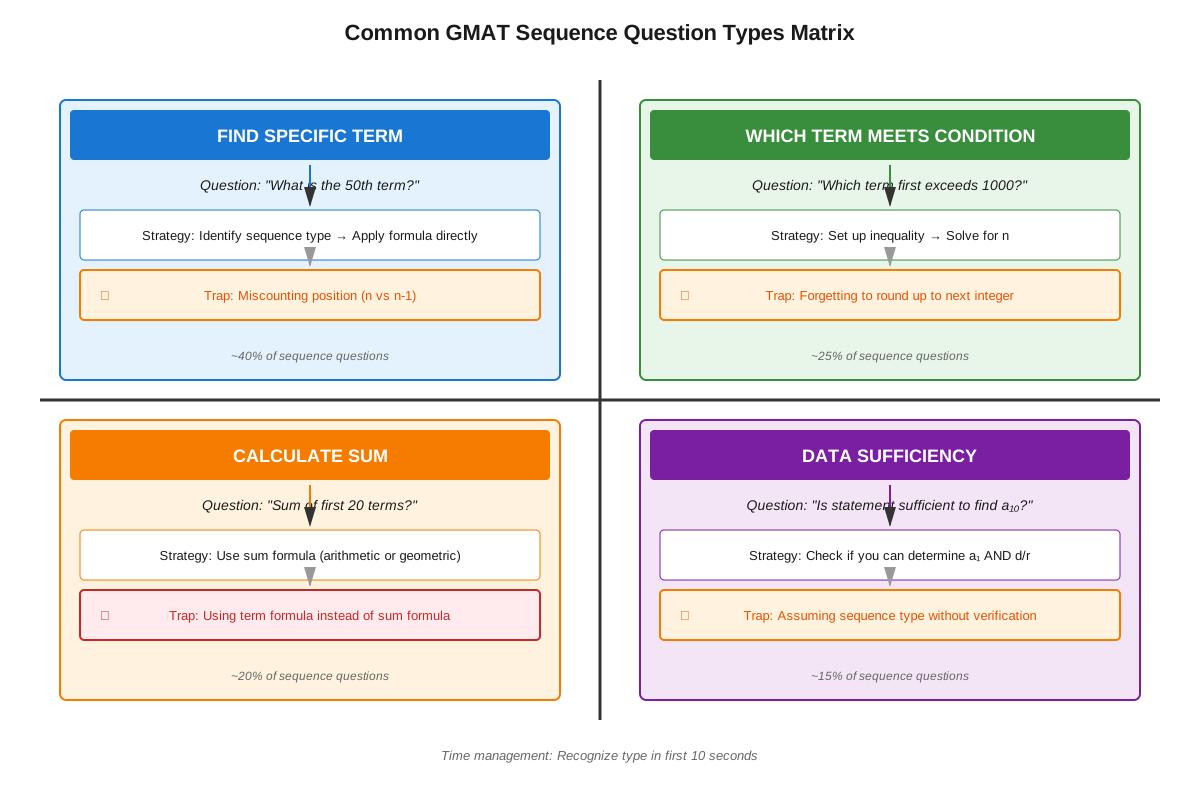
On the GMAT specifically, sequence questions appear with notable frequency—approximately 3-5% of all Quantitative Reasoning questions involve sequences directly, with additional questions incorporating sequence concepts within broader problem contexts. The exam tests sequences through multiple question types: direct calculation of specific terms, finding formulas from given terms, determining sums, and data sufficiency questions asking whether enough information exists to determine sequence properties.
Common GMAT sequence scenarios include: identifying the 50th term of a pattern, determining which term first exceeds a threshold value, calculating the sum of the first n terms, finding the common difference or ratio, and working with sequences defined recursively (where each term depends on previous terms). Data sufficiency questions frequently test whether two pieces of information suffice to determine a sequence uniquely, requiring deep understanding of what defines each sequence type.
Core Concepts
Definition and Notation
A sequence is an ordered list of numbers called terms, where each term occupies a specific position. Sequences are typically denoted using subscript notation: a₁, a₂, a₃, ..., aₙ, where the subscript indicates the position (first term, second term, etc.) and n represents any positive integer position. The general term aₙ represents the nth term of the sequence.
Sequences can be defined in two primary ways: explicitly (with a formula directly giving the nth term) or recursively (with a rule relating each term to previous terms). For example, the sequence 2, 4, 6, 8, ... can be defined explicitly as aₙ = 2n or recursively as a₁ = 2 and aₙ = aₙ₋₁ + 2 for n > 1.
Arithmetic Sequences
An arithmetic sequence is a sequence where consecutive terms differ by a constant amount called the common difference (d). This is the most frequently tested sequence type on the GMAT. The sequence 5, 8, 11, 14, 17, ... is arithmetic with common difference d = 3.
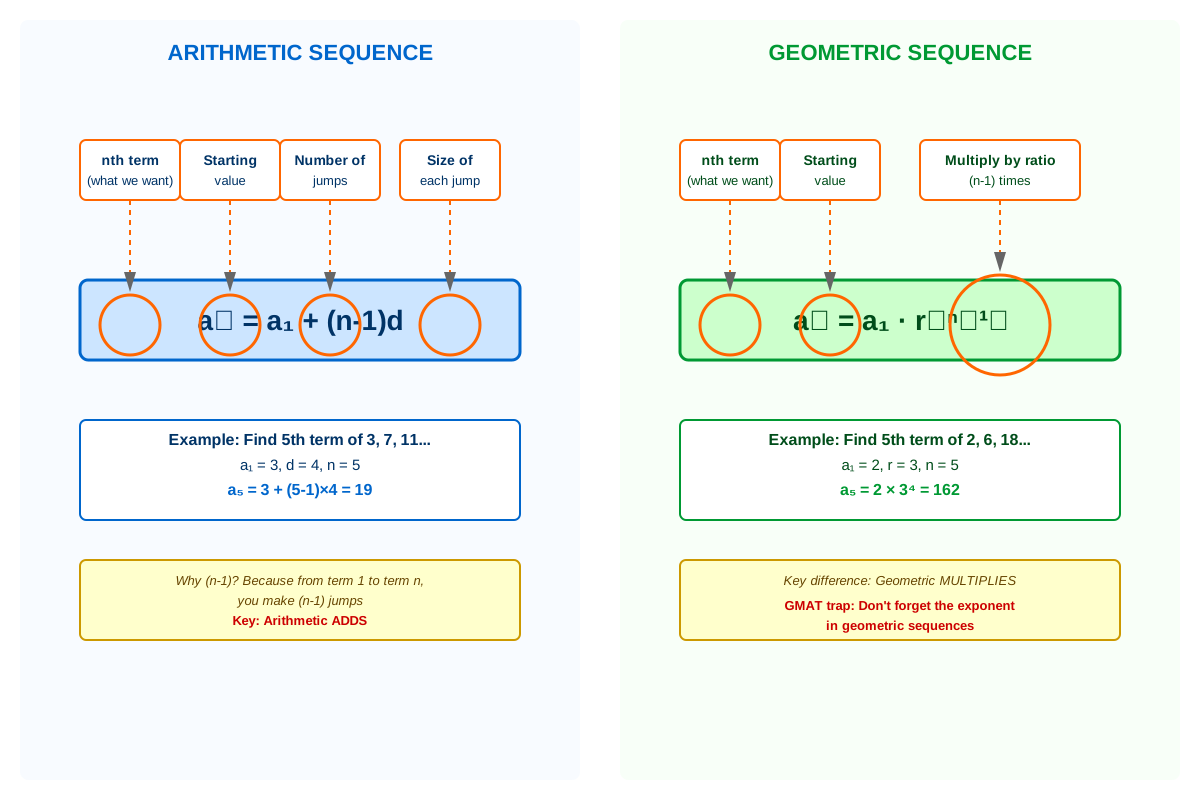
The explicit formula for the nth term of an arithmetic sequence is:
aₙ = a₁ + (n - 1)dWhere:
- aₙ = the nth term
- a₁ = the first term
- n = the position number
- d = the common difference
To find the common difference, subtract any term from the term immediately following it: d = aₙ₊₁ - aₙ.
The sum of the first n terms of an arithmetic sequence (denoted Sₙ) uses the formula:
Sₙ = n/2 × (a₁ + aₙ)or equivalently:
Sₙ = n/2 × [2a₁ + (n - 1)d]The first formula is more efficient when you know both the first and last terms; the second is useful when you know the first term and common difference but haven't calculated the last term.
Geometric Sequences
A geometric sequence is a sequence where consecutive terms have a constant ratio called the common ratio (r). Each term is obtained by multiplying the previous term by r. The sequence 3, 6, 12, 24, 48, ... is geometric with common ratio r = 2.
The explicit formula for the nth term of a geometric sequence is:
aₙ = a₁ × r^(n-1)Where:
- aₙ = the nth term
- a₁ = the first term
- n = the position number
- r = the common ratio
To find the common ratio, divide any term by the term immediately preceding it: r = aₙ₊₁/aₙ.
The sum of the first n terms of a geometric sequence is:
Sₙ = a₁ × (1 - r^n)/(1 - r) [when r ≠ 1]or equivalently:
Sₙ = a₁ × (r^n - 1)/(r - 1) [when r ≠ 1]When r = 1, all terms equal a₁, so Sₙ = n × a₁.
Sequence Type Comparison
| Feature | Arithmetic Sequence | Geometric Sequence |
|---|---|---|
| Pattern | Constant difference | Constant ratio |
| Operation | Addition/Subtraction | Multiplication/Division |
| Formula | aₙ = a₁ + (n-1)d | aₙ = a₁ × r^(n-1) |
| Growth | Linear | Exponential |
| Example | 2, 5, 8, 11, 14 | 2, 6, 18, 54, 162 |
| Common value | d (difference) | r (ratio) |
Recursive Sequences
Recursive sequences define each term based on one or more previous terms. The famous Fibonacci sequence (1, 1, 2, 3, 5, 8, 13, ...) is recursive: each term equals the sum of the two preceding terms (aₙ = aₙ₋₁ + aₙ₋₂ for n > 2).
GMAT recursive sequence problems typically provide:
- One or more initial terms
- A recursive rule
- A question about a specific term
To solve recursive problems, calculate terms sequentially until reaching the desired position. For data sufficiency questions, determine whether the given information provides both initial terms and a complete recursive rule.
Special Sequences
Several special sequences appear occasionally on the GMAT:
Constant sequences: All terms are identical (5, 5, 5, 5, ...). This is technically both arithmetic (d = 0) and geometric (r = 1).
Alternating sequences: Terms alternate between two or more values or follow a pattern with sign changes (2, -2, 2, -2, ... or 1, 4, 1, 4, 1, 4, ...).
Sequences with patterns: Some sequences follow patterns not captured by simple arithmetic or geometric formulas, such as perfect squares (1, 4, 9, 16, 25, ...) where aₙ = n².
Finding Sequence Formulas
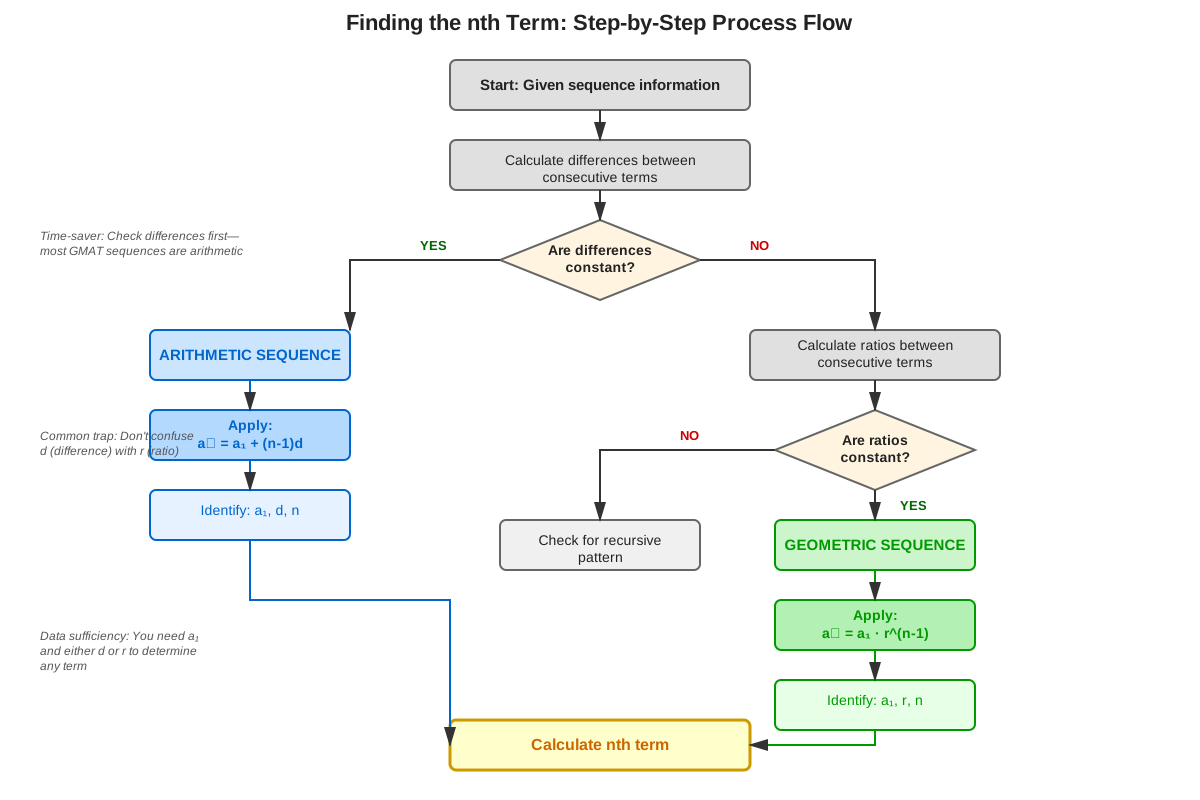
When given several terms of a sequence, determine its type by:
- Check for arithmetic: Calculate differences between consecutive terms. If constant, the sequence is arithmetic.
- Check for geometric: Calculate ratios of consecutive terms. If constant, the sequence is geometric.
- Look for other patterns: Check if terms are perfect squares, cubes, factorials, or follow other recognizable patterns.
- Consider position-based formulas: Sometimes the term value relates directly to its position (e.g., aₙ = 3n + 1).
Concept Relationships
The concepts within sequences build hierarchically. Understanding the basic definition of sequences and subscript notation → enables recognition of arithmetic sequences (constant differences) and geometric sequences (constant ratios) → which leads to applying explicit formulas for the nth term → and calculating sums of multiple terms → ultimately supporting analysis of recursive sequences and complex word problems.
Sequences connect to prerequisite algebra topics through formula manipulation and variable substitution. When solving for unknown terms or finding which term satisfies a condition, students apply equation-solving skills. The linear nature of arithmetic sequences relates directly to linear functions and equations, while geometric sequences connect to exponential functions and exponent rules.
Sequences also relate forward to more advanced topics. Understanding geometric sequences with |r| < 1 provides foundation for infinite geometric series (though rarely tested on the GMAT). Sequence concepts appear within probability problems (sequences of events), combinatorics (counting sequences), and word problems involving time-based patterns.
The relationship map: Basic sequence definition → Arithmetic sequences (linear growth) → Geometric sequences (exponential growth) → Recursive sequences (term interdependence) → Sum formulas → Application to GMAT problem types → Integration with data sufficiency reasoning.
High-Yield Facts
⭐ The nth term of an arithmetic sequence: aₙ = a₁ + (n - 1)d, where d is the common difference
⭐ The nth term of a geometric sequence: aₙ = a₁ × r^(n-1), where r is the common ratio
⭐ Sum of first n terms (arithmetic): Sₙ = n/2 × (a₁ + aₙ) or Sₙ = n/2 × [2a₁ + (n - 1)d]
⭐ Sum of first n terms (geometric): Sₙ = a₁ × (1 - r^n)/(1 - r) when r ≠ 1
⭐ Common difference: d = aₙ₊₁ - aₙ (found by subtracting consecutive terms)
- Common ratio: r = aₙ₊₁/aₙ (found by dividing consecutive terms)
- To find any term when you know two non-consecutive terms of an arithmetic sequence, first find d, then use the formula
- In geometric sequences, if r > 1, the sequence grows; if 0 < r < 1, it decreases; if r < 0, terms alternate signs
- For data sufficiency with sequences, you need enough information to determine both the first term and the common difference/ratio
- The sum formula for arithmetic sequences can be remembered as: (number of terms) × (average of first and last terms)
- When a sequence problem asks "which term first exceeds X," set up an inequality with the nth term formula
- Recursive sequences require initial term(s) plus the recursive rule to be fully determined
- The middle term of an arithmetic sequence with an odd number of terms equals the average of all terms
- In a geometric sequence, any term is the geometric mean of its neighbors: aₙ² = aₙ₋₁ × aₙ₊₁
- Sequence problems often disguise themselves as word problems about payments, growth, depreciation, or repeating patterns
Quick check — test yourself on Sequences so far.
Try Flashcards →Common Misconceptions
Misconception: The formula aₙ = a₁ + nd gives the nth term of an arithmetic sequence.
Correction: The correct formula is aₙ = a₁ + (n - 1)d. The factor is (n - 1), not n, because you add the common difference (n - 1) times to get from position 1 to position n. For example, to get from the 1st term to the 3rd term, you add d twice, not three times.
Misconception: To find the common ratio, subtract consecutive terms.
Correction: The common ratio is found by dividing consecutive terms (r = aₙ₊₁/aₙ), not subtracting. Subtraction finds the common difference in arithmetic sequences. Confusing these operations is a frequent error that leads to identifying sequences incorrectly.
Misconception: All sequences are either arithmetic or geometric.
Correction: Many sequences follow neither pattern. Sequences can be recursive (like Fibonacci), follow polynomial patterns (like perfect squares: 1, 4, 9, 16), or have more complex rules. Always check both arithmetic and geometric patterns, but be prepared for other possibilities.
Misconception: In data sufficiency, knowing any two terms of a sequence is sufficient to determine the entire sequence.
Correction: For arithmetic and geometric sequences, you need two terms to find the common difference or ratio, but you also need to know which positions those terms occupy. Knowing a₃ = 7 and a₅ = 13 is sufficient for an arithmetic sequence, but knowing two terms without their positions is not sufficient.
Misconception: The sum formula Sₙ = n/2 × (a₁ + aₙ) works for all sequences.
Correction: This formula only works for arithmetic sequences. Geometric sequences require the formula Sₙ = a₁ × (1 - r^n)/(1 - r). Using the wrong sum formula is a common trap in GMAT questions.
Misconception: If a sequence has both a constant difference and constant ratio, it must be both arithmetic and geometric.
Correction: Only constant sequences (where all terms are identical) are both arithmetic and geometric. If a sequence has varying terms, it cannot simultaneously have both a constant difference and constant ratio. Check calculations carefully if both seem present.
Misconception: In geometric sequences, the common ratio must be positive.
Correction: The common ratio can be negative, which creates an alternating sequence (e.g., 2, -6, 18, -54 has r = -3). It can also be a fraction between 0 and 1, creating a decreasing sequence (e.g., 80, 40, 20, 10 has r = 1/2).
Worked Examples
Example 1: Arithmetic Sequence - Finding a Specific Term
Problem: In an arithmetic sequence, the 4th term is 17 and the 9th term is 37. What is the 20th term?
Solution:
Step 1: Identify what we know and what we need.
- Known: a₄ = 17, a₉ = 37
- Find: a₂₀
Step 2: Find the common difference (d).
The difference between the 9th and 4th terms spans 5 positions (9 - 4 = 5).
Over these 5 positions, the sequence increases by 37 - 17 = 20.
Therefore: 5d = 20, so d = 4
Step 3: Find the first term (a₁).
Using a₄ = a₁ + (4 - 1)d:
17 = a₁ + 3(4)
17 = a₁ + 12
a₁ = 5
Step 4: Find the 20th term.
a₂₀ = a₁ + (20 - 1)d
a₂₀ = 5 + 19(4)
a₂₀ = 5 + 76
a₂₀ = 81
Alternative approach: Once we know d = 4, we can work directly from a known term.
From a₉ = 37 to a₂₀, we move 11 positions forward.
a₂₀ = a₉ + 11d = 37 + 11(4) = 37 + 44 = 81
This problem demonstrates the learning objective of applying sequence formulas to GMAT questions and shows how to work with non-consecutive terms.
Example 2: Geometric Sequence - Sum Calculation
Problem: A geometric sequence has first term 5 and common ratio 2. What is the sum of the first 6 terms?
Solution:
Step 1: Identify the given information.
- a₁ = 5
- r = 2
- n = 6
- Find: S₆
Step 2: Apply the sum formula for geometric sequences.
Sₙ = a₁ × (r^n - 1)/(r - 1)
S₆ = 5 × (2⁶ - 1)/(2 - 1)
Step 3: Calculate the power.
2⁶ = 64
Step 4: Complete the calculation.
S₆ = 5 × (64 - 1)/(1)
S₆ = 5 × 63
S₆ = 315
Verification: We can check by listing and adding the terms:
- a₁ = 5
- a₂ = 5(2) = 10
- a₃ = 10(2) = 20
- a₄ = 20(2) = 40
- a₅ = 40(2) = 80
- a₆ = 80(2) = 160
Sum = 5 + 10 + 20 + 40 + 80 + 160 = 315 ✓
This example addresses the learning objectives of explaining geometric sequence properties and applying formulas efficiently. The verification step shows the connection between the formula and the underlying concept.
Example 3: Data Sufficiency with Sequences
Problem: Is sequence S arithmetic?
(1) The difference between the 5th and 3rd terms equals 8.
(2) The difference between the 4th and 2nd terms equals 8.
Solution:
Step 1: Understand what makes a sequence arithmetic.
A sequence is arithmetic if and only if it has a constant common difference d between all consecutive terms.
Step 2: Analyze Statement (1).
a₅ - a₃ = 8
If the sequence is arithmetic: a₅ - a₃ = 2d (spanning 2 positions)
So 2d = 8, meaning d = 4
However, Statement (1) tells us the difference over 2 positions is 8, but this doesn't guarantee the sequence is arithmetic. A non-arithmetic sequence could also have this property. For example:
- Arithmetic: 1, 5, 9, 13, 17 (a₅ - a₃ = 17 - 9 = 8) ✓
- Non-arithmetic: 1, 2, 9, 10, 17 (a₅ - a₃ = 17 - 9 = 8) ✓
Statement (1) alone is INSUFFICIENT.
Step 3: Analyze Statement (2).
a₄ - a₂ = 8
By the same reasoning, this also spans 2 positions and would mean 2d = 8 if arithmetic, but doesn't guarantee the sequence is arithmetic.
Statement (2) alone is INSUFFICIENT.
Step 4: Analyze both statements together.
If a₅ - a₃ = 8 and a₄ - a₂ = 8, and both span 2 positions, then if the sequence is arithmetic, we'd have d = 4.
But we can construct a non-arithmetic sequence satisfying both:
Consider: a₂ = 0, a₃ = 0, a₄ = 8, a₅ = 8
- a₅ - a₃ = 8 - 0 = 8 ✓
- a₄ - a₂ = 8 - 0 = 8 ✓
- But a₃ - a₂ = 0 and a₄ - a₃ = 8 (not constant, so not arithmetic)
Both statements together are INSUFFICIENT.
Answer: E
This example demonstrates the critical thinking required for data sufficiency questions involving sequences and reinforces the learning objective of identifying sequences properly.
Exam Strategy
When approaching GMAT sequence questions, follow this systematic process:
Step 1: Identify the sequence type immediately. Look for keywords: "constant difference" or "increases by the same amount" signals arithmetic; "constant ratio," "multiplied by," or "doubles/triples" signals geometric. Calculate differences or ratios between given consecutive terms to confirm.
Step 2: Write down the relevant formula. Don't try to work from memory under pressure. Quickly jot down aₙ = a₁ + (n-1)d for arithmetic or aₙ = a₁ × r^(n-1) for geometric. This prevents formula confusion and provides a roadmap.
Step 3: Identify what you know and what you need. List the given information using proper notation (a₁, aₙ, d, r, n) and clearly mark what the question asks for. This organization prevents solving for the wrong variable.
Trigger words to watch for:
- "nth term" → use the explicit formula
- "sum of the first n terms" → use the sum formula
- "first term that exceeds" → set up an inequality
- "how many terms" → solve for n
- "each term after the first" → indicates a recursive or explicit rule
Process of elimination strategies:
For arithmetic sequences, if the common difference is positive, terms increase; if negative, terms decrease. Eliminate answer choices that violate this direction.
For geometric sequences with r > 1, growth is exponential and rapid. If calculating a₁₀ and answer choices range from 50 to 5,000,000, eliminate the small values.
In data sufficiency, remember that determining an arithmetic sequence requires knowing (or being able to find) both a₁ and d. For geometric sequences, you need a₁ and r. If a statement provides only one of these, it's likely insufficient unless combined with the other statement.
Time allocation:
Standard sequence problems should take 1.5-2 minutes. If you're spending more than 2.5 minutes, you may be missing a shortcut or should consider strategic guessing. Complex recursive problems or those requiring multiple steps may warrant up to 3 minutes, but recognize these as time investments.
For data sufficiency sequence problems, spend 30-45 seconds understanding what would suffice to determine the sequence, then evaluate each statement. Don't calculate actual values unless necessary—often you only need to determine whether calculation is possible.
Memory Techniques
Arithmetic vs. Geometric Mnemonic: "Add for Arithmetic, Grow (multiply) for Geometric"
Formula Memory Device: For arithmetic sequences, remember "First plus (n-1) Differences" → a₁ + (n-1)d. The (n-1) represents how many times you add d to get from position 1 to position n.
Sum Formula Visualization: For arithmetic sequence sums, visualize pairing terms from opposite ends: (a₁ + aₙ) + (a₂ + aₙ₋₁) + ... Each pair has the same sum, and there are n/2 pairs, giving Sₙ = n/2 × (a₁ + aₙ).
Geometric Ratio Memory: "Ratio Requires Real division" (not subtraction) to find r.
Exponent Position Reminder: In aₙ = a₁ × r^(n-1), the exponent is (n-1), not n. Remember: "One less power" because you multiply by r one fewer times than the position number.
Data Sufficiency Acronym - FIND: To determine a sequence, you must Find the Initial term and Nail down the Difference/ratio. Both components are necessary.
Recursive Sequence Reminder: "Recursive Requires Retracing" previous terms—you must calculate sequentially from the beginning.
Summary
Sequences are ordered lists of numbers following specific patterns, representing a high-yield GMAT topic that bridges pattern recognition and algebraic manipulation. The two primary sequence types—arithmetic (constant difference between consecutive terms) and geometric (constant ratio between consecutive terms)—each have explicit formulas for finding the nth term and calculating sums. Arithmetic sequences follow the formula aₙ = a₁ + (n-1)d and sum to Sₙ = n/2 × (a₁ + aₙ), while geometric sequences follow aₙ = a₁ × r^(n-1) and sum to Sₙ = a₁ × (1 - r^n)/(1 - r). Success on GMAT sequence questions requires quickly identifying sequence types, accurately applying formulas, and understanding what information suffices to determine a sequence completely. Recursive sequences, defined by relationships between consecutive terms, require sequential calculation from initial terms. Data sufficiency questions test whether given information provides both the starting point and the pattern rule necessary to determine any term. Mastering sequences involves not just memorizing formulas but developing the strategic thinking to recognize patterns, translate word problems into mathematical notation, and efficiently navigate both problem-solving and data sufficiency formats.
Key Takeaways
- Arithmetic sequences have a constant difference (d) between consecutive terms; find any term using aₙ = a₁ + (n-1)d
- Geometric sequences have a constant ratio (r) between consecutive terms; find any term using aₙ = a₁ × r^(n-1)
- Identify sequence type by checking if consecutive terms have constant differences (arithmetic) or constant ratios (geometric)
- Sum formulas differ by type: arithmetic uses Sₙ = n/2 × (a₁ + aₙ); geometric uses Sₙ = a₁ × (1 - r^n)/(1 - r)
- For data sufficiency, determining a sequence requires knowing both the first term and the common difference/ratio (or sufficient information to calculate them)
- Recursive sequences require initial term(s) plus the recursive rule; calculate terms sequentially
- Watch for sequence problems disguised as word problems about payments, growth patterns, or repeating cycles
Related Topics
Series and Summations: Building on sequence knowledge, series involve summing sequence terms using sigma notation and advanced summation techniques. Mastering sequences provides the foundation for understanding when and how to apply series formulas.
Functions: Sequences can be viewed as discrete functions mapping position numbers to term values. Understanding this connection deepens comprehension of both topics and enables solving more complex problems.
Exponential Growth and Decay: Geometric sequences with r > 1 model exponential growth, while 0 < r < 1 models decay. These concepts extend to continuous exponential functions and compound interest problems.
Linear Equations and Functions: Arithmetic sequences are discrete linear functions. The common difference d corresponds to slope, connecting algebraic and sequence concepts.
Recursive Relationships: Advanced recursive sequences lead to topics like the Fibonacci sequence, difference equations, and dynamic programming concepts that occasionally appear in challenging GMAT problems.
Practice CTA
Now that you've mastered the core concepts of sequences, it's time to solidify your understanding through active practice. Attempt the practice questions to apply these formulas and strategies to realistic GMAT scenarios, and use the flashcards to reinforce the key formulas and concepts until they become automatic. Remember: sequence problems reward pattern recognition and formula fluency, both of which develop through deliberate practice. Each problem you solve strengthens your ability to quickly identify sequence types and execute the solution efficiently—skills that will serve you throughout the Quantitative Reasoning section. You've built the foundation; now make it unshakeable through practice!
Sign up free to keep reading
Create a free AnvayaPrep account to finish this GMAT guide on Sequences — plus flashcards and practice questions.