Overview
The order of operations is a fundamental mathematical convention that dictates the sequence in which operations must be performed when evaluating expressions containing multiple operations. This standardized hierarchy ensures that everyone arrives at the same answer when solving a mathematical expression, eliminating ambiguity and establishing universal consistency in mathematical communication. On the GMAT, mastery of order of operations is not merely helpful—it is absolutely essential for success across virtually every quantitative question type.
The GMAT order of operations appears in approximately 60-70% of Quantitative Reasoning questions, either as the primary concept being tested or as a necessary skill for solving more complex problems. Questions may directly test whether candidates can correctly evaluate expressions with multiple operations, or they may embed order of operations within algebra, word problems, data sufficiency questions, or geometry calculations. A single error in applying the correct sequence can cascade through an entire problem, leading to an incorrect answer even when the underlying mathematical reasoning is sound.
Within the broader landscape of Quantitative Reasoning, order of operations serves as the grammatical foundation upon which all arithmetic and algebraic manipulation rests. Just as sentence structure governs how words combine to create meaning in language, order of operations governs how numbers and operations combine to produce mathematical results. This topic connects directly to arithmetic fundamentals, algebraic simplification, equation solving, and even advanced topics like function evaluation and inequality manipulation. Without fluency in order of operations, students cannot reliably progress to more sophisticated quantitative concepts, making this a high-priority mastery area for all GMAT candidates.
Learning Objectives
- [ ] Identify the correct order of operations in mathematical expressions
- [ ] Explain the rationale and conventions underlying the standard order of operations
- [ ] Apply order of operations to solve GMAT questions accurately and efficiently
- [ ] Recognize when parentheses, brackets, and other grouping symbols override standard operation order
- [ ] Evaluate complex nested expressions using systematic application of operation hierarchy
- [ ] Identify common errors in order of operations and avoid them under time pressure
- [ ] Distinguish between situations requiring left-to-right evaluation versus hierarchical evaluation
Prerequisites
- Basic arithmetic operations: Understanding addition, subtraction, multiplication, and division is essential because order of operations governs how these operations interact within expressions
- Exponents and powers: Familiarity with exponential notation is necessary since exponentiation occupies a specific position in the operation hierarchy
- Algebraic notation: Recognition of variables, coefficients, and mathematical symbols enables application of order of operations to algebraic expressions
- Fraction operations: Understanding fraction arithmetic is relevant because division and fraction bars create implicit grouping that affects operation order
Why This Topic Matters
Order of operations represents one of the most practical mathematical conventions used daily in fields ranging from engineering and computer programming to finance and data science. Spreadsheet formulas, programming languages, financial calculations, and scientific computations all rely on consistent application of operation hierarchy. When a financial analyst calculates compound interest or a data scientist writes an algorithm, correct order of operations ensures accurate results that can be reliably reproduced and verified.
On the GMAT specifically, order of operations appears in approximately 15-20 questions per exam across both Problem Solving and Data Sufficiency formats. The test makers frequently exploit common order of operations errors to create attractive wrong answer choices, making this a high-leverage area for score improvement. Questions may present complex expressions requiring careful evaluation, algebraic simplifications where operation order determines the correct approach, or word problems where translating language into mathematical expressions demands precise understanding of operation hierarchy.
The GMAT tests order of operations in several characteristic ways: direct evaluation questions presenting complex numerical expressions; algebraic simplification problems where incorrect operation order leads to wrong simplified forms; data sufficiency questions where determining whether information is sufficient requires correctly manipulating expressions; and word problems where setting up the correct mathematical model depends on proper operation sequencing. Additionally, order of operations errors frequently appear in wrong answer choices for questions testing other concepts, meaning that even when order of operations isn't the primary focus, it remains a potential trap throughout the exam.
Core Concepts
The Standard Operation Hierarchy
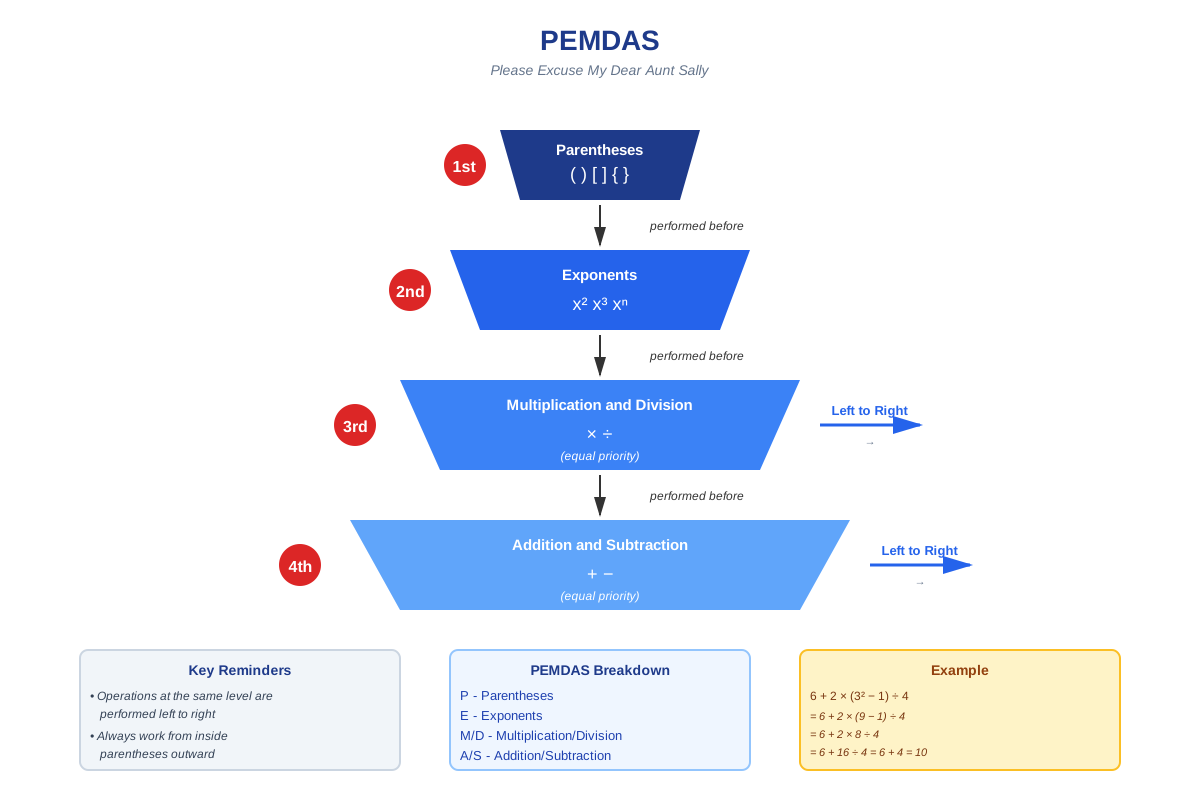
The order of operations follows a specific hierarchy universally accepted in mathematics, often remembered through the acronym PEMDAS (Parentheses, Exponents, Multiplication and Division, Addition and Subtraction). This hierarchy establishes that certain operations must be performed before others when evaluating mathematical expressions:
- Parentheses (and other grouping symbols like brackets [ ], braces { }, and fraction bars)
- Exponents (including roots, which are fractional exponents)
- Multiplication and Division (performed left to right as they appear)
- Addition and Subtraction (performed left to right as they appear)
This hierarchy exists because mathematical notation evolved to represent relationships efficiently. Without a standard order, the expression 3 + 4 × 5 could equal either 35 (if we add first) or 23 (if we multiply first). The convention that multiplication precedes addition eliminates this ambiguity, ensuring universal agreement that 3 + 4 × 5 = 3 + 20 = 23.
Parentheses and Grouping Symbols
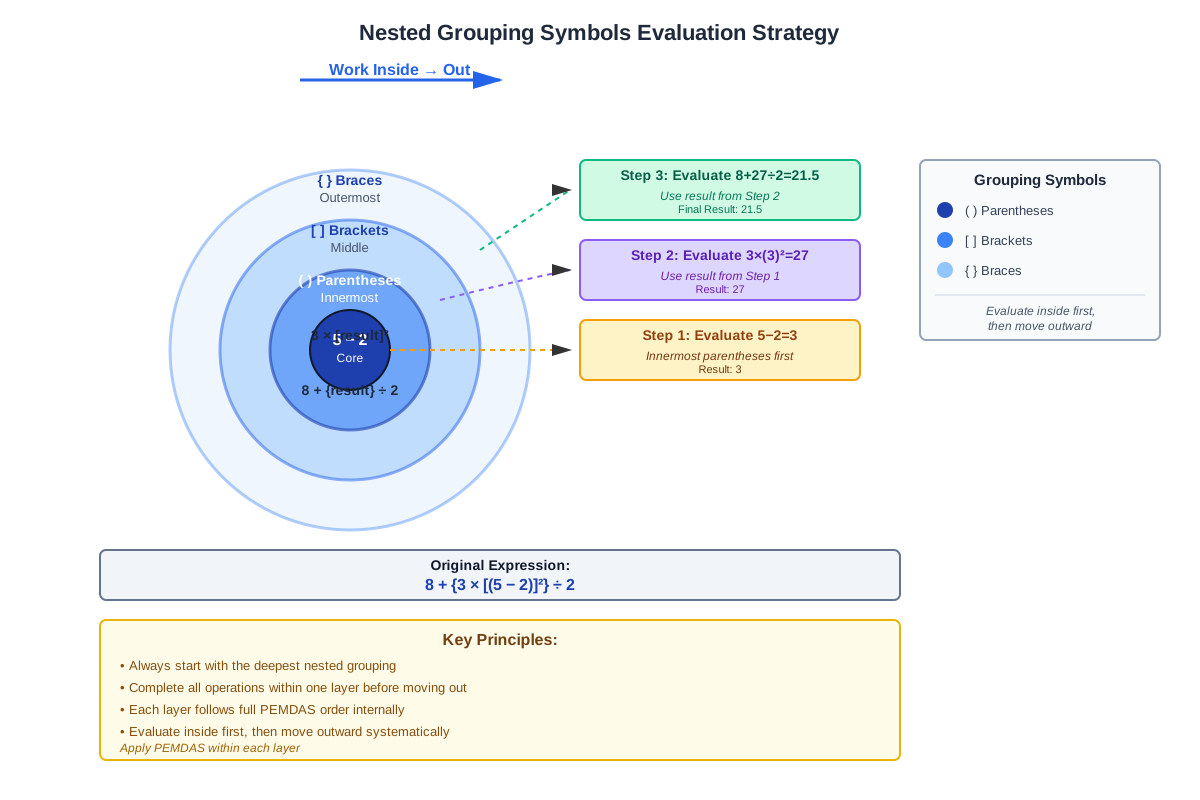
Parentheses and other grouping symbols represent the highest priority in the operation hierarchy because they explicitly indicate which operations should be performed first, overriding the standard order. When multiple grouping symbols are nested, evaluation proceeds from the innermost grouping outward.
For example, in the expression 2 × [3 + (4 × 5)], evaluation proceeds as follows:
- First, evaluate the innermost parentheses: 4 × 5 = 20
- Next, evaluate the brackets: 3 + 20 = 23
- Finally, perform the remaining multiplication: 2 × 23 = 46
Fraction bars act as implicit grouping symbols, requiring complete evaluation of both numerator and denominator before performing the division. The expression (6 + 12)/(3 × 2) requires calculating 6 + 12 = 18 and 3 × 2 = 6 before dividing to get 18/6 = 3.
Exponents and Powers
Exponents occupy the second position in the operation hierarchy, performed after resolving all grouping symbols but before multiplication, division, addition, or subtraction. This positioning reflects the mathematical nature of exponentiation as repeated multiplication.
Consider the expression 2 + 3² × 4:
- First, evaluate the exponent: 3² = 9
- Next, perform multiplication: 9 × 4 = 36
- Finally, perform addition: 2 + 36 = 38
When exponents themselves contain expressions, those expressions must be evaluated first: 2^(3+1) requires calculating 3 + 1 = 4 before evaluating 2⁴ = 16.
Negative signs interacting with exponents require special attention. The expression -3² means -(3²) = -9, while (-3)² means (-3) × (-3) = 9. The parentheses determine whether the negative sign is part of the base being squared.
Multiplication and Division: Left-to-Right Evaluation
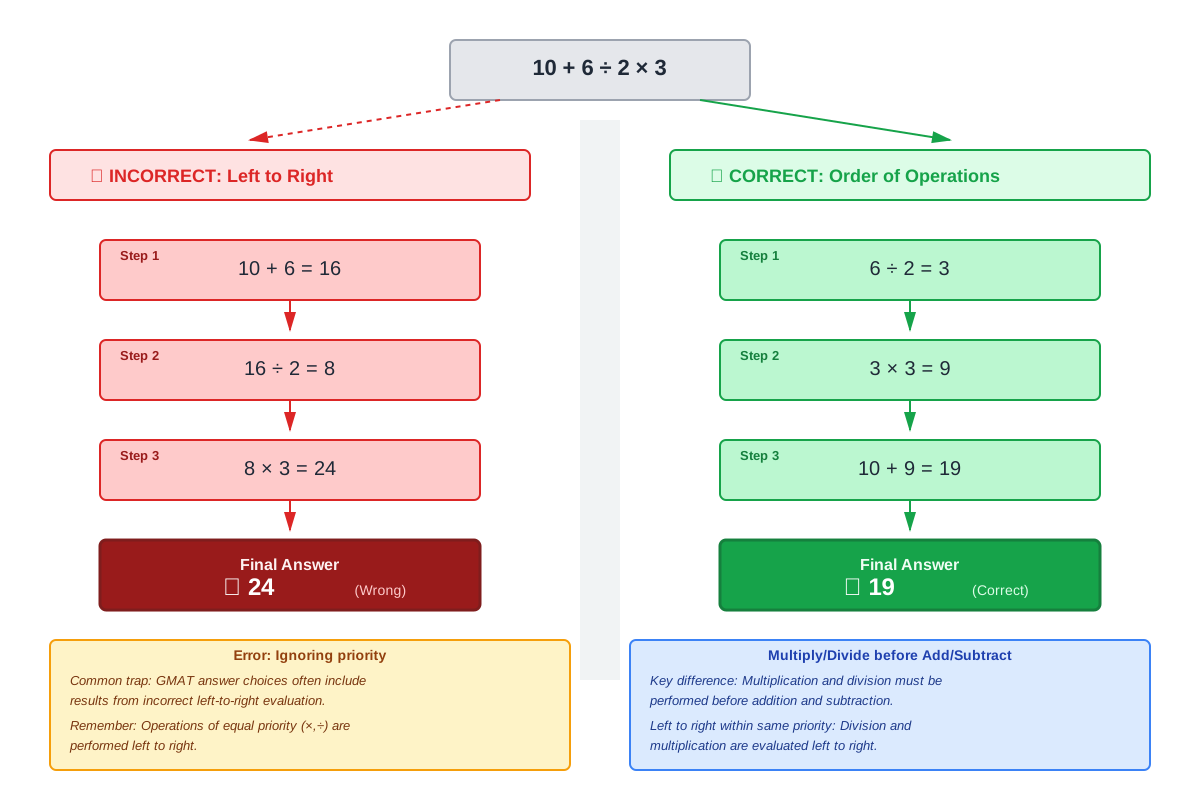
Multiplication and division occupy the same priority level and are performed from left to right as they appear in the expression. This left-to-right convention is crucial because division is not commutative (12 ÷ 3 ≠ 3 ÷ 12).
For the expression 24 ÷ 4 × 3:
- Working left to right: 24 ÷ 4 = 6, then 6 × 3 = 18
- Incorrect approach (multiplication first): 4 × 3 = 12, then 24 ÷ 12 = 2
This left-to-right rule applies equally when operations are written in different notations. The expression 24/4 × 3 follows the same evaluation as 24 ÷ 4 × 3.
Addition and Subtraction: Left-to-Right Evaluation
Addition and subtraction share the lowest priority level and, like multiplication and division, are performed from left to right. While addition is commutative, subtraction is not, making order crucial.
For the expression 15 - 8 + 3:
- Working left to right: 15 - 8 = 7, then 7 + 3 = 10
- Incorrect approach (addition first): 8 + 3 = 11, then 15 - 11 = 4
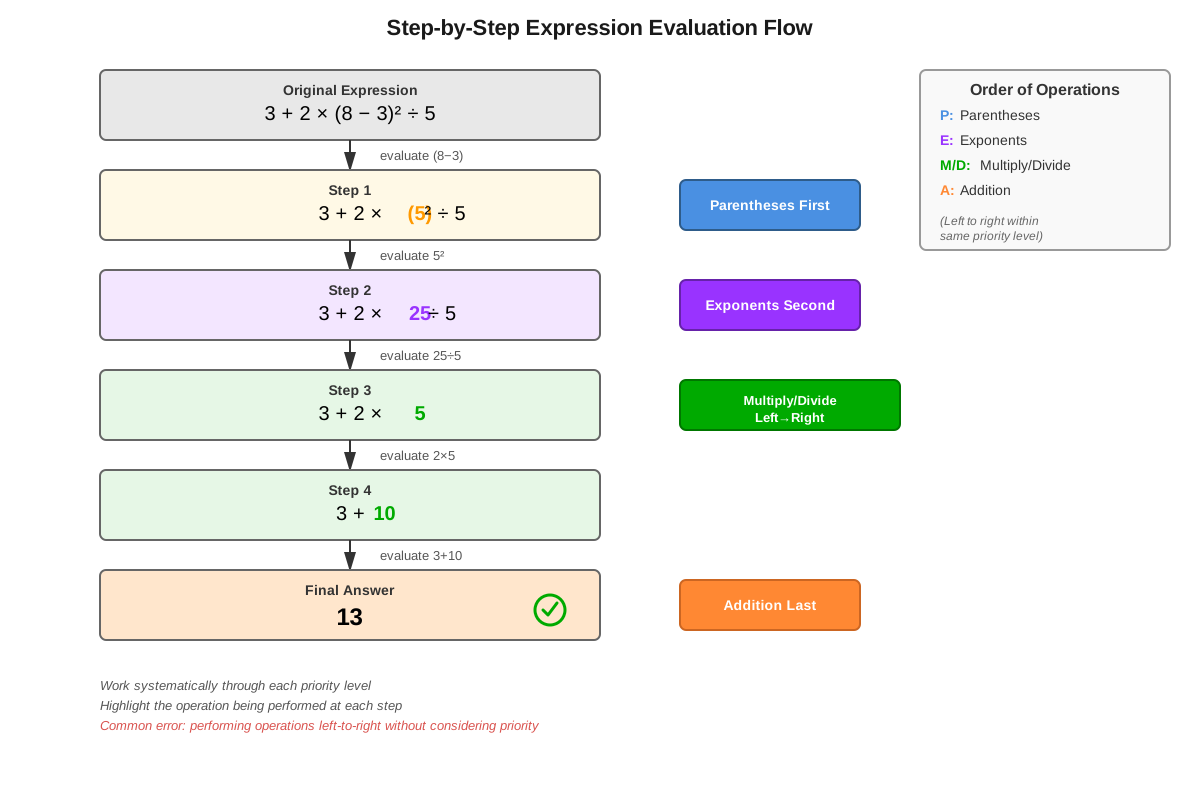
Comprehensive Evaluation Process
When evaluating complex expressions, a systematic approach ensures accuracy:
| Step | Operation Type | Action |
|---|---|---|
| 1 | Grouping | Evaluate all expressions within parentheses, brackets, or braces (innermost first) |
| 2 | Exponents | Calculate all powers and roots |
| 3 | Multiplication/Division | Perform all multiplication and division from left to right |
| 4 | Addition/Subtraction | Perform all addition and subtraction from left to right |
Consider the comprehensive example: 3 + 2 × [8 - (3² - 1)] ÷ 2
Step-by-step evaluation:
- Innermost parentheses: 3² - 1 = 9 - 1 = 8, giving us 3 + 2 × [8 - 8] ÷ 2
- Brackets: 8 - 8 = 0, giving us 3 + 2 × 0 ÷ 2
- Multiplication and division (left to right): 2 × 0 = 0, then 0 ÷ 2 = 0
- Addition: 3 + 0 = 3
Concept Relationships
The order of operations serves as the foundational framework connecting all arithmetic and algebraic concepts. Parentheses and grouping → establish explicit priority → enabling complex expression evaluation. Exponents → build upon repeated multiplication → requiring evaluation before simpler operations. Multiplication and division → represent inverse operations → sharing priority level and requiring left-to-right processing. Addition and subtraction → represent the most basic operations → evaluated last after all other operations complete.
Order of operations connects directly to prerequisite knowledge of basic arithmetic operations by establishing how these operations interact when combined. The concept extends forward to algebraic simplification, where correctly applying operation order determines whether expressions are equivalent. When solving equations, order of operations governs both how to simplify expressions and how to isolate variables through inverse operations applied in reverse order.
The relationship between order of operations and fraction operations is particularly important: fraction bars act as grouping symbols, creating an implicit hierarchy where numerator and denominator must be fully evaluated before division occurs. This connection explains why (6 + 4)/(2 + 3) requires evaluating both 6 + 4 and 2 + 3 before dividing 10 by 5.
In data sufficiency questions, order of operations determines whether given information is sufficient to evaluate expressions uniquely. Understanding operation hierarchy enables test-takers to recognize when different evaluation orders might yield different results, signaling insufficient information.
High-Yield Facts
⭐ Multiplication and division have equal priority and are performed left to right as they appear in the expression
⭐ Addition and subtraction have equal priority and are performed left to right as they appear in the expression
⭐ Parentheses override all other operation priorities, and nested parentheses are evaluated from innermost to outermost
⭐ Exponents are evaluated before multiplication, division, addition, or subtraction but after resolving parentheses
⭐ Fraction bars act as grouping symbols, requiring complete evaluation of numerator and denominator before dividing
- The expression -x² means -(x²), not (-x)², making the result negative when x is positive
- When multiple exponents are stacked, evaluation proceeds from top to bottom: 2^3^2 = 2^(3²) = 2^9 = 512
- Implied multiplication (like 2(3 + 4)) follows the same rules as explicit multiplication using the × symbol
- Absolute value bars function as grouping symbols, requiring complete evaluation of the interior before taking the absolute value
- The order of operations applies identically to algebraic expressions containing variables as to purely numerical expressions
- In expressions with multiple fraction bars at different levels, each fraction bar creates its own grouping that must be respected
- Calculators follow order of operations automatically, but incorrect parentheses entry can still produce wrong results
- The distributive property (a(b + c) = ab + ac) is an application of order of operations, showing how multiplication distributes over addition within parentheses
Quick check — test yourself on Order of operations so far.
Try Flashcards →Common Misconceptions
Misconception: Multiplication always comes before division in every expression → Correction: Multiplication and division have equal priority and must be performed from left to right as they appear. In 20 ÷ 4 × 5, you must divide first (20 ÷ 4 = 5) then multiply (5 × 5 = 25), not multiply first.
Misconception: Addition always comes before subtraction → Correction: Addition and subtraction have equal priority and must be performed from left to right. In 10 - 3 + 2, you must subtract first (10 - 3 = 7) then add (7 + 2 = 9), yielding 9, not 5.
Misconception: The expression -3² equals 9 because the negative sign is part of the base → Correction: Without parentheses, -3² means -(3²) = -9. Only (-3)² equals 9 because the parentheses make the negative sign part of the base being squared.
Misconception: PEMDAS means you always do all multiplication before any division and all addition before any subtraction → Correction: The MD in PEMDAS represents a single priority level (multiplication and division together, left to right), as does AS (addition and subtraction together, left to right). The acronym can be misleading if interpreted too literally.
Misconception: Expressions can be evaluated in any order as long as you're careful → Correction: Order of operations is a strict convention that must be followed to obtain the correct result. Different evaluation orders produce different answers, and only the standard order yields the conventionally correct result.
Misconception: Parentheses are optional and just for clarity → Correction: Parentheses fundamentally change the value of expressions by overriding standard operation order. The expression 2 × 3 + 4 = 10, but 2 × (3 + 4) = 14—the parentheses are not optional but create a mathematically different expression.
Misconception: Once you've done all operations at one level, you can skip checking for more operations at that level → Correction: You must scan the entire expression at each priority level. In 2 + 3 × 4 + 5 × 6, you must perform both multiplications (3 × 4 = 12 and 5 × 6 = 30) before performing any additions.
Worked Examples
Example 1: Complex Numerical Expression
Problem: Evaluate 5 + 3 × 2² - 16 ÷ (2 + 2)
Solution:
Step 1: Identify and evaluate parentheses first
- (2 + 2) = 4
- Expression becomes: 5 + 3 × 2² - 16 ÷ 4
Step 2: Evaluate exponents
- 2² = 4
- Expression becomes: 5 + 3 × 4 - 16 ÷ 4
Step 3: Perform multiplication and division from left to right
- 3 × 4 = 12
- 16 ÷ 4 = 4
- Expression becomes: 5 + 12 - 4
Step 4: Perform addition and subtraction from left to right
- 5 + 12 = 17
- 17 - 4 = 13
Answer: 13
Connection to Learning Objectives: This example demonstrates the complete application of order of operations, requiring identification of each operation type (parentheses, exponents, multiplication, division, addition, subtraction) and systematic evaluation following the standard hierarchy.
Example 2: Algebraic Expression with Nested Grouping
Problem: Simplify and evaluate when x = 2: 3[2x + (x² - 1)] - x
Solution:
Step 1: Substitute x = 2 into the expression
- 3[2(2) + (2² - 1)] - 2
Step 2: Evaluate the innermost parentheses (2² - 1)
- 2² = 4
- 4 - 1 = 3
- Expression becomes: 3[2(2) + 3] - 2
Step 3: Continue evaluating within the brackets
- 2(2) = 4 (implied multiplication)
- 4 + 3 = 7
- Expression becomes: 3[7] - 2
Step 4: Perform multiplication
- 3 × 7 = 21
- Expression becomes: 21 - 2
Step 5: Perform subtraction
- 21 - 2 = 19
Answer: 19
Connection to Learning Objectives: This example illustrates applying order of operations to algebraic expressions with nested grouping symbols, demonstrating how the hierarchy applies identically whether working with numbers or variables, and showing the importance of working from innermost grouping outward.
Example 3: GMAT-Style Problem with Fraction Bars
Problem: What is the value of (8 + 4 × 3)/(2³ - 2)?
Solution:
Step 1: Recognize that fraction bars act as grouping symbols, requiring complete evaluation of numerator and denominator separately
Step 2: Evaluate the numerator: 8 + 4 × 3
- Multiplication first: 4 × 3 = 12
- Then addition: 8 + 12 = 20
Step 3: Evaluate the denominator: 2³ - 2
- Exponent first: 2³ = 8
- Then subtraction: 8 - 2 = 6
Step 4: Perform the division
- 20/6 = 10/3 or 3⅓
Answer: 10/3
Connection to Learning Objectives: This example demonstrates the critical understanding that fraction bars create implicit grouping, requiring complete evaluation of numerator and denominator before division—a concept frequently tested on the GMAT and often missed by test-takers who attempt to simplify prematurely.
Exam Strategy
When approaching GMAT questions involving order of operations, begin by scanning the entire expression to identify all operation types present and any grouping symbols. This initial survey prevents the common error of beginning evaluation prematurely before recognizing all structural elements. Mark or mentally note the locations of parentheses, exponents, and operation symbols to create a mental roadmap of the evaluation sequence.
Trigger words and phrases that signal order of operations questions include: "evaluate," "simplify," "what is the value of," "which expression equals," and "if x = [value], then." Data sufficiency questions may ask "is the value of [expression] greater than [number]?" requiring correct evaluation to determine sufficiency. Word problems containing phrases like "the sum of a number and twice another number" require translating language into mathematical expressions where operation order matters critically.
For process of elimination, recognize that GMAT wrong answers frequently result from predictable order of operations errors. If you evaluate an expression and your answer isn't among the choices, check these common errors: performing operations left to right without respecting hierarchy; treating multiplication/division or addition/subtraction as having different priorities rather than equal priority; forgetting to evaluate exponents before other operations; or neglecting to treat fraction bars as grouping symbols. Often, each wrong answer corresponds to a specific error type, so identifying your mistake can guide you to the correct answer.
Time allocation for order of operations questions should be approximately 1.5-2 minutes for straightforward evaluation problems. If a question requires more than three minutes, you may be making the problem more complex than necessary—look for opportunities to simplify before evaluating or check whether you've misread the question. Practice evaluating expressions systematically rather than relying on mental math for complex expressions, as the time invested in careful step-by-step work prevents costly errors.
Exam Tip: Write out each evaluation step, even briefly. The few seconds spent writing "3² = 9" or "4 × 5 = 20" prevents mental arithmetic errors and creates a trail you can check if your answer doesn't match the choices.
When facing complex nested expressions, use a systematic annotation approach: underline or circle the innermost grouping symbols first, evaluate them, then cross them out and write the result above. This visual tracking prevents losing your place in complex expressions and ensures you don't accidentally skip operations or evaluate out of order.
Memory Techniques
PEMDAS remains the most widely used mnemonic for order of operations, standing for Parentheses, Exponents, Multiplication, Division, Addition, Subtraction. The common phrase "Please Excuse My Dear Aunt Sally" helps recall the sequence. However, remember that MD and AS represent pairs of equal-priority operations performed left to right, not strict sequential order.
An alternative mnemonic that emphasizes the equal priority of MD and AS is GEMS: Grouping symbols, Exponents, Multiplication/Division (left to right), Subtraction/Addition (left to right). This acronym better represents the actual evaluation process.
For visualizing the hierarchy, imagine a pyramid with four levels:
- Top (highest priority): Parentheses and grouping symbols
- Second level: Exponents and roots
- Third level: Multiplication and Division (horizontal level, left to right)
- Bottom (lowest priority): Addition and Subtraction (horizontal level, left to right)
To remember that fraction bars are grouping symbols, visualize the fraction bar as a horizontal line that "groups" or "holds together" everything above it and everything below it, requiring complete evaluation of each section before dividing.
For remembering the left-to-right rule for equal-priority operations, think of reading English text: just as you read words from left to right across a page, you evaluate equal-priority operations from left to right across an expression.
The negative sign with exponents rule can be remembered with this phrase: "Negative outside, negative answer; negative inside (with parentheses), positive answer when the exponent is even." This captures that -3² = -9 but (-3)² = 9.
Summary
Order of operations represents the fundamental convention governing how mathematical expressions are evaluated, establishing a universal hierarchy that ensures consistent results across all mathematical contexts. The standard sequence—parentheses and grouping symbols first, then exponents, followed by multiplication and division (left to right), and finally addition and subtraction (left to right)—must be applied systematically to evaluate expressions correctly. On the GMAT, this topic appears throughout the Quantitative Reasoning section, both as a primary concept being tested and as an essential skill for solving more complex problems. Mastery requires understanding that multiplication and division share equal priority (as do addition and subtraction), that grouping symbols including fraction bars override standard operation order, and that systematic evaluation prevents the common errors that generate attractive wrong answer choices. Success on GMAT order of operations questions depends on recognizing the complete structure of expressions before beginning evaluation, applying the hierarchy methodically rather than rushing through mental calculations, and checking work against common error patterns when answers don't match expected choices.
Key Takeaways
- Order of operations follows the hierarchy PEMDAS, but multiplication/division and addition/subtraction are equal-priority pairs evaluated left to right, not strict sequences
- Parentheses and all grouping symbols (brackets, braces, fraction bars, absolute value bars) override standard operation order and must be evaluated first, working from innermost to outermost
- Exponents are evaluated after resolving all grouping but before multiplication, division, addition, or subtraction
- Fraction bars act as implicit grouping symbols requiring complete evaluation of numerator and denominator before performing division
- The expression -x² means -(x²), not (-x)², a distinction that frequently appears in GMAT wrong answer choices
- Systematic step-by-step evaluation prevents errors and enables checking work when answers don't match available choices
- Order of operations applies identically to algebraic expressions with variables as to purely numerical expressions
Related Topics
Algebraic Simplification: Mastering order of operations enables correct simplification of algebraic expressions, combining like terms, and applying the distributive property—essential skills for equation solving and inequality manipulation.
Equation Solving: Understanding operation hierarchy is crucial for isolating variables through inverse operations, which must be applied in reverse order of operations to maintain equation balance.
Function Evaluation: Substituting values into functions and evaluating the results requires precise application of order of operations, particularly when functions contain nested operations or compositions.
Exponent Rules: Building on the order of operations foundation, exponent rules govern how to simplify expressions with powers, including multiplication and division of exponential terms.
Rational Expressions: Complex fractions and rational expressions extend order of operations concepts, requiring evaluation of multi-level fraction bars and algebraic simplification.
Practice CTA
Now that you've mastered the core concepts of order of operations, it's time to cement your understanding through active practice. Attempt the practice questions to test your ability to identify, explain, and apply order of operations under GMAT-style conditions. Use the flashcards to reinforce high-yield facts and common error patterns until they become automatic. Remember: order of operations mastery isn't about memorizing rules—it's about developing the systematic evaluation habits that prevent errors and build confidence across all quantitative question types. Every practice problem you solve correctly strengthens the neural pathways that will serve you on test day. You've got this!
Sign up free to keep reading
Create a free AnvayaPrep account to finish this GMAT guide on Order of operations — plus flashcards and practice questions.